SOLIDS AND SEMICONDUCTOR
DEVICES

Electrical conductivity
Energy bands in solids
Band structure and conductivity
Semiconductors
Intrinsic semiconductors
Doped semiconductors
n-type materials
p-type materials
Diodes and transistors
p-n junction
depletion region
forward biased p-n junction
reverse biased p-n junction diode
ELECTRICAL CONDUCTIVITY


R = ρL/A, R = resistance, L = length, A = cross section area; resistivity at 20 o
C in order of conductivity:
superconductors, conductors, semiconductors, insulators


superconductors: certain materials have zero resistivity at very low
temperature.



conductors: material capable of carrying electric current, i.e. material
which has “mobile charge carriers” (e.g. electrons, ions,..) e.g. metals,
liquids with ions (water, molten ionic compounds), plasma.



semiconductors: materials with conductivity between that of conductors
and insulators; e.g. germanium Ge, silicon Si, GaAs, GaP, InP.



insulators: materials with no or very few free charge carriers; e.g. quartz,
most covalent and ionic solids, plastics
ENERGY BANDS IN SOLIDS:
In solid materials, electron energy levels form bands of
allowed energies, separated by forbidden bands
valence band = outermost (highest) band filled with
electrons (“filled” = all states occupied)
conduction band = next highest band to valence band
(empty or partly filled)
“gap” = energy difference between valence and conduction
bands, = width of the forbidden band
Note:
electrons in a completely filled band cannot move, since
all states occupied (Pauli principle); only way to move
would be to “jump” into next higher band - needs energy;
electrons in partly filled band can move, since there are
Classification of solids into three
according to their band structure:

types,

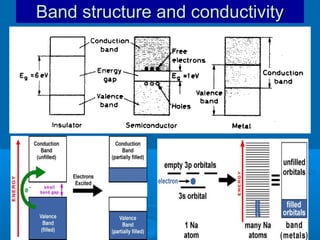
Insulators: gap = forbidden region between
highest filled band (valence band) and lowest
empty or partly filled band (conduction band) is
very wide, about 3 to 6 eV;
semiconductors: gap is small - about 0.1 to 1 eV;
conductors: valence band only partially filled, or (if
it is filled), the next allowed empty band overlaps
with it
Band structure and conductivity
What Is a Semiconductor?

•Many materials, such as most metals, allow electrical current
to flow through them
•These are known as conductors
•Materials that do not allow electrical current to flow through
them are called insulators
•Pure silicon, the base material of most transistors, is
considered a semiconductor because its conductivity can be
modulated by the introduction of impurities
Semiconductors



A material whose properties are such that it is not quite a
conductor, not quite an insulator
Some common semiconductors
 elemental
• Si - Silicon (most common)
• Ge - Germanium

compound
• GaAs - Gallium arsenide
• GaP - Gallium phosphide
• AlAs - Aluminum arsenide
• AlP - Aluminum phosphide
• InP - Indium Phosphide
Crystalline Solids


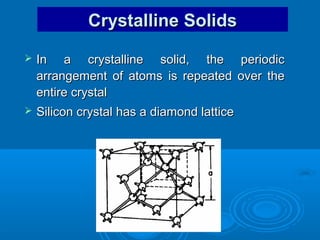
In a crystalline solid, the periodic
arrangement of atoms is repeated over the
entire crystal



Silicon crystal has a diamond lattice
Crystalline Nature of Silicon
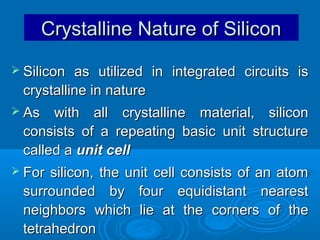
 Silicon

as utilized in integrated circuits is
crystalline in nature

 As

with all crystalline material, silicon
consists of a repeating basic unit structure
called a unit cell

 For

silicon, the unit cell consists of an atom
surrounded by four equidistant nearest
neighbors which lie at the corners of the
tetrahedron
What’s so special about Silicon?
Cheap and abundant
Amazing mechanical,
chemical and electronic
properties
The material is very
well-known to mankind
SiO2: sand, glass
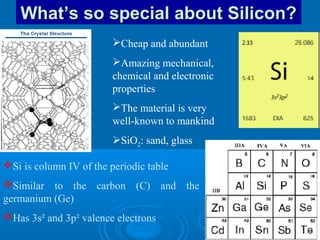
Si is column IV of the periodic table
Similar to the carbon (C) and the
germanium (Ge)
Has 3s² and 3p² valence electrons
Semiconductor Crystalline Structure


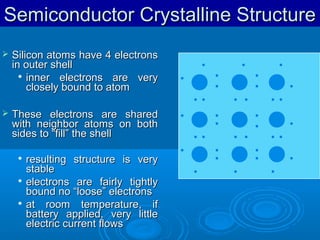
Silicon atoms have 4 electrons
in outer shell
 inner
electrons are very
closely bound to atom



These electrons are shared
with neighbor atoms on both
sides to “fill” the shell
resulting structure is very
stable
 electrons are fairly tightly
bound no “loose” electrons
 at
room temperature, if
battery applied, very little
electric current flows

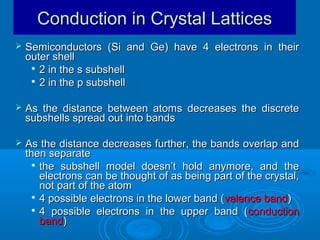
Conduction in Crystal Lattices


Semiconductors (Si and Ge) have 4 electrons in their
outer shell
 2 in the s subshell
 2 in the p subshell



As the distance between atoms decreases the discrete
subshells spread out into bands



As the distance decreases further, the bands overlap and
then separate
 the subshell model doesn’t hold anymore, and the
electrons can be thought of as being part of the crystal,
not part of the atom
 4 possible electrons in the lower band ( valence band)
 4 possible electrons in the upper band ( conduction
band)
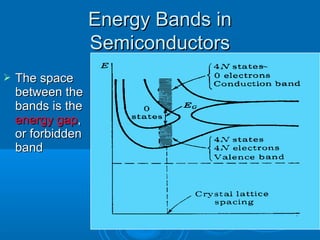
Energy Bands in
Semiconductors


The space
between the
bands is the
energy gap,
or forbidden
band
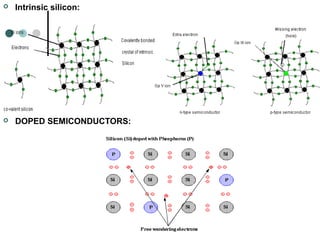
Nature of Intrinsic Silicon
 Silicon

that is free of doping impurities is

called intrinsic
 Silicon

has a valence of 4 and forms

covalent

bonds

with

neighboring silicon atoms

four

other
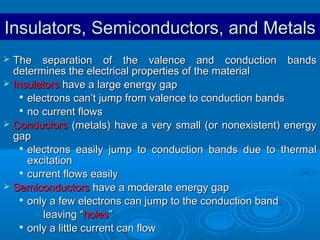
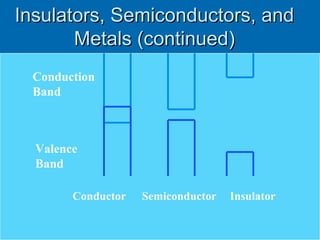
Insulators, Semiconductors, and Metals
The separation of the valence and conduction bands
determines the electrical properties of the material
 Insulators have a large energy gap
 electrons can’t jump from valence to conduction bands

no current flows
 Conductors (metals) have a very small (or nonexistent) energy
gap
 electrons easily jump to conduction bands due to thermal
excitation
 current flows easily
 Semiconductors have a moderate energy gap
 only a few electrons can jump to the conduction band
• leaving “holes”
 only a little current can flow

Insulators, Semiconductors, and
Metals (continued)
Conduction
Band

Valence
Band
Conductor

Semiconductor

Insulator
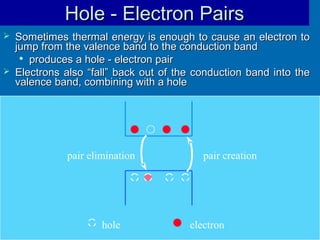
Hole - Electron Pairs




Sometimes thermal energy is enough to cause an electron to
jump from the valence band to the conduction band
 produces a hole - electron pair
Electrons also “fall” back out of the conduction band into the
valence band, combining with a hole

pair elimination

hole

pair creation

electron
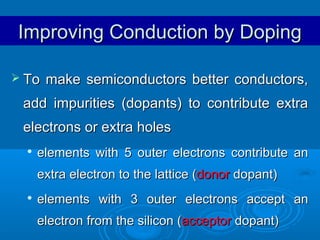
Improving Conduction by Doping
 To

make semiconductors better conductors,

add impurities (dopants) to contribute extra
electrons or extra holes


elements with 5 outer electrons contribute an
extra electron to the lattice (donor dopant)



elements with 3 outer electrons accept an
electron from the silicon (acceptor dopant)
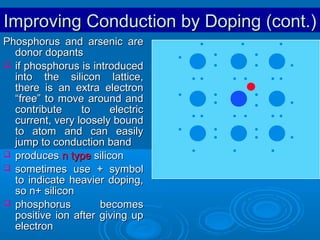
Improving Conduction by Doping (cont.)
Phosphorus and arsenic are
donor dopants
 if phosphorus is introduced
into the silicon lattice,
there is an extra electron
“free” to move around and
contribute
to
electric
current, very loosely bound
to atom and can easily
jump to conduction band
 produces n type silicon
 sometimes use + symbol
to indicate heavier doping,
so n+ silicon
 phosphorus
becomes
positive ion after giving up
electron
Improving Conduction by Doping (cont.)


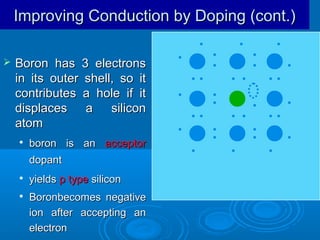
Boron has 3 electrons
in its outer shell, so it
contributes a hole if it
displaces a silicon
atom


boron is an acceptor
dopant




yields p type silicon
Boronbecomes negative
ion after accepting an
electron
Diffusion of Dopants








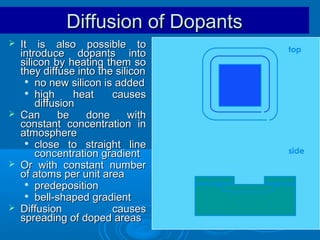
It is also possible to
introduce dopants into
silicon by heating them so
they diffuse into the silicon

no new silicon is added
 high
heat
causes
diffusion
Can
be
done
with
constant concentration in
atmosphere
 close
to straight line
concentration gradient
Or with constant number
of atoms per unit area
 predeposition
 bell-shaped gradient
Diffusion
causes
spreading of doped areas

top

side
Hole and Electron Concentrations


To produce reasonable levels of conduction doesn’t require
much doping





silicon has about 5 x 10²² atoms/cm3
typical dopant levels are about 1015 atoms/cm3

In undoped (intrinsic) silicon, the number of holes and number
of free electrons is equal, and their product equals a constant


actually, ni increases with increasing temperature

np = ni2


This equation holds true for doped silicon as well, so increasing
the number of free electrons decreases the number of holes
INTRINSIC (PURE) SILICON
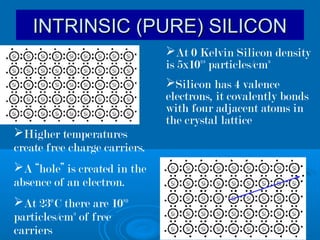
At 0 Kelvin Silicon density
is 5x10²³ particles/cm³
Silicon has 4 valence
electrons, it covalently bonds
with four adjacent atoms in
the crystal lattice
Higher temperatures
create free charge carriers.
A “hole” is created in the
absence of an electron.
At 23ºC there are 10¹º
particles/cm³ of free
carriers
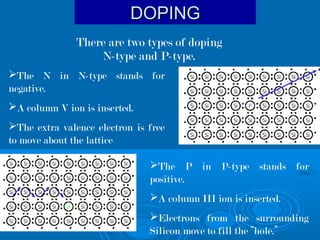
DOPING
There are two types of doping
N-type and P-type.
The N in N-type stands for
negative.
A column V ion is inserted.
The extra valence electron is free
to move about the lattice
The P in P-type stands for
positive.
A column III ion is inserted.
Electrons from the surrounding
Silicon move to fill the “hole.”
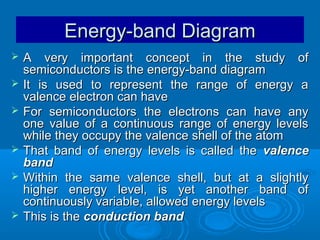
Energy-band Diagram









A very important concept in the study of
semiconductors is the energy-band diagram
It is used to represent the range of energy a
valence electron can have
For semiconductors the electrons can have any
one value of a continuous range of energy levels
while they occupy the valence shell of the atom
That band of energy levels is called the valence
band
Within the same valence shell, but at a slightly
higher energy level, is yet another band of
continuously variable, allowed energy levels
This is the conduction band
Band Gap
 Between

the valence and the conduction
band is a range of energy levels where there
are no allowed states for an electron
 This is the band gap E G
 In silicon at room temperature [in electron
.
volts]: E G = 11 eV
 Electron volt is an atomic measurement
unit, 1 eV energy is necessary to decrease of
the potential of the electron with 1 V.
1eV = 1.602 × 10 −19 joule
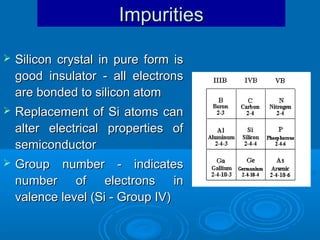
Impurities


Silicon crystal in pure form is
good insulator - all electrons
are bonded to silicon atom



Replacement of Si atoms can
alter electrical properties of
semiconductor



Group number - indicates
number of electrons in
valence level (Si - Group IV)
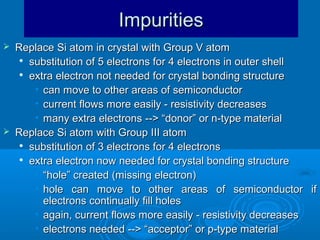
Impurities




Replace Si atom in crystal with Group V atom

substitution of 5 electrons for 4 electrons in outer shell

extra electron not needed for crystal bonding structure
• can move to other areas of semiconductor
• current flows more easily - resistivity decreases
• many extra electrons --> “donor” or n-type material
Replace Si atom with Group III atom
 substitution of 3 electrons for 4 electrons
 extra electron now needed for crystal bonding structure
• “hole” created (missing electron)
• hole can move to other areas of semiconductor if
electrons continually fill holes
• again, current flows more easily - resistivity decreases
• electrons needed --> “acceptor” or p-type material


Intrinsic silicon:



DOPED SEMICONDUCTORS:
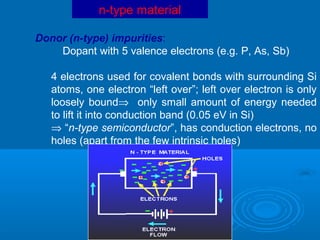
n-type material
Donor (n-type) impurities:
Dopant with 5 valence electrons (e.g. P, As, Sb)
4 electrons used for covalent bonds with surrounding Si
atoms, one electron “left over”; left over electron is only
loosely bound⇒ only small amount of energy needed
to lift it into conduction band (0.05 eV in Si)
⇒ “n-type semiconductor”, has conduction electrons, no
holes (apart from the few intrinsic holes)
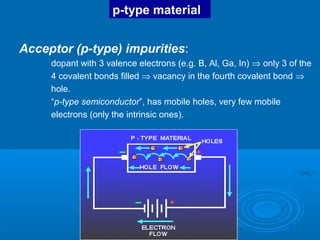
p-type material
Acceptor (p-type) impurities:
dopant with 3 valence electrons (e.g. B, Al, Ga, In) ⇒ only 3 of the
4 covalent bonds filled ⇒ vacancy in the fourth covalent bond ⇒
hole.
“p-type semiconductor”, has mobile holes, very few mobile
electrons (only the intrinsic ones).
P-N Junction


Also known as a diode



One of the basics of semiconductor technology -



Created by placing n-type and p-type material in close
contact



Diffusion - mobile charges (holes) in p-type combine
with mobile charges (electrons) in n-type
P-N Junction


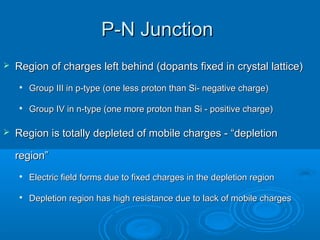
Region of charges left behind (dopants fixed in crystal lattice)






Group III in p-type (one less proton than Si- negative charge)
Group IV in n-type (one more proton than Si - positive charge)

Region is totally depleted of mobile charges - “depletion
region”


Electric field forms due to fixed charges in the depletion region



Depletion region has high resistance due to lack of mobile charges
p-n JUNCTION:
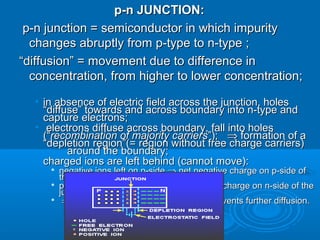
p-n junction = semiconductor in which impurity
changes abruptly from p-type to n-type ;
“diffusion” = movement due to difference in
concentration, from higher to lower concentration;
• in absence of electric field across the junction, holes
“diffuse” towards and across boundary into n-type and
capture electrons;
• electrons diffuse across boundary, fall into holes
(“recombination of majority carriers”); ⇒ formation of a
“depletion region”(= region without free charge carriers)
around the boundary;
• charged ions are left behind (cannot move):




negative ions left on p-side ⇒ net negative charge on p-side of
the junction;
positive ions left on n-side ⇒ net positive charge on n-side of the
junction
⇒ electric field across junction which prevents further diffusion.

Semiconductors

  • 1.
    SOLIDS AND SEMICONDUCTOR DEVICES Electricalconductivity Energy bands in solids Band structure and conductivity Semiconductors Intrinsic semiconductors Doped semiconductors n-type materials p-type materials Diodes and transistors p-n junction depletion region forward biased p-n junction reverse biased p-n junction diode
  • 3.
    ELECTRICAL CONDUCTIVITY  R =ρL/A, R = resistance, L = length, A = cross section area; resistivity at 20 o C in order of conductivity: superconductors, conductors, semiconductors, insulators  superconductors: certain materials have zero resistivity at very low temperature.  conductors: material capable of carrying electric current, i.e. material which has “mobile charge carriers” (e.g. electrons, ions,..) e.g. metals, liquids with ions (water, molten ionic compounds), plasma.  semiconductors: materials with conductivity between that of conductors and insulators; e.g. germanium Ge, silicon Si, GaAs, GaP, InP.  insulators: materials with no or very few free charge carriers; e.g. quartz, most covalent and ionic solids, plastics
  • 4.
    ENERGY BANDS INSOLIDS: In solid materials, electron energy levels form bands of allowed energies, separated by forbidden bands valence band = outermost (highest) band filled with electrons (“filled” = all states occupied) conduction band = next highest band to valence band (empty or partly filled) “gap” = energy difference between valence and conduction bands, = width of the forbidden band Note: electrons in a completely filled band cannot move, since all states occupied (Pauli principle); only way to move would be to “jump” into next higher band - needs energy; electrons in partly filled band can move, since there are
  • 5.
    Classification of solidsinto three according to their band structure: types, Insulators: gap = forbidden region between highest filled band (valence band) and lowest empty or partly filled band (conduction band) is very wide, about 3 to 6 eV; semiconductors: gap is small - about 0.1 to 1 eV; conductors: valence band only partially filled, or (if it is filled), the next allowed empty band overlaps with it
  • 6.
    Band structure andconductivity
  • 7.
    What Is aSemiconductor? •Many materials, such as most metals, allow electrical current to flow through them •These are known as conductors •Materials that do not allow electrical current to flow through them are called insulators •Pure silicon, the base material of most transistors, is considered a semiconductor because its conductivity can be modulated by the introduction of impurities
  • 8.
    Semiconductors   A material whoseproperties are such that it is not quite a conductor, not quite an insulator Some common semiconductors  elemental • Si - Silicon (most common) • Ge - Germanium  compound • GaAs - Gallium arsenide • GaP - Gallium phosphide • AlAs - Aluminum arsenide • AlP - Aluminum phosphide • InP - Indium Phosphide
  • 9.
    Crystalline Solids  In acrystalline solid, the periodic arrangement of atoms is repeated over the entire crystal  Silicon crystal has a diamond lattice
  • 10.
    Crystalline Nature ofSilicon  Silicon as utilized in integrated circuits is crystalline in nature  As with all crystalline material, silicon consists of a repeating basic unit structure called a unit cell  For silicon, the unit cell consists of an atom surrounded by four equidistant nearest neighbors which lie at the corners of the tetrahedron
  • 11.
    What’s so specialabout Silicon? Cheap and abundant Amazing mechanical, chemical and electronic properties The material is very well-known to mankind SiO2: sand, glass Si is column IV of the periodic table Similar to the carbon (C) and the germanium (Ge) Has 3s² and 3p² valence electrons
  • 12.
    Semiconductor Crystalline Structure  Siliconatoms have 4 electrons in outer shell  inner electrons are very closely bound to atom  These electrons are shared with neighbor atoms on both sides to “fill” the shell resulting structure is very stable  electrons are fairly tightly bound no “loose” electrons  at room temperature, if battery applied, very little electric current flows 
  • 13.
    Conduction in CrystalLattices  Semiconductors (Si and Ge) have 4 electrons in their outer shell  2 in the s subshell  2 in the p subshell  As the distance between atoms decreases the discrete subshells spread out into bands  As the distance decreases further, the bands overlap and then separate  the subshell model doesn’t hold anymore, and the electrons can be thought of as being part of the crystal, not part of the atom  4 possible electrons in the lower band ( valence band)  4 possible electrons in the upper band ( conduction band)
  • 14.
    Energy Bands in Semiconductors  Thespace between the bands is the energy gap, or forbidden band
  • 15.
    Nature of IntrinsicSilicon  Silicon that is free of doping impurities is called intrinsic  Silicon has a valence of 4 and forms covalent bonds with neighboring silicon atoms four other
  • 16.
    Insulators, Semiconductors, andMetals The separation of the valence and conduction bands determines the electrical properties of the material  Insulators have a large energy gap  electrons can’t jump from valence to conduction bands  no current flows  Conductors (metals) have a very small (or nonexistent) energy gap  electrons easily jump to conduction bands due to thermal excitation  current flows easily  Semiconductors have a moderate energy gap  only a few electrons can jump to the conduction band • leaving “holes”  only a little current can flow 
  • 17.
    Insulators, Semiconductors, and Metals(continued) Conduction Band Valence Band Conductor Semiconductor Insulator
  • 18.
    Hole - ElectronPairs   Sometimes thermal energy is enough to cause an electron to jump from the valence band to the conduction band  produces a hole - electron pair Electrons also “fall” back out of the conduction band into the valence band, combining with a hole pair elimination hole pair creation electron
  • 19.
    Improving Conduction byDoping  To make semiconductors better conductors, add impurities (dopants) to contribute extra electrons or extra holes  elements with 5 outer electrons contribute an extra electron to the lattice (donor dopant)  elements with 3 outer electrons accept an electron from the silicon (acceptor dopant)
  • 20.
    Improving Conduction byDoping (cont.) Phosphorus and arsenic are donor dopants  if phosphorus is introduced into the silicon lattice, there is an extra electron “free” to move around and contribute to electric current, very loosely bound to atom and can easily jump to conduction band  produces n type silicon  sometimes use + symbol to indicate heavier doping, so n+ silicon  phosphorus becomes positive ion after giving up electron
  • 21.
    Improving Conduction byDoping (cont.)  Boron has 3 electrons in its outer shell, so it contributes a hole if it displaces a silicon atom  boron is an acceptor dopant   yields p type silicon Boronbecomes negative ion after accepting an electron
  • 22.
    Diffusion of Dopants     Itis also possible to introduce dopants into silicon by heating them so they diffuse into the silicon  no new silicon is added  high heat causes diffusion Can be done with constant concentration in atmosphere  close to straight line concentration gradient Or with constant number of atoms per unit area  predeposition  bell-shaped gradient Diffusion causes spreading of doped areas top side
  • 23.
    Hole and ElectronConcentrations  To produce reasonable levels of conduction doesn’t require much doping    silicon has about 5 x 10²² atoms/cm3 typical dopant levels are about 1015 atoms/cm3 In undoped (intrinsic) silicon, the number of holes and number of free electrons is equal, and their product equals a constant  actually, ni increases with increasing temperature np = ni2  This equation holds true for doped silicon as well, so increasing the number of free electrons decreases the number of holes
  • 24.
    INTRINSIC (PURE) SILICON At0 Kelvin Silicon density is 5x10²³ particles/cm³ Silicon has 4 valence electrons, it covalently bonds with four adjacent atoms in the crystal lattice Higher temperatures create free charge carriers. A “hole” is created in the absence of an electron. At 23ºC there are 10¹º particles/cm³ of free carriers
  • 25.
    DOPING There are twotypes of doping N-type and P-type. The N in N-type stands for negative. A column V ion is inserted. The extra valence electron is free to move about the lattice The P in P-type stands for positive. A column III ion is inserted. Electrons from the surrounding Silicon move to fill the “hole.”
  • 26.
    Energy-band Diagram       A veryimportant concept in the study of semiconductors is the energy-band diagram It is used to represent the range of energy a valence electron can have For semiconductors the electrons can have any one value of a continuous range of energy levels while they occupy the valence shell of the atom That band of energy levels is called the valence band Within the same valence shell, but at a slightly higher energy level, is yet another band of continuously variable, allowed energy levels This is the conduction band
  • 27.
    Band Gap  Between thevalence and the conduction band is a range of energy levels where there are no allowed states for an electron  This is the band gap E G  In silicon at room temperature [in electron . volts]: E G = 11 eV  Electron volt is an atomic measurement unit, 1 eV energy is necessary to decrease of the potential of the electron with 1 V. 1eV = 1.602 × 10 −19 joule
  • 28.
    Impurities  Silicon crystal inpure form is good insulator - all electrons are bonded to silicon atom  Replacement of Si atoms can alter electrical properties of semiconductor  Group number - indicates number of electrons in valence level (Si - Group IV)
  • 29.
    Impurities   Replace Si atomin crystal with Group V atom  substitution of 5 electrons for 4 electrons in outer shell  extra electron not needed for crystal bonding structure • can move to other areas of semiconductor • current flows more easily - resistivity decreases • many extra electrons --> “donor” or n-type material Replace Si atom with Group III atom  substitution of 3 electrons for 4 electrons  extra electron now needed for crystal bonding structure • “hole” created (missing electron) • hole can move to other areas of semiconductor if electrons continually fill holes • again, current flows more easily - resistivity decreases • electrons needed --> “acceptor” or p-type material
  • 30.
  • 31.
    n-type material Donor (n-type)impurities: Dopant with 5 valence electrons (e.g. P, As, Sb) 4 electrons used for covalent bonds with surrounding Si atoms, one electron “left over”; left over electron is only loosely bound⇒ only small amount of energy needed to lift it into conduction band (0.05 eV in Si) ⇒ “n-type semiconductor”, has conduction electrons, no holes (apart from the few intrinsic holes)
  • 32.
    p-type material Acceptor (p-type)impurities: dopant with 3 valence electrons (e.g. B, Al, Ga, In) ⇒ only 3 of the 4 covalent bonds filled ⇒ vacancy in the fourth covalent bond ⇒ hole. “p-type semiconductor”, has mobile holes, very few mobile electrons (only the intrinsic ones).
  • 33.
    P-N Junction  Also knownas a diode  One of the basics of semiconductor technology -  Created by placing n-type and p-type material in close contact  Diffusion - mobile charges (holes) in p-type combine with mobile charges (electrons) in n-type
  • 34.
    P-N Junction  Region ofcharges left behind (dopants fixed in crystal lattice)    Group III in p-type (one less proton than Si- negative charge) Group IV in n-type (one more proton than Si - positive charge) Region is totally depleted of mobile charges - “depletion region”  Electric field forms due to fixed charges in the depletion region  Depletion region has high resistance due to lack of mobile charges
  • 36.
    p-n JUNCTION: p-n junction= semiconductor in which impurity changes abruptly from p-type to n-type ; “diffusion” = movement due to difference in concentration, from higher to lower concentration; • in absence of electric field across the junction, holes “diffuse” towards and across boundary into n-type and capture electrons; • electrons diffuse across boundary, fall into holes (“recombination of majority carriers”); ⇒ formation of a “depletion region”(= region without free charge carriers) around the boundary; • charged ions are left behind (cannot move):    negative ions left on p-side ⇒ net negative charge on p-side of the junction; positive ions left on n-side ⇒ net positive charge on n-side of the junction ⇒ electric field across junction which prevents further diffusion.

Editor's Notes

  • #2 {"16":"<number>\n","22":"<number>\n","11":"<number>\n","17":"<number>\n","23":"<number>\n","12":"<number>\n","29":"<number>\n","18":"<number>\n","24":"<number>\n","13":"<number>\n","25":"<number>\n","14":"<number>\n","20":"<number>\n","21":"<number>\n"}