



Welcome to my world
INTRODUCTION
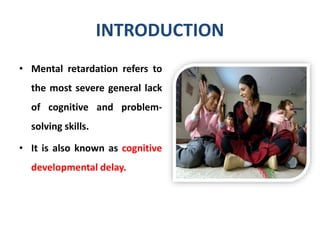
• Mental retardation refers to
the most severe general lack
of cognitive and problem-
solving skills.
• It is also known as cognitive
developmental delay.
MENTAL RETARDATION
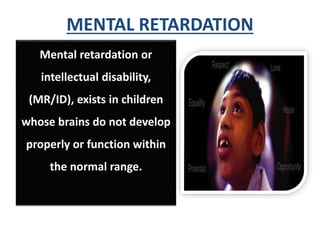
Mental retardation or
intellectual disability,
(MR/ID), exists in children
whose brains do not develop
properly or function within
the normal range.
DEFINITION
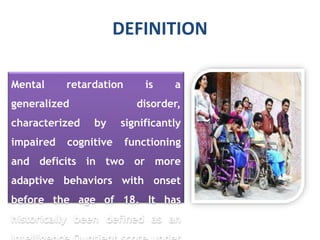
Mental retardation is a
generalized disorder,
characterized by significantly
impaired cognitive functioning
and deficits in two or more
adaptive behaviors with onset
before the age of 18. It has
historically been defined as an
CLASSIFICATION
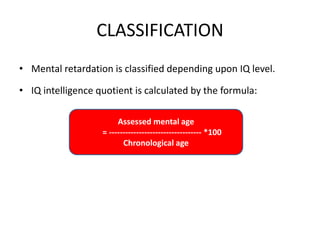
• Mental retardation is classified depending upon IQ level.
• IQ intelligence quotient is calculated by the formula:
Assessed mental age
= ---------------------------------- *100
Chronological age
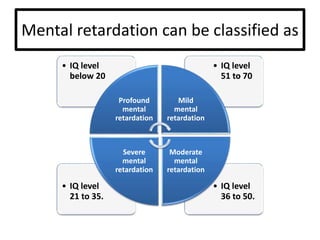
Mental retardation can be classified as
• IQ level
36 to 50.
• IQ level
21 to 35.
• IQ level
51 to 70
• IQ level
below 20
Profound
mental
retardation
Mild
mental
retardation
Moderate
mental
retardation
Severe
mental
retardation
CLASSIFICATION
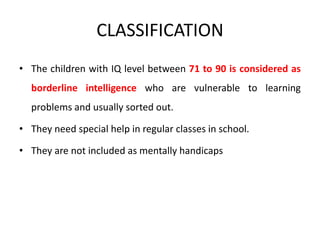
• The children with IQ level between 71 to 90 is considered as
borderline intelligence who are vulnerable to learning
problems and usually sorted out.
• They need special help in regular classes in school.
• They are not included as mentally handicaps
CLASSIFICATION
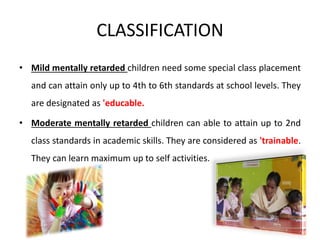
• Mild mentally retarded children need some special class placement
and can attain only up to 4th to 6th standards at school levels. They
are designated as 'educable.
• Moderate mentally retarded children can able to attain up to 2nd
class standards in academic skills. They are considered as 'trainable.
They can learn maximum up to self activities.
CLASSIFICATION
• Severe mentally retarded children can learn only self-care
and simple conversational skills. They need much supervision
and considered as 'custodial.
• Profound mentally retarded children can able to learn very
minimal self-care abilities and language. Total supervision is
must for them and they are also considered as 'custodial.
Etiology of Mental Retardation
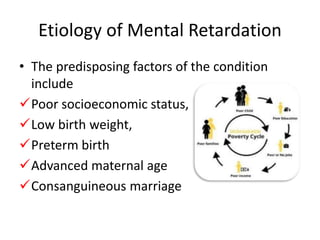
• The predisposing factors of the condition
include
Poor socioeconomic status,
Low birth weight,
Preterm birth
Advanced maternal age
Consanguineous marriage
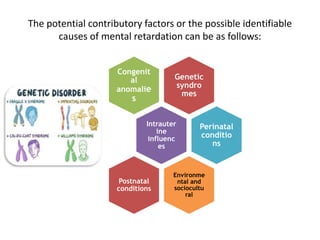
The potential contributory factors or the possible identifiable
causes of mental retardation can be as follows:
Genetic
syndro
mes
Congenit
al
anomalie
s
Intrauter
ine
influenc
es
Perinatal
conditio
ns
Environme
ntal and
sociocultu
ral
Postnatal
conditions
The potential contributory factors or the possible identifiable
causes of mental retardation can be as follows:
• Genetic syndromes-for example, Down syndrome, Fragile 'X'
syndrome, galactosemia, Klinfelter syndrome, etc.
• Congenital anomalies-for example, congenital hydrocephalus,
microcephaly, cranial malformations, craniosynostosis.
• Intrauterine influences-for example, maternal infections, and
exposure to teratogens, placental insufficiency, preeclampsia,
antepartum hemorrhages, etc.
• Perinatal conditions-for example, birth trauma, perinatal
asphyxia, intracranial hemorrhage, prematurity, low birth
weight, etc.
• Postnatal conditions-for example, CNS infections, kernicterus,
head injury, toxic or postvaccinal encephalopathy, thrombosis
of cerebral vessels, iodine deficiency, hypothyroidism, severe
PEM, metabolic disorders, PKU, galactosemia, etc.
• Environmental and sociocultural factors-for example,
poverty, broken family, faulty parenting, child abuse and
neglect, parental psychopathology, and environmental
deprivation
CLINICAL MANIFESTATIONS
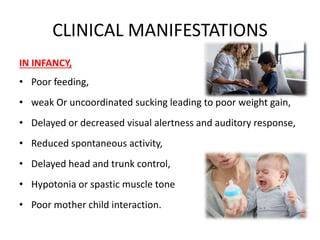
IN INFANCY,
• Poor feeding,
• weak Or uncoordinated sucking leading to poor weight gain,
• Delayed or decreased visual alertness and auditory response,
• Reduced spontaneous activity,
• Delayed head and trunk control,
• Hypotonia or spastic muscle tone
• Poor mother child interaction.
Conti..
IN TODDLER,
• Delayed speech and language disabilities,
• Delayed motor milestones (standing, walking),
• Failure to achieve independence (like self-feeding, dressing
and toilet training),
• Short attention span and distractibility,
• Clumsiness,
• Hyperactivity,
• Poor memory,
• Poor concentration,
• Emotional instability,
• Sleep problems,
• Impulsiveness and low
frustration tolerance
• Convulsions
• Associated defects of musculoskeletal system, vision and
hearing
• Congenital anomalies.
• Neurodegenerative disorders,
• Psychiatric illness,
• Emotional problems and cerebral palsy
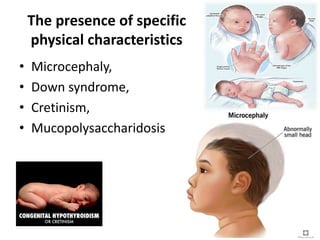
The presence of specific
physical characteristics
• Microcephaly,
• Down syndrome,
• Cretinism,
• Mucopolysaccharidosis
Diagnostic Evaluation
• History: History of developmental period along with family history, birth
history and history of past illnesses, supported by findings of thorough
physical examination and neurological examination.
• IQ test
• Detection of associated diseases
• Urine test for metabolic diseases
• amniocentesis.
 Urine chromatography,
 Chromosomal studies,
 Hormonal assay,
 Enzyme estimation,
 Serological test to detect
intrauterine infections,
 CSF study,
 X-ray skull,
 EEG,
 CT scan,
 MRI,
MANAGEMENT
• Routine basic care,
• Immunization,
• Growth monitoring,
• Nutritional requirements
• Tender loving care
• Necessary drug therapy
• Psychological and emotional support needed for parents and family
members
• The child needs love affection, appreciation, discipline and minimal
criticism for tender loving care from parents and family members.
• Special educational arrangement and available facilities should be
discussed with the parents.
• The child may be send to center or special schools or vocational centers
or self-help.
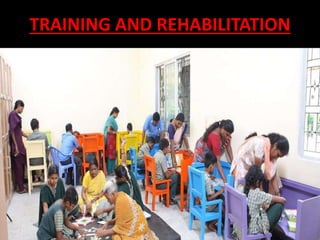
TRAINING AND REHABILITATION
SPECIAL VOCATIONAL SCHOOL TRAINING
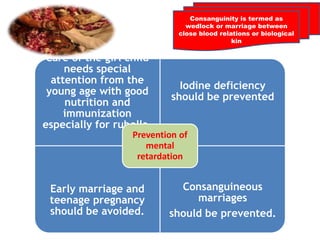
Care of the girl child
needs special
attention from the
young age with good
nutrition and
immunization
especially for rubella.
Iodine deficiency
should be prevented
Early marriage and
teenage pregnancy
should be avoided.
Consanguineous
marriages
should be prevented.
Prevention of
mental
retardation
Consanguinity is termed as
wedlock or marriage between
close blood relations or biological
kin
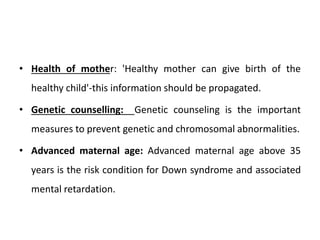
• Health of mother: 'Healthy mother can give birth of the
healthy child'-this information should be propagated.
• Genetic counselling: Genetic counseling is the important
measures to prevent genetic and chromosomal abnormalities.
• Advanced maternal age: Advanced maternal age above 35
years is the risk condition for Down syndrome and associated
mental retardation.
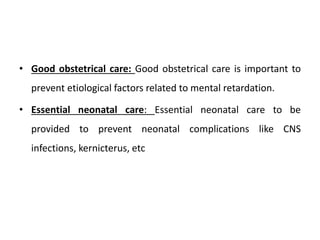
• Good obstetrical care: Good obstetrical care is important to
prevent etiological factors related to mental retardation.
• Essential neonatal care: Essential neonatal care to be
provided to prevent neonatal complications like CNS
infections, kernicterus, etc
Mental Retardation _Abhijit.pptx

Mental Retardation _Abhijit.pptx

  • 1.
  • 3.
    INTRODUCTION • Mental retardationrefers to the most severe general lack of cognitive and problem- solving skills. • It is also known as cognitive developmental delay.
  • 4.
    MENTAL RETARDATION Mental retardationor intellectual disability, (MR/ID), exists in children whose brains do not develop properly or function within the normal range.
  • 5.
    DEFINITION Mental retardation isa generalized disorder, characterized by significantly impaired cognitive functioning and deficits in two or more adaptive behaviors with onset before the age of 18. It has historically been defined as an
  • 6.
    CLASSIFICATION • Mental retardationis classified depending upon IQ level. • IQ intelligence quotient is calculated by the formula: Assessed mental age = ---------------------------------- *100 Chronological age
  • 7.
    Mental retardation canbe classified as • IQ level 36 to 50. • IQ level 21 to 35. • IQ level 51 to 70 • IQ level below 20 Profound mental retardation Mild mental retardation Moderate mental retardation Severe mental retardation
  • 8.
    CLASSIFICATION • The childrenwith IQ level between 71 to 90 is considered as borderline intelligence who are vulnerable to learning problems and usually sorted out. • They need special help in regular classes in school. • They are not included as mentally handicaps
  • 9.
    CLASSIFICATION • Mild mentallyretarded children need some special class placement and can attain only up to 4th to 6th standards at school levels. They are designated as 'educable. • Moderate mentally retarded children can able to attain up to 2nd class standards in academic skills. They are considered as 'trainable. They can learn maximum up to self activities.
  • 10.
    CLASSIFICATION • Severe mentallyretarded children can learn only self-care and simple conversational skills. They need much supervision and considered as 'custodial. • Profound mentally retarded children can able to learn very minimal self-care abilities and language. Total supervision is must for them and they are also considered as 'custodial.
  • 11.
    Etiology of MentalRetardation • The predisposing factors of the condition include Poor socioeconomic status, Low birth weight, Preterm birth Advanced maternal age Consanguineous marriage
  • 12.
    The potential contributoryfactors or the possible identifiable causes of mental retardation can be as follows: Genetic syndro mes Congenit al anomalie s Intrauter ine influenc es Perinatal conditio ns Environme ntal and sociocultu ral Postnatal conditions
  • 13.
    The potential contributoryfactors or the possible identifiable causes of mental retardation can be as follows: • Genetic syndromes-for example, Down syndrome, Fragile 'X' syndrome, galactosemia, Klinfelter syndrome, etc. • Congenital anomalies-for example, congenital hydrocephalus, microcephaly, cranial malformations, craniosynostosis. • Intrauterine influences-for example, maternal infections, and exposure to teratogens, placental insufficiency, preeclampsia, antepartum hemorrhages, etc.
  • 14.
    • Perinatal conditions-forexample, birth trauma, perinatal asphyxia, intracranial hemorrhage, prematurity, low birth weight, etc. • Postnatal conditions-for example, CNS infections, kernicterus, head injury, toxic or postvaccinal encephalopathy, thrombosis of cerebral vessels, iodine deficiency, hypothyroidism, severe PEM, metabolic disorders, PKU, galactosemia, etc.
  • 15.
    • Environmental andsociocultural factors-for example, poverty, broken family, faulty parenting, child abuse and neglect, parental psychopathology, and environmental deprivation
  • 16.
    CLINICAL MANIFESTATIONS IN INFANCY, •Poor feeding, • weak Or uncoordinated sucking leading to poor weight gain, • Delayed or decreased visual alertness and auditory response, • Reduced spontaneous activity, • Delayed head and trunk control, • Hypotonia or spastic muscle tone • Poor mother child interaction.
  • 17.
    Conti.. IN TODDLER, • Delayedspeech and language disabilities, • Delayed motor milestones (standing, walking), • Failure to achieve independence (like self-feeding, dressing and toilet training), • Short attention span and distractibility, • Clumsiness,
  • 18.
    • Hyperactivity, • Poormemory, • Poor concentration, • Emotional instability, • Sleep problems, • Impulsiveness and low frustration tolerance
  • 19.
    • Convulsions • Associateddefects of musculoskeletal system, vision and hearing • Congenital anomalies. • Neurodegenerative disorders, • Psychiatric illness, • Emotional problems and cerebral palsy
  • 20.
    The presence ofspecific physical characteristics • Microcephaly, • Down syndrome, • Cretinism, • Mucopolysaccharidosis
  • 21.
    Diagnostic Evaluation • History:History of developmental period along with family history, birth history and history of past illnesses, supported by findings of thorough physical examination and neurological examination. • IQ test • Detection of associated diseases • Urine test for metabolic diseases • amniocentesis.
  • 22.
     Urine chromatography, Chromosomal studies,  Hormonal assay,  Enzyme estimation,  Serological test to detect intrauterine infections,  CSF study,  X-ray skull,  EEG,  CT scan,  MRI,
  • 23.
    MANAGEMENT • Routine basiccare, • Immunization, • Growth monitoring, • Nutritional requirements • Tender loving care • Necessary drug therapy
  • 24.
    • Psychological andemotional support needed for parents and family members • The child needs love affection, appreciation, discipline and minimal criticism for tender loving care from parents and family members. • Special educational arrangement and available facilities should be discussed with the parents. • The child may be send to center or special schools or vocational centers or self-help.
  • 25.
  • 26.
  • 27.
    Care of thegirl child needs special attention from the young age with good nutrition and immunization especially for rubella. Iodine deficiency should be prevented Early marriage and teenage pregnancy should be avoided. Consanguineous marriages should be prevented. Prevention of mental retardation Consanguinity is termed as wedlock or marriage between close blood relations or biological kin
  • 28.
    • Health ofmother: 'Healthy mother can give birth of the healthy child'-this information should be propagated. • Genetic counselling: Genetic counseling is the important measures to prevent genetic and chromosomal abnormalities. • Advanced maternal age: Advanced maternal age above 35 years is the risk condition for Down syndrome and associated mental retardation.
  • 29.
    • Good obstetricalcare: Good obstetrical care is important to prevent etiological factors related to mental retardation. • Essential neonatal care: Essential neonatal care to be provided to prevent neonatal complications like CNS infections, kernicterus, etc