MOOD DISORDERS
The term “Mood disorders” groups
together a number of clinical
conditions whose common and
essential feature is a disturbance of
mood, accompanied by related
cognitive, psychomotor, psycho-
physiological and interpersonal
difficulties.
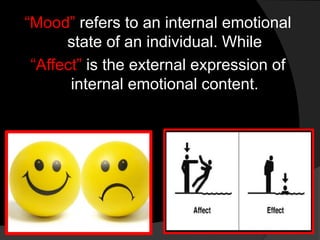
“Mood” refers to an internal emotional
state of an individual. While
“Affect” is the external expression of
internal emotional content.
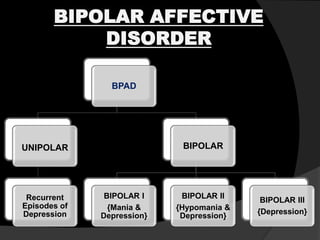
BIPOLAR AFFECTIVE
DISORDER
BPAD
UNIPOLAR
Recurrent
Episodes of
Depression
BIPOLAR
BIPOLAR I
{Mania &
Depression}
BIPOLAR II
{Hypomania &
Depression}
BIPOLAR III
{Depression}
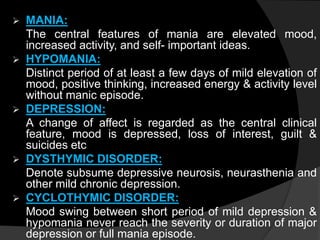
 MANIA:
The central features of mania are elevated mood,
increased activity, and self- important ideas.
 HYPOMANIA:
Distinct period of at least a few days of mild elevation of
mood, positive thinking, increased energy & activity level
without manic episode.
 DEPRESSION:
A change of affect is regarded as the central clinical
feature, mood is depressed, loss of interest, guilt &
suicides etc
 DYSTHYMIC DISORDER:
Denote subsume depressive neurosis, neurasthenia and
other mild chronic depression.
 CYCLOTHYMIC DISORDER:
Mood swing between short period of mild depression &
hypomania never reach the severity or duration of major
depression or full mania episode.
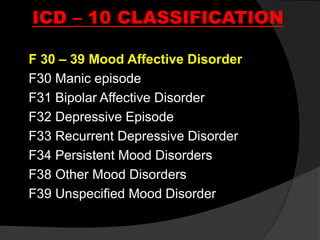
ICD – 10 CLASSIFICATION
F 30 – 39 Mood Affective Disorder
F30 Manic episode
F31 Bipolar Affective Disorder
F32 Depressive Episode
F33 Recurrent Depressive Disorder
F34 Persistent Mood Disorders
F38 Other Mood Disorders
F39 Unspecified Mood Disorder
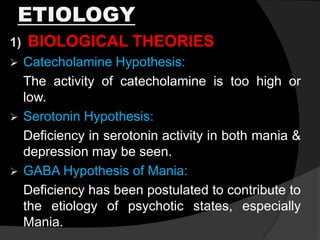
ETIOLOGY
1) BIOLOGICAL THEORIES
 Catecholamine Hypothesis:
The activity of catecholamine is too high or
low.
 Serotonin Hypothesis:
Deficiency in serotonin activity in both mania &
depression may be seen.
 GABA Hypothesis of Mania:
Deficiency has been postulated to contribute to
the etiology of psychotic states, especially
Mania.
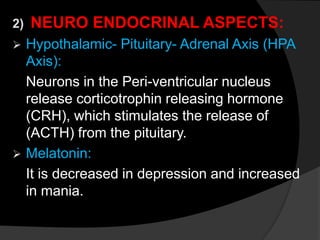
2) NEURO ENDOCRINAL ASPECTS:
 Hypothalamic- Pituitary- Adrenal Axis (HPA
Axis):
Neurons in the Peri-ventricular nucleus
release corticotrophin releasing hormone
(CRH), which stimulates the release of
(ACTH) from the pituitary.
 Melatonin:
It is decreased in depression and increased
in mania.
3) GENETIC STUDIES
Identical twins (monozygotic) have a 54%
risk of one twin developing depression if
the other has had a diagnosed episode,
risk of developing depression in non
identical (dizygotic) twins is about 24% higher
than that of general population but less than
that for monozygotic twins.
 PSYCHOSOCIAL THEORIES
1) Life events and environmental stress:
Stressful life events more often precede the
first episodes of mood disorders than the
subsequent episodes.
2) Premorbid personality factors:
There are certain personality characteristics,
such as lack of energy, breakdown under
stress, introversion, insecurity, tendency
to worry, dependency & obsessionality.
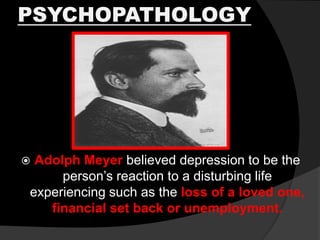
PSYCHOPATHOLOGY
 Adolph Meyer believed depression to be the
person’s reaction to a disturbing life
experiencing such as the loss of a loved one,
financial set back or unemployment.
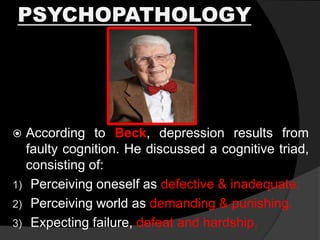
PSYCHOPATHOLOGY
 According to Beck, depression results from
faulty cognition. He discussed a cognitive triad,
consisting of:
1) Perceiving oneself as defective & inadequate.
2) Perceiving world as demanding & punishing.
3) Expecting failure, defeat and hardship.
CLINICAL MANIFESTATION
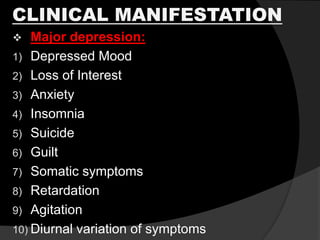
 Major depression:
1) Depressed Mood
2) Loss of Interest
3) Anxiety
4) Insomnia
5) Suicide
6) Guilt
7) Somatic symptoms
8) Retardation
9) Agitation
10) Diurnal variation of symptoms
CLINICAL MANIFESTATION
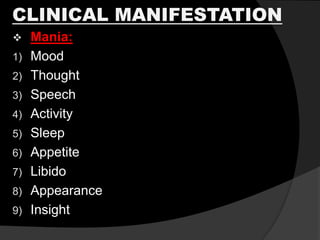
 Mania:
1) Mood
2) Thought
3) Speech
4) Activity
5) Sleep
6) Appetite
7) Libido
8) Appearance
9) Insight
CLINICAL MANIFESTATION
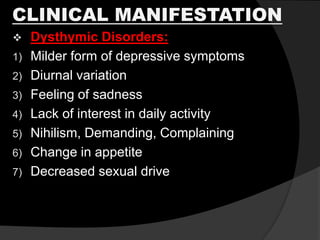
 Dysthymic Disorders:
1) Milder form of depressive symptoms
2) Diurnal variation
3) Feeling of sadness
4) Lack of interest in daily activity
5) Nihilism, Demanding, Complaining
6) Change in appetite
7) Decreased sexual drive
DIAGNOSTIC CRITERIA (DSM-IV)
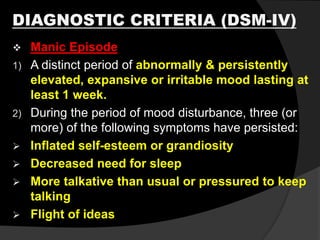
 Manic Episode
1) A distinct period of abnormally & persistently
elevated, expansive or irritable mood lasting at
least 1 week.
2) During the period of mood disturbance, three (or
more) of the following symptoms have persisted:
 Inflated self-esteem or grandiosity
 Decreased need for sleep
 More talkative than usual or pressured to keep
talking
 Flight of ideas
DIAGNOSTIC CRITERIA (DSM-IV)
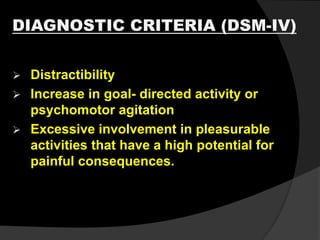
 Distractibility
 Increase in goal- directed activity or
psychomotor agitation
 Excessive involvement in pleasurable
activities that have a high potential for
painful consequences.
DIAGNOSTIC CRITERIA (DSM-IV)
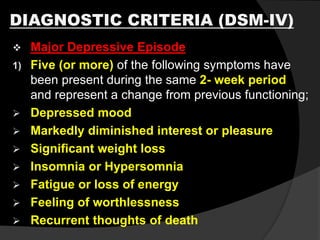
 Major Depressive Episode
1) Five (or more) of the following symptoms have
been present during the same 2- week period
and represent a change from previous functioning;
 Depressed mood
 Markedly diminished interest or pleasure
 Significant weight loss
 Insomnia or Hypersomnia
 Fatigue or loss of energy
 Feeling of worthlessness
 Recurrent thoughts of death
DIAGNOSTIC CRITERIA (DSM-IV)
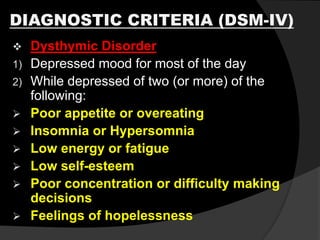
 Dysthymic Disorder
1) Depressed mood for most of the day
2) While depressed of two (or more) of the
following:
 Poor appetite or overeating
 Insomnia or Hypersomnia
 Low energy or fatigue
 Low self-esteem
 Poor concentration or difficulty making
decisions
 Feelings of hopelessness
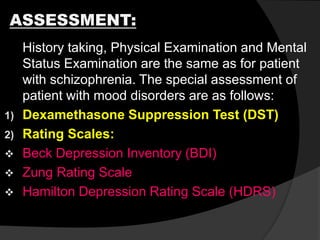
ASSESSMENT:
History taking, Physical Examination and Mental
Status Examination are the same as for patient
with schizophrenia. The special assessment of
patient with mood disorders are as follows:
1) Dexamethasone Suppression Test (DST)
2) Rating Scales:
 Beck Depression Inventory (BDI)
 Zung Rating Scale
 Hamilton Depression Rating Scale (HDRS)
TREATMENT MODALITIES OF
PATIENT WITH MOOD DISORDERS:
1) Pharmacologic Treatments
 Tricyclic Antidepressants
 Mono amine oxidase inhibitors
 Selective Serotonin reuptake inhibitors
2) Electroconvulsive Therapy
3) Psychotherapeutic Approach
 Supportive Psychotherapy
 Brief therapy
 Interpersonal therapy
 Cognitive Behavior therapy
 Marital Therapy and Family Therapy
NURSING MANAGEMENT OF PATIENT
WITH MOOD DISORDERS:
1) NURSING DIAGNOSIS: Risk for violence
directed to self or others related to
hyperactivity, agitation, hostile behavior and
low self esteem
 NURSING GOAL: Demonstrates decreased
restlessness, hyperactivity and agitation,
doesn’t harm himself or herself or others
 INTERVENTION
1) Decrease Environmental stimuli whenever
possible.
2) Provide a consistent, structured environment.
3) Give simple direct explanations for routine
actions, procedures, tests and so forth, do not
argue with the client.
4) Administer chemotherapy (Probably lithium or
antipsychotic medications initially).
5) Encourage supervised physical activity.
NURSING CARE PLAN
2) NURSING DIAGNOSIS: Risk for suicide
related to lack of impulse control, self
destructive tendencies, feeling of
worthlessness, hopelessness, guilt, social
isolation.
 NURSING GOAL: Doesn’t harm him self or her
self or others, demonstrates use of alternative
way of dealing with stress and emotional
problems.
INTERVENTION
1) Determine the appropriate level of suicide
precautions for the client.
2) The client has one to one contact with as staff
member at all times, even when going to the
bathroom and sleeping.
3) Be alert to the possibility of the client saving up his
or her own medications or obtaining medication or
dangerous objects from other client or from visitors.
4) Be alert to the client behavior especially decreased
communication, conversations about death or the
futility of life.
NURSING CARE PLAN
3) NURSING DIAGNOSIS: Defensive coping
evidenced by denial of problems, repeated like
exaggeration of achievements.
 NURSING GOAL: Demonstrate increased
feelings of self worth, demonstrate more
appropriate appearance.
INTERVENTION
1) Decrease environment stimuli.
2) Provide consistent structure environment.
3) Give simple direct explanations
4) Ignore or withdraw your attention from
bizarre appearance and behavior and sexual
acting out, as much as possible.
5) Give the client positive feedback whenever
appropriate.
NURSING CARE PLAN
4) NURSING DIAGNOSIS: Disturbed thought
processes evidenced by tangentiality of ideas
and speech, hallucination, delusions, loose
association.
 NURSING GOAL: Demonstrates orientation to
person, place and time, demonstrates
decreased hallucinations or delusion,
demonstrates decreased push of speech,
tangentiality and loose associations.
 INTERVENTION
1) Reorient the client to person, place and time
as indicated (call the client by name, tell the
client your name, tell the client where he or
she is and the date )
2) Decrease environmental stimuli whenever
possible.
3) Set and maintain limits on behavior that is
destructive or adversely affect others.
4) Show acceptance of the client as a person.
5) Make only promises you can realistically
keep.
NURSING CARE PLAN
5) NURSING DIAGNOSIS: Self- Care deficit
related to inadequate food and fluid intake,
lack of ability to make judgment regarding
health and self care needs, inattention to
personal needs, hyperactivity and fatigue.
 NURSING GOAL: Participates in self-care
activities, establish adequate nutrition,
hydration and elimination.
INTERVENTION
1) If necessary, assist the client with personal
hygiene, including mouth care, bathing,
dressing and laundering clothes.
2) Encourage the client to meet as many of his
or her own needs as possible.
3) Monitor the client eating pattern and fluid
intake.
4) Monitor the client elimination patterns.
5) Teach the client about the signs of relapse,
such as insomnia, decreased nutrition and
poor personal hygiene.
FOLLOW-UP AND HOME CARE
AND REHABILITATION:
1) Educate the family about the impact of untreated
mood disorders on the individual’s life and functional
ability.
2) Tell the client and family to report any worsening
signs of depression or suicidal thoughts.
3) Educate the client and family about mood disorders
as illnesses that are not their “fault”.
4) Teach the client and families about the “lag time”
between starting antidepressants and onset of
therapeutic effect.
5) Tell client about the need to continue medication and
discuss with their prescriber any desire to stop it.
Mood disorder

Mood disorder

  • 2.
    MOOD DISORDERS The term“Mood disorders” groups together a number of clinical conditions whose common and essential feature is a disturbance of mood, accompanied by related cognitive, psychomotor, psycho- physiological and interpersonal difficulties.
  • 3.
    “Mood” refers toan internal emotional state of an individual. While “Affect” is the external expression of internal emotional content.
  • 4.
    BIPOLAR AFFECTIVE DISORDER BPAD UNIPOLAR Recurrent Episodes of Depression BIPOLAR BIPOLARI {Mania & Depression} BIPOLAR II {Hypomania & Depression} BIPOLAR III {Depression}
  • 5.
     MANIA: The centralfeatures of mania are elevated mood, increased activity, and self- important ideas.  HYPOMANIA: Distinct period of at least a few days of mild elevation of mood, positive thinking, increased energy & activity level without manic episode.  DEPRESSION: A change of affect is regarded as the central clinical feature, mood is depressed, loss of interest, guilt & suicides etc  DYSTHYMIC DISORDER: Denote subsume depressive neurosis, neurasthenia and other mild chronic depression.  CYCLOTHYMIC DISORDER: Mood swing between short period of mild depression & hypomania never reach the severity or duration of major depression or full mania episode.
  • 6.
    ICD – 10CLASSIFICATION F 30 – 39 Mood Affective Disorder F30 Manic episode F31 Bipolar Affective Disorder F32 Depressive Episode F33 Recurrent Depressive Disorder F34 Persistent Mood Disorders F38 Other Mood Disorders F39 Unspecified Mood Disorder
  • 7.
    ETIOLOGY 1) BIOLOGICAL THEORIES Catecholamine Hypothesis: The activity of catecholamine is too high or low.  Serotonin Hypothesis: Deficiency in serotonin activity in both mania & depression may be seen.  GABA Hypothesis of Mania: Deficiency has been postulated to contribute to the etiology of psychotic states, especially Mania.
  • 8.
    2) NEURO ENDOCRINALASPECTS:  Hypothalamic- Pituitary- Adrenal Axis (HPA Axis): Neurons in the Peri-ventricular nucleus release corticotrophin releasing hormone (CRH), which stimulates the release of (ACTH) from the pituitary.  Melatonin: It is decreased in depression and increased in mania.
  • 9.
    3) GENETIC STUDIES Identicaltwins (monozygotic) have a 54% risk of one twin developing depression if the other has had a diagnosed episode, risk of developing depression in non identical (dizygotic) twins is about 24% higher than that of general population but less than that for monozygotic twins.
  • 10.
     PSYCHOSOCIAL THEORIES 1)Life events and environmental stress: Stressful life events more often precede the first episodes of mood disorders than the subsequent episodes. 2) Premorbid personality factors: There are certain personality characteristics, such as lack of energy, breakdown under stress, introversion, insecurity, tendency to worry, dependency & obsessionality.
  • 11.
    PSYCHOPATHOLOGY  Adolph Meyerbelieved depression to be the person’s reaction to a disturbing life experiencing such as the loss of a loved one, financial set back or unemployment.
  • 12.
    PSYCHOPATHOLOGY  According toBeck, depression results from faulty cognition. He discussed a cognitive triad, consisting of: 1) Perceiving oneself as defective & inadequate. 2) Perceiving world as demanding & punishing. 3) Expecting failure, defeat and hardship.
  • 13.
    CLINICAL MANIFESTATION  Majordepression: 1) Depressed Mood 2) Loss of Interest 3) Anxiety 4) Insomnia 5) Suicide 6) Guilt 7) Somatic symptoms 8) Retardation 9) Agitation 10) Diurnal variation of symptoms
  • 14.
    CLINICAL MANIFESTATION  Mania: 1)Mood 2) Thought 3) Speech 4) Activity 5) Sleep 6) Appetite 7) Libido 8) Appearance 9) Insight
  • 15.
    CLINICAL MANIFESTATION  DysthymicDisorders: 1) Milder form of depressive symptoms 2) Diurnal variation 3) Feeling of sadness 4) Lack of interest in daily activity 5) Nihilism, Demanding, Complaining 6) Change in appetite 7) Decreased sexual drive
  • 16.
    DIAGNOSTIC CRITERIA (DSM-IV) Manic Episode 1) A distinct period of abnormally & persistently elevated, expansive or irritable mood lasting at least 1 week. 2) During the period of mood disturbance, three (or more) of the following symptoms have persisted:  Inflated self-esteem or grandiosity  Decreased need for sleep  More talkative than usual or pressured to keep talking  Flight of ideas
  • 17.
    DIAGNOSTIC CRITERIA (DSM-IV) Distractibility  Increase in goal- directed activity or psychomotor agitation  Excessive involvement in pleasurable activities that have a high potential for painful consequences.
  • 18.
    DIAGNOSTIC CRITERIA (DSM-IV) Major Depressive Episode 1) Five (or more) of the following symptoms have been present during the same 2- week period and represent a change from previous functioning;  Depressed mood  Markedly diminished interest or pleasure  Significant weight loss  Insomnia or Hypersomnia  Fatigue or loss of energy  Feeling of worthlessness  Recurrent thoughts of death
  • 19.
    DIAGNOSTIC CRITERIA (DSM-IV) Dysthymic Disorder 1) Depressed mood for most of the day 2) While depressed of two (or more) of the following:  Poor appetite or overeating  Insomnia or Hypersomnia  Low energy or fatigue  Low self-esteem  Poor concentration or difficulty making decisions  Feelings of hopelessness
  • 20.
    ASSESSMENT: History taking, PhysicalExamination and Mental Status Examination are the same as for patient with schizophrenia. The special assessment of patient with mood disorders are as follows: 1) Dexamethasone Suppression Test (DST) 2) Rating Scales:  Beck Depression Inventory (BDI)  Zung Rating Scale  Hamilton Depression Rating Scale (HDRS)
  • 21.
    TREATMENT MODALITIES OF PATIENTWITH MOOD DISORDERS: 1) Pharmacologic Treatments  Tricyclic Antidepressants  Mono amine oxidase inhibitors  Selective Serotonin reuptake inhibitors 2) Electroconvulsive Therapy 3) Psychotherapeutic Approach  Supportive Psychotherapy  Brief therapy  Interpersonal therapy  Cognitive Behavior therapy  Marital Therapy and Family Therapy
  • 22.
    NURSING MANAGEMENT OFPATIENT WITH MOOD DISORDERS: 1) NURSING DIAGNOSIS: Risk for violence directed to self or others related to hyperactivity, agitation, hostile behavior and low self esteem  NURSING GOAL: Demonstrates decreased restlessness, hyperactivity and agitation, doesn’t harm himself or herself or others
  • 23.
     INTERVENTION 1) DecreaseEnvironmental stimuli whenever possible. 2) Provide a consistent, structured environment. 3) Give simple direct explanations for routine actions, procedures, tests and so forth, do not argue with the client. 4) Administer chemotherapy (Probably lithium or antipsychotic medications initially). 5) Encourage supervised physical activity.
  • 24.
    NURSING CARE PLAN 2)NURSING DIAGNOSIS: Risk for suicide related to lack of impulse control, self destructive tendencies, feeling of worthlessness, hopelessness, guilt, social isolation.  NURSING GOAL: Doesn’t harm him self or her self or others, demonstrates use of alternative way of dealing with stress and emotional problems.
  • 25.
    INTERVENTION 1) Determine theappropriate level of suicide precautions for the client. 2) The client has one to one contact with as staff member at all times, even when going to the bathroom and sleeping. 3) Be alert to the possibility of the client saving up his or her own medications or obtaining medication or dangerous objects from other client or from visitors. 4) Be alert to the client behavior especially decreased communication, conversations about death or the futility of life.
  • 26.
    NURSING CARE PLAN 3)NURSING DIAGNOSIS: Defensive coping evidenced by denial of problems, repeated like exaggeration of achievements.  NURSING GOAL: Demonstrate increased feelings of self worth, demonstrate more appropriate appearance.
  • 27.
    INTERVENTION 1) Decrease environmentstimuli. 2) Provide consistent structure environment. 3) Give simple direct explanations 4) Ignore or withdraw your attention from bizarre appearance and behavior and sexual acting out, as much as possible. 5) Give the client positive feedback whenever appropriate.
  • 28.
    NURSING CARE PLAN 4)NURSING DIAGNOSIS: Disturbed thought processes evidenced by tangentiality of ideas and speech, hallucination, delusions, loose association.  NURSING GOAL: Demonstrates orientation to person, place and time, demonstrates decreased hallucinations or delusion, demonstrates decreased push of speech, tangentiality and loose associations.
  • 29.
     INTERVENTION 1) Reorientthe client to person, place and time as indicated (call the client by name, tell the client your name, tell the client where he or she is and the date ) 2) Decrease environmental stimuli whenever possible. 3) Set and maintain limits on behavior that is destructive or adversely affect others. 4) Show acceptance of the client as a person. 5) Make only promises you can realistically keep.
  • 30.
    NURSING CARE PLAN 5)NURSING DIAGNOSIS: Self- Care deficit related to inadequate food and fluid intake, lack of ability to make judgment regarding health and self care needs, inattention to personal needs, hyperactivity and fatigue.  NURSING GOAL: Participates in self-care activities, establish adequate nutrition, hydration and elimination.
  • 31.
    INTERVENTION 1) If necessary,assist the client with personal hygiene, including mouth care, bathing, dressing and laundering clothes. 2) Encourage the client to meet as many of his or her own needs as possible. 3) Monitor the client eating pattern and fluid intake. 4) Monitor the client elimination patterns. 5) Teach the client about the signs of relapse, such as insomnia, decreased nutrition and poor personal hygiene.
  • 32.
    FOLLOW-UP AND HOMECARE AND REHABILITATION: 1) Educate the family about the impact of untreated mood disorders on the individual’s life and functional ability. 2) Tell the client and family to report any worsening signs of depression or suicidal thoughts. 3) Educate the client and family about mood disorders as illnesses that are not their “fault”. 4) Teach the client and families about the “lag time” between starting antidepressants and onset of therapeutic effect. 5) Tell client about the need to continue medication and discuss with their prescriber any desire to stop it.