BY
ARUN. M
KVM COLLEGE
Introduction
Mental retardation is a state of
developmental deficit that begins in
childhood and result in significant limitation
of intellect and poor adaptation to the
demands of every day life. Several terms such
as mental handicap, mental deficiency, mental
subnormality and so on have been used to
denote this condition.
Definition
 “Mental retardation is
defined by deficits in general
intellectual functioning and
adaptive functioning (APA, 2000).
General intellectual functioning is measured by
an individual’s performance on intelligence
quotient (IQ) tests.
Adaptive functioning refers to the person’s ability
to adapt to the requirements of daily living and
the expectations of his or her age and cultural
group.
Meaning
Mental retardation is not a disease but a
condition in which the intellectual faculties
are never manifested or have never been
developed sufficiently to enable the
retarded person to acquire such an amount
of knowledge as persons of his own age and
placed in similar circumstance with him-
self are capable of receiving.
Epidemiology
About 20 million people with mild an d 4 million
with moderate and severe mentally retarded .
Highest incidence in school age children with
peak at ages 10 to 12.
Twice as common, in boys and girls.
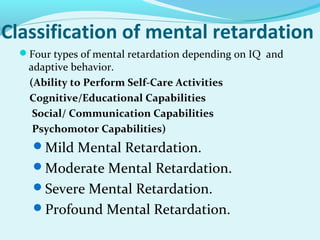
Classification of mental retardation
Four types of mental retardation depending on IQ and
adaptive behavior.
(Ability to Perform Self-Care Activities
Cognitive/Educational Capabilities
Social/ Communication Capabilities
Psychomotor Capabilities)
Mild Mental Retardation.
Moderate Mental Retardation.
Severe Mental Retardation.
Profound Mental Retardation.
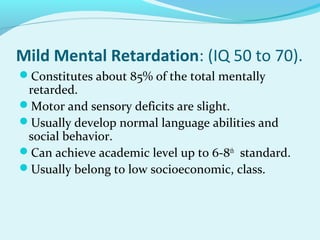
Mild Mental Retardation: (IQ 50 to 70).
Constitutes about 85% of the total mentally
retarded.
Motor and sensory deficits are slight.
Usually develop normal language abilities and
social behavior.
Can achieve academic level up to 6-8th
standard.
Usually belong to low socioeconomic, class.
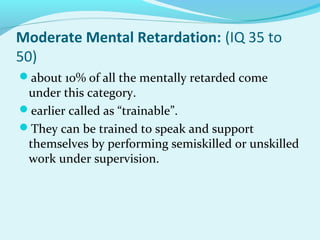
Moderate Mental Retardation: (IQ 35 to
50)
about 10% of all the mentally retarded come
under this category.
earlier called as “trainable”.
They can be trained to speak and support
themselves by performing semiskilled or unskilled
work under supervision.
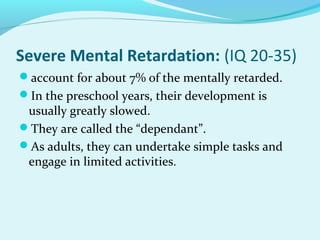
Severe Mental Retardation: (IQ 20-35)
account for about 7% of the mentally retarded.
In the preschool years, their development is
usually greatly slowed.
They are called the “dependant”.
As adults, they can undertake simple tasks and
engage in limited activities.
Profound Mental Retardation: (IQ below
20)
Less than 1% mentally retarded.
Very few of them learn to care themselves
completely.
Some eventually achieve some simple speech and
social behavior.
Etiological Implications
Five major predisposing factors have been identified:
1. Hereditary factors
2. Early alterations in embryonic development
3. Pregnancy and prenatal factors
4. General medical conditions acquired in infancy or
childhood
5. Environmental influences and other mental
disorders.
Hereditary Factors
Hereditary factors are implicated as the cause in
approximately 5 percent of the cases.
These factors include inborn errors of metabolism,
such as Tay-Sachs disease, phenylketonuria, and
hyperglycinemia.
Also included are chromosomal disorders, such as
Down syndrome and Klinefelter’s syndrome, and
single-gene abnormalities, such as tuberous sclerosis
and neurofibromatosis.
Early Alterations in Embryonic Development
Prenatal factors that result in early alterations in
embryonic development account for approximately
30 percent of mental retardation cases.
Damages may occur in response to toxicity
associated with maternal ingestion of alcohol or
other drugs.
 Maternal illnessesand infections during pregnancy
(e.g., rubella, cytomegalovirus)
Complications of pregnancy (e.g., toxemia,
uncontrolled diabetes) also can result in congenital
mental retardation
Pregnancy and Perinatal Factors
Approximately 10 percent of cases of mental
retardation are the result of factors that occur during
pregnancy (e.g., fetal malnutrition, viral and other
infections, and prematurity) or during the birth
process.
Examples of the latter include trauma to
the head incurred duringthe process of birth, placenta
previa or premature separation of the placenta, and
prolapse of the umbilical cord.
General Medical Conditions Acquired in Infancy
or Childhood
General medical conditions acquired during infancy
or childhood account for approximately 5 percent of
cases
They include
infections, such as meningitis and encephalitis;
poisonings, such as from insecticides, medications, and
lead;
physical trauma, such as head injuries, asphyxiation,
and hyperpyrexia
Environmental Influences and Other Mental
Disorders
Between 15 and 20 percent of cases of mental
retardation are attributed to deprivation of
nurturance and social, linguistic, and other
stimulation, and to severe mental disorders, such as
autistic disorder
Disorders Frequent Among Mentally
Retarded
A.. Physical Disorders
Sensory Disorders (about 20%)
Motor Disorders
Psychiatric Disorders (all varieties)
Schizophrenia
Mood Disorders
Neurosis
personality Disorders
Organic Psychiatric Disorders
Autism and Over activity syndromes Behavior Disorders
Sexual Problems
Causes of M.R
Prenatal causes
Infections
Physical Damage
Intoxications
Placental dysfunction
Endocrine disorders
Intranatal causes
Birth asphyxia
Prolonged or difficult birth
Prematurity
Kernicterus
Instrumental delivery
Postnatal Damage
Injury
Infection
Intoxication
Genetic causes
Chromosomal Abnormalities
 Down’s syndrome
 Klinefelter’s syndrome
 Fragile – X – syndrome
 Trisomy – 21
 Turner’s syndrome
Metabolic Disorders
 Amino acids
 Lipids
 Carbohydrates
 Purines-Lesch-Nyansyndrome
 Urea cycle
 Mucopolysaccharides
 Miscellaneous
Gross Disease of Brain
 Tuberous sclerosis
 Neurofibromatosis
 Epilepsy
Cranial Malformations
 Hydrocephaly
 Microcephaly
Sociocultural Causes
 Deprivation of sociocultural stimulation
Psychiatric Conditions
 Autistic disorder
 Rett's syndrome
 Childhood-onset schizophrenia
 Asperger's syndrome
Clinical Picture
Mouth - small mouth and teeth, furrowed tongue
(longitudinal cracks and grooves over the tounge),
high arched palate.
Eyes-oblique palpebral fissures, epicanthic folds
Head – flat occiput
Hands – short and broad, curved with fingers, single
transverse crease (single crease extends across the
palm of the hand ).
Joints – hyper extensibility or hyper flexibility,
hypotonia (low muscle tone), poor Moro reflex
Effects of Mental Retardation on
the Family
Distress, feelings of rejection.
Depression, guilt, shame or anger
Rejection of child.
Overindulgence.
Social problems.
Marital disharmony (in some).
Burden of care for their child.
Dissatisfaction about medical and social services
(even when they are normal).
Diagnosis of mental retardation
History
General Physical Examination
Detailed Neurological Examination
Mental Status Examination
Investigations
Routine
Urine examination
Blood Test
Chromosomal Studies
Endocrinol
Liver Function tests
EEG
CTScan of Brain
Developmental Assessment
Differential Diagnosis
Delayed maturation
Blindness or other sensory defects.
Childhood psychosis
Childhood autism
Severe neuroses.
Systemic disorders with physical handicap.
Deprived children with insufficient
stimulation.
Epilepsy.
States due to the side effects of drugs
Management of mental
retardation
1. Primary Prevention
2. Secondary Prevention
3. Tertiary Prevention
Primary Prevention
Health Promotion
 Good antenatal care and encouraging deliveries in
hospitals under proper supervision and care
 Improving the socioeconomic status of the country.
 Education of the public to help in early detection of
mental retardation and also, to, remove various
misconceptions about its causes and treatment.
 Facilitating research to identify the causes, and to
invent new methods of treatment.
Cont………….
Specific Protection
 Good parental, natal and postnatal care the pregnant
mothers at risk.
 Genetic counseling to at risk patients
 Avoiding childbirths in late age of the mother
 Avoiding consanguinal marriages
 Avoiding marriages of mentally retarded
Secondary Prevention (Early Diagnosis and
Treatment)
 Early detection and treatment of the preventable
disorders
 Amniocentesis and medial termination of pregnancy
on medical grounds.
 Early detection of correctable disorders.
 Prevent them against abuse
Tertiary Prevention
 Disability Limitation
Treatment of physical and psychological problems
Institutionalization of severe mentally retarded or
those with psychological problems.
Education (if educable) and training to avoid
handicaps.
Physiotherapy to treat the associated deficits.
 Rehabilitation
Counseling to Parents
The causation, prognosis of mental retardation.
To educate mothers and families in caring for the
mentally handicapped
Special supervision for the physically
handicapped or those severely and profoundly
men­tally retarded.
Treatment of psychological problems in parents.
Hospitalization
Indications
Attention deficit disorders with hyperkinesis
destructive, assaultive behavior.
Psychosis
Organic psychosis
Social factors
Over crowding
Incompetent parents
Mentally retarded or psychotic parents
Single parenthood
No one to look after
Nursing management
Impaired verbal communication related to delayed
development of milestones.
Attention deficit related to mental retardation
impaired cognitive function.
Self care deficit by difficulty in grooming, nutrition,
hygiene related to impaired cognitive functions.
Impaired health maintenance related to cognitive
impairment
Social isolation related to impaired personal
relationships
Ineffective coping related to mentally retarded
child.
Reference
Dr.K.Lalitha,”MENTAL HEALTH AND PSYCHIATRIC
NURSING AN INDIAN PERSPECTIVE”, 2nd
edition,
Bangalore: V.M.G. Book House, 2008,pg no:529-534
Dr.Kapoor.B, “ TEXTBOOK OF PSYCHIATRIC NURSING”,
vol II, 1st
edition,Delhi: Kumar publishing house,2006, pg no:208-
213
Sreevani R, “A Guide To Mental Health Psychiatric
Nursing”, 2nd
edition, Jaypee publication,
New Delhi. Pg no. 104-108
Assignment
Define mental retardation.
Explain about the classification of M.R
List down the causes of M.R
List down the steps involved in the management of
M.R
Thank You

Mental Subnormality

  • 1.
  • 2.
    Introduction Mental retardation isa state of developmental deficit that begins in childhood and result in significant limitation of intellect and poor adaptation to the demands of every day life. Several terms such as mental handicap, mental deficiency, mental subnormality and so on have been used to denote this condition.
  • 3.
    Definition  “Mental retardationis defined by deficits in general intellectual functioning and adaptive functioning (APA, 2000).
  • 4.
    General intellectual functioningis measured by an individual’s performance on intelligence quotient (IQ) tests. Adaptive functioning refers to the person’s ability to adapt to the requirements of daily living and the expectations of his or her age and cultural group.
  • 5.
    Meaning Mental retardation isnot a disease but a condition in which the intellectual faculties are never manifested or have never been developed sufficiently to enable the retarded person to acquire such an amount of knowledge as persons of his own age and placed in similar circumstance with him- self are capable of receiving.
  • 6.
    Epidemiology About 20 millionpeople with mild an d 4 million with moderate and severe mentally retarded . Highest incidence in school age children with peak at ages 10 to 12. Twice as common, in boys and girls.
  • 7.
    Classification of mentalretardation Four types of mental retardation depending on IQ and adaptive behavior. (Ability to Perform Self-Care Activities Cognitive/Educational Capabilities Social/ Communication Capabilities Psychomotor Capabilities) Mild Mental Retardation. Moderate Mental Retardation. Severe Mental Retardation. Profound Mental Retardation.
  • 8.
    Mild Mental Retardation:(IQ 50 to 70). Constitutes about 85% of the total mentally retarded. Motor and sensory deficits are slight. Usually develop normal language abilities and social behavior. Can achieve academic level up to 6-8th standard. Usually belong to low socioeconomic, class.
  • 9.
    Moderate Mental Retardation:(IQ 35 to 50) about 10% of all the mentally retarded come under this category. earlier called as “trainable”. They can be trained to speak and support themselves by performing semiskilled or unskilled work under supervision.
  • 10.
    Severe Mental Retardation:(IQ 20-35) account for about 7% of the mentally retarded. In the preschool years, their development is usually greatly slowed. They are called the “dependant”. As adults, they can undertake simple tasks and engage in limited activities.
  • 11.
    Profound Mental Retardation:(IQ below 20) Less than 1% mentally retarded. Very few of them learn to care themselves completely. Some eventually achieve some simple speech and social behavior.
  • 12.
    Etiological Implications Five majorpredisposing factors have been identified: 1. Hereditary factors 2. Early alterations in embryonic development 3. Pregnancy and prenatal factors 4. General medical conditions acquired in infancy or childhood 5. Environmental influences and other mental disorders.
  • 13.
    Hereditary Factors Hereditary factorsare implicated as the cause in approximately 5 percent of the cases. These factors include inborn errors of metabolism, such as Tay-Sachs disease, phenylketonuria, and hyperglycinemia. Also included are chromosomal disorders, such as Down syndrome and Klinefelter’s syndrome, and single-gene abnormalities, such as tuberous sclerosis and neurofibromatosis.
  • 14.
    Early Alterations inEmbryonic Development Prenatal factors that result in early alterations in embryonic development account for approximately 30 percent of mental retardation cases. Damages may occur in response to toxicity associated with maternal ingestion of alcohol or other drugs.  Maternal illnessesand infections during pregnancy (e.g., rubella, cytomegalovirus) Complications of pregnancy (e.g., toxemia, uncontrolled diabetes) also can result in congenital mental retardation
  • 15.
    Pregnancy and PerinatalFactors Approximately 10 percent of cases of mental retardation are the result of factors that occur during pregnancy (e.g., fetal malnutrition, viral and other infections, and prematurity) or during the birth process. Examples of the latter include trauma to the head incurred duringthe process of birth, placenta previa or premature separation of the placenta, and prolapse of the umbilical cord.
  • 16.
    General Medical ConditionsAcquired in Infancy or Childhood General medical conditions acquired during infancy or childhood account for approximately 5 percent of cases They include infections, such as meningitis and encephalitis; poisonings, such as from insecticides, medications, and lead; physical trauma, such as head injuries, asphyxiation, and hyperpyrexia
  • 17.
    Environmental Influences andOther Mental Disorders Between 15 and 20 percent of cases of mental retardation are attributed to deprivation of nurturance and social, linguistic, and other stimulation, and to severe mental disorders, such as autistic disorder
  • 18.
    Disorders Frequent AmongMentally Retarded A.. Physical Disorders Sensory Disorders (about 20%) Motor Disorders Psychiatric Disorders (all varieties) Schizophrenia Mood Disorders Neurosis personality Disorders Organic Psychiatric Disorders Autism and Over activity syndromes Behavior Disorders Sexual Problems
  • 19.
    Causes of M.R Prenatalcauses Infections Physical Damage Intoxications Placental dysfunction Endocrine disorders
  • 20.
    Intranatal causes Birth asphyxia Prolongedor difficult birth Prematurity Kernicterus Instrumental delivery Postnatal Damage Injury Infection Intoxication
  • 21.
    Genetic causes Chromosomal Abnormalities Down’s syndrome  Klinefelter’s syndrome  Fragile – X – syndrome  Trisomy – 21  Turner’s syndrome Metabolic Disorders  Amino acids  Lipids  Carbohydrates  Purines-Lesch-Nyansyndrome  Urea cycle  Mucopolysaccharides  Miscellaneous
  • 22.
    Gross Disease ofBrain  Tuberous sclerosis  Neurofibromatosis  Epilepsy Cranial Malformations  Hydrocephaly  Microcephaly Sociocultural Causes  Deprivation of sociocultural stimulation Psychiatric Conditions  Autistic disorder  Rett's syndrome  Childhood-onset schizophrenia  Asperger's syndrome
  • 23.
    Clinical Picture Mouth -small mouth and teeth, furrowed tongue (longitudinal cracks and grooves over the tounge), high arched palate. Eyes-oblique palpebral fissures, epicanthic folds Head – flat occiput Hands – short and broad, curved with fingers, single transverse crease (single crease extends across the palm of the hand ). Joints – hyper extensibility or hyper flexibility, hypotonia (low muscle tone), poor Moro reflex
  • 24.
    Effects of MentalRetardation on the Family Distress, feelings of rejection. Depression, guilt, shame or anger Rejection of child. Overindulgence. Social problems. Marital disharmony (in some). Burden of care for their child. Dissatisfaction about medical and social services (even when they are normal).
  • 25.
    Diagnosis of mentalretardation History General Physical Examination Detailed Neurological Examination Mental Status Examination Investigations Routine Urine examination Blood Test Chromosomal Studies Endocrinol Liver Function tests EEG CTScan of Brain Developmental Assessment
  • 26.
    Differential Diagnosis Delayed maturation Blindnessor other sensory defects. Childhood psychosis Childhood autism Severe neuroses. Systemic disorders with physical handicap. Deprived children with insufficient stimulation. Epilepsy. States due to the side effects of drugs
  • 27.
    Management of mental retardation 1.Primary Prevention 2. Secondary Prevention 3. Tertiary Prevention
  • 28.
    Primary Prevention Health Promotion Good antenatal care and encouraging deliveries in hospitals under proper supervision and care  Improving the socioeconomic status of the country.  Education of the public to help in early detection of mental retardation and also, to, remove various misconceptions about its causes and treatment.  Facilitating research to identify the causes, and to invent new methods of treatment.
  • 29.
    Cont…………. Specific Protection  Goodparental, natal and postnatal care the pregnant mothers at risk.  Genetic counseling to at risk patients  Avoiding childbirths in late age of the mother  Avoiding consanguinal marriages  Avoiding marriages of mentally retarded
  • 30.
    Secondary Prevention (EarlyDiagnosis and Treatment)  Early detection and treatment of the preventable disorders  Amniocentesis and medial termination of pregnancy on medical grounds.  Early detection of correctable disorders.  Prevent them against abuse
  • 31.
    Tertiary Prevention  DisabilityLimitation Treatment of physical and psychological problems Institutionalization of severe mentally retarded or those with psychological problems. Education (if educable) and training to avoid handicaps. Physiotherapy to treat the associated deficits.  Rehabilitation
  • 32.
    Counseling to Parents Thecausation, prognosis of mental retardation. To educate mothers and families in caring for the mentally handicapped Special supervision for the physically handicapped or those severely and profoundly men­tally retarded. Treatment of psychological problems in parents.
  • 33.
    Hospitalization Indications Attention deficit disorderswith hyperkinesis destructive, assaultive behavior. Psychosis Organic psychosis Social factors Over crowding Incompetent parents Mentally retarded or psychotic parents Single parenthood No one to look after
  • 34.
    Nursing management Impaired verbalcommunication related to delayed development of milestones. Attention deficit related to mental retardation impaired cognitive function. Self care deficit by difficulty in grooming, nutrition, hygiene related to impaired cognitive functions. Impaired health maintenance related to cognitive impairment Social isolation related to impaired personal relationships Ineffective coping related to mentally retarded child.
  • 35.
    Reference Dr.K.Lalitha,”MENTAL HEALTH ANDPSYCHIATRIC NURSING AN INDIAN PERSPECTIVE”, 2nd edition, Bangalore: V.M.G. Book House, 2008,pg no:529-534 Dr.Kapoor.B, “ TEXTBOOK OF PSYCHIATRIC NURSING”, vol II, 1st edition,Delhi: Kumar publishing house,2006, pg no:208- 213 Sreevani R, “A Guide To Mental Health Psychiatric Nursing”, 2nd edition, Jaypee publication, New Delhi. Pg no. 104-108
  • 36.
    Assignment Define mental retardation. Explainabout the classification of M.R List down the causes of M.R List down the steps involved in the management of M.R
  • 37.