Mental
Models &
Conceptual
Models
2
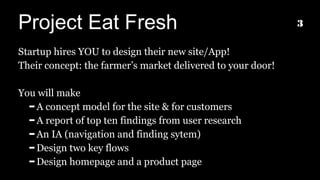
Project Eat Fresh
Startup hires YOU to design their new site/App!
Their concept: the farmer’s market delivered to your door!

You will make
– A concept model for the site & for customers
– A report of top ten findings from user research
– An IA (navigation and finding sytem)
– Design two key flows
– Design homepage and a product page
3
4
HOW
DO USERS
THINK?
5
EXERCISE
DRAW A MAP
FOR A
GROCERY
STORE
6
EXERCISE
SHARE
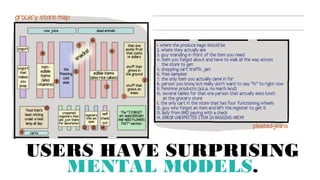
USERS HAVE SURPRISING
MENTAL MODELS.
EXERCISE
10 MINS
1.Work in a pair
2.Interview each other on how the shop for
food and sundries, 5 minutes each
3.Note what you hear
4.Ask about WHAT, WHY and HOW.
• What do they want?
• Why do the want it?
• How do they find it?
• How often do you shop
How do
you shop
for
groceries?
EXERCISE
1.Regroup into new teams of four
2.Combine your post its with the group
3.Sort into patterns.. Behavior, items
sought, etc
4.Place in empathy map
How do
you shop?
10 MINS
http://answers.oreilly.com/topic/1860-gamestorming-empathy-map/
EXERCISE
SHARE
DOES SAFEWAY
SUPPORT
YOUR
TASKS?
DOES WHOLE FOODS
SUPPORT
YOUR
TASKS?
DOES AMAZON
SUPPORT
YOUR
TASKS?
DOES TRADER JOES
SUPPORT
YOUR
TASKS?
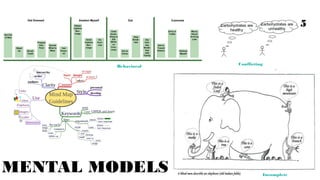
MENTAL MODELS
Behavioral Conflicting
Incomplete
1
A GAP ANALYSIS
HOW COULD
WE MAKE A
BETTER
GROCERY SITE?
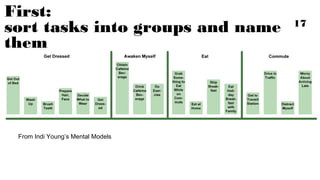
First:
sort tasks into groups and name them
‣ From Indi Young’s Mental Models
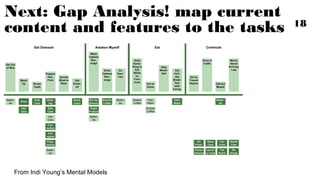
Next: Gap Analysis! map current content and features to the
tasks
‣ From Indi Young’s Mental Models
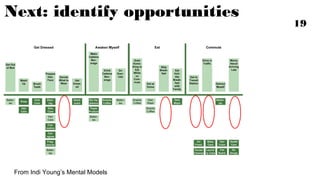
Next: identify opportunities
‣ From Indi Young’s Mental Models
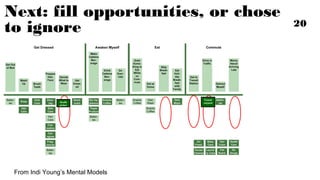
Next: fill opportunities, or chose to ignore
‣ From Indi Young’s Mental Models
Outfit
picker
Casual
carpool
EXERCISE
MENTAL
MODELS
EXERCISE
30
MINUTES
1.Work in your teams
2.Each take a grocery store site and spend
10 minutes creating inventory of products
on post its
3.Now map the products to the tasks
PENCIL
PAPER
OBJECTIVES
COMMUNICATE
USING
CONCEPTUAL
MODELS
2
We explain things with pictures
all the time. How to conceive,
how to build…
CONCEPT MODEL: a
visual representation of a
set of ideas that clarifies
their meaning for both the
thinker and the audience
2
2
CONCEPTUAL MODELS TO
COMMUNICATE TO TEAM
2
User
Designer
Computer designed by Daniel Shannonfrom The Noun Project
Mental model
Conceptual
model
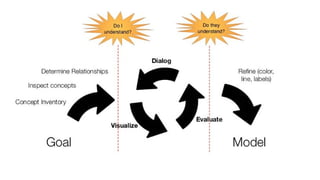
1. Discover
Mental Model
2. Understand
system
3. Synthesize into
conceptual model
System
2
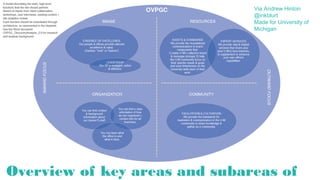
Overview of key areas and subareas of
Via Andrew Hinton
@inkblurt
Made for University of
Michigan
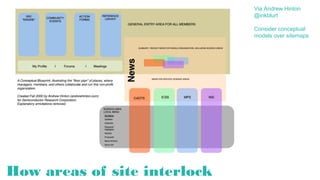
How areas of site interlock
Via Andrew Hinton
@inkblurt
Consider conceptual
models over sitemaps
EXERCISE
20
MINUTES
Individual
1.Draw a conceptual model for the key areas
of the grocery store site, and how they are
related to each other
2.Use size, color and shape to communicate.
You may want to do a quick sketch first,
then a second fuller drawing.
PENCIL
PAPER
Conceptual
Models to
Communicate to
Customers
‣ A conceptual model for
understanding the Gulf of
Mexico Estuaries
‣ Shows how the essential
systems are intertwingled.
‣ Conceptual models take what
users knows and how the
system actually works, and
builds a bridge between the two
so the user can understand.A conceptual model for understanding the Gulf of Mexico Estuaries
http://gulfsci.usgs.gov/tampabay/reports/white/model.html
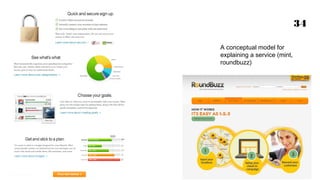
A conceptual
model for
explaining a
service (mint,
roundbuzz)
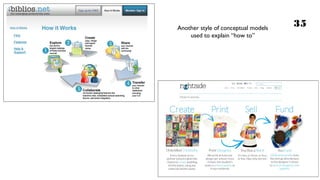
Another style of
conceptual models
used to explain “how
to”
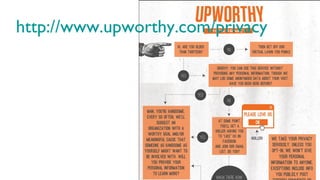
3http://www.upworthy.com/privacy
4
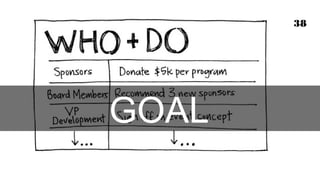
GOAL
WHO DO
employees
- Estimate
better
- Deliver
consistently
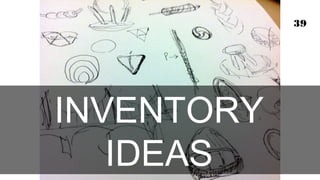
INVENTORY
IDEAS
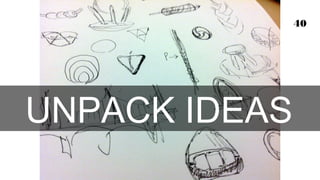
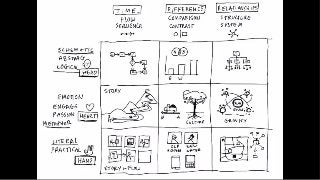
UNPACK IDEAS
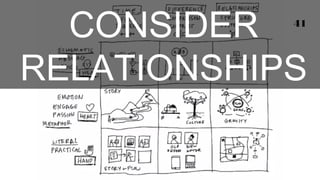
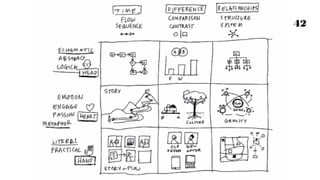
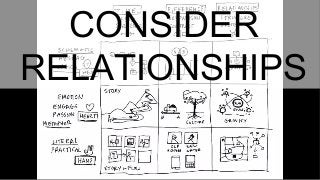
46CONSIDER
RELATIONSHIPS
47
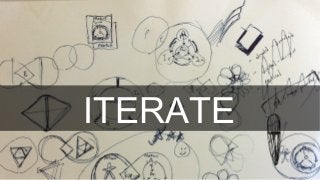
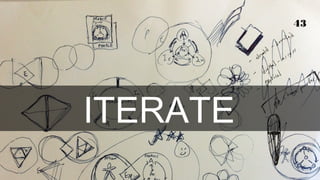
ITERATE
49
TEST
5
STUDIO
CREATE
MENTAL &
CONCEPTUAL
MODELS
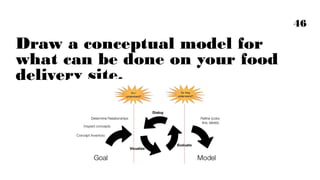
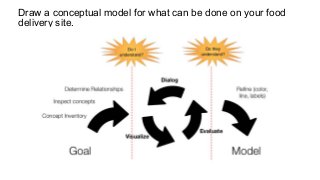
Draw a conceptual model for what can be done on your food
delivery site.
Break out
‣ Break into teams of six
‣ Compare concept models
‣ Discuss your project
‣ Make a plan
53
5
Q&A
HEADER
APPENDIX
notes
‣ This class is rather long. With exercises 3-4 hours. I removed the Indi
Young Gap Analysis exercise to get it to two hours.
‣ Consider breaking to two classes, one on mental models and one on
concept models, each two hours
‣ Concept model is very hard to teach how to do. Support with videos.
‣ http://www.davegrayinfo.com/visual-thinking-school/ Have class
“play along” step by step.
‣ Prerequisite of concept models is a sketching 101 class.
‣ Comparing concept models seemed to help prep class for discussing
project.

Mental Models and Concept Models

Editor's Notes

  • #5 Use this slide for a probing question at the beginning of a discussion or a point you’re trying to make.
  • #6 Sketchbook. 10 minutes. 10 for sharing.
  • #7 Use this slide for a probing question at the beginning of a discussion or a point you’re trying to make.
  • #11 10 minutes. Don’t call on everyone.
  • #12 Note: safeway knows I’m in palo alto (see flyer) but doesn’t link the store. Quick call out to students: do they see support here for a task? On a scale form 1-10 how well does it match?
  • #13 Who food thinks I’m in san francisco! Quick call out to students: do they see support here for a task? On a scale form 1-10 how well does it match?
  • #14 Quick call out to students: do they see support here for a task? On a scale form 1-10 how well does it match?
  • #15 Quick call out to students: do they see support here for a task? On a scale form 1-10 how well does it match?
  • #16 Mental models are how your users think of the world. They may not be accurate. They may conflict. But they are a worldview worth understanding in order to design.
  • #18 Divide into groups. Have them pool their tasks, group them and name the groups. Then order chronologicaly, and name those phases. Then lay them out on posterboard like the above
  • #19 Pull up one of the grocery sites, and use it as reference
  • #20 Exercise: do this.
  • #21 Exercise: do this.
  • #22 If time, have them create an Indi-style gap analysis. If short, do a mental model drawing exercise where they parnter up and draw each other’s project.
  • #30 Most diagrams we use in IA/IxD/UX are already conceptual Diagrams
  • #37 Conceptual Model Critical issues and information needs common to all Gulf of Mexico estuarine research efforts were identified through a series of meetings, workshop presentations and discussions involving representatives from all participating agencies including the EPA’s National Estuary Program, and USGS Chesapeake Bay project. These issues can be categorized under four estuarine system components 1.) Geology and Geomorphology, 2.) Ecosystem Structure and Function, 3.) Hydrodynamics, and 4.) Water and sediment quality and include the following: Geology and Geomorphology Seafloor and subsurface mapping (bathymetry, habitat, sediments, seismic, geomorphology)Pre-anthropogenic and historical environmental reconstructionSediment budget and movementEstuary linkage to the Gulf of MexicoLand use, land cover, and urbanization history and mappingDigital elevation, topo-bathy mapping/modeling of drainage basinCoastal change and hazards Ecosystem Structure and Function Habitat distribution, degradation, loss, and restorationCritical controls on seagrass health and distributionCritical controls on wetland health and distributionHarmful algal bloomsIntroduced (exotic) speciesBenthic and planktonic productivity, carbon and nutrient cycling Hydrodynamics Storm-water runoffGroundwater inflowNatural and anthropogenic flow alterationChanges in freshwater inflowWater circulation and residence timesWave energy impacts Water and sediment quality Excess nutrientsSalinityToxic chemicalsPathogensContaminant hot spots (PAHs, DDT, chlordane, dioxin, nickel, chromium, arsenic,tributyl tin, etc.)Sediment/water interface processes Each of these system components is clearly linked. For example, changes in hydrodynamics (water runoff, inflow, circulation) will, inevitably, affect water and sediment quality which, in turn, may affect the distribution of benthic habitats such as seagrass beds, which then affects sediment accumulation and transport, and eventually alters bathymetry. As a consequence, fishing resources may decline due to destruction of benthic habitat, changes in bathymetry may alter navigation routes, etc. Effective management of coastal resources including estuaries relies upon the ability to examine the consequences of natural and anthropogenic changes on the ecosystem, and the ability to predict how a change in one system component will affect other system components. This predictive ability can only be achieved by developing an understanding of the interrelationships between system components and development of reliable predictive models that aid resource managers in science-based decision making with respect to restoration and regulatory goals. Examining these interrelationships, or establishing links, between system components can be achieved most effectively through an integrated science approach (Figure 1). The factors driving the necessity for an integrated science approach are common to most U.S.G.S. science endeavors and include: social and economic factors concerning the use and preservation of estuarine resources; natural and anthropogenic influences resulting in estuarine ecosystem change; the need to plan, execute, and evaluate restoration and regulatory activities; insuring human health and safety; and enhancing science-based decision making. Most coastal ecosystems have existing research and monitoring efforts either through local universities and agencies or other federally funded exercises. However, many of these efforts lack the resources or expertise to address large-scale integrated science efforts. While much historical information and monitoring data may exist in a given estuarine location, synthesis and integration of existing data, and acquisition of new data to establish links and develop interpretations and products that reveal these links is a critical missing component of many estuarine research programs. Realizing that the state of knowledge of any given estuarine system will vary from place to place, a successful integrated science strategy must be founded on partnerships and collaborative efforts between multidisciplinary teams of U.S.G.S. scientists and the federal, state, and local entities already engaged in research efforts in a given location. Additionally, the science and management approach must be structured to maintain flexibility to accommodate various states of knowledge realizing that critical issues and research priorities will evolve as a project progresses. The primary challenge of an approach to integrated science for adaptive management is to carefully plan and perform integrated field-work and integrated product development that will clearly establish links between system components and provide useful predictive tools for resource managers and scientists.
  • #38 Mint and roundbuzz explain their service to sell it but also to prepare users for the functionality.
  • #39 Bibilios and rightside explain how it works. They remove elements form the process so the user can hold the core elements in their mind.
  • #51 Studio will be to do mental models, gap analysis and conceptual models for thier projects