The Customer Development Methodology Steve Blank [email_address]
Goals of This Presentation A new model for startups  Introduce the Customer Development model Translate this knowledge into a better Company
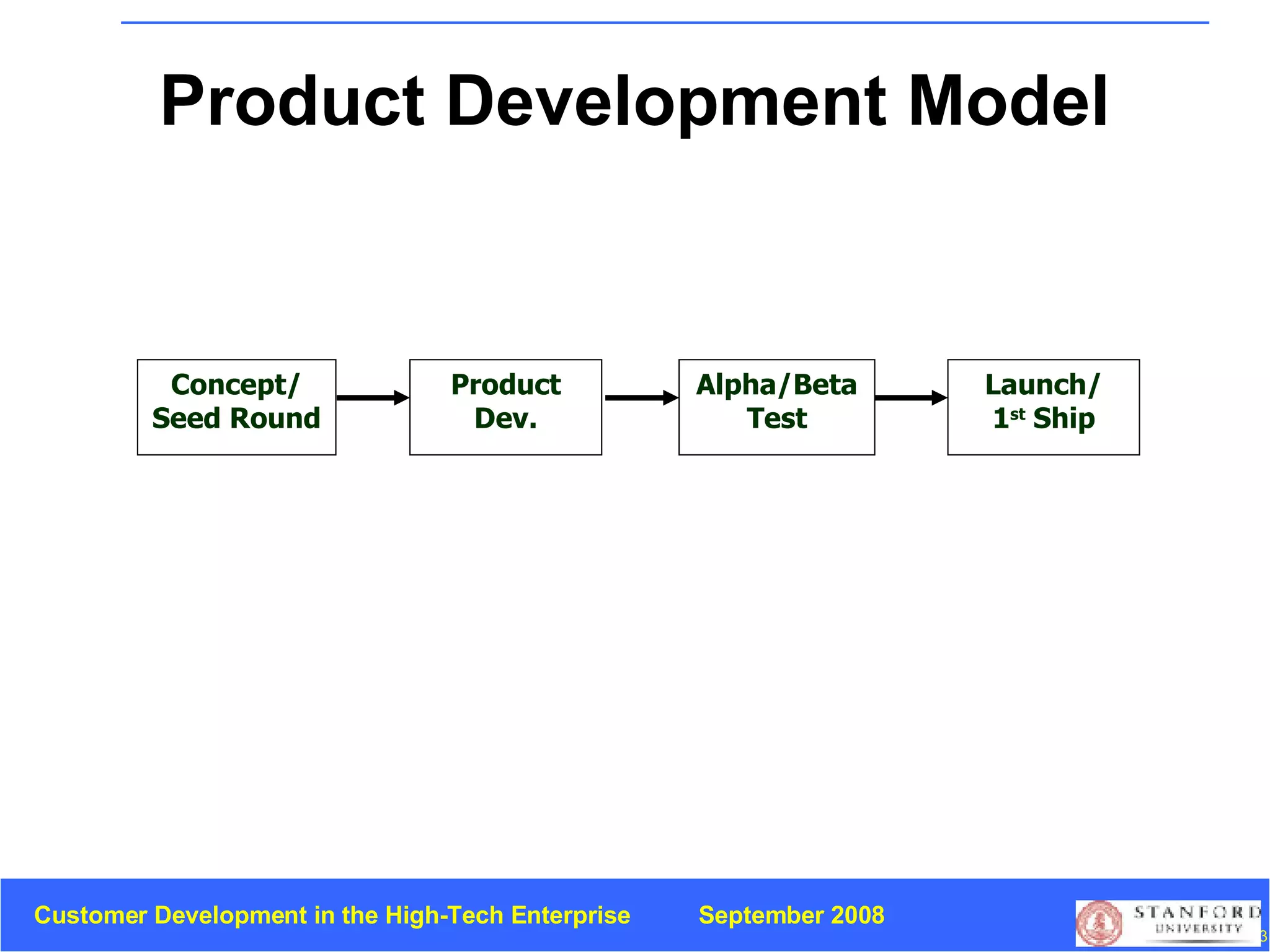
Product Development Model Concept/ Seed Round Product Dev. Alpha/Beta Test Launch/ 1 st  Ship
What’s Wrong With This? Concept/ Seed Round Product Dev. Alpha/Beta Test Launch/ 1 st  Ship Product Development Create Marcom  Materials - Create Positioning - Hire PR Agency - Early Buzz - Create Demand - Launch Event - “Branding” Marketing
What’s Wrong With This? Concept/ Seed Round Product Dev. Alpha/Beta Test Launch/ 1 st  Ship Product Development Create Marcom  Materials - Create Positioning - Hire PR Agency - Early Buzz - Create Demand - Launch Event - “Branding” Build Sales    Organization Marketing Sales Hire Sales VP Hire 1 st   Sales Staff
What’s Wrong With This? Concept/ Seed Round Product Dev. Alpha/Beta Test Launch/ 1 st  Ship Product Development Create Marcom  Materials - Create Positioning - Hire PR Agency - Early Buzz - Create Demand - Launch Event - “Branding” Hire Sales VP Hire 1 st   Sales Staff Build Sales    Organization Marketing Sales Hire First   Bus Dev Do deals for FCS Business  Development
Build It And They Will Come Only true for life and death products i.e. Biotech Cancer Cure Issues are development risks and distribution,  not customer acceptance Not true for most other products Software, Consumer, Web Issues are customer acceptance and market adoption
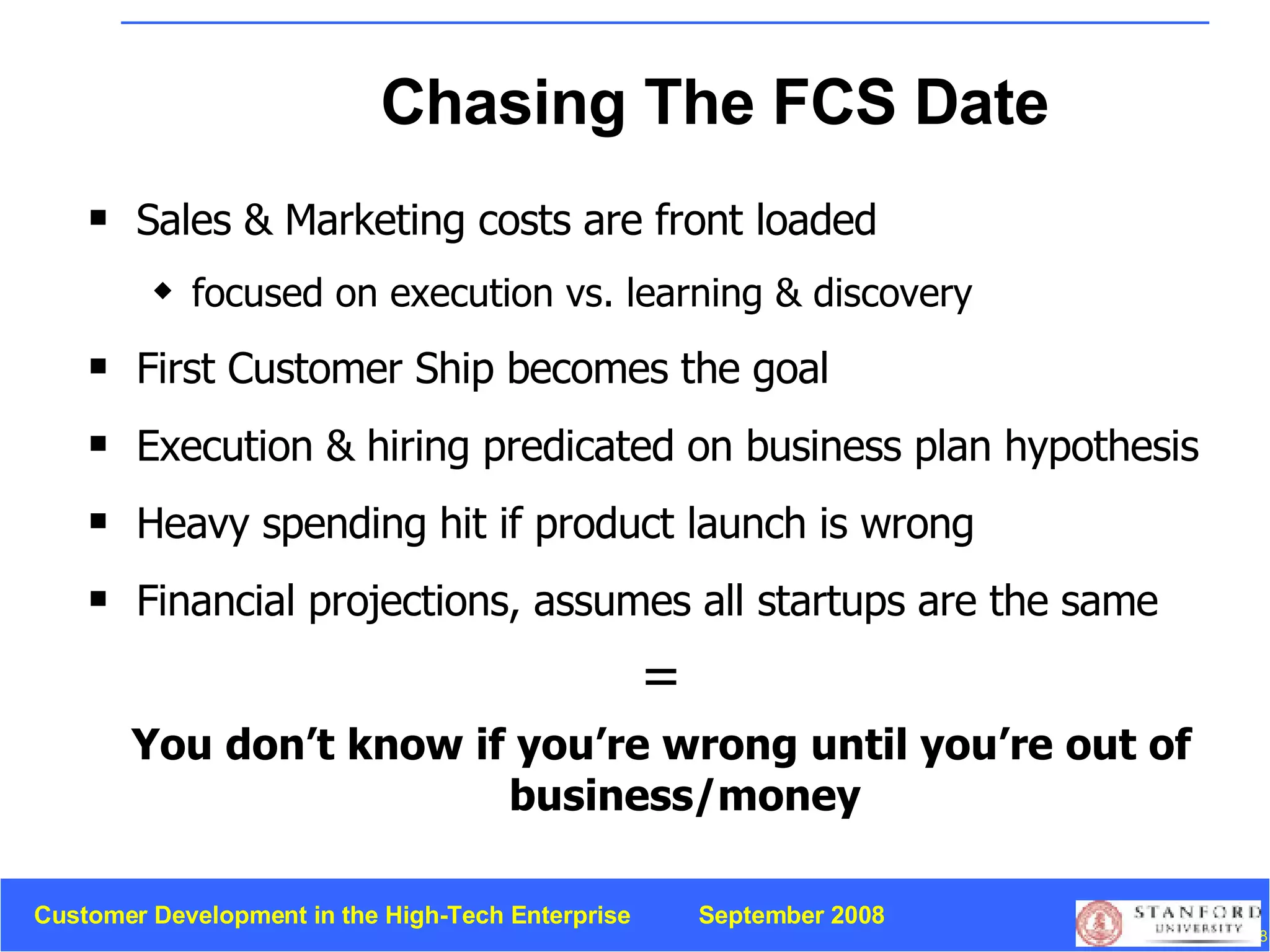
Chasing The FCS Date Sales & Marketing costs are front loaded focused on execution vs. learning & discovery First Customer Ship becomes the goal Execution & hiring predicated on business plan hypothesis Heavy spending hit if product launch is wrong Financial projections, assumes all startups are the same = You don’t know if you’re wrong until you’re out of business/money
If Startups Fail from a   Lack of customers not Product Development Failure  Then Why Do we have: process to manage product development no process   to manage   customer development
An Inexpensive Fix Focus on Customers and Markets from Day One How?
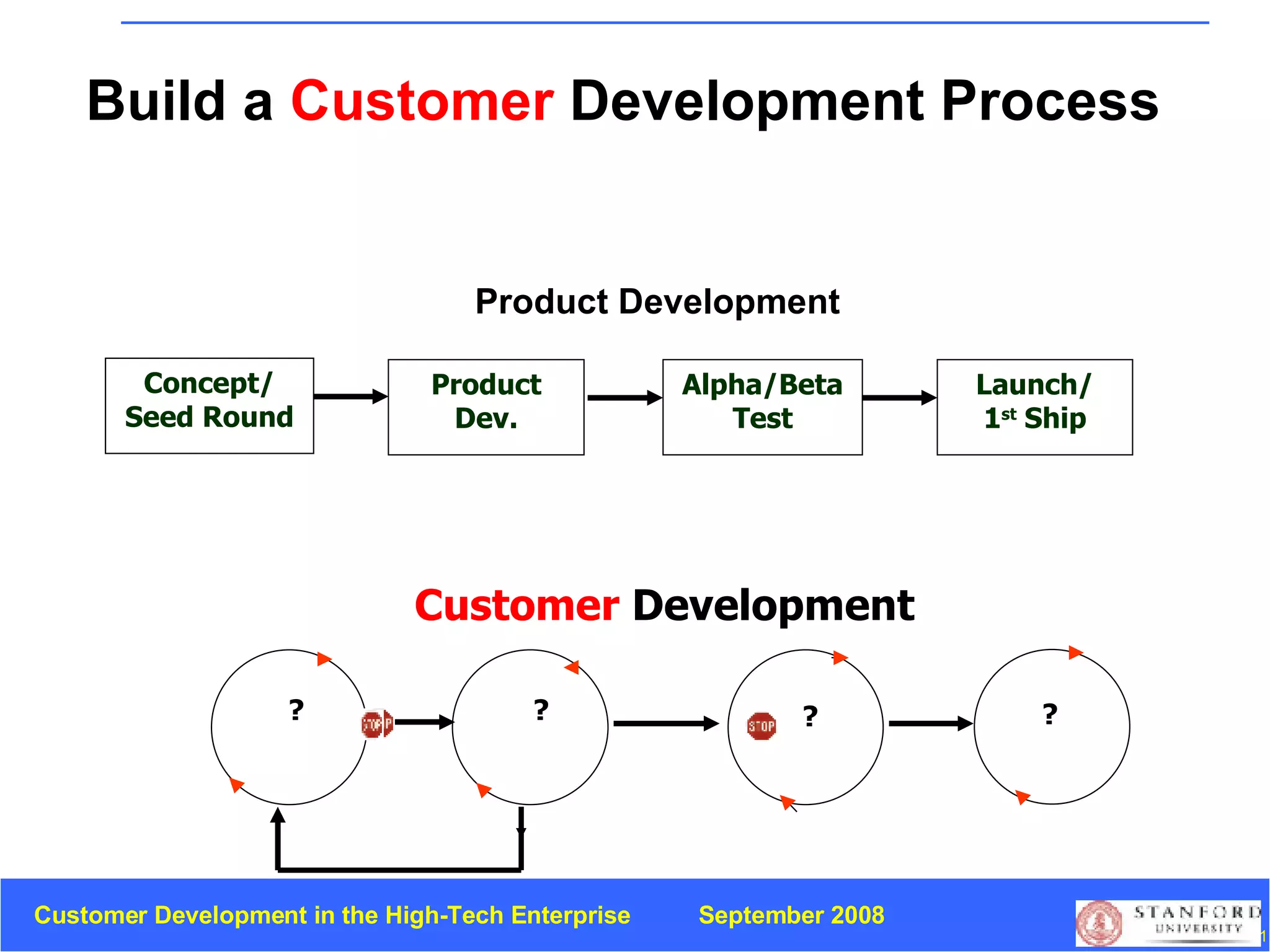
Build a  Customer  Development Process Customer  Development ? ? ? ? Concept/ Seed Round Product Dev. Alpha/Beta Test Launch/ 1 st  Ship Product Development
Customer  Development is as important as Product Development Company Building Customer   Development Customer Discovery Product Development Customer Validation Customer Creation Concept/ Bus. Plan Product Dev. Alpha/Beta Test Launch/ 1 st  Ship
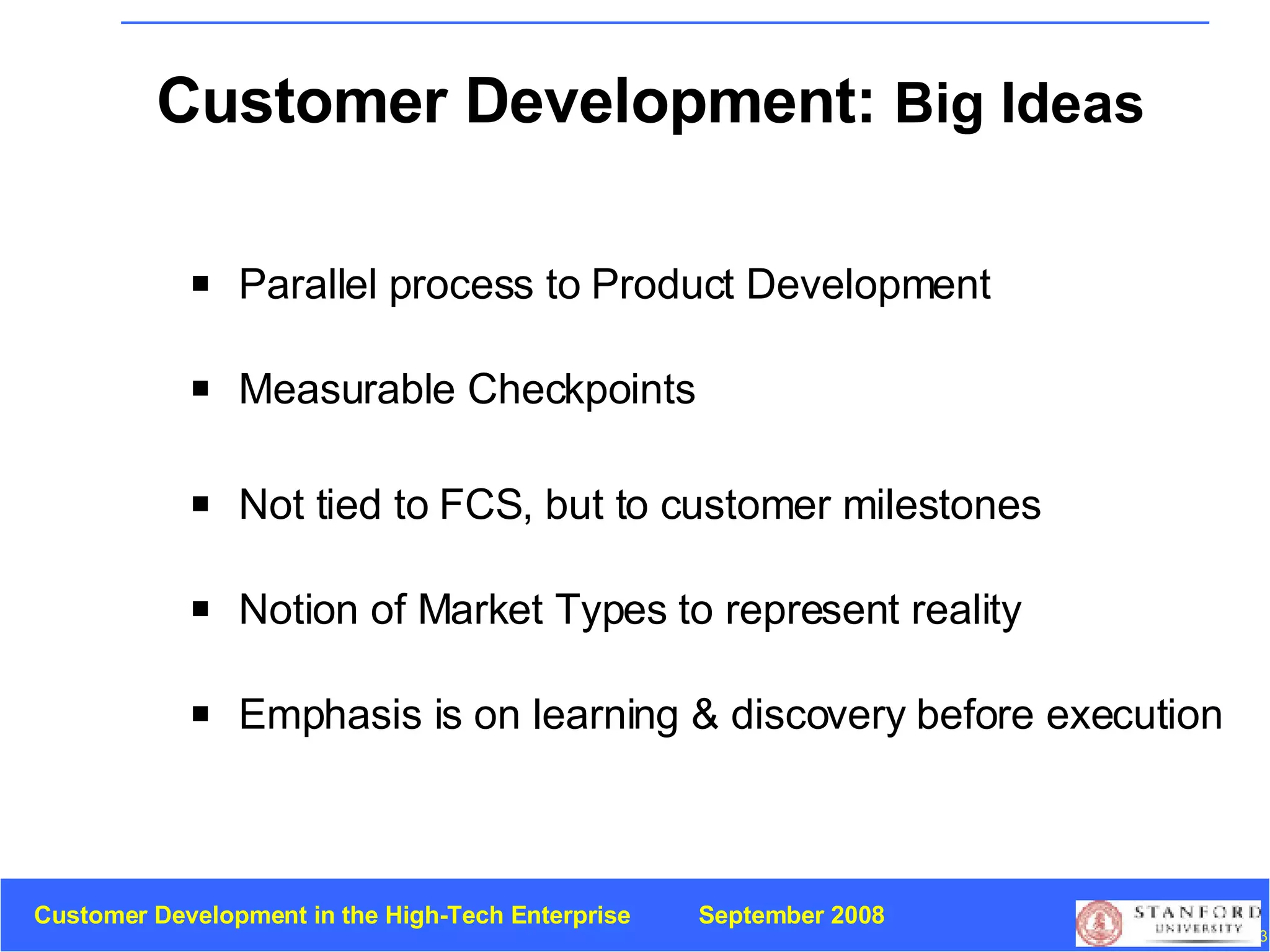
Customer Development:  Big Ideas Parallel process to   Product Development Measurable Checkpoints Not tied to FCS, but to customer milestones Notion of Market Types to represent reality Emphasis is on learning & discovery before execution
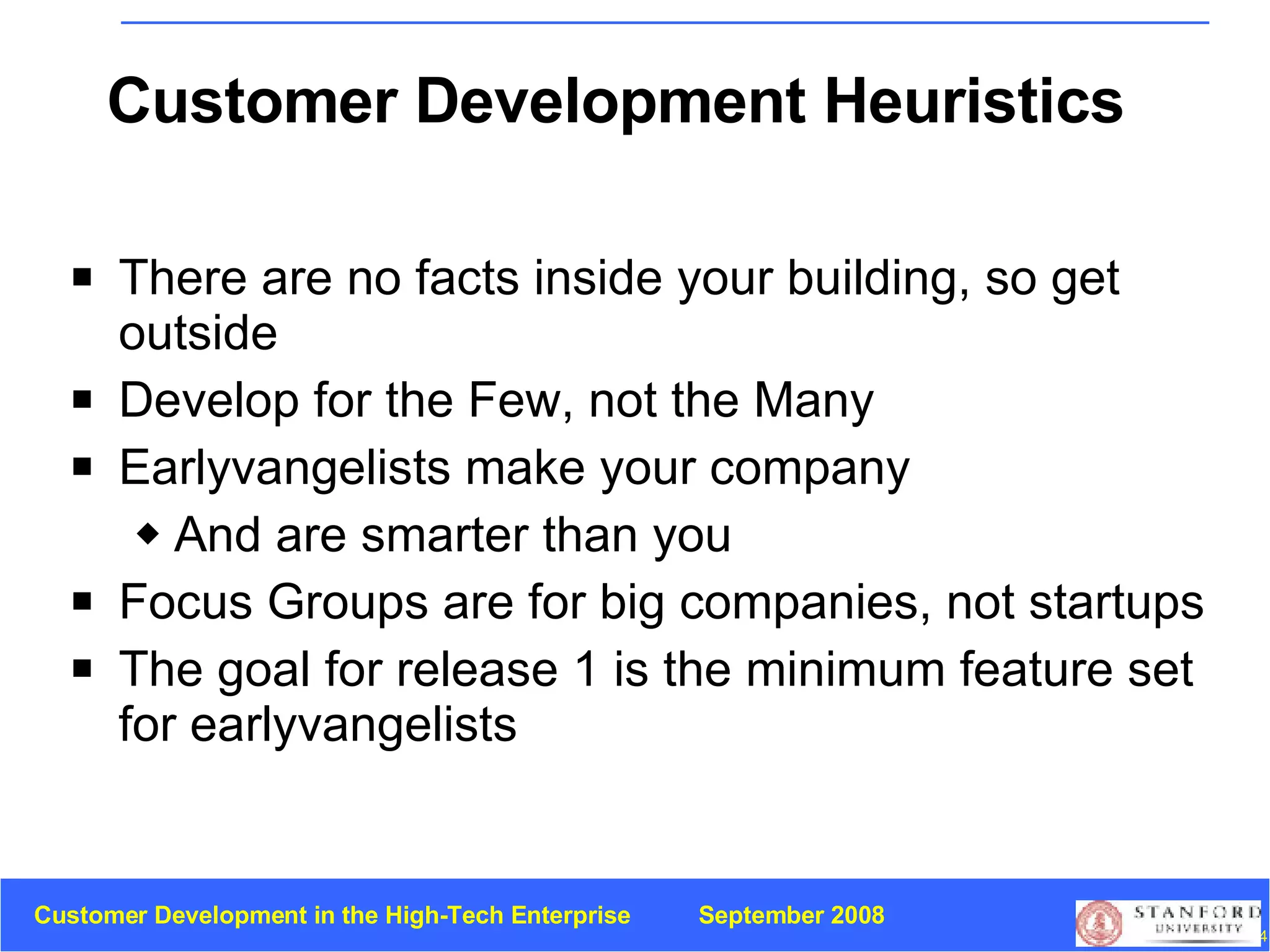
Customer Development Heuristics There are no facts inside your building, so get outside Develop for the Few, not the Many Earlyvangelists make your company And are smarter than you Focus Groups are for big companies, not startups The goal for release 1 is the minimum feature set for earlyvangelists
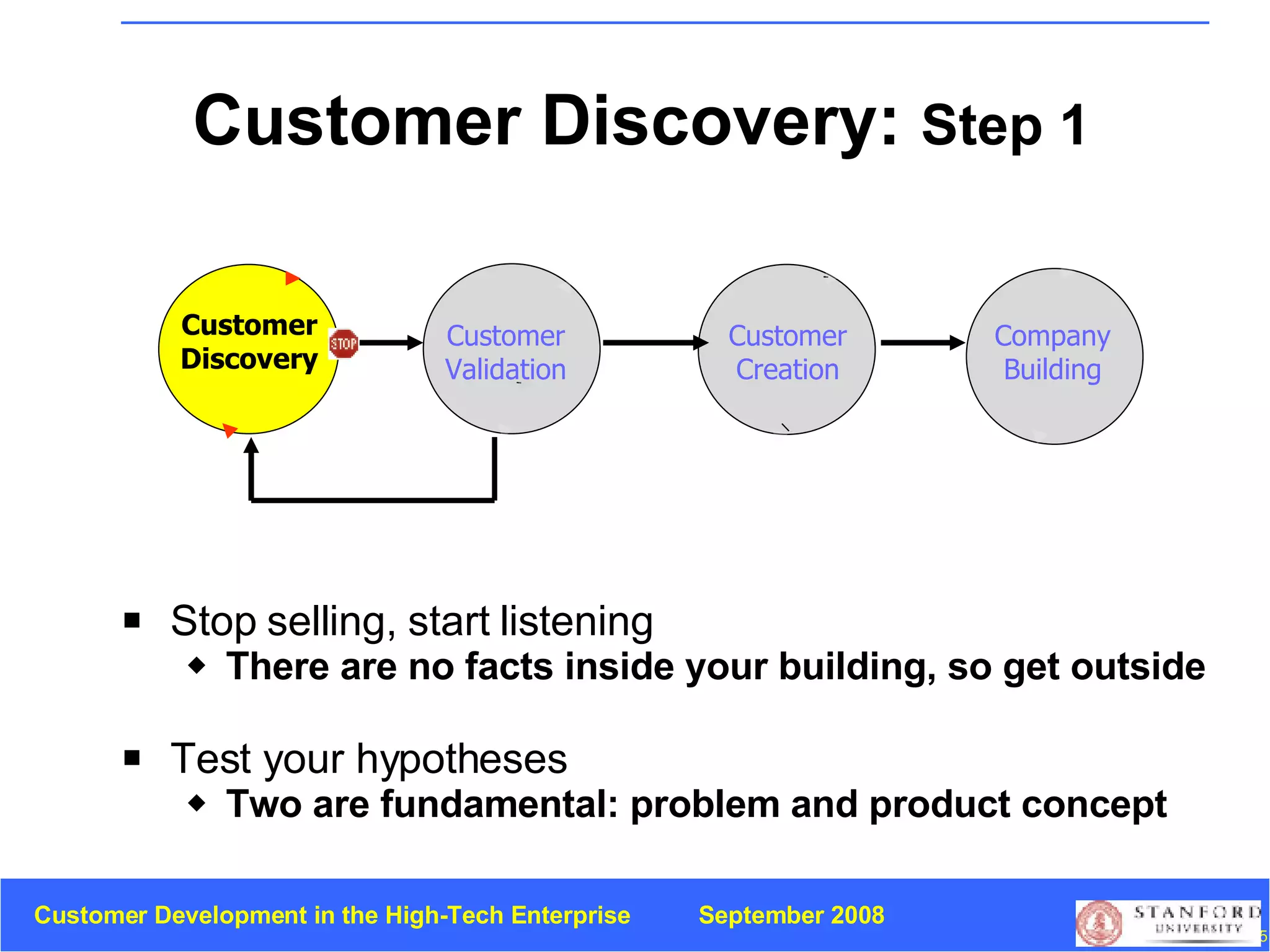
Stop selling, start listening There are no facts inside your building, so get outside Test your hypotheses  Two are fundamental: problem and product concept Customer Discovery:  Step 1 Customer Discovery Customer Validation Company Building Customer Creation
Customer Discovery:  Exit Criteria What are your customers top problems? How much will they pay to solve them Does your product concept solve them? Do customers agree?  How much will they pay? Draw a day-in-the-life   of a customer before & after your product Draw the org chart of users & buyers
Sidebar How to Think About Opportunities
“Venture-Scale” Businesses Create or add value to a customer Solve a significant problem/want or need, for which someone is willing to pay a premium A good fit with the founder(s) and team at the time Can grow large ( ≥ $100 million) Attractive returns for investor
Ideas Technology Driven  Is it buildable  now ? How much R, how much D? Does it depend on anything else? Are there IP issues? Customer Driven  Is there an articulated customer need?  How do you know? How big a market and when? Are others trying to solve it?  If so, why you? Does it solve an existing customer problem? Opportunity Driven Is there an opportunity no one sees but you do?  How do you know it’s a vision not a hallucination?
Facts Vs. Hypothesis Opportunity Assessment How big is the problem/need/desire? How much of it can I take? Sales Distribution Channel Marketing Engineering Fact or Hypothesis?
End of Sidebar
Customer Validation:  Step 2 Customer Discovery Customer Validation Customer Creation Company Building Develop a repeatable sales process Only earlyvangelists are crazy enough to buy
Customer Validation:  Exit Criteria Do you have a proven sales roadmap? Org chart? Influence map? Do you understand the sales cycle? ASP, LTV, ROI, etc. Do you have a set of orders ($’s) validating the roadmap? Does the financial model make sense?
Sidebar Customer Development Engineering   And Agile Development Methodologies
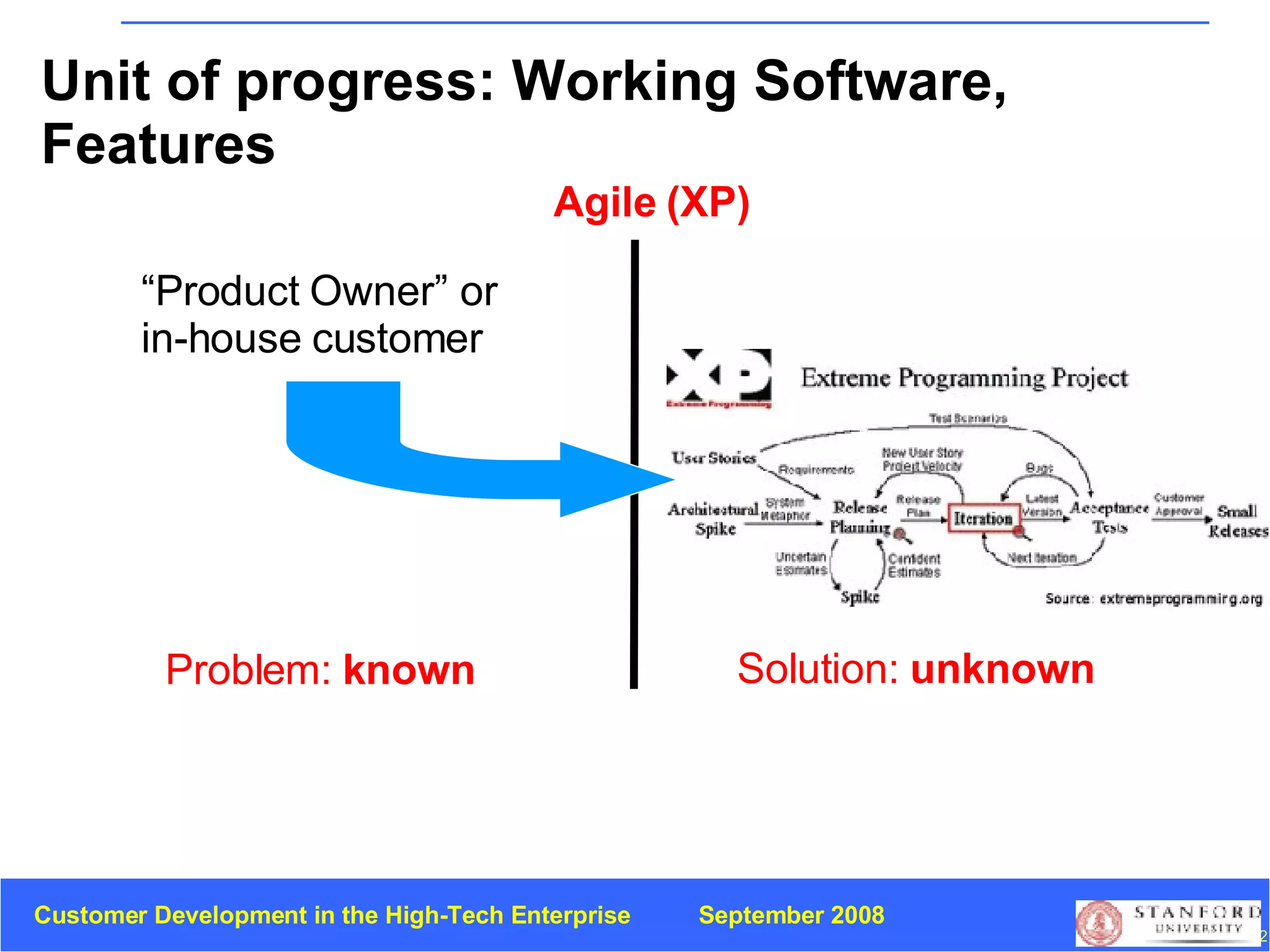
Traditional Agile (XP) Tactics Planning game programmers estimate effort of implementing cust stories  customer decides about scope and timing of releases Short releases new release every 2-3 months Simple design   emphasis on simplest design Testing   development test driven. Unit tests before code Refactoring restructuring and changes to simplify Pair Programming 2 people at 1 computer
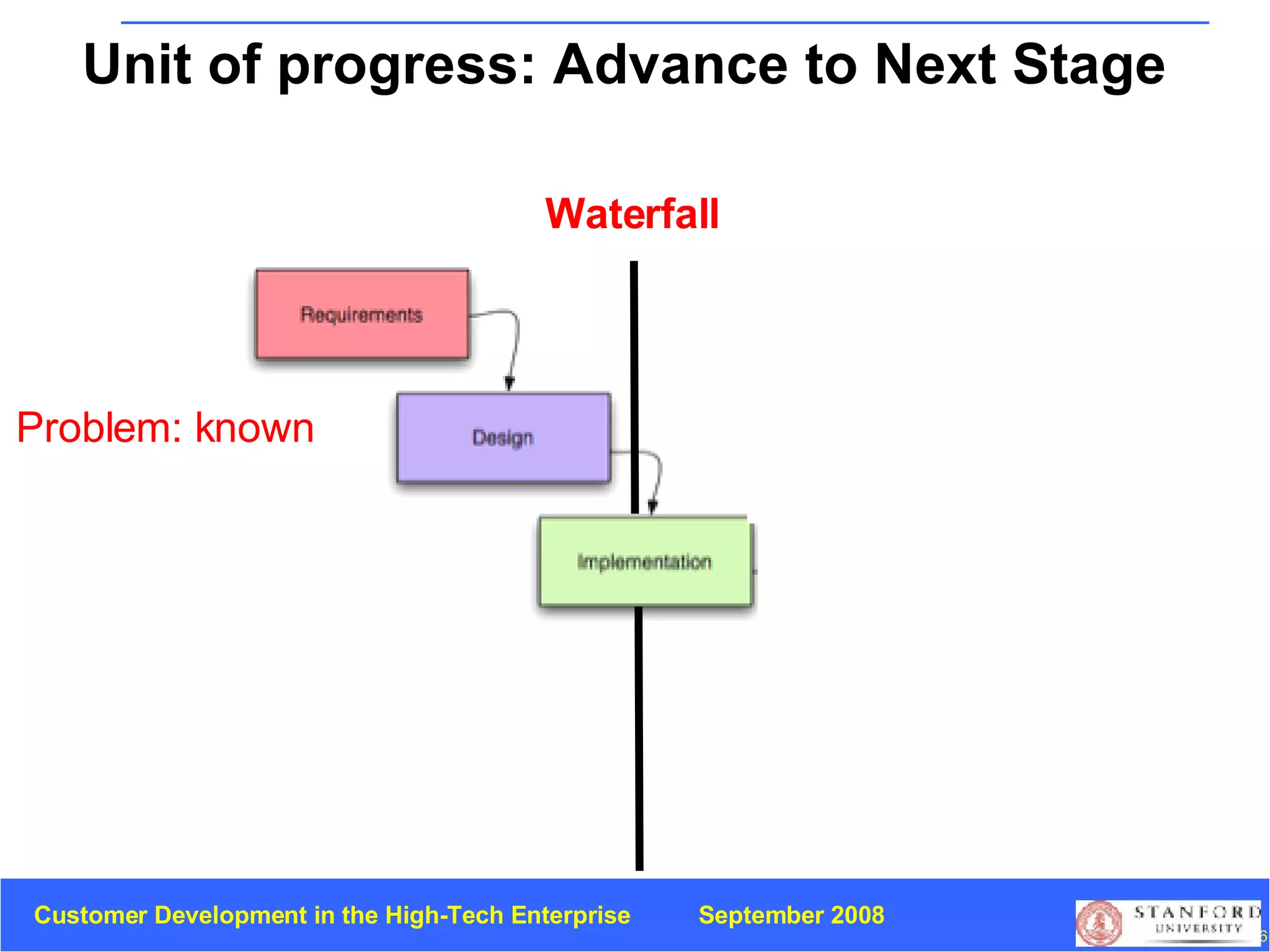
Problem: known Waterfall Unit of progress: Advance to Next Stage
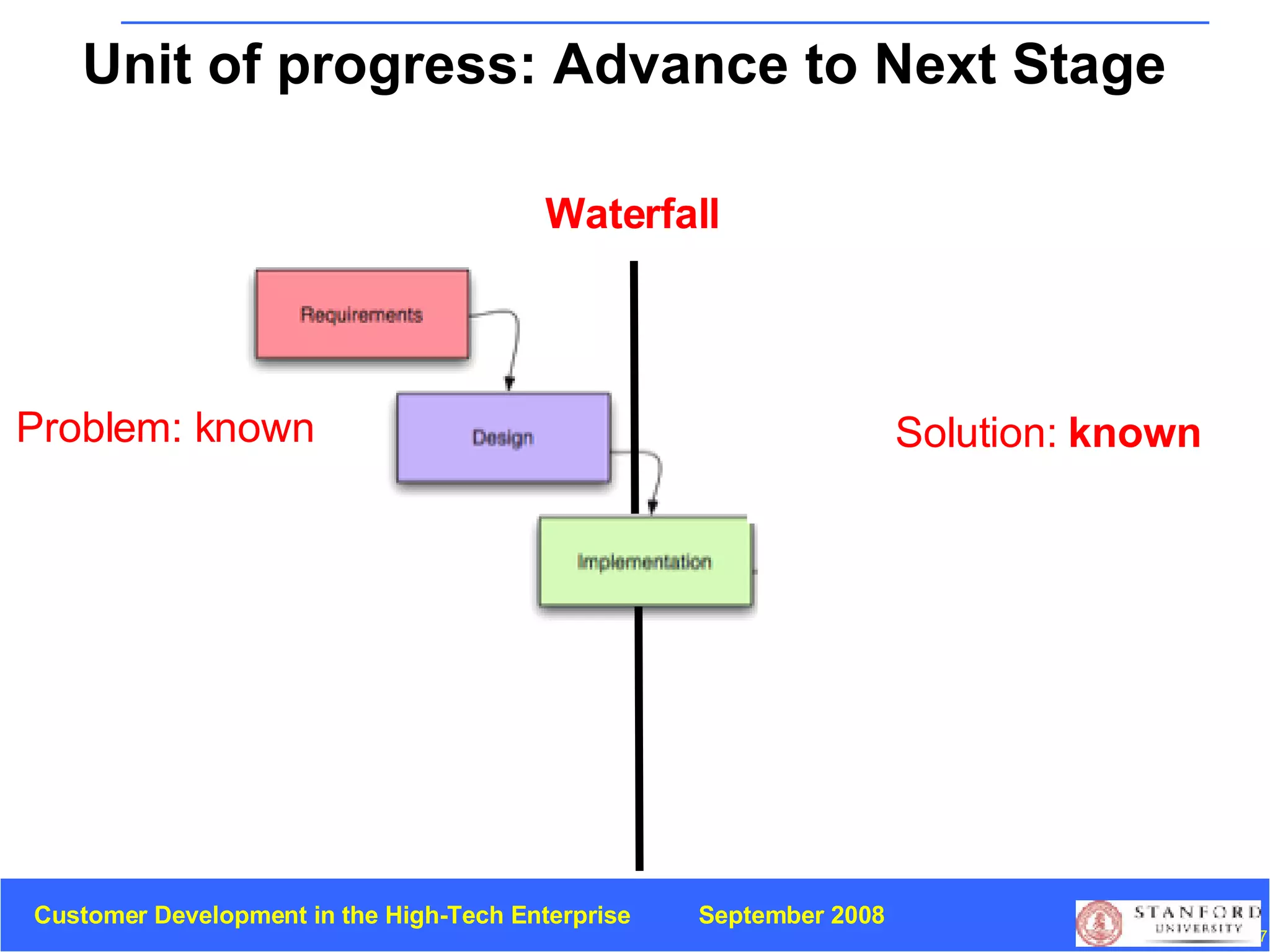
Problem: known Waterfall Unit of progress: Advance to Next Stage Solution:  known
Problem:  known Solution:  known Waterfall Unit of progress: Advance to Next Stage
Agile Development “ Our highest priority is to satisfy the customer through early and continuous delivery of valuable software.”  http://agilemanifesto.org/ Embrace Change Build what you need today Process-oriented development so change is painless Prefer flexibility to perfection Ship early and often Test-driven to find and prevent bugs Continuous improvement vs. ship-and-maintain
Problem:  known Agile (XP) “ Product Owner” or  in-house customer  Unit of progress: Working Software, Features
Problem:  known Solution:  unknown Agile (XP) “ Product Owner” or  in-house customer  Unit of progress: Working Software, Features
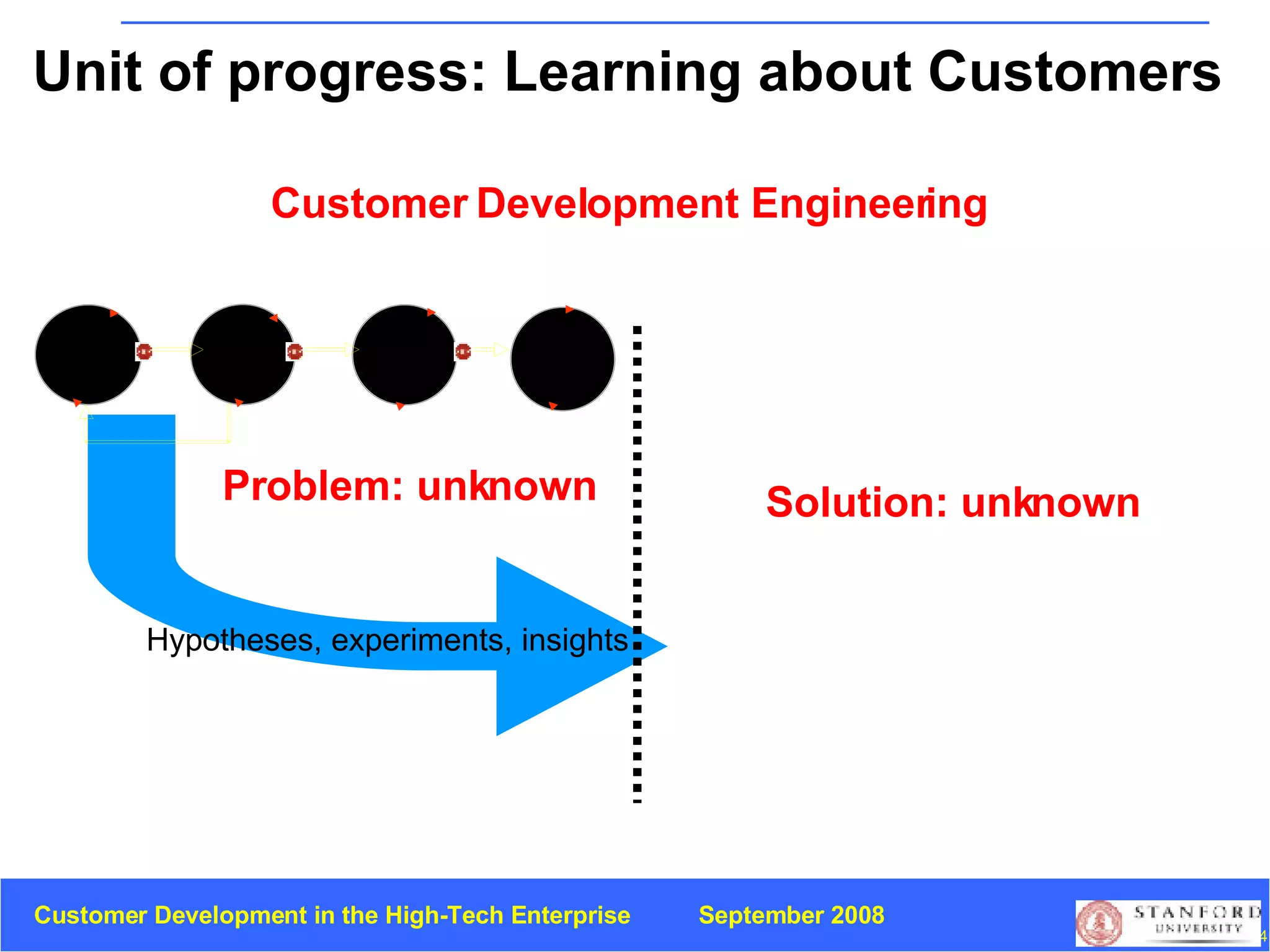
Problem: unknown Customer Development Engineering Unit of progress: Learning about Customers Hypotheses, experiments, insights
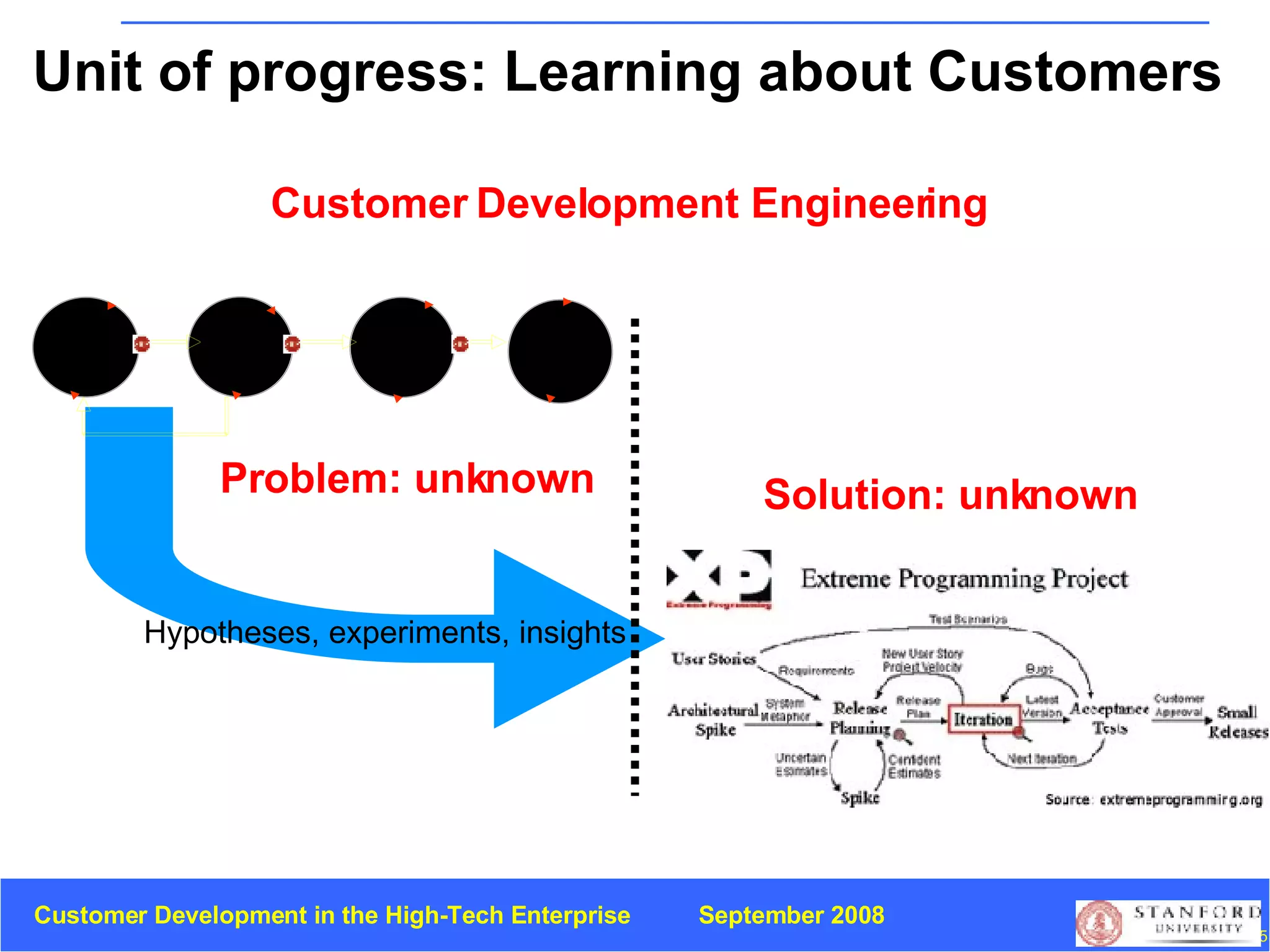
Problem: unknown Solution: unknown Customer Development Engineering Unit of progress: Learning about Customers Hypotheses, experiments, insights
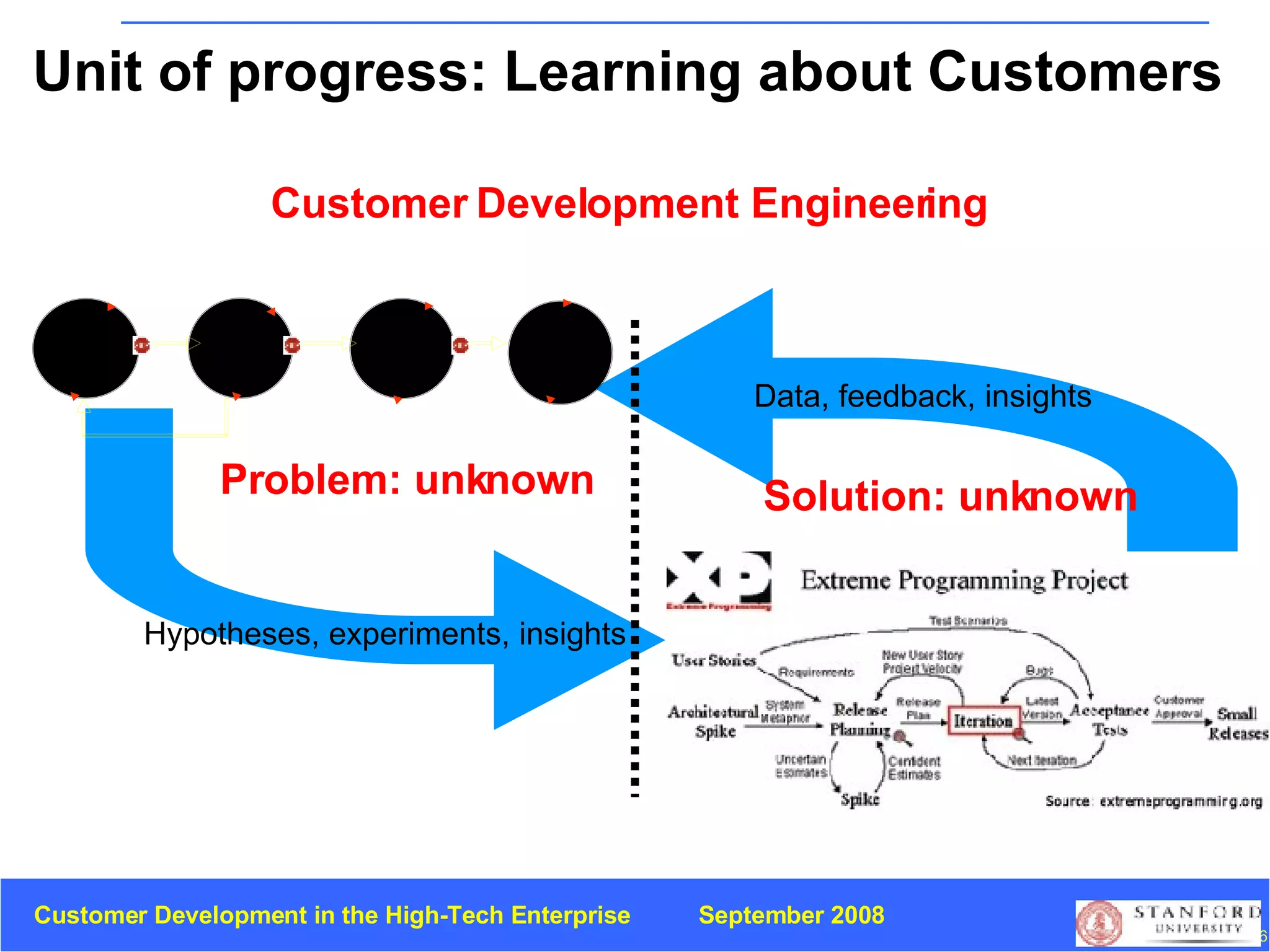
Problem: unknown Solution: unknown Customer Development Engineering Unit of progress: Learning about Customers Hypotheses, experiments, insights Data, feedback, insights
Problem: unknown Solution: unknown Customer Development Engineering Unit of progress: Learning about Customers Hypotheses, experiments, insights Data, feedback, insights Incremental, quick, minimum features, revenue/customer validation
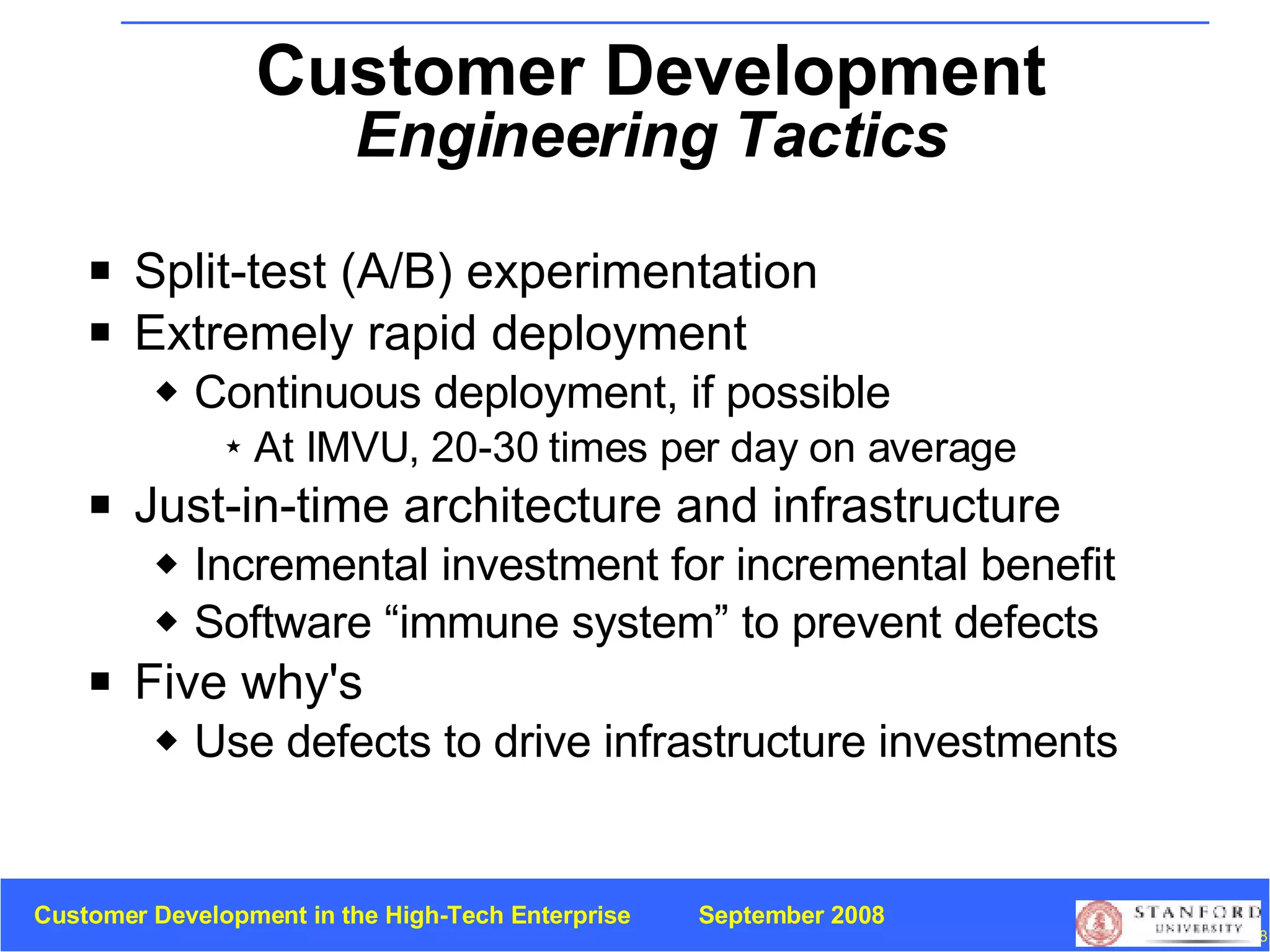
Split-test (A/B) experimentation Extremely rapid deployment Continuous deployment, if possible At IMVU, 20-30 times per day on average Just-in-time architecture and infrastructure Incremental investment for incremental benefit Software “immune system” to prevent defects Five why's Use defects to drive infrastructure investments Customer Development  Engineering Tactics
Five Why's Any defect that affects a stakeholder is a learning opportunity We’re not done until we’ve addressed the root cause… …  including, why didn’t any of our prevention tactics catch it? Technique is to “ask why five times” to get to the root cause
Five Why's Example For example: Why did we change the software so that we don't make any money anymore? Why didn’t operations get paged? Why didn’t the cluster immune system reject the change? Why didn’t automated tests go red and stop the line? Why wasn’t the engineer trained not to make the mistake? We’re not done until we’ve taken corrective action at all five levels
Customer Development Engineering How do you build a product development team that can thrive in a startup environment? Let's start with the traditional way... Waterfall “ The waterfall model is a sequential software development model in which development is seen as flowing steadily downwards through the phases of requirements analysis, design, implementation, testing (validation), integration, and maintenance.”
End of Sidebar
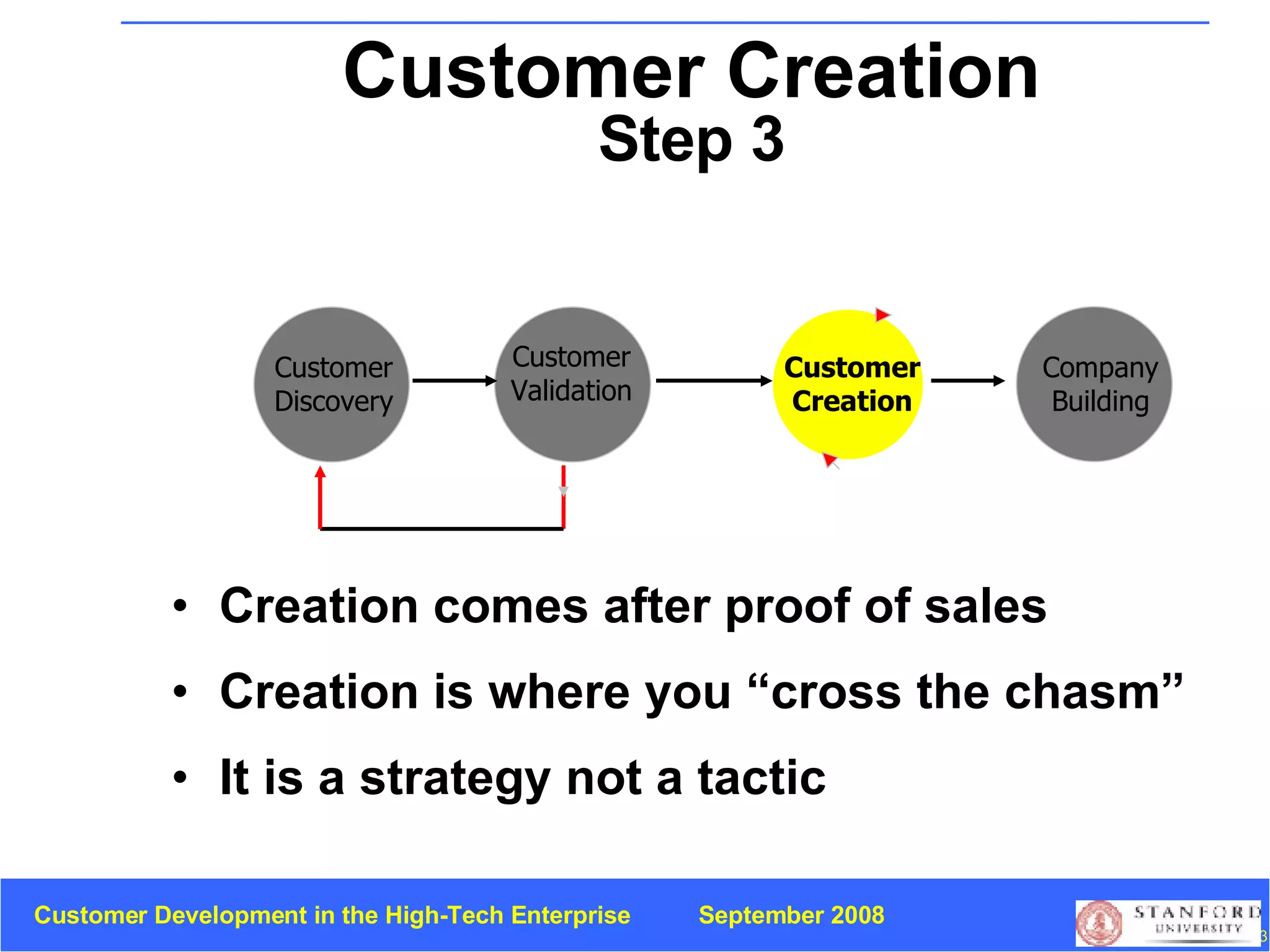
Customer Creation Step 3 Customer Discovery Customer Validation Customer Creation Company Building Creation comes after proof of sales Creation is where you “cross the chasm” It is a strategy not a tactic
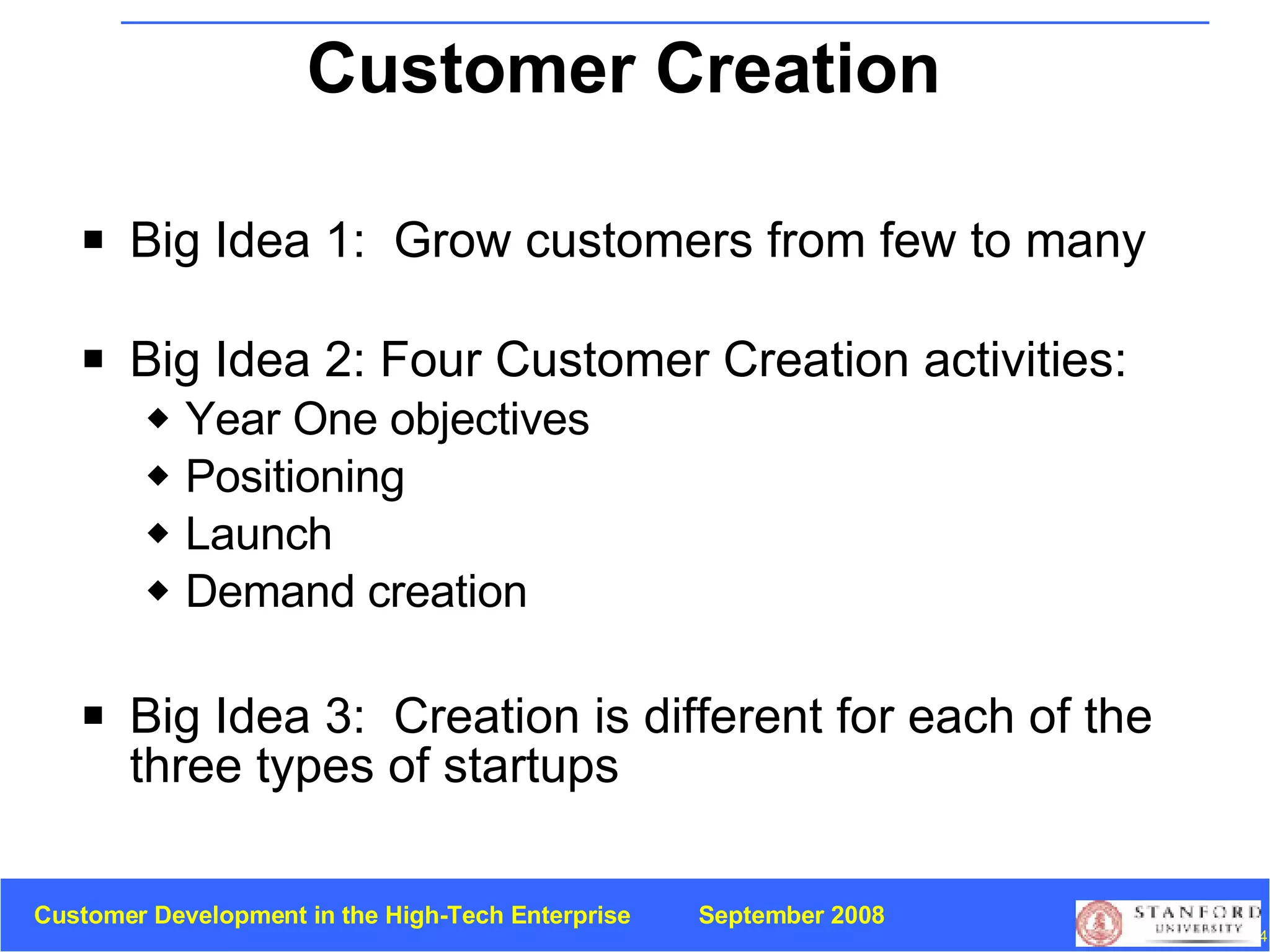
Customer Creation  Big Ideas Big Idea 1:  Grow customers from few to many Big Idea 2: Four Customer Creation activities: Year One objectives Positioning Launch Demand creation Big Idea 3:  Creation is different for each of the three types of startups
New Product Conundrum New Product Introduction methodologies sometimes work, yet sometimes fail Why? Is it the people that are different? Is it the product that are different? Perhaps there are different “types” of startups?
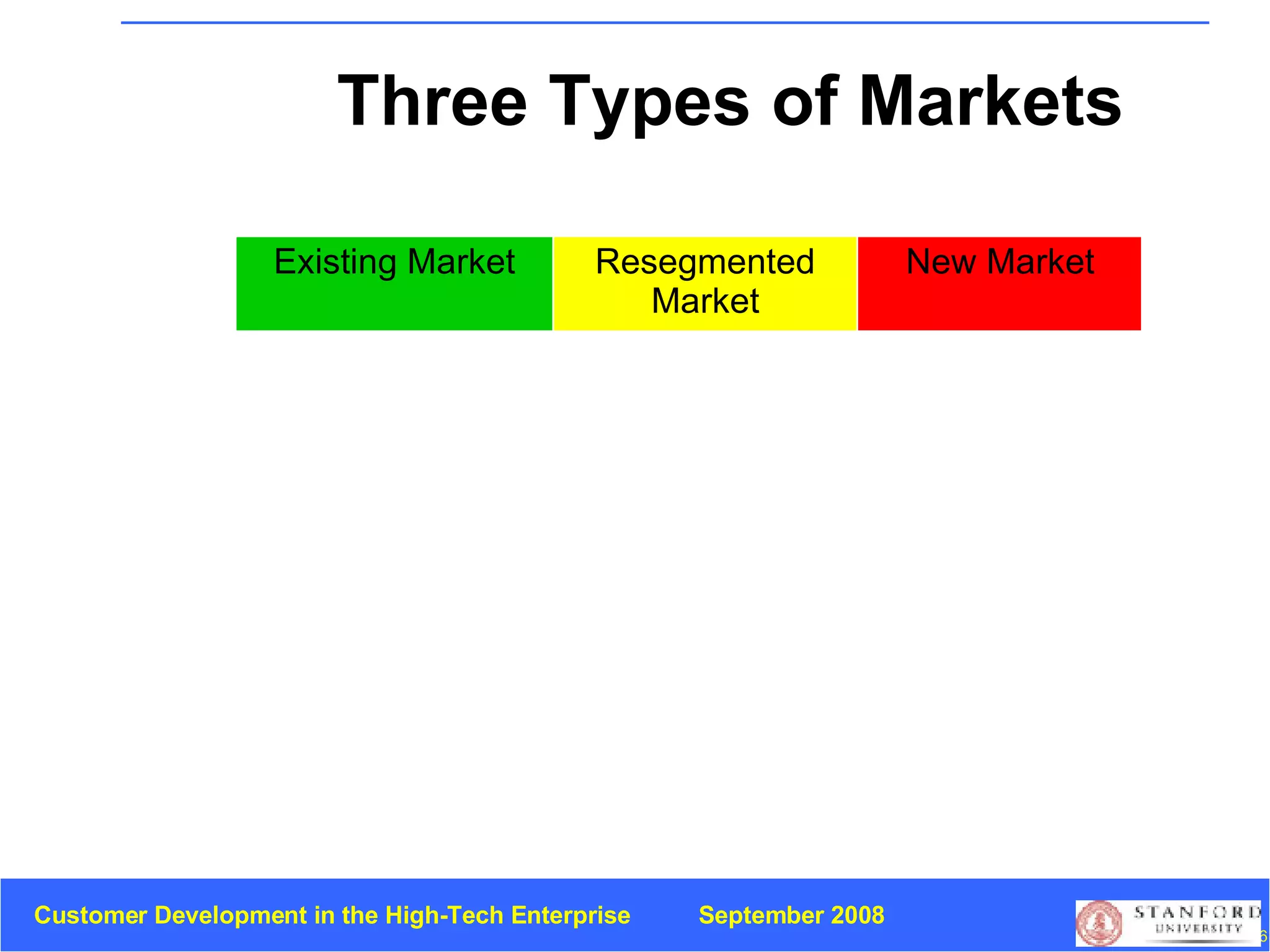
Three Types of Markets New Market Resegmented Market Existing Market
Three Types of Markets Who Cares? Type of Market changes EVERYTHING Sales, marketing and business development differ radically by market type Details next week New Market Resegmented Market Existing Market
Type of Market Changes Everything Market Market Size Cost of Entry Launch Type Competitive Barriers Positioning Sales Sales Model Margins Sales Cycle Chasm Width Finance Ongoing Capital Time to Profitability Customers Needs Adoption New Market Resegmented Market Existing Market
Definitions: Three Types of Markets Existing Market Faster/Better = High end Resegmented Market Niche = marketing/branding driven Cheaper = low end New Market Cheaper/good enough can create a new class of product/customer Innovative/never existed before New Market Resegmented Market Existing Market
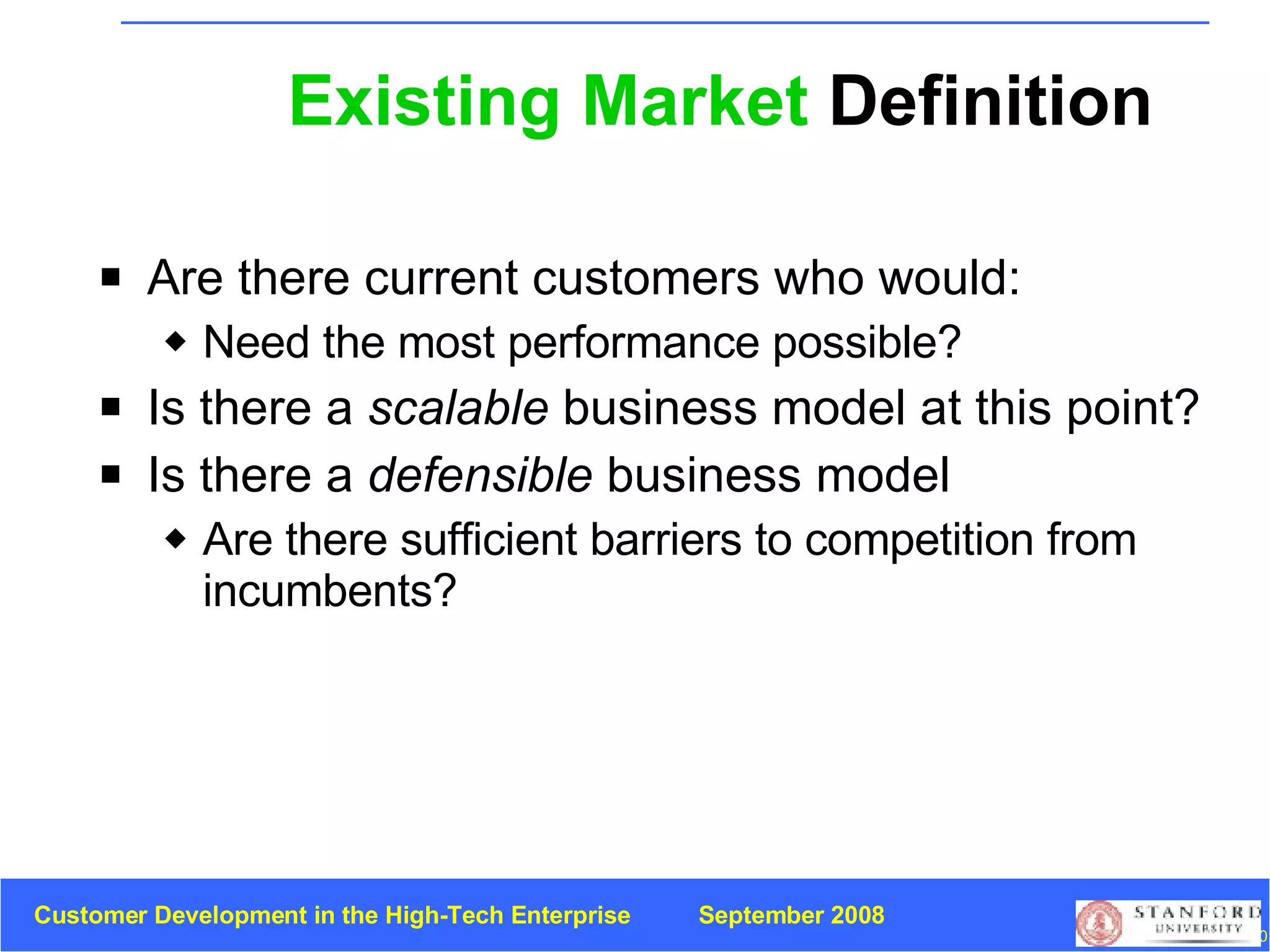
Existing Market  Definition Are there current customers who would: Need the most performance possible? Is there a  scalable  business model at this point? Is there a  defensible  business model Are there sufficient barriers to competition from incumbents?
Resegmented Market  Definition (1) Low End Are there customers at the low end of the market who would: buy less (but good enough) performance  if they could get it at a lower price? Is there a business profitable at this low-end? Are there sufficient barriers to competition from incumbents?
Resegmented Market  Definition (2) Niche Are there customers in the current market who would: buy if it addressed their  specific  needs  if it was the same price? If it cost more? Is there a  defensible  business model at this point? Are there barriers to competition from incumbents?
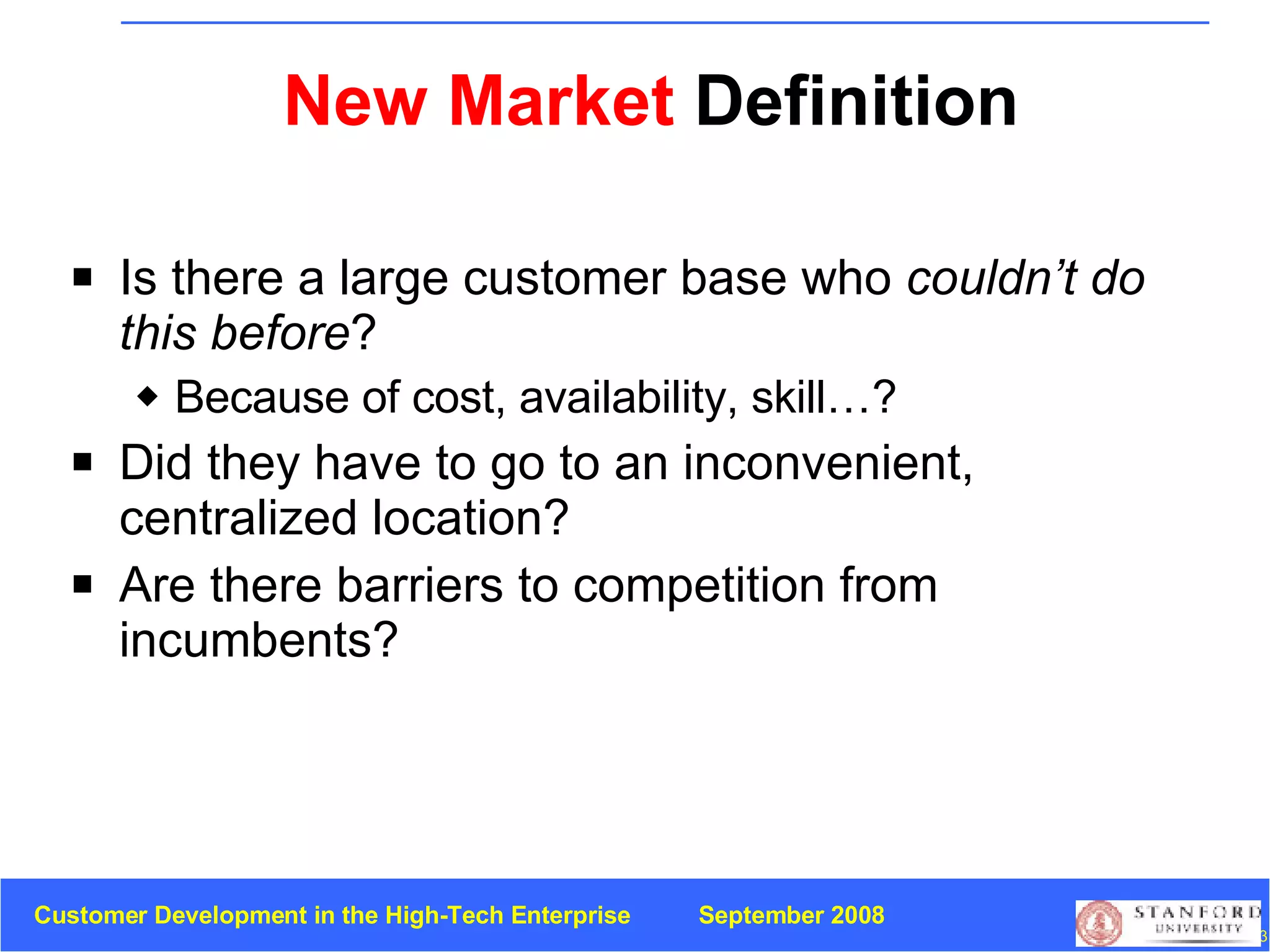
New Market  Definition Is there a large customer base who  couldn’t do this before ? Because of cost, availability, skill…? Did they have to go to an inconvenient, centralized location? Are there barriers to competition from incumbents?
Hy br id  Markets Some products fall into Hybrid Markets Combine characteristics of both a new market and low-end resegmentation SouthWest Airlines Dell Computers Cell Phones Apple IPhone?
Company Building:   Step 4 Customer Discovery Customer Validation Customer Creation Company Building (Re)build your company’s organization & management Re look at your mission
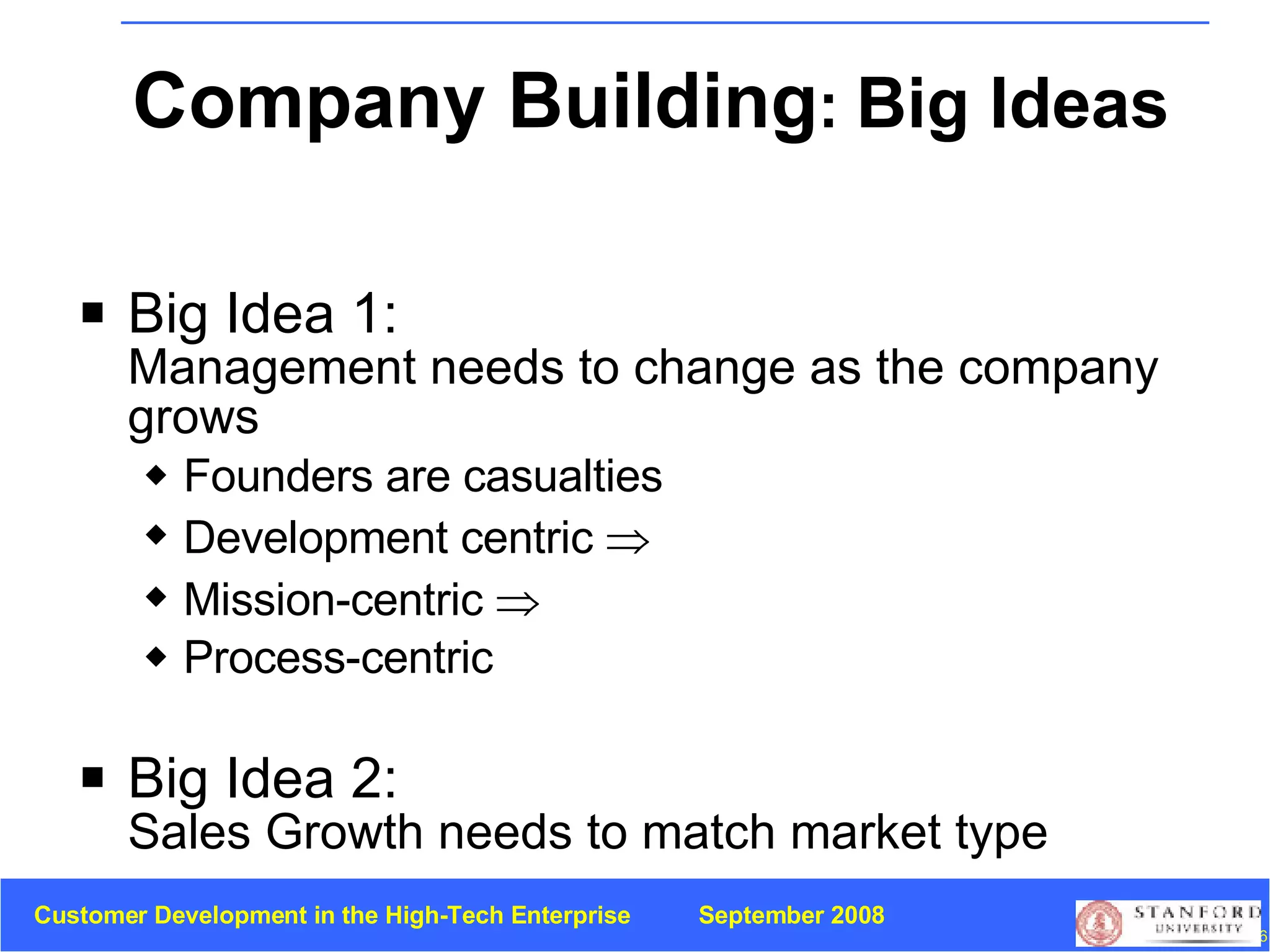
Company Building :  Big Ideas Big Idea 1:   Management needs to change as the company grows Founders are casualties Development centric   Mission-centric   Process-centric Big Idea 2: Sales Growth needs to match market type
Company Building:  Exit Criteria Does sales growth plan match market type? Does spending plan match market type? Does the board agree? Is your team right for the stage of company? Have you built a mission-oriented culture?
New Product Conundrum New Product Introduction methodologies sometimes work, yet sometimes fail Why? Is it the people that are different? Is it the product that are different? Perhaps there are different “types” of startups?
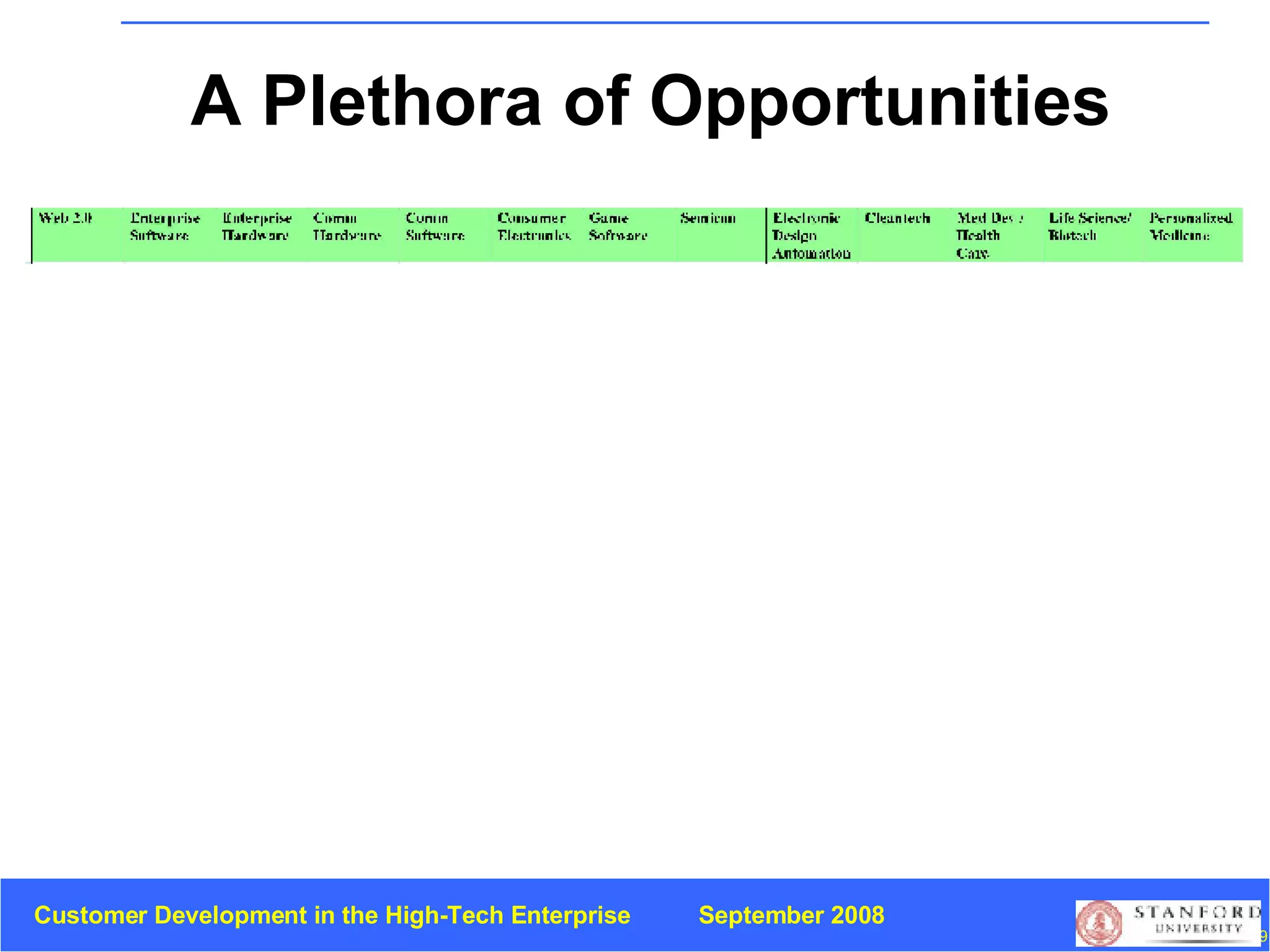
A Plethora of Opportunities
Startup Checklist – 1 What Vertical Market am I In? Web 2.0 Enterprise Software Enterprise Hardware Communciaton Hdw Communication Sftw Consumer Electronics Game Software Semicondutors Electronic Design Automation Cleantech Med Dev / Health Care Life Science / Biotech Personalized Medicine
Market Risk vs. Invention Risk
Startup Checklist - 2 Market Risk? Technical Risk? Both?
Execution: Lots to Worry About
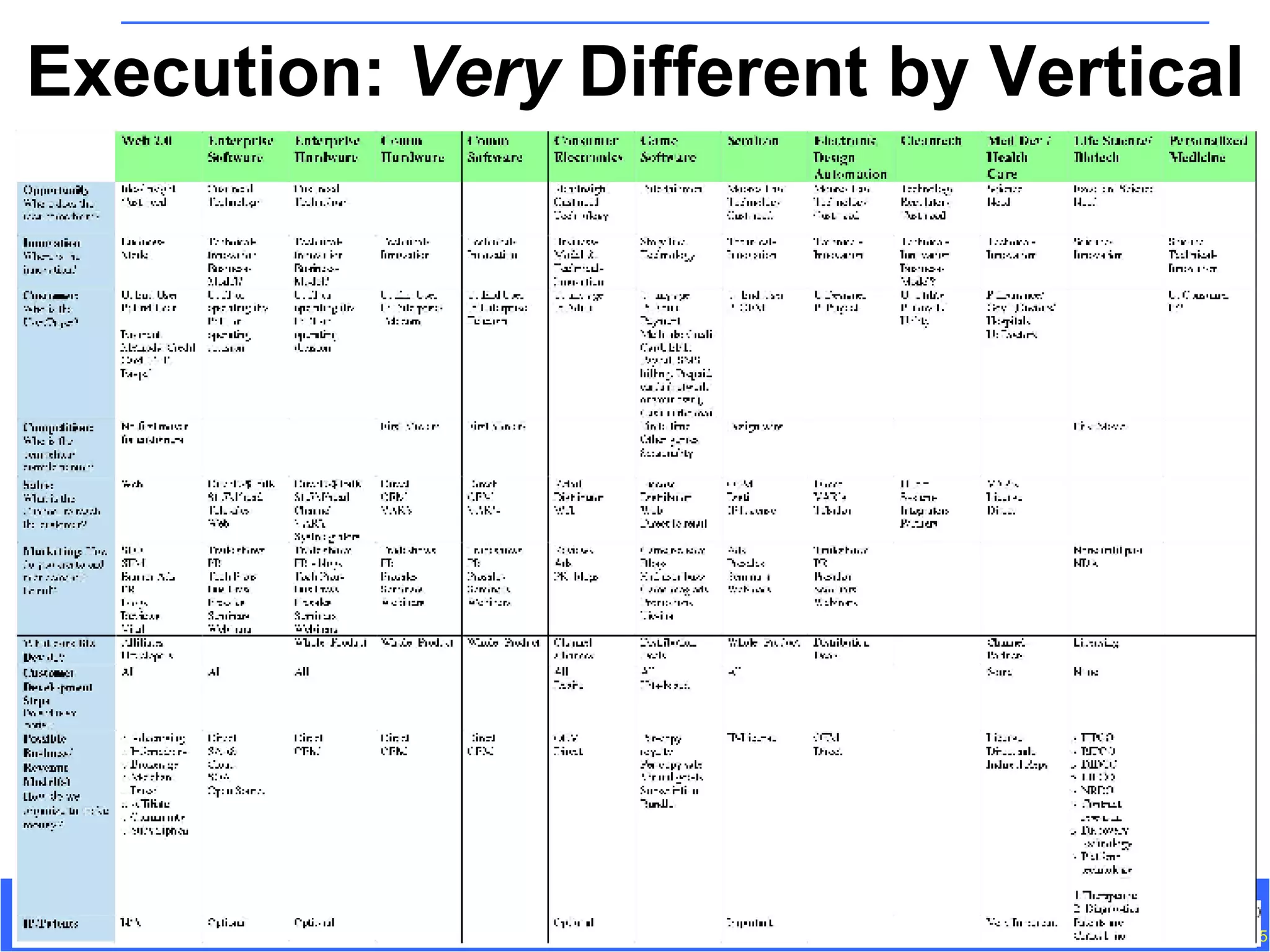
Startup Checklist - 3 Opportunity Where does the idea come from?   Innovation Where is the innovation? Customer Who is the User/Payer? Competition Who is the competitor/complementor? Sales What is the Channel to reach the customer? Marketing:  How do you create end user demand?  What does Biz Dev do? Deals?  Partnerships?  Sales? Business/Revenue Model(s) How do we organize to make money? IP/PatentsRegulatory Issues? How and how long? Time to Market How long does it take to get to market? Product Development Model How to you engineer it? Manufacturing What does it take to build it?   Seed Financing How much? When? Follow-on Financing How much? When? Liquidity How much? When?
Execution:  Very  Different by Vertical
Market Risk  Reduction Strategy
Customer Development and the Business Plan
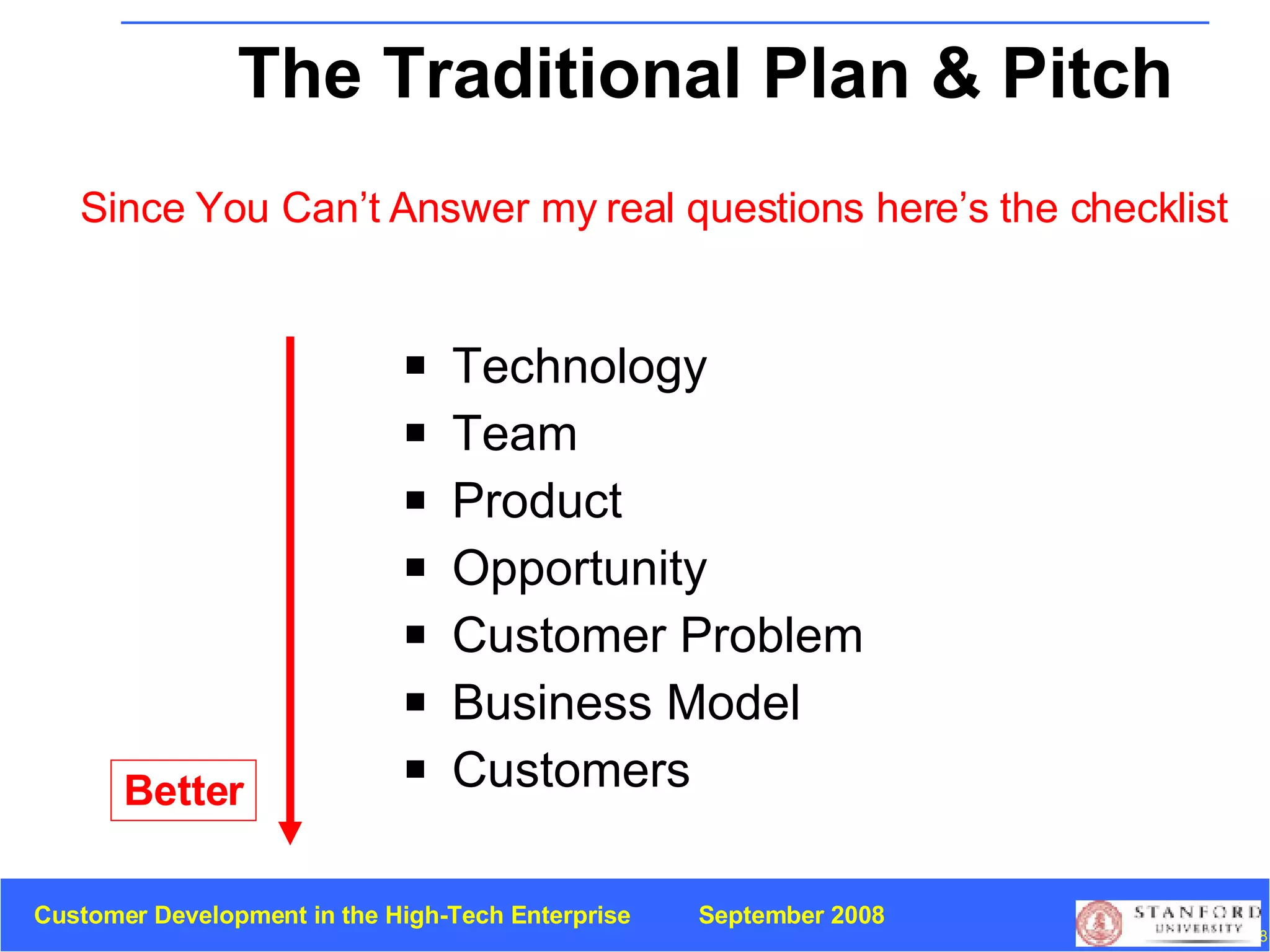
The Traditional Plan & Pitch Technology Team Product Opportunity Customer Problem Business Model Customers Since You Can’t Answer my real questions here’s the checklist Better
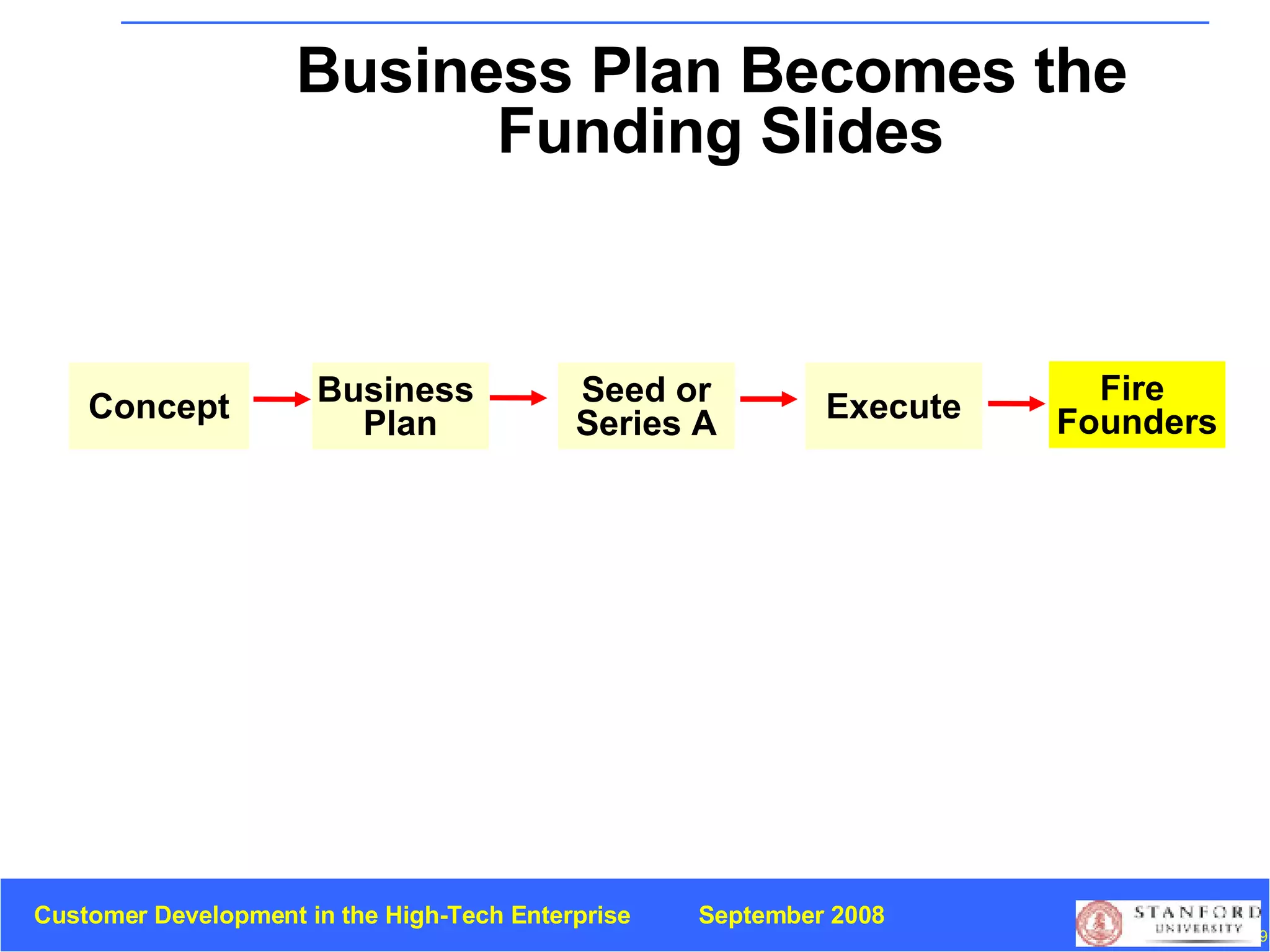
Business Plan Becomes the  Funding Slides Fire  Founders Concept Business  Plan Seed or Series A Execute
Why Don’t VC’s Believe  a Word You Say? What’s wrong with a business plan? Hypothesis are untested Execution Oriented Assumes hypothesis are facts Static No change upon contact with customer and market
What Are Early Stage Investors Really Asking? Are you going to: Blow my initial investment?  Or are you going to make me a ton of money? Are there customers? How many?  Now?  Later? Is there a profitable business model?  Can it scale?
“Lessons Learned” Drives Funding Concept Business  Plan Lessons  Learned Series A Do this first instead of fund raising Test  Hypotheses
Credibility Increases Valuation Customer Development  and  the Business Plan  Extract the hypotheses from the plan Leave the building to test the hypothesis Present the results as:  “Lessons Learned from our customers” Iterate Plan
The Customer Development Presentation Answer the implicit questions about the viability of the business Tell the Discovery & Validation story Lessons Learned & “Our Customers Told Us” Graph some important upward trend
Customer Development:  Summary Parallel process to   Product Development Hypothesis Testing Measurable Checkpoints Not tied to FCS, but to customer milestones Notion of Market Types to represent reality Emphasis is on learning & discovery before execution
Further Reading Course Text at:   www.cafepress.com/kandsranch   or www.amazon.com

Customer Development Methodology

  • 1.
    The Customer DevelopmentMethodology Steve Blank [email_address]
  • 2.
    Goals of ThisPresentation A new model for startups Introduce the Customer Development model Translate this knowledge into a better Company
  • 3.
    Product Development ModelConcept/ Seed Round Product Dev. Alpha/Beta Test Launch/ 1 st Ship
  • 4.
    What’s Wrong WithThis? Concept/ Seed Round Product Dev. Alpha/Beta Test Launch/ 1 st Ship Product Development Create Marcom Materials - Create Positioning - Hire PR Agency - Early Buzz - Create Demand - Launch Event - “Branding” Marketing
  • 5.
    What’s Wrong WithThis? Concept/ Seed Round Product Dev. Alpha/Beta Test Launch/ 1 st Ship Product Development Create Marcom Materials - Create Positioning - Hire PR Agency - Early Buzz - Create Demand - Launch Event - “Branding” Build Sales Organization Marketing Sales Hire Sales VP Hire 1 st Sales Staff
  • 6.
    What’s Wrong WithThis? Concept/ Seed Round Product Dev. Alpha/Beta Test Launch/ 1 st Ship Product Development Create Marcom Materials - Create Positioning - Hire PR Agency - Early Buzz - Create Demand - Launch Event - “Branding” Hire Sales VP Hire 1 st Sales Staff Build Sales Organization Marketing Sales Hire First Bus Dev Do deals for FCS Business Development
  • 7.
    Build It AndThey Will Come Only true for life and death products i.e. Biotech Cancer Cure Issues are development risks and distribution, not customer acceptance Not true for most other products Software, Consumer, Web Issues are customer acceptance and market adoption
  • 8.
    Chasing The FCSDate Sales & Marketing costs are front loaded focused on execution vs. learning & discovery First Customer Ship becomes the goal Execution & hiring predicated on business plan hypothesis Heavy spending hit if product launch is wrong Financial projections, assumes all startups are the same = You don’t know if you’re wrong until you’re out of business/money
  • 9.
    If Startups Failfrom a Lack of customers not Product Development Failure Then Why Do we have: process to manage product development no process to manage customer development
  • 10.
    An Inexpensive FixFocus on Customers and Markets from Day One How?
  • 11.
    Build a Customer Development Process Customer Development ? ? ? ? Concept/ Seed Round Product Dev. Alpha/Beta Test Launch/ 1 st Ship Product Development
  • 12.
    Customer Developmentis as important as Product Development Company Building Customer Development Customer Discovery Product Development Customer Validation Customer Creation Concept/ Bus. Plan Product Dev. Alpha/Beta Test Launch/ 1 st Ship
  • 13.
    Customer Development: Big Ideas Parallel process to Product Development Measurable Checkpoints Not tied to FCS, but to customer milestones Notion of Market Types to represent reality Emphasis is on learning & discovery before execution
  • 14.
    Customer Development HeuristicsThere are no facts inside your building, so get outside Develop for the Few, not the Many Earlyvangelists make your company And are smarter than you Focus Groups are for big companies, not startups The goal for release 1 is the minimum feature set for earlyvangelists
  • 15.
    Stop selling, startlistening There are no facts inside your building, so get outside Test your hypotheses Two are fundamental: problem and product concept Customer Discovery: Step 1 Customer Discovery Customer Validation Company Building Customer Creation
  • 16.
    Customer Discovery: Exit Criteria What are your customers top problems? How much will they pay to solve them Does your product concept solve them? Do customers agree? How much will they pay? Draw a day-in-the-life of a customer before & after your product Draw the org chart of users & buyers
  • 17.
    Sidebar How toThink About Opportunities
  • 18.
    “Venture-Scale” Businesses Createor add value to a customer Solve a significant problem/want or need, for which someone is willing to pay a premium A good fit with the founder(s) and team at the time Can grow large ( ≥ $100 million) Attractive returns for investor
  • 19.
    Ideas Technology Driven Is it buildable now ? How much R, how much D? Does it depend on anything else? Are there IP issues? Customer Driven Is there an articulated customer need? How do you know? How big a market and when? Are others trying to solve it? If so, why you? Does it solve an existing customer problem? Opportunity Driven Is there an opportunity no one sees but you do? How do you know it’s a vision not a hallucination?
  • 20.
    Facts Vs. HypothesisOpportunity Assessment How big is the problem/need/desire? How much of it can I take? Sales Distribution Channel Marketing Engineering Fact or Hypothesis?
  • 21.
  • 22.
    Customer Validation: Step 2 Customer Discovery Customer Validation Customer Creation Company Building Develop a repeatable sales process Only earlyvangelists are crazy enough to buy
  • 23.
    Customer Validation: Exit Criteria Do you have a proven sales roadmap? Org chart? Influence map? Do you understand the sales cycle? ASP, LTV, ROI, etc. Do you have a set of orders ($’s) validating the roadmap? Does the financial model make sense?
  • 24.
    Sidebar Customer DevelopmentEngineering And Agile Development Methodologies
  • 25.
    Traditional Agile (XP)Tactics Planning game programmers estimate effort of implementing cust stories customer decides about scope and timing of releases Short releases new release every 2-3 months Simple design emphasis on simplest design Testing development test driven. Unit tests before code Refactoring restructuring and changes to simplify Pair Programming 2 people at 1 computer
  • 26.
    Problem: known WaterfallUnit of progress: Advance to Next Stage
  • 27.
    Problem: known WaterfallUnit of progress: Advance to Next Stage Solution: known
  • 28.
    Problem: knownSolution: known Waterfall Unit of progress: Advance to Next Stage
  • 29.
    Agile Development “Our highest priority is to satisfy the customer through early and continuous delivery of valuable software.” http://agilemanifesto.org/ Embrace Change Build what you need today Process-oriented development so change is painless Prefer flexibility to perfection Ship early and often Test-driven to find and prevent bugs Continuous improvement vs. ship-and-maintain
  • 30.
    Problem: knownAgile (XP) “ Product Owner” or in-house customer Unit of progress: Working Software, Features
  • 31.
    Problem: knownSolution: unknown Agile (XP) “ Product Owner” or in-house customer Unit of progress: Working Software, Features
  • 32.
    Problem: knownSolution: unknown Agile (XP) “ Product Owner” or in-house customer Unit of progress: Working Software, Features
  • 33.
    Problem: unknown CustomerDevelopment Engineering Unit of progress: Learning about Customers Hypotheses, experiments, insights
  • 34.
    Problem: unknown Solution:unknown Customer Development Engineering Unit of progress: Learning about Customers Hypotheses, experiments, insights
  • 35.
    Problem: unknown Solution:unknown Customer Development Engineering Unit of progress: Learning about Customers Hypotheses, experiments, insights
  • 36.
    Problem: unknown Solution:unknown Customer Development Engineering Unit of progress: Learning about Customers Hypotheses, experiments, insights Data, feedback, insights
  • 37.
    Problem: unknown Solution:unknown Customer Development Engineering Unit of progress: Learning about Customers Hypotheses, experiments, insights Data, feedback, insights Incremental, quick, minimum features, revenue/customer validation
  • 38.
    Split-test (A/B) experimentationExtremely rapid deployment Continuous deployment, if possible At IMVU, 20-30 times per day on average Just-in-time architecture and infrastructure Incremental investment for incremental benefit Software “immune system” to prevent defects Five why's Use defects to drive infrastructure investments Customer Development Engineering Tactics
  • 39.
    Five Why's Anydefect that affects a stakeholder is a learning opportunity We’re not done until we’ve addressed the root cause… … including, why didn’t any of our prevention tactics catch it? Technique is to “ask why five times” to get to the root cause
  • 40.
    Five Why's ExampleFor example: Why did we change the software so that we don't make any money anymore? Why didn’t operations get paged? Why didn’t the cluster immune system reject the change? Why didn’t automated tests go red and stop the line? Why wasn’t the engineer trained not to make the mistake? We’re not done until we’ve taken corrective action at all five levels
  • 41.
    Customer Development EngineeringHow do you build a product development team that can thrive in a startup environment? Let's start with the traditional way... Waterfall “ The waterfall model is a sequential software development model in which development is seen as flowing steadily downwards through the phases of requirements analysis, design, implementation, testing (validation), integration, and maintenance.”
  • 42.
  • 43.
    Customer Creation Step3 Customer Discovery Customer Validation Customer Creation Company Building Creation comes after proof of sales Creation is where you “cross the chasm” It is a strategy not a tactic
  • 44.
    Customer Creation Big Ideas Big Idea 1: Grow customers from few to many Big Idea 2: Four Customer Creation activities: Year One objectives Positioning Launch Demand creation Big Idea 3: Creation is different for each of the three types of startups
  • 45.
    New Product ConundrumNew Product Introduction methodologies sometimes work, yet sometimes fail Why? Is it the people that are different? Is it the product that are different? Perhaps there are different “types” of startups?
  • 46.
    Three Types ofMarkets New Market Resegmented Market Existing Market
  • 47.
    Three Types ofMarkets Who Cares? Type of Market changes EVERYTHING Sales, marketing and business development differ radically by market type Details next week New Market Resegmented Market Existing Market
  • 48.
    Type of MarketChanges Everything Market Market Size Cost of Entry Launch Type Competitive Barriers Positioning Sales Sales Model Margins Sales Cycle Chasm Width Finance Ongoing Capital Time to Profitability Customers Needs Adoption New Market Resegmented Market Existing Market
  • 49.
    Definitions: Three Typesof Markets Existing Market Faster/Better = High end Resegmented Market Niche = marketing/branding driven Cheaper = low end New Market Cheaper/good enough can create a new class of product/customer Innovative/never existed before New Market Resegmented Market Existing Market
  • 50.
    Existing Market Definition Are there current customers who would: Need the most performance possible? Is there a scalable business model at this point? Is there a defensible business model Are there sufficient barriers to competition from incumbents?
  • 51.
    Resegmented Market Definition (1) Low End Are there customers at the low end of the market who would: buy less (but good enough) performance if they could get it at a lower price? Is there a business profitable at this low-end? Are there sufficient barriers to competition from incumbents?
  • 52.
    Resegmented Market Definition (2) Niche Are there customers in the current market who would: buy if it addressed their specific needs if it was the same price? If it cost more? Is there a defensible business model at this point? Are there barriers to competition from incumbents?
  • 53.
    New Market Definition Is there a large customer base who couldn’t do this before ? Because of cost, availability, skill…? Did they have to go to an inconvenient, centralized location? Are there barriers to competition from incumbents?
  • 54.
    Hy br id Markets Some products fall into Hybrid Markets Combine characteristics of both a new market and low-end resegmentation SouthWest Airlines Dell Computers Cell Phones Apple IPhone?
  • 55.
    Company Building: Step 4 Customer Discovery Customer Validation Customer Creation Company Building (Re)build your company’s organization & management Re look at your mission
  • 56.
    Company Building : Big Ideas Big Idea 1: Management needs to change as the company grows Founders are casualties Development centric  Mission-centric  Process-centric Big Idea 2: Sales Growth needs to match market type
  • 57.
    Company Building: Exit Criteria Does sales growth plan match market type? Does spending plan match market type? Does the board agree? Is your team right for the stage of company? Have you built a mission-oriented culture?
  • 58.
    New Product ConundrumNew Product Introduction methodologies sometimes work, yet sometimes fail Why? Is it the people that are different? Is it the product that are different? Perhaps there are different “types” of startups?
  • 59.
    A Plethora ofOpportunities
  • 60.
    Startup Checklist –1 What Vertical Market am I In? Web 2.0 Enterprise Software Enterprise Hardware Communciaton Hdw Communication Sftw Consumer Electronics Game Software Semicondutors Electronic Design Automation Cleantech Med Dev / Health Care Life Science / Biotech Personalized Medicine
  • 61.
    Market Risk vs.Invention Risk
  • 62.
    Startup Checklist -2 Market Risk? Technical Risk? Both?
  • 63.
    Execution: Lots toWorry About
  • 64.
    Startup Checklist -3 Opportunity Where does the idea come from? Innovation Where is the innovation? Customer Who is the User/Payer? Competition Who is the competitor/complementor? Sales What is the Channel to reach the customer? Marketing: How do you create end user demand? What does Biz Dev do? Deals? Partnerships? Sales? Business/Revenue Model(s) How do we organize to make money? IP/PatentsRegulatory Issues? How and how long? Time to Market How long does it take to get to market? Product Development Model How to you engineer it? Manufacturing What does it take to build it? Seed Financing How much? When? Follow-on Financing How much? When? Liquidity How much? When?
  • 65.
    Execution: Very Different by Vertical
  • 66.
    Market Risk Reduction Strategy
  • 67.
    Customer Development andthe Business Plan
  • 68.
    The Traditional Plan& Pitch Technology Team Product Opportunity Customer Problem Business Model Customers Since You Can’t Answer my real questions here’s the checklist Better
  • 69.
    Business Plan Becomesthe Funding Slides Fire Founders Concept Business Plan Seed or Series A Execute
  • 70.
    Why Don’t VC’sBelieve a Word You Say? What’s wrong with a business plan? Hypothesis are untested Execution Oriented Assumes hypothesis are facts Static No change upon contact with customer and market
  • 71.
    What Are EarlyStage Investors Really Asking? Are you going to: Blow my initial investment? Or are you going to make me a ton of money? Are there customers? How many? Now? Later? Is there a profitable business model? Can it scale?
  • 72.
    “Lessons Learned” DrivesFunding Concept Business Plan Lessons Learned Series A Do this first instead of fund raising Test Hypotheses
  • 73.
    Credibility Increases ValuationCustomer Development and the Business Plan Extract the hypotheses from the plan Leave the building to test the hypothesis Present the results as: “Lessons Learned from our customers” Iterate Plan
  • 74.
    The Customer DevelopmentPresentation Answer the implicit questions about the viability of the business Tell the Discovery & Validation story Lessons Learned & “Our Customers Told Us” Graph some important upward trend
  • 75.
    Customer Development: Summary Parallel process to Product Development Hypothesis Testing Measurable Checkpoints Not tied to FCS, but to customer milestones Notion of Market Types to represent reality Emphasis is on learning & discovery before execution
  • 76.
    Further Reading CourseText at: www.cafepress.com/kandsranch or www.amazon.com