Mental ModelsLadders of Inference, Advocacy & Inquiry
2
the challenge of dialogue3Truman show is life as I experience it real/true?Life assume my perspective of life is real every point of view is a view from a point
4
5
6
7
8
2 primary skills9Reflection slow down my thinking process -> become aware of formation of thoughts(Advocacy)/Inquiry conversations that examine assumptions (mine & others)
New ground …10Prepare for strong emotions
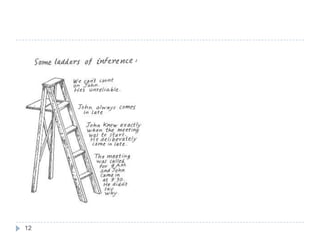
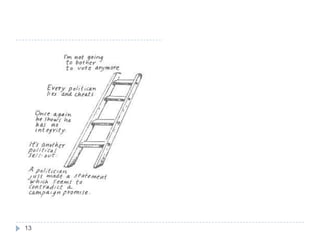
Listen for frustrationLadder of inference11
12
13
Left column14
Left column15
Left column16Think of a problem, or a tough interpersonal difficulty you have been dealing with recently. Examples:You can’t reach agreement with a close associate.Someone is not pulling their weight.You believe you are being treated unfairly.You point of view is not being taken seriously. Describe the situation briefly: 
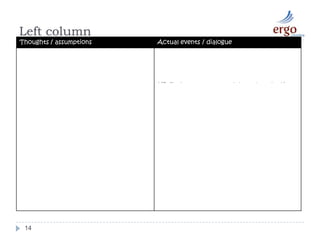
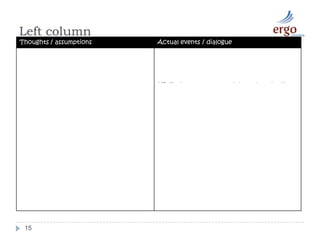
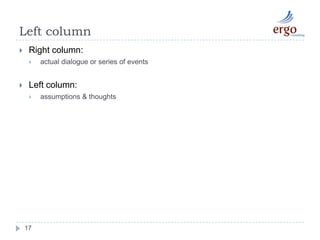
Left column17Right column: actual dialogue or series of eventsLeft column: assumptions & thoughts
Opening Lines18When…Strong views are expressed without any reasoning or illustrations …The discussion goes off on an apparent tangent …You doubt the relevance of your own thoughts …Two members pursue a topic at length while others observe …Several views are advocated at once …… you might say …“You may be right, but I’d like to understand more. What leads you to believe … ?”“I’m unclear how that connects to what we’ve been saying. Can you say how you see it as relevant?”“This may not be relevant now. If so, let me know and I will wait.”“I’d like to give my reaction to what you two have said so far, and then see what you and others think.”“We now have three ideas on the table [say what they are]. I suggest we address them one at a time …”
Opening Lines19When…You perceive a negative reaction in others …You perceive a negative reaction in yourself …Other appear un-influenceable …… you might say …“When you said [give illustration] ... I had the impression you were feeling [fill in the emotion]. If so, I’d like to understand what upset you. Is there something I’ve said or done?”“This may be more my problem than yours, but when you said [give illustration] … I felt … Am I misunderstanding what you said or intended?”“Is there anything that I can say or do that would convince you otherwise?”
Listening tips (respect)20Stop talking: to others and to yourself. Learn to still the voice within. You can’t listen if you are talking.
Imagine the other person’s point of viewpoint. Picture yourself in her position, doing her work, facing her problems, using her language, having her values, experiencing her experiences.
Look, act and be interested. Don’t read your mail, doodle, shuffle papers or fiddle while others are talking. 
Listening tips (concentrate)21Observe non-verbal behaviour, like body language to glean meanings beyond what is being said.
Don’t interrupt. Sit still past your tolerance level.
Listen between the lines for implicit meanings as well as explicit ones. Listen for what is not being said, and ask questions. 
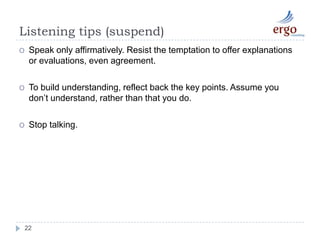
Listening tips (suspend)22Speak only affirmatively. Resist the temptation to offer explanations or evaluations, even agreement.
To build understanding, reflect back the key points. Assume you don’t understand, rather than that you do.
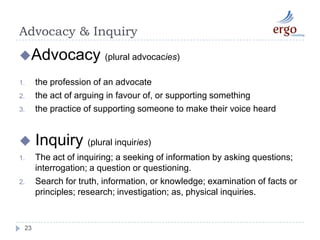
Stop talking.Advocacy & Inquiry23Advocacy (plural advocacies)the profession of an advocatethe act of arguing in favour of, or supporting somethingthe practice of supporting someone to make their voice heardInquiry (plural inquiries)The act of inquiring; a seeking of information by asking questions; interrogation; a question or questioning.Search for truth, information, or knowledge; examination of facts or principles; research; investigation; as, physical inquiries.
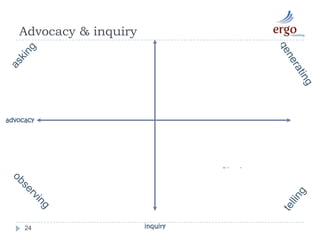
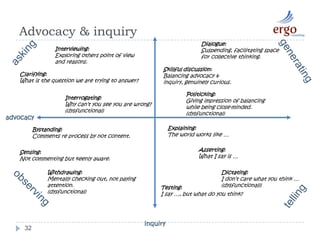
Advocacy & inquiry24Dialogue:Suspending, facilitating space for collective thinking.Interviewing:Exploring others point of viewand reasons.askinggeneratingSkillful discussion:Balancing advocacy & inquiry, genuinely curious. Clarifying:What is the question we are trying to answer?Politicking:Giving impression of balancing while being close-minded.(dysfunctional)Interrogating:Why can’t you see you are wrong?(dysfunctional)advocacyExplaining:The world works like …Bystanding:Comments re process by not content.Asserting:What I say is …Sensing:Not commenting but keenly aware.Dictating:I don’t care what you think …(dysfunctional)(dysfunctional)Withdrawing:Mentally checking out.(dysfunctional)observingTesting:I say …, but what do you think?tellinginquiry
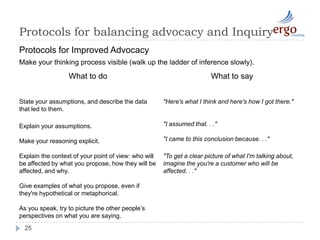
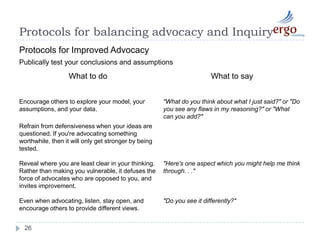
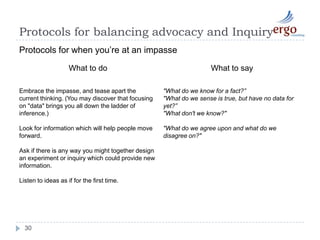
Protocols for balancing advocacy and Inquiry25Protocols for Improved AdvocacyMake your thinking process visible (walk up the ladder of inference slowly).What to doWhat to sayState your assumptions, and describe the data that led to them.Explain your assumptions.Make your reasoning explicit.	Explain the context of your point of view: who will be affected by what you propose, how they will be affected, and why.	Give examples of what you propose, even if they're hypothetical or metaphorical.As you speak, try to picture the other people’s perspectives on what you are saying.	"Here's what I think and here's how I got there."	"I assumed that. . ."	"I came to this conclusion because. . ."	"To get a clear picture of what I'm talking about, imagine the you're a customer who will be affected. . ."
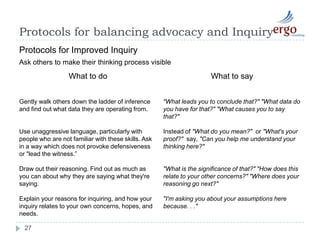
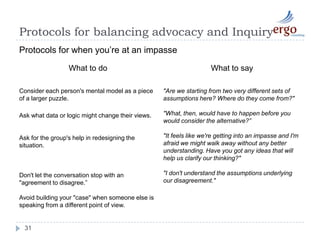
Protocols for balancing advocacy and Inquiry26Protocols for Improved AdvocacyPublically test your conclusions and assumptionsWhat to doWhat to sayEncourage others to explore your model, your assumptions, and your data.Refrain from defensiveness when your ideas are questioned. If you're advocating something worthwhile, then it will only get stronger by being tested.Reveal where you are least clear in your thinking. Rather than making you vulnerable, it defuses the force of advocates who are opposed to you, and invites improvement.Even when advocating, listen, stay open, and encourage others to provide different views.	"What do you think about what I just said?" or "Do you see any flaws in my reasoning?" or "What can you add?"	"Here's one aspect which you might help me think through. . ."	"Do you see it differently?"
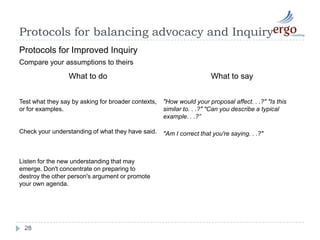
Protocols for balancing advocacy and Inquiry27Protocols for Improved InquiryAsk others to make their thinking process visibleWhat to doWhat to sayGently walk others down the ladder of inference and find out what data they are operating from.	Use unaggressive language, particularly with people who are not familiar with these skills. Ask in a way which does not provoke defensiveness or "lead the witness.”Draw out their reasoning. Find out as much as you can about why they are saying what they're saying.Explain your reasons for inquiring, and how your inquiry relates to your own concerns, hopes, and needs.	"What leads you to conclude that?" "What data do you have for that?" "What causes you to say that?"	Instead of "What do you mean?"  or "What's your proof?"  say, "Can you help me understand your thinking here?"	"What is the significance of that?" "How does this relate to your other concerns?" "Where does your reasoning go next?"	"I'm asking you about your assumptions here because. . ."

Mental models

  • 1.
    Mental ModelsLadders ofInference, Advocacy & Inquiry
  • 2.
  • 3.
    the challenge ofdialogue3Truman show is life as I experience it real/true?Life assume my perspective of life is real every point of view is a view from a point
  • 4.
  • 5.
  • 6.
  • 7.
  • 8.
  • 9.
    2 primary skills9Reflectionslow down my thinking process -> become aware of formation of thoughts(Advocacy)/Inquiry conversations that examine assumptions (mine & others)
  • 10.
    New ground …10Preparefor strong emotions
  • 11.
  • 12.
  • 13.
  • 14.
  • 15.
  • 16.
    Left column16Think ofa problem, or a tough interpersonal difficulty you have been dealing with recently. Examples:You can’t reach agreement with a close associate.Someone is not pulling their weight.You believe you are being treated unfairly.You point of view is not being taken seriously. Describe the situation briefly: 
  • 17.
    Left column17Right column:actual dialogue or series of eventsLeft column: assumptions & thoughts
  • 18.
    Opening Lines18When…Strong viewsare expressed without any reasoning or illustrations …The discussion goes off on an apparent tangent …You doubt the relevance of your own thoughts …Two members pursue a topic at length while others observe …Several views are advocated at once …… you might say …“You may be right, but I’d like to understand more. What leads you to believe … ?”“I’m unclear how that connects to what we’ve been saying. Can you say how you see it as relevant?”“This may not be relevant now. If so, let me know and I will wait.”“I’d like to give my reaction to what you two have said so far, and then see what you and others think.”“We now have three ideas on the table [say what they are]. I suggest we address them one at a time …”
  • 19.
    Opening Lines19When…You perceivea negative reaction in others …You perceive a negative reaction in yourself …Other appear un-influenceable …… you might say …“When you said [give illustration] ... I had the impression you were feeling [fill in the emotion]. If so, I’d like to understand what upset you. Is there something I’ve said or done?”“This may be more my problem than yours, but when you said [give illustration] … I felt … Am I misunderstanding what you said or intended?”“Is there anything that I can say or do that would convince you otherwise?”
  • 20.
    Listening tips (respect)20Stoptalking: to others and to yourself. Learn to still the voice within. You can’t listen if you are talking.
  • 21.
    Imagine the otherperson’s point of viewpoint. Picture yourself in her position, doing her work, facing her problems, using her language, having her values, experiencing her experiences.
  • 22.
    Look, act andbe interested. Don’t read your mail, doodle, shuffle papers or fiddle while others are talking. 
  • 23.
    Listening tips (concentrate)21Observenon-verbal behaviour, like body language to glean meanings beyond what is being said.
  • 24.
    Don’t interrupt. Sitstill past your tolerance level.
  • 25.
    Listen between thelines for implicit meanings as well as explicit ones. Listen for what is not being said, and ask questions. 
  • 26.
    Listening tips (suspend)22Speakonly affirmatively. Resist the temptation to offer explanations or evaluations, even agreement.
  • 27.
    To build understanding,reflect back the key points. Assume you don’t understand, rather than that you do.
  • 28.
    Stop talking.Advocacy &Inquiry23Advocacy (plural advocacies)the profession of an advocatethe act of arguing in favour of, or supporting somethingthe practice of supporting someone to make their voice heardInquiry (plural inquiries)The act of inquiring; a seeking of information by asking questions; interrogation; a question or questioning.Search for truth, information, or knowledge; examination of facts or principles; research; investigation; as, physical inquiries.
  • 29.
    Advocacy & inquiry24Dialogue:Suspending,facilitating space for collective thinking.Interviewing:Exploring others point of viewand reasons.askinggeneratingSkillful discussion:Balancing advocacy & inquiry, genuinely curious. Clarifying:What is the question we are trying to answer?Politicking:Giving impression of balancing while being close-minded.(dysfunctional)Interrogating:Why can’t you see you are wrong?(dysfunctional)advocacyExplaining:The world works like …Bystanding:Comments re process by not content.Asserting:What I say is …Sensing:Not commenting but keenly aware.Dictating:I don’t care what you think …(dysfunctional)(dysfunctional)Withdrawing:Mentally checking out.(dysfunctional)observingTesting:I say …, but what do you think?tellinginquiry
  • 30.
    Protocols for balancingadvocacy and Inquiry25Protocols for Improved AdvocacyMake your thinking process visible (walk up the ladder of inference slowly).What to doWhat to sayState your assumptions, and describe the data that led to them.Explain your assumptions.Make your reasoning explicit. Explain the context of your point of view: who will be affected by what you propose, how they will be affected, and why. Give examples of what you propose, even if they're hypothetical or metaphorical.As you speak, try to picture the other people’s perspectives on what you are saying. "Here's what I think and here's how I got there." "I assumed that. . ." "I came to this conclusion because. . ." "To get a clear picture of what I'm talking about, imagine the you're a customer who will be affected. . ."
  • 31.
    Protocols for balancingadvocacy and Inquiry26Protocols for Improved AdvocacyPublically test your conclusions and assumptionsWhat to doWhat to sayEncourage others to explore your model, your assumptions, and your data.Refrain from defensiveness when your ideas are questioned. If you're advocating something worthwhile, then it will only get stronger by being tested.Reveal where you are least clear in your thinking. Rather than making you vulnerable, it defuses the force of advocates who are opposed to you, and invites improvement.Even when advocating, listen, stay open, and encourage others to provide different views. "What do you think about what I just said?" or "Do you see any flaws in my reasoning?" or "What can you add?" "Here's one aspect which you might help me think through. . ." "Do you see it differently?"
  • 32.
    Protocols for balancingadvocacy and Inquiry27Protocols for Improved InquiryAsk others to make their thinking process visibleWhat to doWhat to sayGently walk others down the ladder of inference and find out what data they are operating from. Use unaggressive language, particularly with people who are not familiar with these skills. Ask in a way which does not provoke defensiveness or "lead the witness.”Draw out their reasoning. Find out as much as you can about why they are saying what they're saying.Explain your reasons for inquiring, and how your inquiry relates to your own concerns, hopes, and needs. "What leads you to conclude that?" "What data do you have for that?" "What causes you to say that?" Instead of "What do you mean?"  or "What's your proof?"  say, "Can you help me understand your thinking here?" "What is the significance of that?" "How does this relate to your other concerns?" "Where does your reasoning go next?" "I'm asking you about your assumptions here because. . ."

Editor's Notes

  • #9 Iceberg diagram – emotions/behaviours
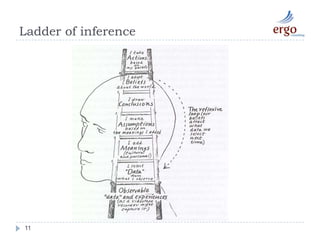
  • #13 Observe: lateData: didn’t say whyMeanings:Assumptions: knew the starting time/deliberately lateConclusions: Always comes lateBeliefs: John’s unreliableActions
  • #17 For the next bit draw a line down your page.
  • #18 Draw a line down the page.Right hand side = actual conversation had or going to have.Left hand side = thoughts and assumptions that went along with that conversation
  • #19 Not to be used verbatim … put into own words.An illustration to give you idea’s about how to steer a conversation