Mental Models Aligning Design Strategy With Human Behavior 1st Indi Young
Mental Models Aligning Design Strategy With Human Behavior 1st Indi Young
Mental Models Aligning Design Strategy With Human Behavior 1st Indi Young
Mental Models Aligning Design Strategy With Human Behavior 1st Indi Young
Mental Models Aligning Design Strategy With Human Behavior 1st Indi Young
1.
Mental Models AligningDesign Strategy With
Human Behavior 1st Indi Young download
https://ebookbell.com/product/mental-models-aligning-design-
strategy-with-human-behavior-1st-indi-young-2263146
Explore and download more ebooks at ebookbell.com
2.
Here are somerecommended products that we believe you will be
interested in. You can click the link to download.
Mental Models Aligning Design Strategy With Human Behavior 1st Edition
Indi Young
https://ebookbell.com/product/mental-models-aligning-design-strategy-
with-human-behavior-1st-edition-indi-young-5645304
Mental Models And Their Dynamics Adaptation And Control A Selfmodeling
Network Modeling Approach Jan Treur
https://ebookbell.com/product/mental-models-and-their-dynamics-
adaptation-and-control-a-selfmodeling-network-modeling-approach-jan-
treur-38203788
Mental Models Across Languages Pawel Sickinger
https://ebookbell.com/product/mental-models-across-languages-pawel-
sickinger-42601760
Mental Models The Mind Volume 138 Current Developments In Cognitive
Psychology Neuroscience And Philosophy Of Mind 1st Edition Carsten
Held
https://ebookbell.com/product/mental-models-the-mind-
volume-138-current-developments-in-cognitive-psychology-neuroscience-
and-philosophy-of-mind-1st-edition-carsten-held-4452810
3.
Mental Models 1stEdition Kirsten M A Revell Neville A Stanton
https://ebookbell.com/product/mental-models-1st-edition-kirsten-m-a-
revell-neville-a-stanton-5838210
Mental Models For Kids Niraj Bedekar
https://ebookbell.com/product/mental-models-for-kids-niraj-
bedekar-46285082
Mental Models At Work The 16 Most Valuable Thinking Tools For
Effective Work Performance 1st Edition Thinknetic
https://ebookbell.com/product/mental-models-at-work-the-16-most-
valuable-thinking-tools-for-effective-work-performance-1st-edition-
thinknetic-47862086
Mental Models Across Languages The Visual Representation Of Baldness
Terms In German English And Japanese Pawel Sickinger
https://ebookbell.com/product/mental-models-across-languages-the-
visual-representation-of-baldness-terms-in-german-english-and-
japanese-pawel-sickinger-42601768
Mental Models 30 Thinking Tools That Separate The Average From The
Exceptional Improved Decisionmaking Logical Analysis And
Problemsolving 1st Edition Kevin P Ericcson
https://ebookbell.com/product/mental-models-30-thinking-tools-that-
separate-the-average-from-the-exceptional-improved-decisionmaking-
logical-analysis-and-problemsolving-1st-edition-kevin-p-
ericcson-10498188
5.
MENTAL MODELS
Aligning DesignStrategy with Human Behavior
by INDI YOUNG foreword by Jeff Veen
There is no single methodology for creating the perfect product—but
you can increase your odds. One of the best ways is to understand
users’ reasons for doing things. Mental Models gives you the tools
to help you grasp, and design for, those reasons. Adaptive Path
co-founder Indi Young has written a roll-up-your-sleeves book for
designers, managers, and anyone else interested in making design
strategic, and successful.
“Indi Young’s mental models are the perfect way for your team to integrate your user’s perspective
into your design. I’ll be giving this book out to all our important clients and insisting they make it
part of their process.”
JARED SPOOL
CEO and Founding Principal
User Interface Engineering
“Indi’s book provides a systematic and invaluable means for applying mental models; having used
her method on many large projects, I’m a true believer.”
CAMILLE SOBALVARRO
Senior Director, Web Marketing & Communications
Sybase Inc.
“Indi Young’s common-sense approach focuses on user behavior, diagrammatic representations,
and the participation of all stakeholders in collaborative discovery. It is a book that designers and
students alike will find useful.”
RICHARD BUCHANAN
Professor of Design
Carnegie Mellon University School of Design
M
E
N
T
A
L
M
O
D
E
L
S
by
INDI
YOUNG
www.rosenfeldmedia.com
MORE ON MENTAL MODELS
www.rosenfeldmedia.com/books/mental-models/
6.
Enter code MMDEfor 10% off any Rosenfeld Media product directly
purchased from our site: http://rosenfeldmedia.com
mental models
Aligning Design Strategy with Human behavior
by indi young
Rosenfeld Media
Brooklyn, New York
D
o
iii
Table of Contents
tableof contents
How to Use this Book x
Who Should Read this Book? xi
What’s in the Book? xiii
What comes with the Book? xiv
Here’s How You Can Use Mental Models xvi
Frequently asked Questions xxi
Foreword xxv
What, Why, When, and Who?
Chapter 1
What and Why?
The Advantages of a Mental Model 1
What is a Mental Model? 2
Why Use Mental Models? 11
Confidence in Your Design 12
Clarity in Direction 24
Continuity of Strategy 37
Chapter 2
When? Using Mental Models with
Your Other Work 40
Determine Your Research Method 41
How Mental Models Hook into Other UX Techniques 46
Shortcuts and Other Ways to Use Mental Models 53
9.
table of contents
iv
Tableof Contents
Chapter 3
Who? Mental Model
Team Participants 63
Project Leader 64
Project Practitioners 66
Project Guides 68
Project Support 69
The Method
Chapter 4
Define Task-Based
Audience Segments 72
Task-Based Audience Segments 74
Set Research Scope 103
Chapter 5
Specify Recruiting Details 110
Estimate the Tally 111
Write the Screener 117
Coordinate Schedules 127
Recruit Participants 135
10.
Table of Contents
tableof contents
Chapter 6
Set Scope for the Interviews 143
Set Research Goals 144
List Interview Prompts 148
Chapter 7
Interview Participants 162
Chat by Telephone or Face-to-Face 163
Do Not Lead 166
Plan Your International Interviews 196
Chapter 8
Analyze the Transcripts 204
Comb for Tasks 206
Get Some Practice 241
Answers 250
Chapter 9
Look for Patterns 251
Group Tasks into Patterns 252
Plan Your Logistics 286
Congratulate Yourself 298
11.
table of contents
vi
Tableof Contents
Chapter 10
Create the Mental Model 299
Build the Model Automatically 301
Build the Model Block-by-Block 304
Review the Diagram with Project Guides 326
What Did You Learn? 330
Decorate the Diagram 331
Ask for Feedback 338
Chapter 11
Adjust the Audience Segments 339
Compare Results to Original Hypothesis 340
Clarify Segment Names 342
Adjust Segment Definitions 343
Use Audience Segments for Other Projects 350
Transition from Research to Design, Verbs to Nouns 350
Applications
Chapter 12
Alignment and Gap Analysis 352
Draw a Content Map of Your Proposed Solution 354
Align the Content Under the Mental Model 359
Consider the Opportunities 377
Share the Findings 387
Print the Diagram 389
Prioritize the Opportunities 392
table of contents
12.
Chapter 13
Structure Derivation401
Derive High-Level Architecture 403
Provide Vocabulary for Labels 418
Test Your Structure and Labels 421
Generate Features and Functionality 422
Index 428
Acknowledgments 445
About the Author 450
vii
Table of Contents
table of contents
13.
This book isdedicated to my
father, Evert Hale Young, Jr.
His “can do” approach laid the
perspective for my entire life.
14.
How to Usethis Book
ix
How to Use this Book
Necessity is the mother of invention.
Historically, tool design—from a sharpened
stone ax to a folding Japanese pruning saw—
has been inspired by need. The designers
themselves range from seemingly isolated
genius inventors to cubicle farms of engineers
with explicit specification documents. Really
successful design—that which solves the
problem, is easy to use, and is beautiful to
behold while functioning—is hit and miss.
Innovation is elusive. Lots of money and
hope are put towards products that look
encouraging at the outset, but end up not
quite reaching the mark. Entrepreneurs,
investors, designers, engineers, and customers
all get burned more often than they succeed.
There is no one method to follow to create
perfect products. But there are many ways
to increase the odds. One of them is to
understand the reason for the tool in the
first place. Deeply investigate what people
are trying to get done and line up your
15.
solutions to match.Are you trying to solve
a small part of a larger puzzle that could be
simplified if you look at a broader context of
the customer’s behavior and philosophies?
Do you have so many aspects to your service
that it’s hard to prioritize where to invest more
development dollars?
As first a software engineer and then as a
specialist in web applications, I had been
doing this broad sort of task analysis for many
years before I came up with a way to draw a
picture of it all—a mental model, which is an
affinity diagram of user behaviors surrounding
a particular topic. (See “What is an Affinity
Diagram?” in Chapter 1; and see Appendix B
( www.rosenfeldmedia.com/books/mental-
models/content/appendix_b) for the story of
how the technique evolved.) Mental models
help me illustrate a profound understanding
of the user, align solutions to areas that make
a difference, and chart my way through a
decade of development. When people saw the
How to Use this Book
How To Use This Book
16.
How to Usethis Book
xi
How to Use this Book
first diagrams, they encouraged me to share
them in print. Seven years later, I can finally
give you this book.
Who Should Read this Book?
Depending on your role, you might be
interested in reading certain chapters first. I
anticipate that a lot of you will be practitioners
actually creating mental models. I also hope
that many of you are responsible for product
strategy—directors and executives—and are
interested in how mental models can help
guide your decisions. For those of you who
are project managers and team managers
within large organizations, I have included
information about how to run a mental model
project successfully as a part of a network
of other research and design projects. And
for all of you who need to persuade key
people in your business to cultivate a better
understanding of the people who use your
products, I am listing key chapters to
reference.
How to Use this Book
17.
How to Usethis Book
xii
How to Use this Book
Product Strategists Executives:
Chapter 1: What and Why?
The Advantages of a Mental Model
Chapter 12: Alignment and Gap Analysis
Team Managers:
Chapter 2: When?
Using Mental Models with Your Other Work
Chapter 3: Who? Mental Model Team Participants
Evangelists:
Chapter 1: What and Why?
The Advantages of a Mental Model
Chapter 12: Alignment and Gap Analysis
Project Managers:
Appendix A: How Much Time and Money?
Available on the book site at www.rosenfeldmedia.
com/books/mental-models/content/
appendix_a.
Practitioners:
Chapter 4: Define Task-Based Audience Segments
Chapter 5: Specify Recruiting Details
Chapter 6: Set Scope for the Interviews
Chapter 7: Interview Participants
Chapter 8: Analyze the Transcripts
Chapter 9: Look for Patterns
Chapter 10: Create the Mental Model
How to Use this Book
18.
How to Usethis Book
xiii
How to Use this Book
Chapter 11: Adjust the Audience Segments
Chapter 12: Alignment and Gap Analysis
Chapter 13: Structure Derivation
I expect you’ll use this book as your resource
when you create your first mental model.
I also expect this book to be your resource
when explaining the benefits of mental
models to people in your organization, as
you convince them that you really can turn
the ship around and create user-centered
solutions.
What’s in the Book?
This book answers some of the harder
questions I am asked about how to create
and use mental models. I begin with a set of
chapters that introduce mental models and
talk about why and when to make a mental
model:
Chapter 1: Why? The Advantages of a Mental Model
Chapter 2: When?
Using Mental Models with Your Other Work
Chapter 3: Who? Mental Model Team Participants
How to Use this Book
19.
How to Usethis Book
xiv
How to Use this Book
The second section describes the method used
to create a mental model:
Chapter 4: Define Task-Based Audience Segments
Chapter 5: Specify Recruiting Details
Chapter 6: Set Scope for the Interviews
Chapter 7: Interview Participants
Chapter 8: Analyze the Transcripts
Chapter 9: Look for Patterns
Chapter 10: Create the Mental Model
Chapter 11: Adjust the Audience Segments
The third section of the book describes how
to apply a mental model to your work:
Chapter 12: Alignment and Gap Analysis
Chapter 13: Structure Derivation
The appendices and bibliography are
available as links on the book site at www.
rosenfeldmedia.com/books/mental-models
We recommend that you display the digital
version of the book using a recent version
of Adobe’s Reader or Acrobat Professional,
which support live links. That way you can
jump to other parts of the book (i.e., from
the table of contents to a specific section)
How to Use this Book
20.
How to Usethis Book
xv
How to Use this Book
and to external web pages (such as the large,
high-resolution version of each of the book’s
illustrations, which we’ve made available via
Flickr) by simply clicking. You’ll also find
navigation easier if you display the Navigation
Pane (in Apple’s Preview reader, the Drawer).
We’ve optimized the digital version of this book
for being read and used on a computer. As
digital books are still quite a new phenomenon,
we’d love your suggestions for how to do
improve our digital design; please contact us
at info@rosenfeldmedia.com.
What comes with the Book?
This book’s companion web site ( www.
rosenfeldmedia.com/books/mental-models) is
chock-full of mental models-related goodies.
You’ll find:
21.
How to Usethis Book
xvi
How to Use this Book
• A variety of Excel and Word templates
(including ones that help you with
recruiting and capturing behaviors)
• Scripts for converting Excel and Word
templates into XML Visio and Omnigraffle
diagrams
• Every diagram in the book (download and
insert them in your own presentations!)
• The book’s bibliography
• Appendix A: How Much Time and Money?
(learn what’ll it cost you to develop mental
models)
• Appendix B: The Evolution of the Mental
Model Technique (learn how this method
came to be)
The book site also includes a blog where
an occasionally lively discussion of mental
models breaks out; please join in!
22.
xvii
How to Usethis Book
You can keep up with book-related
announcements, new content additions, and
other changes on the site by subscribing to
its RSS feed: feeds.rosenfeldmedia.com/
mental-models
Here’s How You Can Use Mental
Models
You might make a mental model for a lot
of reasons. For example, you can improve
project management by studying those who
coordinate project teams. Or, you can invent
a new commuting service by understanding
all the aspects of how people get to their jobs.
You can capitalize on the gaps between the
solutions you offer and what your customers
are trying to accomplish. You can derive the
architecture of your design from the resulting
diagram. While the words I am about to list
may sound dated when you read this book
in a few years, I’ll go ahead and say them (so
you can envision it more easily in the present
day). This method can be used for:
How to Use this Book
23.
xviii
How to Usethis Book
• Digital products, such as internet
applications
• Physical products with interactive functions,
such as a watch
• Location-aware products, such as a phone
• Methodologies, such as project
management
• Information delivery, such as a monthly
statement
• Services, such as controlling your
household’s carbon footprint
• Physical spaces for providing services, such
as a library
• Browsable databases, such as knowledge
bases
• Platform-specific networked applications
• Online media, online stores, etc.
You get the idea. Throughout this book I use
the word “design” to mean something closer
to “engineering design”—making something
for someone to use. There are tons of other
How to Use this Book
24.
How to Usethis Book
xix
How to Use this Book
definitions for “design,” but for this book I
focus on just this one aspect. So when you
read the word “design,” think of digital,
physical, and environmental interactions that
people carry out to accomplish something.
Mental model diagrams have been used
for design by for-profit and non-profit
organizations, universities, government
agencies, private individuals, and internal
departments. I will illustrate the breadth
of applications throughout this book with
analogies and real-life examples.
One thing to take from this book is a
sense of moving beyond constraints. You’re
probably not a strict rule-follower, yourself.
Just because my background is software
design doesn’t mean you can’t use mental
models to develop a government building
or a production workflow or anything else
you need. Merge the technique with its
established cousins in your particular field of
25.
How to Usethis Book
xx
How to Use this Book
expertise, and tell the rest of us how you did
it. Treat it kind of like open source: It is yours
to manipulate and extend. Let everyone else
benefit from your contributions.
My hope is that our generation of designers
can execute an inflection point that will be
remembered as the point in time when we
stopped designing by necessity.
26.
Frequently
asked Questions
xxi
Frequently AskedQuestions
What is a mental model?
The top part of the model is a visual depiction
of the behavior of a particular audience,
faithfully representing root motivations. The
bottom part of the model shows various ways
of supporting matching behaviors. Where
support and behavior are aligned, you have a
solution. Where a behavior is not supported,
you have an opportunity to explore further.
See page 2 for more information.
What if I don’t have a big budget?
If your organization already conducts usability
tests with some regularity, piggyback short
interviews on top of each session. Ask the
participant to stay with you for an hour,
and spend half the time on the usability test
and half on conducting a non-leading
interview See page 57.
What do you mean by “task?”
The word “task” is used loosely. When I use
the word “task,” it means actions, thoughts,
feelings, and motivations—everything that
Frequently
asked Questions
27.
xxii
Frequently Asked Questions
comesup when a person accomplishes
something, sets something in motion, or
achieves a certain state. See page 207.
What are task-based audience segments?
Task-based audience segments are, quite
simply, groups of people who do similar
things. While personality types do touch
upon behavior, generative research for
building mental models requires that you
select from groups of people who want to
get different things done. Because you will
want to tailor your end solutions to fit each
audience exactly, grouping audiences by
differences in behavior is important. You want
to end up with solutions that match behaviors
and philosophies closely rather than with one
solution that fits several audiences loosely.
Figure out what people want to accomplish,
look for differences, and group accordingly.
See page 74.
Frequently
asked Questions
28.
Frequently
asked Questions
xxiii
Frequently AskedQuestions
How do I uncover the root task?
During analysis, you are required to interpret
a little. This is the “art” to the process. You
will find it easier if you ask yourself, “What is
this person really trying to do?” The idea is to
simplify to the “root” task. See pages 211 and
218.
What do you mean by a content map’s
“content”?
Let me assure you that the name “content”
does not limit your map to text documents.
Your content map should include all the
ways you serve people, including things like
monthly account statements or yearly awards
banquets, registration for training courses, or
a mortgage calculator. See page 354.
Does a content map show every
detail of my solution?
It includes all functionality that exists or is
intended for your solution. See page 354.
Frequently
asked Questions
29.
Frequently
asked Questions
xxiv
Frequently AskedQuestions
How can analyzing gaps in a mental model
show me innovative ideas?
The first thing to look at is the obvious gaps
where there is an absence of content items.
Your hope is that you can find a gap that
you can fill easily. Then look for scarcity of
content items. Think about where you can
flesh out things a bit. Look for opportunities
to redefine, combine, or augment existing
content. See page 377.
How can mental models help me make sense
of all my web properties?
Each one of your web properties is a building
on your internet campus. Each property has
its own unique navigation that represents the
mental model of the people populating it. See
page 324.
Frequently
asked Questions
30.
“You’re researching allthe creativity out of
this project!”
I can’t tell you how many times I’ve heard
designers, developers, and even business
owners say this. It usually comes just after
a project has begun, as I’m preparing for
interviews with users. Designers just want
to start designing, developers want to start
writing code, managers want the thing to
ship—so why are we spending all this time
talking? And all this stuff just seems so
obvious. Do we really need users to tell us
what we already know?
I try to be diplomatic. “Maybe a few interviews
now will save us lots of grief later,” I tell them.
“Think of this as insurance: Let’s make sure
we’ve got the basics right before we’ve designed
everything and written all the code.”
But no matter what I say to convince a team
to do research early in their project, I never let
xxv
Foreword
foreword
31.
xxvi
Foreword
foreword
them know mydirty little secret: I used to be
just as skeptical as them.
I’ve always believed in a user-centered design
methodology. Even early in my career, when
I was journalist, we always started with
the mantra “know your audience.” Later in
my career, I’d go to conferences and watch
presentations with process diagrams—boxes
representing users needs with arrows pointing
to boxes representing product requirements.
Intellectually, I agreed. But when I started
a new project, in that intoxicating first stage
when anything is possible, I’d jump straight
to solutions. “Let’s use Flash for this part!
And over here, we’ll design some awesome
icons for navigation…” Our users were still
important, but they were there to bear witness
to how cool our designs were.
Then I met Indi Young. Indi and I were
among the founding partners of Adaptive
Path, a user experience consulting company
32.
xxvii
Foreword
foreword
that focused onresearch-driven design. We
founded the company in the dark days of the
Web industry. It was 2001. “Dot com” was
a dirty word, companies were cutting their
Web budgets, and projects were drying up
everywhere.
It was then that “research-driven” started
having real meaning to me. As Indi
introduced her methodology and resulting
visualizations, it became clear that she wasn’t
just trying to make designs better in some
abstract way. Rather, her process was simple
enough to resonate with anyone on a Web
team. And perhaps more importantly, it would
help connect Web teams to other core parts
of their organizations who were skeptical of
spending even another cent on their web sites.
In the end, using Indi’s process, we were able
to convince teams that we weren’t researching
all the creativity out of their projects. We were
33.
researching the riskout. And no matter how
the industry is faring, that’s a story people
want to hear.
This book is an excellent guide to a research
method firmly grounded in common sense.
But don’t let the simplicity of the process
detract from the power of the change it
can enable. Talking to users in a structured
way, analyzing in a collaborative way, and
diagramming with clarity can transform the
way you approach the Web.
And it might just ignite your creativity!
Jeffrey Veen
San Francisco
August, 2007
xxviii
Foreword
foreword
D
o
34.
Enter code MMDEfor 10% off any Rosenfeld Media product directly
purchased from our site: http://rosenfeldmedia.com
CHAPTER 1
What and Why?
The Advantages
of a Mental Model
What is a Mental Model? 2
Why Use Mental Models? 11
Confidence in Your Design 12
Clarity in Direction 24
Continuity of Strategy 37
35.
Mental Models byIndi Young
Rosenfeld Media, 2008; version 1.1
Chapter 1
What and Why? The Advantages of a Mental Model
You might be thinking, “What does she mean
by ‘mental models?’” Since the phrase “mental
model” is somewhat commonly used—at least
in the realm of research—I want to set out
what I mean by the term and then outline
why you would ever want to make one.
What is a Mental Model?
“The deepest form of understanding another
person is empathy…[which] involves a
shift from…observing how you seem on the
outside, to…imagining what it feels like to be
you on the inside.”
Designing something requires that you
completely understand what a person wants
to get done. Empathy with a person is distinct
from studying how a person uses something.
Empathy extends to knowing what the person
wants to accomplish regardless of whether she
has or is aware of the thing you are designing.
You need to know the person’s goals and
what procedure and philosophy she follows to
From the book Difficult Conversations by Douglas Stone, Bruce Patton, and
Sheila Heen of the Harvard Negotiation Project, Chapter 9, “Empathy is a
Journey, Not a Destination,” p. 183.
36.
Mental Models byIndi Young
Rosenfeld Media, 2008; version 1.1
Chapter 1
What and Why? The Advantages of a Mental Model
accomplish them. Mental models give you a
deep understanding of people’s motivations and
thought-processes, along with the emotional
and philosophical landscape in which they are
operating.
Mental models embrace anything from
looking up a part number online to asking
the guy at the hardware store how to mix
epoxy. A mental model consists of several
sections, with groups within each section.
Mental models are simply affinity diagrams
of behaviors made from ethnographic data
gathered from audience representatives.
For example, when you wake up in the
morning you get dressed, you eat, and you
get on the train. These can be considered
“mental spaces” in a diagram of your morning
(Figure 1.1). On holidays you skip the “get on
a train” mental space and instead you “eat a
big breakfast with the family.” On mornings
when you are tired, maybe you add a mental
space about “become awakened” by perhaps
drinking coffee or tea or doing some exercise.
37.
What is anAffinity Diagram?
Affinity diagrams, in the simplest interpretation, show
groups of related things. You can make an affinity
diagram out of your grocery list. Some items, like milk
and eggs, might be found near each other in your store.
Other items, like pasta sauce and spaghetti, are elements
of a single meal you’re planning. The diagram below
shows an example.
http://flickr.com/photos/rosenfeldmedia/2159445698
A mental model for a particular topic is, in essence,
an affinity diagram of user behaviors. The towers in
the diagrams represent group names for the behaviors
within. The sets of towers represent a higher-level
group of the behaviors.
Baby Lettuce
Mix
Potatoes
Pasta Sauce
Spaghetti
Dinner
Milk
Eggs
Yogurt
Parmesan
Cheese
Ground
Turkey Refrigerated
Section of Store
Green Beans
Broccoli
Asperagus
Red Peppers
Snow Peas (if
in season)
Tangerines
Dried
Cranberries
Sunflower
Seeds
Produce Section
of Store
Dried Fruit
Nuts Aisle
Mental Models by Indi Young
Rosenfeld Media, 2008; version 1.1
Chapter 1
What and Why? The Advantages of a Mental Model
38.
Mental Models byIndi Young
Rosenfeld Media, 2008; version 1.1
Chapter 1
What and Why? The Advantages of a Mental Model
So the full mental model about your morning
has several parts. The “Eat” section would
have various divisions within it depending on
whether you were heading to work or joining
the family for Sunday brunch.
To create a mental model, you talk to people
about what they’re doing, look for patterns,
and organize those patterns from the bottom up
into a model. From the field research, you will
glean maybe 60 or 120 behaviors per person.
Over time you see the same behaviors and
you group them together. You line them up
in towers; then line up the towers into groups
that represent different cognitive spaces. The
diagram looks a lot like a city skyline.
Once you have created the top half of the
diagram, you focus on the lower half. Take
the product features that you intend to
create and align them beneath all the towers
they support. In other words, you align the
features that your business values beneath
concepts that people mentioned. When you
have finished, you will see areas of the mental
39.
Mental Models byIndi Young
Rosenfeld Media, 2008; version 1.1
Chapter 11
Adjust the Audience Segments
Eat
Grab
Some-
thing to
Eat
While
on
Com-
mute
Eat at
Home
Eat
Holi-
day
Break-
fast
with
Family
Skip
Break-
fast
Commute
Get to
Transit
Station
Drive in
Traffic
Distract
Myself
Worry
About
Arriving
Late
Get Dressed
Get Out
of Bed
Wash
Up Brush
Teeth
Prepare
Hair,
Face
Decide
What to
Wear
Get
Dress-
ed
Obtain
Caffeine
Bev-
erage
Drink
Caffeine
Bev-
erage
Awaken Myself
Do
Exer-
cise
Figure 1.1. http://flickr.com/photos/rosenfeldmedia/2125040309
Mental model of a typical morning for people who commute to work or school. There are additional examples on
the book site under Cases: www.rosenfeldmedia.com/books/mental-models
40.
Mental Models byIndi Young
Rosenfeld Media, 2008; version 1.1
Chapter 1
What and Why? The Advantages of a Mental Model
model that are less supported than others,
and you may have leftover functions that
don’t support anything in the mental model.
The resulting diagram tells a story about
the viability of your business strategy for a
particular solution. In Figure 1.2, dark green
indicates a primary match for the feature.
Light green indicates additional secondary
matches for the feature. In other words, for
every light green feature there is one dark
green feature aligned beneath the best match.
Excess features that do not map to the mental
model appear in the lower right corner.
Use the name “mental model” whether the
diagram shows just the towers above the
horizontal line or it shows the features aligned
beneath the towers. It is this entire picture
that becomes the heart of your strategy.
41.
Eat
Grab
Some-
thing to
Eat
While
on
Com-
mute
Eat at
Home
Eat
Holi-
day
Break-
fast
with
Family
Skip
Break-
fast
Commute
Getto
Transit
Station
Drive in
Traffic
Distract
Myself
Worry
About
Arriving
Late
Batter-
ies
Snacks
Coffee
Snacks
Coffee
Dish
Wash
Dish
Wash
Air
Fresh.
House
Cleaner
Baby
Care
Laund-
ry Care
Hair
Color
Pet
Nutrit.
Health
Care
Rx
Drugs
Get Dressed
Get Out
of Bed
Wash
Up Brush
Teeth
Prepare
Hair,
Face
Decide
What to
Wear
Get
Dress-
ed
Make
Caffeine
Bev-
erage
Drink
Caffeine
Bev-
erage
Awaken Myself
Do
Exer-
cise
Batter-
ies
Batter-
ies
Batter-
ies
Soap
Hair
Care
Oral
Care
Shav-
ing
Skin
Care
Hair
Care
Cos-
metics
Col-
ognes
Frag-
rances
Batter-
ies
Deod-
erant
Sm Ap-
pliance
Paper
Product
Snacks
Coffee
Figure 1.2. http://flickr.com/photos/rosenfeldmedia/2125040269
Mental model with features aligned beneath it. (Features borrowed from the product category list from Procter
Gamble’s site www.pg.com)
Mental Models by Indi Young
Rosenfeld Media, 2008; version 1.1
Chapter 11
Adjust the Audience Segments
42.
Taking the topand bottom half together, the
resulting mental model is a diagram of how a
certain segment of people tend to accomplish
something, with the things you are making
aligned to the depicted concepts. You use the
model to understand how your current offerings
do and do not support people and devise your
strategy going forward. You do this through
multiple workshops with team members and
stakeholders in your organization, which
develops understanding and innovation. The
model has a long lifespan, so you can use it to
direct your progress with deep awareness of
user-centered design for 10 or more years.
Mental Models by Indi Young
Rosenfeld Media, 2008; version 1.1
Chapter 1
What and Why? The Advantages of a Mental Model
43.
Mental Models byIndi Young
Rosenfeld Media, 2008; version 1.1
10
Chapter 1
What and Why? The Advantages of a Mental Model
First, reach out to actual users and have a conversation
with them, collecting their perspective and vocabulary.
Analyze all of those conversations and composite them
into a diagram called “the mental model diagram.” Then
compare all of the things your solution is supposed to do
with the different parts of that mental model diagram.
Align them with the concepts that they support. You can
do this with functionality just as it exists, or functionality
being planned, or you can play around with brainstorm-
ing new ideas. When you step back and look at the
whole picture with teammates and stakeholders in the
organization, you can develop a design strategy—a vi-
sion—to follow over the next decade. Then you can start
devising tactical solutions for high priority areas of the
mental model.
The Mental Model Process
The mental models defined in this book
are models of a person’s somewhat stable
behaviors, rather than ephemeral models that
are temporary representations of one situation.
I want to acknowledge this distinction
because those in the field of cognitive research
have explored mental representation in great
detail in the past decade, and I want to
indicate where these mental models might
fall within the currently defined parameters.
44.
Mental Models byIndi Young
Rosenfeld Media, 2008; version 1.1
11
Chapter 1
What and Why? The Advantages of a Mental Model
“‘Mental model’ has become a more generic
term for mental representation. Cognitive
research is now so specialized that article
abstracts begin with verbose strings of
qualifiers to narrow down the type of mental
representation they mean.”
Because the
mental models in this book are collections
of the root reasons why a person is doing
something, they belong to the set of mental
representations that are built over a long
period of experience and are thus resilient.
These mental models represent what a person
is trying to accomplish in a larger context, no
matter which tools are used.
Why Use Mental Models?
“Why should I use a mental model?” This is
probably one of the questions that prompted
you to open this book—indeed, it’s a good one.
Using a mental model can advance several
tasks for you—both from a tactical and a
strategic standpoint. It can guide the design
Jay Morgan, Applied Cognitive Scientist, MS in Applied Cognition and
Neuroscience, University of Texas at Dallas, 2004.
45.
Mental Models byIndi Young
Rosenfeld Media, 2008; version 1.1
12
Chapter 1
What and Why? The Advantages of a Mental Model
of the solution you are working on. It can
help you, and your team, make good user
and business decisions. And, it can act as a
roadmap, ensuring continuity
of vision and opportunity as the makeup of
your team evolves over the next decade.
You might notice that the three main reasons I use to
describe the advantages of mental models all begin with
the letter “C”:
Confidence in Your Design—guide the design of the
solution
Clarity in Direction—make good user and business
decisions
Continuity of Strategy—ensure longevity of vision
and opportunity
I thought this was a neat way to remember the reasons,
especially if you have to persuade your CEO in the
elevator why you want to create some mental models of
your customers.
�
�
�
The Three C’s
Confidence in Your Design
How do you know if you’ve got it right?
You’re looking for something that will ensure
46.
Mental Models byIndi Young
Rosenfeld Media, 2008; version 1.1
13
Chapter 1
What and Why? The Advantages of a Mental Model
that you’ve hit the mark. A mental model
will give your team members confidence
in their design because it is based on a
solid foundation of research. It will assure
management that success is likely. Likewise,
your users will have confidence in using the
design because it matches what they already
have in mind. They will not hesitate while
using your solution. It will make sense to
them, embody some of their philosophies, and
respect the emotional component of what they
are doing.
Leverage Luck + Intent
As you might suspect, any number of
variables combine to make success—not
the least of which is luck. “Being in the
right place at the right time,” experiencing
“a freakish alignment of the stars,” “having
things just go right”…no matter the phrase,
luck plays a larger part in the process than any
organization wants to face. Michael Bierut, a
respected visual designer, said this about
47.
Mental Models byIndi Young
Rosenfeld Media, 2008; version 1.1
14
Chapter 1
What and Why? The Advantages of a Mental Model
luck during an interview
with Adaptive Path
founder Peter Merholz: “It’s a dirty secret that
much of what we admire in the design world
is a byproduct not of ‘strategy’ but of common
sense, taste, and luck. Some clients are too
unnerved by ambiguity to accept this and
create gargantuan superstructures of bullshit
to provide a sense of security.”
You’re fortunate if you work in an
environment where the “luck component” is
acknowledged. Most people have to justify
their decisions with cold, hard facts. What I
like to bring to the picture is a tool that can
free you to recognize possibilities
while at
the same time provide solid data. In other
words, you can “embrace the ambiguity”
of
the design process because you have a mental
model to steer you.
“A Conversation with Michael Bierut,” www.tinyurl.com/pkruo
Adaptive Path blog entry “Designing for Luck,” www.tinyurl.com/2hh9oc
Favorite mantra of Mary Piontkowski, researcher, information architect,
interaction designer, and a frequent collaborator of mine, and contributor to
mental-model process adaptations and improvements.
48.
Mental Models byIndi Young
Rosenfeld Media, 2008; version 1.1
15
Chapter 1
What and Why? The Advantages of a Mental Model
The mental model method is a qualitative approach
based on interpretation of data that looks like a scientific
method. It is a hybrid produced by science and intu-
ition; it’s a little of both. It is a very successful method
in environments where people are looking to support
decisions with real data. It is also enormously useful in
environments where teams can define and communicate
product/information design with more intuitive tech-
niques such as storyboards, comics, or videos.*
*
See the work of Kevin Cheng and Tom Wailes at Yahoo!, as presented
in “Finding Innovation in the Five Hundred Pound Gorilla” at IA Summit
2007. www.tinyurl.com/38wdbn. Also see Jared Spool’s June
2007 UIE article “Knowledge Navigator Deconstructed: Building an
Envisionment” www.tinyurl.com/ywsx7m
Scientific versus Intuitive Methods
So how does a mental model give you the
evidence you need to support your design,
in addition to the leeway to create luck? A
mental model is a visual language. Its text
is the data. Its grammar is the vertical and
horizontal alignments of concepts. With
a language you can convey anything you
can think of. Frank Gehry, the well-known
architect of the Walt Disney Concert Hall
49.
Mental Models byIndi Young
Rosenfeld Media, 2008; version 1.1
16
Chapter 1
What and Why? The Advantages of a Mental Model
in Los Angeles, explains
it this way, “For
Disney Hall, I spent a lot of time thinking
about how to listen. I worked closely with the
acoustician, who said sometimes the sound
has to be big, and then sometimes it has to
be like candlelight. I got a sense of what a
conductor thinks about when he gets up on
stage, and what the musicians need in their
relationship to the room. Once I had all of
that, I could free-associate, because I was
programmed like a computer. I couldn’t go
wrong because I’d learned the language so
completely. It’s what I try to explain to my
students—the more you know, the freer you
are in the end.”
People have had similar experiences with the
language of a mental model. Jeff Veen, User
Experience Manager at Google and founding
partner of Adaptive Path, created a mental
model diagram for his redesign of Google
Analytics in 2006. He says he used the
mental model as a way to gain empathy with
House Beautiful, June 2006, “Giants of Design” awards article, page 120.
50.
Mental Models byIndi Young
Rosenfeld Media, 2008; version 1.1
17
Chapter 1
What and Why? The Advantages of a Mental Model
the people who were trying to understand
their web traffic. Talking to users “bought me
time to absorb the difficulty of the problem
we were facing and time to start pondering
solutions to that [problem].” Although he did
not use the diagram to specifically derive the
design, he says, “Most of what made it into
the design was based on my own …empathy
[which] was certainly developed while going
through this research and analysis.”
Distinguish Among Solutions
A mental model represents the entirety of
each audience segment’s environment. Thus,
the diagram depicts where one segment’s
experience ends and where the next one
begins. You certainly wouldn’t want to
combine the experience of truck drivers with
that of dispatchers—that much is obvious,
and the separate mental models will show
it. More subtle is the experience differences
among people of a similar segment but, say,
in a different country. Do the differences
merit separate solutions or not? Compare the
mental models. If they have a lot in common,
51.
Mental Models byIndi Young
Rosenfeld Media, 2008; version 1.1
18
Chapter 1
What and Why? The Advantages of a Mental Model
a common solution is dictated. If not, then
different solutions are needed, each with its
own architecture matching the mental model.
As another example, corporate intranets
should be specific to each workgroup type.
Software engineers need a different set of
tools on their intranet than corporate lawyers.
Understanding the differences among the
mental spaces of your audience segments will
bring clarity to your design.
Assemble Original Ideas
Use the mental model diagrams to derive
design decisions. For example, if a tower
in the diagram shows that people “Collect
Pictures of Renovated Kitchens to Mull
Over,” perhaps you can create a scrapbook
of renovated kitchens for a showroom, or
point people to “kitchen renovation” as a
tag word on Del.icio.us. Use the person’s
real world as inspiration. What if there is a
tower called “Distrust Sales Reps”? What
can you possibly do to help customers who
believe that talking to a sales representative
is a waste of time? Connect them directly
52.
Mental Models byIndi Young
Rosenfeld Media, 2008; version 1.1
19
Chapter 1
What and Why? The Advantages of a Mental Model
with the technical representative? Get rid of
sales representatives entirely, and change the
way your organization approaches potential
customers? Deriving ideas from the diagram
will simplify the work of deciding which
features support which behaviors. Prioritizing
these feature ideas according to business goals
and resources will simplify discussions about
what the customer intends to do and how the
business will serve them.
Validate That Ideas Match Needs
You can use the mental model to double-
check design decisions, just as you use
personas to do a mental double-check: “What
would Meredith do?” Say someone powerful
in your organization decides he really wants a
stock ticker to appear on a particular web site.
You can validate that request by matching it
to a tower in the mental model that shows
“track market stock prices.” If no behavior
of this description appears in the mental
model, you can respectfully point out this
absence and possibly talk the person out of an
unnecessary feature.
53.
Mental Models byIndi Young
Rosenfeld Media, 2008; version 1.1
20
Chapter 1
What and Why? The Advantages of a Mental Model
“The mental model provided us a global, durable defini-
tion of tasks, processes, terminology, and guiding princi-
ples to design our intranet HR portal and quickly course-
correct whenever teams propose new programs with
obscure names, hidden in odd parts of the architecture,
whose value would not be obvious to our employees.”
—Jacqueline De Muro, e-HR Channel Manager,
Global HR Services, Agilent Technologies, Inc.
How Did Mental Models Help Your Organization?
Avoid Politics
Who among us has not worked in a situation
where other people wanted to second-guess
your design decisions? Sometimes these
people can comprise whole departments.
Battles ensue among groups as to who
makes the final design decision, or who gets
preferential placement in a particular solution
(e.g., placement in primary navigation of a
web site). That’s office politics. A mental
model can act as a third-party mediator. It
is essentially a collection of data placed in
relationship to other data based on your
interpretation. The data is concrete—your
interpretation is circumstantial. Suddenly
54.
Mental Models byIndi Young
Rosenfeld Media, 2008; version 1.1
21
Chapter 1
What and Why? The Advantages of a Mental Model
the conversation isn’t about the design
you’ve created; it’s about your analysis
of the data. Conversations with your
erstwhile foes center on phrases like, “My
understanding of what this customer means
is x; what is your interpretation?” People
from different disciplines can come to a
common understanding of the customer’s
situation. You both end up on the same
side of the table, both looking at the neutral
data. This fortuitous arrangement produces
more effective design discussions and faster
decision-making.
“Developing a design using mental models (and display-
ing the results) is a durable reminder to the team and the
organisation that you did not just ‘make something up.’
It’s the IA equivalent of calculus from first principles.
Once you have done it, it’s hard to imagine justifying
design any other way.”
—Craig Duncan, Head of the Information Management
Unit of the U.N. International Strategy for
Disaster Reduction
How Did Mental Models Help Your Organization?
“Oh! I don’tcare about that, monsieur; at any rate, I didn’t have any
choice.”
“Then you’re not afraid to pass the night with me?”
“No, monsieur; I see that you’re an honorable man, and that I needn’t be
afraid of anything in your rooms.”
“Oho! she sees that I am an honorable man!” said I to myself; “in that
case, I must have a very captivating countenance. However, I am not ill-
looking; some women say that I am rather handsome; and this girl isn’t
afraid to pass the night with a good-looking bachelor! Perhaps she thinks
me ugly.”
These reflections annoyed me; while making them, I looked at Nicette
more closely than I had hitherto been able to do. She was really very good-
looking; a face at once piquant and sweet, and with some character—
absolutely unlike what we ordinarily find in a flower girl: she had the
freshness and charm of her flowers, and she was the daughter of a fruit
peddler, of Mother Jérôme! There are such odd contrasts in nature;
however, I could but acknowledge that chance had been very favorable to
me this time. I began to be quite reconciled to my evening’s entertainment;
I forgot the grisette and the petite-maîtresse, to think solely of the charming
face at my side.
As I gazed at the girl, I had moved nearer to her; I softly passed my arm
about her waist; and the more favorable the examination, the more tightly I
pressed the red gown.
Nicette did not speak, but she seemed agitated; her bosom rose and fell
more frequently, her respiration became shorter; she kept her eyes on the
floor. Suddenly she extricated herself from my embrace, rose, and asked
me, in a trembling voice, where she was to pass the night.
That question embarrassed me; I admit that I had not yet thought of that.
I glanced at Nicette; her lovely eyes were still fastened on the floor. Was she
afraid to meet mine? Did she love me already? and—— Nonsense! that
infernal self-esteem of mine was off at a gallop!
“We have time enough to think about that, Nicette. Do you feel sleepy?”
“Oh, no! it ain’t that, monsieur.”
“Ah! so there’s another reason, is there?”
“I don’t want to be in your way; you told me you was tired, too.”
57.
“That has allpassed away; I have forgotten it.”
“Never mind, monsieur; show me where I can pass the night. I’ll go into
one of the other rooms. I shall be very comfortable on a chair, and——”
“Pass the night on a chair! Nonsense! you mustn’t think of such a thing!”
“Oh, yes! I ain’t hard to suit, monsieur.”
“No matter; I shan’t consent to that. But sit down, Nicette, there’s no
hurry now. Come and sit down. Are you afraid to sit beside me?”
“No, monsieur.”
But she took her seat at the other end of the couch. Her blushing face
and her confusion betrayed a part of her sensations. I myself was
embarrassed—think of it! with a flower girl! Indeed, it was just because she
was a flower girl that I didn’t know where to begin. I give you my word,
reader, that I should have made much more rapid progress with a grande
dame or a grisette.
“Do you know, Nicette, that you are charming?”
“I have been told so, monsieur.”
“You must have many men making love to you?”
“Oh! there’s some that try to fool me when they come to buy flowers of
me; but I don’t listen to ’em.”
“Why do you think that they are trying to fool you?”
“Oh! because they’re swells—like you.”
“So, if I should mention the word love to you, you would think——”
“That you was making fun of me. Pardi! that’s plain enough!”
That beginning was not of good augury. No matter, I continued the
attack, moving gradually nearer the girl.
“I swear to you, Nicette, that I never make fun of anyone!”
“All men say that!”
“Besides, you are quite pretty enough to arouse a genuine passion.”
“Yes, a passion of a fortnight! Oh! I ain’t to be caught in that trap.”
“On my honor, you are too pretty for a flower girl.”
“Bah! you are joking.”
“If you chose, Nicette, you could find something better to do than that.”
58.
“No, monsieur, no;I don’t want to sell anything but bouquets. Oh! I ain’t
vain. I refused Beauvisage, who’s got money, and who’d have given me
calico dresses, caps à la glaneuse, and gilt chains; but all those things didn’t
tempt me. When I don’t like a person, nothing can make me change my
mind.”
She was not covetous; so that it was necessary to win her regard in order
to obtain anything from her. I determined to win her regard. But I have this
disadvantage when I try to make myself agreeable: I never know what I am
saying; that was why I sat for ten minutes without speaking a word to
Nicette, contenting myself with frequent profound sighs and an occasional
cough, to revive the conversation. But Nicette was very innocent, or
perhaps she meant to laugh at me when she said with great sang-froid:
“Have you got a bad cold, monsieur?”
I blushed at my idiocy; the idea of being so doltish and timid with a
flower seller! Really, I hardly recognized myself.
And the better to recognize myself, I put my arms about Nicette and
tried to draw her into my lap.
“Let go of me, monsieur; let go, I beg you!”
“Why, what harm are we doing, Nicette?”
“I don’t want you to squeeze me so tight.”
“One kiss, and I’ll let you go.”
“Just one, all right.”
Her consent was necessary, for she was very well able to defend herself;
she was strong and could make a skilful use of her hands and knees; and as
I was not accustomed to contests of that sort, in which our society ladies
give us little practice, I began to think that I should find it difficult to
triumph over the girl.
She gave me permission to kiss her, and I made the most of it; trusting in
my promise, she allowed me to take that coveted kiss, and offered me her
fresh, rosy cheek, still graced with the down of youth and innocence.
But I desired a still greater privilege; I longed to steal from a lovely pair
of lips a far sweeter kiss. Nicette tried, but too late, to prevent me. I took
one, I took a thousand. Ah! how sweet were those kisses that I imprinted on
Nicette’s lips! Saint-Preux found Julie’s bitter; but I have never detected a
59.
trace of bitternessin a pretty woman’s kisses; to be sure, I am no Saint-
Preux, thank heaven!
A consuming flame coursed through my veins. Nicette shared my
emotion; I could tell by the expression of her eyes, by the quivering of her
whole frame. I sought to take advantage of her confusion to venture still
further; but she repulsed me, she tore herself from my arms, rushed to the
door, and was already on the landing, when I overtook her and caught her
by her skirt.
“Where in heaven’s name are you going, Nicette?”
“I am going away, monsieur.”
“What’s that?”
“Yes, monsieur, I am going away; I see now that I mustn’t pass the night
here in your rooms; I wouldn’t have believed that you’d take advantage of
my trouble to—— But since I made a mistake, I’m going away.”
“Stop, for heaven’s sake! Where would you go?”
“Oh! I don’t know about that; but it don’t make any difference! I see that
I’d be safer in the street than alone here with you.”
I felt that I deserved that reproach. The girl was virtuous; she had placed
herself under my protection without distrust; she had asked me for
hospitality, and I was about to take advantage of her helpless plight, to
seduce her! That was contemptible behavior. But I may say, in my own
justification, that I did not know Nicette, and that, for all the artless
simplicity of her language, a young girl who suggests to a man that she pass
the night under his roof certainly lays herself open to suspicion, especially
in Paris, where innocent young maids are so rare.
She still held the door ajar, and I did not relax my grasp of her skirt. I
looked in her face, and saw great tears rolling down her cheeks. Poor child!
it was I who caused them to fall! She seemed prettier to me than ever; I was
tempted to throw myself at her feet and beg her to forgive me. But what! I,
on my knees before a street peddler! Do not be alarmed: I did not offend the
proprieties to that extent.
“I beg you to remain, Nicette,” I said, at last.
“No, monsieur; I made a mistake about you; I must go.”
“Listen to me; in the first place, you can’t go away from the house alone;
at this time of night the concierge opens the door only to those who give
60.
their names.”
“Oh! butI remember your name; it’s Dorsan.”
“It isn’t enough to give my name; she would know that it wasn’t my
voice.”
“All right; then I’ll stay in the courtyard till morning.”
“Excellent; everybody will see you; and think of the remarks and tittle-
tattle of all the cooks of the quarter! It’s bad enough that that infernal
Raymond should have seen you. Come back to my rooms, Nicette; I
promise, yes, I swear, to behave myself and not to torment you.”
She hesitated; she looked into my face, and doubtless my eyes told her
all that was taking place in my mind; for she closed the door of the landing,
and smiled at me, saying:
“I believe you, and I’ll stay.”
In my joy I was going to kiss her again; but I checked myself, and I did
well: oaths amount to so little!
“But, monsieur,” she said, “we can’t pass the night sitting in your big
easy-chair.”
She was quite right; that would have been too dangerous.
“You will sleep in my bed,” I replied, “and I will pass the night on the
sofa in my study. No objections, mademoiselle; I insist upon it. You will be
at liberty to double-lock my study door; you can go to sleep without the
slightest fear. Does that suit you?”
“Yes, monsieur.”
We went back into my bedroom; I lighted another candle, and carried the
couch into my study, with Nicette’s assistance. I confess that that operation
was a painful one to me. However, it was done at last.
“Now you may go to bed and sleep in peace. Good-night, Nicette!”
“Good-night, monsieur!”
I took my candle and retired to my study, closing the door behind me.
There we were, in our respective quarters. I blew out the candle and threw
myself on the couch. If only I could sleep; time passes so quickly then! And
yet, we sleep about a third part of our lives! and we are always glad to
plunge into that oblivion, albeit we stand in fear of death, which is simply a
61.
never-ending sleep, duringwhich it is certain that one is not disturbed by
bad dreams!
Sleep, indeed! In vain did I stretch myself out, and twist and turn in
every direction. I could not sleep; it was impossible. I concluded to resign
myself to the inevitable, and I began to recall the incidents of my
extraordinary evening; I thought of Caroline, of the charming woman at the
theatre, of that infernal cabman. I tried to put Nicette out of my thoughts;
but she constantly returned; I strove in vain to banish her. The idea that she
was close at hand, within a few feet of me, that only a thin partition
separated me from her—that idea haunted me! When I thought that I might
be beside her, that I might hold her in my arms and give her her first lessons
in love and pleasure—then I lost my head, my blood boiled. Only Nicette’s
consent was needed to make us happy, and she would not give it! To be
sure, that same happiness might have results most embarrassing to her.
I had the fidgets in my legs. I rose and paced the floor, but very softly;
perhaps she was asleep, and I would not wake her. Poor child! she had had
trouble enough during the evening, and I was afraid that still greater trouble
was in store for her; for if her mother persisted in her refusal to take her in,
what would she do? Until that moment, I had not given a thought to her
future.
But I had not heard the key turn in the lock; therefore, she had not
locked herself in. That was strange; evidently she relied on my oath. What
imprudence, to believe in a young man’s promises!
Was she asleep or not? that was what tormented me. For half an hour I
stood close against the door, turning first one ear, then the other, and
listening intently; but I could hear nothing. I looked through the keyhole;
there was a light in the room; was it from caution, or forgetfulness?
But she had not locked the door. Ah! perhaps she had locked it without
my hearing it. It was very easy to satisfy myself on that point. I turned the
knob very gently, and the door opened. I stopped, fearing that I had made a
noise. But I heard nothing. If I could see her for a moment asleep, see her in
bed—for there, and only there can one judge a woman’s beauty fairly. I
leaned forward; the candle stood on the commode, at some little distance
from the bed. I stepped into the room, holding my breath, and stood by her
side. She was not undressed; I might have guessed as much. I turned to
62.
walk away. Ah!those miserable shoes! they squeaked, and Nicette awoke. I
determined to change my shoemaker.
“Do you want anything, monsieur?” she asked.
“No; that is to say, yes, I—I was looking for a book; but I have found it.”
I returned quickly to my study, feeling that I must have cut a sorry
figure. The door was closed, and I was not tempted to open it again. Ah!
how long that night seemed to me! The day came at last!
63.
VI
MADEMOISELLE AGATHE
It waslong after daybreak. People were already going and coming in the
house, and I had not yet ventured to wake Nicette. She was sleeping so
soundly! and the preceding day had been a day of tempest, after which rest
was essential. But I heard a movement at last; she rose, opened the door,
and came toward me, smiling.
“Monsieur, will you allow me to kiss you?”
I understood: that was my reward for my continence during the night,
and it was well worth it. She kissed me with evident pleasure, and I began
to feel the enjoyment that one is likely to feel when one has no occasion for
self-reproach.
“Now, Nicette, let us talk seriously; but, no, let us breakfast first of all;
we can talk quite as well at table. You must feel the need of something to
eat, do you not?”
“Yes, monsieur, I should like some breakfast right well.”
“I always keep something on hand for unexpected guests.”
“Tell me where everything is, monsieur, and I’ll set the table.”
“On the sideboard yonder, and in the drawers.”
“All right, all right!”
She ran to fetch what we required. In two minutes the table was set. I
admired Nicette’s grace and activity; a little maid-servant like that, I
thought, would suit me infinitely better than my concierge, Madame
Dupont, who took care of my rooms. But, apropos of Madame Dupont,
suppose she should appear? We had time enough, however; for it was only
seven o’clock, and the concierge, knowing that I was a little inclined to be
lazy, never came up before eight. So that we could breakfast at our ease.
“Let us talk a little, Nicette. I am interested in your future; you cannot
doubt that.”
“You have proved it, monsieur.”
64.
“What are yougoing to do when you leave me?”
“Go back to my mother.”
“That is quite right; but suppose she still refuses to let you in?”
“I will try to find work; I will go out to service, if I must; perhaps I shall
be able to get in somewhere.”
“Undoubtedly; but who can say what sort of people you will encounter,
and what hands you will fall into? Young and pretty as you are, you will
find it harder than others might to get a suitable place, if, as I assume, you
mean to remain virtuous.”
“Oh! indeed I do mean to remain virtuous, monsieur.”
“I know what men are; they are almost all libertines; marriage puts no
curb on their passions. Wherever you take service, your masters will make
you some unequivocal proposals, and will maltreat you if you reject them.”
“Then I will leave the house; I’ll hire myself out to a single lady.”
“Old maids are exacting, and keep their young servants in close
confinement, for fear that they may walk the streets and make
acquaintances. Young women receive much company, and will set you a
dangerous example.”
“How good you talk this morning!”
“Don’t wonder at that; a drunkard is a connoisseur in wine, a welcher in
horses, a painter in pictures, a libertine in methods of seduction. For the
very reason that I am not virtuous, I am better able than another to warn you
of the risks you are about to run. Experience teaches. You did not yield to
me, and I desire to preserve you for the future. Don’t be grateful to me for
it; very likely, it is simply a matter of self-esteem on my part, for I feel that
it would be distressing to me to see the profanation of a flower that I have
failed to pluck. You understand me, don’t you, Nicette?”
“Yes, yes, monsieur! I’m no prude, and I know what you mean! But
don’t be afraid! How could I give another what I refused you?”
She said this with evident feeling and sincerity. Clearly she liked me; I
could not doubt it; she was all the more praiseworthy for having resisted
me.
“After all, my dear girl, I don’t see why you shouldn’t continue to sell
flowers; it is better suited to you than domestic service.”
“That is true, monsieur, but——”
65.
“I understand you.Here, Nicette, take this purse; you may accept it
without a blush, for it is not the price of your dishonor. I am simply doing
you a favor, lending you a little money, if you like that better.”
“Oh! monsieur, money—from a young man! What will people think of
that?”
“You must not say from whom you got it.”
“When a girl suddenly has money in her possession, people think, they
imagine that——”
“Let the gossips chatter, and force them to hold their tongues by the way
you behave.”
“My mother——”
“A mother who refuses to support her child has no right to demand an
account of her actions.”
“But this purse—you are giving me too much, monsieur.”
“The purse contains only three hundred francs; I won it two days ago at
écarté. Really, Nicette, if you knew how easily money is lost at cards, you
would be less grateful to me for this trifle.”
“A trifle! three hundred francs! enough to set me up in business! Why,
monsieur, it’s a treasure!”
“Yes, to you who know the full value of money, and use it judiciously.
But things are valuable only so long as they are in their proper place.”
“All this means, I suppose, that you are very rich?”
“It means that, having been brought up in affluence, accustomed to
gratify all my whims, I am not familiar enough with the value of money.
This three hundred francs that I offer you, I should probably lose at cards
without a pang; so take the money, Nicette; you can give it back to me, if
the day ever comes when I need it.”
“Oh, yes! whenever you want it, monsieur; everything I have will always
be at your service.”
“I don’t doubt it, my dear friend; so that business is settled.”
“Yes, monsieur; if my mother sends me away, I’ll hire a small room, I’ll
buy flowers; I’ll be saving and orderly, and perhaps some day I’ll get where
I can have a nice little shop of my own.”
“Then you will marry according to your taste, and you’ll be happy.”
66.
“Perhaps so! butlet’s not talk about that, monsieur.”
“Well! time flies; it’s nearly eight o’clock, and you must go, Nicette.”
“Yes, monsieur, that is true; whenever you say the word. But I—is——”
“What do you want to say?”
“Shan’t I see you again?”
“Yes, indeed; I hope to see you often. If you move to another quarter,
you must leave your new address with my concierge.”
“Very well, monsieur; I won’t fail.”
The child was in evident distress; she turned her face away to conceal
her tears. Could it be that she was sorry to leave me? What nonsense! We
had known each other only since the night before! And yet, I too was
unhappy at parting from her.
She was certain to meet one or more servants on the stairs; but what was
she to do? there was no other way out. She promised to go down very
rapidly, and to hurry under the porte cochère.
I kissed her affectionately—too affectionately for a man who had given
her three hundred francs; it was too much like taking compensation for the
gift.
I opened the door leading to the landing, and stood aside to let Nicette go
out first, when a roar of laughter made me look up. That fiendish
Raymond’s door was open, and he stood inside with a young woman; that
young woman was Agathe!
It was a contemptible trick. I recognized Raymond’s prying curiosity and
Agathe’s spirit of mischief. They were on the watch for me, no doubt;
possibly they had been on sentry-go since daybreak. But how did it happen
that Agathe was there? She had never spoken to Raymond. I swore that he
should pay me for his perfidy.
Nicette looked at me, trying to read in my eyes whether she should go
forward or back. It was useless to pretend any longer; perhaps, indeed, if
there were any further delay, Monsieur Raymond would succeed in
collecting a large part of the household on my landing. So I pushed Nicette
toward the stairs.
“Adieu, Monsieur Dorsan!” she said sadly.
“Adieu, adieu, my child! I hope that your mother—— I will see—you
shall hear—perhaps we may—adieu!”
67.
I had noidea what I was saying; anger and vexation impeded my
utterance. But Nicette, who was moved by but one sentiment,—regret at
leaving me,—wiped the tears from her eyes with a corner of her apron.
“Ha! ha! this is really sentimental!” laughed Mademoiselle Agathe, as
she watched the girl go downstairs; “what! tears and sighs! Ha! ha! it’s
enough to make one die of laughing! But I should be much obliged to you,
monsieur, if you would tell me how it happened that I was at a ball with you
last night, and disguised, without knowing anything about it. Well! why
don’t you speak? don’t you hear me?”
My attention was engrossed by another object. My eyes were fastened
on my neighbor, and my steadfast gaze evidently embarrassed him; for, in a
moment, I saw that he turned as red as fire; he began to shift about in his
confusion, tried to smile, and at last returned to his own room, taking care
to lock the door.
“Ah! Monsieur Raymond, I owe you one for this! we shall meet again!”
I said, walking toward his door. Then I turned to answer Mademoiselle
Agathe, but she had entered my apartment; and as she was perfectly
familiar with the locality, I found her in my little study, nonchalantly
reclining on the sofa.
“Do tell me, Eugène, what all this means? Mon Dieu! how things are
changed about! the couch in the study; the bed partly tumbled; the remains
of a breakfast. What happened here last night?”
“Nothing, I assure you.”
“Oh! nothing out of the ordinary course, I understand that. But this
couch puzzles me. Tell me about it, Eugène, my little Eugène. Because you
are no longer my lover is no reason why we shouldn’t be friends.”
You are aware, reader, that Mademoiselle Agathe is the milliner with
whom I had fallen out because I discovered that she was unfaithful to me.
In fact, it was my vexation on her account that had led me to indulge in
those melancholy reflections during my stroll along the boulevard on the
preceding evening. But since then my susceptible heart had experienced so
many new sensations, that the memory of Agathe’s treachery had vanished
altogether; I had ceased to regret her, consequently I was no longer angry
with her. I realized that she was justified in joking me about my serious air,
which was not at all consistent with our former liaison, and which might
68.
have led oneto think that I expected to find a Penelope in a young milliner.
So I assumed a more cheerful demeanor, and questioned her in my turn.
“How did you happen to be there on my landing, talking with Raymond,
whom you could never endure?”
“But this couch—this couch here in the study?”
“You shall know all about it, but answer me first.”
“Oh! I’ve no objection; I went into the country yesterday with Gerville
—you know, the young government clerk who lives on the floor below.”
“Yes, my successor, in fact.”
“Your successor, call him so. We returned late; I was very tired, and
——”
“You passed the night with him; that’s a matter of course, and perfectly
natural, in my opinion. Well?”
“Why, I had to go away this morning. At half-past six, I crept softly
downstairs and was just passing through the porte cochère, when I saw
Raymond standing guard at the corner. He scrutinized me, and smiled slyly.
—‘On my word,’ he said, ‘I didn’t believe it was you; you were perfectly
disguised; the fishwoman’s costume is very becoming to you, and yet it
changes you amazingly. I’d have sworn that Monsieur Dorsan was lying to
me.’—I listened, without understanding a word; but your name and what he
said aroused my curiosity. I suspected some mistake, so I forced Raymond
to tell me all he knew; I haven’t stopped laughing at it yet. Raymond was
delighted when he found out that it wasn’t I who was with you. I asked him
if he was certain that your new victim was still in the house. He said he
was; for he had passed most of the night on the landing, and had gone on
duty at the porte cochère at daybreak. So I came up with him, to make the
tableau more interesting; and we waited at least an hour, until it was your
good pleasure to open your door. We would have stayed there till night, I
assure you, rather than not satisfy our mutual curiosity.”
“Gad! what a fellow that Raymond is! An old woman couldn’t have done
better.”
“Well, I’ve told my story; now it’s your turn.”
“What do you want me to tell you? You saw a girl leave my rooms, eh?”
“Yes, she was very pretty; a face that takes your eye; rather a large
mouth. But that costume! What, Monsieur Eugène! you, a dandy of dandies,
69.
caught by around cap! Why, I no longer recognize you!”
“For what I propose to do, mademoiselle, the question of cap or hat is of
no consequence at all.”
“Of course, you don’t propose to do anything, because you have done
enough.”
“You are mistaken, Agathe. That is an honest, virtuous girl; she is
nothing to me, and never will be.”
“What’s that? Oh! it’s as plain as a pikestaff: she came here to sleep, so
as not to be afraid of the dark; that’s all!—
“‘Go and see if they’re coming, Jean!’”
“I realize that appearances are against us; and yet nothing can be more
true than what I tell you. The explanation as to the couch being in the study
is that she slept in my bedroom, and I slept here.”
“For ten minutes, very likely; but after that you joined her.”
“No; I swear that I did not.”
“You’d never have been donkey enough to stay here.”
“I understand that, in your eyes, virtue and innocence are the merest
folly.”
“Ah! you are not polite, monsieur. But as I have never known you to be
either virtuous or innocent, I may be permitted to express surprise at your
virtuous qualities, which are entirely unfamiliar to me.”
“I am not trying to make myself out any better than I am, and I confess
to you frankly that I attempted to triumph over this girl; but her resistance
was so natural, her tears so genuine, her entreaties so touching, that I was
really deeply moved and almost repented of what I had tried to do.”
“That is magnificent; and I presume that the virtuous and innocent
orange girl came to your rooms in order that her resistance might be the
better appreciated.—Ha! ha! what a fairy tale!”
“You may believe what you choose. It is none the less true that Nicette is
virtuous and that she isn’t an orange girl.”
“Oh! pardon me, monsieur, if I have unintentionally slighted your
charmer. Mademoiselle Nicette probably sells herring at the Marché des
Innocents?”
70.
“No, mademoiselle; shesells nothing but flowers.”
“Flowers! Why, that is superb! Ah! so she’s a flower girl! I am no longer
surprised at your consideration for her.”
“She certainly deserves more consideration than many women who wear
fashionable bonnets.”
“Or who make them, eh?”
“The argument is even stronger as to them.”
“Monsieur is vexed because I venture to doubt the virtuous morals of a
girl who comes, very innocently no doubt, to sleep with a young man, who
has himself turned Cato in twenty-four hours! Look you, Eugène, I don’t
care what you say, it isn’t possible.”
“I shall say nothing more, because I attach no value to your opinion.”
“Again! No matter, let’s make peace; and I will believe, if it will give
you pleasure, that your friend was the Maid of Orleans.”
Mademoiselle Agathe came to me and kissed me; she was almost on my
knees; she embraced me very lovingly, and I believe that it rested with me
to betray my successor, but I had no desire so to do. My mind was still full
of Nicette; I was angry with the woman who refused to believe in her
innocence and virtue, and who made sport of my heroic behavior. When one
has had to make such a mighty effort to do a good deed, the person who
seeks to rob us of our satisfaction therein is always unwelcome. So that I
received Mademoiselle Agathe’s caress very coolly.
At that, the young milliner took offence in her turn, although she loved
me no more than I loved her; probably she had never loved me; but in many
people self-esteem takes the place of love and, of itself alone, gives birth to
jealousy. Agathe put on her shawl, which she had laid aside when she came
in, tied her bonnet strings, and gave me a courtesy accompanied by a smile
in which she tried to cast an expression of irony, but in which anger and
vexation were clearly marked.
“Adieu, monsieur! I understand that the events of last night must have
fatigued you; you need rest, and a little solitude; I leave you to dream at
your leisure of the brilliant conquest which will furnish you with constant
enjoyment from this time on! I beg you to be good enough to give my
address to Mademoiselle de Nicette; I shall be delighted to have her custom,
in case she should think of changing her style of dress; unless, however,
71.
you intend totake her under your protection in that modest gown. I can
understand that, to a sensitive and loving heart, the round cap of virtue is
preferable to the toque of frivolity.”
And Mademoiselle Agathe took her leave, humming:
“‘When one knows how to love and please,
What else need one desire?’”
72.
VII
A WORD ABOUTMYSELF
Agathe had been gone for a long while, and I was still in my study,
thinking of the past evening and night. Somebody opened the door of my
apartment: it was my concierge, Madame Dupont, coming to put my room
to rights, as usual. As she came in, the good soul did not fail to glance at
everything within range; and a woman will see more at a glance than we
men can see in fifteen minutes.
Fool that I was! I had forgotten to put the couch where it belonged! that
wretched Agathe was responsible for that! But when all was said and done,
I was master in my own apartment; I could arrange my furniture as I
pleased. I was not in the habit of talking with my concierge, and Madame
Dupont knew it. Nevertheless, I noticed that she hovered about me and tried
to enter into conversation.
“It looks as though ‘twill be a lovely day; that’s very lucky, seeing it’s
Sunday; there are so many people who don’t have any other day for an
outing!”
“Yes,” I assented, “it is very fortunate.”
“Ah! monsieur has moved his furniture, I see. Does monsieur mean to
leave this couch in his study?”
“No; you may put it back where it belongs; I’ll help you.”
“I see; monsieur has been trying an experiment?”
“Yes, it was an experiment.”
“That’s like my daughter, who’s forever moving her son’s cradle from
one place to another. Last night, she put it beside the bed; but my son-in-
law wouldn’t have it there, because the child’s nearly four years old, and it
is embarrassing for a husband and wife, when—— Why, your bed’s hardly
tumbled at all, monsieur!”
“I suppose that I didn’t move much.”
73.
“Monsieur has alreadybreakfasted, apparently? Monsieur was hungry
earlier to-day than usual.”
I made no reply, but dressed to go out, being impatient to leave the
house. Madame Dupont stooped and picked up something, which she
brought to me with a mischievous air.
“Here’s a little cross à la Jeannette, monsieur, that I just found beside
your bed.”
“Ah! give it to me, Madame Dupont, give it to me; I know what it is, I
bought it yesterday. I have got to send it to someone; it’s to go into the
country, to our farmer’s daughter.”
“It’s a pretty little cross; but I shouldn’t think it was new.”
“You don’t know what you’re talking about, Madame Dupont.”
And I hastily put the cross in my pocket, to hide it from the glances of
that accursed concierge, who, finding that I no longer replied to her, talked
on all alone, in order to keep the conversation alive.
“They say the girl was very pretty, and that she was crying! That’s a
strange thing.”
“What girl are you talking about?”
“A little thing—a sort of—faith! I don’t know just what she was, for I
didn’t see her. To be sure, she passed my lodge, but she went by so quick!
brrr! like a bomb!”
“Who told you anything about her?”
“Madame Martin, Madame Bertin’s cook, who saw her when she went
downstairs to get her milk.”
“Where did the girl come from?”
“Oh!—I—they—that is—I don’t know anything about it, monsieur.”
The tone in which Madame Dupont told me that she knew nothing
satisfied me that she did know a great deal. Raymond had probably tattled
to Madame Martin, and she to the concierge. And then the couch, and the
gilt cross: I had certainly become the byword of the whole house! Madame
Bertin would undoubtedly be the first one to hear about it, and Madame
Bertin was the mother of two pretty daughters, whose esteem I was most
anxious to retain. And yet it was a generous action, a sublime action when
performed by a young man, which was likely to injure me in the opinion of
many people. Ah! how untrustworthy are appearances!
74.
I was aboutto put an end to the chatter of my concierge by leaving my
lodgings, when she detained me.
“By the way, monsieur, I beg your pardon—I quite forgot—I have
something for you.”
“What is it, pray?”
“I had entirely forgotten it; that girl is on my brain. It’s a letter.”
“A letter! who gave it to you?”
“The postman, monsieur; he brought it last night; you’d gone out, and
when you came home it was very late and I was in bed; for I couldn’t even
see you, and that’s how it was that——”
“Morbleu! Madame Dupont, give me the letter, and spare me your
reflections!”
“Here it is, monsieur.”
I recognized the postmark and the handwriting: it was from my sister,
my dear Amélie. But that reminds me that I ought to have told you before
this who I am, where I come from, and what my business is. I confess that it
never occurred to me; indeed, I should have been quite capable of going on
to the end without giving you any further information, and my adventures
would have been none the less simple in your eyes; for as I have not to tell
of mysteries, murders, abductions, substitution of children,—which always
produces an excellent effect,—promenades in the galleries of the West,
visits to subterranean caverns, moonlight visions, encounters in murky
caves, etc., etc., I shall have nothing to explain or disentangle for my
dénouement, and shall be constrained, in all probability, to end as simply as
I began.
“But,” you will say, “it is always well to know with whom one is
dealing; in fact, it is customary to begin with that.”—That is true; but I care
little about doing as others do, and, moreover, it seems to me that these
never-ending stories of births and family anecdotes are not adapted to afford
you much amusement; for that reason, I shall be very brief.
My name is Eugène Dorsan; I am of a Parisian family; my father was a
king’s attorney [procureur]; they say avoué now, a title which lends itself
less readily to pleasantry. However, my father was a very honorable man, so
I have always been told, and I have never doubted it. He earned a great deal
of money, to his credit be it said; but he died young, wherein he made a
75.
mistake; especially ashis death was the result of overwork. My mother was
left a widow with two children: my sister Amélie, my senior by a year, and
your humble servant. Madame Dorsan was rich; she was in a position to
marry again, but she preferred to retain her freedom; she was wise both on
her own account and on ours; for, in my opinion, marriage, while a most
excellent thing, should be used in moderation.
My sister and I received a good education. We made the most of it,
especially my sister, who is naturally amiable, kindly, and gentle, and
whose only aim was to satisfy her teachers, and to demonstrate to her
mother her affection and her obedience. For my part, I am no phoenix, but I
have no glaring faults. My predominant passion is the love which women
arouse in me; but as that passion could not develop in my childhood, it did
not impede my progress.
My mother had bought a beautiful country estate near Melun, and we
spent the summer there. Our childhood and youth passed away without
accident or trouble, without any important occurrences, and, I may say also,
without sorrow or tribulation. Indeed, what sources of affliction can one
encounter before the age of fifteen, when one is surrounded by wealthy and
generous kindred?
How I pity the poor wretches reared in poverty by parents whom
misfortune often makes stern and unfeeling! Even in the days of innocence,
they know the afflictions of maturity; what a pitiable apprenticeship to life!
At the age of sixteen my sister married a young man of twenty-four, a
steady, orderly youth and a tremendous worker, who owned a cotton mill at
Melun. Three years after the wedding, our mother died. She had
economized in the interest of her children, and she left us ten thousand a
year each. Amélie, now Madame Déneterre, and her husband took up their
abode in our country house; and I returned to Paris, partly to seek diversion
from my grief at my mother’s death, and partly to complete my
acquaintance with the world.
Six years had passed since then, and I had become so attached to the
seductive capital that I spent only six weeks, in the summer, with my sister.
I had not yet been to her that year, and I assumed that that was why she was
writing to me. That dear sister of mine, knowing that I was not over-
virtuous, was exceedingly anxious that I should marry, in the hope that that
would put an end to my follies; and every summer I found at her house a
76.
new young woman,very pretty and sweet and well bred, possessed of
abundant talents and attractions and a very respectable dowry. She was
presented to me without affectation, but I knew what was in the air. But,
despite the attentions of her parents, the eloquent sermons from my sister on
the joys of wedded life, and the sighs and sidelong glances of the young
lady herself, I took my leave at the end of six weeks without making a
declaration.
“Patience!” my sister would say to her husband; “next year, I’ll find one
who will turn his head, I’ll wager.”
“So be it!” Déneterre would reply tranquilly; “we’ll put it off till next
year.”
Now, let us read my sister’s letter:
“MY DEAR EUGÈNE:
“It is the last of July, and you haven’t come to see us yet; can it be that
life in Paris has made you entirely forgetful of the relations who love you
and think constantly of you and your future?——”
My future! Oh, yes! that means another marriage on the carpet. What a
mania it is of Amélie’s! always trying to induce me to marry! It is worse
than the conventional guardian of comedy. But let us go on:
“It seems to me that you must be tired of those numerous conquests, of
those gallant adventures, of those women who have no other guide than
pleasure, and who forget you as quickly as they adore you.——”
Aha! sarcasm! You are mistaken, my dear sister; I am not tired of
making conquests; those that I make are not all so simple as you think, said
I to myself. But in the provinces people are even more spiteful, more evil-
tongued than in Paris; and since my sister has left the capital, she takes it
upon herself to lecture me. But at heart she is kindness itself! I cannot be
angry with her for constantly thinking of me. But where was I?
“As quickly as they adore you. I often hear of you from people who
come here from Paris; I know that you are more heedless than ever, that you
think of nothing but your pleasures, that you deceive all your mistresses,
that they pay you back in your own coin.——”
How well she divines the truth! it is astonishing!
77.
“We never hearof any sensible action on your part.——”
Ah! my dear sister, if you had known the story of the night I had just
passed! And people slander me, and call me a libertine!—But you were
very, very pretty, Nicette! and I was really entitled to great credit for my
self-restraint.
“I trust, however, that you are not incorrigible. Come to us very soon.
We have pretty women here, too; they are modest and virtuous, and I should
suppose that that would give them an additional attraction.——”
Oh, of course! very pretty women! stiff, affected, prudish, or simpering!
And such costumes! In a word, genuine provincials—I need say no more.
As for their virtue, it is possible that—but it is not safe to trust to
appearances, as I know better than most; for I would have sworn that
Nicette was a little wanton.
“My husband sends a memorandum of a few errands he would like you
to do for him. He is organizing grand fishing parties for your visit, and I
look forward with delight to the prospect of embracing you.
“AMÉLIE DÉNETERRE.”
I determined to go to Melun—in a few days. There were several business
matters that I must first attend to. Moreover, I should be very glad to know
what Nicette was going to do; I was deeply interested in that young woman,
and I did not propose to lose sight of her.
I left my apartment and was going downstairs; but I could not resist my
desire to speak to my neighbor Raymond. I wished to thank him for his
discretion. I rang at his door; no one answered, but I heard a noise within. I
rang again, and that time the bellrope remained in my hand. He did not
open the door. I felt sure that he had bored a hole in his door and had seen
that it was I. No matter: he could not always avoid me; meanwhile, that he
might know that it was I who had broken his bellrope, I tied it to my own.
I went downstairs at last; and on the first floor I met Madame Bertin and
her two daughters, going to mass.
I bowed; they returned my bow, but with a frigid air very different from
the amiable greeting they were accustomed to bestow on me. The two
young ladies stood aside without raising their eyes, and the mother’s face
wore a glacial expression that made me afraid to speak to her.
78.
“This is theresult of the infernal chatter of Raymond and Madame
Martin and the concierge,” I thought; “these ladies know that Nicette passed
the night in my rooms; that is to say, the mamma knows it, and that is why
she ordered her daughters to pass me without raising their eyes, without
smiling, and, above all, without speaking to me.”
But you will tell me, the milliner also used to pass the night in your
rooms. Ah! that was very different. Agathe was dressed like everybody else,
and nobody noticed her; moreover, there were several people in the house
for whom she made hats; and no one ever knew certainly whom she was
going to see. So that I was able to retain Madame Bertin’s good graces, and
was admitted to her society, when Mademoiselle Agathe honored me with
her favors. And now I was tabooed because Nicette, the pretty flower girl,
had passed the night in my rooms. And you know how it all came about.
But the world is made that way; it judges by the exterior before it knows
what is within. Be whatever you choose, but observe the proprieties; save
appearances, and you will be received everywhere.
These reflections made me angry. I left the house, cursing those people
who see everything in the same light and refuse to depart from the narrow
circle that custom has marked out. I paced the streets angrily, I dined
angrily, I drank my coffee angrily, and my frame of mind had not changed
when, finding myself at the foot of the Champs-Élysées, I sat down in a
chair, the back of which was against a large tree.
79.
VIII
THE MAGIC LANTERN
Ihad been sitting against the tree for some time; the darkness had
dispersed some of the saunterers; and those who remained plunged deeper
into the cross paths, seeking, as it seemed, by preference the darkest and
least-frequented spots. Doubtless they had their reasons for that. I do not
know precisely what I was thinking about, when I heard heavy steps
approach and stop behind me. I turned and saw a man carrying what we call
a magic lantern. He set his apparatus down against the tree; he had not seen
me, or did not notice me. He lighted his lantern to exhibit his pictures,
whereupon I at once thought of Florian’s monkey; the reminiscence made
me laugh, and I prepared to listen to the owner of the lantern, although I
feared that the comparison would be unfavorable to him.
I heard him mutter between his teeth as he arranged his lights:
“Ah! the hussy! the rascal! where has she been these three hours, since
she left me on the pretext of going to feed the brat? She’s playing some
game on me. If it wasn’t a show day, how quickly I’d drop the whole
business!—Never mind, Madame Trousquin, I’ll find a way to solve my
doubts; and if I see anything crooked, there’ll be a sharp and effective
reckoning!”
The poor man was evidently jealous; he swore and stamped and glared
from side to side, but Madame Trousquin did not appear. By way of
compensation, the gleam of the magic lantern attracted a girl and a young
soldier, the latter of whom took his seat close beside the former, bidding the
showman to close the curtain around them. He enveloped them in an old
blue or gray sheet,—it was impossible to distinguish the color,—and I could
not help thinking that a magic lantern may be at times a very great
convenience.
Père Trousquin began his performance, interrupting himself frequently to
swear at his wife, who did not return; and I listened attentively, although I
could see nothing, not being under the curtain; but I had an idea that the
80.
spectators for whomthe pictures were being explained were not looking at
them.
“First of all, messieurs and mesdames, you see the sun, the moon, the
stars, and the little fishes. Farther on, the products of the soil, such as trees,
vegetables, animals, caves, waterfalls, rattlesnakes. Pray examine Monsieur
Sun, whom you can’t look at because he’s so bright; and Madame Moon,
who is full because she’s in her first quarter. See those stars, how fast they
travel, as if the devil was carrying ’em off!—Three hours to put Fifi to bed!
Ah! the slut! how I’ll make her dance to-night!—See Venus, glistening like
a pinchbeck pin! See the shepherd’s star! The shepherd Tircis, I suppose,
seeing what his reputation is. And there’s the Three Kings, who are always
together. And the Chariot, that travels like those you see in the mountains of
Russia. And Mercury and Jupiter. And the Virgin and the Twins. And the
Bull and the Goat. Anybody can understand about them. Do you see the
Scales? Do you see the Scorpion?—a wicked beast he is! All these,
messieurs and mesdames, are planets that determine the nervous infections
of the people born under their affluence. The planet Venus is for wanton
women, the Shepherd for good-looking youths, the Three Kings for heroes,
the Chariot for coachmen, Jupiter for roistering blades, Mercury for
apothecaries, the Virgin for little girls, and the Goat for many worthy
gentlemen whom you know. Observe, messieurs and mesdames, in the
middle of that great black cloud, full of stars, between the Bear and the
Ram, you’ll see a big, hairy comet, with a tail longer than a fox’s. That
brilliant meteor has in all ages announced the end of the world; with its tail
or its head it is capable of overturning our globe, which is held in place only
by a thread, and broiling us all like chestnuts.”
At this point, a movement under the curtain led me to surmise that the
comet had aroused great curiosity.
“One moment, messieurs and mesdames, and you’ll see what you will
see.”
Père Trousquin pulled a cord to change the picture, and, after several
very emphatic oaths, resumed his explanation, not changing his voice a
quarter of a tone.
“This, messieurs and mesdames, shows you the interior of the palace of
the great Kin-Kin-Li-King, Emperor of China and King of all the Pekins.
You perceive him seated in his beautiful gilt armchair of state, in full
81.
ceremonial costume, surroundedby learned mandarins and national
guardsmen. He is giving a public audience and receiving petitions from all
the Chinese of the suburbs. Observe, in a corner, that father leaning on his
daughter and a bamboo stick; he has come to demand justice upon a seducer
who has made that poor innocent creature the mother of five little children,
and who feeds them on blows alone. See, messieurs, how the ill-fated
father’s features gleam with wrath and indignation; read the sorrow, pain,
and repentance in the girl’s eyes. That man just to the left, wrapped in a
brown cloak, with only his nose visible, is the seducer, awaiting his
condemnation. See how pale and cadaverous his face is, how hollow his
eyes, and how tremulous his gait; well he knows that he will not be let off
cheap. Farther on, in the background——”
A stout female appeared at this juncture, panting for breath, and
interrupted the explanation of the picture. I presumed that it was Madame
Trousquin, and the dialogue that ensued between her and the owner of the
lantern proved to me that my conjecture was well founded.
MONSIEUR TROUSQUIN.
Ah! here you are at last, you cursed street walker!—Farther away, in the
background—(To his wife.) You’ll pay me for this, that’s all I’ve got to say
to you!—Farther away, in the background, that wretched creature whom the
guards are taking away, and who is struggling and writhing as if he had the
colic, is a deserter, who has just deserted and was going to the enemy’s
camp on treason bent; his business will soon be settled; he’ll be shot and
then hung.
MADAME TROUSQUIN. (during her husband’s explanation).
Hoity-toity! what are you making so much noise about? Didn’t I have to
put Fifi to bed and make the soup? And I’d like to know if it ain’t a good,
long walk from the Champs-Élysées to Rue Jean-Pain-Mollet!
MONSIEUR TROUSQUIN.
You lie, I tell you; you went off at five o’clock, and here it is nine.
Where in the devil have you been? Pull the cord.
Madame Trousquin placed on a stool a bowl which she had under her
apron, then assumed her post on that side of the lantern from which the
change of pictures was operated.
82.
MONSIEUR TROUSQUIN.
This, messieursand mesdames, represents a view of Athens, in Greece.
—(To his wife.) Put my soup on the charcoal and tell me where you’ve
been.
MADAME TROUSQUIN.
Why, I’ve been at home, I tell you, you jealous fool! I met Angélique
and talked with her a minute. Have you much of an audience?
MONSIEUR TROUSQUIN.
Observe the beauty of the sky and water. Observe the palaces, the
columns and temples, built by the Romans; note those magnificent statues,
of which but few fragments remain. See that circus, in which they used to
hold bull fights, to train the young men to be strong.—(To his wife.) I’m
satisfied that you’ve been gallivanting with Grugeon.—See, in the distance,
the famous Partiates fighting with their fists like Englishmen, and playing
the game of Siam with a large roulette table.—(To his wife.) He asked you
to take a glass of beer in a private room.—That handsome young man you
see at the right is Alcibiades, with Socrates, his teacher, who is teaching him
things he don’t know.
While I listened I saw the curtain move more violently, and I heard the
girl say in an undertone:
“Oh! how stupid! Ah! how stupid! I tell you I won’t!”
Père Trousquin motioned to his wife to pull the cord, and resumed his
harangue.
“This, messieurs and mesdames, is taken from mythology; it is the
magnificent Judgment of Solomon, called the Wise, who is preparing to
carve a little child, exactly as if it was a pie. Observe the consternation of
the little one as he awaits his fate, with his legs in the air; observe the
fiendish glee of that shrewish stepmother, who looks on, dry-eyed, as if
someone was going to give her a slice of rabbit; but observe the grief of the
real mother, who seeks to turn aside the cleaver which already threatens the
innocent child’s navel.”
THE YOUNG WOMAN (under the curtain).
Ah! the villain! ah! the villain! he keeps right on. What a stupid!
MONSIEUR TROUSQUIN.
83.
Don’t be alarmed,there won’t be any cutting done; nature is about to
speak.—(To his wife.) Give me my soup; I’m hungry.—The mighty
Solomon, looking at the two mothers with Argus eyes, says to himself—(To
his wife.) In God’s name, why don’t you get through with the onions?
—“This child cannot have two mothers; if it was two fathers, that might be,
such things have been seen.”—(To his wife.) You know something about
that.—“Now, there’s a snake in the grass here; the real mother’s affection
manifests itself by a deluge of tears; but this other vixen of a mother, who’s
as placid as Baptiste,”—(To his wife.) It smells as if it was burned.—“has
no maternal entrails; so the case is decided!”—Pull the cord.—“This,
messieurs and mesdames, represents King David doing battle with the giant
Goliath, the terror of the Philistines.”—(To his wife.) Why don’t you look
and see if it’s right?—See with what force David hurls the stone that lays
the giant in the dust.
MADAME TROUSQUIN. (looking over the lantern).
This ain’t the one; you’re showing ’em the Battle of Marengo now.
MONSIEUR TROUSQUIN.MONSIEUR TROUSQUIN.
As I was saying, messieurs and mesdames, you see the famous Battle of
Marengo, won by the French troops.—(To his wife.) You always put in too
many carrots.
MADAME TROUSQUIN.
You don’t say! you want to choose your vegetables, do you? You’re
getting to be very particular. How much have you made to-day?
MONSIEUR TROUSQUIN.
Eighteen sous.—Note the gunners and the cuirassiers; see how the sabres
play, while the cannonballs meet in mid air and the shells spread fire and
blood on all sides; see the hussars, the dragoons, the trumpets, and the
drums! hear the shrieks of the dead and dying, the moans of the wounded
and vanquished. See that young soldier on the right, defending his flag with
his teeth, because both his arms have been cut off; and at the left, that
officer who has three dead horses upon him, and who forgets that he is
suffocating while he takes aim at the enemy’s general. See the dust, the
flame, the smoke, the carnage, and the corpses that embellish the picture.
The action is superb, you see; the battle waxes hotter and more furious——
84.
At this point,the explanation was interrupted by an unforeseen
catastrophe: the young woman and the soldier, who were evidently taking
the liveliest interest in the battle,—for I kept hearing exclamations from the
damsel and energetic monosyllables from her companion,—not content
with moving the curtain, threw themselves violently against the magic
lantern, at the most critical point of the Battle of Marengo. The shock was
so violent that the ambulatory theatre could not sustain it; it fell backward,
and the spectators fell upon it, while the manager of the establishment was
thrown to the ground with his bowl of soup, and Madame Trousquin was
entangled by the cords that she held in each hand.
I was left standing alone in the midst of the devastation, for my great tree
preserved me from all peril. What a grotesque picture was presented to my
eyes! Solomon and the great Kin-Kin-Li-King were lying in a heap with the
gardens of the Luxembourg and of Athens; the sun no longer shone, the
moon was covered with oil, the comet shorn of its tail. Père Trousquin was
struggling under his broken lantern, still holding in his hand the handle of
his bowl; and the young woman had fallen in a posture that disclosed
beauty which would have put to shame the most perfect moon that ever
graced a magic lantern. The young soldier’s head was in Père Trousquin’s
bowl; his face was covered by carrots and onions; he seemed to be caught
in such a way that he could not extricate himself from the trap. As for Mère
Trousquin, she had fallen gracefully; her cords had held her up, and the
curtain of the lantern concealed what might have caused her modesty to
blush. However, as those who are least hurt always make the most noise,
Madame Trousquin’s shrieks were simply deafening; her husband uttered
the most frightful oaths, and the young woman groaned plaintively. The
soldier alone made no outcry; I believe that he found the soup and
vegetables to his liking. All the idlers in the neighborhood were attracted to
the broken lantern by the uproar, the shrieks and oaths; and I was
surrounded in an instant by a crowd of people who came from I don’t know
where; for a moment before I could not see a soul on the Champs-Élysées.
My retreat was cut off; I could not make my way out of the crowd; but I
was not sorry to see how it would end. After shouting and swearing to their
heart’s content, the unfortunates tried to extricate themselves from the
tangle they were in: the soldier succeeded in uncovering his face, the girl
rose and arranged her skirts. Mère Trousquin disentangled herself from her
cords, the magic lantern was lifted from the ground, and Père Trousquin
85.
struggled to hisfeet. The soldier tried to slink away with his companion; but
he could not elude the owner of the lantern, who insisted that he should pay
for the damages.
“My glasses are smashed,” said Père Trousquin; “you’ve spoiled my sun
and moon, you’ve broken my Judgment of Solomon and my Chinese
palace, and ruined my views of Greece; you’ve got to pay me for all that.”
“Go to the devil!” said the soldier, repairing the disorder of his costume
as best he could. “I won’t pay you for anything at all. What do I care for
your Chinese and your Solomon! your sun and moon look just like the night
lights you buy for a sou; and as for your fat, just put it in your lamps.”
“You broke my lantern, and you’ve got to pay me for it.”
“You’re an old drunkard; if your lantern wasn’t firm on its legs, it’s no
fault of mine.”
“You tumbled against it during the Battle of Marengo.”
“You threw it over, yourself, trying to imitate cannon.”
“You made me break my bowl.”
“You’re responsible for my tearing my breeches.”
“Besides, my lantern is a moral and respectable show, and I don’t
propose to have it used for——”
“I say! stop that, or I’ll cut out your tongue!”
The soldier put his hand to his sword; the crowd instantly made a
backward movement, the girl clung to her friend’s arm, and Mère Trousquin
pulled her husband out of range, taking the stool for a buckler. The two
adversaries measured each other with their eyes for several minutes,
without moving. The soldier gave no sign of paying, and Père Trousquin did
not seem to be in a mood to let him go away until he had remunerated him
for his losses. Thereupon I concluded that there was but one way to adjust
the affair without bloodshed. The magic lantern episode had amused me,
and had entirely dispelled my ill humor; it was no more than fair that I
should act as mediator in the dispute. I alone had remained near the
combatants; for the bystanders held themselves respectfully aloof from the
sword and the stool. I felt in my pocket and took out two five-franc pieces,
which I tossed upon the damaged lantern.
“There,” said I to the proprietor, “is the means to restore your palaces
and your planets; but take my advice, and another time don’t fasten your
86.
curtain so closelyround your audience. Children’s theatres are frequented
now by people of all ages; if you don’t believe me, ask Séraphin, who
receives petite-maîtresses at his show, because of the darkness in the hall
during his arabesque fires.”
Père Trousquin stared with all his eyes; his wife pounced on the two
coins, and the soldier was allowed to go his way with his companion; which
he did not do without bowing to me most respectfully.
I too walked away, and turned into Rue de Rivoli. I looked at my watch;
it was only nine o’clock, and I have never been fond of going to bed early,
especially when I am in the mood for amusing myself. As the scene of the
magic lantern had put me in that mood, I determined to encourage such a
desirable disposition.
How was I to amuse myself? There are thousands of ways in Paris, you
will say; but, in the matter of pleasure, you must never promise yourself too
much, if you wish to have a little. In a large assembly, for six agreeable
people you will find twenty bores; in a small party, your friends may have
business affairs that annoy them; the ladies, sick headaches or the vapors;
and you often pass a very dull hour where you looked forward to much
entertainment. The wisest plan, therefore, is not to count upon anything. But
I remembered that there was a grand fête at Tivoli. It was nine o’clock; if I
took a cab, I should arrive just at the height of the evening.
87.
Welcome to ourwebsite – the perfect destination for book lovers and
knowledge seekers. We believe that every book holds a new world,
offering opportunities for learning, discovery, and personal growth.
That’s why we are dedicated to bringing you a diverse collection of
books, ranging from classic literature and specialized publications to
self-development guides and children's books.
More than just a book-buying platform, we strive to be a bridge
connecting you with timeless cultural and intellectual values. With an
elegant, user-friendly interface and a smart search system, you can
quickly find the books that best suit your interests. Additionally,
our special promotions and home delivery services help you save time
and fully enjoy the joy of reading.
Join us on a journey of knowledge exploration, passion nurturing, and
personal growth every day!
ebookbell.com



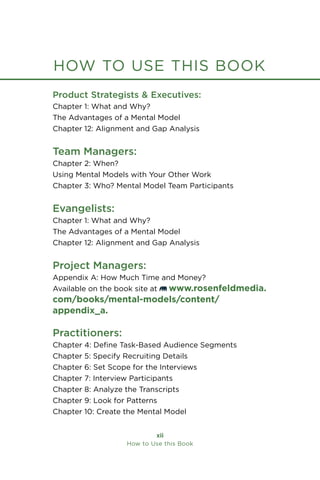
![Mental Models by Indi Young
Rosenfeld Media, 2008; version 1.1
Chapter 1
What and Why? The Advantages of a Mental Model
You might be thinking, “What does she mean
by ‘mental models?’” Since the phrase “mental
model” is somewhat commonly used—at least
in the realm of research—I want to set out
what I mean by the term and then outline
why you would ever want to make one.
What is a Mental Model?
“The deepest form of understanding another
person is empathy…[which] involves a
shift from…observing how you seem on the
outside, to…imagining what it feels like to be
you on the inside.”
Designing something requires that you
completely understand what a person wants
to get done. Empathy with a person is distinct
from studying how a person uses something.
Empathy extends to knowing what the person
wants to accomplish regardless of whether she
has or is aware of the thing you are designing.
You need to know the person’s goals and
what procedure and philosophy she follows to
From the book Difficult Conversations by Douglas Stone, Bruce Patton, and
Sheila Heen of the Harvard Negotiation Project, Chapter 9, “Empathy is a
Journey, Not a Destination,” p. 183.](https://image.slidesharecdn.com/1131573-250521090808-30c417c0/85/Mental-Models-Aligning-Design-Strategy-With-Human-Behavior-1st-Indi-Young-35-320.jpg)
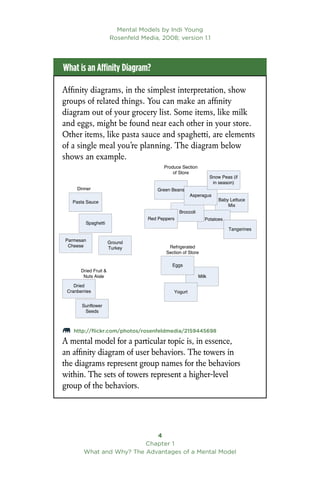
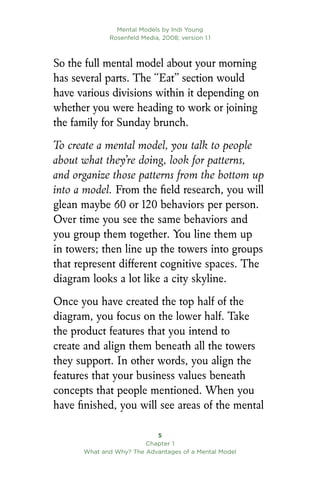
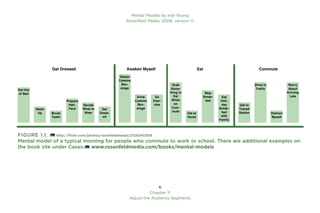
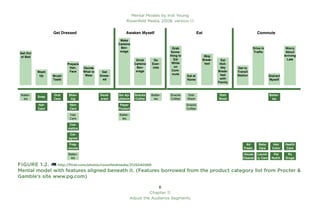
![Mental Models by Indi Young
Rosenfeld Media, 2008; version 1.1
17
Chapter 1
What and Why? The Advantages of a Mental Model
the people who were trying to understand
their web traffic. Talking to users “bought me
time to absorb the difficulty of the problem
we were facing and time to start pondering
solutions to that [problem].” Although he did
not use the diagram to specifically derive the
design, he says, “Most of what made it into
the design was based on my own …empathy
[which] was certainly developed while going
through this research and analysis.”
Distinguish Among Solutions
A mental model represents the entirety of
each audience segment’s environment. Thus,
the diagram depicts where one segment’s
experience ends and where the next one
begins. You certainly wouldn’t want to
combine the experience of truck drivers with
that of dispatchers—that much is obvious,
and the separate mental models will show
it. More subtle is the experience differences
among people of a similar segment but, say,
in a different country. Do the differences
merit separate solutions or not? Compare the
mental models. If they have a lot in common,](https://image.slidesharecdn.com/1131573-250521090808-30c417c0/85/Mental-Models-Aligning-Design-Strategy-With-Human-Behavior-1st-Indi-Young-50-320.jpg)

![I was about to put an end to the chatter of my concierge by leaving my
lodgings, when she detained me.
“By the way, monsieur, I beg your pardon—I quite forgot—I have
something for you.”
“What is it, pray?”
“I had entirely forgotten it; that girl is on my brain. It’s a letter.”
“A letter! who gave it to you?”
“The postman, monsieur; he brought it last night; you’d gone out, and
when you came home it was very late and I was in bed; for I couldn’t even
see you, and that’s how it was that——”
“Morbleu! Madame Dupont, give me the letter, and spare me your
reflections!”
“Here it is, monsieur.”
I recognized the postmark and the handwriting: it was from my sister,
my dear Amélie. But that reminds me that I ought to have told you before
this who I am, where I come from, and what my business is. I confess that it
never occurred to me; indeed, I should have been quite capable of going on
to the end without giving you any further information, and my adventures
would have been none the less simple in your eyes; for as I have not to tell
of mysteries, murders, abductions, substitution of children,—which always
produces an excellent effect,—promenades in the galleries of the West,
visits to subterranean caverns, moonlight visions, encounters in murky
caves, etc., etc., I shall have nothing to explain or disentangle for my
dénouement, and shall be constrained, in all probability, to end as simply as
I began.
“But,” you will say, “it is always well to know with whom one is
dealing; in fact, it is customary to begin with that.”—That is true; but I care
little about doing as others do, and, moreover, it seems to me that these
never-ending stories of births and family anecdotes are not adapted to afford
you much amusement; for that reason, I shall be very brief.
My name is Eugène Dorsan; I am of a Parisian family; my father was a
king’s attorney [procureur]; they say avoué now, a title which lends itself
less readily to pleasantry. However, my father was a very honorable man, so
I have always been told, and I have never doubted it. He earned a great deal
of money, to his credit be it said; but he died young, wherein he made a](https://image.slidesharecdn.com/1131573-250521090808-30c417c0/85/Mental-Models-Aligning-Design-Strategy-With-Human-Behavior-1st-Indi-Young-74-320.jpg)