Design Thinking
crash course
3 tools to work on
customer empathy
by www.boardofinnovation.com
pic flickr cc kheelcenter
subtitle
Design Thinking
=
Innovative
problem solving
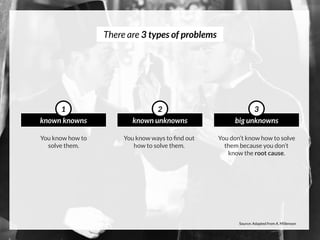
big unknownsknown unknownsknown knowns
321
You know how to
solve them.
You know ways to find out
how to solve them.
You don’t know how to solve
them because you don’t
know the root cause.
There are 3 types of problems
Source: Adapted from A. Millenson
I gave a free online crash course on
Design Thinking through Hangout
8 December 2015
Pssst, before I forget..
Replay here
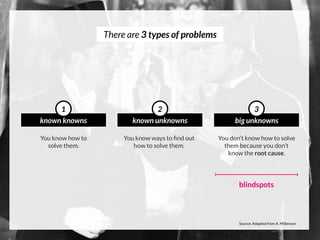
big unknownsknown unknownsknown knowns
321
There are 3 types of problems
blindspots
You know how to
solve them.
You know ways to find out
how to solve them.
You don’t know how to solve
them because you don’t
know the root cause.
Source: Adapted from A. Millenson
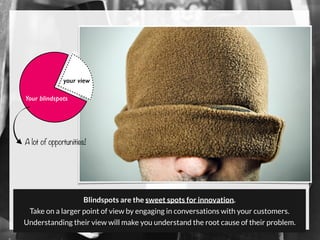
your view
Your blindspots
Blindspots are the sweet spots for innovation.
Take on a larger point of view by engaging in conversations with your customers.
Understanding their view will make you understand the root cause of their problem.
A lot of opportunities!
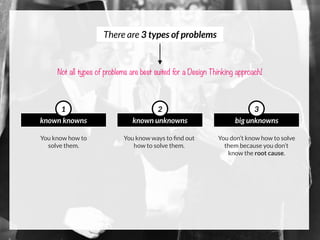
There are 3 types of problems
big unknownsknown unknownsknown knowns
321
Not all types of problems are best suited for a Design Thinking approach!
You know how to
solve them.
You know ways to find out
how to solve them.
You don’t know how to solve
them because you don’t
know the root cause.
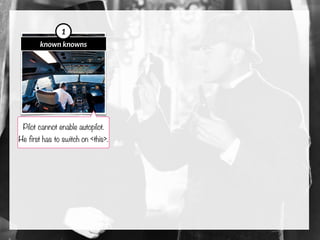
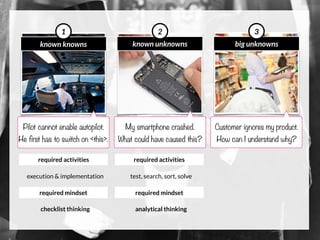
known knowns
1
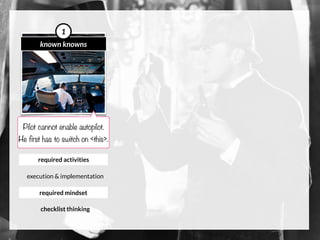
Bad weather during flight.
Switch off auto-pilot.
known knowns
1
Bad weather during flight.
Switch off auto-pilot.
execution & implementation
checklist thinking
required activities
required mindset
known knowns
1
Bad weather during flight.
Switch off auto-pilot.
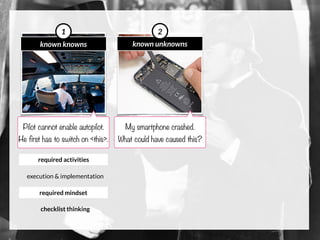
known unknowns
2
My smartphone crashed.
What could have caused this?
execution & implementation
checklist thinking
required activities
required mindset
known knowns
1
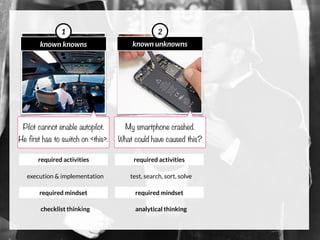
test, search, sort, solve
analytical thinking
required activities
required mindset
known unknowns
2
execution & implementation
checklist thinking
required activities
required mindset
Bad weather during flight.
Switch off auto-pilot.
My smartphone crashed.
What could have caused this?
known knowns
1
Bad weather during flight.
Switch off auto-pilot.
known unknowns
2
My smartphone crashed.
What could have caused this?
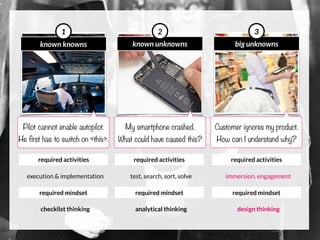
big unknowns
3
Customer ignores my product.
How can I understand why?
execution & implementation
checklist thinking
required activities
required mindset
test, search, sort, solve
analytical thinking
required activities
required mindset
known knowns
1
Bad weather during flight.
Switch off auto-pilot.
known unknowns
2
My smartphone crashed.
What could have caused this?
big unknowns
3
Customer ignores my product.
How can I understand why?
immersion, engagement
Design Thinking
required activities
required mindset
test, search, sort, solve
analytical thinking
required activities
required mindset
execution & implementation
checklist thinking
required activities
required mindset
5 tips on how to identify big unknowns
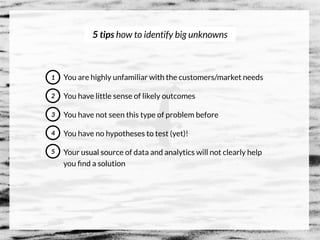
You are highly unfamiliar with the customers/market needs
You have little sense of likely outcomes
You have not seen this type of problem before
You have no hypotheses to test (yet)!
Your usual source of data and analytics will not clearly help
you find a solution
1
2
3
4
5
5 tips on how to identify big unknowns
Design Thinking
Lean Start-up
Agile
Execute
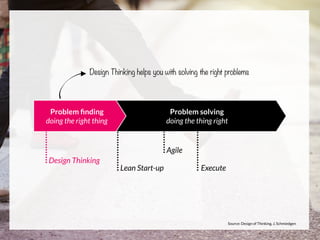
Problem solving
doing the thing right
Problem finding
doing the right thing
Design Thinking helps you with solving the right problems
Source: Design of Thinking, J, Schmiedgen
Design Thinking
Lean Start-up
Agile
Execute
Problem solving
doing the thing right
Problem finding
doing the right thing
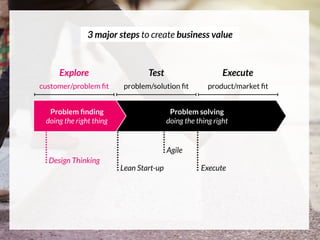
3 major steps to create business value
Explore Test Execute
customer/problem fit problem/solution fit product/market fit
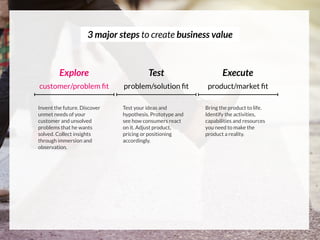
3 major steps to create business value
Invent the future. Discover
unmet needs of your
customer and unsolved
problems that he wants
solved. Collect insights
through immersion and
observation.
Test your ideas and
hypothesis. Prototype and
see how consumers react
on it. Adjust product,
pricing or positioning
accordingly.
Bring the product to life.
Identify the activities,
capabilities and resources
you need to make the
product a reality.
Explore Test Execute
customer/problem fit problem/solution fit product/market fit
3 major steps to create business value
Test your ideas and
hypothesis. Prototype and
see how consumers react
on it. Adjust product,
pricing or positioning
accordingly.
Bring the product to life.
Identify the activities,
capabilities and resources
you need to make the
product a reality.
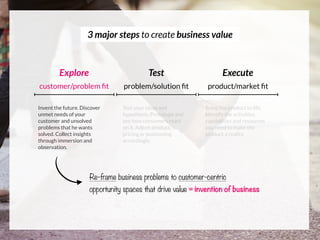
Re-frame business problems to customer-centric
opportunity spaces that drive value = invention of business
Explore Test Execute
customer/problem fit problem/solution fit product/market fit
Invent the future. Discover
unmet needs of your
customer and unsolved
problems that he wants
solved. Collect insights
through immersion and
observation.
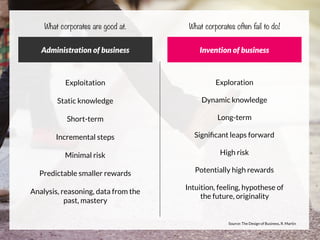
Administration of business Invention of business
What corporates are good at. What corporates often fail to do!
Source: The Design of Business, R. Martin
Exploitation
Static knowledge
Short-term
Incremental steps
Minimal risk
Predictable smaller rewards
Analysis, reasoning, data from the
past, mastery
Exploration
Dynamic knowledge
Long-term
Significant leaps forward
High risk
Potentially high rewards
Intuition, feeling, hypothese of
the future, originality
Administration of business Invention of business
Source: The Design of Business, R. Martin
How to identify real problems?
Exploration
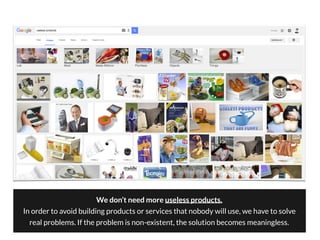
We don’t need more useless products.
In order to avoid building products or services that nobody will use, we have to solve
real problems. If the problem is non-existent, the solution becomes meaningless.
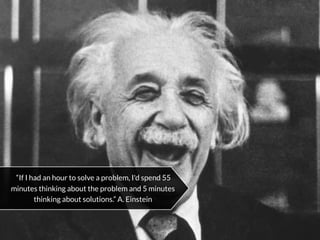
“If I had an hour to solve a problem, I'd spend 55
minutes thinking about the problem and 5 minutes
thinking about solutions.” A. Einstein
First identify the root cause of your problem
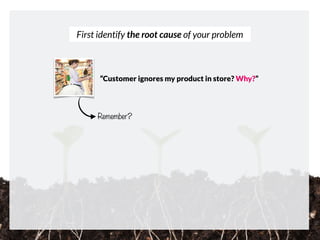
Remember?
First identify the root cause of your problem
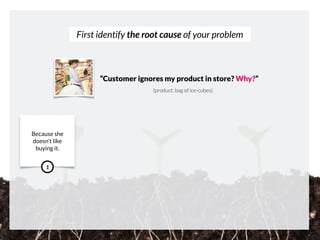
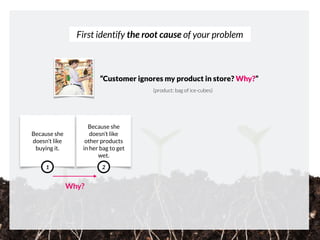
“Customer ignores my product in store? Why?”
First identify the root cause of your problem
e.g. bag of ice-cubes
“Customer ignores my product in store? Why?”
First identify the root cause of your problem
e.g. bag of ice-cubes
“Customer ignores my product in store? Why?”
Because she
doesn’t like
buying it.
1
First identify the root cause of your problem
e.g. bag of ice-cubes
“Customer ignores my product in store? Why?”
Because she
doesn’t like
buying it.
Because she
doesn’t like
other products
in her bag to get
wet.
1 2
Why?
First identify the root cause of your problem
e.g. bag of ice-cubes
“Customer ignores my product in store? Why?”
Because she
doesn’t like
buying it.
Because she
doesn’t like
other products
in her bag to get
wet.
Because this
affects other
products and
she doesn’t like
that.
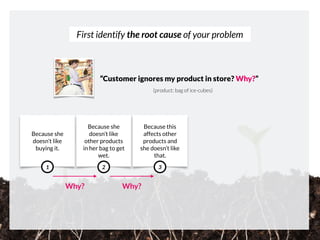
1 2 3
Why? Why?
First identify the root cause of your problem
e.g. bag of ice-cubes
“Customer ignores my product in store? Why?”
Because she
doesn’t like
buying it.
Because she
doesn’t like
other products
in her bag to get
wet.
Because this
affects other
products and
she doesn’t like
that.
Because she
doesn’t want
to pay for
products in
wet packaging.
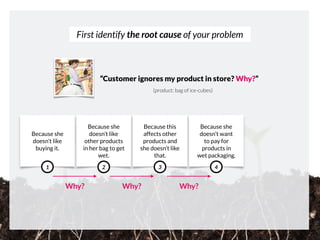
1 2 3 4
Why? Why? Why?
First identify the root cause of your problem
e.g. bag of ice-cubes
“Customer ignores my product in store? Why?”
Because she
only wants to
pay for quality.
Because she
doesn’t want
to pay for
products in
wet packaging.
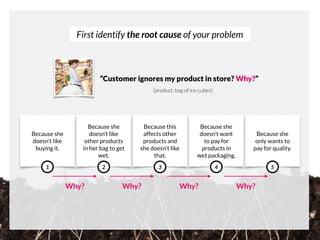
1 2 3 4 5
Why? Why? Why? Why?
Because she
doesn’t like
buying it.
Because she
doesn’t like
other products
in her bag to get
wet.
Because this
affects other
products and
she doesn’t like
that.
First identify the root cause of your problem
e.g. bag of ice-cubes
“Customer ignores my product in store? Why?”
Because she
doesn’t like
buying it.
Because she
doesn’t like
other products
in her bag to get
wet.
Because she
only wants to
pay for quality.
Because this
affects other
products and
she doesn’t like
that.
Because she
doesn’t want
to pay for
products in
wet packaging.
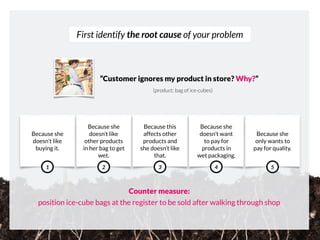
1 2 3 4 5
Counter measure:
position ice-cube bags at the register to be sold after walking through shop
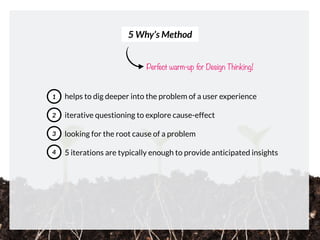
helps to dig deeper into the problem of a user experience
iterative questioning to explore cause-effect
looking for the root cause of a problem
5 iterations are typically enough to provide anticipated insights
1
2
3
4
5 Why’s Method
Perfect warm-up for Design Thinking!
“Design Thinking helps you with
identifying the root cause of a problem.”
It’s called CUSTOMER EMPATHY.
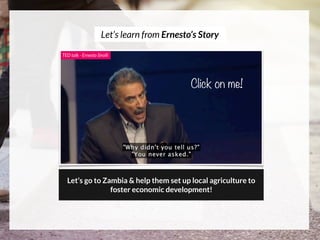
Let’s go to Zambia & help them set up local agriculture to
foster economic development!
TED talk - Ernesto Sirolli
Click on me!
Let’s learn from Ernesto’s Story
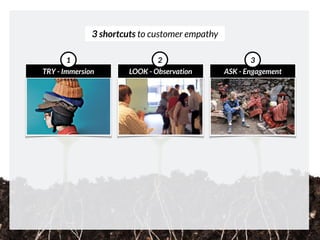
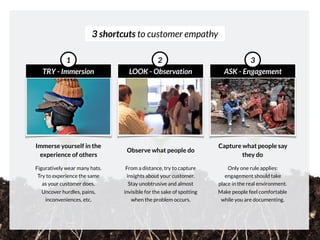
3 shortcuts to customer empathy
TRY - Immersion
1
LOOK - Observation
2
ASK - Engagement
3
3 shortcuts to customer empathy
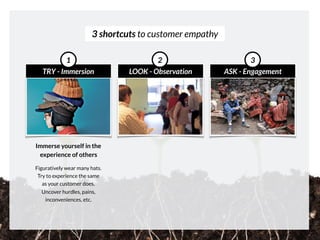
Immerse yourself in the
experience of others
Figuratively wear many hats.
Try to experience the same
as your customer does.
Uncover hurdles, pains,
inconveniences, etc.
TRY - Immersion
1
LOOK - Observation
2
ASK - Engagement
3
3 shortcuts to customer empathy
Immerse yourself in the
experience of others
TRY - Immersion
1
LOOK - Observation
2
ASK - Engagement
3
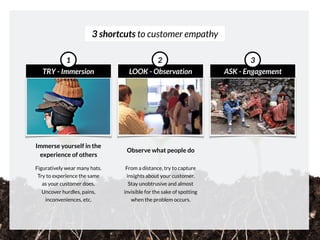
Observe what people do
From a distance, try to capture
insights about your customer.
Stay unobtrusive and almost
invisible for the sake of spotting
when the problem occurs.
Figuratively wear many hats.
Try to experience the same
as your customer does.
Uncover hurdles, pains,
inconveniences, etc.
3 shortcuts to customer empathy
TRY - Immersion
1
LOOK - Observation
2
ASK - Engagement
3
Capture what people say
they do
Only one rule applies:
engagement should take
place in the real environment.
Make people feel comfortable
while you are documenting.
Immerse yourself in the
experience of others
Observe what people do
From a distance, try to capture
insights about your customer.
Stay unobtrusive and almost
invisible for the sake of spotting
when the problem occurs.
Figuratively wear many hats.
Try to experience the same
as your customer does.
Uncover hurdles, pains,
inconveniences, etc.
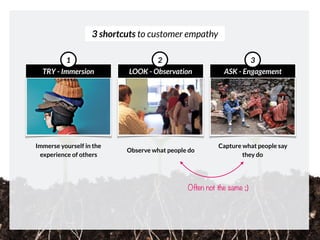
3 shortcuts to customer empathy
Immerse yourself in the
experience of others
TRY - Immersion
1
LOOK - Observation
2
ASK - Engagement
3
Observe what people do
Capture what people say
they do
Often not the same ;)
Some examples
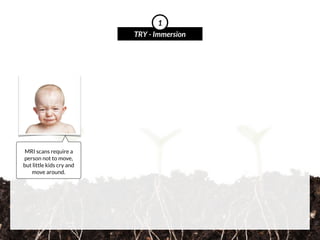
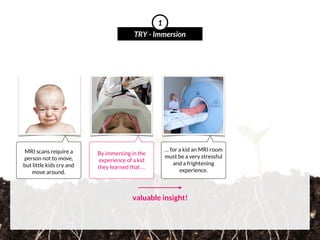
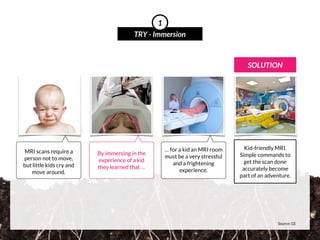
MRI scans require a
person not to move,
but little kids cry and
move around.
TRY - Immersion
1
MRI scans require a
person not to move,
but little kids cry and
move around.
TRY - Immersion
1
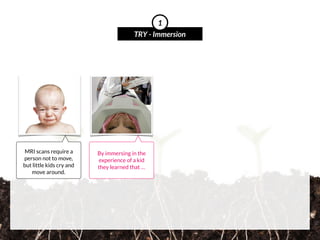
By immersing in the
experience of a kid
they learned that …
MRI scans require a
person not to move,
but little kids cry and
move around.
TRY - Immersion
1
… for a kid an MRI room
must be a very stressful
and a frightening
experience.
By immersing in the
experience of a kid
they learned that …
valuable insight!
MRI scans require a
person not to move,
but little kids cry and
move around.
TRY - Immersion
1
… for a kid an MRI room
must be a very stressful
and a frightening
experience.
By immersing in the
experience of a kid
they learned that …
Kid-friendly MRI.
Simple commands to
get the scan done
accurately become
part of an adventure.
SOLUTION
Source: GE
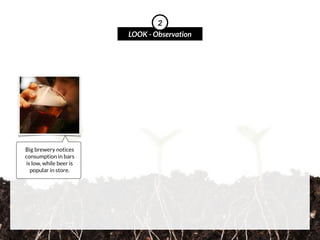
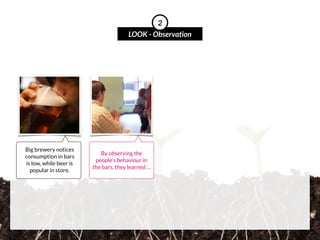
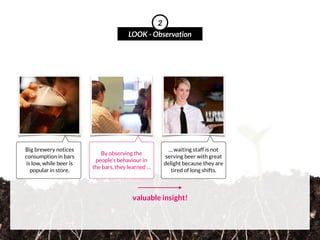
Big brewery notices
consumption in bars
is low, while beer is
popular in store.
LOOK - Observation
2
Big brewery notices
consumption in bars
is low, while beer is
popular in stores.
LOOK - Observation
2
By observing the
people’s behaviour in
the bars, they learned …
Big brewery notices
consumption in bars
is low, while beer is
popular in store.
LOOK - Observation
2
… waiting staff is not
serving beer with great
enthusiasm because
they are tired of long
shifts.
By observing the
people’s behaviour in
the bars, they learned …
valuable insight!
Big brewery notices
consumption in bars
is low, while beer is
popular in store.
LOOK - Observation
2
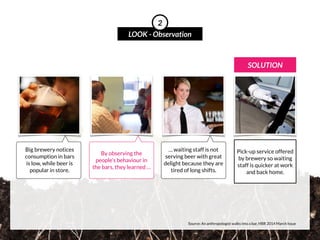
… waiting staff is not
serving beer with great
delight because they are
tired of long shifts.
By observing the
people’s behaviour in
the bars, they learned …
Pick-up service offered
by brewery so waiting
staff is quicker at work
and back home.
SOLUTION
Source: An anthropologist walks into a bar, HBR 2014 March Issue
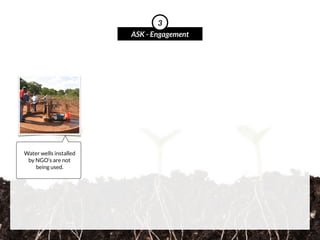
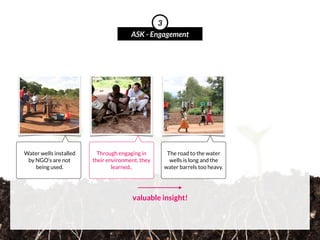
Water wells installed
by NGO’s are not
being used.
ASK - Engagement
3
Water wells installed
by NGO’s are not
being used.
ASK - Engagement
3
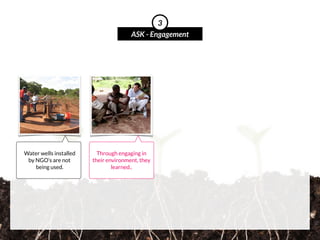
Through engaging in
their environment, they
learned..
Water wells installed
by NGO’s are not
being used.
ASK - Engagement
3
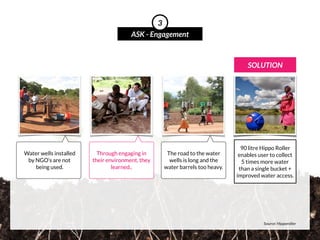
The road to the water
wells is long and the
water barrels too heavy.
Through engaging in
their environment, they
learned..
valuable insight!
Water wells installed
by NGO’s are not
being used.
ASK - Engagement
3
The road to the water
wells is long and the
water barrels too heavy.
Through engaging in
their environment, they
learned..
90 litre Hippo Roller
enables user to collect
5 times more water
than a single bucket +
improved water access.
SOLUTION
Source: Hippo Roller
Thank you!
arnout@boardofinnovation.com
Let’s connect!

Crash Course Design Thinking - by @arnoutsmeets

  • 1.
    Design Thinking crash course 3tools to work on customer empathy by www.boardofinnovation.com pic flickr cc kheelcenter
  • 2.
  • 3.
    big unknownsknown unknownsknownknowns 321 You know how to solve them. You know ways to find out how to solve them. You don’t know how to solve them because you don’t know the root cause. There are 3 types of problems Source: Adapted from A. Millenson
  • 4.
    I gave afree online crash course on Design Thinking through Hangout 8 December 2015 Pssst, before I forget.. Replay here
  • 5.
    big unknownsknown unknownsknownknowns 321 There are 3 types of problems blindspots You know how to solve them. You know ways to find out how to solve them. You don’t know how to solve them because you don’t know the root cause. Source: Adapted from A. Millenson
  • 6.
    your view Your blindspots Blindspotsare the sweet spots for innovation. Take on a larger point of view by engaging in conversations with your customers. Understanding their view will make you understand the root cause of their problem. A lot of opportunities!
  • 7.
    There are 3types of problems big unknownsknown unknownsknown knowns 321 Not all types of problems are best suited for a Design Thinking approach! You know how to solve them. You know ways to find out how to solve them. You don’t know how to solve them because you don’t know the root cause.
  • 8.
    known knowns 1 Bad weatherduring flight. Switch off auto-pilot.
  • 9.
    known knowns 1 Bad weatherduring flight. Switch off auto-pilot. execution & implementation checklist thinking required activities required mindset
  • 10.
    known knowns 1 Bad weatherduring flight. Switch off auto-pilot. known unknowns 2 My smartphone crashed. What could have caused this? execution & implementation checklist thinking required activities required mindset
  • 11.
    known knowns 1 test, search,sort, solve analytical thinking required activities required mindset known unknowns 2 execution & implementation checklist thinking required activities required mindset Bad weather during flight. Switch off auto-pilot. My smartphone crashed. What could have caused this?
  • 12.
    known knowns 1 Bad weatherduring flight. Switch off auto-pilot. known unknowns 2 My smartphone crashed. What could have caused this? big unknowns 3 Customer ignores my product. How can I understand why? execution & implementation checklist thinking required activities required mindset test, search, sort, solve analytical thinking required activities required mindset
  • 13.
    known knowns 1 Bad weatherduring flight. Switch off auto-pilot. known unknowns 2 My smartphone crashed. What could have caused this? big unknowns 3 Customer ignores my product. How can I understand why? immersion, engagement Design Thinking required activities required mindset test, search, sort, solve analytical thinking required activities required mindset execution & implementation checklist thinking required activities required mindset
  • 14.
    5 tips onhow to identify big unknowns
  • 15.
    You are highlyunfamiliar with the customers/market needs You have little sense of likely outcomes You have not seen this type of problem before You have no hypotheses to test (yet)! Your usual source of data and analytics will not clearly help you find a solution 1 2 3 4 5 5 tips on how to identify big unknowns
  • 16.
    Design Thinking Lean Start-up Agile Execute Problemsolving doing the thing right Problem finding doing the right thing Design Thinking helps you with solving the right problems Source: Design of Thinking, J, Schmiedgen
  • 17.
    Design Thinking Lean Start-up Agile Execute Problemsolving doing the thing right Problem finding doing the right thing 3 major steps to create business value Explore Test Execute customer/problem fit problem/solution fit product/market fit
  • 18.
    3 major stepsto create business value Invent the future. Discover unmet needs of your customer and unsolved problems that he wants solved. Collect insights through immersion and observation. Test your ideas and hypothesis. Prototype and see how consumers react on it. Adjust product, pricing or positioning accordingly. Bring the product to life. Identify the activities, capabilities and resources you need to make the product a reality. Explore Test Execute customer/problem fit problem/solution fit product/market fit
  • 19.
    3 major stepsto create business value Test your ideas and hypothesis. Prototype and see how consumers react on it. Adjust product, pricing or positioning accordingly. Bring the product to life. Identify the activities, capabilities and resources you need to make the product a reality. Re-frame business problems to customer-centric opportunity spaces that drive value = invention of business Explore Test Execute customer/problem fit problem/solution fit product/market fit Invent the future. Discover unmet needs of your customer and unsolved problems that he wants solved. Collect insights through immersion and observation.
  • 20.
    Administration of businessInvention of business What corporates are good at. What corporates often fail to do! Source: The Design of Business, R. Martin
  • 21.
    Exploitation Static knowledge Short-term Incremental steps Minimalrisk Predictable smaller rewards Analysis, reasoning, data from the past, mastery Exploration Dynamic knowledge Long-term Significant leaps forward High risk Potentially high rewards Intuition, feeling, hypothese of the future, originality Administration of business Invention of business Source: The Design of Business, R. Martin
  • 22.
    How to identifyreal problems? Exploration
  • 23.
    We don’t needmore useless products. In order to avoid building products or services that nobody will use, we have to solve real problems. If the problem is non-existent, the solution becomes meaningless.
  • 24.
    “If I hadan hour to solve a problem, I'd spend 55 minutes thinking about the problem and 5 minutes thinking about solutions.” A. Einstein
  • 25.
    First identify theroot cause of your problem
  • 26.
    Remember? First identify theroot cause of your problem “Customer ignores my product in store? Why?”
  • 27.
    First identify theroot cause of your problem e.g. bag of ice-cubes “Customer ignores my product in store? Why?”
  • 28.
    First identify theroot cause of your problem e.g. bag of ice-cubes “Customer ignores my product in store? Why?” Because she doesn’t like buying it. 1
  • 29.
    First identify theroot cause of your problem e.g. bag of ice-cubes “Customer ignores my product in store? Why?” Because she doesn’t like buying it. Because she doesn’t like other products in her bag to get wet. 1 2 Why?
  • 30.
    First identify theroot cause of your problem e.g. bag of ice-cubes “Customer ignores my product in store? Why?” Because she doesn’t like buying it. Because she doesn’t like other products in her bag to get wet. Because this affects other products and she doesn’t like that. 1 2 3 Why? Why?
  • 31.
    First identify theroot cause of your problem e.g. bag of ice-cubes “Customer ignores my product in store? Why?” Because she doesn’t like buying it. Because she doesn’t like other products in her bag to get wet. Because this affects other products and she doesn’t like that. Because she doesn’t want to pay for products in wet packaging. 1 2 3 4 Why? Why? Why?
  • 32.
    First identify theroot cause of your problem e.g. bag of ice-cubes “Customer ignores my product in store? Why?” Because she only wants to pay for quality. Because she doesn’t want to pay for products in wet packaging. 1 2 3 4 5 Why? Why? Why? Why? Because she doesn’t like buying it. Because she doesn’t like other products in her bag to get wet. Because this affects other products and she doesn’t like that.
  • 33.
    First identify theroot cause of your problem e.g. bag of ice-cubes “Customer ignores my product in store? Why?” Because she doesn’t like buying it. Because she doesn’t like other products in her bag to get wet. Because she only wants to pay for quality. Because this affects other products and she doesn’t like that. Because she doesn’t want to pay for products in wet packaging. 1 2 3 4 5 Counter measure: position ice-cube bags at the register to be sold after walking through shop
  • 34.
    helps to digdeeper into the problem of a user experience iterative questioning to explore cause-effect looking for the root cause of a problem 5 iterations are typically enough to provide anticipated insights 1 2 3 4 5 Why’s Method Perfect warm-up for Design Thinking!
  • 35.
    “Design Thinking helpsyou with identifying the root cause of a problem.” It’s called CUSTOMER EMPATHY.
  • 36.
    Let’s go toZambia & help them set up local agriculture to foster economic development! TED talk - Ernesto Sirolli Click on me! Let’s learn from Ernesto’s Story
  • 37.
    3 shortcuts tocustomer empathy TRY - Immersion 1 LOOK - Observation 2 ASK - Engagement 3
  • 38.
    3 shortcuts tocustomer empathy Immerse yourself in the experience of others Figuratively wear many hats. Try to experience the same as your customer does. Uncover hurdles, pains, inconveniences, etc. TRY - Immersion 1 LOOK - Observation 2 ASK - Engagement 3
  • 39.
    3 shortcuts tocustomer empathy Immerse yourself in the experience of others TRY - Immersion 1 LOOK - Observation 2 ASK - Engagement 3 Observe what people do From a distance, try to capture insights about your customer. Stay unobtrusive and almost invisible for the sake of spotting when the problem occurs. Figuratively wear many hats. Try to experience the same as your customer does. Uncover hurdles, pains, inconveniences, etc.
  • 40.
    3 shortcuts tocustomer empathy TRY - Immersion 1 LOOK - Observation 2 ASK - Engagement 3 Capture what people say they do Only one rule applies: engagement should take place in the real environment. Make people feel comfortable while you are documenting. Immerse yourself in the experience of others Observe what people do From a distance, try to capture insights about your customer. Stay unobtrusive and almost invisible for the sake of spotting when the problem occurs. Figuratively wear many hats. Try to experience the same as your customer does. Uncover hurdles, pains, inconveniences, etc.
  • 41.
    3 shortcuts tocustomer empathy Immerse yourself in the experience of others TRY - Immersion 1 LOOK - Observation 2 ASK - Engagement 3 Observe what people do Capture what people say they do Often not the same ;)
  • 42.
  • 43.
    MRI scans requirea person not to move, but little kids cry and move around. TRY - Immersion 1
  • 44.
    MRI scans requirea person not to move, but little kids cry and move around. TRY - Immersion 1 By immersing in the experience of a kid they learned that …
  • 45.
    MRI scans requirea person not to move, but little kids cry and move around. TRY - Immersion 1 … for a kid an MRI room must be a very stressful and a frightening experience. By immersing in the experience of a kid they learned that … valuable insight!
  • 46.
    MRI scans requirea person not to move, but little kids cry and move around. TRY - Immersion 1 … for a kid an MRI room must be a very stressful and a frightening experience. By immersing in the experience of a kid they learned that … Kid-friendly MRI. Simple commands to get the scan done accurately become part of an adventure. SOLUTION Source: GE
  • 47.
    Big brewery notices consumptionin bars is low, while beer is popular in store. LOOK - Observation 2
  • 48.
    Big brewery notices consumptionin bars is low, while beer is popular in stores. LOOK - Observation 2 By observing the people’s behaviour in the bars, they learned …
  • 49.
    Big brewery notices consumptionin bars is low, while beer is popular in store. LOOK - Observation 2 … waiting staff is not serving beer with great enthusiasm because they are tired of long shifts. By observing the people’s behaviour in the bars, they learned … valuable insight!
  • 50.
    Big brewery notices consumptionin bars is low, while beer is popular in store. LOOK - Observation 2 … waiting staff is not serving beer with great delight because they are tired of long shifts. By observing the people’s behaviour in the bars, they learned … Pick-up service offered by brewery so waiting staff is quicker at work and back home. SOLUTION Source: An anthropologist walks into a bar, HBR 2014 March Issue
  • 51.
    Water wells installed byNGO’s are not being used. ASK - Engagement 3
  • 52.
    Water wells installed byNGO’s are not being used. ASK - Engagement 3 Through engaging in their environment, they learned..
  • 53.
    Water wells installed byNGO’s are not being used. ASK - Engagement 3 The road to the water wells is long and the water barrels too heavy. Through engaging in their environment, they learned.. valuable insight!
  • 54.
    Water wells installed byNGO’s are not being used. ASK - Engagement 3 The road to the water wells is long and the water barrels too heavy. Through engaging in their environment, they learned.. 90 litre Hippo Roller enables user to collect 5 times more water than a single bucket + improved water access. SOLUTION Source: Hippo Roller
  • 55.