Medical Applications of Nuclear Physics
Nuclear Physics Medical Applications Diagnostic Imaging
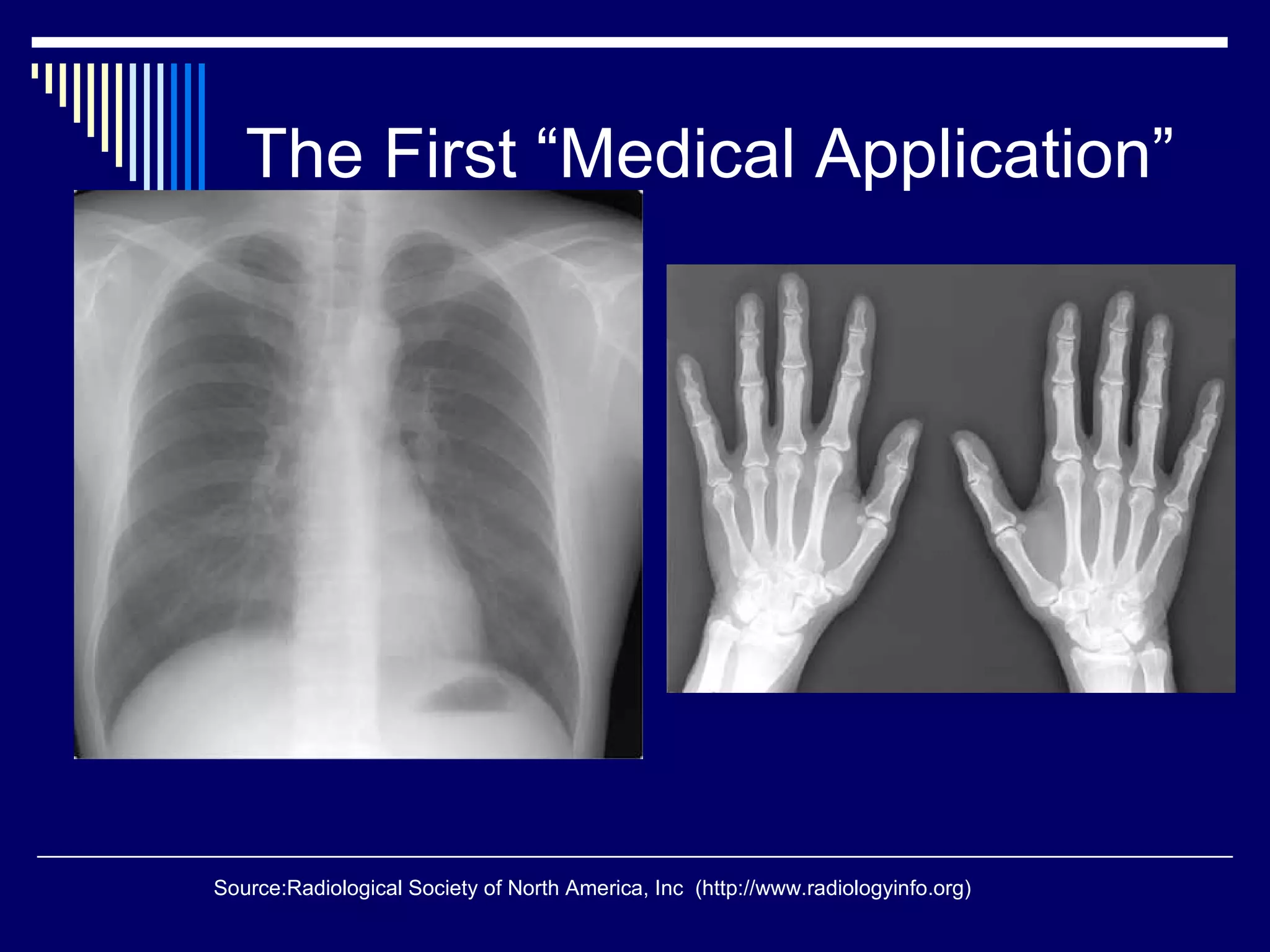
The First “Medical Application” Source:Radiological Society of North America, Inc  (http://www.radiologyinfo.org)
CAT scan Computerized Axial Tomography Source: Cutnell and Johnson, 7 th  edition image gallery
CAT scan X-rays are produced and emitted in thin, fanned out beams Detected on the opposite side of the patient via arrays of x-ray detectors Scanner rotates to get the full 2-D picture The patient is passed through the scanner in small steps to get ‘slices’ for 3-D reconstruction Computer control allows for high level of precision yield very detailed images
CAT scan advantages 3-D reconstruction of the internal organs High resolution giving doctors very good details prior to grabbing a knife CAT scans can image soft tissue, bone, and blood vessels at the same time Often less expensive than an MRI and can be used with medical implants and metal objects Source: Radiological Society of North America, Inc   (http://www.radiologyinfo.org)
CAT scan reconstructed Source: Cutnell and Johnson, 7th edition image gallery
CAT scan image of lung Source: Radiological Society of North America, Inc  (http://www.radiologyinfo.org)
CAT scan dangers Increased exposure to x-ray radiation NBC Nightly News recently reported on an article in the  New England Journal of Medicine  that up to as much as 2% of new cancer cases may be caused by CT scans A CT scan of the chest involves 10 to 15 millisieverts versus 0.01 to 0.15 for a regular chest X-ray Nevertheless, it’s still a powerful tool  … just don’t over use it. Source: http://www.msnbc.msn.com/id/22012569/
PET scan P ositron  E mission  T omography A radioactive source (positron emitter) is injected into the patient usually attached to a sugar Cancers have unusually high metabolic rates so the sugar solution goes more to the cancer cells than the other tissues Emitted positron annihilates with an electron to produce two gamma rays Gamma rays leave traveling in opposite directions Coincident detection of gamma rays can be computer reconstructed to give high resolution images of the internal organs Source: Radiological Society of North America, Inc   (http://www.radiologyinfo.org) Source: Cutnell and Johnson, 5 th  edition text
PET scan advantages Very powerful imaging tool Produces higher resolution images  Can detect changes in metabolic activity before changes in the anatomy are seen in CAT and MRI images Can be used in combination with CT and MRI images (CT/PET scans are becoming more widely used) Source: Radiological Society of North America, Inc   (http://www.radiologyinfo.org)
PET scanner Source: Cutnell and Johnson, 7th edition image gallery
PET scan image Source: Cutnell and Johnson, 7th edition image gallery
CAT/PET scan combined Source: Radiological Society of North America, Inc   (http://www.radiologyinfo.org)
PET scan dangers and limitations PET scan dosages are very small (it’s an efficient method for imaging) but its still radiation Must weigh the danger against the rewards  These radio-nuclides have short half-lives which means they must be produced locally or pay huge shipping costs Sometimes gives false positives if there is chemical imbalances in the patient Source: Radiological Society of North America, Inc   (http://www.radiologyinfo.org)
MRI imaging M agnetic  R esonance  I maging Patient is placed in a powerful non-uniform magnetic field  A electromagnetic wave is transmitted into the body and at the right frequency it is absorbed.  This absorption is detected by the machine. A computer reconstructs the location of the cells to develop 3-D images Source: Radiological Society of North America, Inc   (http://www.radiologyinfo.org) Source: Cutnell and Johnson, 5 th  edition
MRI imaging machine Source: Radiological Society of North America, Inc   (http://www.radiologyinfo.org)
MRI image of the knee Source: Radiological Society of North America, Inc   (http://www.radiologyinfo.org)
MRI dangers and limitations Confined environment No metals allowed! Does not do well with lungs The patient must lie perfectly still so anxiousness may make the images blurry MRI’s can be expensive
Nuclear Physics Medical Applications Treatments
Gamma Knife Radio surgery Use of gamma rays to treat cancerous tumors Directs gamma radiation from many directions to a specific location to delivery a powerful dose of radiation Does not require surgery Can treat cancers where conventional surgery is not possible Source: Cutnell and Johnson, 7th edition image gallary
Gamma Knife device Source: Cutnell and Johnson, 7th edition image gallery
Gamma Knife disadvantages Exposure to significant radiation Must be aligned to within a millimeter for accurate treatment Is not guaranteed to destroy all the cancer (it’s a treatment, after all) Source: Radiological Society of North America, Inc   (http://www.radiologyinfo.org)
Linear Accelerator High energy electrons are crashed into a heavy metal target and emit x-rays Energy, intensity, and location of the x-rays are controlled to deliver radiation to a tumor Precision and accuracy are very good and getting better Source: Radiological Society of North America, Inc   (http://www.radiologyinfo.org)
Linear Accelerator in Operation Source: Radiological Society of North America, Inc   (http://www.radiologyinfo.org)
Linear Accelerator Drawbacks X-ray radiation can damage healthy tissue Must be aligned correctly for good accuracy Movement of internal organs requires larger beam area to get the cancer … you don’t want to do this again Equipment is expensive … but getting much better
Proton Therapy Similar to the linear accelerator therapy except energetic protons are directed at the tumor Varying the energy of the protons results in good deep control Can be focused to the size of a pin Usually results in less damage to healthy tissue Source: Radiological Society of North America, Inc   (http://www.radiologyinfo.org)
Proton Therapy Source: Radiological Society of North America, Inc   (http://www.radiologyinfo.org)
Proton Therapy Disadvantages Radiation exposure to good tissues Requires the cancer to remain still for good precision and minimization of collateral damage Very expensive and only used at a few locations in North America Source: Radiological Society of North America, Inc   (http://www.radiologyinfo.org)

Medical applications of nuclear physics

  • 1.
    Medical Applications ofNuclear Physics
  • 2.
    Nuclear Physics MedicalApplications Diagnostic Imaging
  • 3.
    The First “MedicalApplication” Source:Radiological Society of North America, Inc (http://www.radiologyinfo.org)
  • 4.
    CAT scan ComputerizedAxial Tomography Source: Cutnell and Johnson, 7 th edition image gallery
  • 5.
    CAT scan X-raysare produced and emitted in thin, fanned out beams Detected on the opposite side of the patient via arrays of x-ray detectors Scanner rotates to get the full 2-D picture The patient is passed through the scanner in small steps to get ‘slices’ for 3-D reconstruction Computer control allows for high level of precision yield very detailed images
  • 6.
    CAT scan advantages3-D reconstruction of the internal organs High resolution giving doctors very good details prior to grabbing a knife CAT scans can image soft tissue, bone, and blood vessels at the same time Often less expensive than an MRI and can be used with medical implants and metal objects Source: Radiological Society of North America, Inc (http://www.radiologyinfo.org)
  • 7.
    CAT scan reconstructedSource: Cutnell and Johnson, 7th edition image gallery
  • 8.
    CAT scan imageof lung Source: Radiological Society of North America, Inc (http://www.radiologyinfo.org)
  • 9.
    CAT scan dangersIncreased exposure to x-ray radiation NBC Nightly News recently reported on an article in the New England Journal of Medicine that up to as much as 2% of new cancer cases may be caused by CT scans A CT scan of the chest involves 10 to 15 millisieverts versus 0.01 to 0.15 for a regular chest X-ray Nevertheless, it’s still a powerful tool … just don’t over use it. Source: http://www.msnbc.msn.com/id/22012569/
  • 10.
    PET scan Positron E mission T omography A radioactive source (positron emitter) is injected into the patient usually attached to a sugar Cancers have unusually high metabolic rates so the sugar solution goes more to the cancer cells than the other tissues Emitted positron annihilates with an electron to produce two gamma rays Gamma rays leave traveling in opposite directions Coincident detection of gamma rays can be computer reconstructed to give high resolution images of the internal organs Source: Radiological Society of North America, Inc (http://www.radiologyinfo.org) Source: Cutnell and Johnson, 5 th edition text
  • 11.
    PET scan advantagesVery powerful imaging tool Produces higher resolution images Can detect changes in metabolic activity before changes in the anatomy are seen in CAT and MRI images Can be used in combination with CT and MRI images (CT/PET scans are becoming more widely used) Source: Radiological Society of North America, Inc (http://www.radiologyinfo.org)
  • 12.
    PET scanner Source:Cutnell and Johnson, 7th edition image gallery
  • 13.
    PET scan imageSource: Cutnell and Johnson, 7th edition image gallery
  • 14.
    CAT/PET scan combinedSource: Radiological Society of North America, Inc (http://www.radiologyinfo.org)
  • 15.
    PET scan dangersand limitations PET scan dosages are very small (it’s an efficient method for imaging) but its still radiation Must weigh the danger against the rewards These radio-nuclides have short half-lives which means they must be produced locally or pay huge shipping costs Sometimes gives false positives if there is chemical imbalances in the patient Source: Radiological Society of North America, Inc (http://www.radiologyinfo.org)
  • 16.
    MRI imaging Magnetic R esonance I maging Patient is placed in a powerful non-uniform magnetic field A electromagnetic wave is transmitted into the body and at the right frequency it is absorbed. This absorption is detected by the machine. A computer reconstructs the location of the cells to develop 3-D images Source: Radiological Society of North America, Inc (http://www.radiologyinfo.org) Source: Cutnell and Johnson, 5 th edition
  • 17.
    MRI imaging machineSource: Radiological Society of North America, Inc (http://www.radiologyinfo.org)
  • 18.
    MRI image ofthe knee Source: Radiological Society of North America, Inc (http://www.radiologyinfo.org)
  • 19.
    MRI dangers andlimitations Confined environment No metals allowed! Does not do well with lungs The patient must lie perfectly still so anxiousness may make the images blurry MRI’s can be expensive
  • 20.
    Nuclear Physics MedicalApplications Treatments
  • 21.
    Gamma Knife Radiosurgery Use of gamma rays to treat cancerous tumors Directs gamma radiation from many directions to a specific location to delivery a powerful dose of radiation Does not require surgery Can treat cancers where conventional surgery is not possible Source: Cutnell and Johnson, 7th edition image gallary
  • 22.
    Gamma Knife deviceSource: Cutnell and Johnson, 7th edition image gallery
  • 23.
    Gamma Knife disadvantagesExposure to significant radiation Must be aligned to within a millimeter for accurate treatment Is not guaranteed to destroy all the cancer (it’s a treatment, after all) Source: Radiological Society of North America, Inc (http://www.radiologyinfo.org)
  • 24.
    Linear Accelerator Highenergy electrons are crashed into a heavy metal target and emit x-rays Energy, intensity, and location of the x-rays are controlled to deliver radiation to a tumor Precision and accuracy are very good and getting better Source: Radiological Society of North America, Inc (http://www.radiologyinfo.org)
  • 25.
    Linear Accelerator inOperation Source: Radiological Society of North America, Inc (http://www.radiologyinfo.org)
  • 26.
    Linear Accelerator DrawbacksX-ray radiation can damage healthy tissue Must be aligned correctly for good accuracy Movement of internal organs requires larger beam area to get the cancer … you don’t want to do this again Equipment is expensive … but getting much better
  • 27.
    Proton Therapy Similarto the linear accelerator therapy except energetic protons are directed at the tumor Varying the energy of the protons results in good deep control Can be focused to the size of a pin Usually results in less damage to healthy tissue Source: Radiological Society of North America, Inc (http://www.radiologyinfo.org)
  • 28.
    Proton Therapy Source:Radiological Society of North America, Inc (http://www.radiologyinfo.org)
  • 29.
    Proton Therapy DisadvantagesRadiation exposure to good tissues Requires the cancer to remain still for good precision and minimization of collateral damage Very expensive and only used at a few locations in North America Source: Radiological Society of North America, Inc (http://www.radiologyinfo.org)