Radiation-Based Diagnostic Methods:
Medical Imaging Modalities
Biophysics II Course
Washington University of Health and Science
Summer 2025
Lecturer: Huda Nasser
2
Overview of Medical Imaging
Medical Imaging
◉ Medical imaging is a type of diagnostic testing.
◉ Non-invasive techniques and approaches used to create visual
representations of the internal organs and tissues of the human
body.
◉ Medical imaging is widely used to examine and visualize different
parts of the body, including bones, muscles, organs, blood vessels,
and other internal structures.
3
Medical Imaging
Medical imaging is used to visualize body parts in different anatomical
planes.
4
*=
ray Ct bruin
details
show MRI-CSEshows
-Space
btur
vertebreas
(disc
Shows
clearly
Medical Imaging
Medical imaging is used to visualize body parts in different anatomical
planes.
5
X-ray Ct CT MRI
-
> brain
details,
bones are
notbright
Medical Imaging
Medical imaging is used to visualize body parts in different anatomical
planes.
6
MRI+
p
ul luyers show
↳ Skull Shows
white more details -
> ventricles
parts are
in cancer dye would
contrast/dye-Oralsprea more, or it blood
Vessel blocked,youcan
see
dye stopped
Medical Imaging
Medical imaging is used to visualize body parts in different anatomical
planes.
7
4th pic page(axial) first pic is ct,( abdomen) and you can’t really see csf,
2nd pic is mri( white part which is first layer in mri is always fat) ct
however shows bone clearly as white
↓
w , contrast
Imaging Modalities
8
Imaging
Modalities
Computed
Tomography
(CT)
Radiography
Ultrasound
Magnetic
Resonance
Imaging (MRI)
Nuclear
Medicine
Single Photon
Emission
Computed
Tomography
(SPECT)
Positron
Emission
Tomography
(PET)
Fluoroscopy
Plain X-Ray
Mammography
Dental Radiography
3D
3D 2
Imaging Modalities
◉ Each modality has its own principles, indications and limitations.
◉ Understanding the principles of each modality is essential for
interpreting images accurately and providing effective patient care.
9
·
Electromagnetic Spectrum
10
axidl= brain
sagittal
Specie
axial
knee
sagittal
Electromagnetic Spectrum
11
sagittal frontal
Apart
lumber
Spine
fronte
APPA
plevis
Frontal
APorpA
frontal
Electromagnetic Spectrum
12
56
Computed Tomogrphy (CT Scan)
57
CT Machine
Gantry
CT Table
Tomo
=
Slice or section
Computed Tomography (CT Scan)
58
Graph
=
To write or to describe
From Ancient Greek
 Computed tomography (CT) is a powerful
imaging technique that utilizes X-Rays to
create detailed cross-sectional images of
the human body.
◉ Unlike traditional X-Rays that provide a flat
2D image, CT scans offer a much more
comprehensive view, by capturing X-Ray
data from multiple angles.
◉ A sophisticated computerized method is
used to obtain data and transform them
into cross-sectional slices of the human
body.
◉ Advanced computer processing is utilized
to reconstruct highly detailed 3D images of
internal organs, bones, and soft tissues.
59
CT Scan
60
CT Image Acquisition
Image
Reconstruction
C
◉ All CT examinations are performed by obtaining data for a series of
slices through a designated area of interest.
◉ The structures in a CT image are represented by varying shades of
gray. The creation of these shades of gray is based on basic X-
radiation principles.
◉ Hounsfield Units can be defined as the quantification of the degree
that a structure attenuates an X-Ray beam.
◉ These units are also referred to as CT numbers, or density values.
61
CT Scan
62
Hounsfield Gray Scale
63
CT Image Windowing
Lung window
64
CT Image Windowing
Soft tissue window
65
CT Image Windowing
Bone window
66
CT Image Windowing
67
CT Image Windowing
Brain window
68
CT Image Windowing
Temporal bone window
69
CT Image Windowing
Sinus window
◉ CT contrast media, also known as CT contrast
dye or contrast agent, is a substance that is used
to improve the visibility of certain organs,
tissues, and blood vessels during a CT scan.
◉ They are chemically designed to be radiopaque.
◉ Iodine-based contrast is the most common
type. It may be ingested (orally) or injected
intravenously (IV) by a contrast injector
(automatically) or manually.
70
CT Contrast Media
Contrast Injector
71
CT Contrast Media
Carotid CT Angiography (CTA)
72
CT Contrast Media
Lower limbs CTA
◉ Cancer detection and staging.
73
Clinical Applications of CT Scan
◉ Trauma evaluation.
74
Clinical Applications of CT Scan
◉ Neurological conditions
○ Stroke, brain tumors, and bleeding in the brain.
75
Clinical Applications of CT Scan
◉ Musculoskeletal conditions.
76
Clinical Applications of CT Scan
◉ Limited soft tissue visualization
○ CT scans are not as good as MRI scans for visualizing certain soft tissues,
such as the brain and muscles.
◉ Radiation exposure
○ CT scans use ionizing radiation, which carries a risk of harm to the patient.
○ CT scan generally is not recommended for pregnant patients.
◉ Contrast media
○ Some CT scans require the use of contrast media, which may cause allergic
reactions and may be harmful to patients with kidney problems.
77
Limitations of CT Scan
78
Diagnostic Nuclear Medicine
◉ Nuclear medicine utilizes radioactive materials called
radiopharmaceuticals.
◉ These radiopharmaceuticals are radioactive drugs used
for diagnosis or therapy in trace quantities.
◉ Once injected or ingested, the radiopharmaceuticals
accumulate in the target areas, emitting energy in the
form of gamma rays or positrons, which can be
detected by special imaging equipment.
79
Nuclear Medicine
Targeting Molecule
Radiopharmaceuticals
80
Radionuclide
Composed of:
The delivery vehicle that guides the
radiopharmaceutical to the desired
location in the body.
Examples: sugars, antibodies, peptides
Beta-Plus ẞ+ Decay (Positron Emission)
◉ Unstable atomic nucleus (a proton-rich
nucleus) undergoes a transformation.
◉ A proton inside the nucleus is transformed
into a neutron, resulting in emission of a
positron (e+) and neutrino (ve).
81
Radionuclides
Commonly used radionuclides in nuclear medicine:
 Technetium-99m (Tc-99m) → Half-life of 6 hours
 Fluorine-18 (F-18) → Half-life of 109.7 minutes
 Iodine-131 (I-131) → Half-life of 8 days
 Thallium-201 (Tl-201) → Half-life of 73.1 hours
 Gallium-67 (Ga-67) → Half-life of 3.26 days
 And others …
82
Radionuclides
The first Tc-99m generator, 1958
Imaging Techniques:
There are several different imaging
techniques used in nuclear medicine,
including:
◉ Single-photon emission computed
tomography (SPECT): this technique
uses a gamma camera that rotate
around the patient to create 3D
images of the distribution of
radioactivity in the body.
83
Nuclear Medicine
Imaging Techniques:
◉ Positron emission tomography (PET):
this technique uses a PET scanner to
detect positrons that are emitted by
certain radiopharmaceuticals, creating
a 3D image of the distribution of
radioactivity in body, which reflects
the level of cellular activity in different
tissues.
84
Nuclear Medicine
85
86
Safe Handling of Radioactive Materials
◉ Personal Protective Equipment (PPE): lab
coat, gloves, eye protection, thyroid shield
and shoe covers.
◉ Healthcare professional should work in
designated areas with proper ventilation.
◉ Radioactive waste is disposed in designated
containers according to regulations.
◉ Typically, radioactive waste should be
stored for at least 10 half-lives.
87
Safety First: A Crucial Aspect of Nuclear Medicine
◉ Presenting cellular function.
◉ Cancer detection.
◉ Monitoring treatment.
◉ Other uses → diagnose and assess heart disease, brain disorders,
and other conditions.
88
Clinical Applications of Nuclear Medicine
◉ Nuclear medicine images primarily reveal function, not detailed
anatomy. Sometimes, additional imaging tests like CT or MRI
might be needed for a complete picture.
◉ Pregnant and breastfeeding women often require special
considerations due to radiation exposure risks to the fetus or
infant.
89
Limitations of Nuclear Medicine
90
Magnetic Resonance Imaging (MRI)
91
Permanent Magnet is located
inside
Strong Superconductive Magnet
is located inside
The primary atom used in MR imaging is Hydrogen (1H).
Due to:
◉ Abundance in the human body, primarily found in
water and fat, making up around 70% of the body.
◉ Its nucleus has a single proton, which has a
significant magnetic moment → produces a strong
signal.
92
Basic Principle
93
What happens when we put a patient into the magnet of MR machine?
What happens, when we put a patient into
the magnet of MR machine?
◉ Proton inside the nucleus of (H) atom
has a positive electrical charge which
possesses a spin (rotates around its
own axis).
◉ A moving of electrical charge (electrical
current) is accompanied by a magnetic
field.
◉ The proton has its own magnetic field.
94
Basic Principle
What happens, when we put a patient into the
magnet of MR machine?
◉ The protons -being a little magnets- in the
human body align themselves in the external
magnetic field.
◉ Radiofrequency (RF) pulses are sent from the
RF coils to the human body.
◉ Protons pick up some energy from those radio
waves (RF pulses) → Resonance phenomenon.
95
Basic Principle
What happens, when we put a patient into the
magnet of MR machine?
◉ When the RF pulse is switched off, protons
start to relax, and release the absorbed
energy (relaxation).
◉ The rate at which the protons relax back to
their original state depends on the type of
tissue they are in.
◉ Different tissues have different relaxation
times, aiding in tissue differentiation.
96
Basic Principle
Signal Detection
◉ The MRI scanner detects the radio
signals emitted by the relaxing protons.
◉ By analyzing these signals, the MRI
scanner can create a map of the
different tissues in the body.
97
Basic Principle
Magnetic Field Strength: Measured in Tesla (T), a stronger magnetic field
generally produces higher quality images with better resolution.
98
MR Magnet
99
The commonly encountered field strengths:
◉ 0.2T to 1.5T: This is the most common range for clinical MRI scanners.
○ 1.5T: This is the current workhorse of MRI, offering a good balance
between image quality, patient comfort, and cost.
○ 0.2T to 1.0T: these scanners might be used in specific situations like
imaging or for patients who experience claustrophobia.
◉ 3T: This is considered a high-field strength and offers improved image
quality and advanced techniques.
◉ 7T and above: These are considered ultra-high-field strengths and are
primarily used in research settings.
100
MR Magnet
MRI encompasses a variety of techniques tailored to visualize
different tissue properties and pathologies. Here are some of the
main MR imaging techniques:
101
MR Imaging Techniques
1. T1-Weighted Imaging
Appearance:
 Tissues with short T1 relaxation
time (like fat) appear bright
 Tissues with longer T1 times
(like fluid, water) appear dark
 Muscles appear intermediate
102
MR Imaging Techniques
Brain T1 MRI
(Axial ‘Horizontal’ View)
Brain T1 MRI
(Coronal View)
103
T1-Weighted Images
Cervical Spine MRI
(Sagittal View)
Lumbar Spine MRI
(Sagittal View)
Lumbar Spine MRI
(Axial “Horizontal” View)
104
T1-Weighted Images
Sacroiliac Joint MRI
(Coronal View)
Knee MRI
(Sagittal View)
Ankle MRI
(Sagittal View)
Clinical use:
 Good at providing high anatomical details
 Detection of fat-containing structures and
post-contrast imaging
105
Tumor
MR Imaging Techniques
Brain MRI (Post-Contrast T1)
2. T2-Weighted Imaging
Appearance:
 Fluids appear bright
 Fat appears dark
 Muscles appear dark
106
MR Imaging Techniques
Brain T2 MRI
(Axial ‘Horizontal’ View)
Brain T2 MRI
(Sagittal View)
107
T2-Weighted Images
Cervical Spine MRI
(Sagittal View)
Lumbar Spine MRI
(Sagittal View)
Lumbar Spine MRI
(Axial “Horizontal” View)
108
T2-Weighted Images
Pelvis MRI
(Sagittal View)
Knee MRI
(Sagittal View)
Knee MRI
(Axial ‘Horizontal’ View)
Clinical use:
 Useful for identifying pathology
 Detection of edema, inflammation and
other fluid-containing lesions
109
MR Imaging Techniques
Brain MRI (T2 Image)
110
T1 VS. T2 -Weighted Images
Brain T2 MRI
(Axial View)
Brain T1 MRI
(Axial View)
CSF (dark)
Fat (bright)
Fat
(darker than T1)
CSF (Bright)
111
T1 VS. T2 -Weighted Images
Lumbar Spine T2 MRI
(Axial View)
Lumbar Spine T1 MRI
(Axial View)
3. Fluid-Attenuated Inversion Recovery
(FLAIR)
A special technique designed to
suppress the signal from fluids-
particularly cerebrospinal fluid CSF
Appearance:
 CSF (suppressed) → dark
 Pathological fluid → bright
 Normal brain tissue → intermediate
112
MR Imaging Techniques
Brain T2 FLAIR MRI
(Axial View)
Brain T2 FLAIR MRI
(Coronal View)
Clinical use:
 Useful in detecting lesions near CSF
spaces
 Multiple sclerosis, periventricular
lesions, subarachnoid hemorrhages
and others
113
MR Imaging Techniques
Multiple Sclerosis
Hemorrhage
4. Short Tau Inversion Recovery (STIR)
A special technique that suppresses the
signal from fat
Appearance:
 Fluids and water → bright
 Fat (suppressed) → dark
 Bone → dark
114
MR Imaging Techniques
Ankle STIR MRI
(Sagittal View)
115
STIR Images
Cervical Spine MRI
(Sagittal View)
Foot MRI
(Coronal View)
Shoulder MRI
(Coronal View)
Clinical use:
 Effective in distinguishing
between fat and other tissue
types
 In musculoskeletal imaging →
edema, inflammation, tumors
and others
116
MR Imaging Techniques
Shoulder Metastasis
Inflamed SI Joint
Summary of the main imaging techniques:
117
MR Imaging Techniques
Tissue Type T1 Weighted T2 Weighted T2 FLAR STIR
CSF Dark Bright Dark (suppressed) Bright
Pathological Fluid Dark Bright Bright Bright
Fat Bright Darker than T1 Darker than T1 Dark (suppressed)
Muscle Intermediate Darker than T1 Darker than T1 Intermediate to dark
◉ Gadolinium is a rare earth metal with
paramagnetic properties (it enhances
the signal in MRI) → makes tissues
appear brighter on T1 images.
◉ Used in MRI to improve the visibility of
internal structures and the contrast
between normal and abnormal tissues.
◉ Administered to the human body
through intravenous (IV) injection.
118
Gadolinium-Based Contrast Agent
119
Gadolinium-Based Contrast Agent
◉ Items such as jewelry, watches, credit
cards, cell phones and any metal objects
must be removed before entering the
MRI room.
◉ Patients usually are provided with
earplugs, as MR machines produce loud
knocking sounds.
120
MRI Safety
◉ Materials used in and around MR
scanners must be non-ferromagnetic
and non-metallic to prevent interactions
with the magnetic field.
◉ The scanning room is prepared with a
compatible materials (MRI table,
contrast injector, lighting lamps …)
121
MRI Safety
◉ Neurology
○ Brain and spinal imaging.
◉ Musculoskeletal System
○ Examining muscles, ligaments, tendons, and bones.
◉ Cardiology
○ Cardiomyopathies, congenital heart disease and vascular imaging.
◉ Oncology
○ Tumor detection and monitoring treatment response.
◉ Abdominal imaging, vascular imaging and others …
122
Clinical Applications of MRI
◉ Time consuming
○ Scan duration ranges between 15 minutes to over an hour.
○ May lead to patient movement during scan → motion artifacts.
◉ Patient contraindications
○ Metal implants and devices as pacemakers and other electronic devices.
○ Claustrophobia.
◉ Limited information on bones
○ MRI is not the best imaging modality for examining bones. CT scan is typically
preferred for imaging bones.
◉ Small risk of allergic reactions to contrast media
◉ High cost
123
Limitations of MRI
Heart Electrophysiology and Electrocardiography
Biophysics II Course
Washington University of Health and Science
Summer 2025
Lecturer: Huda Nasser
2
3
Heart Electrophysiology
 The heart is a muscular organ
comprised of four chambers with
two atria (right and left) opening
into right and left ventricles via
tricuspid and mitral valves,
respectively.
 A wall of muscle called the septum
separates all four chambers.
4
made up
-
Heart Electrophysiology
5
 The heart is a mechanical pump whose
activity is governed by the electrical
conduction system.
 This mechanical work of pumping blood
to the whole body occurs in a
synchronized manner and is under the
control of the cardiac conduction system.
Heart Electrophysiology
 It is comprised of two types of cells,
pacemaker and non-pacemaker cells.
 Pacemaker cells are located primarily
in the SA and AV node, and it is the SA
node that drives the rate and rhythm
of the heart.
 The AV node gets suppressed by the
more rapid pace of the SA node.
6
Heart Electrophysiology
 The specialized function associated
with the pacemaker cells is their
spontaneous depolarization with no
true resting potential.
 When spontaneous depolarization
reaches the threshold voltage, it
triggers a rapid depolarization
followed by repolarization.
7
Heart Electrophysiology
 The non-pacemaker cells mainly comprise the atrial and
ventricular cardiac muscle cells and Purkinje fibers of the
conduction system.
8
Heart Electrophysiology
 They consist of true resting
membrane potential, and upon
initiation of an action potential, rapid
depolarization is triggered, followed
by a plateau phase and subsequent
repolarization.
 Action potentials are generated by
ion conductance via the opening
and closing of the ion channels.
9
10
 Electricity is simply the flow of electric charge across a gradient.
 In living organisms, charge gradients across membranes
produce electricity in the form of flowing ions.
 The flow of charged ions causes heart to beat and muscles to
contract.
11
Heart Electrophysiology
12
Electrocardiography (ECG)
Electrocardiography
Electro-Cradio-Gram (ECG)
Electricity Heart Visualize
 In German, it is elektro-kardio-graphie → (EKG)
13
Electrocardiography
 The electrocardiogram (abbreviated as
ECG or EKG) is a test that records the
electrical activity of the heart,
including the rate and rhythm to
diagnose heart disorders.
 It is recorded non-invasively from the
surface of the body.
14
Electrocardiography
 It was invented in 1902 by the Dutch physician William
Einthovan.
 This invention laid the foundation of the most fundamental
technique for investigating heart disorders.
 ECG was soon recognized as a robust screening and clinical
diagnostic tool, and today it is used globally in almost every
healthcare setting.
15
Electrocardiography
 The goal of the electrocardiogram interpretation is to
determine whether the ECG waves and intervals are normal or
pathological. Electrical signal interpretation gives a good
approximation of heart pathology.
16
Electrocardiography
The equipment for performing a
conventional 12-lead ECG includes:
 Electrodes (sensors)
 Gauze and skin preparation (alcohol
rub) solution
 Razors, clippers, or a roll of tape (for
hair removal)
 Skin adhesive and/or antiperspirant
 ECG paper
 Cardiac monitor or ECG machine
17
found inside the electrodes
Cadiff
reading from diff places
-
-
① -> 10 of them (physical
②
③
be it causes artifacts
⑨
-
antisweat
⑤ -
> beforePrinting on/after printing is called ECC
Trace
⑯
Electrocardiography
18
Electrocardiography
 The conventional 12-lead ECG consisting of six limbs and six
precordial leads is organized into ten wires (electrodes).
 The limb leads include I, II, III, aVL, aVR, and aVF and are
named RA, LA, RL, and LL.
 The limb leads are color-coded to avoid misplacement (red -
right arm, yellow - left arm, green - left leg, and black - right
leg).
19
-
>
4 electrodes (contain 6 limb leads)
Electrocardiography
 The precordial (chest) leads V1 to V6 are attached to the
surface of the chest.
 Electrodes: is the physical sticky patches (wires attached)
placed on the body.
 Leads: the electrical views or recordings the ECG machine
makes.
 10 electrodes → 12 leads
20
u
Samenamefor elected
as
21
22
Electrocardiography
Principle
 The fundamental principle behind recording an ECG is an
electromagnetic force, current, or vector with both magnitude
and direction. When a depolarization current travels towards
the electrode, it gets recorded as a positive deflection, and
when it moves away from the electrode, it appears as a
negative deflection.
23
Electrocardiography
Principle
 A current of repolarization traveling away from the positive
electrode is seen as a positive deflection and towards a
positive electrode as a negative deflection.
 When the current is perpendicular to the electrode, it touches
the baseline and produces a biphasic wave.
24
Electrocardiography
Principle
 Electrocardiogram machines are designed to record changes
in electrical activity by drawing a trace on a moving
electrocardiograph paper.
 The electrocardiograph moves at a speed of 25 mm/sec. Time
is plotted on the x-axis and voltage on the y-axis. On the x-
axis, 1 second is divided into five large squares, each
representing 0.2 sec.
 Each large square is further divided into five small squares of
0.04 sec each.
25
Electrocardiography
Principle
 Electrical signals from the heart can be detected on the surface
with electrodes.
 These signals are amplified and displayed as waves on a
screen or paper.
26
Electrocardiography
ECG Waveform
 P-wave: represents atrial depolarization
on the ECG.
As atrial depolarization initiates by the SA
node located in the right atrium, the right
atrium gets depolarized first, followed by
left atrial depolarization. So the first half of
the P wave represents right atrial
depolarization and the second half shows
left atrial depolarization.
27
Electrocardiography
ECG Waveform
 PR Interval: represents the time from
the beginning of atrial depolarization to
the start of ventricular depolarization
and includes the delay at the AV node.
 QRS complex: represents ventricular
depolarization as current passes down
the AV node.
28
Electrocardiography
ECG Waveform
 Q-wave: represents the depolarization of
the interventricular septum.
 R-wave: represents the electrical stimulus
as it passes down the ventricles during
depolarization.
 S-wave: represents the final depolarization
of the Purkinje fibers.
29
Electrocardiography
ECG Waveform
 ST-segment: depicts the end of
ventricular depolarization and the
beginning of ventricular repolarization.
 T-wave: represents ventricular
repolarization.
 QT interval: represents the start of
depolarization to the end of the
repolarization of ventricles.
30
Electrocardiography
Interpretation
 The best way to interpret an ECG is to
read it systematically.
 Heart rate and heart rhythm are
evaluated by ECG.
31
Electrocardiography
1. Rate:
For the calculation of rate:
 The number of either small or large squares between an R-R
interval should be calculated.
 The rate can be calculated by either dividing 300 by the
number of big squares or 1500 by the number of small
squares between two R waves.
32
Electrocardiography
1. Rate:
The heart rate can be calculated as:
Heart Rate (bpm) = 300 / R-R interval (no. of large squares)
or Heart Rate (bpm) = 1500 / R-R interval (no. of small squares)
 Normal HR is 60 to 99 beats per minute.
 If it is less than 60, it is called bradycardia, and if greater than
100, it is referred to as tachycardia.
33
Electrocardiography
1. Rate:
34
Electrocardiography
2. Heart rhythm:
For an accurate interpretation of rhythm. It involves looking for
several points:
1. The presence or absence of regular P waves
2. The duration of QRS complexes (narrow or wide)
3. The correlation between P waves and QRS complexes, whether
the rhythm is regular or irregular
4. The morphology of P waves
35
Electrocardiography
2. Heart rhythm:
Those features also help identify if the arrhythmia originates in the
atria or ventricles. Many disorders are related to rhythm
abnormalities.
36
Electrocardiography
Several types of ECG monitoring
equipment are available, including:
 Continuous ECG monitoring
 Telemetry ECG system
 Ambulatory ECG
 Wireless mobile cardiac monitoring
systems, etc.
37
Continuous
Ambulatory
Telemetry
Wireless (Portable)
Electrocardiography
 With the evolution of technology, there are electronic
wristwatches that can also monitor the heart rate and rhythm.
 However, the accuracy of these devices may be somewhat
inferior compared to a 12-lead ECG. When prompted for
abnormal findings, these require confirmation by standardized
clinical testing available in the cardiology office.
38
Electrocardiography
Preparation
 Before the procedure, a brief history regarding drugs and allergies
to adhesive gel is necessary.
 For good contact between the body surface and electrodes, it is
advised to shave the chest hair.
 Any metallic object requires removal.
 Limb and precordial leads should be accurately placed to avoid
vector misinterpretation.
 Finally, the patient must lie down and relax before recording the
standard 10-second strip.
39
Indications of the ECG
 Symptoms are the foremost indication of the ECG, including
palpitation, dizziness, chest pain, seizure, and poisoning.
 Symptoms or signs associated with heart disease include
tachycardia, bradycardia, and clinical conditions including
hypothermia, shock, hypotension, and hypertension.
 To detect myocardial injury, ischemia, and the presence of
prior infarction.
 Rheumatic heart disease.
40
00 ⑤
Indications of the ECG
 Detecting pacemaker or defibrillator device malfunction,
evaluating their programming and function.
 Helpful for the assessment of blunt cardiac trauma.
 Perioperative anesthesia monitoring, as well as preoperative
assessment and postoperative monitoring.
41
Limitations of the ECG
 Limited structural (anatomical) and blood flow information.
 May miss early heart disorders.
 Incorrect electrode placement can lead to false readings.
 Less reliable in some patients, e.g. obese, muscular, or those
with lung disease.
42
Radiation Therapy
Biophysics II Course
Washington University of Health and Science
Summer 2025
Lecturer: Huda Nasser
2
◉ Radiation therapy (also called
radiotherapy) is a cancer
treatment that uses high doses of
radiation to kill cancer cells and
shrink tumors.
3
Radiation Therapy
◉ Ionizing radiations generate free radicles, which subsequently
damage vital cellular components and lead to double-stranded DNA
breaks (DSBs), resulting in chromosomal aberrations and
rearrangements.
◉ Some cells undergo apoptosis due to the resulting damage, and
some cells die during mitosis due to improperly repaired
chromosomal damage.
◉ Normal cells can repair DNA breaks better than tumor cells.
4
Radiation Therapy
◉ At high doses, radiation kills cancer cells or slows their growth by
damaging their DNA. Cancer cells whose DNA is damaged beyond
repair stop dividing or die. When the damaged cells die, they are
broken down and removed by the body.
◉ Radiation therapy does not kill cancer cells right away. It takes days
or weeks of treatment before DNA is damaged enough for cancer
cells to die. Then, cancer cells keep dying for weeks or months after
radiation therapy ends.
5
Radiation Therapy
Primary goals of radiotherapy:
• Curing cancer (curative)
• Controlling tumor growth
• Adjuvant (post-surgery)
• Palliative (symptom relief) purpose
6
Goals of Radiation Therapy
• The most commonly used radiotherapy treatment employs a beam
of high-energy X-Rays (photon beam) generated external to the
patient and directed toward the tumor.
• Electron beams
• Protons and neutrons (these particles offer more precise targeting
compared to X-rays but are less commonly available).
• Implanted radioactive sources (gamma, beta and alpha emitters).
7
Types of Radiation Used in Cancer Treatment
①
⑫
③
④
◉ There are different types of radiation therapy.
◉ The two major types are:
○ External-beam radiation therapy
○ Internal radiation therapy
8
Types of Radiation Therapy
External-beam radiation therapy
◉ Is the most common type and delivers radiation from a machine
outside the body.
◉ The types of external-beam radiation therapy are:
○ Three-Dimensional Conformal Radiation Therapy (3D-CRT)
○ Intensity Modulated Radiation Therapy (IMRT)
○ Proton Beam Therapy
○ Stereotactic Radiation Therapy (SRT)
9
Types of Radiation Therapy
Three-Dimensional Conformal Radiation Therapy (3D-CRT)
 Three-dimensional images of the cancer are created, from CT or
MRI scans.
 Directs radiation beams toward the tumor that “conform” or fit the
tumor’s exact size and shape.
 This allows aiming the radiation therapy more precisely.
 It means that higher doses of radiation therapy can be used while
reducing damage to healthy tissue.
10
Types of Radiation Therapy
Intensity Modulated Radiation Therapy (IMRT)
 This is a more complex form of radiation (an advanced form of 3D-
CRT).
 With IMRT, each beam also contains several small beams with
variable intensities, or strengths, unlike conventional 3D-CRT, which
uses the same intensity throughout each beam.
 IMRT targets the tumor and avoids healthy tissue better than
conventional 3D-CRT.
11
Types of Radiation Therapy
Stereotactic Radiation Therapy (SRT)
 This treatment delivers extremely precise, and very intense radiation
therapy dose to a small tumor area.
Stereotactic surgery (SRS) and stereotactic body radiation therapy
(SBRT).
 SRS: delivers a high dose of radiation in a single session.
 SBRT: delivers high doses over several sessions (fractions).
12
Types of Radiation Therapy
Stereotactic Radiation Therapy (SRT)
 Single fraction treatment (SRS) or multi-fractional (SBRT)
administration of high dose radiation to particular target areas from
multiple directions to maximize dose delivery at highly specific
points helps reduce exposure to surrounding normal tissues.
 Commonly utilized in intracranial, spinal, or extracranial sites in
sensitive tissues (e.g., lungs, pancreas, head and neck cancers).
13
Types of Radiation Therapy
SBRT
14
Types of Radiation Therapy
Proton Beam Therapy
 This treatment uses protons rather than x-rays.
 At high energy, protons can destroy cancer cells.
 The protons deposit the specific dose of radiation therapy to the
targeted tissue.
 There is very little radiation dose beyond the tumor as compared to
x-rays.
 This limits damage to nearby healthy tissue.
15
Types of Radiation Therapy
·
Internal-beam radiation therapy
◉ Also called brachytherapy.
◉ A radiation source (radioactive material) is placed inside the tumor or
next to the target area and slowly emits radiation, which is active only
for a short distance.
◉ Commonly utilized for prostate cancer and gynecological malignancies.
◉ Types of internal radiation therapy include:
○ Permanent Implants
○ Temporary Internal Radiation Therapy
16
Types of Radiation Therapy
·
Permanent Implants
◉ These are tiny steel seeds about the size of a grain of rice that
contains radioactive material.
◉ They deliver most of the radiation therapy around the implant area.
17
Types of Radiation Therapy
Temporary Internal radiation therapy
◉ Radiation therapy is given via needles, catheters, and special
applicators.
◉ The radiation stays in the body from a few minutes to a few days.
◉ Most people receive radiation therapy for just a few minutes, some
may receive for more time.
18
Types of Radiation Therapy
◉ A linear accelerator, abbreviated as ‘linac,’
refers to a device that accelerates ions
(electrons) along a linear path to produce
electrons or high-energy X-rays (by colliding
the electrons with a target).
◉ The most commonly used radiation therapy
machine.
◉ Used in 3D-CRT, IMRT, SRS and SBRT.
19
Linear Accelerator
◉ Gamma Knife (GK) radiosurgery is the
most frequently used SRS technique
worldwide.
◉ The GK system consists of an array of 192
or 201 sources of cobalt-60 that align
with an inner collimator to direct the
resulting photon beams delivered by the
decay of Cobalt 60 (gamma rays).
20
Gamma Knife
◉ GK allows to precisely deliver high
doses of radiation to small targets
minimizing the volume of normal brain
structures irradiated to high doses.
◉ Frequently employed in patients with
brain tumors.
◉ GK is usually given in single fraction or,
less frequently, in a reduced number of
fractions (from 2 to a maximum of 5).
21
Gamma Knife
• The radiotherapy planning process begins by defining the tumor
target and susceptible normal tissues.
• The process then involves arranging the radiation beams such that
they cover target tissues while minimizing exposure to the adjacent
normal organs.
• The optimal beam angles, dose distribution, and fractionation
(dividing the total dose into smaller doses over several treatments)
are determined by the radiation oncologist.
22
Treatment Planning
D ② ③
• Simulation is a critical step in the radiation
treatment planning process.
• It is performed at the simulation room
equipped with a dedicated big-bore CT
scanner.
• During the simulation, the treatment setup
will be simulated by positioning the
patient on the flat couch immobilized by
specially designed devices.
23
Simulation
• The patient will then be aligned to the reference low-energy lasers in
the room and be marked on the skin with ink marks.
24
Simulation
• Then, a CT scan will be performed to
acquire the anatomy involved in the
treatment.
• CT scan will be used to identify the
tumor and surrounding normal critical
organs for developing a treatment plan
that will guide the treatment machine to
target the tumor accurately and spare
critical organs as much as possible.
25
Simulation
Acute side effects:
• Fatigue: feeling tired or exhausted.
• Skin reactions: redness, dryness, itching, or peeling in the treated area.
• Hair loss: in the area being treated.
• Nausea and vomiting: although less common than with chemotherapy.
• Diarrhea or constipation: if the treatment area includes the abdomen or
pelvis.
• Mouth sores: if the head and neck area is treated.
26
Side Effects of Radiotherapy
D
⑪
⑤
④
⑤
G
Long-term side effects:
• Chronic fatigue.
• Fibrosis: scar tissue formation.
• Secondary cancers: a small risk of developing a new cancer in the treated
area.
• And others
27
Side Effects of Radiotherapy
Electroencephalography (EEG) and Magnetoencephalography (MEG)
Biophysics II Course
Washington University of Health and Science
Summer 2025
Lecturer: Huda Nasser
2
Brain Electricity
Brain Electricity
 Electricity is simply the flow of electric
charge across a gradient.
 In living organisms, charge gradients
across membranes produce electricity
in the form of flowing ions.
 The brain contains roughly a hundred
billion electrically conductive biological
wires (neurons).
3
Brain Electricity
 Neurons = nerve cells.
 The basic unit of structure and
function in the nervous system.
 Collect and send information to
and from sensory organs,
muscles, glands, and other
neurons.
4
Axon
Cell Body
Brain Electricity
 When the neurons fire, electrical
impulses cause us to dream, laugh,
think, see, and move.
 Plasma membrane of all living cells
have a membrane potential (polarized
electrically), due to differences in
concentration.
5
Brain Electricity
Membrane Potential
 A resting membrane potential is the
difference between the electric
potential in the intracellular fluid
(ICF) and extracellular fluid (ECF) of
the cell when it is not excited (at
rest).
 Results from the uneven distribution
of electrical charge (ions) between
ECF and ICF.
6
Brain Electricity
Membrane Potential
 Neurons (excitable cells) can change
membrane potential and generate an
action potential, when neurons are
excited (stimulated).
 Changes in potential are directly
proportional to the intensity of the
stimulation.
7
Brain Electricity
Membrane Potential
 An action potential can be thought
of as the firing of the neuron.
 Action potentials will propagate
down the length of a neuron’s axon.
 Action potentials are the electrical
signals that move down a neuron.
8
Conduction of action potentials
Brain Electricity
 When an action potential occurs in one
region of a neuron membrane, it causes
a bioelectric current to flow to adjacent
portions of the membrane.
 This propagation of action potentials
along a nerve axon constitutes a nerve
impulse.
9
Brain Electricity
 Every time one of neurons fires, it
produces a charge gradient of about
105 millivolt (mV) → the net change
between resting potential and peak.
 This tiny change in voltage causes a
tinier amount of current to flow (about 1
nano-ampere).
10
11
Electroencephalography (EEG)
Electroencephalography
 An electroencephalogram (EEG) is
an essential tool that studies the
electrical activity of the neuronal cells
in the brain.
 Records the voltage differences
caused by summed action potentials
in the cerebral cortex.
 There are at least 10 billion neurons in
the outermost layer of the brain, the
cerebral cortex.
12
Electroencephalography
 The basic equipment includes
electrodes, an amplifier, and an EEG
system (monitor and processor).
 Metal electrodes are used to pick up
the electrical potentials in the scalp.
13
Electroencephalography
 Typically, at least 21 electrodes are
placed on the scalp.
 EEG electrodes are sensitive to the
potential changes over the head surface.
 The difference in electrical potential
between two electrodes ranges in
micro-volt (μV).
 An amplifier is used to amplify it in a
range where digitization can be
performed precisely.
14
Electroencephalography
 The strongest EEG signal comes when the
neurons are perpendicular to the scalp.
 The fact that the cortex is folded, forming gyri
and sulci implies that:
 Some populations of neurons have apical
dendrites that are perpendicular to the scalp,
i.e. those are at the top of a gyrus.
 Others are parallel to the scalp, i.e. those that
are on the wall of a sulcus
15
Electroencephalography
 Excitatory postsynaptic potential (EPSP) and inhibitory
postsynaptic potential (IPSP) are the two main kinds of
postsynaptic potentials.
 The summation of EPSP and IPSP over a selected cortical region
creates an electrical field with positive and negative ends (dipole).
 The dipole is typically parallel to the pyramidal cell orientation.
 The EEG measures this summation.
16
Electroencephalography
 The recorded EEG signals can be
classified into four basic groups at
various frequency bands (waves).
 Each is associated with various
functional state.
 Alpha (8 to 12 Hz), beta (13 to 30
Hz), theta (4 to 7 Hz), and delta
(less than 4 Hz).
17
Indications of the EEG
 Primarily used to assess seizure disorders, such as epilepsy.
 To classify the type of seizure and localize the onset of
seizures.
 To determine the hemisphere dominance for language and
memory.
 Patients with altered mental status from various etiologies like
toxic metabolic encephalopathies.
18
Indications of the EEG
 Symptoms of loss of consciousness with a negative cardiac
workup.
 Identify delayed ischemic changes after brain hemorrhage.
 Brain death determination.
19
Limitations of the EEG
 EEG cannot precisely locate the source of brain activity.
 Mainly records surface activity (cortex), missing deeper brain
structures.
 EEG shows function (electrical activity), not anatomy, unlike
CT or MRI.
 EEG signals can be distorted by motion, such as eye
movements, muscle activity, blinking, …
20
21
Magnetoencephalography (MEG)
Magnetoencephalography
 The current is always associated
with a magnetic field
perpendicular to its direction.
 Magnetoencephalography (MEG) is
based on the ability to detect very
weak magnetic fields that originate
from electrical activity within the
brain.
22
Magnetoencephalography
 These signals are detected with an array of
devices that are placed close to the scalp,
known as SQUIDS (superconducting
quantum interference devices).
 SQUID is an ultra-sensitive detector of
magnetic flux.
23
Magnetoencephalography
 SQUIDs can detect tiny magnetic signals,
much less than one-billionth the strength
of the Earth's magnetic field.
 SQUIDS convert these magnetic signals
into recordable electric voltages.
 The SQUID array is mounted in a close-
fitting helmet, can measure field changes
of the order of 10-15 femto-Tesla.
24
Magnetoencephalography
 That requires sensitive magnetic detectors, and has the ability to
deal with environmental noise (shielding and smart sensor
design).
 These tiny signals are picked up by SQUID sensors, but they are
too weak to be analyzed directly.
 Therefore, the system uses amplifiers to boost the signals before
digitization and analysis.
25
Magnetoencephalography
 MEG sees only the magnetic fields that
have a component perpendicular to the
skull.
 At least 10,000 neighboring neurons
firing simultaneously for MEG to detect.
26
Magnetoencephalography
27
Magnetoencephalography
Magnetic Shielded Room
 A special room made with materials
that block external magnetic noise to
ensure accurate and clean recordings.
 Most shielded rooms comprise either
2 or 3 shells.
28
Magnetoencephalography
 Different patterns of brain waves
can be recognized by their
frequencies and amplitudes.
 Brain waves are categorized
based on their level of activity
and frequency.
 Slow activity: lower frequency
and high amplitude.
 Fast activity: refers to higher
frequency and often smaller
amplitude.
29
Magnetoencephalography
Types of brain waves:
 Delta: generated in deepest meditation or dreamless sleep.
30
Magnetoencephalography
Types of brain waves:
 Theta: indicates deep relaxation.
 Dreaming during sleep, ...
31
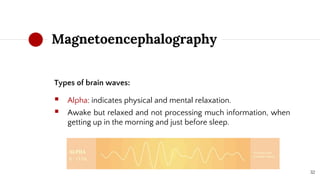
Magnetoencephalography
Types of brain waves:
 Alpha: indicates physical and mental relaxation.
 Awake but relaxed and not processing much information, when
getting up in the morning and just before sleep.
32
Magnetoencephalography
Types of brain waves:
 Beta: indicates normal alert consciousness, active thinking.
 Active conversations, making decisions, solving a problem,
focusing on a task, learning a new concept, ...
33
Magnetoencephalography
Types of brain waves:
 Gamma: indicates heightened perception or a peak mental state.
 Higher levels of consciousness.
34
Magnetoencephalography
Types of brain waves:
 It is very hard to capture gamma wave in an EEG, they originate
in the thalamus (center of the brain) and move from the back
part of the brain to the front with incredible speed.
35
Indications of the MEG
 Tumor and lesion evaluation
 Stroke and brain injury assessment
 Assess brain function post-injury
 Cognitive neuroscience and research
 Language processing
 Memory
 Neurodevelopmental and psychiatric disorders
 Autism spectrum disorder (ASD)
 Schizophrenia
 ADHD
36
Limitations of the MEG
 MEG systems are very expensive to purchase and maintain.
 Limited in availability (not widely accessible compared to EEG
or MRI).
 Less effective at detecting activity from deep brain structures.
 Movement sensitivity (even small head movements can distort
results).
 Does not provide structural (anatomical) information.
37
124
Ultrasound Imaging
125
◉ Ultrasound imaging, also known as sonography or
ultrasonography, is a diagnostic technique that uses high-
frequency sound waves to create cross-sectional images of the
human body.
◉ Real-time imaging technique (the ability to see moving structures
and changes within the body instantly).
◉ It relies on the principles of sound wave propagation and their
interactions with biological tissues.
126
Ultrasound Imaging
◉ Sound waves are mechanical waves
that require a medium to propagate.
◉ They are able to travel through air,
water and biological tissues.
127
Physical Principle
-onefoldspeed
di
require
adium
↳2 feilds Perpendiciar le speed
t
T
o TQ light
↳ electrmagnetic
↳ doesn't require medium
◉ Sound wave transmits their energy
mechanically, through pressure
variations on the particles.
◉ Regions of high pressure and density
are called “compressions” while
regions of low pressure and density
are called “rarefactions”.
128
Physical Principle
Properties of Sound Waves:
 Frequency: number of oscillations
(cycles) per second, measured in Hz.
 Wavelength: distance between
successive compressions or
rarefactions.
 Amplitude: height of the wave, also
called intensity/strength of the wave.
 Speed: speed at which the wave
travels through the medium.
129
Physical Principle
(nm or mm)
↓
decreases
themore
it travels
◉ Ultrasounds refer to sound waves with
frequencies above the audible range
for humans (20 Hz – 20 kHz).
◉ In medical ultrasound the frequency
of sound waves is in the range of
millions of cycles per second (2 MHz
to 20 MHz).
130
Physical Principle
T lowerthan higher than normal
normal human human
Mega Dange range
Longitudinal wave vs. transverse wave
• Longitudinal wave → the movements of particles in a medium are
parallel to the direction of propagation of the sound wave.
• Longitudinal sound waves are used in ultrasound imaging.
• Transverse wave → the movements of particles in a medium are
perpendicular to the direction of propagation of the sound wave.
131
Physical Principle
-
-
Generation of Ultrasound
 An ultrasound transducer (probe):
ultrasound waves are produced by
piezoelectric crystals in the
transducer.
• The electric signal is converted into
vibrations of the piezoelectric crystal,
which then generates ultrasound
waves.
132
Physical Principle
Pressure
[
me
In the pico electic crystal
converted into ultrasound
the electic Signals -
> wares
 The transducer sends an ultrasound pulse into tissue → ultrasound
images are produced relying on properties of acoustic physics
(reflection, refraction, absorption, and scattering) → these properties
cause attenuation of ultrasound that is used to localize and
characterize different tissue types.
Acoustic impedance is a physical property of a tissue in which how much
resistance it offers to stop the transmission of an ultrasound beam.
Differences between the acoustic impedance of two mediums govern the
proportions of reflected and transmitted sound waves.
133
Physical Principle
forsoundware
.
a
goes
back
(
tothe C
probe
generates
theimage
.
C
fortheeself
 If the sound waves encounter an impedance (resistance) on their way,
e.g. at the boundary between fatty tissue and water → then they are
reflected (echoed) → and received by the transducer → enough data
are recorded to form a rapidly moving real-time image.
134
Physical Principle
What happens to ultrasound waves in the body?
1. Absorption: a large part of the ultrasound waves is completely
absorbed into a medium.
• Absorption increases with increasing image depth and the applied
frequency.
2. Reflection: occurs when sound waves encounter a boundary
between two different tissues with varying acoustic impedance.
135
Physical Principle
b< when frequency inc qualit inc , but
Absorptionina so won't
b. we
limitation
helpinimage need reflection.
a
-
What happens to ultrasound waves in the body?
3. Refraction: bending of the ultrasound wave as it passes through a
boundary between two media with different propagation speeds.
4. Scattering: redirection of ultrasound waves in multiple directions
due to small inhomogeneities within the tissue.
136
Physical Principle
V
araying
↳ lung or stone in Kidney /some pathologies / you use scattering ba
some might reflect back to from image
137
The speed of propagation of the sound waves depends on the medium
which they pass through, and its elasticity and density.
The propagation speed of sound is higher in tissues with increased
stiffness (decreased elasticity) and reduced density.
• Density relates to the amount of matter in a given space.
• Elasticity relates to a material's ability to deform and recover its
original shape.
138
Physical Principle
Types of Transducers (Probes)
Transducers are subdivided according
to the propagation of the sound waves:
a. Linear transducers: the sound waves
propagate in parallel, which has the
advantage of geometrically accurate
imaging.
139
Basic Principles
Types of Transducers (Probes)
b. Convex transducers (curved array):
the sound waves spread out like a fan. A
large area can be imaged.
c. Sector transducers: the sound wave
propagation is fan-shaped and radial.
Typical application is cardiac ultrasound
with a transcostal access (between the
ribs).
140
Basic Principles
Convex
Sector
-
> for pregnant
women
Image Formation
• Ultrasound images are formed by sending short pulses of sound
waves into the body and receiving echoes from tissue interfaces
(reflected sound waves).
• The time taken for echoes to return helps calculate the distance
and create the image.
141
Basic Principles
-
gives location
Image Formation
• The time it takes for the ultrasound waves to reflect back to the
transducer varies depending on the density and composition of the
tissues.
• By analyzing the timing and intensity of these echoes, ultrasound
machines create detailed images that represent the internal
structures of organs, blood flow, and abnormalities.
142
Basic Principles
·
·
·
aplitude
T
-
Ultrasound Gel
• Because sound waves have a difficult
time traveling through the air, ultrasound
gel is used to reduce the air between the
transducer and the skin (to reduce the
acoustic impedance and reflection).
143
Basic Principles
1. A-Mode
• The A-mode is the oldest method.
• “A” stands for amplitude modulation.
• Today, this mode is still used for distance determination in ENT,
ophthalmology and neurology.
144
Imaging Techniques (Modes)
2. B-Mode
• The B-mode (for “brightness”)
• Is the most frequently used method.
• In the 2D image, the different pixels
are detected with different
brightness grey dots, depending on
the strength of the reflected signal.
145
Imaging Techniques (Modes)
3. M-Mode
• The M-mode (motion).
• Can be used to map the temporal
behavior of a tissue.
• It is used particularly in cardiology. A
typical example is the imaging of the
movement of a heart valve or the
myocardium.
146
Imaging Techniques (Modes)
4. Doppler Sonography
• Is used to assess blood flow through
blood vessels.
• Detect a frequency shift in echoes,
and determine whether the tissue
(blood) is moving toward or away
from the transducer.
147
Imaging Techniques (Modes)
proble pobt
V ~
Fed ↑ d ()
blue
↳ also depends
on way you
hold the
-
can
see
stenosisstels
movina again
Probe
4. Doppler Sonography
A general guide to the color scheme:
• Red: indicates blood flow towards the ultrasound probe. This color
typically appears when the blood is moving in the same direction as
the sound waves emitted by the probe.
• Blue: represents blood flow away from the ultrasound probe. This
color is used when the blood is moving in the opposite direction from
the sound waves.
148
Imaging Techniques (Modes)
◉ Abdominal Imaging
◉ Gynecology (prenatal imaging and gynecological imaging)
◉ Cardiovascular imaging (echocardiography and carotid ultrasound)
◉ Endocrinology (thyroid Ultrasound)
◉ Vascular Imaging
◉ Urology
◉ Musculoskeletal imaging and others.
149
Clinical Applications
↳ breasts imaging
◉ Depth of Penetration
○ Ultrasound waves have limited penetration depth compared to other imaging
modalities like CT or MRI.
○ Higher frequency ultrasound waves provide better resolution but penetrate less
deeply, limiting visualization of structures deep within the body.
◉ Obesity and Air
○ Ultrasound waves are attenuated by air and bone, which can hinder imaging
quality in obese patients or in regions where there is significant gas (e.g., bowel
loops). This can make it challenging to obtain clear images in these situations.
◉ Operator Dependency
150
Limitations
for
abdomen
they
a
◉ Limited Field of View
◉ Limited Tissue Characterization
○ Ultrasound provides limited information on tissue composition or specific tissue
characteristics (e.g., distinguishing between different types of liver masses)
◉ Patient Factors and Positioning
○ Patient factors such as body habitus, patient cooperation, and the need for specific
patient positioning can affect the ability to obtain optimal ultrasound images
151
Limitations
Electromagnetic Spectrum
13
Electromagnetic Spectrum
14
Electromagnetic Spectrum
15
Electromagnetic Spectrum
16
metabolic
activity
ofcancer
cellsShow·
T
-
> dye-radioactivity
Exkidney
-
> hybrid imaging
modalities
17
Radiography (X-Ray Imaging)
18
History of X-Ray
 Wilhelm Roentgen discovered X-Ray in
1895 by accident while experimenting
with cathode rays. He observed a
fluorescent glow from a nearby screen,
he named the new rays "X-rays“, where
"X" stood for an unknown.
 Roentgen’s discovery quickly led to the
development of medical imaging.
19
Wall Bucky
X-Ray Tube
X-Ray Table
X-Ray detector
is located here
X-Ray Machine Components
ag
theinteractia
X-ray
Production-
1 % X-ray
/Characteristic
breaking
dete
Basic Principles
◉ X-Ray beam is generated in the X-Ray tube.
20
tungsten (high atomic #)
- Produces
is
chase
on
j Charged
e-
so
C all e-
be
has
e-
& They'retalea & releasa
pulledit
e-gotow
and
amodeeurgett
Basic Principles
◉ When X-Rays are emitted towards the body,
one of three situations will happen:
○ X-Rays pass through the body (body parts with
low density ‘low atomic number’ e.g. air and fat).
○ X-Rays are blocked and absorbed by the body
(body parts with high density ‘high atomic
number’ e.g. bone and implanted metals).
○ X-Rays may be deflected or scattered.
◉ X-Rays pass through the body, with varying
degrees of absorption (attenuation).
21
&The film itself is
white ,
oncexray passes
a
itmakes
e
air
for
e WHITE
film
spot
of
↳ never waso
attentuation
Basic Principles
◉ A device located behind the patient, called
X-Ray detector, captures the transmitted X-
Rays, converting them into an image.
○ X-Rays that pass through the body render the
film dark (black) → Radiolucent.
○ X-Rays that are totally blocked and absorbed
render the film light (white) → Radiopaque.
○ The varying degrees of the X-Ray attenuation
make the various radiographic densities in the
image (gray-scale).
22
if X-ray passes
clothing ,
that part
of film
tenuations
remains
white diffrent
a
give
us
aspectiae
◉ Plain X-Ray, also called conventional radiography, is the simplest
and most common type of X-Ray imaging that offers a quick and
cost-effective way to visualize certain internal structures.
◉ Uses a beam of X-rays to create a two-dimensional image
(superimposed view) of the internal structures within the body.
○ Multiple views (projections) from different angles may be necessary for a
comprehensive understanding.
◉ A valuable tool for initial evaluations and diagnosing various
conditions.
23
X-Ray Imaging
X-Rays may be taken in various patient positions, based on patient
condition and the body part being examined.
Common patient positions include:
24
Standing Supine Decubitus
Prone
X-Ray Imaging
X-Ray projections describe the direction the X-ray beam travels in
relation to the body part being imaged. Common projections include:
25
AnteroPosterior (AP)
X-Ray Imaging
Path -> where X-ray
enter & exits
26
PosteroAnterior (PA)
X-Ray Imaging
Skull
-
>
is
Pa
ess
to scan the
Sinusesato
detecte
↓
better
betweena
27
Lateral
X-Ray Imaging
-
> 90
%
lateral
medial
↓
Lateral
medial
Put
left side
-
> left
on
detector lateral
Closer +o
detecter)
28
Oblique
X-Ray Imaging
29
X-Ray Imaging
Why do we need more than one view?
We need more than one view for an X-ray because a 2D image
can hide details. Structures can overlap, and we may miss
fractures, fluid, or masses seen only from another angle
kVp (Kilovolt Peak)
• Kilovolt peak (kVp) refers to the maximum voltage applied across
the X-ray tube during an exposure.
• It determines the energy and penetrating ability of the X-ray
photons produced.
• Higher kVp results in more energetic X-rays that can pass through
denser tissues.
30
X-Ray Imaging
mAs (Milliampere-Seconds)
• Milliampere-seconds (mAs) is the product of the tube current
(measured in milliamperes) and the exposure time (measured in
seconds).
• It controls the total quantity of X-ray photons generated during an
exposure.
• It has a direct relationship with patient dose, where higher mAs
increases radiation dose.
• mAs = mA x exposure time (seconds)
31
X-Ray Imaging
32
X-Ray Imaging
X-ray Control Panel
Clinical Indications:
• Evaluating fractures and bone injuries.
• Examining joints for signs of arthritis or other problems.
• Checking for pneumonia or other lung diseases.
• Identifying foreign objects swallowed or lodged in the body.
• Monitoring the progress of certain medical conditions.
30
X-Ray Imaging
>
romatizim
Limitations:
• Does not provide detailed information about soft tissues or organs
other than bones and lungs.
• Can be difficult to distinguish between certain structures that have
similar densities.
• Involves exposure to ionizing radiation, although the amount is
relatively low for plain X-Rays.
31
X-Ray Imaging
32
Fluoroscopy
◉ Fluoroscopy uses a continuous X-Ray
beam to create live images on a
monitor, similar to an X-Ray but with
the added benefit of motion.
○ Allowing physicians to observe the
movement of organs and tissues.
◉ It allows real-time visualization of the
internal structures of the body.
33
Fluoroscopy
Applications of fluoroscopy
◉ Diagnostic imaging:
a. Gastrointestinal tract (barium
swallow and barium enema)
34
Fluoroscopy
·
↳ Liquid/gadin
tum
oraly
Applications of Fluoroscopy
◉ Diagnostic imaging:
b. Assessing blood flow
(angiography = arteriography)
35
Fluoroscopy
Coronary Angiography Cerebral Angiography
- the more
you cen
construct
here
not due
colo's
& ability to
distinguish
-
> differentiatiate (less
its the
diff in
colors) so more contrast
& btw
obj thathave
ity - many densities= low contrast
similar
IV
Apex of
Brain
heart
Angio
steries
Used in eatherization
Applications of Fluoroscopy
◉ Diagnostic imaging:
c. Assessing joint movement
36
Fluoroscopy
↳bone is black because
its postprocessing
,
so
its negative
editting
after
recording it to see
morearly
Applications of Fluoroscopy
◉ Interventional procedures:
a. Angioplasty and stents implantation
37
Fluoroscopy
We put needle
through femeral
artem first ba
its widest
Circumflex
Y
narrowing
↓
Stenosis
Applications of Fluoroscopy
◉ Interventional procedures:
b. Biopsy needle guidance
38
Fluoroscopy MRF ,
neck, Sagittal
rig
lung
②
Applications of Fluoroscopy
◉ Interventional procedures:
c. Joint injections
39
Fluoroscopy
·
↳ ex) oily needle injection
forsmoother flow
Applications of Fluoroscopy
◉ Interventional procedures:
d. Spinal procedures
40
Fluoroscopy
Clinical Applications:
• Guiding medical procedures (stent implantation, biopsies, joint
injections and spinal procedures).
• Gastrointestinal studies (barium swallow and barium enema).
• Angiography (cardiac, cerebral and peripheral …)
41
Fluoroscopy
Limitations:
• Involves exposure to ionizing radiation (continuous exposure).
• Limited soft tissue detail.
• Limited field of view.
• Contrast medium limitations.
42
Fluoroscopy
·
↳
Some pol can't
·
takeitbe of allergies
or kidney problems
43
Mammography
◉ Mammography is a specialized
medical imaging technique used to
examine the breasts, primarily for the
early detection of breast cancer.
◉ It involves using low-energy X-Rays
to create detailed images of the
breast tissue.
44
Mammography
↳ 2D
Types of Mammography:
◉ Screening mammography: this is used for routine, asymptomatic
patients to detect early signs of breast cancer, often before
symptoms appear.
◉ Diagnostic mammography: used for patients who have signs or
symptoms (such as a lump or abnormal physical exam) or those
with an abnormal screening mammogram.
45
Mammography
Clinical Applications:
• Screening for breast cancer.
• Breast cancer staging.
• Monitoring post-treatment changes.
• Biopsy guidance.
46
Mammography
Limitations:
• Inability to detect small tumors in dense breasts.
• Limited sensitivity in young women (under 40 years).
• Involves exposure to ionizing radiation.
47
Mammography
runger
women
Y
usually havedensyou
e
sound
X use ul
-
> Ultrasoundhe40
48
Dental Radiography (Panoramic X-Ray)
◉ Panoramic X-Ray is a type of
dental radiograph that captures
a broad, panoramic image of
the entire mouth area, including
the teeth, jaws, and surrounding
structures, in a single shot.
◉ It provides a comprehensive
view of the upper and lower
jaws, teeth, and the surrounding
bones and tissues.
49
Panoramic X-Ray
LBLT
-
istypeatdetailed
Than
Panoramic
be its 3D ,
but its
higher close
of
X-ray
used for these alot
-
Sinuses & TMjoints
mastonr cells
Shows
O
◉ In a panoramic X-Ray, a machine rotates
around the patient's head to capture a full, 180-
degree view of the mouth, teeth, and jaw.
◉ The machine creates a single image by
capturing X-Rays from all angles, which are
then combined into one large panoramic image.
50
Panoramic X-Ray
#
1888
tube 2 detecter
↳ putyour tongue on the roof of e
rotate
mouth to
prevent air
from Coming in -
Clinical Applications:
• Evaluation of teeth and jaw structures.
• Orthodontic treatment planning.
• Implant planning.
• Oral and Maxillofacial pathology (cysts, tumors or infections within
the jawbone or surrounding structures).
• Sinus evaluation.
• Temporomandibular joint (TMJ) assessment.
51
Panoramic X-Ray
Limitations:
• Not ideal for small-scale issues (between teeth or along the root
surfaces).
• Image distortion.
• Involves exposure to ionizing radiation.
52
Panoramic X-Ray
-
> betube itself is moving

Biophysics 2.pdffffffffffffffffffffffffff

  • 1.
    Radiation-Based Diagnostic Methods: MedicalImaging Modalities Biophysics II Course Washington University of Health and Science Summer 2025 Lecturer: Huda Nasser
  • 2.
  • 3.
    Medical Imaging ◉ Medicalimaging is a type of diagnostic testing. ◉ Non-invasive techniques and approaches used to create visual representations of the internal organs and tissues of the human body. ◉ Medical imaging is widely used to examine and visualize different parts of the body, including bones, muscles, organs, blood vessels, and other internal structures. 3
  • 4.
    Medical Imaging Medical imagingis used to visualize body parts in different anatomical planes. 4 *= ray Ct bruin details show MRI-CSEshows -Space btur vertebreas (disc Shows clearly
  • 5.
    Medical Imaging Medical imagingis used to visualize body parts in different anatomical planes. 5 X-ray Ct CT MRI - > brain details, bones are notbright
  • 6.
    Medical Imaging Medical imagingis used to visualize body parts in different anatomical planes. 6 MRI+ p ul luyers show ↳ Skull Shows white more details - > ventricles parts are in cancer dye would contrast/dye-Oralsprea more, or it blood Vessel blocked,youcan see dye stopped
  • 7.
    Medical Imaging Medical imagingis used to visualize body parts in different anatomical planes. 7 4th pic page(axial) first pic is ct,( abdomen) and you can’t really see csf, 2nd pic is mri( white part which is first layer in mri is always fat) ct however shows bone clearly as white ↓ w , contrast
  • 8.
    Imaging Modalities 8 Imaging Modalities Computed Tomography (CT) Radiography Ultrasound Magnetic Resonance Imaging (MRI) Nuclear Medicine SinglePhoton Emission Computed Tomography (SPECT) Positron Emission Tomography (PET) Fluoroscopy Plain X-Ray Mammography Dental Radiography 3D 3D 2
  • 9.
    Imaging Modalities ◉ Eachmodality has its own principles, indications and limitations. ◉ Understanding the principles of each modality is essential for interpreting images accurately and providing effective patient care. 9 ·
  • 10.
  • 11.
  • 12.
  • 13.
  • 14.
  • 15.
    Tomo = Slice or section ComputedTomography (CT Scan) 58 Graph = To write or to describe From Ancient Greek  Computed tomography (CT) is a powerful imaging technique that utilizes X-Rays to create detailed cross-sectional images of the human body.
  • 16.
    ◉ Unlike traditionalX-Rays that provide a flat 2D image, CT scans offer a much more comprehensive view, by capturing X-Ray data from multiple angles. ◉ A sophisticated computerized method is used to obtain data and transform them into cross-sectional slices of the human body. ◉ Advanced computer processing is utilized to reconstruct highly detailed 3D images of internal organs, bones, and soft tissues. 59 CT Scan
  • 17.
  • 18.
    ◉ All CTexaminations are performed by obtaining data for a series of slices through a designated area of interest. ◉ The structures in a CT image are represented by varying shades of gray. The creation of these shades of gray is based on basic X- radiation principles. ◉ Hounsfield Units can be defined as the quantification of the degree that a structure attenuates an X-Ray beam. ◉ These units are also referred to as CT numbers, or density values. 61 CT Scan
  • 19.
  • 20.
  • 21.
  • 22.
  • 23.
  • 24.
  • 25.
  • 26.
  • 27.
    ◉ CT contrastmedia, also known as CT contrast dye or contrast agent, is a substance that is used to improve the visibility of certain organs, tissues, and blood vessels during a CT scan. ◉ They are chemically designed to be radiopaque. ◉ Iodine-based contrast is the most common type. It may be ingested (orally) or injected intravenously (IV) by a contrast injector (automatically) or manually. 70 CT Contrast Media Contrast Injector
  • 28.
    71 CT Contrast Media CarotidCT Angiography (CTA)
  • 29.
  • 30.
    ◉ Cancer detectionand staging. 73 Clinical Applications of CT Scan
  • 31.
    ◉ Trauma evaluation. 74 ClinicalApplications of CT Scan
  • 32.
    ◉ Neurological conditions ○Stroke, brain tumors, and bleeding in the brain. 75 Clinical Applications of CT Scan
  • 33.
  • 34.
    ◉ Limited softtissue visualization ○ CT scans are not as good as MRI scans for visualizing certain soft tissues, such as the brain and muscles. ◉ Radiation exposure ○ CT scans use ionizing radiation, which carries a risk of harm to the patient. ○ CT scan generally is not recommended for pregnant patients. ◉ Contrast media ○ Some CT scans require the use of contrast media, which may cause allergic reactions and may be harmful to patients with kidney problems. 77 Limitations of CT Scan
  • 35.
  • 36.
    ◉ Nuclear medicineutilizes radioactive materials called radiopharmaceuticals. ◉ These radiopharmaceuticals are radioactive drugs used for diagnosis or therapy in trace quantities. ◉ Once injected or ingested, the radiopharmaceuticals accumulate in the target areas, emitting energy in the form of gamma rays or positrons, which can be detected by special imaging equipment. 79 Nuclear Medicine
  • 37.
    Targeting Molecule Radiopharmaceuticals 80 Radionuclide Composed of: Thedelivery vehicle that guides the radiopharmaceutical to the desired location in the body. Examples: sugars, antibodies, peptides
  • 38.
    Beta-Plus ẞ+ Decay(Positron Emission) ◉ Unstable atomic nucleus (a proton-rich nucleus) undergoes a transformation. ◉ A proton inside the nucleus is transformed into a neutron, resulting in emission of a positron (e+) and neutrino (ve). 81 Radionuclides
  • 39.
    Commonly used radionuclidesin nuclear medicine:  Technetium-99m (Tc-99m) → Half-life of 6 hours  Fluorine-18 (F-18) → Half-life of 109.7 minutes  Iodine-131 (I-131) → Half-life of 8 days  Thallium-201 (Tl-201) → Half-life of 73.1 hours  Gallium-67 (Ga-67) → Half-life of 3.26 days  And others … 82 Radionuclides The first Tc-99m generator, 1958
  • 40.
    Imaging Techniques: There areseveral different imaging techniques used in nuclear medicine, including: ◉ Single-photon emission computed tomography (SPECT): this technique uses a gamma camera that rotate around the patient to create 3D images of the distribution of radioactivity in the body. 83 Nuclear Medicine
  • 41.
    Imaging Techniques: ◉ Positronemission tomography (PET): this technique uses a PET scanner to detect positrons that are emitted by certain radiopharmaceuticals, creating a 3D image of the distribution of radioactivity in body, which reflects the level of cellular activity in different tissues. 84 Nuclear Medicine
  • 42.
  • 43.
  • 44.
    Safe Handling ofRadioactive Materials ◉ Personal Protective Equipment (PPE): lab coat, gloves, eye protection, thyroid shield and shoe covers. ◉ Healthcare professional should work in designated areas with proper ventilation. ◉ Radioactive waste is disposed in designated containers according to regulations. ◉ Typically, radioactive waste should be stored for at least 10 half-lives. 87 Safety First: A Crucial Aspect of Nuclear Medicine
  • 45.
    ◉ Presenting cellularfunction. ◉ Cancer detection. ◉ Monitoring treatment. ◉ Other uses → diagnose and assess heart disease, brain disorders, and other conditions. 88 Clinical Applications of Nuclear Medicine
  • 46.
    ◉ Nuclear medicineimages primarily reveal function, not detailed anatomy. Sometimes, additional imaging tests like CT or MRI might be needed for a complete picture. ◉ Pregnant and breastfeeding women often require special considerations due to radiation exposure risks to the fetus or infant. 89 Limitations of Nuclear Medicine
  • 47.
  • 48.
    91 Permanent Magnet islocated inside Strong Superconductive Magnet is located inside
  • 49.
    The primary atomused in MR imaging is Hydrogen (1H). Due to: ◉ Abundance in the human body, primarily found in water and fat, making up around 70% of the body. ◉ Its nucleus has a single proton, which has a significant magnetic moment → produces a strong signal. 92 Basic Principle
  • 50.
    93 What happens whenwe put a patient into the magnet of MR machine?
  • 51.
    What happens, whenwe put a patient into the magnet of MR machine? ◉ Proton inside the nucleus of (H) atom has a positive electrical charge which possesses a spin (rotates around its own axis). ◉ A moving of electrical charge (electrical current) is accompanied by a magnetic field. ◉ The proton has its own magnetic field. 94 Basic Principle
  • 52.
    What happens, whenwe put a patient into the magnet of MR machine? ◉ The protons -being a little magnets- in the human body align themselves in the external magnetic field. ◉ Radiofrequency (RF) pulses are sent from the RF coils to the human body. ◉ Protons pick up some energy from those radio waves (RF pulses) → Resonance phenomenon. 95 Basic Principle
  • 53.
    What happens, whenwe put a patient into the magnet of MR machine? ◉ When the RF pulse is switched off, protons start to relax, and release the absorbed energy (relaxation). ◉ The rate at which the protons relax back to their original state depends on the type of tissue they are in. ◉ Different tissues have different relaxation times, aiding in tissue differentiation. 96 Basic Principle
  • 54.
    Signal Detection ◉ TheMRI scanner detects the radio signals emitted by the relaxing protons. ◉ By analyzing these signals, the MRI scanner can create a map of the different tissues in the body. 97 Basic Principle
  • 55.
    Magnetic Field Strength:Measured in Tesla (T), a stronger magnetic field generally produces higher quality images with better resolution. 98 MR Magnet
  • 56.
  • 57.
    The commonly encounteredfield strengths: ◉ 0.2T to 1.5T: This is the most common range for clinical MRI scanners. ○ 1.5T: This is the current workhorse of MRI, offering a good balance between image quality, patient comfort, and cost. ○ 0.2T to 1.0T: these scanners might be used in specific situations like imaging or for patients who experience claustrophobia. ◉ 3T: This is considered a high-field strength and offers improved image quality and advanced techniques. ◉ 7T and above: These are considered ultra-high-field strengths and are primarily used in research settings. 100 MR Magnet
  • 58.
    MRI encompasses avariety of techniques tailored to visualize different tissue properties and pathologies. Here are some of the main MR imaging techniques: 101 MR Imaging Techniques
  • 59.
    1. T1-Weighted Imaging Appearance: Tissues with short T1 relaxation time (like fat) appear bright  Tissues with longer T1 times (like fluid, water) appear dark  Muscles appear intermediate 102 MR Imaging Techniques Brain T1 MRI (Axial ‘Horizontal’ View) Brain T1 MRI (Coronal View)
  • 60.
    103 T1-Weighted Images Cervical SpineMRI (Sagittal View) Lumbar Spine MRI (Sagittal View) Lumbar Spine MRI (Axial “Horizontal” View)
  • 61.
    104 T1-Weighted Images Sacroiliac JointMRI (Coronal View) Knee MRI (Sagittal View) Ankle MRI (Sagittal View)
  • 62.
    Clinical use:  Goodat providing high anatomical details  Detection of fat-containing structures and post-contrast imaging 105 Tumor MR Imaging Techniques Brain MRI (Post-Contrast T1)
  • 63.
    2. T2-Weighted Imaging Appearance: Fluids appear bright  Fat appears dark  Muscles appear dark 106 MR Imaging Techniques Brain T2 MRI (Axial ‘Horizontal’ View) Brain T2 MRI (Sagittal View)
  • 64.
    107 T2-Weighted Images Cervical SpineMRI (Sagittal View) Lumbar Spine MRI (Sagittal View) Lumbar Spine MRI (Axial “Horizontal” View)
  • 65.
    108 T2-Weighted Images Pelvis MRI (SagittalView) Knee MRI (Sagittal View) Knee MRI (Axial ‘Horizontal’ View)
  • 66.
    Clinical use:  Usefulfor identifying pathology  Detection of edema, inflammation and other fluid-containing lesions 109 MR Imaging Techniques Brain MRI (T2 Image)
  • 67.
    110 T1 VS. T2-Weighted Images Brain T2 MRI (Axial View) Brain T1 MRI (Axial View) CSF (dark) Fat (bright) Fat (darker than T1) CSF (Bright)
  • 68.
    111 T1 VS. T2-Weighted Images Lumbar Spine T2 MRI (Axial View) Lumbar Spine T1 MRI (Axial View)
  • 69.
    3. Fluid-Attenuated InversionRecovery (FLAIR) A special technique designed to suppress the signal from fluids- particularly cerebrospinal fluid CSF Appearance:  CSF (suppressed) → dark  Pathological fluid → bright  Normal brain tissue → intermediate 112 MR Imaging Techniques Brain T2 FLAIR MRI (Axial View) Brain T2 FLAIR MRI (Coronal View)
  • 70.
    Clinical use:  Usefulin detecting lesions near CSF spaces  Multiple sclerosis, periventricular lesions, subarachnoid hemorrhages and others 113 MR Imaging Techniques Multiple Sclerosis Hemorrhage
  • 71.
    4. Short TauInversion Recovery (STIR) A special technique that suppresses the signal from fat Appearance:  Fluids and water → bright  Fat (suppressed) → dark  Bone → dark 114 MR Imaging Techniques Ankle STIR MRI (Sagittal View)
  • 72.
    115 STIR Images Cervical SpineMRI (Sagittal View) Foot MRI (Coronal View) Shoulder MRI (Coronal View)
  • 73.
    Clinical use:  Effectivein distinguishing between fat and other tissue types  In musculoskeletal imaging → edema, inflammation, tumors and others 116 MR Imaging Techniques Shoulder Metastasis Inflamed SI Joint
  • 74.
    Summary of themain imaging techniques: 117 MR Imaging Techniques Tissue Type T1 Weighted T2 Weighted T2 FLAR STIR CSF Dark Bright Dark (suppressed) Bright Pathological Fluid Dark Bright Bright Bright Fat Bright Darker than T1 Darker than T1 Dark (suppressed) Muscle Intermediate Darker than T1 Darker than T1 Intermediate to dark
  • 75.
    ◉ Gadolinium isa rare earth metal with paramagnetic properties (it enhances the signal in MRI) → makes tissues appear brighter on T1 images. ◉ Used in MRI to improve the visibility of internal structures and the contrast between normal and abnormal tissues. ◉ Administered to the human body through intravenous (IV) injection. 118 Gadolinium-Based Contrast Agent
  • 76.
  • 77.
    ◉ Items suchas jewelry, watches, credit cards, cell phones and any metal objects must be removed before entering the MRI room. ◉ Patients usually are provided with earplugs, as MR machines produce loud knocking sounds. 120 MRI Safety
  • 78.
    ◉ Materials usedin and around MR scanners must be non-ferromagnetic and non-metallic to prevent interactions with the magnetic field. ◉ The scanning room is prepared with a compatible materials (MRI table, contrast injector, lighting lamps …) 121 MRI Safety
  • 79.
    ◉ Neurology ○ Brainand spinal imaging. ◉ Musculoskeletal System ○ Examining muscles, ligaments, tendons, and bones. ◉ Cardiology ○ Cardiomyopathies, congenital heart disease and vascular imaging. ◉ Oncology ○ Tumor detection and monitoring treatment response. ◉ Abdominal imaging, vascular imaging and others … 122 Clinical Applications of MRI
  • 80.
    ◉ Time consuming ○Scan duration ranges between 15 minutes to over an hour. ○ May lead to patient movement during scan → motion artifacts. ◉ Patient contraindications ○ Metal implants and devices as pacemakers and other electronic devices. ○ Claustrophobia. ◉ Limited information on bones ○ MRI is not the best imaging modality for examining bones. CT scan is typically preferred for imaging bones. ◉ Small risk of allergic reactions to contrast media ◉ High cost 123 Limitations of MRI
  • 81.
    Heart Electrophysiology andElectrocardiography Biophysics II Course Washington University of Health and Science Summer 2025 Lecturer: Huda Nasser
  • 82.
  • 83.
  • 84.
    Heart Electrophysiology  Theheart is a muscular organ comprised of four chambers with two atria (right and left) opening into right and left ventricles via tricuspid and mitral valves, respectively.  A wall of muscle called the septum separates all four chambers. 4 made up -
  • 85.
    Heart Electrophysiology 5  Theheart is a mechanical pump whose activity is governed by the electrical conduction system.  This mechanical work of pumping blood to the whole body occurs in a synchronized manner and is under the control of the cardiac conduction system.
  • 86.
    Heart Electrophysiology  Itis comprised of two types of cells, pacemaker and non-pacemaker cells.  Pacemaker cells are located primarily in the SA and AV node, and it is the SA node that drives the rate and rhythm of the heart.  The AV node gets suppressed by the more rapid pace of the SA node. 6
  • 87.
    Heart Electrophysiology  Thespecialized function associated with the pacemaker cells is their spontaneous depolarization with no true resting potential.  When spontaneous depolarization reaches the threshold voltage, it triggers a rapid depolarization followed by repolarization. 7
  • 88.
    Heart Electrophysiology  Thenon-pacemaker cells mainly comprise the atrial and ventricular cardiac muscle cells and Purkinje fibers of the conduction system. 8
  • 89.
    Heart Electrophysiology  Theyconsist of true resting membrane potential, and upon initiation of an action potential, rapid depolarization is triggered, followed by a plateau phase and subsequent repolarization.  Action potentials are generated by ion conductance via the opening and closing of the ion channels. 9
  • 90.
  • 91.
     Electricity issimply the flow of electric charge across a gradient.  In living organisms, charge gradients across membranes produce electricity in the form of flowing ions.  The flow of charged ions causes heart to beat and muscles to contract. 11 Heart Electrophysiology
  • 92.
  • 93.
    Electrocardiography Electro-Cradio-Gram (ECG) Electricity HeartVisualize  In German, it is elektro-kardio-graphie → (EKG) 13
  • 94.
    Electrocardiography  The electrocardiogram(abbreviated as ECG or EKG) is a test that records the electrical activity of the heart, including the rate and rhythm to diagnose heart disorders.  It is recorded non-invasively from the surface of the body. 14
  • 95.
    Electrocardiography  It wasinvented in 1902 by the Dutch physician William Einthovan.  This invention laid the foundation of the most fundamental technique for investigating heart disorders.  ECG was soon recognized as a robust screening and clinical diagnostic tool, and today it is used globally in almost every healthcare setting. 15
  • 96.
    Electrocardiography  The goalof the electrocardiogram interpretation is to determine whether the ECG waves and intervals are normal or pathological. Electrical signal interpretation gives a good approximation of heart pathology. 16
  • 97.
    Electrocardiography The equipment forperforming a conventional 12-lead ECG includes:  Electrodes (sensors)  Gauze and skin preparation (alcohol rub) solution  Razors, clippers, or a roll of tape (for hair removal)  Skin adhesive and/or antiperspirant  ECG paper  Cardiac monitor or ECG machine 17 found inside the electrodes Cadiff reading from diff places - - ① -> 10 of them (physical ② ③ be it causes artifacts ⑨ - antisweat ⑤ - > beforePrinting on/after printing is called ECC Trace ⑯
  • 98.
  • 99.
    Electrocardiography  The conventional12-lead ECG consisting of six limbs and six precordial leads is organized into ten wires (electrodes).  The limb leads include I, II, III, aVL, aVR, and aVF and are named RA, LA, RL, and LL.  The limb leads are color-coded to avoid misplacement (red - right arm, yellow - left arm, green - left leg, and black - right leg). 19 - > 4 electrodes (contain 6 limb leads)
  • 100.
    Electrocardiography  The precordial(chest) leads V1 to V6 are attached to the surface of the chest.  Electrodes: is the physical sticky patches (wires attached) placed on the body.  Leads: the electrical views or recordings the ECG machine makes.  10 electrodes → 12 leads 20 u Samenamefor elected as
  • 101.
  • 102.
  • 103.
    Electrocardiography Principle  The fundamentalprinciple behind recording an ECG is an electromagnetic force, current, or vector with both magnitude and direction. When a depolarization current travels towards the electrode, it gets recorded as a positive deflection, and when it moves away from the electrode, it appears as a negative deflection. 23
  • 104.
    Electrocardiography Principle  A currentof repolarization traveling away from the positive electrode is seen as a positive deflection and towards a positive electrode as a negative deflection.  When the current is perpendicular to the electrode, it touches the baseline and produces a biphasic wave. 24
  • 105.
    Electrocardiography Principle  Electrocardiogram machinesare designed to record changes in electrical activity by drawing a trace on a moving electrocardiograph paper.  The electrocardiograph moves at a speed of 25 mm/sec. Time is plotted on the x-axis and voltage on the y-axis. On the x- axis, 1 second is divided into five large squares, each representing 0.2 sec.  Each large square is further divided into five small squares of 0.04 sec each. 25
  • 106.
    Electrocardiography Principle  Electrical signalsfrom the heart can be detected on the surface with electrodes.  These signals are amplified and displayed as waves on a screen or paper. 26
  • 107.
    Electrocardiography ECG Waveform  P-wave:represents atrial depolarization on the ECG. As atrial depolarization initiates by the SA node located in the right atrium, the right atrium gets depolarized first, followed by left atrial depolarization. So the first half of the P wave represents right atrial depolarization and the second half shows left atrial depolarization. 27
  • 108.
    Electrocardiography ECG Waveform  PRInterval: represents the time from the beginning of atrial depolarization to the start of ventricular depolarization and includes the delay at the AV node.  QRS complex: represents ventricular depolarization as current passes down the AV node. 28
  • 109.
    Electrocardiography ECG Waveform  Q-wave:represents the depolarization of the interventricular septum.  R-wave: represents the electrical stimulus as it passes down the ventricles during depolarization.  S-wave: represents the final depolarization of the Purkinje fibers. 29
  • 110.
    Electrocardiography ECG Waveform  ST-segment:depicts the end of ventricular depolarization and the beginning of ventricular repolarization.  T-wave: represents ventricular repolarization.  QT interval: represents the start of depolarization to the end of the repolarization of ventricles. 30
  • 111.
    Electrocardiography Interpretation  The bestway to interpret an ECG is to read it systematically.  Heart rate and heart rhythm are evaluated by ECG. 31
  • 112.
    Electrocardiography 1. Rate: For thecalculation of rate:  The number of either small or large squares between an R-R interval should be calculated.  The rate can be calculated by either dividing 300 by the number of big squares or 1500 by the number of small squares between two R waves. 32
  • 113.
    Electrocardiography 1. Rate: The heartrate can be calculated as: Heart Rate (bpm) = 300 / R-R interval (no. of large squares) or Heart Rate (bpm) = 1500 / R-R interval (no. of small squares)  Normal HR is 60 to 99 beats per minute.  If it is less than 60, it is called bradycardia, and if greater than 100, it is referred to as tachycardia. 33
  • 114.
  • 115.
    Electrocardiography 2. Heart rhythm: Foran accurate interpretation of rhythm. It involves looking for several points: 1. The presence or absence of regular P waves 2. The duration of QRS complexes (narrow or wide) 3. The correlation between P waves and QRS complexes, whether the rhythm is regular or irregular 4. The morphology of P waves 35
  • 116.
    Electrocardiography 2. Heart rhythm: Thosefeatures also help identify if the arrhythmia originates in the atria or ventricles. Many disorders are related to rhythm abnormalities. 36
  • 117.
    Electrocardiography Several types ofECG monitoring equipment are available, including:  Continuous ECG monitoring  Telemetry ECG system  Ambulatory ECG  Wireless mobile cardiac monitoring systems, etc. 37 Continuous Ambulatory Telemetry Wireless (Portable)
  • 118.
    Electrocardiography  With theevolution of technology, there are electronic wristwatches that can also monitor the heart rate and rhythm.  However, the accuracy of these devices may be somewhat inferior compared to a 12-lead ECG. When prompted for abnormal findings, these require confirmation by standardized clinical testing available in the cardiology office. 38
  • 119.
    Electrocardiography Preparation  Before theprocedure, a brief history regarding drugs and allergies to adhesive gel is necessary.  For good contact between the body surface and electrodes, it is advised to shave the chest hair.  Any metallic object requires removal.  Limb and precordial leads should be accurately placed to avoid vector misinterpretation.  Finally, the patient must lie down and relax before recording the standard 10-second strip. 39
  • 120.
    Indications of theECG  Symptoms are the foremost indication of the ECG, including palpitation, dizziness, chest pain, seizure, and poisoning.  Symptoms or signs associated with heart disease include tachycardia, bradycardia, and clinical conditions including hypothermia, shock, hypotension, and hypertension.  To detect myocardial injury, ischemia, and the presence of prior infarction.  Rheumatic heart disease. 40 00 ⑤
  • 121.
    Indications of theECG  Detecting pacemaker or defibrillator device malfunction, evaluating their programming and function.  Helpful for the assessment of blunt cardiac trauma.  Perioperative anesthesia monitoring, as well as preoperative assessment and postoperative monitoring. 41
  • 122.
    Limitations of theECG  Limited structural (anatomical) and blood flow information.  May miss early heart disorders.  Incorrect electrode placement can lead to false readings.  Less reliable in some patients, e.g. obese, muscular, or those with lung disease. 42
  • 123.
    Radiation Therapy Biophysics IICourse Washington University of Health and Science Summer 2025 Lecturer: Huda Nasser
  • 124.
  • 125.
    ◉ Radiation therapy(also called radiotherapy) is a cancer treatment that uses high doses of radiation to kill cancer cells and shrink tumors. 3 Radiation Therapy
  • 126.
    ◉ Ionizing radiationsgenerate free radicles, which subsequently damage vital cellular components and lead to double-stranded DNA breaks (DSBs), resulting in chromosomal aberrations and rearrangements. ◉ Some cells undergo apoptosis due to the resulting damage, and some cells die during mitosis due to improperly repaired chromosomal damage. ◉ Normal cells can repair DNA breaks better than tumor cells. 4 Radiation Therapy
  • 127.
    ◉ At highdoses, radiation kills cancer cells or slows their growth by damaging their DNA. Cancer cells whose DNA is damaged beyond repair stop dividing or die. When the damaged cells die, they are broken down and removed by the body. ◉ Radiation therapy does not kill cancer cells right away. It takes days or weeks of treatment before DNA is damaged enough for cancer cells to die. Then, cancer cells keep dying for weeks or months after radiation therapy ends. 5 Radiation Therapy
  • 128.
    Primary goals ofradiotherapy: • Curing cancer (curative) • Controlling tumor growth • Adjuvant (post-surgery) • Palliative (symptom relief) purpose 6 Goals of Radiation Therapy
  • 129.
    • The mostcommonly used radiotherapy treatment employs a beam of high-energy X-Rays (photon beam) generated external to the patient and directed toward the tumor. • Electron beams • Protons and neutrons (these particles offer more precise targeting compared to X-rays but are less commonly available). • Implanted radioactive sources (gamma, beta and alpha emitters). 7 Types of Radiation Used in Cancer Treatment ① ⑫ ③ ④
  • 130.
    ◉ There aredifferent types of radiation therapy. ◉ The two major types are: ○ External-beam radiation therapy ○ Internal radiation therapy 8 Types of Radiation Therapy
  • 131.
    External-beam radiation therapy ◉Is the most common type and delivers radiation from a machine outside the body. ◉ The types of external-beam radiation therapy are: ○ Three-Dimensional Conformal Radiation Therapy (3D-CRT) ○ Intensity Modulated Radiation Therapy (IMRT) ○ Proton Beam Therapy ○ Stereotactic Radiation Therapy (SRT) 9 Types of Radiation Therapy
  • 132.
    Three-Dimensional Conformal RadiationTherapy (3D-CRT)  Three-dimensional images of the cancer are created, from CT or MRI scans.  Directs radiation beams toward the tumor that “conform” or fit the tumor’s exact size and shape.  This allows aiming the radiation therapy more precisely.  It means that higher doses of radiation therapy can be used while reducing damage to healthy tissue. 10 Types of Radiation Therapy
  • 133.
    Intensity Modulated RadiationTherapy (IMRT)  This is a more complex form of radiation (an advanced form of 3D- CRT).  With IMRT, each beam also contains several small beams with variable intensities, or strengths, unlike conventional 3D-CRT, which uses the same intensity throughout each beam.  IMRT targets the tumor and avoids healthy tissue better than conventional 3D-CRT. 11 Types of Radiation Therapy
  • 134.
    Stereotactic Radiation Therapy(SRT)  This treatment delivers extremely precise, and very intense radiation therapy dose to a small tumor area. Stereotactic surgery (SRS) and stereotactic body radiation therapy (SBRT).  SRS: delivers a high dose of radiation in a single session.  SBRT: delivers high doses over several sessions (fractions). 12 Types of Radiation Therapy
  • 135.
    Stereotactic Radiation Therapy(SRT)  Single fraction treatment (SRS) or multi-fractional (SBRT) administration of high dose radiation to particular target areas from multiple directions to maximize dose delivery at highly specific points helps reduce exposure to surrounding normal tissues.  Commonly utilized in intracranial, spinal, or extracranial sites in sensitive tissues (e.g., lungs, pancreas, head and neck cancers). 13 Types of Radiation Therapy
  • 136.
  • 137.
    Proton Beam Therapy This treatment uses protons rather than x-rays.  At high energy, protons can destroy cancer cells.  The protons deposit the specific dose of radiation therapy to the targeted tissue.  There is very little radiation dose beyond the tumor as compared to x-rays.  This limits damage to nearby healthy tissue. 15 Types of Radiation Therapy ·
  • 138.
    Internal-beam radiation therapy ◉Also called brachytherapy. ◉ A radiation source (radioactive material) is placed inside the tumor or next to the target area and slowly emits radiation, which is active only for a short distance. ◉ Commonly utilized for prostate cancer and gynecological malignancies. ◉ Types of internal radiation therapy include: ○ Permanent Implants ○ Temporary Internal Radiation Therapy 16 Types of Radiation Therapy ·
  • 139.
    Permanent Implants ◉ Theseare tiny steel seeds about the size of a grain of rice that contains radioactive material. ◉ They deliver most of the radiation therapy around the implant area. 17 Types of Radiation Therapy
  • 140.
    Temporary Internal radiationtherapy ◉ Radiation therapy is given via needles, catheters, and special applicators. ◉ The radiation stays in the body from a few minutes to a few days. ◉ Most people receive radiation therapy for just a few minutes, some may receive for more time. 18 Types of Radiation Therapy
  • 141.
    ◉ A linearaccelerator, abbreviated as ‘linac,’ refers to a device that accelerates ions (electrons) along a linear path to produce electrons or high-energy X-rays (by colliding the electrons with a target). ◉ The most commonly used radiation therapy machine. ◉ Used in 3D-CRT, IMRT, SRS and SBRT. 19 Linear Accelerator
  • 142.
    ◉ Gamma Knife(GK) radiosurgery is the most frequently used SRS technique worldwide. ◉ The GK system consists of an array of 192 or 201 sources of cobalt-60 that align with an inner collimator to direct the resulting photon beams delivered by the decay of Cobalt 60 (gamma rays). 20 Gamma Knife
  • 143.
    ◉ GK allowsto precisely deliver high doses of radiation to small targets minimizing the volume of normal brain structures irradiated to high doses. ◉ Frequently employed in patients with brain tumors. ◉ GK is usually given in single fraction or, less frequently, in a reduced number of fractions (from 2 to a maximum of 5). 21 Gamma Knife
  • 144.
    • The radiotherapyplanning process begins by defining the tumor target and susceptible normal tissues. • The process then involves arranging the radiation beams such that they cover target tissues while minimizing exposure to the adjacent normal organs. • The optimal beam angles, dose distribution, and fractionation (dividing the total dose into smaller doses over several treatments) are determined by the radiation oncologist. 22 Treatment Planning D ② ③
  • 145.
    • Simulation isa critical step in the radiation treatment planning process. • It is performed at the simulation room equipped with a dedicated big-bore CT scanner. • During the simulation, the treatment setup will be simulated by positioning the patient on the flat couch immobilized by specially designed devices. 23 Simulation
  • 146.
    • The patientwill then be aligned to the reference low-energy lasers in the room and be marked on the skin with ink marks. 24 Simulation
  • 147.
    • Then, aCT scan will be performed to acquire the anatomy involved in the treatment. • CT scan will be used to identify the tumor and surrounding normal critical organs for developing a treatment plan that will guide the treatment machine to target the tumor accurately and spare critical organs as much as possible. 25 Simulation
  • 148.
    Acute side effects: •Fatigue: feeling tired or exhausted. • Skin reactions: redness, dryness, itching, or peeling in the treated area. • Hair loss: in the area being treated. • Nausea and vomiting: although less common than with chemotherapy. • Diarrhea or constipation: if the treatment area includes the abdomen or pelvis. • Mouth sores: if the head and neck area is treated. 26 Side Effects of Radiotherapy D ⑪ ⑤ ④ ⑤ G
  • 149.
    Long-term side effects: •Chronic fatigue. • Fibrosis: scar tissue formation. • Secondary cancers: a small risk of developing a new cancer in the treated area. • And others 27 Side Effects of Radiotherapy
  • 150.
    Electroencephalography (EEG) andMagnetoencephalography (MEG) Biophysics II Course Washington University of Health and Science Summer 2025 Lecturer: Huda Nasser
  • 151.
  • 152.
    Brain Electricity  Electricityis simply the flow of electric charge across a gradient.  In living organisms, charge gradients across membranes produce electricity in the form of flowing ions.  The brain contains roughly a hundred billion electrically conductive biological wires (neurons). 3
  • 153.
    Brain Electricity  Neurons= nerve cells.  The basic unit of structure and function in the nervous system.  Collect and send information to and from sensory organs, muscles, glands, and other neurons. 4 Axon Cell Body
  • 154.
    Brain Electricity  Whenthe neurons fire, electrical impulses cause us to dream, laugh, think, see, and move.  Plasma membrane of all living cells have a membrane potential (polarized electrically), due to differences in concentration. 5
  • 155.
    Brain Electricity Membrane Potential A resting membrane potential is the difference between the electric potential in the intracellular fluid (ICF) and extracellular fluid (ECF) of the cell when it is not excited (at rest).  Results from the uneven distribution of electrical charge (ions) between ECF and ICF. 6
  • 156.
    Brain Electricity Membrane Potential Neurons (excitable cells) can change membrane potential and generate an action potential, when neurons are excited (stimulated).  Changes in potential are directly proportional to the intensity of the stimulation. 7
  • 157.
    Brain Electricity Membrane Potential An action potential can be thought of as the firing of the neuron.  Action potentials will propagate down the length of a neuron’s axon.  Action potentials are the electrical signals that move down a neuron. 8 Conduction of action potentials
  • 158.
    Brain Electricity  Whenan action potential occurs in one region of a neuron membrane, it causes a bioelectric current to flow to adjacent portions of the membrane.  This propagation of action potentials along a nerve axon constitutes a nerve impulse. 9
  • 159.
    Brain Electricity  Everytime one of neurons fires, it produces a charge gradient of about 105 millivolt (mV) → the net change between resting potential and peak.  This tiny change in voltage causes a tinier amount of current to flow (about 1 nano-ampere). 10
  • 160.
  • 161.
    Electroencephalography  An electroencephalogram(EEG) is an essential tool that studies the electrical activity of the neuronal cells in the brain.  Records the voltage differences caused by summed action potentials in the cerebral cortex.  There are at least 10 billion neurons in the outermost layer of the brain, the cerebral cortex. 12
  • 162.
    Electroencephalography  The basicequipment includes electrodes, an amplifier, and an EEG system (monitor and processor).  Metal electrodes are used to pick up the electrical potentials in the scalp. 13
  • 163.
    Electroencephalography  Typically, atleast 21 electrodes are placed on the scalp.  EEG electrodes are sensitive to the potential changes over the head surface.  The difference in electrical potential between two electrodes ranges in micro-volt (μV).  An amplifier is used to amplify it in a range where digitization can be performed precisely. 14
  • 164.
    Electroencephalography  The strongestEEG signal comes when the neurons are perpendicular to the scalp.  The fact that the cortex is folded, forming gyri and sulci implies that:  Some populations of neurons have apical dendrites that are perpendicular to the scalp, i.e. those are at the top of a gyrus.  Others are parallel to the scalp, i.e. those that are on the wall of a sulcus 15
  • 165.
    Electroencephalography  Excitatory postsynapticpotential (EPSP) and inhibitory postsynaptic potential (IPSP) are the two main kinds of postsynaptic potentials.  The summation of EPSP and IPSP over a selected cortical region creates an electrical field with positive and negative ends (dipole).  The dipole is typically parallel to the pyramidal cell orientation.  The EEG measures this summation. 16
  • 166.
    Electroencephalography  The recordedEEG signals can be classified into four basic groups at various frequency bands (waves).  Each is associated with various functional state.  Alpha (8 to 12 Hz), beta (13 to 30 Hz), theta (4 to 7 Hz), and delta (less than 4 Hz). 17
  • 167.
    Indications of theEEG  Primarily used to assess seizure disorders, such as epilepsy.  To classify the type of seizure and localize the onset of seizures.  To determine the hemisphere dominance for language and memory.  Patients with altered mental status from various etiologies like toxic metabolic encephalopathies. 18
  • 168.
    Indications of theEEG  Symptoms of loss of consciousness with a negative cardiac workup.  Identify delayed ischemic changes after brain hemorrhage.  Brain death determination. 19
  • 169.
    Limitations of theEEG  EEG cannot precisely locate the source of brain activity.  Mainly records surface activity (cortex), missing deeper brain structures.  EEG shows function (electrical activity), not anatomy, unlike CT or MRI.  EEG signals can be distorted by motion, such as eye movements, muscle activity, blinking, … 20
  • 170.
  • 171.
    Magnetoencephalography  The currentis always associated with a magnetic field perpendicular to its direction.  Magnetoencephalography (MEG) is based on the ability to detect very weak magnetic fields that originate from electrical activity within the brain. 22
  • 172.
    Magnetoencephalography  These signalsare detected with an array of devices that are placed close to the scalp, known as SQUIDS (superconducting quantum interference devices).  SQUID is an ultra-sensitive detector of magnetic flux. 23
  • 173.
    Magnetoencephalography  SQUIDs candetect tiny magnetic signals, much less than one-billionth the strength of the Earth's magnetic field.  SQUIDS convert these magnetic signals into recordable electric voltages.  The SQUID array is mounted in a close- fitting helmet, can measure field changes of the order of 10-15 femto-Tesla. 24
  • 174.
    Magnetoencephalography  That requiressensitive magnetic detectors, and has the ability to deal with environmental noise (shielding and smart sensor design).  These tiny signals are picked up by SQUID sensors, but they are too weak to be analyzed directly.  Therefore, the system uses amplifiers to boost the signals before digitization and analysis. 25
  • 175.
    Magnetoencephalography  MEG seesonly the magnetic fields that have a component perpendicular to the skull.  At least 10,000 neighboring neurons firing simultaneously for MEG to detect. 26
  • 176.
  • 177.
    Magnetoencephalography Magnetic Shielded Room A special room made with materials that block external magnetic noise to ensure accurate and clean recordings.  Most shielded rooms comprise either 2 or 3 shells. 28
  • 178.
    Magnetoencephalography  Different patternsof brain waves can be recognized by their frequencies and amplitudes.  Brain waves are categorized based on their level of activity and frequency.  Slow activity: lower frequency and high amplitude.  Fast activity: refers to higher frequency and often smaller amplitude. 29
  • 179.
    Magnetoencephalography Types of brainwaves:  Delta: generated in deepest meditation or dreamless sleep. 30
  • 180.
    Magnetoencephalography Types of brainwaves:  Theta: indicates deep relaxation.  Dreaming during sleep, ... 31
  • 181.
    Magnetoencephalography Types of brainwaves:  Alpha: indicates physical and mental relaxation.  Awake but relaxed and not processing much information, when getting up in the morning and just before sleep. 32
  • 182.
    Magnetoencephalography Types of brainwaves:  Beta: indicates normal alert consciousness, active thinking.  Active conversations, making decisions, solving a problem, focusing on a task, learning a new concept, ... 33
  • 183.
    Magnetoencephalography Types of brainwaves:  Gamma: indicates heightened perception or a peak mental state.  Higher levels of consciousness. 34
  • 184.
    Magnetoencephalography Types of brainwaves:  It is very hard to capture gamma wave in an EEG, they originate in the thalamus (center of the brain) and move from the back part of the brain to the front with incredible speed. 35
  • 185.
    Indications of theMEG  Tumor and lesion evaluation  Stroke and brain injury assessment  Assess brain function post-injury  Cognitive neuroscience and research  Language processing  Memory  Neurodevelopmental and psychiatric disorders  Autism spectrum disorder (ASD)  Schizophrenia  ADHD 36
  • 186.
    Limitations of theMEG  MEG systems are very expensive to purchase and maintain.  Limited in availability (not widely accessible compared to EEG or MRI).  Less effective at detecting activity from deep brain structures.  Movement sensitivity (even small head movements can distort results).  Does not provide structural (anatomical) information. 37
  • 187.
  • 188.
  • 189.
    ◉ Ultrasound imaging,also known as sonography or ultrasonography, is a diagnostic technique that uses high- frequency sound waves to create cross-sectional images of the human body. ◉ Real-time imaging technique (the ability to see moving structures and changes within the body instantly). ◉ It relies on the principles of sound wave propagation and their interactions with biological tissues. 126 Ultrasound Imaging
  • 190.
    ◉ Sound wavesare mechanical waves that require a medium to propagate. ◉ They are able to travel through air, water and biological tissues. 127 Physical Principle -onefoldspeed di require adium ↳2 feilds Perpendiciar le speed t T o TQ light ↳ electrmagnetic ↳ doesn't require medium
  • 191.
    ◉ Sound wavetransmits their energy mechanically, through pressure variations on the particles. ◉ Regions of high pressure and density are called “compressions” while regions of low pressure and density are called “rarefactions”. 128 Physical Principle
  • 192.
    Properties of SoundWaves:  Frequency: number of oscillations (cycles) per second, measured in Hz.  Wavelength: distance between successive compressions or rarefactions.  Amplitude: height of the wave, also called intensity/strength of the wave.  Speed: speed at which the wave travels through the medium. 129 Physical Principle (nm or mm) ↓ decreases themore it travels
  • 193.
    ◉ Ultrasounds referto sound waves with frequencies above the audible range for humans (20 Hz – 20 kHz). ◉ In medical ultrasound the frequency of sound waves is in the range of millions of cycles per second (2 MHz to 20 MHz). 130 Physical Principle T lowerthan higher than normal normal human human Mega Dange range
  • 194.
    Longitudinal wave vs.transverse wave • Longitudinal wave → the movements of particles in a medium are parallel to the direction of propagation of the sound wave. • Longitudinal sound waves are used in ultrasound imaging. • Transverse wave → the movements of particles in a medium are perpendicular to the direction of propagation of the sound wave. 131 Physical Principle - -
  • 195.
    Generation of Ultrasound An ultrasound transducer (probe): ultrasound waves are produced by piezoelectric crystals in the transducer. • The electric signal is converted into vibrations of the piezoelectric crystal, which then generates ultrasound waves. 132 Physical Principle Pressure [ me In the pico electic crystal converted into ultrasound the electic Signals - > wares
  • 196.
     The transducersends an ultrasound pulse into tissue → ultrasound images are produced relying on properties of acoustic physics (reflection, refraction, absorption, and scattering) → these properties cause attenuation of ultrasound that is used to localize and characterize different tissue types. Acoustic impedance is a physical property of a tissue in which how much resistance it offers to stop the transmission of an ultrasound beam. Differences between the acoustic impedance of two mediums govern the proportions of reflected and transmitted sound waves. 133 Physical Principle forsoundware . a goes back ( tothe C probe generates theimage . C fortheeself
  • 197.
     If thesound waves encounter an impedance (resistance) on their way, e.g. at the boundary between fatty tissue and water → then they are reflected (echoed) → and received by the transducer → enough data are recorded to form a rapidly moving real-time image. 134 Physical Principle
  • 198.
    What happens toultrasound waves in the body? 1. Absorption: a large part of the ultrasound waves is completely absorbed into a medium. • Absorption increases with increasing image depth and the applied frequency. 2. Reflection: occurs when sound waves encounter a boundary between two different tissues with varying acoustic impedance. 135 Physical Principle b< when frequency inc qualit inc , but Absorptionina so won't b. we limitation helpinimage need reflection. a -
  • 199.
    What happens toultrasound waves in the body? 3. Refraction: bending of the ultrasound wave as it passes through a boundary between two media with different propagation speeds. 4. Scattering: redirection of ultrasound waves in multiple directions due to small inhomogeneities within the tissue. 136 Physical Principle V araying ↳ lung or stone in Kidney /some pathologies / you use scattering ba some might reflect back to from image
  • 200.
  • 201.
    The speed ofpropagation of the sound waves depends on the medium which they pass through, and its elasticity and density. The propagation speed of sound is higher in tissues with increased stiffness (decreased elasticity) and reduced density. • Density relates to the amount of matter in a given space. • Elasticity relates to a material's ability to deform and recover its original shape. 138 Physical Principle
  • 202.
    Types of Transducers(Probes) Transducers are subdivided according to the propagation of the sound waves: a. Linear transducers: the sound waves propagate in parallel, which has the advantage of geometrically accurate imaging. 139 Basic Principles
  • 203.
    Types of Transducers(Probes) b. Convex transducers (curved array): the sound waves spread out like a fan. A large area can be imaged. c. Sector transducers: the sound wave propagation is fan-shaped and radial. Typical application is cardiac ultrasound with a transcostal access (between the ribs). 140 Basic Principles Convex Sector - > for pregnant women
  • 204.
    Image Formation • Ultrasoundimages are formed by sending short pulses of sound waves into the body and receiving echoes from tissue interfaces (reflected sound waves). • The time taken for echoes to return helps calculate the distance and create the image. 141 Basic Principles - gives location
  • 205.
    Image Formation • Thetime it takes for the ultrasound waves to reflect back to the transducer varies depending on the density and composition of the tissues. • By analyzing the timing and intensity of these echoes, ultrasound machines create detailed images that represent the internal structures of organs, blood flow, and abnormalities. 142 Basic Principles · · · aplitude T -
  • 206.
    Ultrasound Gel • Becausesound waves have a difficult time traveling through the air, ultrasound gel is used to reduce the air between the transducer and the skin (to reduce the acoustic impedance and reflection). 143 Basic Principles
  • 207.
    1. A-Mode • TheA-mode is the oldest method. • “A” stands for amplitude modulation. • Today, this mode is still used for distance determination in ENT, ophthalmology and neurology. 144 Imaging Techniques (Modes)
  • 208.
    2. B-Mode • TheB-mode (for “brightness”) • Is the most frequently used method. • In the 2D image, the different pixels are detected with different brightness grey dots, depending on the strength of the reflected signal. 145 Imaging Techniques (Modes)
  • 209.
    3. M-Mode • TheM-mode (motion). • Can be used to map the temporal behavior of a tissue. • It is used particularly in cardiology. A typical example is the imaging of the movement of a heart valve or the myocardium. 146 Imaging Techniques (Modes)
  • 210.
    4. Doppler Sonography •Is used to assess blood flow through blood vessels. • Detect a frequency shift in echoes, and determine whether the tissue (blood) is moving toward or away from the transducer. 147 Imaging Techniques (Modes) proble pobt V ~ Fed ↑ d () blue ↳ also depends on way you hold the - can see stenosisstels movina again Probe
  • 211.
    4. Doppler Sonography Ageneral guide to the color scheme: • Red: indicates blood flow towards the ultrasound probe. This color typically appears when the blood is moving in the same direction as the sound waves emitted by the probe. • Blue: represents blood flow away from the ultrasound probe. This color is used when the blood is moving in the opposite direction from the sound waves. 148 Imaging Techniques (Modes)
  • 212.
    ◉ Abdominal Imaging ◉Gynecology (prenatal imaging and gynecological imaging) ◉ Cardiovascular imaging (echocardiography and carotid ultrasound) ◉ Endocrinology (thyroid Ultrasound) ◉ Vascular Imaging ◉ Urology ◉ Musculoskeletal imaging and others. 149 Clinical Applications ↳ breasts imaging
  • 213.
    ◉ Depth ofPenetration ○ Ultrasound waves have limited penetration depth compared to other imaging modalities like CT or MRI. ○ Higher frequency ultrasound waves provide better resolution but penetrate less deeply, limiting visualization of structures deep within the body. ◉ Obesity and Air ○ Ultrasound waves are attenuated by air and bone, which can hinder imaging quality in obese patients or in regions where there is significant gas (e.g., bowel loops). This can make it challenging to obtain clear images in these situations. ◉ Operator Dependency 150 Limitations for abdomen they a
  • 214.
    ◉ Limited Fieldof View ◉ Limited Tissue Characterization ○ Ultrasound provides limited information on tissue composition or specific tissue characteristics (e.g., distinguishing between different types of liver masses) ◉ Patient Factors and Positioning ○ Patient factors such as body habitus, patient cooperation, and the need for specific patient positioning can affect the ability to obtain optimal ultrasound images 151 Limitations
  • 215.
  • 216.
  • 217.
  • 218.
  • 219.
  • 220.
    18 History of X-Ray Wilhelm Roentgen discovered X-Ray in 1895 by accident while experimenting with cathode rays. He observed a fluorescent glow from a nearby screen, he named the new rays "X-rays“, where "X" stood for an unknown.  Roentgen’s discovery quickly led to the development of medical imaging.
  • 221.
    19 Wall Bucky X-Ray Tube X-RayTable X-Ray detector is located here X-Ray Machine Components ag theinteractia X-ray Production- 1 % X-ray /Characteristic breaking dete
  • 222.
    Basic Principles ◉ X-Raybeam is generated in the X-Ray tube. 20 tungsten (high atomic #) - Produces is chase on j Charged e- so C all e- be has e- & They'retalea & releasa pulledit e-gotow and amodeeurgett
  • 223.
    Basic Principles ◉ WhenX-Rays are emitted towards the body, one of three situations will happen: ○ X-Rays pass through the body (body parts with low density ‘low atomic number’ e.g. air and fat). ○ X-Rays are blocked and absorbed by the body (body parts with high density ‘high atomic number’ e.g. bone and implanted metals). ○ X-Rays may be deflected or scattered. ◉ X-Rays pass through the body, with varying degrees of absorption (attenuation). 21 &The film itself is white , oncexray passes a itmakes e air for e WHITE film spot of ↳ never waso attentuation
  • 224.
    Basic Principles ◉ Adevice located behind the patient, called X-Ray detector, captures the transmitted X- Rays, converting them into an image. ○ X-Rays that pass through the body render the film dark (black) → Radiolucent. ○ X-Rays that are totally blocked and absorbed render the film light (white) → Radiopaque. ○ The varying degrees of the X-Ray attenuation make the various radiographic densities in the image (gray-scale). 22 if X-ray passes clothing , that part of film tenuations remains white diffrent a give us aspectiae
  • 225.
    ◉ Plain X-Ray,also called conventional radiography, is the simplest and most common type of X-Ray imaging that offers a quick and cost-effective way to visualize certain internal structures. ◉ Uses a beam of X-rays to create a two-dimensional image (superimposed view) of the internal structures within the body. ○ Multiple views (projections) from different angles may be necessary for a comprehensive understanding. ◉ A valuable tool for initial evaluations and diagnosing various conditions. 23 X-Ray Imaging
  • 226.
    X-Rays may betaken in various patient positions, based on patient condition and the body part being examined. Common patient positions include: 24 Standing Supine Decubitus Prone X-Ray Imaging
  • 227.
    X-Ray projections describethe direction the X-ray beam travels in relation to the body part being imaged. Common projections include: 25 AnteroPosterior (AP) X-Ray Imaging Path -> where X-ray enter & exits
  • 228.
    26 PosteroAnterior (PA) X-Ray Imaging Skull - > is Pa ess toscan the Sinusesato detecte ↓ better betweena
  • 229.
    27 Lateral X-Ray Imaging - > 90 % lateral medial ↓ Lateral medial Put leftside - > left on detector lateral Closer +o detecter)
  • 230.
  • 231.
    29 X-Ray Imaging Why dowe need more than one view? We need more than one view for an X-ray because a 2D image can hide details. Structures can overlap, and we may miss fractures, fluid, or masses seen only from another angle
  • 232.
    kVp (Kilovolt Peak) •Kilovolt peak (kVp) refers to the maximum voltage applied across the X-ray tube during an exposure. • It determines the energy and penetrating ability of the X-ray photons produced. • Higher kVp results in more energetic X-rays that can pass through denser tissues. 30 X-Ray Imaging
  • 233.
    mAs (Milliampere-Seconds) • Milliampere-seconds(mAs) is the product of the tube current (measured in milliamperes) and the exposure time (measured in seconds). • It controls the total quantity of X-ray photons generated during an exposure. • It has a direct relationship with patient dose, where higher mAs increases radiation dose. • mAs = mA x exposure time (seconds) 31 X-Ray Imaging
  • 234.
  • 235.
    Clinical Indications: • Evaluatingfractures and bone injuries. • Examining joints for signs of arthritis or other problems. • Checking for pneumonia or other lung diseases. • Identifying foreign objects swallowed or lodged in the body. • Monitoring the progress of certain medical conditions. 30 X-Ray Imaging > romatizim
  • 236.
    Limitations: • Does notprovide detailed information about soft tissues or organs other than bones and lungs. • Can be difficult to distinguish between certain structures that have similar densities. • Involves exposure to ionizing radiation, although the amount is relatively low for plain X-Rays. 31 X-Ray Imaging
  • 237.
  • 238.
    ◉ Fluoroscopy usesa continuous X-Ray beam to create live images on a monitor, similar to an X-Ray but with the added benefit of motion. ○ Allowing physicians to observe the movement of organs and tissues. ◉ It allows real-time visualization of the internal structures of the body. 33 Fluoroscopy
  • 239.
    Applications of fluoroscopy ◉Diagnostic imaging: a. Gastrointestinal tract (barium swallow and barium enema) 34 Fluoroscopy · ↳ Liquid/gadin tum oraly
  • 240.
    Applications of Fluoroscopy ◉Diagnostic imaging: b. Assessing blood flow (angiography = arteriography) 35 Fluoroscopy Coronary Angiography Cerebral Angiography - the more you cen construct here not due colo's & ability to distinguish - > differentiatiate (less its the diff in colors) so more contrast & btw obj thathave ity - many densities= low contrast similar IV Apex of Brain heart Angio steries Used in eatherization
  • 241.
    Applications of Fluoroscopy ◉Diagnostic imaging: c. Assessing joint movement 36 Fluoroscopy ↳bone is black because its postprocessing , so its negative editting after recording it to see morearly
  • 242.
    Applications of Fluoroscopy ◉Interventional procedures: a. Angioplasty and stents implantation 37 Fluoroscopy We put needle through femeral artem first ba its widest Circumflex Y narrowing ↓ Stenosis
  • 243.
    Applications of Fluoroscopy ◉Interventional procedures: b. Biopsy needle guidance 38 Fluoroscopy MRF , neck, Sagittal rig lung ②
  • 244.
    Applications of Fluoroscopy ◉Interventional procedures: c. Joint injections 39 Fluoroscopy · ↳ ex) oily needle injection forsmoother flow
  • 245.
    Applications of Fluoroscopy ◉Interventional procedures: d. Spinal procedures 40 Fluoroscopy
  • 246.
    Clinical Applications: • Guidingmedical procedures (stent implantation, biopsies, joint injections and spinal procedures). • Gastrointestinal studies (barium swallow and barium enema). • Angiography (cardiac, cerebral and peripheral …) 41 Fluoroscopy
  • 247.
    Limitations: • Involves exposureto ionizing radiation (continuous exposure). • Limited soft tissue detail. • Limited field of view. • Contrast medium limitations. 42 Fluoroscopy · ↳ Some pol can't · takeitbe of allergies or kidney problems
  • 248.
  • 249.
    ◉ Mammography isa specialized medical imaging technique used to examine the breasts, primarily for the early detection of breast cancer. ◉ It involves using low-energy X-Rays to create detailed images of the breast tissue. 44 Mammography ↳ 2D
  • 250.
    Types of Mammography: ◉Screening mammography: this is used for routine, asymptomatic patients to detect early signs of breast cancer, often before symptoms appear. ◉ Diagnostic mammography: used for patients who have signs or symptoms (such as a lump or abnormal physical exam) or those with an abnormal screening mammogram. 45 Mammography
  • 251.
    Clinical Applications: • Screeningfor breast cancer. • Breast cancer staging. • Monitoring post-treatment changes. • Biopsy guidance. 46 Mammography
  • 252.
    Limitations: • Inability todetect small tumors in dense breasts. • Limited sensitivity in young women (under 40 years). • Involves exposure to ionizing radiation. 47 Mammography runger women Y usually havedensyou e sound X use ul - > Ultrasoundhe40
  • 253.
  • 254.
    ◉ Panoramic X-Rayis a type of dental radiograph that captures a broad, panoramic image of the entire mouth area, including the teeth, jaws, and surrounding structures, in a single shot. ◉ It provides a comprehensive view of the upper and lower jaws, teeth, and the surrounding bones and tissues. 49 Panoramic X-Ray LBLT - istypeatdetailed Than Panoramic be its 3D , but its higher close of X-ray used for these alot - Sinuses & TMjoints mastonr cells Shows O
  • 255.
    ◉ In apanoramic X-Ray, a machine rotates around the patient's head to capture a full, 180- degree view of the mouth, teeth, and jaw. ◉ The machine creates a single image by capturing X-Rays from all angles, which are then combined into one large panoramic image. 50 Panoramic X-Ray # 1888 tube 2 detecter ↳ putyour tongue on the roof of e rotate mouth to prevent air from Coming in -
  • 256.
    Clinical Applications: • Evaluationof teeth and jaw structures. • Orthodontic treatment planning. • Implant planning. • Oral and Maxillofacial pathology (cysts, tumors or infections within the jawbone or surrounding structures). • Sinus evaluation. • Temporomandibular joint (TMJ) assessment. 51 Panoramic X-Ray
  • 257.
    Limitations: • Not idealfor small-scale issues (between teeth or along the root surfaces). • Image distortion. • Involves exposure to ionizing radiation. 52 Panoramic X-Ray - > betube itself is moving