General Anatomy, Terminology and Positioning Procedures I, Bontrager
Expectations and Assignments for this chapter READ this chapter (as you will ALL chapters) Follow along and take notes (or I can copy this file onto a disc or CD if you bring one) Workbook chapter 1 (will be checked on test day)
Review of Structural Organization Atoms Molecules Cell Tissue Organ System organism
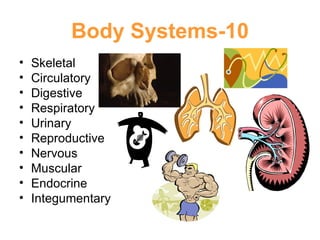
Body Systems-10 Skeletal Circulatory Digestive Respiratory Urinary Reproductive Nervous Muscular Endocrine Integumentary
Skeletal Much general diagnostic radiography involves exams of the bones and joints (osteology and arthrology) 206 separate bones Divided into axial and appendicular
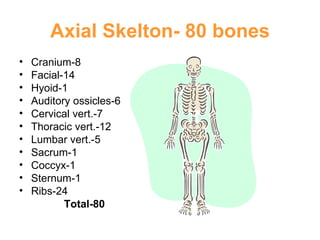
Axial Skelton- 80 bones Cranium-8 Facial-14 Hyoid-1 Auditory ossicles-6 Cervical vert.-7 Thoracic vert.-12 Lumbar vert.-5 Sacrum-1 Coccyx-1 Sternum-1 Ribs-24 Total-80
Appendicular Skeleton- 126 Clavicles-2 Scapulae-2 Humeri-2 Ulnae-2 Radii-2 Carpals-16 Metacarpals-10 Phalanges-28 Hip bones-2 Femora-2 Tibias-2 Fibulas-2 Patellae-2 Tarsals-14 Metatarsals-10 Phalanges-28   total:  126
Sesamoid Bones Special, oval-shaped bones found in tendons mostly near joints Not present in developing fetus The only sesamoids that are included in the total body bone count are the patellae Commonly found on the palmar surface of hand and sometimes in tendons of other upper of lower limb joints Any sesamoid can be fractured and may need to be demonstrated radiographically
Bone Classification Long Flat Short Irregular
Long Bones Body 2 ends or extremities Composed of compact bone or cortex, body, spongy bone (red marrow), medullary cavity, periosteum, hyaline cartilage, articular cartilage and the periosteum
Short Bones Carpals and tarsals
Flat Bones Consist of 2 plates of compact bone with cancellous bone and marrow between them Examples- calvarium, sternum, ribs and scapulae Diploe:  space between the inner and outer table of flat bones in the cranium
Irregular Bones Bones with peculiar shapes- vertebrae, facial bones, bones of the cranial base and bones of the pelvis
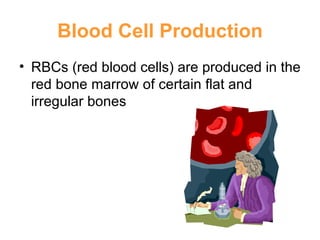
Blood Cell Production RBCs (red blood cells) are produced in the red bone marrow of certain flat and irregular bones
Bone Development Ossification begins in the sixth embryonic week and continues until adulthood 2 kinds of bone formation Intramembranous: occurs rapidly in bones necessary for protection (i.e. sutures of the skull) Endochondral:  much slower than intramembranous; occurs in most parts of the skeleton
Centers of Endochondral Ossification Primary  center- midbody or  diaphysis Secondary  center- ends or extremities of the long bones or  epiphysis Epiphyseal plates : found between the diaphysis and the epiphysis until skeletal growth is complete
Arthrology: study of joints Functional classification- Synarthrosis- immovable Amphiarthrosis- limited movement Diarthrosis- freely moveable
Structural  Classification #1 Fibrous:  held together by fibrous connective tissue Syndesmosis :  only one in the body- distal tibiofibular joint- amphiarthrodial Sutures :  between the bones of the skull- synarthrodial Gomphoses :  roots of the teeth- very limited movement
#2 Cartilaginous :  held tightly together by cartilage Symphyses :example is intervertebral disks- amphiarthrodial Synchondroses : these are temporary growth joints; example is the acetabulum- they are synarthrodial
#3 Synovial :  fibrous capsule containing synovial fluid- they are diarthodial and some examples are the knee, elbow.
Movement Types of Synovial Joints 1.  plane or gliding 2.  ginglymus or hinge 3.  trochoid or pivot 4.  ellipsoid or condyloid 5.  sellar or saddle 6.  spheroid or ball and socket
5 Functions of a Radiographic Procedure Positioning of the body and CR alignment Selection of the radiation protection measures Selection of exposure factors on the control panel Patient instructions relating to breathing Processing of the IR (image receptor- could be film or a digital plate)
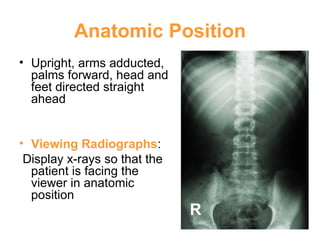
Anatomic Position Upright, arms adducted, palms forward, head and feet directed straight ahead Viewing Radiographs : Display x-rays so that the patient is facing the viewer in anatomic position R
Body Planes, Sections and Lines Sagittal - any longitudinal plane dividing the body into right and left parts Mid-sagittal  or median plane- divides the body into equal right and left halves Coronal - longitudinal plane dividing the body into anterior and posterior parts Mid-coronal - divides the body into equal anterior and posterior parts
Horizontal or axial plane-  transverse plane passing through the body at right angles to the longitudinal plane; divides into superior and inferior portions Oblique plane-  longitudinal or transverse that is on an angle or slant to the sagittal, coronal or horizontal planes.
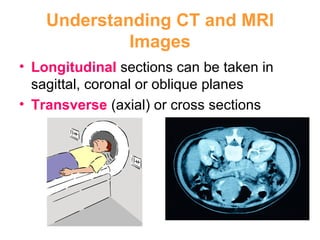
Understanding CT and MRI Images Longitudinal  sections can be taken in sagittal, coronal or oblique planes Transverse  (axial) or cross sections
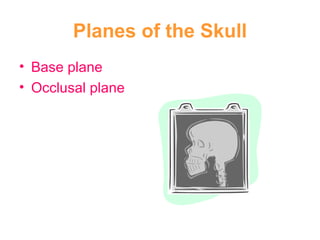
Planes of the Skull Base plane Occlusal plane
Body Surfaces and Parts Posterior or dorsal Anterior or ventral Plantar - sole of foot Dorsal - top of anterior surface of foot, back or posterior aspect of hand Palmar - palm of hand or the anterior/ventral surface
Radiographic Projections Posteroanterior or PA Anteroposterior or AP AP oblique (LPO and RPO) PA oblique (LAO and RAO) Mediolateral or Lateromedial
Body Positions and special projections Supine Prone Erect Recumbent Trendelenburg Fowler’s Sim’s  Lithotomy Decubitus Axial Inferosuperior or superioinferior Tangenital AP axial or lordotic Transthoracic Dorsoplantar or plantodorsal Parietoacanthial or acanthioparietal Submentovertex or verticosubmental (SMV and VSM)
Relationship Terms Medial v. lateral Proximal v. distal Cephalad v. caudad Interior v. exterior Superficial v. deep Ipsilateral v. contralateral Lordosis v. kyphosis Scoliosis Flexion v. extension Ulnar deviation v. radial deviation Dorsiflexion v. plantar flexion Eversion v. inversion Valgus v. varus Medial rotation v. lateral rotation Abduction v. adduction Supination v. pronation Protraction v. retraction Elevation v. depression Circumduction Rotation v. tilt
Clarification on Positioning Terms Position :  use this when indicating the patient’s general physical position such as supine, prone, etc.  It is also used to describe specific body positions such as obliques and laterals.  Restrict the use of this word to the patient’s physical position. Projection :  describes the path or direction of the central ray; restrict the use of this word to the CR View :  not a correct positioning term in the US; restrict the use of the word view to describing the image from the vantage of the image receptor
Radiographic Criteria The goal of every technologist should be not just a passable radiograph, but rather an optimal one that can be evaluated by a definable standard as described under radiographic criteria Structures shown Position Collimation and CR Exposure criteria Image markers
Image Markers and Patient ID All films should have two markers: Patient ID and date Anatomic side markers R or L
ARRT Code of Ethics (again) Page 32- review code of ethics
Protocol and Order for Diagnostic Procedures Review this page (p. 33) out loud
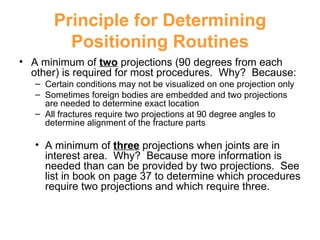
Principle for Determining Positioning Routines A minimum of  two  projections (90 degrees from each other) is required for most procedures.  Why?  Because: Certain conditions may not be visualized on one projection only Sometimes foreign bodies are embedded and two projections are needed to determine exact location All fractures require two projections at 90 degree angles to determine alignment of the fracture parts A minimum of  three  projections when joints are in interest area.  Why?  Because more information is needed than can be provided by two projections.  See list in book on page 37 to determine which procedures require two projections and which require three.

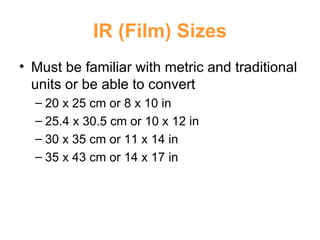
IR (Film) Sizes Must be familiar with metric and traditional units or be able to convert 20 x 25 cm or 8 x 10 in 25.4 x 30.5 cm or 10 x 12 in 30 x 35 cm or 11 x 14 in 35 x 43 cm or 14 x 17 in
Topographic Positioning Landmarks Vertebra prominens Jugular notch Sternal angle Xiphoid process Inferior costal margin Iliac crest ASIS Greater trochanter Symphysis pubis Ischial tuberosity
Body Habitus Hypersthenic Sthenic Hyposthenic Asthenic

Procedures I Chapter 1 Bontrager

  • 1.
    General Anatomy, Terminologyand Positioning Procedures I, Bontrager
  • 2.
    Expectations and Assignmentsfor this chapter READ this chapter (as you will ALL chapters) Follow along and take notes (or I can copy this file onto a disc or CD if you bring one) Workbook chapter 1 (will be checked on test day)
  • 3.
    Review of StructuralOrganization Atoms Molecules Cell Tissue Organ System organism
  • 4.
    Body Systems-10 SkeletalCirculatory Digestive Respiratory Urinary Reproductive Nervous Muscular Endocrine Integumentary
  • 5.
    Skeletal Much generaldiagnostic radiography involves exams of the bones and joints (osteology and arthrology) 206 separate bones Divided into axial and appendicular
  • 6.
    Axial Skelton- 80bones Cranium-8 Facial-14 Hyoid-1 Auditory ossicles-6 Cervical vert.-7 Thoracic vert.-12 Lumbar vert.-5 Sacrum-1 Coccyx-1 Sternum-1 Ribs-24 Total-80
  • 7.
    Appendicular Skeleton- 126Clavicles-2 Scapulae-2 Humeri-2 Ulnae-2 Radii-2 Carpals-16 Metacarpals-10 Phalanges-28 Hip bones-2 Femora-2 Tibias-2 Fibulas-2 Patellae-2 Tarsals-14 Metatarsals-10 Phalanges-28 total: 126
  • 8.
    Sesamoid Bones Special,oval-shaped bones found in tendons mostly near joints Not present in developing fetus The only sesamoids that are included in the total body bone count are the patellae Commonly found on the palmar surface of hand and sometimes in tendons of other upper of lower limb joints Any sesamoid can be fractured and may need to be demonstrated radiographically
  • 9.
    Bone Classification LongFlat Short Irregular
  • 10.
    Long Bones Body2 ends or extremities Composed of compact bone or cortex, body, spongy bone (red marrow), medullary cavity, periosteum, hyaline cartilage, articular cartilage and the periosteum
  • 11.
  • 12.
    Flat Bones Consistof 2 plates of compact bone with cancellous bone and marrow between them Examples- calvarium, sternum, ribs and scapulae Diploe: space between the inner and outer table of flat bones in the cranium
  • 13.
    Irregular Bones Boneswith peculiar shapes- vertebrae, facial bones, bones of the cranial base and bones of the pelvis
  • 14.
    Blood Cell ProductionRBCs (red blood cells) are produced in the red bone marrow of certain flat and irregular bones
  • 15.
    Bone Development Ossificationbegins in the sixth embryonic week and continues until adulthood 2 kinds of bone formation Intramembranous: occurs rapidly in bones necessary for protection (i.e. sutures of the skull) Endochondral: much slower than intramembranous; occurs in most parts of the skeleton
  • 16.
    Centers of EndochondralOssification Primary center- midbody or diaphysis Secondary center- ends or extremities of the long bones or epiphysis Epiphyseal plates : found between the diaphysis and the epiphysis until skeletal growth is complete
  • 17.
    Arthrology: study ofjoints Functional classification- Synarthrosis- immovable Amphiarthrosis- limited movement Diarthrosis- freely moveable
  • 18.
    Structural Classification#1 Fibrous: held together by fibrous connective tissue Syndesmosis : only one in the body- distal tibiofibular joint- amphiarthrodial Sutures : between the bones of the skull- synarthrodial Gomphoses : roots of the teeth- very limited movement
  • 19.
    #2 Cartilaginous : held tightly together by cartilage Symphyses :example is intervertebral disks- amphiarthrodial Synchondroses : these are temporary growth joints; example is the acetabulum- they are synarthrodial
  • 20.
    #3 Synovial : fibrous capsule containing synovial fluid- they are diarthodial and some examples are the knee, elbow.
  • 21.
    Movement Types ofSynovial Joints 1. plane or gliding 2. ginglymus or hinge 3. trochoid or pivot 4. ellipsoid or condyloid 5. sellar or saddle 6. spheroid or ball and socket
  • 22.
    5 Functions ofa Radiographic Procedure Positioning of the body and CR alignment Selection of the radiation protection measures Selection of exposure factors on the control panel Patient instructions relating to breathing Processing of the IR (image receptor- could be film or a digital plate)
  • 23.
    Anatomic Position Upright,arms adducted, palms forward, head and feet directed straight ahead Viewing Radiographs : Display x-rays so that the patient is facing the viewer in anatomic position R
  • 24.
    Body Planes, Sectionsand Lines Sagittal - any longitudinal plane dividing the body into right and left parts Mid-sagittal or median plane- divides the body into equal right and left halves Coronal - longitudinal plane dividing the body into anterior and posterior parts Mid-coronal - divides the body into equal anterior and posterior parts
  • 25.
    Horizontal or axialplane- transverse plane passing through the body at right angles to the longitudinal plane; divides into superior and inferior portions Oblique plane- longitudinal or transverse that is on an angle or slant to the sagittal, coronal or horizontal planes.
  • 26.
    Understanding CT andMRI Images Longitudinal sections can be taken in sagittal, coronal or oblique planes Transverse (axial) or cross sections
  • 27.
    Planes of theSkull Base plane Occlusal plane
  • 28.
    Body Surfaces andParts Posterior or dorsal Anterior or ventral Plantar - sole of foot Dorsal - top of anterior surface of foot, back or posterior aspect of hand Palmar - palm of hand or the anterior/ventral surface
  • 29.
    Radiographic Projections Posteroanterioror PA Anteroposterior or AP AP oblique (LPO and RPO) PA oblique (LAO and RAO) Mediolateral or Lateromedial
  • 30.
    Body Positions andspecial projections Supine Prone Erect Recumbent Trendelenburg Fowler’s Sim’s Lithotomy Decubitus Axial Inferosuperior or superioinferior Tangenital AP axial or lordotic Transthoracic Dorsoplantar or plantodorsal Parietoacanthial or acanthioparietal Submentovertex or verticosubmental (SMV and VSM)
  • 31.
    Relationship Terms Medialv. lateral Proximal v. distal Cephalad v. caudad Interior v. exterior Superficial v. deep Ipsilateral v. contralateral Lordosis v. kyphosis Scoliosis Flexion v. extension Ulnar deviation v. radial deviation Dorsiflexion v. plantar flexion Eversion v. inversion Valgus v. varus Medial rotation v. lateral rotation Abduction v. adduction Supination v. pronation Protraction v. retraction Elevation v. depression Circumduction Rotation v. tilt
  • 32.
    Clarification on PositioningTerms Position : use this when indicating the patient’s general physical position such as supine, prone, etc. It is also used to describe specific body positions such as obliques and laterals. Restrict the use of this word to the patient’s physical position. Projection : describes the path or direction of the central ray; restrict the use of this word to the CR View : not a correct positioning term in the US; restrict the use of the word view to describing the image from the vantage of the image receptor
  • 33.
    Radiographic Criteria Thegoal of every technologist should be not just a passable radiograph, but rather an optimal one that can be evaluated by a definable standard as described under radiographic criteria Structures shown Position Collimation and CR Exposure criteria Image markers
  • 34.
    Image Markers andPatient ID All films should have two markers: Patient ID and date Anatomic side markers R or L
  • 35.
    ARRT Code ofEthics (again) Page 32- review code of ethics
  • 36.
    Protocol and Orderfor Diagnostic Procedures Review this page (p. 33) out loud
  • 37.
    Principle for DeterminingPositioning Routines A minimum of two projections (90 degrees from each other) is required for most procedures. Why? Because: Certain conditions may not be visualized on one projection only Sometimes foreign bodies are embedded and two projections are needed to determine exact location All fractures require two projections at 90 degree angles to determine alignment of the fracture parts A minimum of three projections when joints are in interest area. Why? Because more information is needed than can be provided by two projections. See list in book on page 37 to determine which procedures require two projections and which require three.
  • 38.
    IR (Film) SizesMust be familiar with metric and traditional units or be able to convert 20 x 25 cm or 8 x 10 in 25.4 x 30.5 cm or 10 x 12 in 30 x 35 cm or 11 x 14 in 35 x 43 cm or 14 x 17 in
  • 39.
    Topographic Positioning LandmarksVertebra prominens Jugular notch Sternal angle Xiphoid process Inferior costal margin Iliac crest ASIS Greater trochanter Symphysis pubis Ischial tuberosity
  • 40.
    Body Habitus HypersthenicSthenic Hyposthenic Asthenic