ULTRASOUND A Deep Thermal & Non-thermal Mechanical Modality
What is Ultrasound? Located in the Acoustical Spectrum May be used for diagnostic imaging, therapeutic tissue healing, or tissue destruction Thermal & Non-thermal effects We use it for therapeutic effects Can deliver medicine to subcutaneous tissues (phonophoresis)
Ultrasound Sinusoidal waveform Therapeutic ultrasound waves range from 750,000 to 3,000,000 Hz (0.75 to 3 MHz) Displays properties of  wavelength,  frequency,  Amplitude
Transducer A device that converts one form of energy to another Piezoelectric crystal:  a crystal that produces (+) and  (-) electrical charges when it contracts or expands Crystal of quartz, barium titanate, lead zirconate, or titanate housed within transducer Reverse (indirect) piezoelectric effect:   occurs when an alternating current is passed through a crystal resulting in contraction & expansion of the crystal US is produced through the reverse piezoelectric effect Vibration of crystal results in high-frequency sound waves Fresnal zone  (near field) – area of the ultrasound beam on the transducer used for therapeutic purposes
Types of Current Direct Current:  the uninterrupted unidirectional flow of electrons Alternating Current:  the uninterrupted bidirectional flow of electrons Ultrasound is produced by this type of current flowing through a piezoelectric crystal Pulsed Current:  the flow of electrons interrupted by discrete periods of noncurrent flow
Longitudinal vs. Transverse Waves Longitudinal waves  – molecular displacement is along direction in which waves travel (bungee cord) Compression  – regions of high molecular density (molecules in high pressure areas compress) Rarefraction  – regions of low molecular density (molecules in low pressure areas expand) Transverse waves  – molecular displacement in direction perpendicular to wave (guitar string)
Longitudinal waves  – travel in solids & liquids Soft tissue – more like liquids US primarily travels as longitudinal wave Transverse waves  – cannot pass through fluids; found in the body only when ultrasound strikes bone
Frequency Frequency:  number of times an event occurs in 1 second; expressed in  Hertz or pulses per second Hertz:  cycles per second Megahertz:  1,000,000 cycles per second In the U.S., we mainly use ultrasound frequencies of 1, 2 and 3 MHz 1 = low frequency; 3 = high frequency   frequency =    depth of penetration   frequency = sound waves are absorbed in more superficial tissues (3 MHz)
Velocity The speed of sound wave is directly related to the density (   velocity =    density) Denser & more rigid materials have a higher velocity of transmission At 1 MHz, sound travels through soft tissue @ 1540 m/sec and 4000 m/sec through compact bone
Influences on the Transmission of Energy Reflection  – occurs when the wave can’t pass through the next density Refraction  – is the bending of waves as a result of a change in the speed of a wave as it enters a medium with a different density Absorption  – occurs by the tissue collecting the wave’s energy
Attenuation Decrease in a wave’s intensity resulting from absorption, reflection, & refraction    as the frequency of US is    because of molecular friction the waves must overcome in order to pass through tissues US penetrates through tissue high in water content & is absorbed in dense tissues high in protein    Absorption =    Frequency (3 MHz) , and    Penetration =    Absorption (1 MHz) , so    Penetration =    Frequency +    Absorption (1 MHz)  Tissues    water content = low absorption rate (fat) Tissues    protein content = high absorption rate (peripheral nerve, bone) Muscle is in between both
Attenuation: Acoustic Impedance Determines amount of US energy reflected at tissue interfaces If acoustic impedance of the 2 materials forming the interface is the same, all sound will be transmitted The larger the difference, the more energy is reflected & the less energy that can enter the 2 nd  medium US passing through air = almost all reflected (99%) US through fat = 1% reflected  Both reflected/refracted @ m. interface Soft-tissue: bone interfaced = much reflected As US energy is reflected @ tissue interfaces with different impedances, intensity is increased creating a  Standing Wave  (hot spot)
Effective Radiating Area (ERA):  area of the sound head that produces ultrasonic waves; expressed in  square centimeters (cm 2 ) Represents the portion of the head’s surface area that produces US waves Measured 5 mm from face of sound head; represents all areas producing more than 5% of max. power output Always lesser area than actual size of sound head Large diameter heads – column beam Small diameter heads – more divergent beam Low frequency (1 MHz) – diverge more than 3 MHz Treatment Duration:  time for total treatment
Intensity Output & Power  Power:  measured in watts (W);  amount of energy being produced by the transducer Intensity:   strength of sound waves @ a given location within the tissues being treated Spatial Average Intensity (SAI):   amount of US energy passing through the US head’s ERA;  expressed in  watts per square centimeter (W/cm 2 )  (power/ERA) Changing head size affects power density (larger head results in lower density) Limited to 3.0 W/cm 2  of maximum output
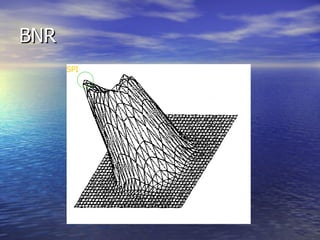
Intensity Output & Power Spatial Average Temporal Peak Intensity (SATP):   average intensity during the “on” time of the pulse Output meter displays the SATP intensity Spatial Peak Intensity (SPI):  max. output (power) produced within an ultrasound beam   Spatial Average Temporal Average Intensity (SATA)  or  Temporal (time) Average Intensity: Power of US energy delivered to tissues over a given period of time Only meaningful for Pulsed US  SAI x Duty Cycles
Beam Nonuniformity Ratio (BNR) Ratio between the spatial peak intensity (SPI) to the average output as reported on the unit’s meter The lower the BNR, the more uniform the beam is A BNR greater than 8:1 is unsafe Because of the existence of high-intensity areas in the beam (hot spots), it is necessary to keep the US head moving
BNR SPI
Duty Cycle Percentage of time that US is actually being emitted from the head Ratio between the US’s pulse length & pulse interval when US is being delivered in the pulsed mode Pulse length  = amount of time from the initial nonzero charge to the return to a zero charge Pulse interval  – amount of time between ultrasonic pulses Duty cycle  = pulse length/(pulse length + pulse interval) x 100 100% duty cycle indicates a constant US output Low output produces nonthermal effects (20%)
Movement of the Transducer 4 cm 2 /sec Remaining stationary can cause problems Moving too rapidly decreases the total amount of energy absorbed per unit area May cause clinician to treat larger area and the desired temps. May not be attained Slower strokes can be easier maintained If patient complains of pain or excessive heat, then  decrease intensity  but increase time Apply constant pressure – not too much & not too little
Coupling Agents Optimal agent – distilled H 2 0  (.2% reflection) Modern units have a shut down mechanism if sound head becomes too hot (Dynatron beeps; red lights on Chattanoogas) Improperly coupled head causes    temp. Types of agents: Direct H 2 0 immersion Bladder Reduce amount of air bubbles
Direct Coupling Effectiveness is    if body part is hair, irregular shaped, or unclean Must maintain firm, constant pressure Various gels utilized
Water Immersion Used for odd shaped parts Place head approx. 1” away from part Operator’s hand should not be immersed No metal on part or operator’s hand Ceramic tub is recommended If nondistilled H 2 0 is used, intensity can be    .5 w/cm 2  because of air & minerals  Don’t touch skin except to briefly sweep skin when bubbles form
Bladder  H 2 0 filled balloon or plastic bag coated with coupling gel Use on irregular shape part Place gel on skin, then place the bladder on the part, and then place gel on bladder Make sure all air pockets are removed from bladder
Indications Soft tissue healing & repair Joint contractures & scar tissue Muscle spasm Neuroma Trigger areas Warts Sympathetic nervous system disorders Postacute reduction of myositis ossificans Acute inflammatory conditions (pulsed) Has been shown to be ok to use following the stopping of bleeding with an acute injury (pulsed)
Contraindications Acute conditions (continous output) Ischemic areas or impaired circulation areas Tendency to hemorrhage Around eyes, heart, skull, or genitals Over pelvic or lumbar areas in pregnant or menstruating females Cancerous tumors Spinal cord or large nerve plexus in high doses Anesthetic areas Stress fracture sites or over fracture site before healing is complete (continuous); epiphysis Acute infection
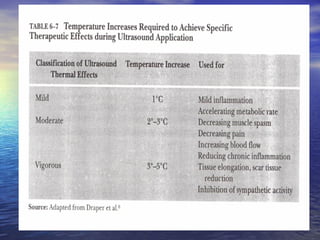
Thermal Effects    blood flow    sensory & motor nerve conduction velocity    extensibility of structures (collagen);    joint stiffness    collagen deposition    macrophage activity Mild inflammatory response which may enhance adhesion of leukocytes to damaged endothelial cells    muscle spasm    pain + all Nonthermal effects
Nonthermal Effects    cell membrane permeability    vascular permeability    blood flow    fibroblastic activity Altered rates of diffusion across cell membrane Secretion of chemotactics Stimulation of phagocytosis Production of granulation tissue Synthesis of protein    edema Diffusion of ions Tissue regeneration Formation of stronger CT
Pulsed Ultrasound Stimulates phagocytosis  (assists w/    of chronic inflammation)  & increases # of free radicals  (   ionic conductance on cell membrane) Cavitation:  formation of gas bubbles that expand & compress due to pressure changes in tissue fluids Stable  – occurs when bubbles compress during the   -press. peaks followed expansion of bubbles during   -press. troughs Unstable (transient)  – compression of bubbles during   -press. Peaks, but is followed by total collapse during trough (BAD!)
Pulsed Ultrasound Acoustical Streaming:  stable cavitation leads this; one-directional flow of tissue fluids, & is most marked around cell membranes  Facilitates passage of calcium potassium & other ions, etc. in/out of cells  Collagen synthesis, chemotactics secretion,    update of calcium in fibroblasts,    fibroblastic activity Eddies (Eddy) – circular current of fluid often moving against the main flow Flows around the cell membranes & its organelles Flow of bubbles in stream cause change in cell membrane permeability
Clinical Applications – Soft Tissue Stimulates release of histamine from mast cells May be due to cavitation & streaming     transport of calcium ions across membrane that stimulates histamine release Histamine attracts leukocytes, that clean up debris, & monocytes that release chemotactic agens & growth factors that stimulate fibroblasts & endothelial cells to form a collagen-rich, well-vascularized tissue
Clinical Applications – Soft Tissue & Plantar Warts Pitting edema -    temp. makes thick edema liquefy thus promoting lymphatic drainage   fibroblasts = stimulation of collagen production = gives CT more strength  Plantar Warts - 0.6 W/cm 2  for 7-15 min.
Clinical Applications – Scar Tissue, Joint Contracture, & Pain Reduction    mobility of mature scar     tissue extensibility Softens scar tissue    pain threshold Stimulates large-diameter myelinated n. fibers    n. conduction velocity
Clinical Applications  Chronic Inflammation  - Pulsed US has been shown to be effective with    pain &    ROM  1.0 to 2.0 W/cm 2  at 20% duty cycle Bone Healing  – Pulsed US has been shown to accelerate fracture repair  0.5 W/cm 2  at 20% duty cycle for 5 min., 4x/wk Caution over epiphysis – may cause premature closure
Treatment Duration & Area Length of time depends on the Size of area Output intensity Goals of treatment Frequency Area should be no larger than 2-3 times the surface area of the sound head ERA If the area is large, it can divided into smaller treatment zones When vigorous heating is desired, duration should be 10-12 min. for 1 MHz & 3-4 min. for 3 MHz Generally a 10-14 day treatment period
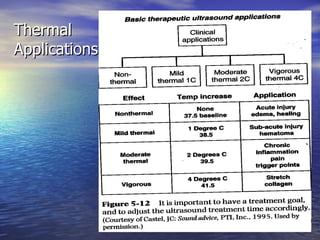
Thermal Applications
 
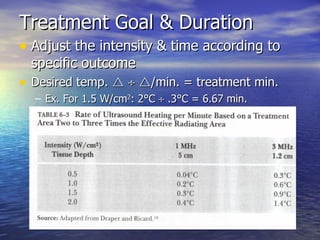
Treatment Goal & Duration Adjust the intensity & time according to specific outcome Desired temp.         /min. = treatment min. Ex. For 1.5 W/cm 2 : 2°C    .3°C = 6.67 min.
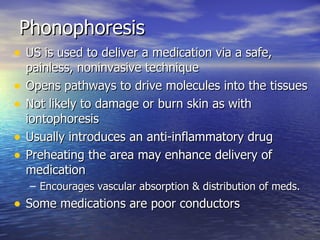
Phonophoresis US is used to deliver a medication via a safe, painless, noninvasive technique Opens pathways to drive molecules into the tissues Not likely to damage or burn skin as with iontophoresis Usually introduces an anti-inflammatory drug Preheating the area may enhance delivery of medication Encourages vascular absorption & distribution of meds. Some medications are poor conductors
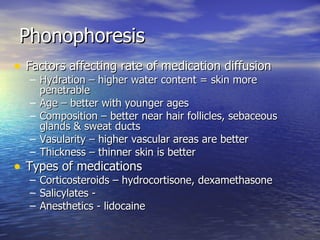
Phonophoresis Factors affecting rate of medication diffusion Hydration – higher water content = skin more penetrable Age – better with younger ages Composition – better near hair follicles, sebaceous glands & sweat ducts Vasularity – higher vascular areas are better Thickness – thinner skin is better Types of medications Corticosteroids – hydrocortisone, dexamethasone Salicylates -  Anesthetics - lidocaine

Ultrasound 2

  • 1.
    ULTRASOUND A DeepThermal & Non-thermal Mechanical Modality
  • 2.
    What is Ultrasound?Located in the Acoustical Spectrum May be used for diagnostic imaging, therapeutic tissue healing, or tissue destruction Thermal & Non-thermal effects We use it for therapeutic effects Can deliver medicine to subcutaneous tissues (phonophoresis)
  • 3.
    Ultrasound Sinusoidal waveformTherapeutic ultrasound waves range from 750,000 to 3,000,000 Hz (0.75 to 3 MHz) Displays properties of wavelength, frequency, Amplitude
  • 4.
    Transducer A devicethat converts one form of energy to another Piezoelectric crystal: a crystal that produces (+) and (-) electrical charges when it contracts or expands Crystal of quartz, barium titanate, lead zirconate, or titanate housed within transducer Reverse (indirect) piezoelectric effect: occurs when an alternating current is passed through a crystal resulting in contraction & expansion of the crystal US is produced through the reverse piezoelectric effect Vibration of crystal results in high-frequency sound waves Fresnal zone (near field) – area of the ultrasound beam on the transducer used for therapeutic purposes
  • 5.
    Types of CurrentDirect Current: the uninterrupted unidirectional flow of electrons Alternating Current: the uninterrupted bidirectional flow of electrons Ultrasound is produced by this type of current flowing through a piezoelectric crystal Pulsed Current: the flow of electrons interrupted by discrete periods of noncurrent flow
  • 6.
    Longitudinal vs. TransverseWaves Longitudinal waves – molecular displacement is along direction in which waves travel (bungee cord) Compression – regions of high molecular density (molecules in high pressure areas compress) Rarefraction – regions of low molecular density (molecules in low pressure areas expand) Transverse waves – molecular displacement in direction perpendicular to wave (guitar string)
  • 7.
    Longitudinal waves – travel in solids & liquids Soft tissue – more like liquids US primarily travels as longitudinal wave Transverse waves – cannot pass through fluids; found in the body only when ultrasound strikes bone
  • 8.
    Frequency Frequency: number of times an event occurs in 1 second; expressed in Hertz or pulses per second Hertz: cycles per second Megahertz: 1,000,000 cycles per second In the U.S., we mainly use ultrasound frequencies of 1, 2 and 3 MHz 1 = low frequency; 3 = high frequency  frequency =  depth of penetration  frequency = sound waves are absorbed in more superficial tissues (3 MHz)
  • 9.
    Velocity The speedof sound wave is directly related to the density (  velocity =  density) Denser & more rigid materials have a higher velocity of transmission At 1 MHz, sound travels through soft tissue @ 1540 m/sec and 4000 m/sec through compact bone
  • 10.
    Influences on theTransmission of Energy Reflection – occurs when the wave can’t pass through the next density Refraction – is the bending of waves as a result of a change in the speed of a wave as it enters a medium with a different density Absorption – occurs by the tissue collecting the wave’s energy
  • 11.
    Attenuation Decrease ina wave’s intensity resulting from absorption, reflection, & refraction  as the frequency of US is  because of molecular friction the waves must overcome in order to pass through tissues US penetrates through tissue high in water content & is absorbed in dense tissues high in protein  Absorption =  Frequency (3 MHz) , and  Penetration =  Absorption (1 MHz) , so  Penetration =  Frequency +  Absorption (1 MHz) Tissues  water content = low absorption rate (fat) Tissues  protein content = high absorption rate (peripheral nerve, bone) Muscle is in between both
  • 12.
    Attenuation: Acoustic ImpedanceDetermines amount of US energy reflected at tissue interfaces If acoustic impedance of the 2 materials forming the interface is the same, all sound will be transmitted The larger the difference, the more energy is reflected & the less energy that can enter the 2 nd medium US passing through air = almost all reflected (99%) US through fat = 1% reflected Both reflected/refracted @ m. interface Soft-tissue: bone interfaced = much reflected As US energy is reflected @ tissue interfaces with different impedances, intensity is increased creating a Standing Wave (hot spot)
  • 13.
    Effective Radiating Area(ERA): area of the sound head that produces ultrasonic waves; expressed in square centimeters (cm 2 ) Represents the portion of the head’s surface area that produces US waves Measured 5 mm from face of sound head; represents all areas producing more than 5% of max. power output Always lesser area than actual size of sound head Large diameter heads – column beam Small diameter heads – more divergent beam Low frequency (1 MHz) – diverge more than 3 MHz Treatment Duration: time for total treatment
  • 14.
    Intensity Output &Power Power: measured in watts (W); amount of energy being produced by the transducer Intensity: strength of sound waves @ a given location within the tissues being treated Spatial Average Intensity (SAI): amount of US energy passing through the US head’s ERA; expressed in watts per square centimeter (W/cm 2 ) (power/ERA) Changing head size affects power density (larger head results in lower density) Limited to 3.0 W/cm 2 of maximum output
  • 15.
    Intensity Output &Power Spatial Average Temporal Peak Intensity (SATP): average intensity during the “on” time of the pulse Output meter displays the SATP intensity Spatial Peak Intensity (SPI): max. output (power) produced within an ultrasound beam Spatial Average Temporal Average Intensity (SATA) or Temporal (time) Average Intensity: Power of US energy delivered to tissues over a given period of time Only meaningful for Pulsed US SAI x Duty Cycles
  • 16.
    Beam Nonuniformity Ratio(BNR) Ratio between the spatial peak intensity (SPI) to the average output as reported on the unit’s meter The lower the BNR, the more uniform the beam is A BNR greater than 8:1 is unsafe Because of the existence of high-intensity areas in the beam (hot spots), it is necessary to keep the US head moving
  • 17.
  • 18.
    Duty Cycle Percentageof time that US is actually being emitted from the head Ratio between the US’s pulse length & pulse interval when US is being delivered in the pulsed mode Pulse length = amount of time from the initial nonzero charge to the return to a zero charge Pulse interval – amount of time between ultrasonic pulses Duty cycle = pulse length/(pulse length + pulse interval) x 100 100% duty cycle indicates a constant US output Low output produces nonthermal effects (20%)
  • 19.
    Movement of theTransducer 4 cm 2 /sec Remaining stationary can cause problems Moving too rapidly decreases the total amount of energy absorbed per unit area May cause clinician to treat larger area and the desired temps. May not be attained Slower strokes can be easier maintained If patient complains of pain or excessive heat, then decrease intensity but increase time Apply constant pressure – not too much & not too little
  • 20.
    Coupling Agents Optimalagent – distilled H 2 0 (.2% reflection) Modern units have a shut down mechanism if sound head becomes too hot (Dynatron beeps; red lights on Chattanoogas) Improperly coupled head causes  temp. Types of agents: Direct H 2 0 immersion Bladder Reduce amount of air bubbles
  • 21.
    Direct Coupling Effectivenessis  if body part is hair, irregular shaped, or unclean Must maintain firm, constant pressure Various gels utilized
  • 22.
    Water Immersion Usedfor odd shaped parts Place head approx. 1” away from part Operator’s hand should not be immersed No metal on part or operator’s hand Ceramic tub is recommended If nondistilled H 2 0 is used, intensity can be  .5 w/cm 2 because of air & minerals Don’t touch skin except to briefly sweep skin when bubbles form
  • 23.
    Bladder H2 0 filled balloon or plastic bag coated with coupling gel Use on irregular shape part Place gel on skin, then place the bladder on the part, and then place gel on bladder Make sure all air pockets are removed from bladder
  • 24.
    Indications Soft tissuehealing & repair Joint contractures & scar tissue Muscle spasm Neuroma Trigger areas Warts Sympathetic nervous system disorders Postacute reduction of myositis ossificans Acute inflammatory conditions (pulsed) Has been shown to be ok to use following the stopping of bleeding with an acute injury (pulsed)
  • 25.
    Contraindications Acute conditions(continous output) Ischemic areas or impaired circulation areas Tendency to hemorrhage Around eyes, heart, skull, or genitals Over pelvic or lumbar areas in pregnant or menstruating females Cancerous tumors Spinal cord or large nerve plexus in high doses Anesthetic areas Stress fracture sites or over fracture site before healing is complete (continuous); epiphysis Acute infection
  • 26.
    Thermal Effects  blood flow  sensory & motor nerve conduction velocity  extensibility of structures (collagen);  joint stiffness  collagen deposition  macrophage activity Mild inflammatory response which may enhance adhesion of leukocytes to damaged endothelial cells  muscle spasm  pain + all Nonthermal effects
  • 27.
    Nonthermal Effects  cell membrane permeability  vascular permeability  blood flow  fibroblastic activity Altered rates of diffusion across cell membrane Secretion of chemotactics Stimulation of phagocytosis Production of granulation tissue Synthesis of protein  edema Diffusion of ions Tissue regeneration Formation of stronger CT
  • 28.
    Pulsed Ultrasound Stimulatesphagocytosis (assists w/  of chronic inflammation) & increases # of free radicals (  ionic conductance on cell membrane) Cavitation: formation of gas bubbles that expand & compress due to pressure changes in tissue fluids Stable – occurs when bubbles compress during the  -press. peaks followed expansion of bubbles during  -press. troughs Unstable (transient) – compression of bubbles during  -press. Peaks, but is followed by total collapse during trough (BAD!)
  • 29.
    Pulsed Ultrasound AcousticalStreaming: stable cavitation leads this; one-directional flow of tissue fluids, & is most marked around cell membranes Facilitates passage of calcium potassium & other ions, etc. in/out of cells Collagen synthesis, chemotactics secretion,  update of calcium in fibroblasts,  fibroblastic activity Eddies (Eddy) – circular current of fluid often moving against the main flow Flows around the cell membranes & its organelles Flow of bubbles in stream cause change in cell membrane permeability
  • 30.
    Clinical Applications –Soft Tissue Stimulates release of histamine from mast cells May be due to cavitation & streaming  transport of calcium ions across membrane that stimulates histamine release Histamine attracts leukocytes, that clean up debris, & monocytes that release chemotactic agens & growth factors that stimulate fibroblasts & endothelial cells to form a collagen-rich, well-vascularized tissue
  • 31.
    Clinical Applications –Soft Tissue & Plantar Warts Pitting edema -  temp. makes thick edema liquefy thus promoting lymphatic drainage  fibroblasts = stimulation of collagen production = gives CT more strength Plantar Warts - 0.6 W/cm 2 for 7-15 min.
  • 32.
    Clinical Applications –Scar Tissue, Joint Contracture, & Pain Reduction  mobility of mature scar  tissue extensibility Softens scar tissue  pain threshold Stimulates large-diameter myelinated n. fibers  n. conduction velocity
  • 33.
    Clinical Applications Chronic Inflammation - Pulsed US has been shown to be effective with  pain &  ROM 1.0 to 2.0 W/cm 2 at 20% duty cycle Bone Healing – Pulsed US has been shown to accelerate fracture repair 0.5 W/cm 2 at 20% duty cycle for 5 min., 4x/wk Caution over epiphysis – may cause premature closure
  • 34.
    Treatment Duration &Area Length of time depends on the Size of area Output intensity Goals of treatment Frequency Area should be no larger than 2-3 times the surface area of the sound head ERA If the area is large, it can divided into smaller treatment zones When vigorous heating is desired, duration should be 10-12 min. for 1 MHz & 3-4 min. for 3 MHz Generally a 10-14 day treatment period
  • 35.
  • 36.
  • 37.
    Treatment Goal &Duration Adjust the intensity & time according to specific outcome Desired temp.    /min. = treatment min. Ex. For 1.5 W/cm 2 : 2°C  .3°C = 6.67 min.
  • 38.
    Phonophoresis US isused to deliver a medication via a safe, painless, noninvasive technique Opens pathways to drive molecules into the tissues Not likely to damage or burn skin as with iontophoresis Usually introduces an anti-inflammatory drug Preheating the area may enhance delivery of medication Encourages vascular absorption & distribution of meds. Some medications are poor conductors
  • 39.
    Phonophoresis Factors affectingrate of medication diffusion Hydration – higher water content = skin more penetrable Age – better with younger ages Composition – better near hair follicles, sebaceous glands & sweat ducts Vasularity – higher vascular areas are better Thickness – thinner skin is better Types of medications Corticosteroids – hydrocortisone, dexamethasone Salicylates - Anesthetics - lidocaine