ENDOTRACHEAL
TUBES
BY DR. ABHINAV SHREERAM
INTRODUCTION
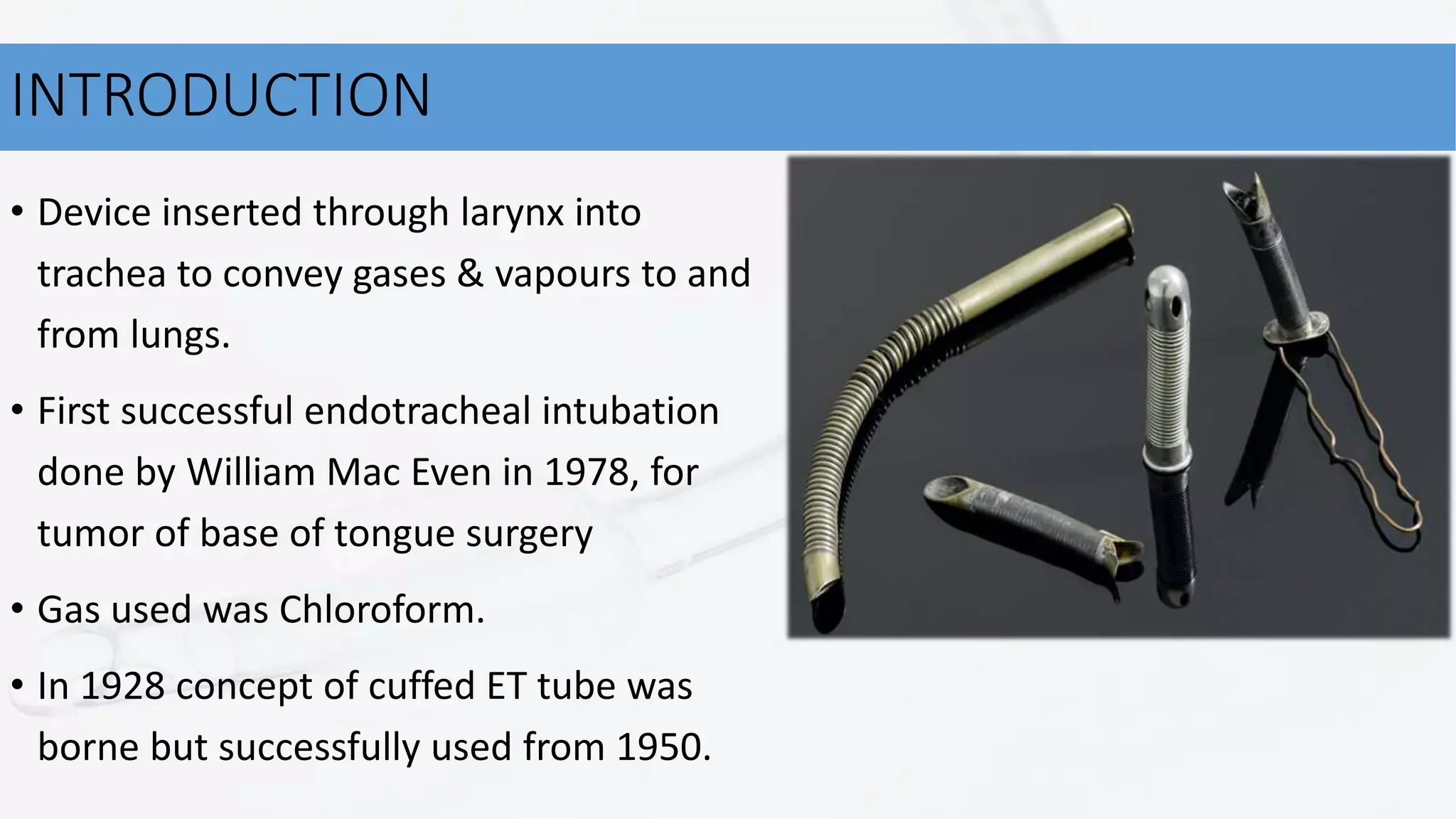
• Device inserted through larynx into
trachea to convey gases & vapours to and
from lungs.
• First successful endotracheal intubation
done by William Mac Even in 1978, for
tumor of base of tongue surgery
• Gas used was Chloroform.
• In 1928 concept of cuffed ET tube was
borne but successfully used from 1950.
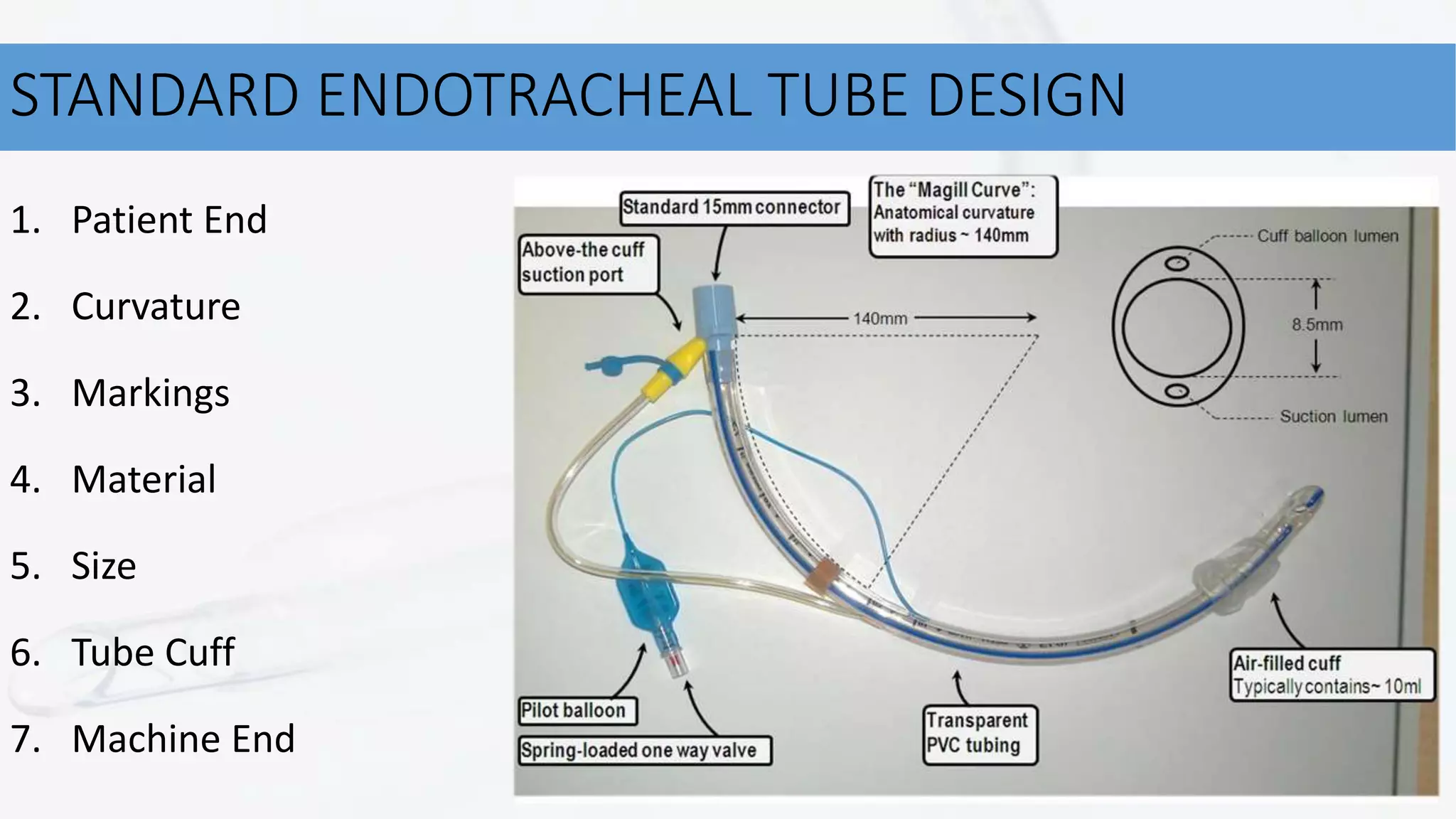
STANDARD ENDOTRACHEAL TUBE DESIGN
1. Patient End
2. Curvature
3. Markings
4. Material
5. Size
6. Tube Cuff
7. Machine End
PATIENT END
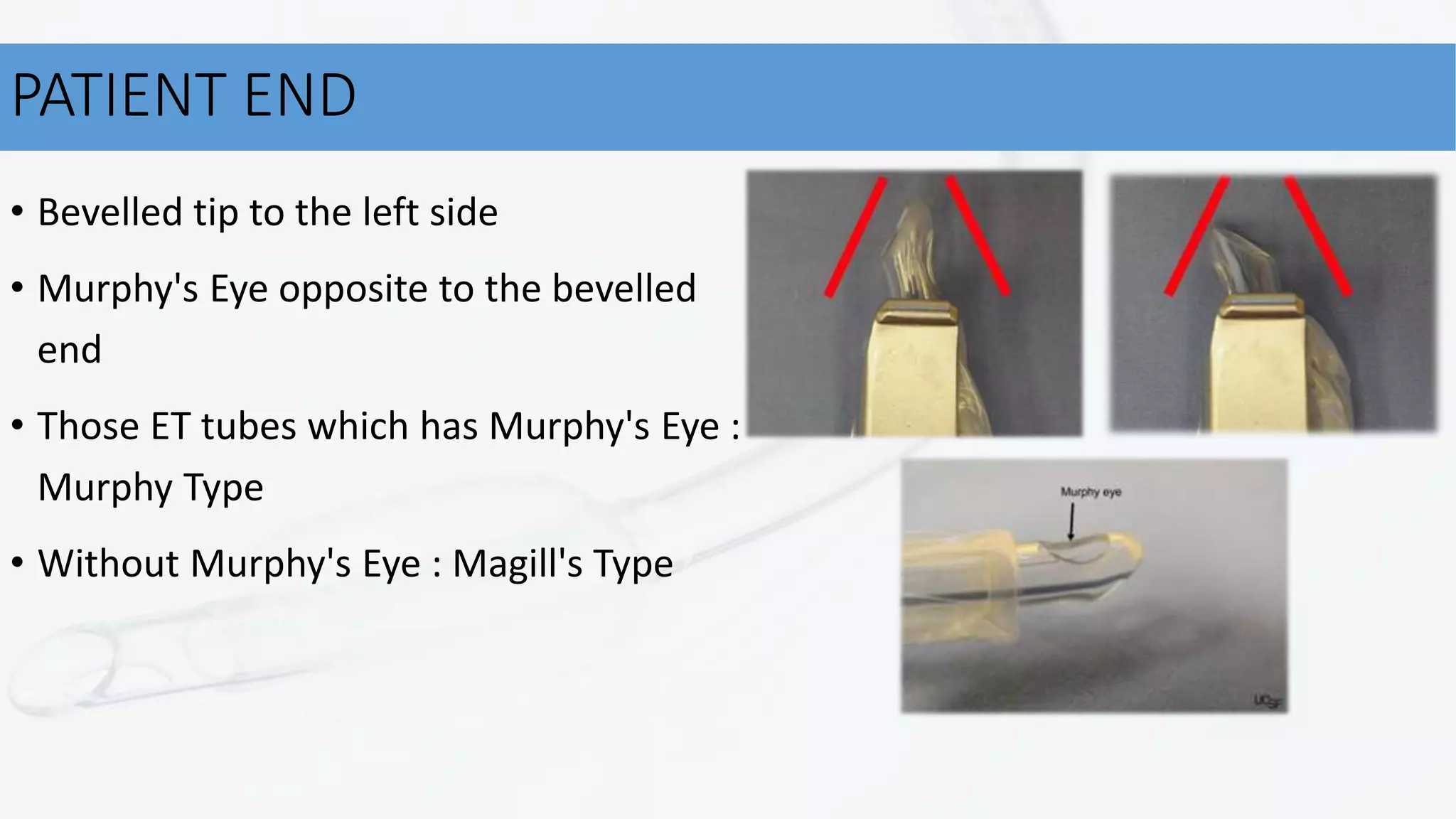
• Bevelled tip to the left side
• Murphy's Eye opposite to the bevelled
end
• Those ET tubes which has Murphy's Eye :
Murphy Type
• Without Murphy's Eye : Magill's Type
CURVATURE
• Matches the anatomical curvature
of oral cavity.
• Arc : 140mm Radius
MARKINGS
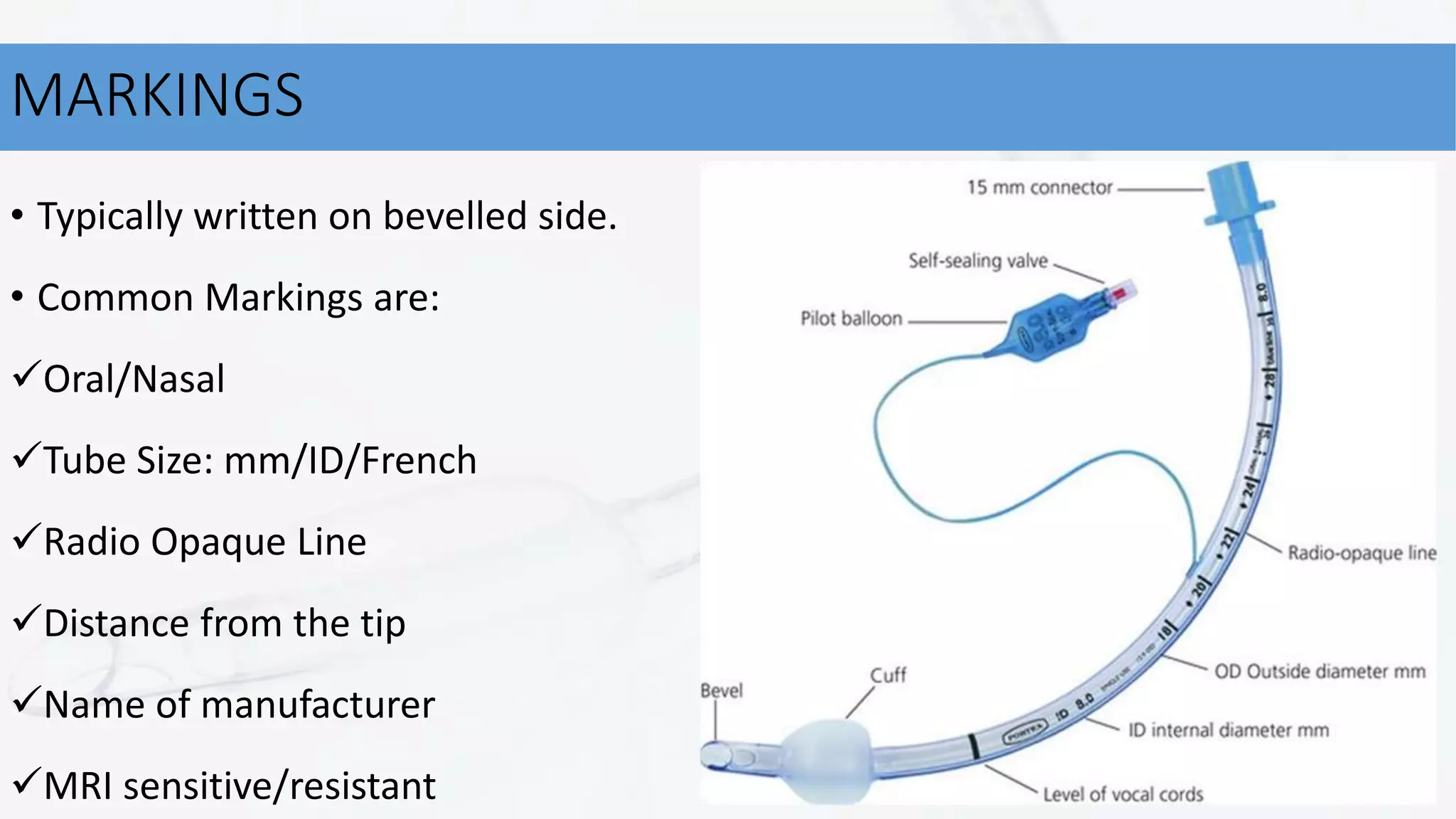
• Typically written on bevelled side.
• Common Markings are:
Oral/Nasal
Tube Size: mm/ID/French
Radio Opaque Line
Distance from the tip
Name of manufacturer
MRI sensitive/resistant
MATERIALS
1.Red Rubber/Natural Latex
• Reusable
• Rigid
• Less traumatic
• Opaque
• Repated washing makes it soft & kinkable
• Can be allergic
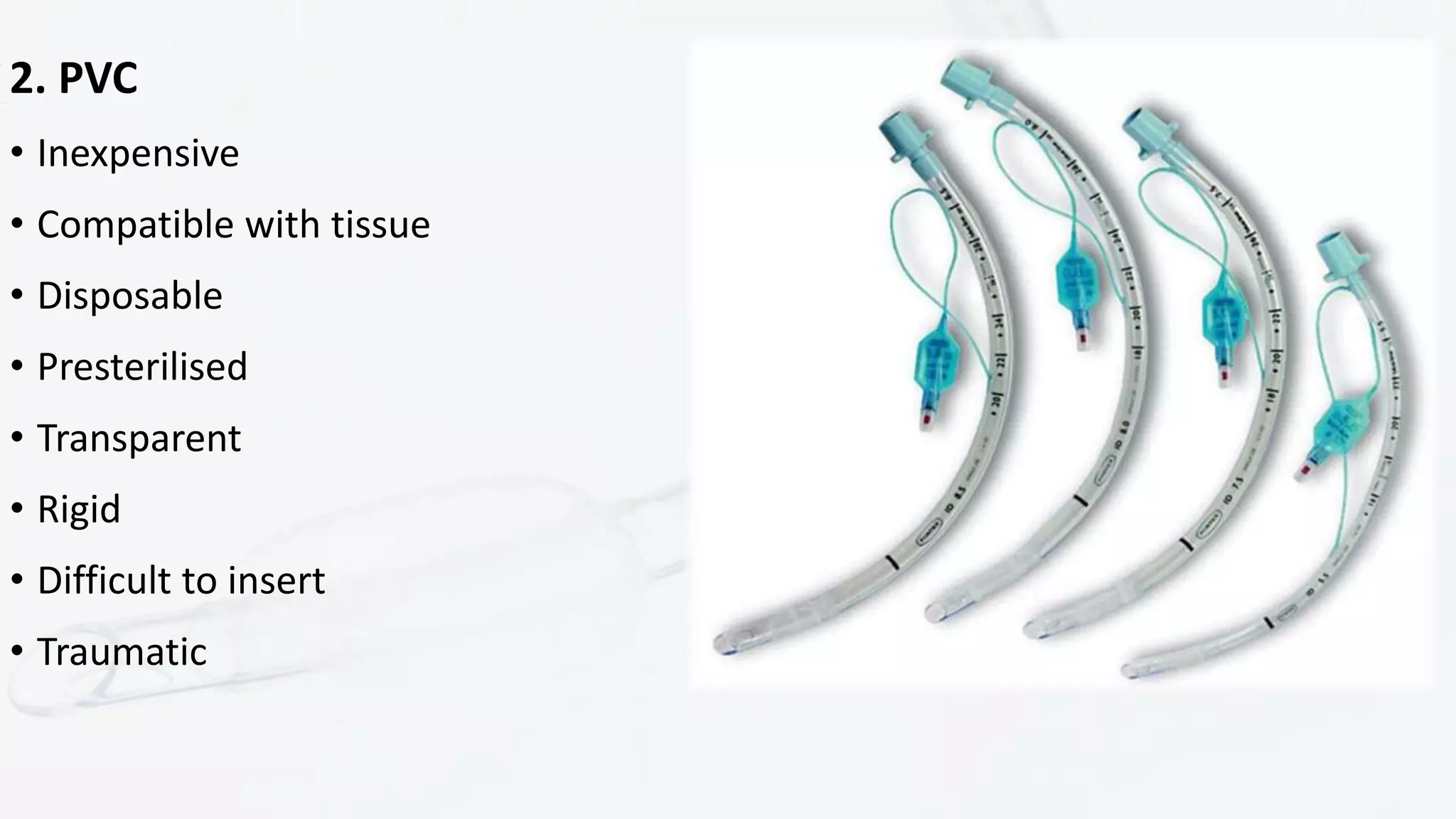
2. PVC
• Inexpensive
• Compatible with tissue
• Disposable
• Presterilised
• Transparent
• Rigid
• Difficult to insert
• Traumatic
3. Silicon Ruber
• PVC+Silicon Oil
• Less surface adhesion
• Opaque
• Inexpensive
• Can be reused after autoclaving
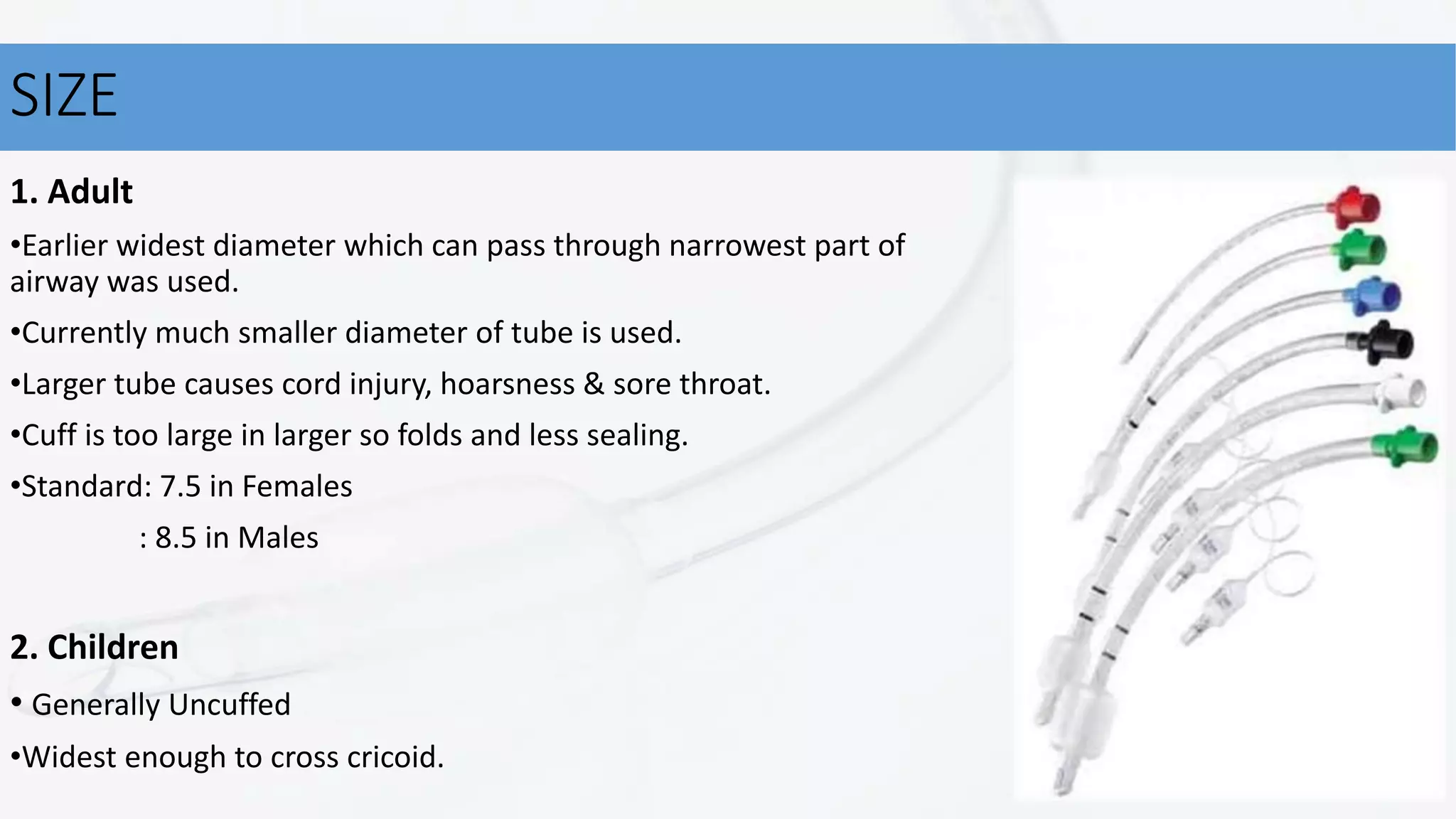
SIZE
1. Adult
•Earlier widest diameter which can pass through narrowest part of
airway was used.
•Currently much smaller diameter of tube is used.
•Larger tube causes cord injury, hoarsness & sore throat.
•Cuff is too large in larger so folds and less sealing.
•Standard: 7.5 in Females
: 8.5 in Males
2. Children
• Generally Uncuffed
•Widest enough to cross cricoid.
Uncuffed Tubes
• For children below 6 years: Age in years/3 + 3.5
• For children older than 6 years: Age in years/4 + 4.5
• ID = Age in years/4 + 4 (modifed Cole formula) for children
above 2 years
• ID = 3 mm for those 3 months of age and younger
• ID = 3.5 mm for those from 3 months to 9 months of age
• ID = (Age in years + 16)/4 over 9 months of age
• External diameter is the same width as the distal phalanx of
the little fnger approximately.
Cuffed Tubes
• ID in mm = Age/4 + 3 (Khine formula)
• A tube 0.5–1 mm smaller than that calculated for an uncuffed
tube
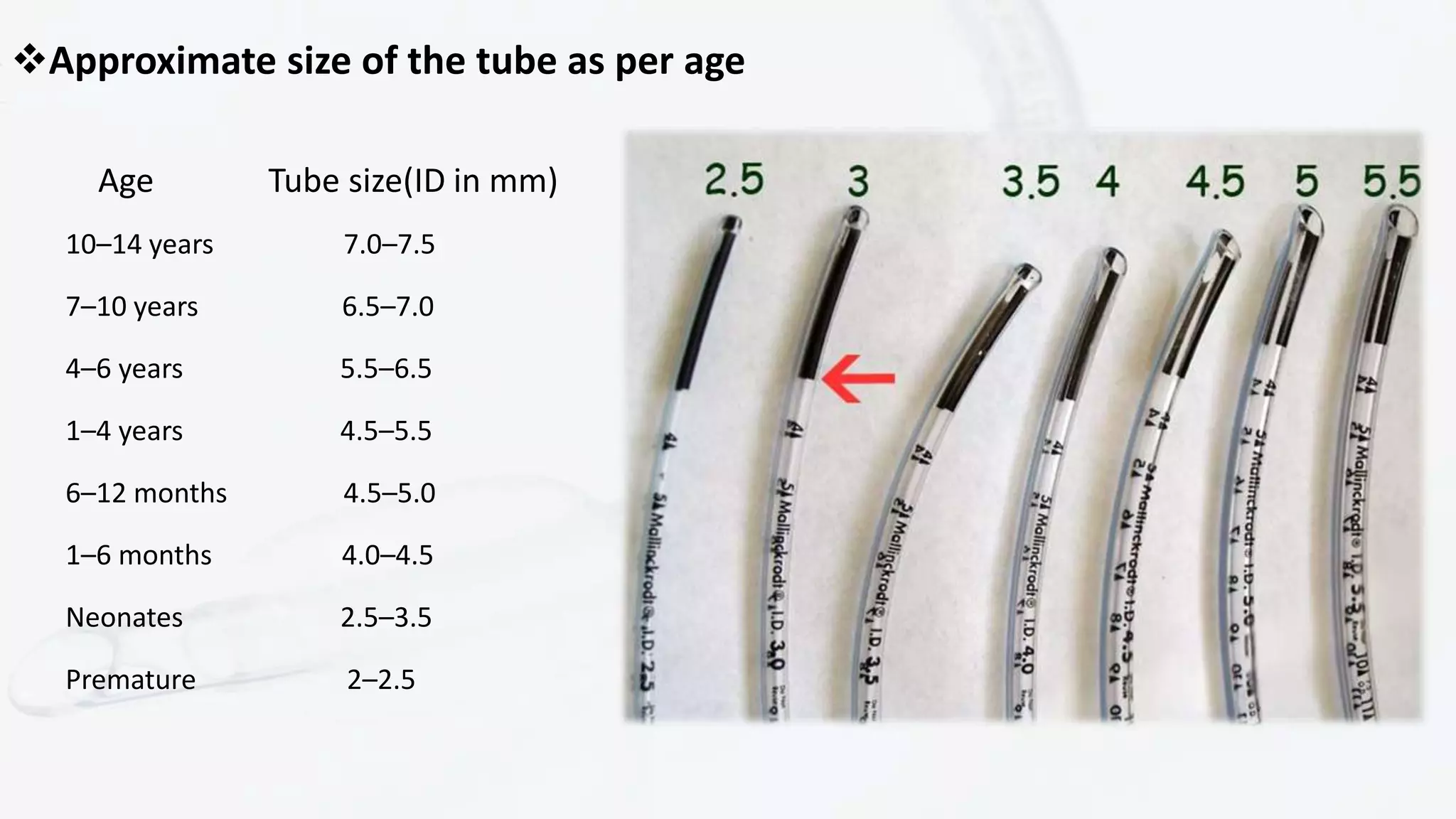
Approximate size of the tube as per age
Age Tube size(ID in mm)
10–14 years 7.0–7.5
7–10 years 6.5–7.0
4–6 years 5.5–6.5
1–4 years 4.5–5.5
6–12 months 4.5–5.0
1–6 months 4.0–4.5
Neonates 2.5–3.5
Premature 2–2.5
CUFF
With pilot baloon : One way spring valve
Without pilot baloon : Plugged or clamped
On the basis of pressure two types:
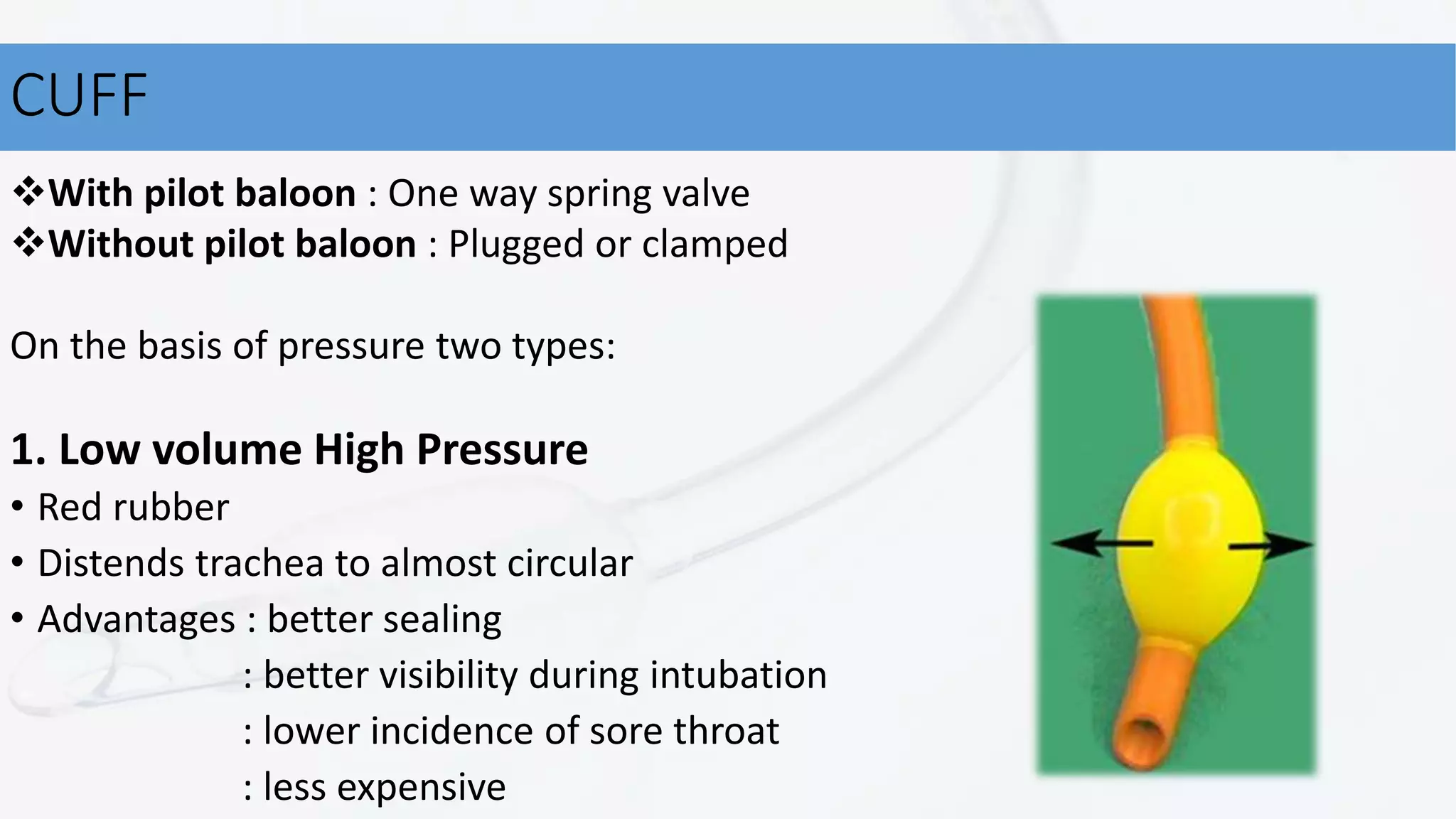
1. Low volume High Pressure
• Red rubber
• Distends trachea to almost circular
• Advantages : better sealing
: better visibility during intubation
: lower incidence of sore throat
: less expensive
• Disadvantage : Tracheal ischemia
: Scarring
: Stenosis
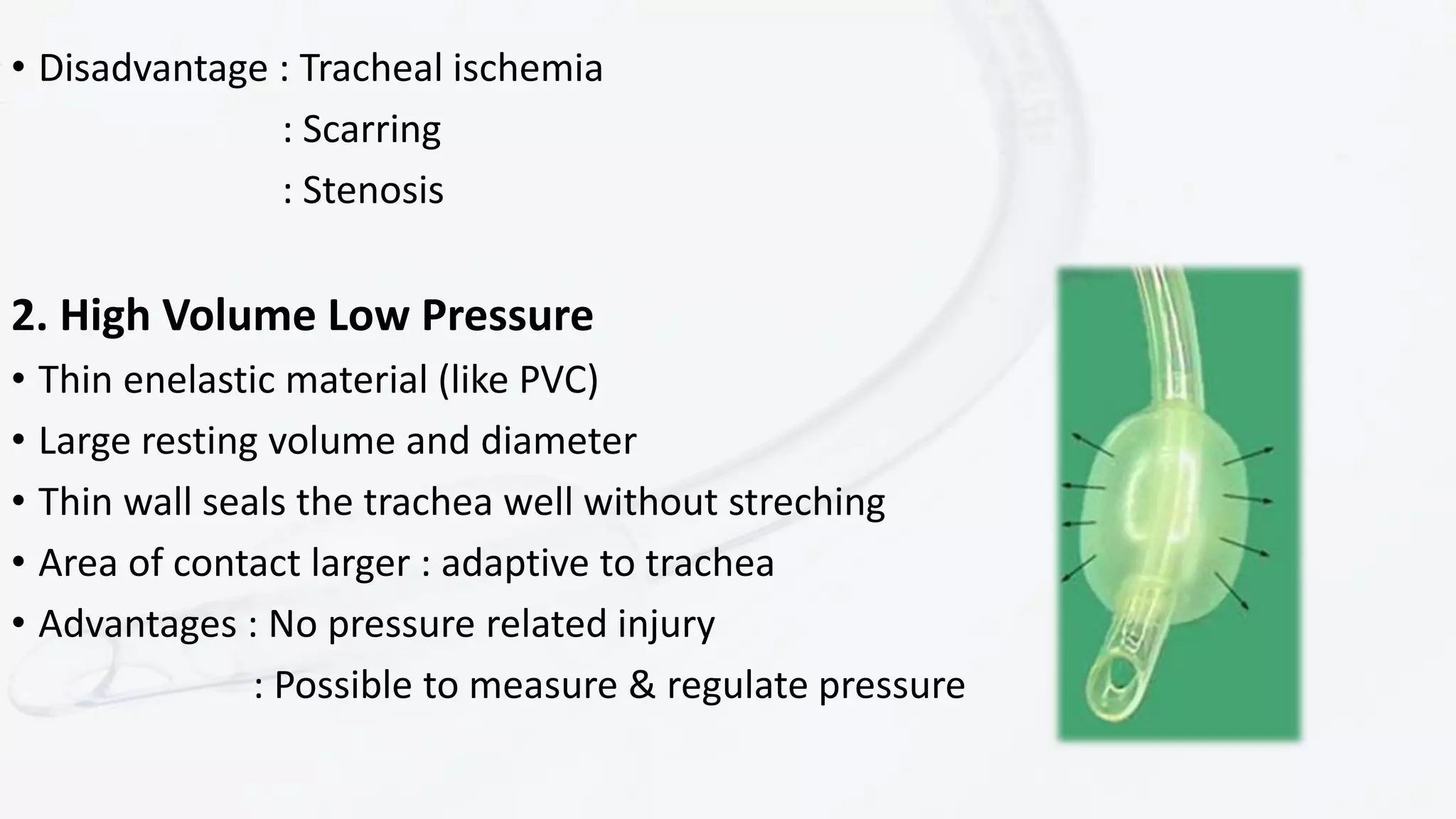
2. High Volume Low Pressure
• Thin enelastic material (like PVC)
• Large resting volume and diameter
• Thin wall seals the trachea well without streching
• Area of contact larger : adaptive to trachea
• Advantages : No pressure related injury
: Possible to measure & regulate pressure
• Disadvantage : More difficult to insert
: Greater incidence of sore throat
: Seal may not be effective
: Microfolds leading to aspiration
: N2O diffuse into the cuff
: Can be overfilled
Foam cuff
: Polyurethane foam
: Has bigger diameter
: Deflated first with suction then
reinflated
: Good seal
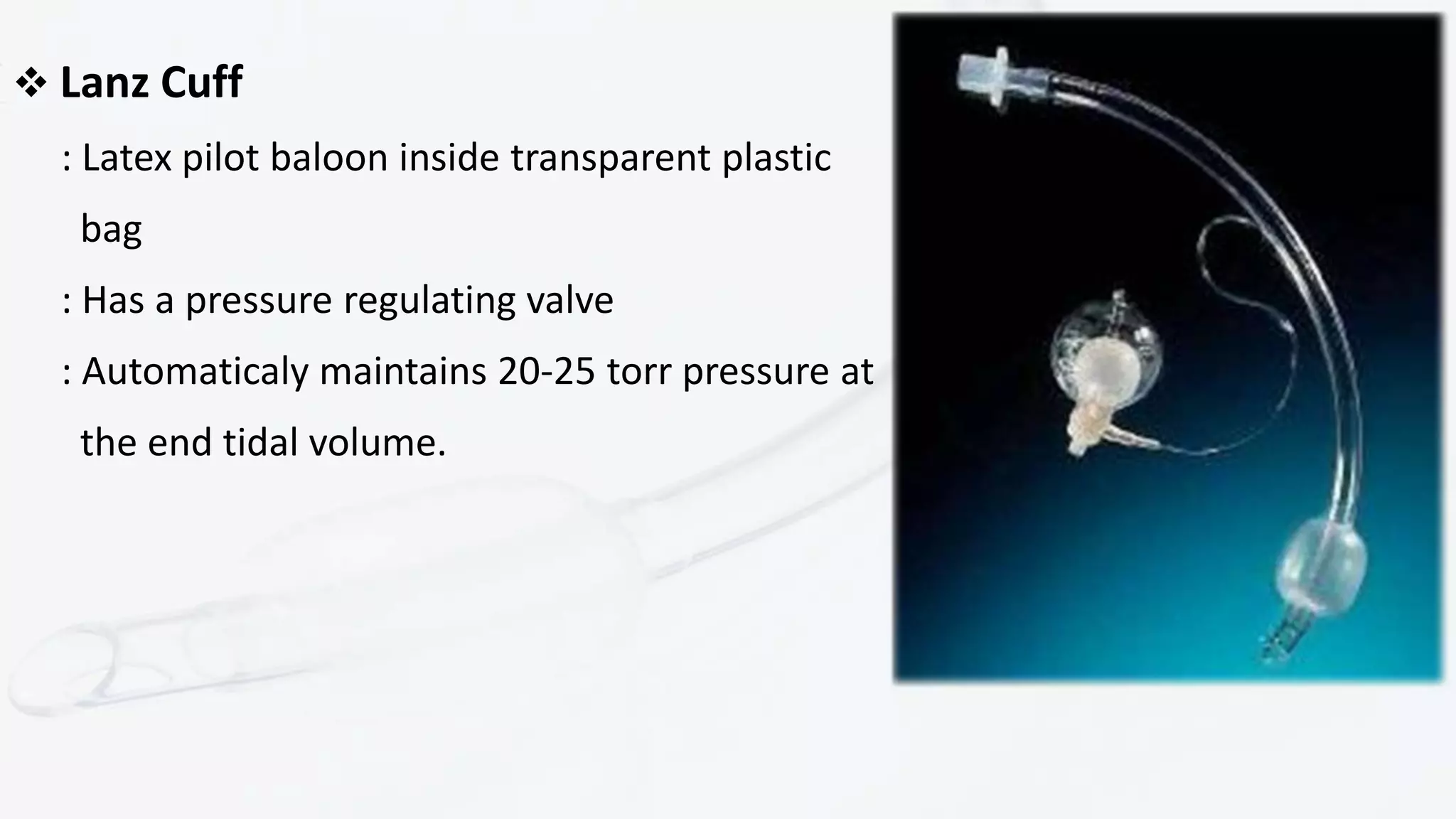
 Lanz Cuff
: Latex pilot baloon inside transparent plastic
bag
: Has a pressure regulating valve
: Automaticaly maintains 20-25 torr pressure at
the end tidal volume.
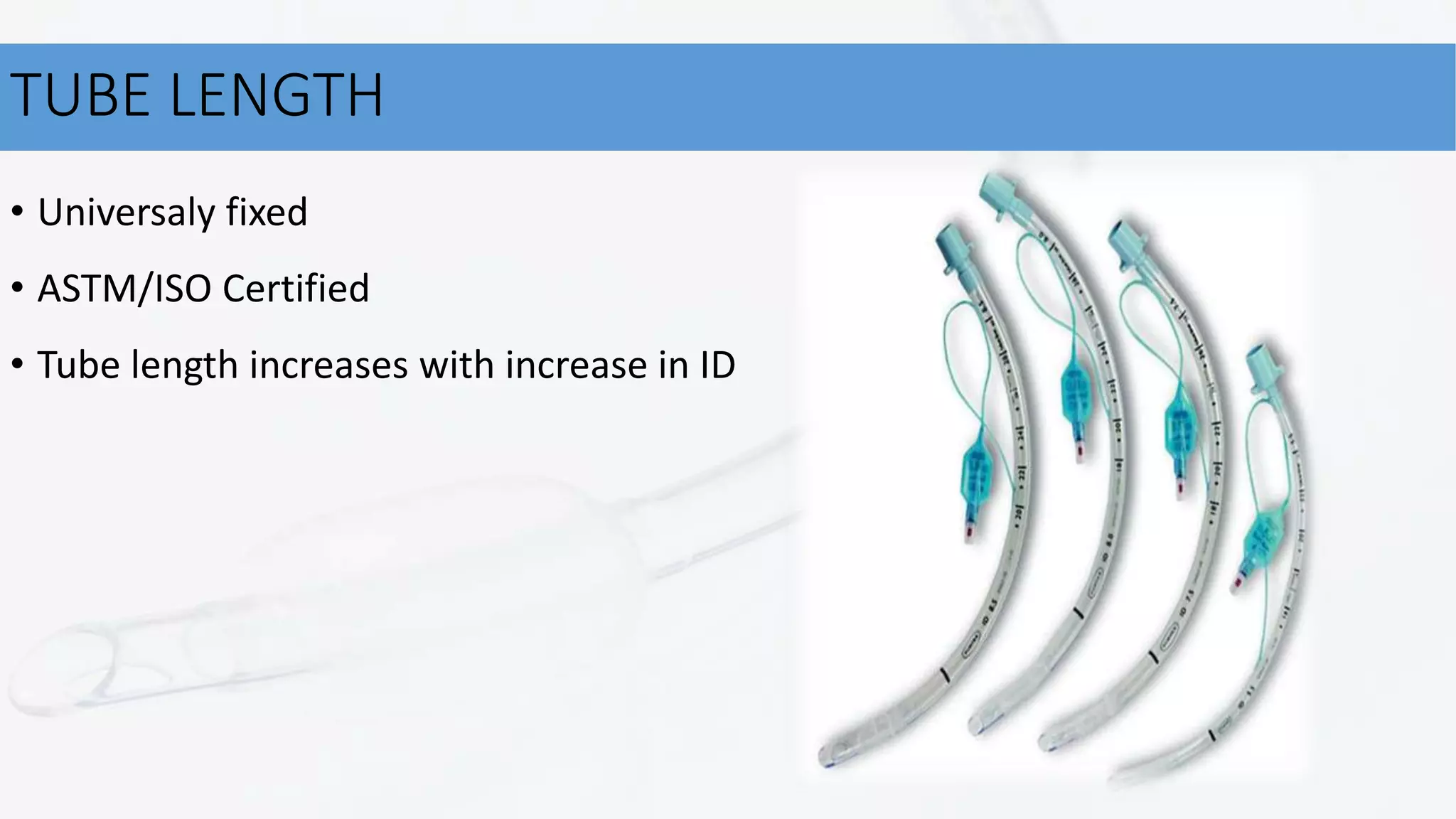
TUBE LENGTH
• Universaly fixed
• ASTM/ISO Certified
• Tube length increases with increase in ID
MACHINE END
• Male type of connector.
• Plastic/ Metal
• Universally designed to fit with 15mm female
plug
• Generally 900 angulated
SPECIAL TUBES
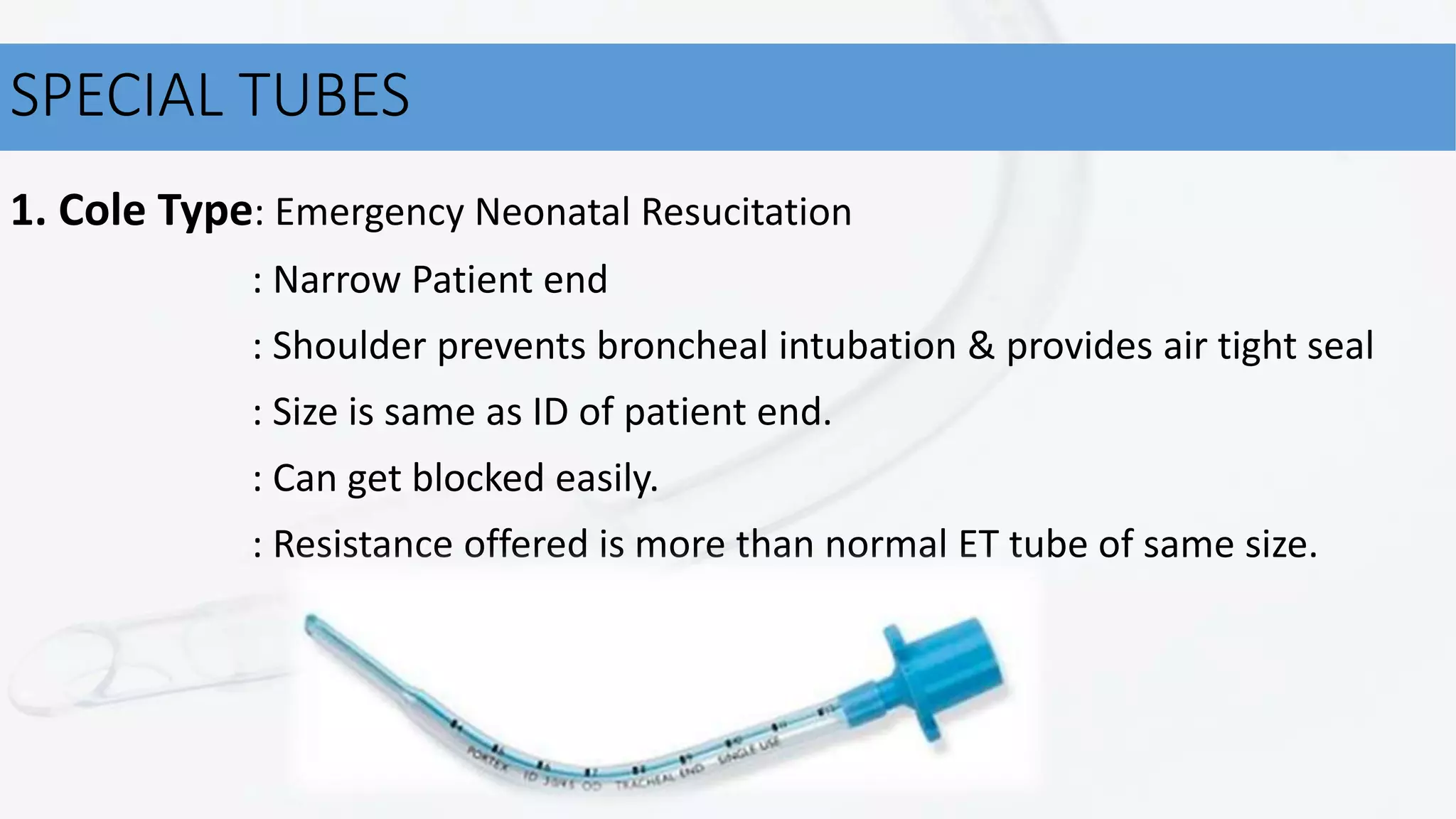
1. Cole Type: Emergency Neonatal Resucitation
: Narrow Patient end
: Shoulder prevents broncheal intubation & provides air tight seal
: Size is same as ID of patient end.
: Can get blocked easily.
: Resistance offered is more than normal ET tube of same size.
2. Microcuff ET tube
: cuffed tube for children
: Short ultrathin cuff away from subglottic area
:Can be inflated at very less pressure
: No murphy's Eye
: So cuff can be placed too distal
: Reduced risk of pressure to Cricoid.
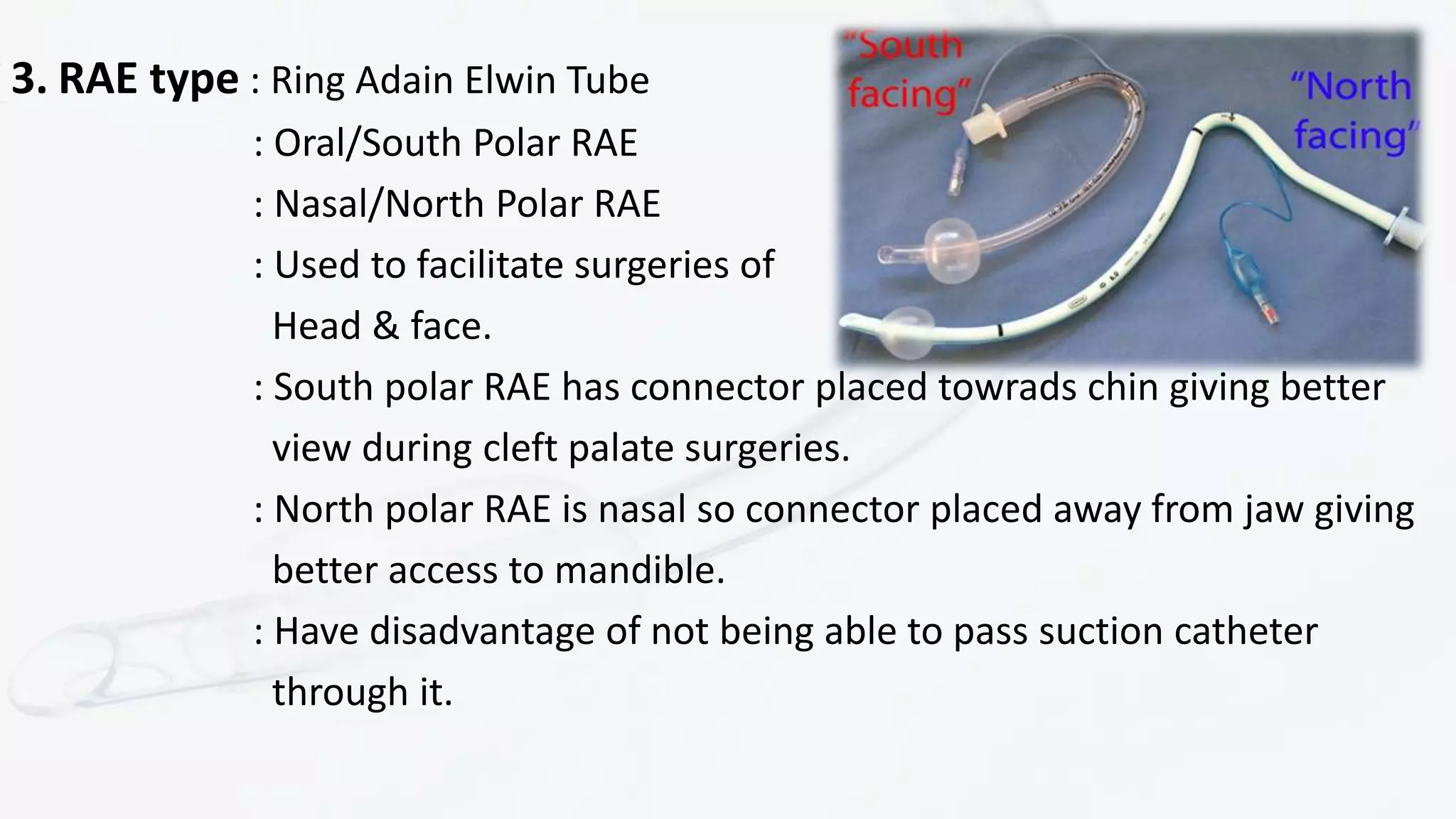
3. RAE type : Ring Adain Elwin Tube
: Oral/South Polar RAE
: Nasal/North Polar RAE
: Used to facilitate surgeries of
Head & face.
: South polar RAE has connector placed towrads chin giving better
view during cleft palate surgeries.
: North polar RAE is nasal so connector placed away from jaw giving
better access to mandible.
: Have disadvantage of not being able to pass suction catheter
through it.
4. Flexometalic tube : Head & Neck surgery with high movements
: Reinforced with wire within the tube.
: Flexible & Non kinking
: More esily slipped over fibreoptic broncoscope
: No nasal entubation possible
: No Murphy's Eye
: Expensive
: Spontaneous extubation can
happen
: May obstruct the radiological
view of Cx Spine
6. Microlaryngeal Tube : Microlaryngeal surgeries & with narrow airway.
: Available as 4,5 or 6 sized tube.
: High volume low pressure cuff.
: Can be inserted through LMA
: Forcep is required during intubation.
7. Tehran tube : specially designed for nasal intubation
: Have a typical upper airway curve.
: Reusable.
: Made of silicon.
: Can be inserted blindly.
8. Laryngectomy Tube
: Designed to be inserted through
tracheostomy
: J shaped.
: To be made straight before
intubation
: No bevel end.
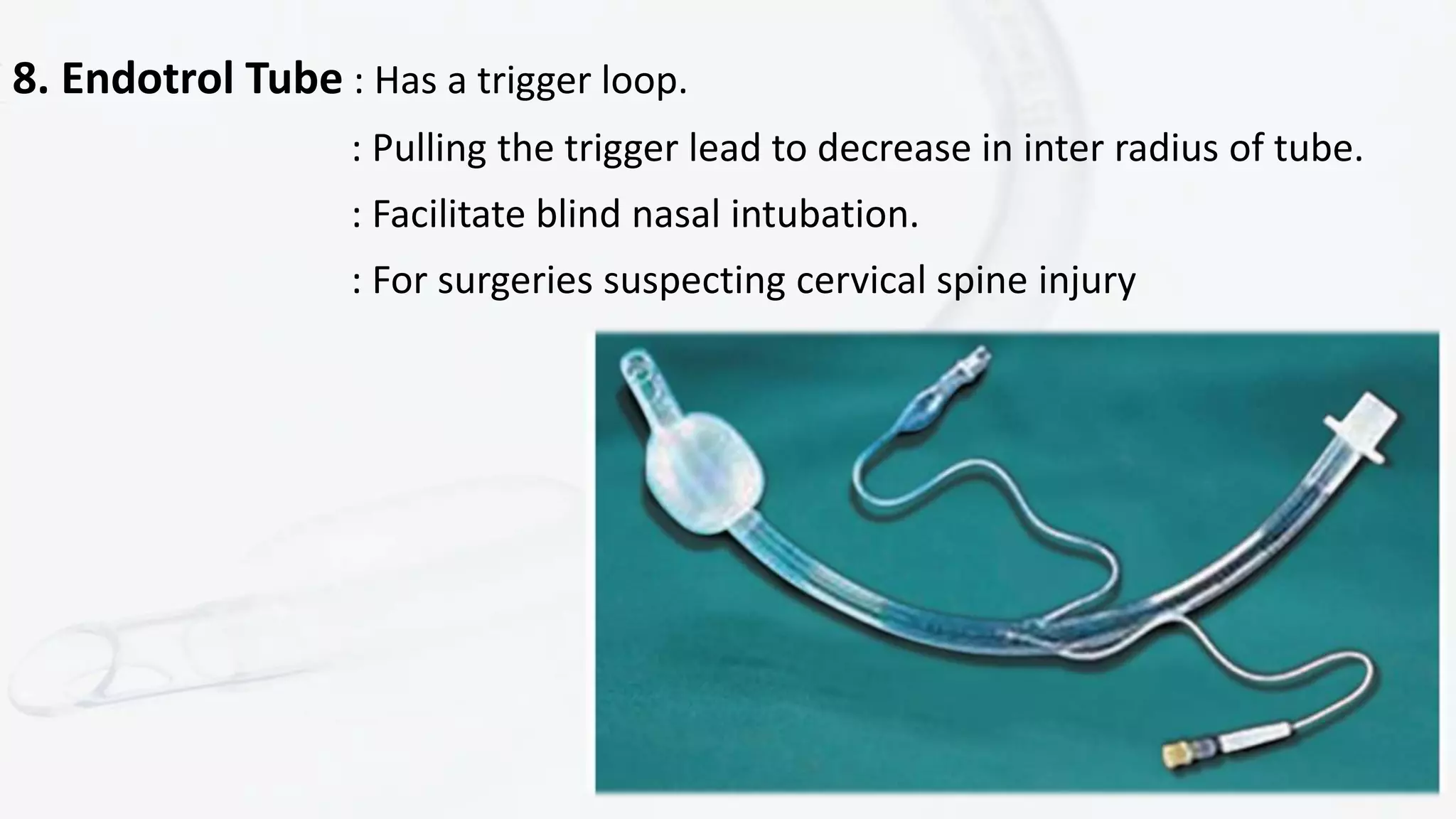
8. Endotrol Tube : Has a trigger loop.
: Pulling the trigger lead to decrease in inter radius of tube.
: Facilitate blind nasal intubation.
: For surgeries suspecting cervical spine injury
9. EndoFlex® Tube
: Almost same as endotrol tube.
: Pulling the white bar causes tube tio to bend anteriorily.
: Facilitates intubation in patient with anteriorly placed larynx
10. Parker Flex-Tip® Tube : Hooded tip.
: Flexible distal end.
: Best to go with bronchoscope.
: Available with or without Murphy's Eye.
11. Electromyogram Reinforced Tracheal Tube
: To monitor RLN electromyogram during surgery.
: Wired reinforcement.
: Four electrodes above cuff.
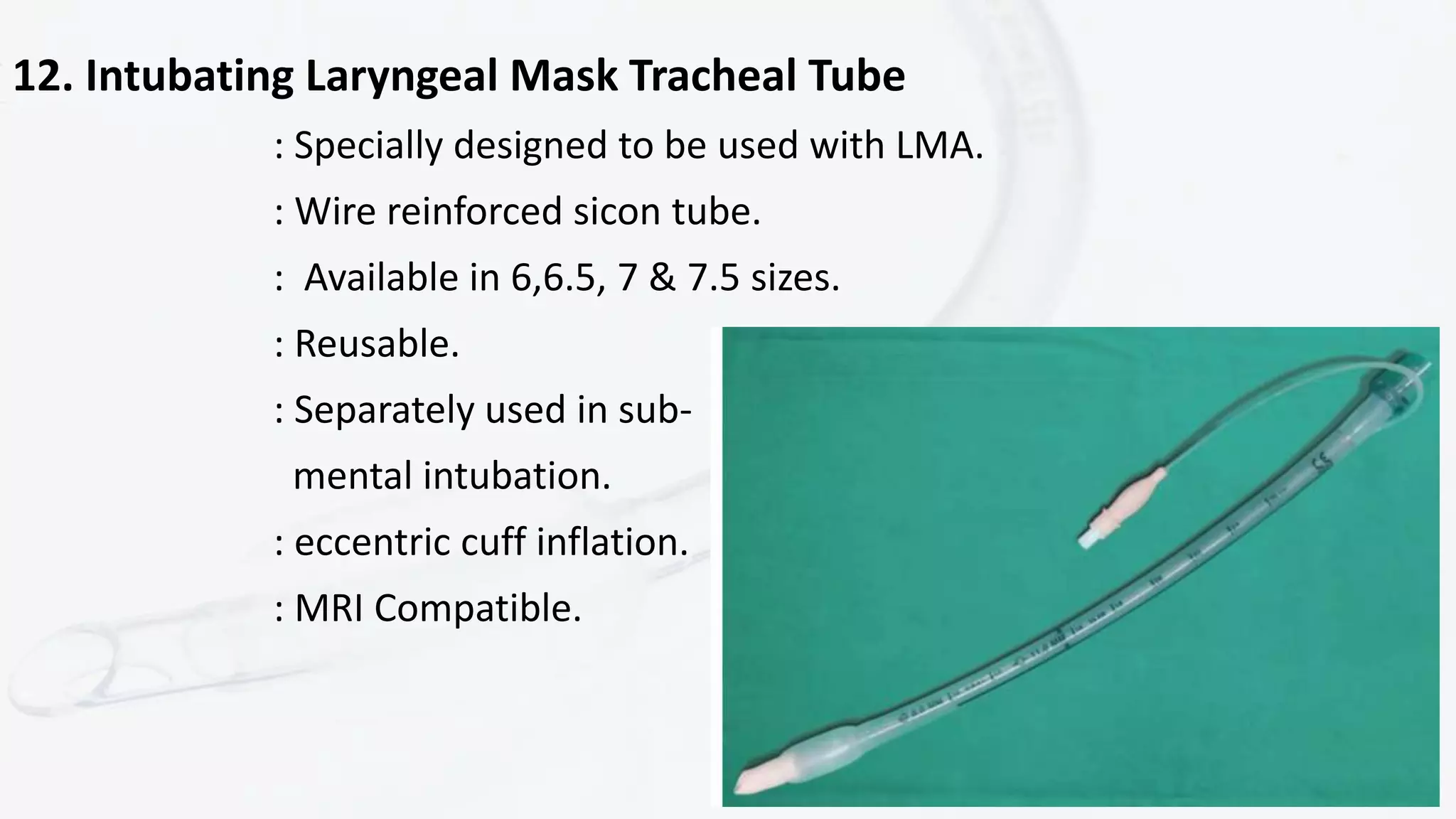
12. Intubating Laryngeal Mask Tracheal Tube
: Specially designed to be used with LMA.
: Wire reinforced sicon tube.
: Available in 6,6.5, 7 & 7.5 sizes.
: Reusable.
: Separately used in sub-
mental intubation.
: eccentric cuff inflation.
: MRI Compatible.
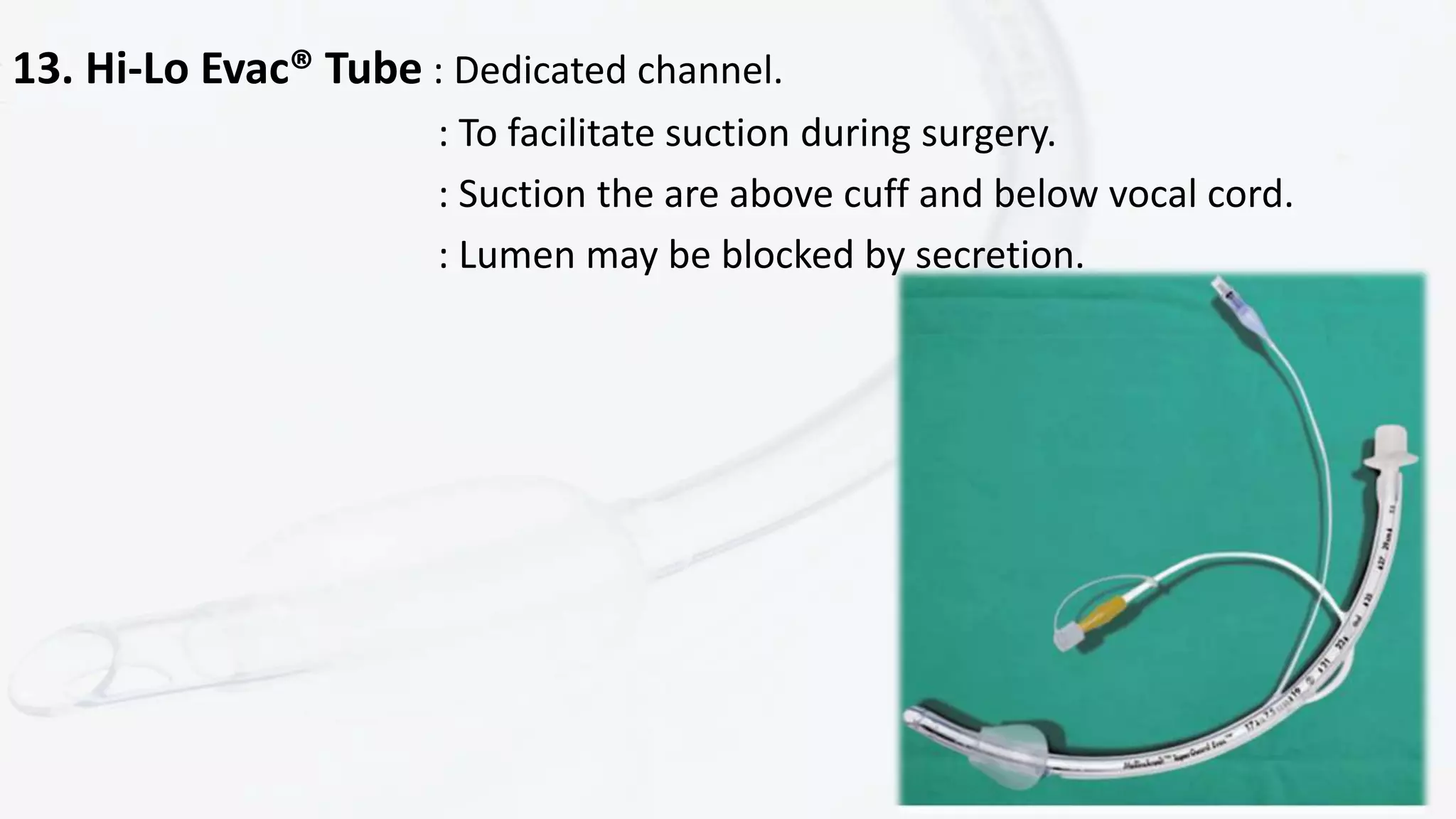
13. Hi-Lo Evac® Tube : Dedicated channel.
: To facilitate suction during surgery.
: Suction the are above cuff and below vocal cord.
: Lumen may be blocked by secretion.
14. Hi-Lo Jet Tube : Uncuffed tube with additional lumen.
: Jet ventilation.
: Monitoring airway pressure.
: Sampling respiratory gases.
: Administering LA.
: Irrigating the airway.
: Suction through main tube is
difficult.
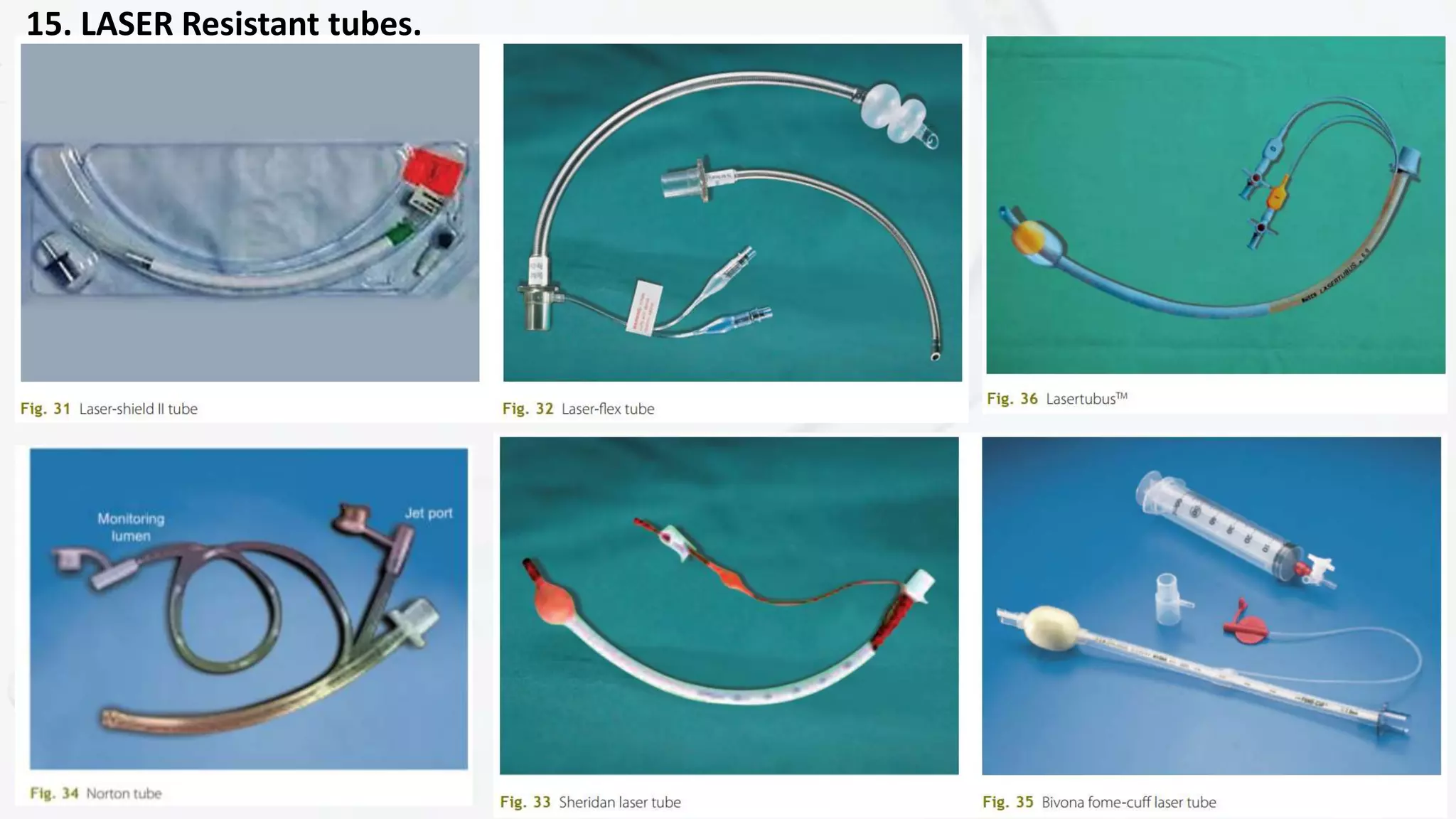
15. Laser-Resistant Tubes
15. LASER Resistant tubes.
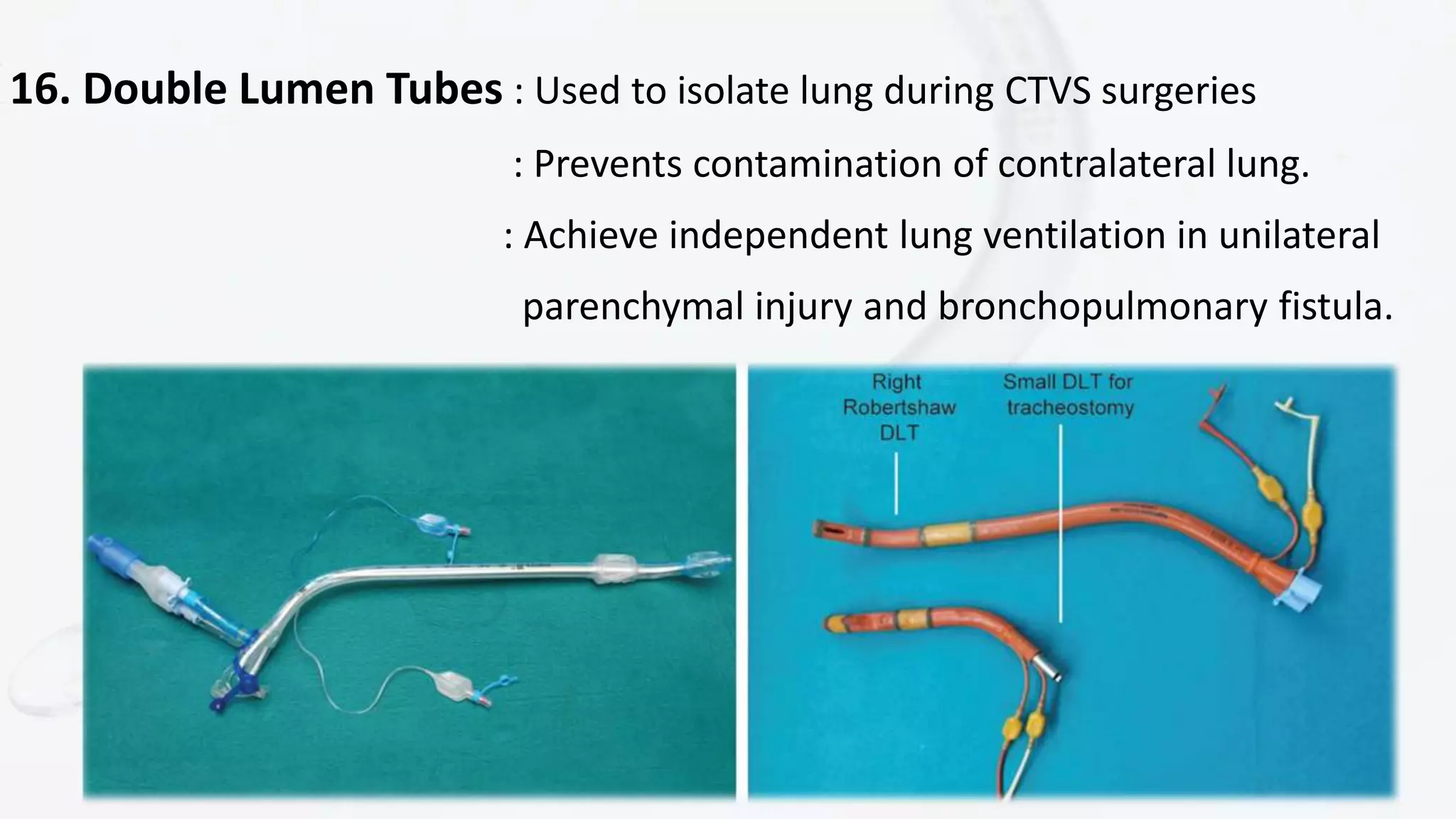
16. Double Lumen Tubes : Used to isolate lung during CTVS surgeries
: Prevents contamination of contralateral lung.
: Achieve independent lung ventilation in unilateral
parenchymal injury and bronchopulmonary fistula.
THANK YOU
Reference : Understanding Anesthetic Equipment & Procedures A Practical Approach
A book by Dwarkadas K Baheti & Vandana V Laheri

Endotracheal tube

  • 1.
  • 2.
    INTRODUCTION • Device insertedthrough larynx into trachea to convey gases & vapours to and from lungs. • First successful endotracheal intubation done by William Mac Even in 1978, for tumor of base of tongue surgery • Gas used was Chloroform. • In 1928 concept of cuffed ET tube was borne but successfully used from 1950.
  • 3.
    STANDARD ENDOTRACHEAL TUBEDESIGN 1. Patient End 2. Curvature 3. Markings 4. Material 5. Size 6. Tube Cuff 7. Machine End
  • 4.
    PATIENT END • Bevelledtip to the left side • Murphy's Eye opposite to the bevelled end • Those ET tubes which has Murphy's Eye : Murphy Type • Without Murphy's Eye : Magill's Type
  • 5.
    CURVATURE • Matches theanatomical curvature of oral cavity. • Arc : 140mm Radius
  • 6.
    MARKINGS • Typically writtenon bevelled side. • Common Markings are: Oral/Nasal Tube Size: mm/ID/French Radio Opaque Line Distance from the tip Name of manufacturer MRI sensitive/resistant
  • 7.
    MATERIALS 1.Red Rubber/Natural Latex •Reusable • Rigid • Less traumatic • Opaque • Repated washing makes it soft & kinkable • Can be allergic
  • 8.
    2. PVC • Inexpensive •Compatible with tissue • Disposable • Presterilised • Transparent • Rigid • Difficult to insert • Traumatic
  • 9.
    3. Silicon Ruber •PVC+Silicon Oil • Less surface adhesion • Opaque • Inexpensive • Can be reused after autoclaving
  • 10.
    SIZE 1. Adult •Earlier widestdiameter which can pass through narrowest part of airway was used. •Currently much smaller diameter of tube is used. •Larger tube causes cord injury, hoarsness & sore throat. •Cuff is too large in larger so folds and less sealing. •Standard: 7.5 in Females : 8.5 in Males 2. Children • Generally Uncuffed •Widest enough to cross cricoid.
  • 11.
    Uncuffed Tubes • Forchildren below 6 years: Age in years/3 + 3.5 • For children older than 6 years: Age in years/4 + 4.5 • ID = Age in years/4 + 4 (modifed Cole formula) for children above 2 years • ID = 3 mm for those 3 months of age and younger • ID = 3.5 mm for those from 3 months to 9 months of age • ID = (Age in years + 16)/4 over 9 months of age • External diameter is the same width as the distal phalanx of the little fnger approximately. Cuffed Tubes • ID in mm = Age/4 + 3 (Khine formula) • A tube 0.5–1 mm smaller than that calculated for an uncuffed tube
  • 12.
    Approximate size ofthe tube as per age Age Tube size(ID in mm) 10–14 years 7.0–7.5 7–10 years 6.5–7.0 4–6 years 5.5–6.5 1–4 years 4.5–5.5 6–12 months 4.5–5.0 1–6 months 4.0–4.5 Neonates 2.5–3.5 Premature 2–2.5
  • 13.
    CUFF With pilot baloon: One way spring valve Without pilot baloon : Plugged or clamped On the basis of pressure two types: 1. Low volume High Pressure • Red rubber • Distends trachea to almost circular • Advantages : better sealing : better visibility during intubation : lower incidence of sore throat : less expensive
  • 14.
    • Disadvantage :Tracheal ischemia : Scarring : Stenosis 2. High Volume Low Pressure • Thin enelastic material (like PVC) • Large resting volume and diameter • Thin wall seals the trachea well without streching • Area of contact larger : adaptive to trachea • Advantages : No pressure related injury : Possible to measure & regulate pressure
  • 15.
    • Disadvantage :More difficult to insert : Greater incidence of sore throat : Seal may not be effective : Microfolds leading to aspiration : N2O diffuse into the cuff : Can be overfilled Foam cuff : Polyurethane foam : Has bigger diameter : Deflated first with suction then reinflated : Good seal
  • 16.
     Lanz Cuff :Latex pilot baloon inside transparent plastic bag : Has a pressure regulating valve : Automaticaly maintains 20-25 torr pressure at the end tidal volume.
  • 17.
    TUBE LENGTH • Universalyfixed • ASTM/ISO Certified • Tube length increases with increase in ID
  • 18.
    MACHINE END • Maletype of connector. • Plastic/ Metal • Universally designed to fit with 15mm female plug • Generally 900 angulated
  • 19.
    SPECIAL TUBES 1. ColeType: Emergency Neonatal Resucitation : Narrow Patient end : Shoulder prevents broncheal intubation & provides air tight seal : Size is same as ID of patient end. : Can get blocked easily. : Resistance offered is more than normal ET tube of same size.
  • 20.
    2. Microcuff ETtube : cuffed tube for children : Short ultrathin cuff away from subglottic area :Can be inflated at very less pressure : No murphy's Eye : So cuff can be placed too distal : Reduced risk of pressure to Cricoid.
  • 21.
    3. RAE type: Ring Adain Elwin Tube : Oral/South Polar RAE : Nasal/North Polar RAE : Used to facilitate surgeries of Head & face. : South polar RAE has connector placed towrads chin giving better view during cleft palate surgeries. : North polar RAE is nasal so connector placed away from jaw giving better access to mandible. : Have disadvantage of not being able to pass suction catheter through it.
  • 22.
    4. Flexometalic tube: Head & Neck surgery with high movements : Reinforced with wire within the tube. : Flexible & Non kinking : More esily slipped over fibreoptic broncoscope : No nasal entubation possible : No Murphy's Eye : Expensive : Spontaneous extubation can happen : May obstruct the radiological view of Cx Spine
  • 23.
    6. Microlaryngeal Tube: Microlaryngeal surgeries & with narrow airway. : Available as 4,5 or 6 sized tube. : High volume low pressure cuff. : Can be inserted through LMA : Forcep is required during intubation.
  • 24.
    7. Tehran tube: specially designed for nasal intubation : Have a typical upper airway curve. : Reusable. : Made of silicon. : Can be inserted blindly.
  • 25.
    8. Laryngectomy Tube :Designed to be inserted through tracheostomy : J shaped. : To be made straight before intubation : No bevel end.
  • 26.
    8. Endotrol Tube: Has a trigger loop. : Pulling the trigger lead to decrease in inter radius of tube. : Facilitate blind nasal intubation. : For surgeries suspecting cervical spine injury
  • 27.
    9. EndoFlex® Tube :Almost same as endotrol tube. : Pulling the white bar causes tube tio to bend anteriorily. : Facilitates intubation in patient with anteriorly placed larynx
  • 28.
    10. Parker Flex-Tip®Tube : Hooded tip. : Flexible distal end. : Best to go with bronchoscope. : Available with or without Murphy's Eye.
  • 29.
    11. Electromyogram ReinforcedTracheal Tube : To monitor RLN electromyogram during surgery. : Wired reinforcement. : Four electrodes above cuff.
  • 30.
    12. Intubating LaryngealMask Tracheal Tube : Specially designed to be used with LMA. : Wire reinforced sicon tube. : Available in 6,6.5, 7 & 7.5 sizes. : Reusable. : Separately used in sub- mental intubation. : eccentric cuff inflation. : MRI Compatible.
  • 31.
    13. Hi-Lo Evac®Tube : Dedicated channel. : To facilitate suction during surgery. : Suction the are above cuff and below vocal cord. : Lumen may be blocked by secretion.
  • 32.
    14. Hi-Lo JetTube : Uncuffed tube with additional lumen. : Jet ventilation. : Monitoring airway pressure. : Sampling respiratory gases. : Administering LA. : Irrigating the airway. : Suction through main tube is difficult.
  • 33.
    15. Laser-Resistant Tubes 15.LASER Resistant tubes.
  • 34.
    16. Double LumenTubes : Used to isolate lung during CTVS surgeries : Prevents contamination of contralateral lung. : Achieve independent lung ventilation in unilateral parenchymal injury and bronchopulmonary fistula.
  • 35.
    THANK YOU Reference :Understanding Anesthetic Equipment & Procedures A Practical Approach A book by Dwarkadas K Baheti & Vandana V Laheri