{
VENTILATION
MDM NURUL AINI/QUS 3206
 Definition - a means of changing the air in an enclosed
space to :
VENTILATION REQUIREMENTS
Keep fresh air for
respiratory system Preserve correct level
Of Oxygen in the air
Control Carbon Dioxide
Control the moisture level
Lowering the heat level
Remove dust and odors
 Requirements for an acceptable amount of fresh air supply
in buildings will vary depending on the nature of
occupation and activity.
 Air changes per hour or ventilation rate is the preferred
criteria for system design.
 This is calculated by dividing the quantity of air by the
room volume and multiplying by the occupancy.
VENTILATION REQUIREMENTS
Air changes per hour = quantity of air x occupancy
room volume
SYSTEM OF VENTILATION
Natural
Ventilation Mechanical
Ventilation
 Definition - the process of supplying and removing air
through an indoor space without using mechanical
systems. It refers to the flow of external air to an indoor
space as a result of pressure or temperature differences
 The benefits of natural ventilation include:-
1. Improved Indoor air quality (IAQ)
2. Energy savings
3. Reduction of greenhouse gas emissions
4. Occupant control
5. Reduction in occupant illness associated with Sick
Building Syndrome
6. Increased worker productivity
SYSTEM OF VENTILATION –Natural
 How can you relate the natural ventilation with
this criteria :
1- Indoor Air Quality
2- Energy saving
3- Greenhouse
4- Sick Building Syndrome
DURATION : 30 minutes
DISCUSSION 1
 Recommendations from design guidelines from various
building regulations suggest the following:
1. Building orientation and location.
2. Building form and dimensions.
3. Window typologies and operations;
4. Types, shape and size of openings;
5. Construction methods and detailing;
6. Urban planning consideration
SYSTEM OF VENTILATION - Natural
WIND EFFECT STACK EFFECT COMBINATION
EFFECT
 Definition - mechanical ventilation systems circulate fresh
air using ducts and fans rather than relying on airflow
through small holes or crack’s in a home’s wall, roof or
windows. Homeowners can breath easier knowing their
home has a good ventilation.
 Benefits of using mechanical ventilation:-
1. Better indoor air quality –can remove
pollutants, allergens, and moisture that can cause mold
problems
2. More control – provide proper fresh air flow along with
appropriate locations for intake and exhaust
3. Improved comfort – allow a constant flow of outside air
into the home and can also provide
filtration, dehumidification, and conditioning of the
incoming outside air.
SYSTEM OF VENTILATION - Mechanical
 These systems employ an electrically driven fan or fans to
provide the necessary air movement;
 They also ensure a specified air change and the air under
fan pressure can be forced through filters. There are three
types of mechanical ventilation systems:
1. Natural inlet and mechanical extract (exhaust system).
2. Mechanical inlet and natural extract
3. Mechanical inlet and extract
SYSTEM OF VENTILATION -Mechanical
NATURAL INLET & MECHANICAL EXTRACT
 This is the most common type of system and is used for
kitchens, workshops, laboratories, internal sanitary
apartments, garages and assembly halls.
 The fan creates negative pressure on its inlet side, and this
causes the air inside the room to move towards the fan, and
the room air is displaced by the fresh air from outside the
room.
SYSTEM OF VENTILATION -Mechanical
MECHANICAL INLET & NATURAL EXTRACT
 It is essential with this system that the air is heated before it
is forced into the building.
 The system may be used for boiler rooms, offices and certain
types of factories.
 The air may be heated in a central plant and ducted to the
various rooms, or a unit fan convector may be used.
SYSTEM OF VENTILATION -Mechanical
MECHANICAL INLET & EXTRACT
 This provides the best possible system of ventilation, but it is
also the most expensive and is used for many types of
buildings including cinemas, theatres, offices, lecture
theatres, dance halls, restaurants, departmental stores and
sports centers. The system is essential for operating theatres
and sterilizing rooms.
SYSTEM OF VENTILATION -Mechanical
TYPES OF FAN
FANS
- Propeller Fan
does not create much air
pressure and has limited
effect in ductwork. Ideal for use
at air openings in windows
and walls.
TYPES OF FAN
FANS
- Axial Flow Fan
can develop high pressure and is
used for moving air through long
sections of ductwork. The fan is
integral with the run of ducting and
does not require a base.
TYPES OF FAN
FANS
- Centrifugal Fan
can produce high pressure and has the
capacity for large volumes of air. Most
suited to larger installations such as air
conditioning systems. It may have one
or two inlets. Various forms of impeller
can be selected depending on the air
condition. Variable impellers and pulley
ratios from the detached drive motor
make this the most versatile of fans.
CELL OR PANEL TYPE
 Flat or in a vee formation to increase
the surface contact area.
 Available in dry or wet (viscous)
composition in disposable format for
simple fitting within the ductwork. A
rigid outer frame is necessary to
prevent flanking leakage of dirty air.
 Dry filters can be vacuum cleaned to
extend their life, but in time will be
replaced. The viscous filter is coated
with an odorless, non-toxic, non-
flammable oil. These can be cleaned
in hot soapy water and recoated with
oil.
AIR FILTERS
BAG TYPE
 A form of filtration material
providing a large air contact area.
 When the fan is inactive the bag
will hang limply unless wire
reinforced.
 It will resume a horizontal profile
during normal system operation.
 Fabric bags can be washed
periodically and replaced.
AIR FILTERS
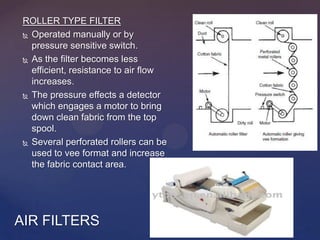
ROLLER TYPE FILTER
 Operated manually or by
pressure sensitive switch.
 As the filter becomes less
efficient, resistance to air flow
increases.
 The pressure effects a detector
which engages a motor to bring
down clean fabric from the top
spool.
 Several perforated rollers can be
used to vee format and increase
the fabric contact area.
AIR FILTERS
VISCOUS TYPE FILTER
 These have a high dust
retention capacity and are often
specified for application to
industrial situations.
 An improvement on the panel
type has close spaced
corrugated metal plates
continuously sprayed with oil. A
rotating variation has filter
plates hung from chains.
 The lower plates in the cycle
pass through a bath of oil which
removes attached particles and
resurfaces the plates with clean
oil.
AIR FILTERS
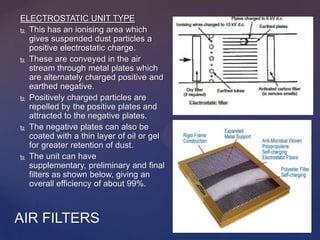
ELECTROSTATIC UNIT TYPE
 This has an ionising area which
gives suspended dust particles a
positive electrostatic charge.
 These are conveyed in the air
stream through metal plates which
are alternately charged positive and
earthed negative.
 Positively charged particles are
repelled by the positive plates and
attracted to the negative plates.
 The negative plates can also be
coated with a thin layer of oil or gel
for greater retention of dust.
 The unit can have
supplementary, preliminary and final
filters as shown below, giving an
overall efficiency of about 99%.
AIR FILTERS
 DETERMINE THE VARIOUS CONCEPT OF DESIGN
MINIMIZING THE USAGE OF MECHANICAL
VENTILATION
Duration : 30 minutes
DISCUSSION 2

Ventilation system

  • 1.
  • 2.
     Definition -a means of changing the air in an enclosed space to : VENTILATION REQUIREMENTS Keep fresh air for respiratory system Preserve correct level Of Oxygen in the air Control Carbon Dioxide Control the moisture level Lowering the heat level Remove dust and odors
  • 3.
     Requirements foran acceptable amount of fresh air supply in buildings will vary depending on the nature of occupation and activity.  Air changes per hour or ventilation rate is the preferred criteria for system design.  This is calculated by dividing the quantity of air by the room volume and multiplying by the occupancy. VENTILATION REQUIREMENTS Air changes per hour = quantity of air x occupancy room volume
  • 4.
  • 5.
     Definition -the process of supplying and removing air through an indoor space without using mechanical systems. It refers to the flow of external air to an indoor space as a result of pressure or temperature differences  The benefits of natural ventilation include:- 1. Improved Indoor air quality (IAQ) 2. Energy savings 3. Reduction of greenhouse gas emissions 4. Occupant control 5. Reduction in occupant illness associated with Sick Building Syndrome 6. Increased worker productivity SYSTEM OF VENTILATION –Natural
  • 6.
     How canyou relate the natural ventilation with this criteria : 1- Indoor Air Quality 2- Energy saving 3- Greenhouse 4- Sick Building Syndrome DURATION : 30 minutes DISCUSSION 1
  • 7.
     Recommendations fromdesign guidelines from various building regulations suggest the following: 1. Building orientation and location. 2. Building form and dimensions. 3. Window typologies and operations; 4. Types, shape and size of openings; 5. Construction methods and detailing; 6. Urban planning consideration SYSTEM OF VENTILATION - Natural
  • 8.
    SYSTEM OF VENTILATION- Natural WIND EFFECT STACK EFFECT COMBINATION EFFECT
  • 9.
     Definition -mechanical ventilation systems circulate fresh air using ducts and fans rather than relying on airflow through small holes or crack’s in a home’s wall, roof or windows. Homeowners can breath easier knowing their home has a good ventilation.  Benefits of using mechanical ventilation:- 1. Better indoor air quality –can remove pollutants, allergens, and moisture that can cause mold problems 2. More control – provide proper fresh air flow along with appropriate locations for intake and exhaust 3. Improved comfort – allow a constant flow of outside air into the home and can also provide filtration, dehumidification, and conditioning of the incoming outside air. SYSTEM OF VENTILATION - Mechanical
  • 10.
     These systemsemploy an electrically driven fan or fans to provide the necessary air movement;  They also ensure a specified air change and the air under fan pressure can be forced through filters. There are three types of mechanical ventilation systems: 1. Natural inlet and mechanical extract (exhaust system). 2. Mechanical inlet and natural extract 3. Mechanical inlet and extract SYSTEM OF VENTILATION -Mechanical
  • 11.
    NATURAL INLET &MECHANICAL EXTRACT  This is the most common type of system and is used for kitchens, workshops, laboratories, internal sanitary apartments, garages and assembly halls.  The fan creates negative pressure on its inlet side, and this causes the air inside the room to move towards the fan, and the room air is displaced by the fresh air from outside the room. SYSTEM OF VENTILATION -Mechanical
  • 12.
    MECHANICAL INLET &NATURAL EXTRACT  It is essential with this system that the air is heated before it is forced into the building.  The system may be used for boiler rooms, offices and certain types of factories.  The air may be heated in a central plant and ducted to the various rooms, or a unit fan convector may be used. SYSTEM OF VENTILATION -Mechanical
  • 13.
    MECHANICAL INLET &EXTRACT  This provides the best possible system of ventilation, but it is also the most expensive and is used for many types of buildings including cinemas, theatres, offices, lecture theatres, dance halls, restaurants, departmental stores and sports centers. The system is essential for operating theatres and sterilizing rooms. SYSTEM OF VENTILATION -Mechanical
  • 14.
    TYPES OF FAN FANS -Propeller Fan does not create much air pressure and has limited effect in ductwork. Ideal for use at air openings in windows and walls.
  • 15.
    TYPES OF FAN FANS -Axial Flow Fan can develop high pressure and is used for moving air through long sections of ductwork. The fan is integral with the run of ducting and does not require a base.
  • 16.
    TYPES OF FAN FANS -Centrifugal Fan can produce high pressure and has the capacity for large volumes of air. Most suited to larger installations such as air conditioning systems. It may have one or two inlets. Various forms of impeller can be selected depending on the air condition. Variable impellers and pulley ratios from the detached drive motor make this the most versatile of fans.
  • 17.
    CELL OR PANELTYPE  Flat or in a vee formation to increase the surface contact area.  Available in dry or wet (viscous) composition in disposable format for simple fitting within the ductwork. A rigid outer frame is necessary to prevent flanking leakage of dirty air.  Dry filters can be vacuum cleaned to extend their life, but in time will be replaced. The viscous filter is coated with an odorless, non-toxic, non- flammable oil. These can be cleaned in hot soapy water and recoated with oil. AIR FILTERS
  • 18.
    BAG TYPE  Aform of filtration material providing a large air contact area.  When the fan is inactive the bag will hang limply unless wire reinforced.  It will resume a horizontal profile during normal system operation.  Fabric bags can be washed periodically and replaced. AIR FILTERS
  • 19.
    ROLLER TYPE FILTER Operated manually or by pressure sensitive switch.  As the filter becomes less efficient, resistance to air flow increases.  The pressure effects a detector which engages a motor to bring down clean fabric from the top spool.  Several perforated rollers can be used to vee format and increase the fabric contact area. AIR FILTERS
  • 20.
    VISCOUS TYPE FILTER These have a high dust retention capacity and are often specified for application to industrial situations.  An improvement on the panel type has close spaced corrugated metal plates continuously sprayed with oil. A rotating variation has filter plates hung from chains.  The lower plates in the cycle pass through a bath of oil which removes attached particles and resurfaces the plates with clean oil. AIR FILTERS
  • 21.
    ELECTROSTATIC UNIT TYPE This has an ionising area which gives suspended dust particles a positive electrostatic charge.  These are conveyed in the air stream through metal plates which are alternately charged positive and earthed negative.  Positively charged particles are repelled by the positive plates and attracted to the negative plates.  The negative plates can also be coated with a thin layer of oil or gel for greater retention of dust.  The unit can have supplementary, preliminary and final filters as shown below, giving an overall efficiency of about 99%. AIR FILTERS
  • 22.
     DETERMINE THEVARIOUS CONCEPT OF DESIGN MINIMIZING THE USAGE OF MECHANICAL VENTILATION Duration : 30 minutes DISCUSSION 2