Building Services 
VENTILATION 
& WIND FLOW
By - 
Akshay (04) 
Balraj (14) 
Ciby (16) 
Ketan ( 
Manita (37)
CONTENTS 
•Introduction 
•Function of natural ventilation 
•Supply of fresh air 
•Stack due to thermal force 
•Convective cooling 
•Wind simulators 
•Physiology coding 
•Air movement through building & around 
the building 
•Factors affecting indoor air flow & 
Around building 
•Wind shadow
INTRODUCTION 
Climate means a region with a certain condition of temperature, dryness, 
wind, light, etc.. 
It is rather an integration in time of physical states of atmospheric 
environment, characteristics of geographical location. 
Weather is the momentary state of atmospheric environment at a certain 
location . 
Climate can be called the integration of time of weather condition. 
Climate has 4 major elements:- 
EARTH – soil 
WATER – humidity 
FIRE – sun and temperature 
AIR – wind 
Climatology is all about the study of these elements
ARCHITECTURAL CLIMATOLOGY 
Architecture is all about ART and TECHNOLOGY. 
It includes public services, water supply and drainage, air 
conditioning, ventilation, lighting, etc. 
it is the basic science a designer is concerned about. 
It involves majorly on:- 
climatic elements how they are behaving on us how to be 
benefited by these climatic elements how to protect ourselves from 
the adverse effect of climatic elements 
The major steps in architectural climatology are:- 
climatology-study of climatic elements 
biology-study of human comfort level with respect to 
climatology 
technology-creating of built environment architecture 
-the combination of the above and the final product
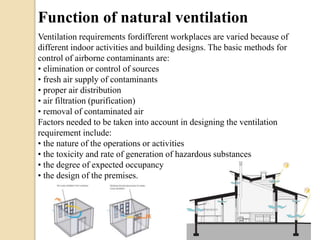
Function of natural ventilation 
Ventilation requirements fordifferent workplaces are varied because of 
different indoor activities and building designs. The basic methods for 
control of airborne contaminants are: 
• elimination or control of sources 
• fresh air supply of contaminants 
• proper air distribution 
• air filtration (purification) 
• removal of contaminated air 
Factors needed to be taken into account in designing the ventilation 
requirement include: 
• the nature of the operations or activities 
• the toxicity and rate of generation of hazardous substances 
• the degree of expected occupancy 
• the design of the premises.
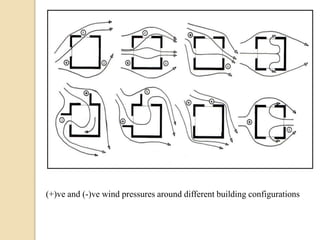
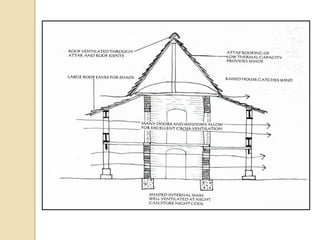
(+)ve and (-)ve wind pressures around different building configurations
VENTILATION 
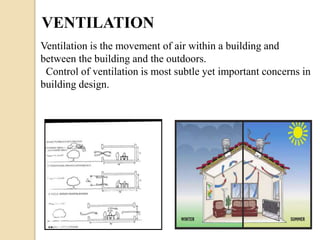
Ventilation is the movement of air within a building and 
between the building and the outdoors. 
Control of ventilation is most subtle yet important concerns in 
building design.
Supply of fresh air 
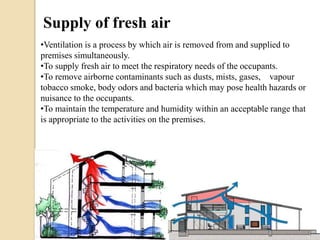
•Ventilation is a process by which air is removed from and supplied to 
premises simultaneously. 
•To supply fresh air to meet the respiratory needs of the occupants. 
•To remove airborne contaminants such as dusts, mists, gases, vapour 
tobacco smoke, body odors and bacteria which may pose health hazards or 
nuisance to the occupants. 
•To maintain the temperature and humidity within an acceptable range that 
is appropriate to the activities on the premises.
Stack due to thermal force 
•All practical steps have been taken by means of 
collectors, scrubbers, or process changes to reduce the 
contaminant discharge rates to of reducing emission rates. 
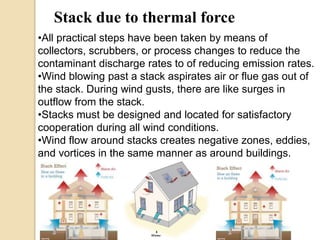
•Wind blowing past a stack aspirates air or flue gas out of 
the stack. During wind gusts, there are like surges in 
outflow from the stack. 
•Stacks must be designed and located for satisfactory 
cooperation during all wind conditions. 
•Wind flow around stacks creates negative zones, eddies, 
and vortices in the same manner as around buildings.
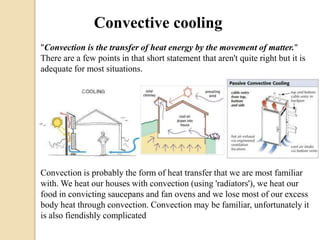
Convective cooling 
"Convection is the transfer of heat energy by the movement of matter." 
There are a few points in that short statement that aren't quite right but it is 
adequate for most situations. 
Convection is probably the form of heat transfer that we are most familiar 
with. We heat our houses with convection (using 'radiators'), we heat our 
food in convicting saucepans and fan ovens and we lose most of our excess 
body heat through convection. Convection may be familiar, unfortunately it 
is also fiendishly complicated
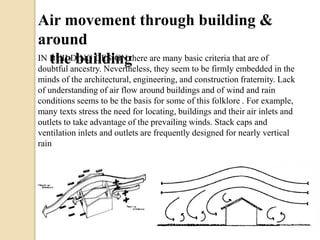
Air movement through building & 
around 
IN BthUIeLD bINuG iDlEdSiIGnNg there are many basic criteria that are of 
doubtful ancestry. Nevertheless, they seem to be firmly embedded in the 
minds of the architectural, engineering, and construction fraternity. Lack 
of understanding of air flow around buildings and of wind and rain 
conditions seems to be the basis for some of this folklore . For example, 
many texts stress the need for locating, buildings and their air inlets and 
outlets to take advantage of the prevailing winds. Stack caps and 
ventilation inlets and outlets are frequently designed for nearly vertical 
rain
Factors affecting indoor air flow & 
Around building 
Natural ventilation is the process of supplying and 
removing air through an indoor space without using mechanical 
systems. It refers to the flow of external air to an indoor space as a 
result of pressure or temperature differences. There are two types of 
natural ventilation occurring in buildings: wind driven 
ventilation and buoyancy-driven ventilation. While wind is the main 
mechanism of wind driven ventilation, buoyancy-driven ventilation 
occurs as a result of the directional buoyancy force that results from 
temperature differences between the interior and exterior
Factors affecting indoor air flow & 
Around building 
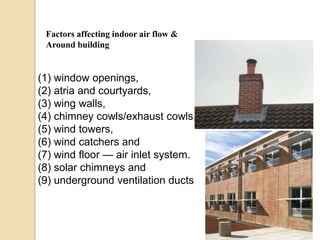
(1) window openings, 
(2) atria and courtyards, 
(3) wing walls, 
(4) chimney cowls/exhaust cowls, 
(5) wind towers, 
(6) wind catchers and 
(7) wind floor — air inlet system. 
(8) solar chimneys and 
(9) underground ventilation ducts
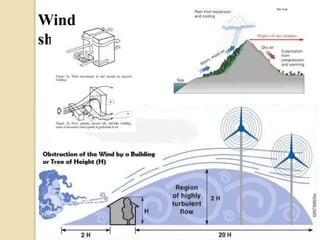
Wind 
shadow
BIBLIOGRAPH 
Y 
www.wikipedia.com 
www.google.com

Building Services- Ventilation

  • 1.
  • 2.
    By - Akshay(04) Balraj (14) Ciby (16) Ketan ( Manita (37)
  • 3.
    CONTENTS •Introduction •Functionof natural ventilation •Supply of fresh air •Stack due to thermal force •Convective cooling •Wind simulators •Physiology coding •Air movement through building & around the building •Factors affecting indoor air flow & Around building •Wind shadow
  • 4.
    INTRODUCTION Climate meansa region with a certain condition of temperature, dryness, wind, light, etc.. It is rather an integration in time of physical states of atmospheric environment, characteristics of geographical location. Weather is the momentary state of atmospheric environment at a certain location . Climate can be called the integration of time of weather condition. Climate has 4 major elements:- EARTH – soil WATER – humidity FIRE – sun and temperature AIR – wind Climatology is all about the study of these elements
  • 5.
    ARCHITECTURAL CLIMATOLOGY Architectureis all about ART and TECHNOLOGY. It includes public services, water supply and drainage, air conditioning, ventilation, lighting, etc. it is the basic science a designer is concerned about. It involves majorly on:- climatic elements how they are behaving on us how to be benefited by these climatic elements how to protect ourselves from the adverse effect of climatic elements The major steps in architectural climatology are:- climatology-study of climatic elements biology-study of human comfort level with respect to climatology technology-creating of built environment architecture -the combination of the above and the final product
  • 6.
    Function of naturalventilation Ventilation requirements fordifferent workplaces are varied because of different indoor activities and building designs. The basic methods for control of airborne contaminants are: • elimination or control of sources • fresh air supply of contaminants • proper air distribution • air filtration (purification) • removal of contaminated air Factors needed to be taken into account in designing the ventilation requirement include: • the nature of the operations or activities • the toxicity and rate of generation of hazardous substances • the degree of expected occupancy • the design of the premises.
  • 7.
    (+)ve and (-)vewind pressures around different building configurations
  • 9.
    VENTILATION Ventilation isthe movement of air within a building and between the building and the outdoors. Control of ventilation is most subtle yet important concerns in building design.
  • 10.
    Supply of freshair •Ventilation is a process by which air is removed from and supplied to premises simultaneously. •To supply fresh air to meet the respiratory needs of the occupants. •To remove airborne contaminants such as dusts, mists, gases, vapour tobacco smoke, body odors and bacteria which may pose health hazards or nuisance to the occupants. •To maintain the temperature and humidity within an acceptable range that is appropriate to the activities on the premises.
  • 11.
    Stack due tothermal force •All practical steps have been taken by means of collectors, scrubbers, or process changes to reduce the contaminant discharge rates to of reducing emission rates. •Wind blowing past a stack aspirates air or flue gas out of the stack. During wind gusts, there are like surges in outflow from the stack. •Stacks must be designed and located for satisfactory cooperation during all wind conditions. •Wind flow around stacks creates negative zones, eddies, and vortices in the same manner as around buildings.
  • 12.
    Convective cooling "Convectionis the transfer of heat energy by the movement of matter." There are a few points in that short statement that aren't quite right but it is adequate for most situations. Convection is probably the form of heat transfer that we are most familiar with. We heat our houses with convection (using 'radiators'), we heat our food in convicting saucepans and fan ovens and we lose most of our excess body heat through convection. Convection may be familiar, unfortunately it is also fiendishly complicated
  • 13.
    Air movement throughbuilding & around IN BthUIeLD bINuG iDlEdSiIGnNg there are many basic criteria that are of doubtful ancestry. Nevertheless, they seem to be firmly embedded in the minds of the architectural, engineering, and construction fraternity. Lack of understanding of air flow around buildings and of wind and rain conditions seems to be the basis for some of this folklore . For example, many texts stress the need for locating, buildings and their air inlets and outlets to take advantage of the prevailing winds. Stack caps and ventilation inlets and outlets are frequently designed for nearly vertical rain
  • 14.
    Factors affecting indoorair flow & Around building Natural ventilation is the process of supplying and removing air through an indoor space without using mechanical systems. It refers to the flow of external air to an indoor space as a result of pressure or temperature differences. There are two types of natural ventilation occurring in buildings: wind driven ventilation and buoyancy-driven ventilation. While wind is the main mechanism of wind driven ventilation, buoyancy-driven ventilation occurs as a result of the directional buoyancy force that results from temperature differences between the interior and exterior
  • 15.
    Factors affecting indoorair flow & Around building (1) window openings, (2) atria and courtyards, (3) wing walls, (4) chimney cowls/exhaust cowls, (5) wind towers, (6) wind catchers and (7) wind floor — air inlet system. (8) solar chimneys and (9) underground ventilation ducts
  • 16.
  • 17.