Shaper & Planer
Manoj Yadav
Deptt. Of Mech. Engg.
IPEC, Ghaziabad
Specifications of Shaping Machine
• Max.length of Stroke of Ram
• Type of Drive
• Power input
• Floor Space required
• Weight of the Machine
• Cutting to Return Stroke ratio
• Feed
SHAPER
SHAPER
6
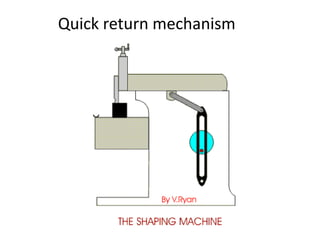
Quick return mechanism
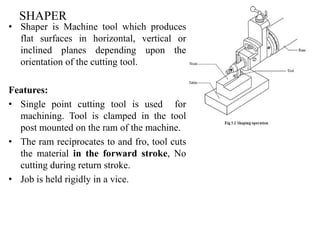
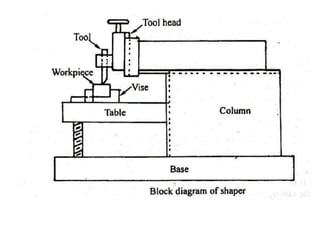
• Shaper is Machine tool which produces
flat surfaces in horizontal, vertical or
inclined planes depending upon the
orientation of the cutting tool.
Features:
• Single point cutting tool is used for
machining. Tool is clamped in the tool
post mounted on the ram of the machine.
• The ram reciprocates to and fro, tool cuts
the material in the forward stroke, No
cutting during return stroke.
• Job is held rigidly in a vice.
SHAPER
Operations done using a shaper
• Machining Horizontal Surfaces
• Machining Vertical Surfaces
• Machining Angular Surfaces
• Cutting Slots, Grooves & Key ways
• Machining irregular surfaces
• Machining Splines / Cutting Gears
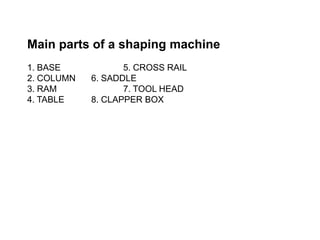
Main parts of a shaping machine
1. BASE 5. CROSS RAIL
2. COLUMN 6. SADDLE
3. RAM 7. TOOL HEAD
4. TABLE 8. CLAPPER BOX
PARTS OF SHAPER
BASE made of cast iron. Provides
support for other parts of
machine.
COLUMN- box type casting
mounted vertically on top of
base.
• It has 2 guide ways. One
vertical guideway in the front
over which a cross slide moves
up and down.
• 2nd horizontal guide ways on
top over which ram reciprocate.
• The reciprocating mechanism is
housed inside the column
CROSS RAIL : It is mounted on the
f ront vertical guide ways.
• The table can be lowered or raised
by adjusting the cross rail
TABLE: mounted on a saddle which
is located above the cross rail. Top
and sides are accurately machined
and have T slots.
RAM: supports tool head on its front.
It reciprocates on accurately
machined guideways on top of
column
PARTS OF SHAPER TOOL HEAD fitted on the face of
ram. Holds the tool rigidly.
• Provide vertical and angular feeds
for the tool
• Tool head can be positioned at
any angle
MP II UNIT 3 SHAPER AND PLANER
MECH DEPT KSSEM 2013
14
Classification of shapers
1 Position of ram travel
• Horizontal Shaper- Ram holding the cutting tool moves In
horizontal plane
• Vertical Shaper-The cutting tool moves in vertical plane
• Traveling head Shaper-Cutting tool reciprocates & moves
cross wise simultaneously
2 Acc. to Cutting Stroke action
a) Push Type Shaper- Standard Shaper.
• Metal is removed when the ram moves away from column
• Most common type used in practice
• Unless otherwise specified, the term shaper refers to Push
type Shaper
b) Draw Type Shaper
• Metal is removed when the tool is drawn towards the
column
• Allows heavier cuts to be made
• Less vibration during cutting
3 Acc. to Driving Mechanism:
a) Crank type - Driving mechanism is by crank & gear
b) Geared type - Driven by Rack & Pinion mechanism
c) Hydraulic Shaper - Driven by oil pressure developed by a
pump, which is run by an electric motor
4 Acc. to the Table Design:
a) Standard shaper- Work Table can be moved
1.Vertically & 2. Horizontally
b) Universal Shaper- Table can be moved
1. Horizontally 2. Vertically 3. Swivelled & 4. Tilted
This is mostly used in Tool Rooms
SHAPING OPERATIONS
1
Machining of horizontal surface
The work surface is held securely on the table
and tool is fixed in the tool head with
minimum overhang, as shown in figure. The
table with fixed work piece is raised close to
the tool; the length and position of the stroke
are adjusted. The stroke length is about 20mm
longer than the work and stroke is adjusted
such that the tool starts about 10-15 mm
before work piece and continues about 10 mm
after the end of cut.
2
Work piece is mounted on the table and the
surface to be machined is set parallel to stroke
axis. A side cutting tool is fitted in the tool head
as shown in figure. The length of stroke is
adjusted. The cutting feed is given by rotating
the down feed screw by hand (0.25 -0.50 mm)
Forward stroke is the cutting stroke. Return stroke the tool does not cut,
Double stroke= cutting stroke + return stroke
Stroke starts slightly before the work piece (a) and ends after the work piece (b)
Total stroke length = l+a+b
L
vc
f
w
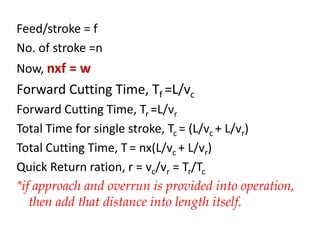
Feed/stroke = f
No. of stroke =n
Now, nxf = w
Forward Cutting Time, Tf =L/vc
Forward Cutting Time, Tr =L/vr
Total Time for single stroke, Tc = (L/vc + L/vr)
Total Cutting Time, T = nx(L/vc + L/vr)
Quick Return ration, r = vc/vr = Tr/Tc
*if approach and overrun is provided into operation,
then add that distance into length itself.
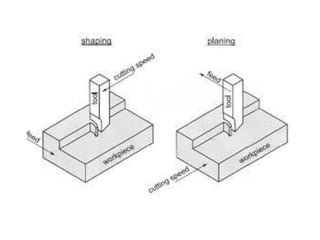
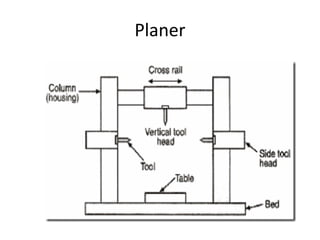
Planer

Ipec shaper and planer

  • 1.
    Shaper & Planer ManojYadav Deptt. Of Mech. Engg. IPEC, Ghaziabad
  • 3.
    Specifications of ShapingMachine • Max.length of Stroke of Ram • Type of Drive • Power input • Floor Space required • Weight of the Machine • Cutting to Return Stroke ratio • Feed
  • 4.
  • 6.
  • 7.
  • 8.
    • Shaper isMachine tool which produces flat surfaces in horizontal, vertical or inclined planes depending upon the orientation of the cutting tool. Features: • Single point cutting tool is used for machining. Tool is clamped in the tool post mounted on the ram of the machine. • The ram reciprocates to and fro, tool cuts the material in the forward stroke, No cutting during return stroke. • Job is held rigidly in a vice. SHAPER
  • 9.
    Operations done usinga shaper • Machining Horizontal Surfaces • Machining Vertical Surfaces • Machining Angular Surfaces • Cutting Slots, Grooves & Key ways • Machining irregular surfaces • Machining Splines / Cutting Gears
  • 11.
    Main parts ofa shaping machine 1. BASE 5. CROSS RAIL 2. COLUMN 6. SADDLE 3. RAM 7. TOOL HEAD 4. TABLE 8. CLAPPER BOX
  • 12.
    PARTS OF SHAPER BASEmade of cast iron. Provides support for other parts of machine. COLUMN- box type casting mounted vertically on top of base. • It has 2 guide ways. One vertical guideway in the front over which a cross slide moves up and down. • 2nd horizontal guide ways on top over which ram reciprocate. • The reciprocating mechanism is housed inside the column
  • 13.
    CROSS RAIL :It is mounted on the f ront vertical guide ways. • The table can be lowered or raised by adjusting the cross rail TABLE: mounted on a saddle which is located above the cross rail. Top and sides are accurately machined and have T slots. RAM: supports tool head on its front. It reciprocates on accurately machined guideways on top of column PARTS OF SHAPER TOOL HEAD fitted on the face of ram. Holds the tool rigidly. • Provide vertical and angular feeds for the tool • Tool head can be positioned at any angle
  • 14.
    MP II UNIT3 SHAPER AND PLANER MECH DEPT KSSEM 2013 14
  • 15.
    Classification of shapers 1Position of ram travel • Horizontal Shaper- Ram holding the cutting tool moves In horizontal plane • Vertical Shaper-The cutting tool moves in vertical plane • Traveling head Shaper-Cutting tool reciprocates & moves cross wise simultaneously 2 Acc. to Cutting Stroke action a) Push Type Shaper- Standard Shaper. • Metal is removed when the ram moves away from column • Most common type used in practice • Unless otherwise specified, the term shaper refers to Push type Shaper b) Draw Type Shaper • Metal is removed when the tool is drawn towards the column • Allows heavier cuts to be made • Less vibration during cutting
  • 16.
    3 Acc. toDriving Mechanism: a) Crank type - Driving mechanism is by crank & gear b) Geared type - Driven by Rack & Pinion mechanism c) Hydraulic Shaper - Driven by oil pressure developed by a pump, which is run by an electric motor 4 Acc. to the Table Design: a) Standard shaper- Work Table can be moved 1.Vertically & 2. Horizontally b) Universal Shaper- Table can be moved 1. Horizontally 2. Vertically 3. Swivelled & 4. Tilted This is mostly used in Tool Rooms
  • 17.
    SHAPING OPERATIONS 1 Machining ofhorizontal surface The work surface is held securely on the table and tool is fixed in the tool head with minimum overhang, as shown in figure. The table with fixed work piece is raised close to the tool; the length and position of the stroke are adjusted. The stroke length is about 20mm longer than the work and stroke is adjusted such that the tool starts about 10-15 mm before work piece and continues about 10 mm after the end of cut. 2 Work piece is mounted on the table and the surface to be machined is set parallel to stroke axis. A side cutting tool is fitted in the tool head as shown in figure. The length of stroke is adjusted. The cutting feed is given by rotating the down feed screw by hand (0.25 -0.50 mm)
  • 18.
    Forward stroke isthe cutting stroke. Return stroke the tool does not cut, Double stroke= cutting stroke + return stroke Stroke starts slightly before the work piece (a) and ends after the work piece (b) Total stroke length = l+a+b
  • 19.
  • 20.
    Feed/stroke = f No.of stroke =n Now, nxf = w Forward Cutting Time, Tf =L/vc Forward Cutting Time, Tr =L/vr Total Time for single stroke, Tc = (L/vc + L/vr) Total Cutting Time, T = nx(L/vc + L/vr) Quick Return ration, r = vc/vr = Tr/Tc *if approach and overrun is provided into operation, then add that distance into length itself.
  • 21.