The Fixture Design
Procedure
Prof. Ms. Amruta A. Rane
Assistant Professor,
DJSCE, University of Mumbai,
Mumbai.
Steps in Fixture Design Procedure
1. Locating
2. Clamping
3. Supporting
4. Applying cutter guides
5. Drawing the fixture outline as an envelop that combines all the previously drawn
elements.
In practice, one operates continuously with the part and hence the part outline
should be drawn either in thin lines or in coloured lines.
Locating and Degree of Freedom
• The forces acting (weight, clamping force, cutting forces) are not taken into
consideration with respect to their magnitude.
• Only direction of the forces are considered to ensure that part is located in a
position of static stability.
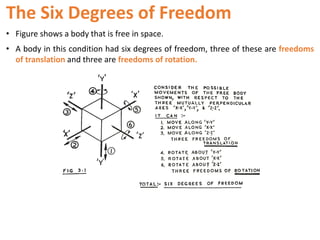
The Six Degrees of Freedom
• Figure shows a body that is free in space.
• A body in this condition had six degrees of freedom, three of these are freedoms
of translation and three are freedoms of rotation.
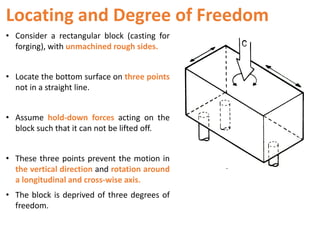
Locating and Degree of Freedom
• Consider a rectangular block (casting for
forging), with unmachined rough sides.
• Locate the bottom surface on three points
not in a straight line.
• Assume hold-down forces acting on the
block such that it can not be lifted off.
• These three points prevent the motion in
the vertical direction and rotation around
a longitudinal and cross-wise axis.
• The block is deprived of three degrees of
freedom.
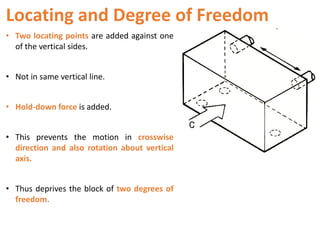
Locating and Degree of Freedom
• Two locating points are added against one
of the vertical sides.
• Not in same vertical line.
• Hold-down force is added.
• This prevents the motion in crosswise
direction and also rotation about vertical
axis.
• Thus deprives the block of two degrees of
freedom.
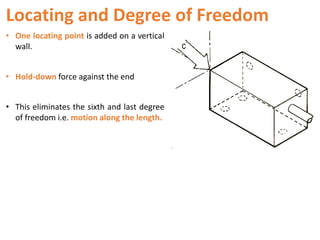
Locating and Degree of Freedom
• One locating point is added on a vertical
wall.
• Hold-down force against the end
• This eliminates the sixth and last degree
of freedom i.e. motion along the length.
Locating and Degree of Freedom
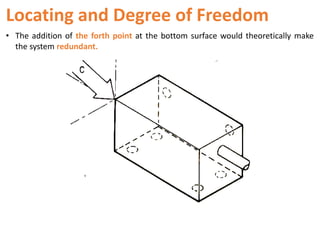
• The addition of the forth point at the bottom surface would theoretically make
the system redundant.
Locating and Degree of Freedom
• In actual fixture design the very first step is to deprive the part of its six degrees of
freedom by applying six individual locating points.
Clamping Elements
• Hold-down forces in above example are clamping forces.
• In practice they are applied by using bolts, straps, cams, etc.
• The number of clamping elements used are not necessarily equal to the number
of locating points.
Clamping Elements
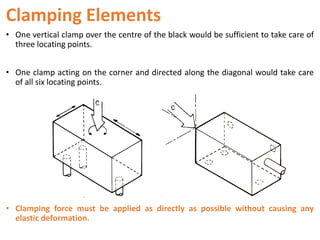
• One vertical clamp over the centre of the black would be sufficient to take care of
three locating points.
• One clamp acting on the corner and directed along the diagonal would take care
of all six locating points.
• Clamping force must be applied as directly as possible without causing any
elastic deformation.
Support
• Some support is provided by locating points.
• The locators only provide sufficient support to ensure the geometrical stability of
the part.
• The locating points are not sufficient to absorb all the acting loads without
causing elastic deformation of the part.
• Support – Sufficient in number and strength to absorb all acting loads.
• Should not interfere with locating points.
• Should not interfere with loading and unloading.
• Shouldn’t produce geometrical redundancy.
Cutter Guidance
• To provide guidance for the cutter.
• By providing the drill bushings in drill jigs
• By providing the tool guides to position the tool prior to start of the cut in fixtures.
Completing the body
• To draw the jig or fixture body that carries all the individual elements.
• Has enough strength and rigidity to hold them in proper places under load.
Jig or fixture body must accommodate following conditions:
• Must accommodate the part
• Have clearance for loading and unloading
• Clearance for chips
• Should have feet or some other supporting surface to place it on the machine
table.
• Locating elements for aligning it with machine table, machine spindle
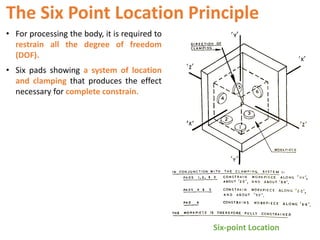
The Six Point Location Principle
• For processing the body, it is required to
restrain all the degree of freedom
(DOF).
• Six pads showing a system of location
and clamping that produces the effect
necessary for complete constrain.
Six-point Location
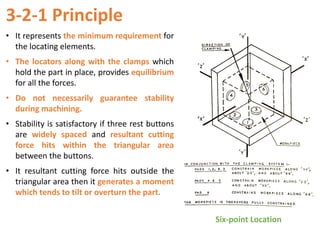
3-2-1 Principle
• It represents the minimum requirement for
the locating elements.
• The locators along with the clamps which
hold the part in place, provides equilibrium
for all the forces.
• Do not necessarily guarantee stability
during machining.
• Stability is satisfactory if three rest buttons
are widely spaced and resultant cutting
force hits within the triangular area
between the buttons.
• It resultant cutting force hits outside the
triangular area then it generates a moment
which tends to tilt or overturn the part.
Six-point Location
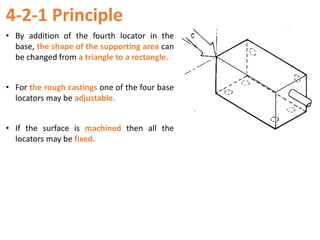
4-2-1 Principle
• By addition of the fourth locator in the
base, the shape of the supporting area can
be changed from a triangle to a rectangle.
• For the rough castings one of the four base
locators may be adjustable.
• If the surface is machined then all the
locators may be fixed.
References
1. Jig and Fixture Design Manual, Erik K. Henrikson, Industrail Press.
2. Jigs and Fixture, P.H. Joshi, THM.
3. An introduction to jig and tool Design, M.H.A. – Kempster, III Ed.Pub ELBS.
Thank You!

The jig and fixture design procedure

  • 1.
    The Fixture Design Procedure Prof.Ms. Amruta A. Rane Assistant Professor, DJSCE, University of Mumbai, Mumbai.
  • 2.
    Steps in FixtureDesign Procedure 1. Locating 2. Clamping 3. Supporting 4. Applying cutter guides 5. Drawing the fixture outline as an envelop that combines all the previously drawn elements. In practice, one operates continuously with the part and hence the part outline should be drawn either in thin lines or in coloured lines.
  • 3.
    Locating and Degreeof Freedom • The forces acting (weight, clamping force, cutting forces) are not taken into consideration with respect to their magnitude. • Only direction of the forces are considered to ensure that part is located in a position of static stability.
  • 4.
    The Six Degreesof Freedom • Figure shows a body that is free in space. • A body in this condition had six degrees of freedom, three of these are freedoms of translation and three are freedoms of rotation.
  • 5.
    Locating and Degreeof Freedom • Consider a rectangular block (casting for forging), with unmachined rough sides. • Locate the bottom surface on three points not in a straight line. • Assume hold-down forces acting on the block such that it can not be lifted off. • These three points prevent the motion in the vertical direction and rotation around a longitudinal and cross-wise axis. • The block is deprived of three degrees of freedom.
  • 6.
    Locating and Degreeof Freedom • Two locating points are added against one of the vertical sides. • Not in same vertical line. • Hold-down force is added. • This prevents the motion in crosswise direction and also rotation about vertical axis. • Thus deprives the block of two degrees of freedom.
  • 7.
    Locating and Degreeof Freedom • One locating point is added on a vertical wall. • Hold-down force against the end • This eliminates the sixth and last degree of freedom i.e. motion along the length.
  • 8.
    Locating and Degreeof Freedom • The addition of the forth point at the bottom surface would theoretically make the system redundant.
  • 9.
    Locating and Degreeof Freedom • In actual fixture design the very first step is to deprive the part of its six degrees of freedom by applying six individual locating points.
  • 10.
    Clamping Elements • Hold-downforces in above example are clamping forces. • In practice they are applied by using bolts, straps, cams, etc. • The number of clamping elements used are not necessarily equal to the number of locating points.
  • 11.
    Clamping Elements • Onevertical clamp over the centre of the black would be sufficient to take care of three locating points. • One clamp acting on the corner and directed along the diagonal would take care of all six locating points. • Clamping force must be applied as directly as possible without causing any elastic deformation.
  • 12.
    Support • Some supportis provided by locating points. • The locators only provide sufficient support to ensure the geometrical stability of the part. • The locating points are not sufficient to absorb all the acting loads without causing elastic deformation of the part. • Support – Sufficient in number and strength to absorb all acting loads. • Should not interfere with locating points. • Should not interfere with loading and unloading. • Shouldn’t produce geometrical redundancy.
  • 13.
    Cutter Guidance • Toprovide guidance for the cutter. • By providing the drill bushings in drill jigs • By providing the tool guides to position the tool prior to start of the cut in fixtures.
  • 14.
    Completing the body •To draw the jig or fixture body that carries all the individual elements. • Has enough strength and rigidity to hold them in proper places under load. Jig or fixture body must accommodate following conditions: • Must accommodate the part • Have clearance for loading and unloading • Clearance for chips • Should have feet or some other supporting surface to place it on the machine table. • Locating elements for aligning it with machine table, machine spindle
  • 15.
    The Six PointLocation Principle • For processing the body, it is required to restrain all the degree of freedom (DOF). • Six pads showing a system of location and clamping that produces the effect necessary for complete constrain. Six-point Location
  • 16.
    3-2-1 Principle • Itrepresents the minimum requirement for the locating elements. • The locators along with the clamps which hold the part in place, provides equilibrium for all the forces. • Do not necessarily guarantee stability during machining. • Stability is satisfactory if three rest buttons are widely spaced and resultant cutting force hits within the triangular area between the buttons. • It resultant cutting force hits outside the triangular area then it generates a moment which tends to tilt or overturn the part. Six-point Location
  • 17.
    4-2-1 Principle • Byaddition of the fourth locator in the base, the shape of the supporting area can be changed from a triangle to a rectangle. • For the rough castings one of the four base locators may be adjustable. • If the surface is machined then all the locators may be fixed.
  • 18.
    References 1. Jig andFixture Design Manual, Erik K. Henrikson, Industrail Press. 2. Jigs and Fixture, P.H. Joshi, THM. 3. An introduction to jig and tool Design, M.H.A. – Kempster, III Ed.Pub ELBS.
  • 19.