GUIDED BY Presented by
A.GODHAVARI M.Tech., P.Lakshmi prasanna
Asst.Prof, HOD 123M1A0438
BIOMECHATRONIC HAND
MODUGULA KALAVATHAMMA INSTITUTE OF TECHNOLOGY
FOR WOMEN
CONTENTS
 INTRODUCTION
 WORKING
 DESIGN OF HAND PROTOTYPE
 POSTION AND FORCE SENSORS
 FINGERED TIP FORCE ANALYSIS
 ADVANTAGES
 DISADVANTAGES
 CURRENT RESEARCH
 CONCLUSION
 REFERENCES
INTRODUCTION
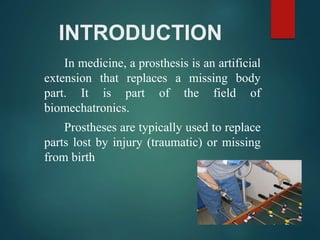
In medicine, a prosthesis is an artificial
extension that replaces a missing body
part. It is part of the field of
biomechatronics.
Prostheses are typically used to replace
parts lost by injury (traumatic) or missing
from birth
WORKING
 Biomechatronics devices have to be based
on how the human body works.
 First, impulses from the motor center of
the brain are sent to the foot and leg
muscles.
 Next the nerve cells in the feet send
information to the brain telling it to adjust
the muscle groups
DESIGN OF HAND
PROTOTYPE
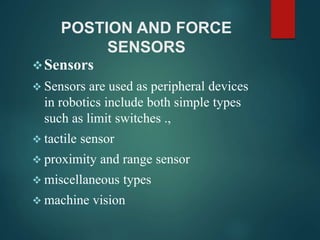
 Actuator System Architecture
 In order to match the size of a human finger, two
micro motors have been integrated within the pal
 The selected micro motors are Smoovy (RMB,
eckweg, CH) micro drivers (5mm diameter) high
precision linear motion using lead screw
transmission.
POSTION AND FORCE
SENSORS
Sensors
 Sensors are used as peripheral devices
in robotics include both simple types
such as limit switches .,
 tactile sensor
 proximity and range sensor
 miscellaneous types
 machine vision
USE OF SENSORS IN
ROBOTICS
 The major use of sensors in robotics and
other automated manufacturing systems
 Safety monitoring.
 Inter locks in work cell control.
 Part inspection for quality control.
 Determining position and related
information about objects in the robot cell.
POSITION SENSORS
 A position sensor, based on the Hall
Effect sensor is mounted at each
active joint of the hand.
 The main advantages of Hall Effect
sensors are there small sizes and their
contact less working principle.
FINGERED TIP FORCE ANALYSIS
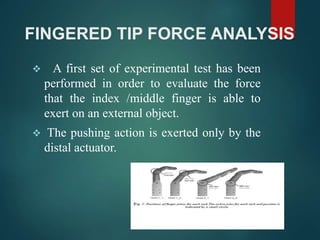
 A first set of experimental test has been
performed in order to evaluate the force
that the index /middle finger is able to
exert on an external object.
 The pushing action is exerted only by the
distal actuator.
ADVANTAGES
 Handicapt can lead an independent life.
 Noiseless operation
 cost suitable for support by the health
insurance system.
DISADVANTAGES
 Implementation cost is highly expensive.
 It can’t withstand a load of more than 40 N.
CURRENT RESEARCH
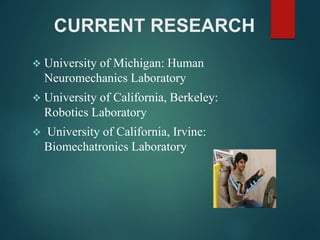
 University of Michigan: Human
Neuromechanics Laboratory
 University of California, Berkeley:
Robotics Laboratory
 University of California, Irvine:
Biomechatronics Laboratory
CONCLUSION
The biomechatronic design consists of
integrating multiple DOF’S finger
mechanisms, multisensing capabilities and
distributed control inorder to obtain human
like appearance, simple and direct
controllability and low mass.
Implementing a neural of the hand by
means of interfaces implanted at
peripheral nerves of the amputee is very
challenging.
REFERENCES
 www.wikipedia.com
 www.studymafia.org
 www.google.com
ANY QUIRES ?
THANKS

Mech biomechatronic hand ppt

  • 1.
    GUIDED BY Presentedby A.GODHAVARI M.Tech., P.Lakshmi prasanna Asst.Prof, HOD 123M1A0438 BIOMECHATRONIC HAND MODUGULA KALAVATHAMMA INSTITUTE OF TECHNOLOGY FOR WOMEN
  • 2.
    CONTENTS  INTRODUCTION  WORKING DESIGN OF HAND PROTOTYPE  POSTION AND FORCE SENSORS  FINGERED TIP FORCE ANALYSIS  ADVANTAGES  DISADVANTAGES  CURRENT RESEARCH  CONCLUSION  REFERENCES
  • 3.
    INTRODUCTION In medicine, aprosthesis is an artificial extension that replaces a missing body part. It is part of the field of biomechatronics. Prostheses are typically used to replace parts lost by injury (traumatic) or missing from birth
  • 4.
    WORKING  Biomechatronics deviceshave to be based on how the human body works.  First, impulses from the motor center of the brain are sent to the foot and leg muscles.  Next the nerve cells in the feet send information to the brain telling it to adjust the muscle groups
  • 5.
    DESIGN OF HAND PROTOTYPE Actuator System Architecture  In order to match the size of a human finger, two micro motors have been integrated within the pal  The selected micro motors are Smoovy (RMB, eckweg, CH) micro drivers (5mm diameter) high precision linear motion using lead screw transmission.
  • 6.
    POSTION AND FORCE SENSORS Sensors Sensors are used as peripheral devices in robotics include both simple types such as limit switches .,  tactile sensor  proximity and range sensor  miscellaneous types  machine vision
  • 7.
    USE OF SENSORSIN ROBOTICS  The major use of sensors in robotics and other automated manufacturing systems  Safety monitoring.  Inter locks in work cell control.  Part inspection for quality control.  Determining position and related information about objects in the robot cell.
  • 8.
    POSITION SENSORS  Aposition sensor, based on the Hall Effect sensor is mounted at each active joint of the hand.  The main advantages of Hall Effect sensors are there small sizes and their contact less working principle.
  • 9.
    FINGERED TIP FORCEANALYSIS  A first set of experimental test has been performed in order to evaluate the force that the index /middle finger is able to exert on an external object.  The pushing action is exerted only by the distal actuator.
  • 10.
    ADVANTAGES  Handicapt canlead an independent life.  Noiseless operation  cost suitable for support by the health insurance system.
  • 11.
    DISADVANTAGES  Implementation costis highly expensive.  It can’t withstand a load of more than 40 N.
  • 12.
    CURRENT RESEARCH  Universityof Michigan: Human Neuromechanics Laboratory  University of California, Berkeley: Robotics Laboratory  University of California, Irvine: Biomechatronics Laboratory
  • 13.
    CONCLUSION The biomechatronic designconsists of integrating multiple DOF’S finger mechanisms, multisensing capabilities and distributed control inorder to obtain human like appearance, simple and direct controllability and low mass. Implementing a neural of the hand by means of interfaces implanted at peripheral nerves of the amputee is very challenging.
  • 14.
  • 15.
  • 16.

Editor's Notes