
HIGH VOLTAGE
ENGINEERING
 TOWNSEND’S
IONIZATION
COEFFICIENT
IN SIMPLE
LAUNGUAGE
LEC # 05
BREAKDOWN
IN GASES
 When one electron collides with a neutral particle, a positive ion and an
electron are formed. This is called an ionizing collision.
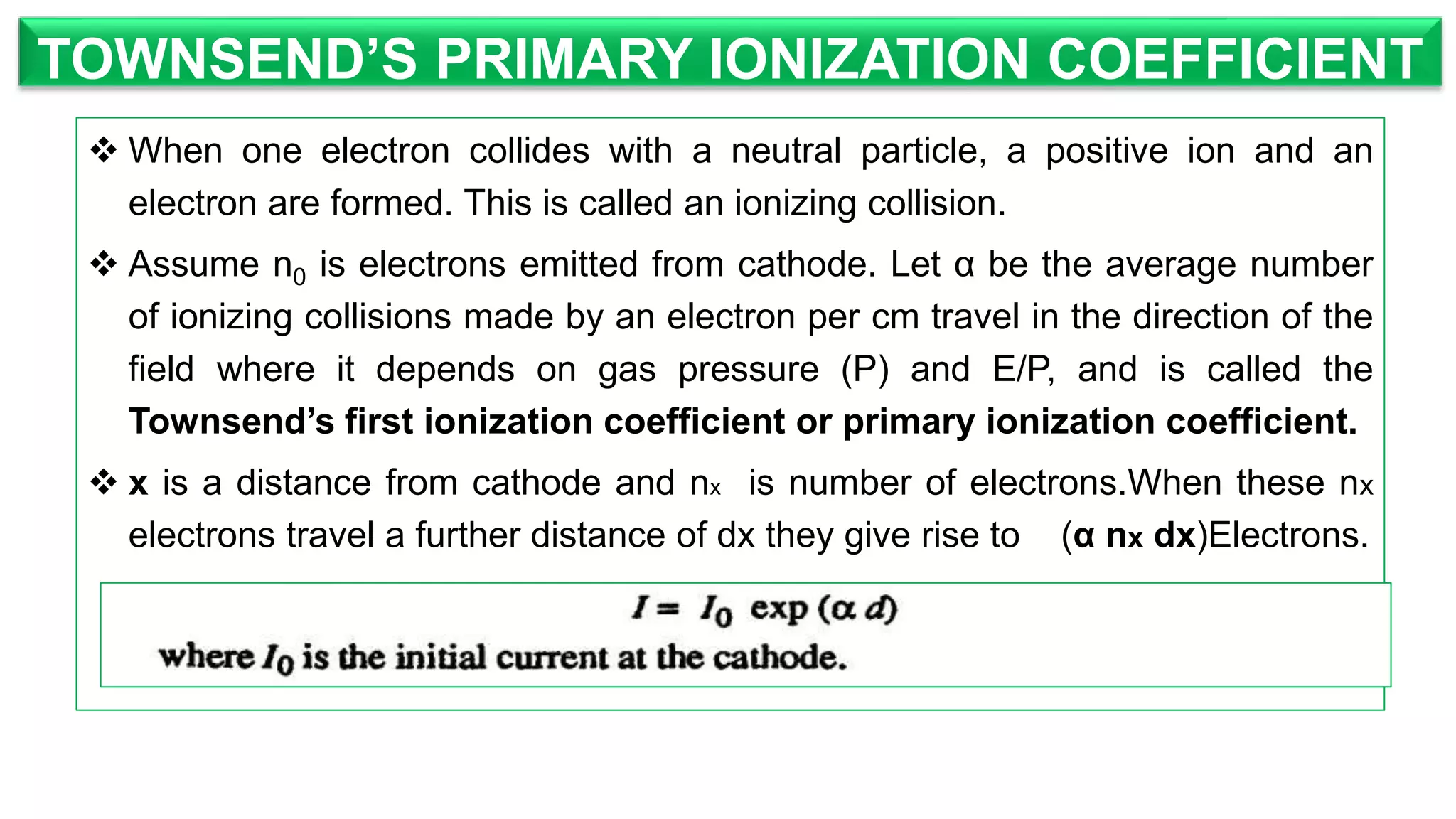
 Assume n0 is electrons emitted from cathode. Let α be the average number
of ionizing collisions made by an electron per cm travel in the direction of the
field where it depends on gas pressure (P) and E/P, and is called the
Townsend’s first ionization coefficient or primary ionization coefficient.
 x is a distance from cathode and nx is number of electrons.When these nx
electrons travel a further distance of dx they give rise to (α nx dx)Electrons.
TOWNSEND’S PRIMARY IONIZATION COEFFICIENT
TOWNSEND’S SECONDARY IONIZATION COEFFICIENT
 The electrons produced by these processes are called secondary
electrons. The secondary ionization coefficient is γ.
 Once Townsend’s primary ionization is initiated secondary ionization
processes follow resulting in the final breakdown of gases.
 These processes are :
 Ionization due to positive ions.
 Photo ionization
 Liberation of electrons from cathode due to positive ions
bombardment.
 The metastable particles may diffuse back causing electron emission
TOWNSEND’S SECONDARY IONIZATION COEFFICIENT
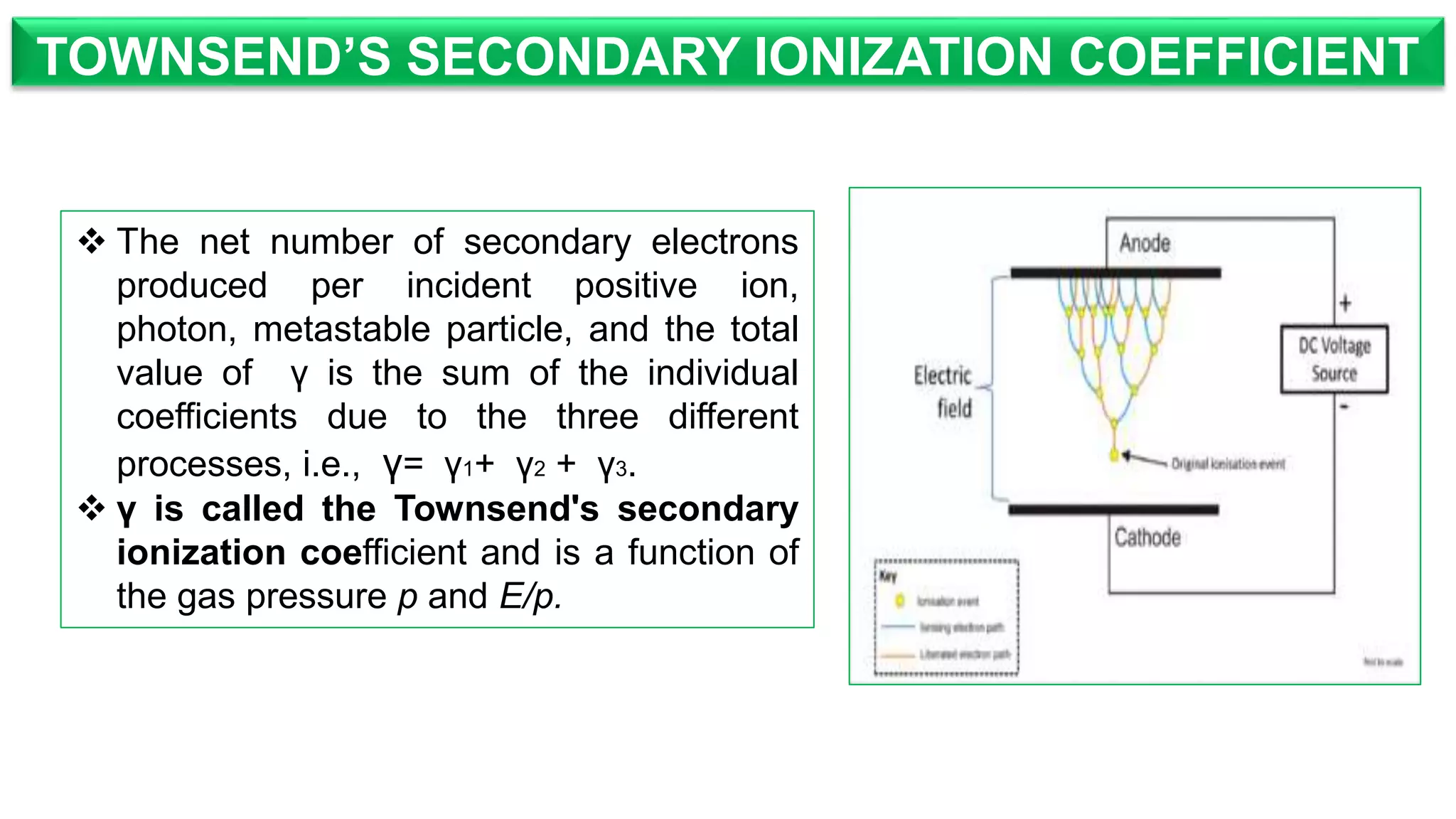
 The net number of secondary electrons
produced per incident positive ion,
photon, metastable particle, and the total
value of γ is the sum of the individual
coefficients due to the three different
processes, i.e., γ= γ1+ γ2 + γ3.
 γ is called the Townsend's secondary
ionization coefficient and is a function of
the gas pressure p and E/p.
PLZ VISIT YPUTUBE CHANNEL FOR VIDEO
LINK IS GIVEN IN DESCRIPTION BOX

TOWNSEND"S (FIRST)PRIMARY & SECONDARY IONIZATION COEFFICIENT|DERIVATION|HIGH VOLTAGE ENGINEERING

  • 1.
    HIGH VOLTAGE ENGINEERING  TOWNSEND’S IONIZATION COEFFICIENT INSIMPLE LAUNGUAGE LEC # 05 BREAKDOWN IN GASES
  • 2.
     When oneelectron collides with a neutral particle, a positive ion and an electron are formed. This is called an ionizing collision.  Assume n0 is electrons emitted from cathode. Let α be the average number of ionizing collisions made by an electron per cm travel in the direction of the field where it depends on gas pressure (P) and E/P, and is called the Townsend’s first ionization coefficient or primary ionization coefficient.  x is a distance from cathode and nx is number of electrons.When these nx electrons travel a further distance of dx they give rise to (α nx dx)Electrons. TOWNSEND’S PRIMARY IONIZATION COEFFICIENT
  • 3.
    TOWNSEND’S SECONDARY IONIZATIONCOEFFICIENT  The electrons produced by these processes are called secondary electrons. The secondary ionization coefficient is γ.  Once Townsend’s primary ionization is initiated secondary ionization processes follow resulting in the final breakdown of gases.  These processes are :  Ionization due to positive ions.  Photo ionization  Liberation of electrons from cathode due to positive ions bombardment.  The metastable particles may diffuse back causing electron emission
  • 4.
    TOWNSEND’S SECONDARY IONIZATIONCOEFFICIENT  The net number of secondary electrons produced per incident positive ion, photon, metastable particle, and the total value of γ is the sum of the individual coefficients due to the three different processes, i.e., γ= γ1+ γ2 + γ3.  γ is called the Townsend's secondary ionization coefficient and is a function of the gas pressure p and E/p.
  • 5.
    PLZ VISIT YPUTUBECHANNEL FOR VIDEO LINK IS GIVEN IN DESCRIPTION BOX