TOPIC :-
MAXIMUM POWER
TRANSFER
THEOREM.
BRAINWARE
UNIVERSITY
PRESENTATION BY:-AAMIR HUSSAIN
STUDENT CODE:- BWU/BTD/22/292
SUBJECT NAME:- BASIC ELECTRICAL ENGINEERING
SUBJECT CODE:- ESCD101
DEPARTMENT:-B.TECH-CSE(DS) SECTION:-E
The Maximum Power Transfer Theorem:-
Maximum Power Transfer Theorem explains that to generate maximum external power through a finite
internal resistance (DC network), the resistance of the given load must be equal to the resistance of the
available source.
In other words, the resistance of the load must be the same as Thevenin’s equivalent resistance.
In the case of AC voltage sources, maximum power is produced only if the load impedance’s value is
equivalent to the complex conjugate of the source impedance.
Maximum Power Transfer Formula
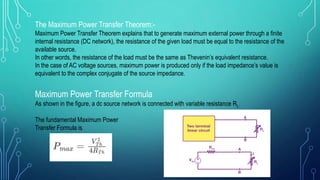
As shown in the figure, a dc source network is connected with variable resistance RL.
The fundamental Maximum Power
Transfer Formula is
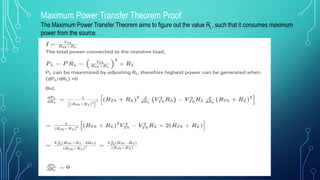
Maximum Power Transfer Theorem Proof
The Maximum Power Transfer Theorem aims to figure out the value RL, such that it consumes maximum
power from the source.
Application of Maximum Power Transfer Theorem:-
The presence of linked sources enables the network to be active, so the Maximum Power Transfer
Theorem is applied for active networks & passive networks.
 Maximum Power Transfer Theorem can also be implemented to linear networks, the network
system, along with R, L, C, & restrained linear sources as elements.
 Maximum power transfer theorem functions only when there is a variable load. If not, choose the
least available internal sources of impedance, which paves in maximum current through the fixed
load. Consequently, maximum power is expelled by the load circuit.
 Large sound systems are built around this process. Maximum power transfer is generated in the
circuit by making the speaker’s (load) resistance equivalent to the resistance of the amplifier. Once
the speaker and amplifier have equal resistance, both are considered harmonized.
 Another application is on the relationship between the starter motor and the battery of a car engine.
Power applied to the starter will rely on the effectual resistance of the motor and battery resistance.
When their values are equal, the highest power will be transmitted to kickstart the engine.
Maximum power transfer theorem

Maximum power transfer theorem

  • 1.
    TOPIC :- MAXIMUM POWER TRANSFER THEOREM. BRAINWARE UNIVERSITY PRESENTATIONBY:-AAMIR HUSSAIN STUDENT CODE:- BWU/BTD/22/292 SUBJECT NAME:- BASIC ELECTRICAL ENGINEERING SUBJECT CODE:- ESCD101 DEPARTMENT:-B.TECH-CSE(DS) SECTION:-E
  • 2.
    The Maximum PowerTransfer Theorem:- Maximum Power Transfer Theorem explains that to generate maximum external power through a finite internal resistance (DC network), the resistance of the given load must be equal to the resistance of the available source. In other words, the resistance of the load must be the same as Thevenin’s equivalent resistance. In the case of AC voltage sources, maximum power is produced only if the load impedance’s value is equivalent to the complex conjugate of the source impedance. Maximum Power Transfer Formula As shown in the figure, a dc source network is connected with variable resistance RL. The fundamental Maximum Power Transfer Formula is
  • 3.
    Maximum Power TransferTheorem Proof The Maximum Power Transfer Theorem aims to figure out the value RL, such that it consumes maximum power from the source.
  • 5.
    Application of MaximumPower Transfer Theorem:- The presence of linked sources enables the network to be active, so the Maximum Power Transfer Theorem is applied for active networks & passive networks.  Maximum Power Transfer Theorem can also be implemented to linear networks, the network system, along with R, L, C, & restrained linear sources as elements.  Maximum power transfer theorem functions only when there is a variable load. If not, choose the least available internal sources of impedance, which paves in maximum current through the fixed load. Consequently, maximum power is expelled by the load circuit.  Large sound systems are built around this process. Maximum power transfer is generated in the circuit by making the speaker’s (load) resistance equivalent to the resistance of the amplifier. Once the speaker and amplifier have equal resistance, both are considered harmonized.  Another application is on the relationship between the starter motor and the battery of a car engine. Power applied to the starter will rely on the effectual resistance of the motor and battery resistance. When their values are equal, the highest power will be transmitted to kickstart the engine.