
DC Circuits
Mr. C D Patil
Dept. of EE
Ohms Law
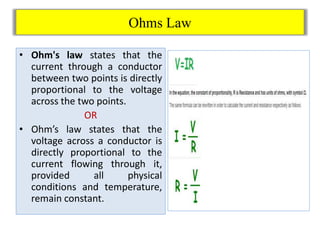
• Ohm's law states that the
current through a conductor
between two points is directly
proportional to the voltage
across the two points.
OR
• Ohm’s law states that the
voltage across a conductor is
directly proportional to the
current flowing through it,
provided all physical
conditions and temperature,
remain constant.
Internal Resistance of Source
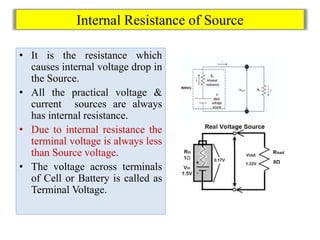
• It is the resistance which
causes internal voltage drop in
the Source.
• All the practical voltage &
current sources are always
has internal resistance.
• Due to internal resistance the
terminal voltage is always less
than Source voltage.
• The voltage across terminals
of Cell or Battery is called as
Terminal Voltage.
Resistance in Series
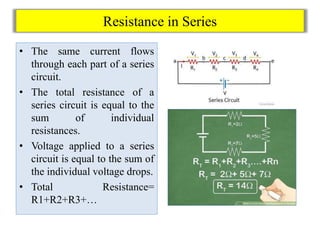
• The same current flows
through each part of a series
circuit.
• The total resistance of a
series circuit is equal to the
sum of individual
resistances.
• Voltage applied to a series
circuit is equal to the sum of
the individual voltage drops.
• Total Resistance=
R1+R2+R3+…
Resistance in Series
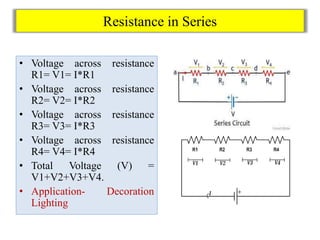
• Voltage across resistance
R1= V1= I*R1
• Voltage across resistance
R2= V2= I*R2
• Voltage across resistance
R3= V3= I*R3
• Voltage across resistance
R4= V4= I*R4
• Total Voltage (V) =
V1+V2+V3+V4.
• Application- Decoration
Lighting
Resistance in Parallel
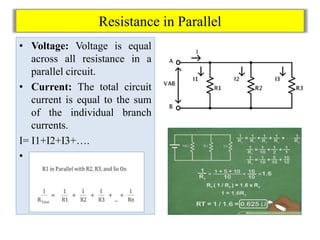
• Voltage: Voltage is equal
across all resistance in a
parallel circuit.
• Current: The total circuit
current is equal to the sum
of the individual branch
currents.
I= I1+I2+I3+….
• Total resistance=
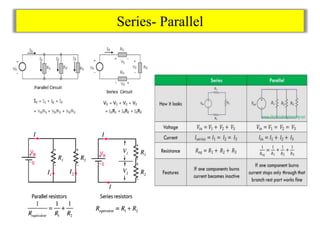
Series- Parallel
Definition of Basic Terms
• Active Element- An element which can
generate or produce the energy is called as
Active element.
e.g.- Voltage Source, Current source, genearator
etc
• Passive element- An element which can not
generate energy is called as Passive element.
e.g.- Resistance, Inductance, Capacitance
Definition of Basic Terms
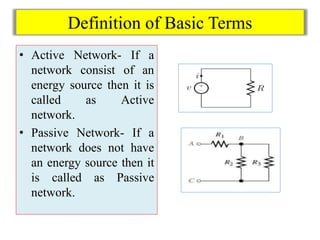
• Active Network- If a
network consist of an
energy source then it is
called as Active
network.
• Passive Network- If a
network does not have
an energy source then it
is called as Passive
network.
Definition of Basic Terms
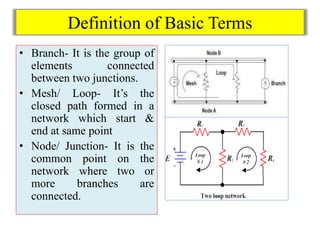
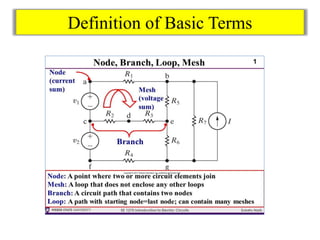
• Branch- It is the group of
elements connected
between two junctions.
• Mesh/ Loop- It’s the
closed path formed in a
network which start &
end at same point
• Node/ Junction- It is the
common point on the
network where two or
more branches are
connected.
Definition of Basic Terms
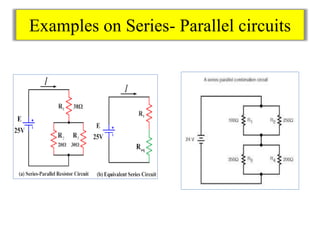
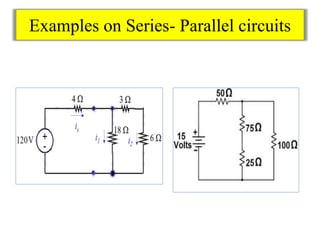
Examples on Series- Parallel circuits
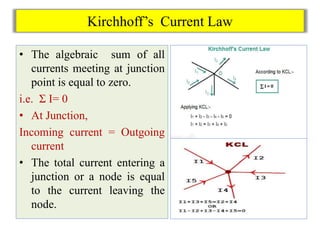
Kirchhoff’s Current Law
• The algebraic sum of all
currents meeting at junction
point is equal to zero.
i.e. Σ I= 0
• At Junction,
Incoming current = Outgoing
current
• The total current entering a
junction or a node is equal
to the current leaving the
node.
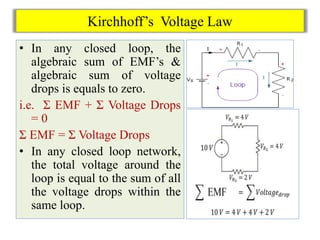
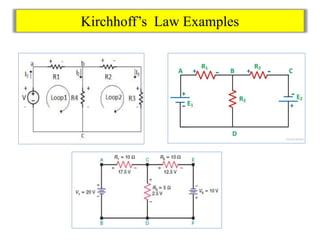
Kirchhoff’s Voltage Law
• In any closed loop, the
algebraic sum of EMF’s &
algebraic sum of voltage
drops is equals to zero.
i.e. Σ EMF + Σ Voltage Drops
= 0
Σ EMF = Σ Voltage Drops
• In any closed loop network,
the total voltage around the
loop is equal to the sum of all
the voltage drops within the
same loop.
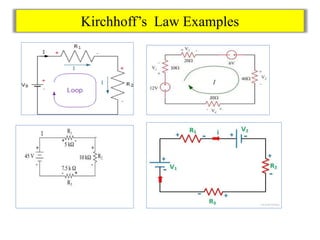
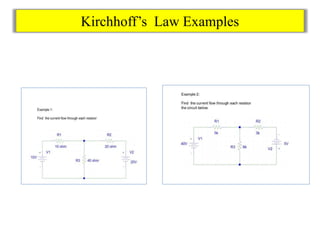
Kirchhoff’s Law Examples
Thank You!!!

DC Circuits

  • 1.
    DC Circuits Mr. CD Patil Dept. of EE
  • 2.
    Ohms Law • Ohm'slaw states that the current through a conductor between two points is directly proportional to the voltage across the two points. OR • Ohm’s law states that the voltage across a conductor is directly proportional to the current flowing through it, provided all physical conditions and temperature, remain constant.
  • 3.
    Internal Resistance ofSource • It is the resistance which causes internal voltage drop in the Source. • All the practical voltage & current sources are always has internal resistance. • Due to internal resistance the terminal voltage is always less than Source voltage. • The voltage across terminals of Cell or Battery is called as Terminal Voltage.
  • 4.
    Resistance in Series •The same current flows through each part of a series circuit. • The total resistance of a series circuit is equal to the sum of individual resistances. • Voltage applied to a series circuit is equal to the sum of the individual voltage drops. • Total Resistance= R1+R2+R3+…
  • 5.
    Resistance in Series •Voltage across resistance R1= V1= I*R1 • Voltage across resistance R2= V2= I*R2 • Voltage across resistance R3= V3= I*R3 • Voltage across resistance R4= V4= I*R4 • Total Voltage (V) = V1+V2+V3+V4. • Application- Decoration Lighting
  • 6.
    Resistance in Parallel •Voltage: Voltage is equal across all resistance in a parallel circuit. • Current: The total circuit current is equal to the sum of the individual branch currents. I= I1+I2+I3+…. • Total resistance=
  • 7.
  • 8.
    Definition of BasicTerms • Active Element- An element which can generate or produce the energy is called as Active element. e.g.- Voltage Source, Current source, genearator etc • Passive element- An element which can not generate energy is called as Passive element. e.g.- Resistance, Inductance, Capacitance
  • 9.
    Definition of BasicTerms • Active Network- If a network consist of an energy source then it is called as Active network. • Passive Network- If a network does not have an energy source then it is called as Passive network.
  • 10.
    Definition of BasicTerms • Branch- It is the group of elements connected between two junctions. • Mesh/ Loop- It’s the closed path formed in a network which start & end at same point • Node/ Junction- It is the common point on the network where two or more branches are connected.
  • 11.
  • 12.
    Examples on Series-Parallel circuits
  • 13.
    Examples on Series-Parallel circuits
  • 14.
    Kirchhoff’s Current Law •The algebraic sum of all currents meeting at junction point is equal to zero. i.e. Σ I= 0 • At Junction, Incoming current = Outgoing current • The total current entering a junction or a node is equal to the current leaving the node.
  • 15.
    Kirchhoff’s Voltage Law •In any closed loop, the algebraic sum of EMF’s & algebraic sum of voltage drops is equals to zero. i.e. Σ EMF + Σ Voltage Drops = 0 Σ EMF = Σ Voltage Drops • In any closed loop network, the total voltage around the loop is equal to the sum of all the voltage drops within the same loop.
  • 16.
  • 17.
  • 18.
  • 19.