Topic – Maximum Power
Transfer Theorem
PowerPoint Presentation by:- Mohit
Content
• Maximum power transfer theorem for DC circuit
• Proof
• Steps for solving network using maximum power
transfer theorem
• Example
• Efficiency
• Applications
• Limitations
Maximum Power Transfer
Theorem for DC Circuit
• Maximum power transfer theorem states that the
maximum power will be transferred to the load
when the value of load resistance is equal to
thevenin’s equivalent resistance of the circuit.
• Now, thevenin’s equivalent resistance is nothing
but the equivalent of the circuit, seen through
load by turning off all the independent sources in
the electrical circuit.
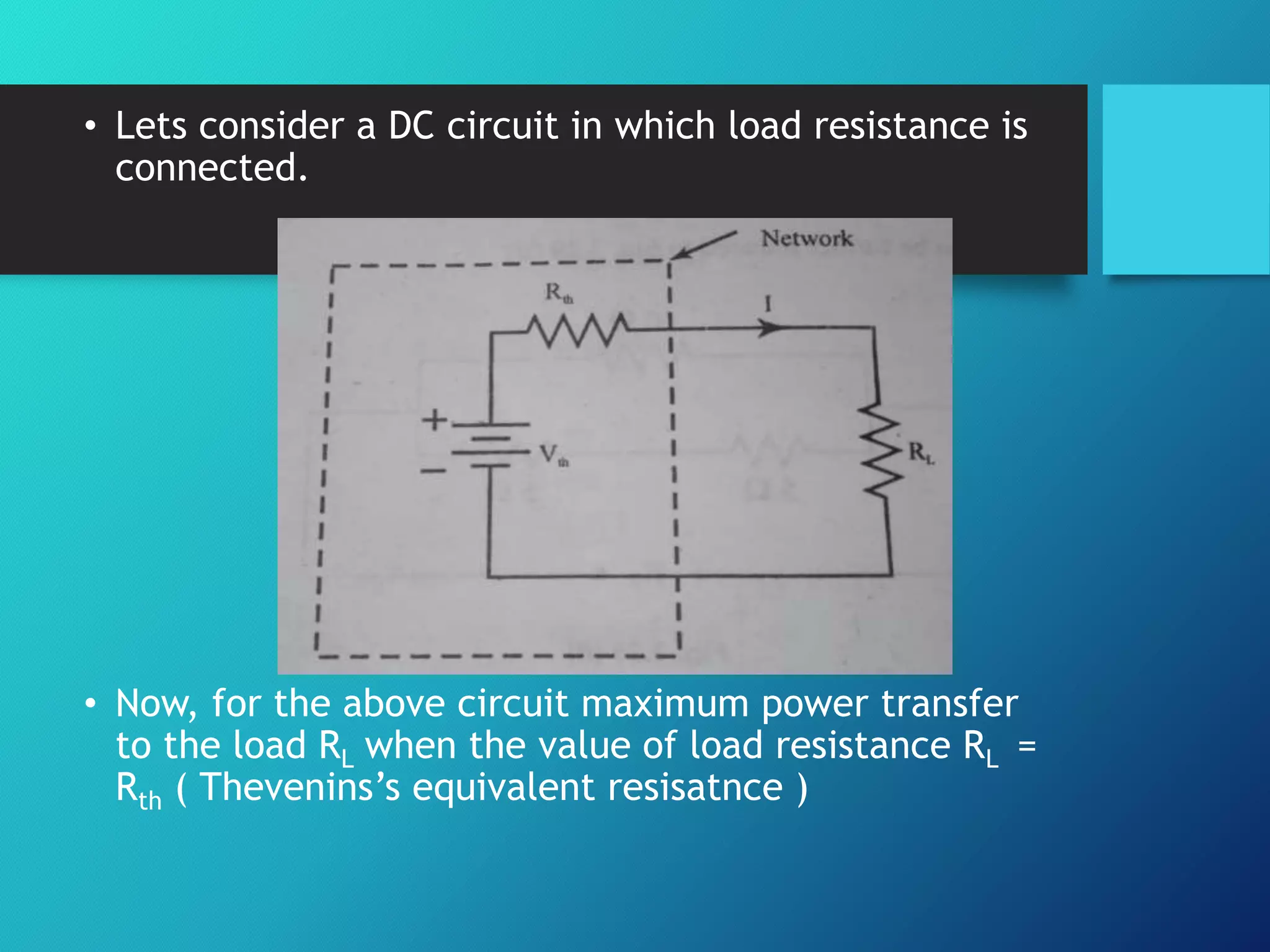
• Lets consider a DC circuit in which load resistance is
connected.
• Now, for the above circuit maximum power transfer
to the load RL when the value of load resistance RL =
Rth ( Thevenins’s equivalent resisatnce )
Proof :-
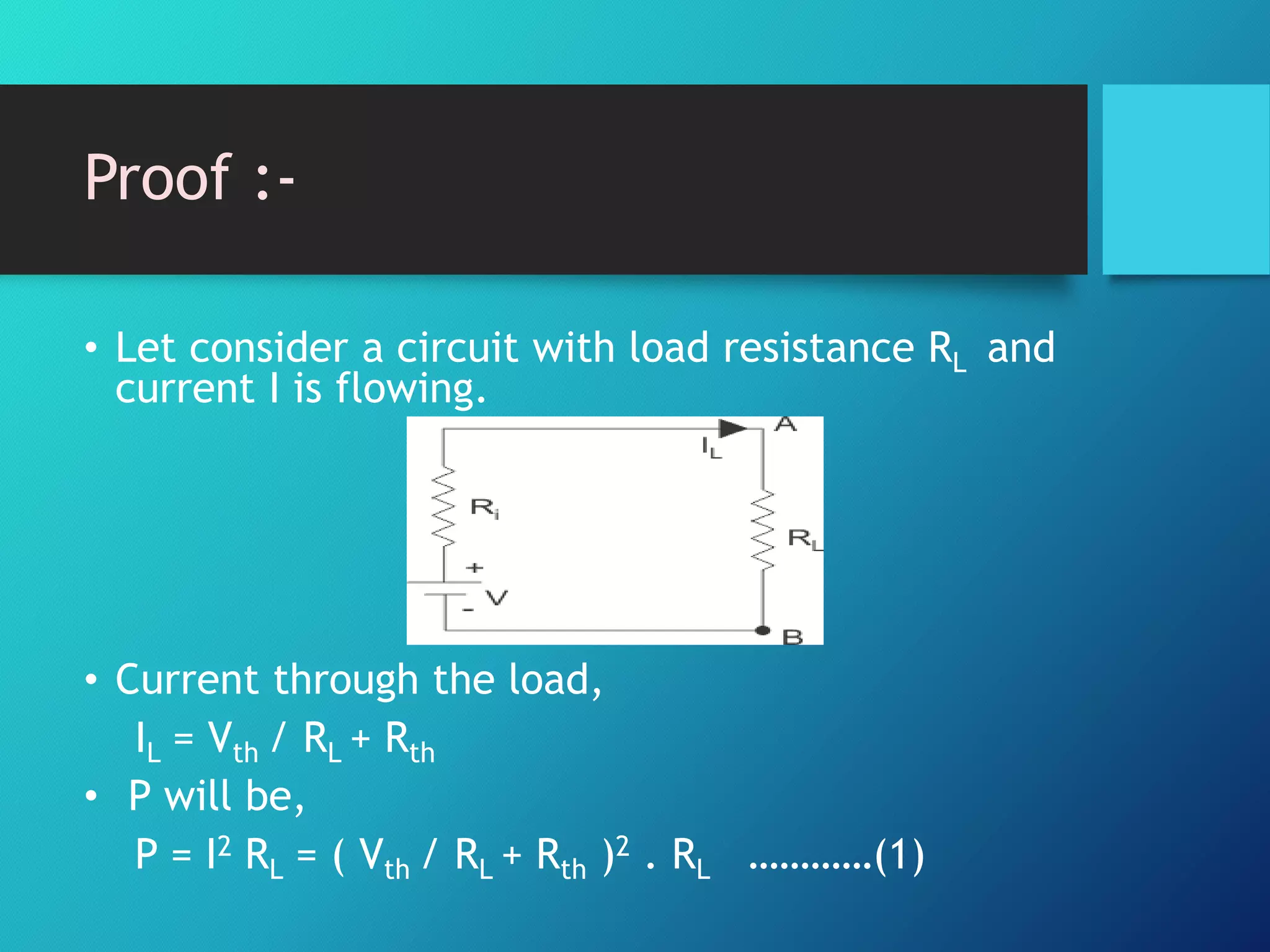
• Let consider a circuit with load resistance RL and
current I is flowing.
• Current through the load,
IL = Vth / RL + Rth
• P will be,
P = I2 RL = ( Vth / RL + Rth )2 . RL …………(1)
• Power will be maximum if dP/dRL = 0
d/dRL ( Vth / RL + Rth )2 . RL = 0
Vth
2 [( RL + Rth )2 - 2RL ( RL + Rth ) / (RL + Rth )4 ] = 0
( RL + Rth )2 - 2RL ( RL + Rth ) = 0
( RL + Rth )2 = 2RL ( RL + Rth )
RL + Rth = 2RL
Rth = RL ………….(2)
Equivalent resistance = load resistance
• We conclude that for maximum power transfer
theorem, the load resistance RL must be equal to
the internal resistance of source i.e. Rth .
• From above proof, if we put RL = Rth in eqn 1
• We get, Pmax = Vth
2 / 4Rth
Steps for solving network using
maximum power transfer theorem :-
• Remove the load resistance of the circuit.
• Find the thevenin’s resistance ( Rth ) by applying
thevenin theorem.
• As per the maximum power transfer theorem,
this Rth is the load resistance of the network, i.e.
RL = Rth that allow the maximum power to
transfer .
• Maximum power is calculate by,
Pmax = Vth
2 / 4Rth
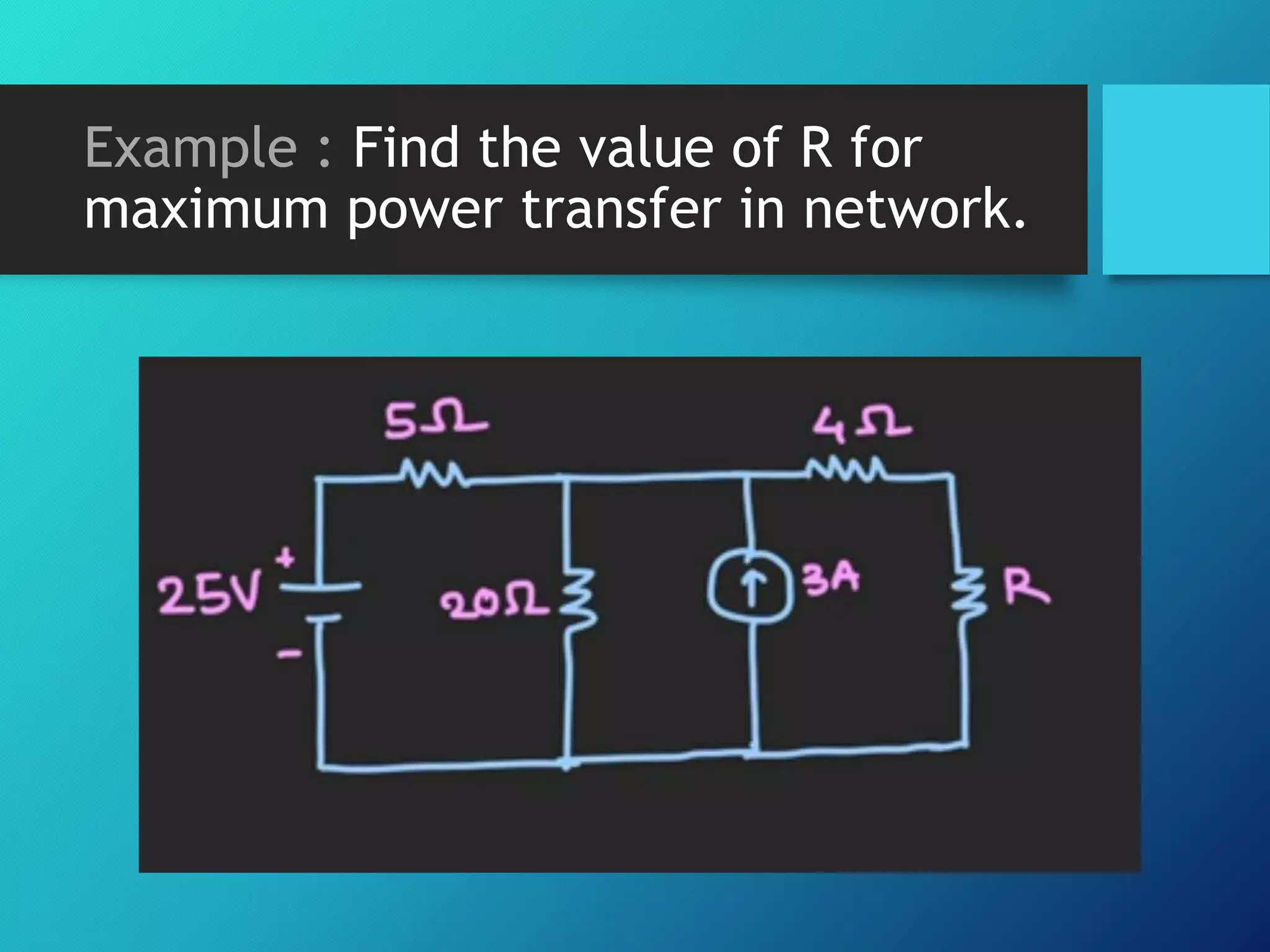
Example : Find the value of R for
maximum power transfer in network.
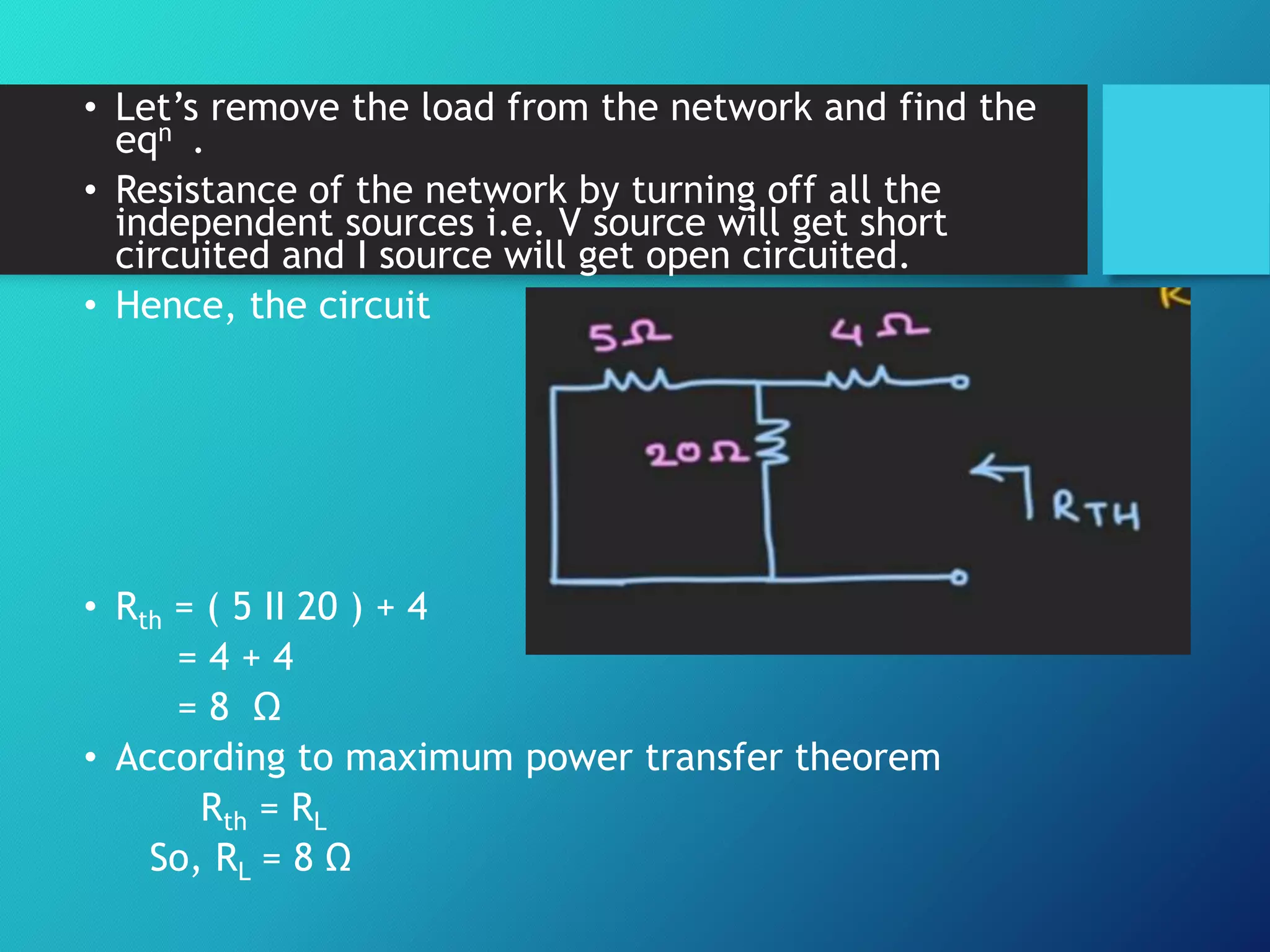
• Let’s remove the load from the network and find the
eqn .
• Resistance of the network by turning off all the
independent sources i.e. V source will get short
circuited and I source will get open circuited.
• Hence, the circuit
• Rth = ( 5 II 20 ) + 4
= 4 + 4
= 8 Ω
• According to maximum power transfer theorem
Rth = RL
So, RL = 8 Ω
Efficiency :
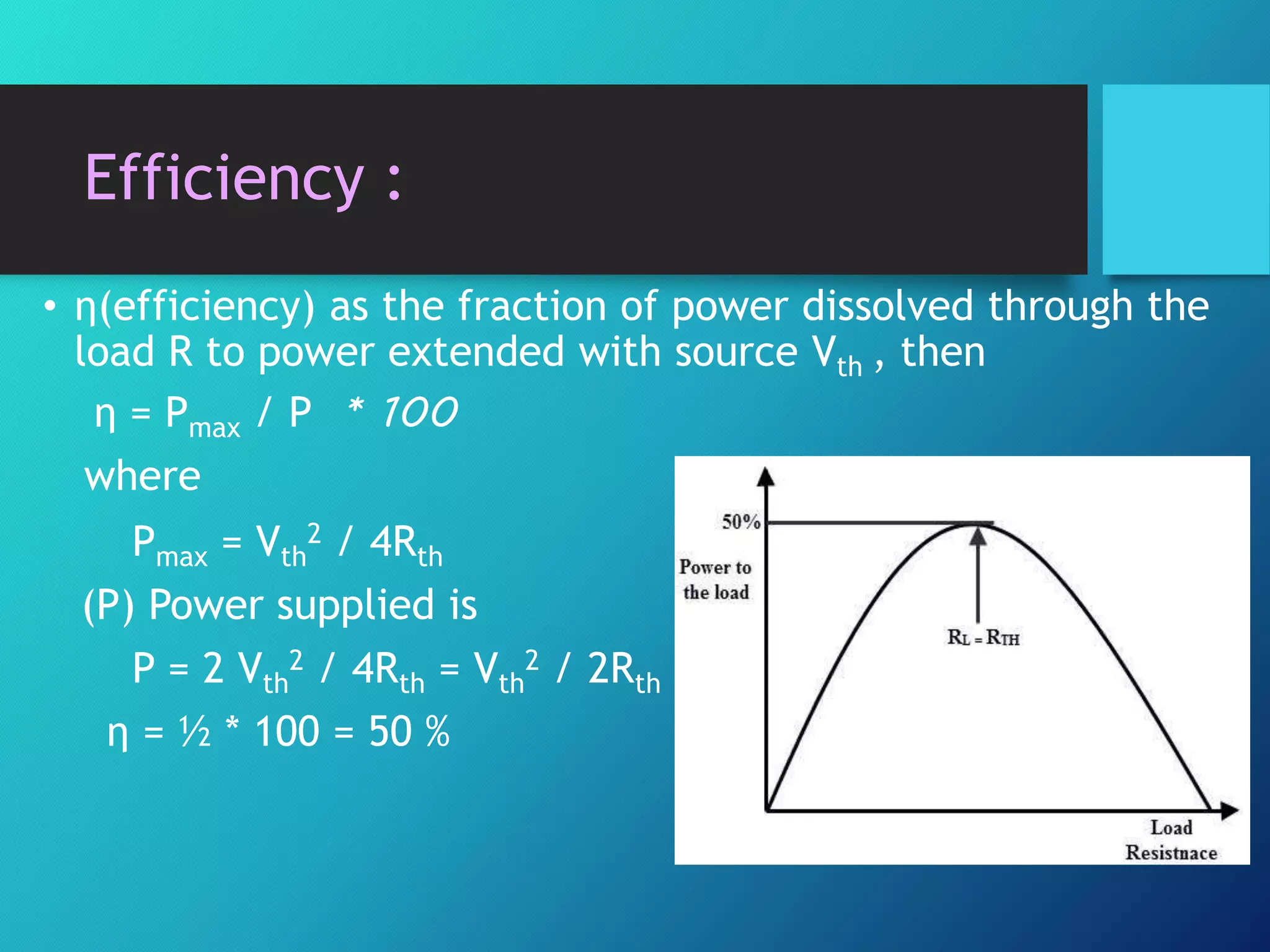
• η(efficiency) as the fraction of power dissolved through the
load R to power extended with source Vth , then
η = Pmax / P * 100
where
Pmax = Vth
2 / 4Rth
(P) Power supplied is
P = 2 Vth
2 / 4Rth = Vth
2 / 2Rth
η = ½ * 100 = 50 %
Application of Maximum power
transfer theorem :-
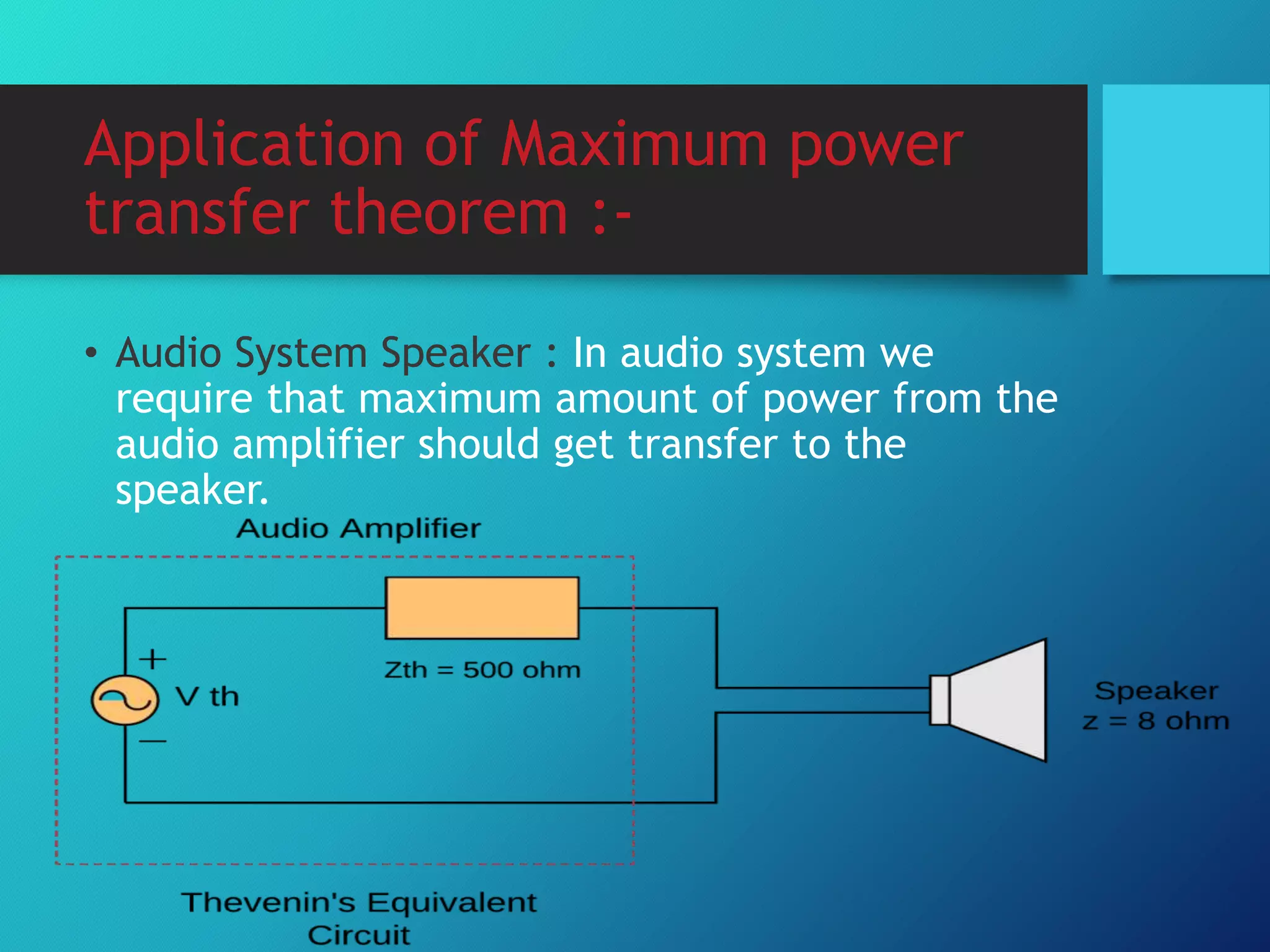
• Audio System Speaker : In audio system we
require that maximum amount of power from the
audio amplifier should get transfer to the
speaker.
• Automobile engine : In automobile engines, the
power transmitted to the motor stator of
automobile will depend on the effective
resistance of the motor and the batteries inner
resistance. When the two resistance are
equivalent, then the highest power will be
transmitted to the motor to activate the engine.
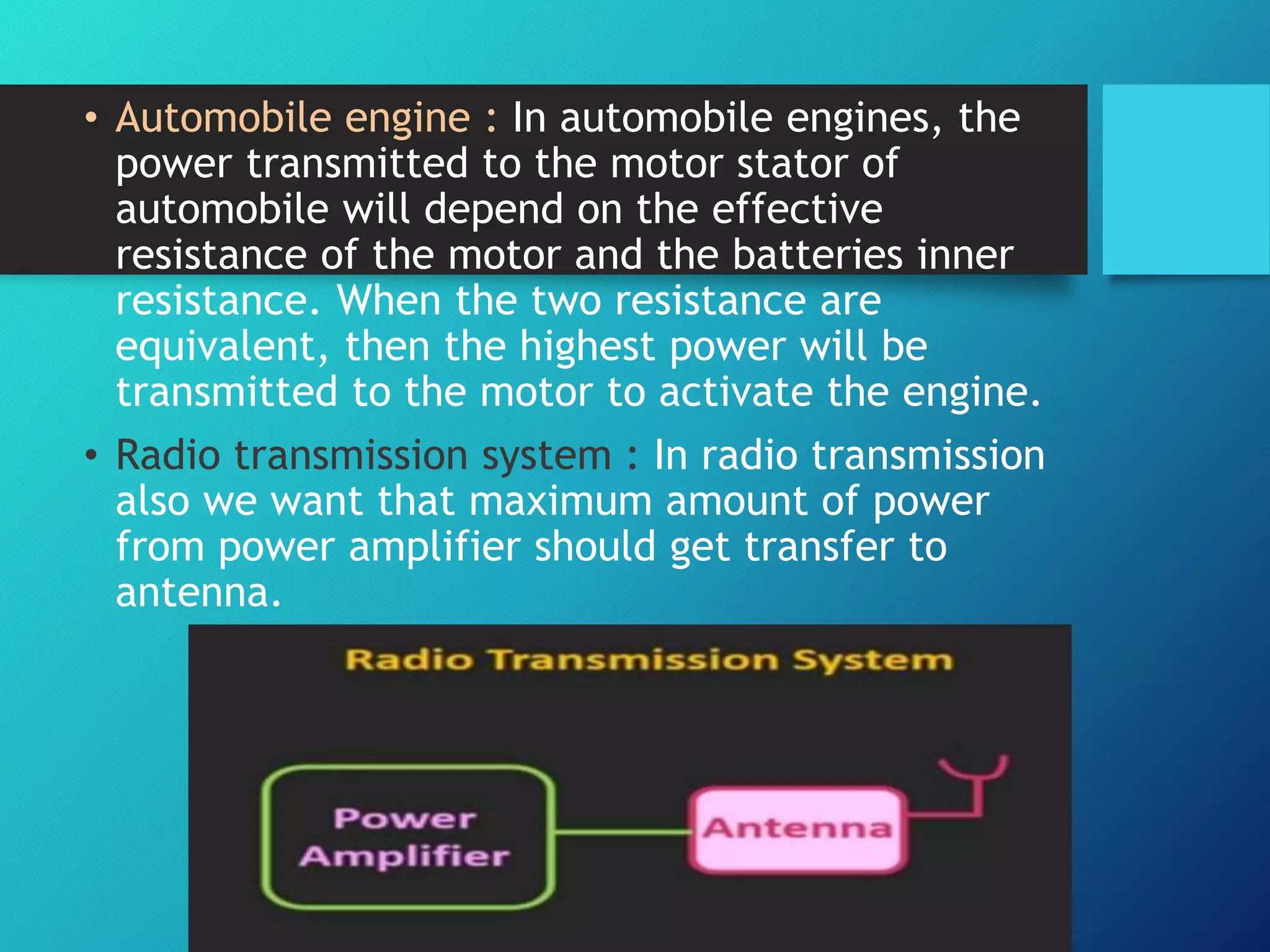
• Radio transmission system : In radio transmission
also we want that maximum amount of power
from power amplifier should get transfer to
antenna.
LIMITATIONS :
• Maximum power transfer theorem gets efficiency
of only 50%. So, it is not well in application
where efficiency is more corcern.
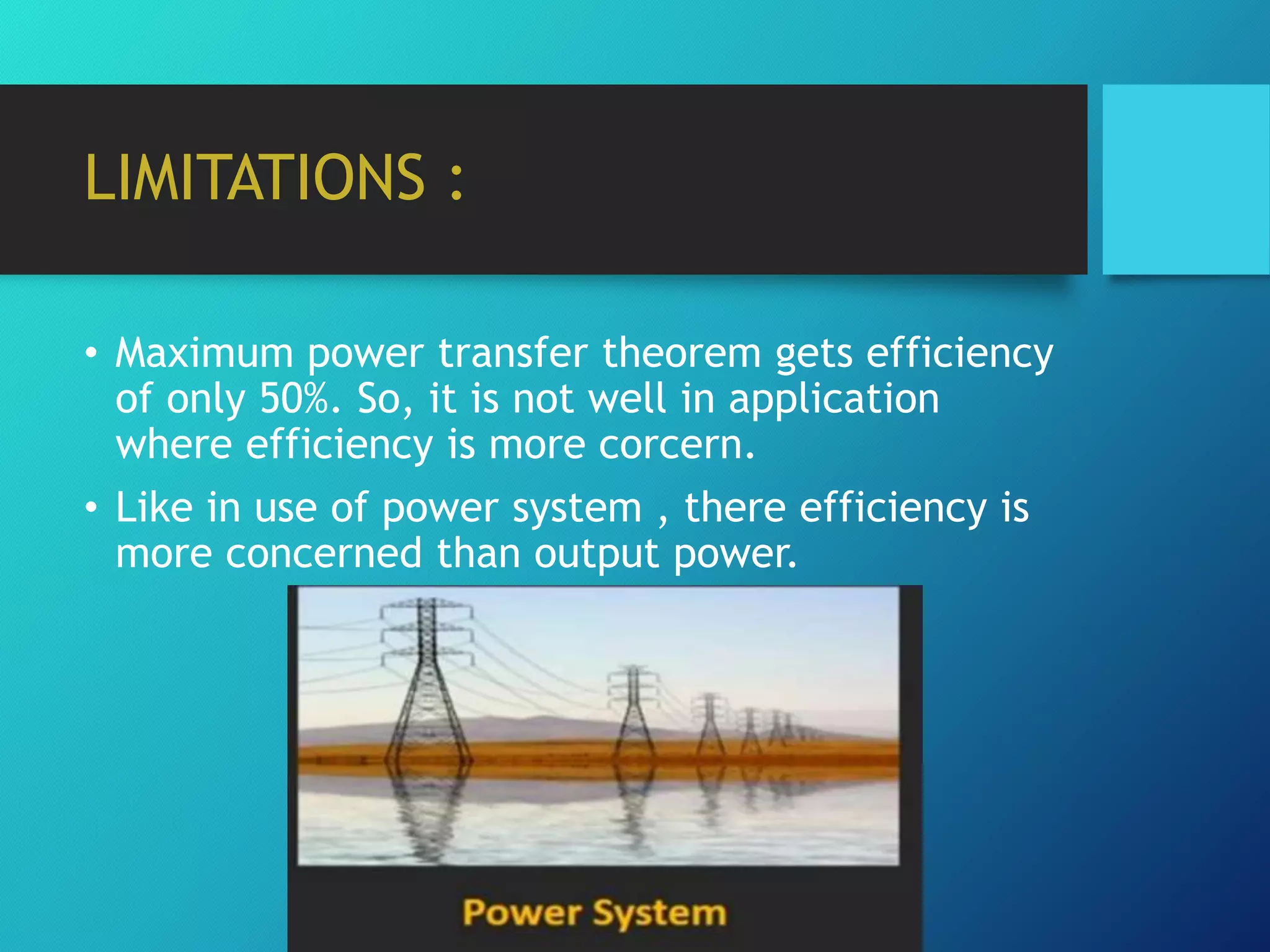
• Like in use of power system , there efficiency is
more concerned than output power.
Presentation of Electrical Engineering ( Maximum Power Transfer Theorem )

Presentation of Electrical Engineering ( Maximum Power Transfer Theorem )

  • 1.
    Topic – MaximumPower Transfer Theorem PowerPoint Presentation by:- Mohit
  • 2.
    Content • Maximum powertransfer theorem for DC circuit • Proof • Steps for solving network using maximum power transfer theorem • Example • Efficiency • Applications • Limitations
  • 3.
    Maximum Power Transfer Theoremfor DC Circuit • Maximum power transfer theorem states that the maximum power will be transferred to the load when the value of load resistance is equal to thevenin’s equivalent resistance of the circuit. • Now, thevenin’s equivalent resistance is nothing but the equivalent of the circuit, seen through load by turning off all the independent sources in the electrical circuit.
  • 4.
    • Lets considera DC circuit in which load resistance is connected. • Now, for the above circuit maximum power transfer to the load RL when the value of load resistance RL = Rth ( Thevenins’s equivalent resisatnce )
  • 5.
    Proof :- • Letconsider a circuit with load resistance RL and current I is flowing. • Current through the load, IL = Vth / RL + Rth • P will be, P = I2 RL = ( Vth / RL + Rth )2 . RL …………(1)
  • 6.
    • Power willbe maximum if dP/dRL = 0 d/dRL ( Vth / RL + Rth )2 . RL = 0 Vth 2 [( RL + Rth )2 - 2RL ( RL + Rth ) / (RL + Rth )4 ] = 0 ( RL + Rth )2 - 2RL ( RL + Rth ) = 0 ( RL + Rth )2 = 2RL ( RL + Rth ) RL + Rth = 2RL Rth = RL ………….(2) Equivalent resistance = load resistance • We conclude that for maximum power transfer theorem, the load resistance RL must be equal to the internal resistance of source i.e. Rth . • From above proof, if we put RL = Rth in eqn 1 • We get, Pmax = Vth 2 / 4Rth
  • 7.
    Steps for solvingnetwork using maximum power transfer theorem :- • Remove the load resistance of the circuit. • Find the thevenin’s resistance ( Rth ) by applying thevenin theorem. • As per the maximum power transfer theorem, this Rth is the load resistance of the network, i.e. RL = Rth that allow the maximum power to transfer . • Maximum power is calculate by, Pmax = Vth 2 / 4Rth
  • 8.
    Example : Findthe value of R for maximum power transfer in network.
  • 9.
    • Let’s removethe load from the network and find the eqn . • Resistance of the network by turning off all the independent sources i.e. V source will get short circuited and I source will get open circuited. • Hence, the circuit • Rth = ( 5 II 20 ) + 4 = 4 + 4 = 8 Ω • According to maximum power transfer theorem Rth = RL So, RL = 8 Ω
  • 10.
    Efficiency : • η(efficiency)as the fraction of power dissolved through the load R to power extended with source Vth , then η = Pmax / P * 100 where Pmax = Vth 2 / 4Rth (P) Power supplied is P = 2 Vth 2 / 4Rth = Vth 2 / 2Rth η = ½ * 100 = 50 %
  • 11.
    Application of Maximumpower transfer theorem :- • Audio System Speaker : In audio system we require that maximum amount of power from the audio amplifier should get transfer to the speaker.
  • 12.
    • Automobile engine: In automobile engines, the power transmitted to the motor stator of automobile will depend on the effective resistance of the motor and the batteries inner resistance. When the two resistance are equivalent, then the highest power will be transmitted to the motor to activate the engine. • Radio transmission system : In radio transmission also we want that maximum amount of power from power amplifier should get transfer to antenna.
  • 13.
    LIMITATIONS : • Maximumpower transfer theorem gets efficiency of only 50%. So, it is not well in application where efficiency is more corcern. • Like in use of power system , there efficiency is more concerned than output power.