Matters
Discover
Everything around us is made of matter: our bodies, the air we
breathe, the ground we talk on and the water we drink.
Matter can´t be created or destroyed: it just changes. Some of
the changes it undergoes are chemical. Chemical reactions,
such as fermentation or combustion, change a substance into
a new one with different properties. How can we classify
matters?
Discover 1!
What states can matter exist in? Gove some examples of
matter which change state. What causes these changes?
Discover 2!
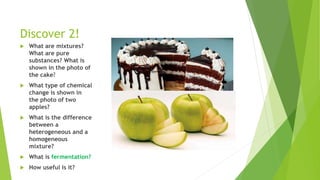
 What are mixtures?
What are pure
substances? What is
shown in the photo of
the cake?
 What type of chemical
change is shown in
the photo of two
apples?
 What is the difference
between a
heterogeneous and a
homogeneous
mixture?
 What is fermentation?
 How useful is it?
Analyse and
organise
Substances can be divided into pure
substances or mixtures.
Look at the different substances below. Classify
them into pure substances or mixtures in your
notebook.
aluminium, biscuits, coal, copper, milk, mud,
nitrogen, mayonnaise, silver, cardboard
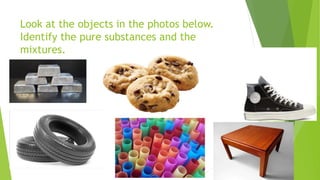
Look at the objects in the photos below.
Identify the pure substances and the
mixtures.
Separating mixtures: heterogeneous
mixtures and homogeneous mixtures.
 There are two types of mixtures: heterogeneous mixtures
and homogeneous mixtures.
 In a heterogeneous mixture, we can see the individual
substances that make it up, so it is possible to separate
the substances easily.
 In a homogeneous mixture we can´t see the individual
substance but we can still separate them.
 We can separate substances in mixtures in different ways.
Separating mixtures
 Magnetic separation: Magnets attract certain types of
metals. We can use Magnetic separation if we want to
separate mixtures that consist of substances attracted by
magnets and substances that are not.
 Decantation: Heavy sediments in liquids sink to the
bottom of a container. Sand in a bucket of water collects
a the bottom of the bucket. When we decant a liquid, we
pour off the liquid so that the sediment remains in the
container. Two liquids of different density, such as oil and
water, can also be separated by decantation as the oil
floats on top of the water.
Separating mixtures
 Filtration: filtration separates much smaller particles from a liquid or gas. A filter is
used to catch the particles, but allows the liquid to pass. Coffee grounds can be
separated from liquid in this way.
 Filters in face masks are used to prevent germs or disease spreading through the air as
we breathe.
 Evaporation: Solids which have been dissolved in a liquid can be separated using heat.
The liquid turns into vapour and the remaining sediment, the solids, can be collected.
Evaporation is used to remove water in salt evaporation ponds; the sun evaporates the
water and the salt is left behind.
 Distillation: When two liquids evaporate at a different rate, such as water and ethanol,
the mixture can be separated using distillation. The liquid is heated and as the ethanol
has a lower boiling point than water, it evaporates first and forms vapour. This vapour is
then collected and cooled, resulting in pure ethanol.
 Distillation is used to produce alcohol and in the petrochemical industry.
Physical changes: Change in state: solid,
liquid and gas.
 Chemical changes: Chemical reactions change the properties of the
original substance, and a new substance is created. Chemical
changes go on around us all the time. Heat, oxygen and other
agents all cause chemical changes. Combustion, oxidation and
fermentation are irreversible changes. For example,
 Combustion
 Oxidation
 Fermentation
Matters

Matters

  • 2.
  • 3.
    Discover Everything around usis made of matter: our bodies, the air we breathe, the ground we talk on and the water we drink. Matter can´t be created or destroyed: it just changes. Some of the changes it undergoes are chemical. Chemical reactions, such as fermentation or combustion, change a substance into a new one with different properties. How can we classify matters? Discover 1! What states can matter exist in? Gove some examples of matter which change state. What causes these changes?
  • 4.
    Discover 2!  Whatare mixtures? What are pure substances? What is shown in the photo of the cake?  What type of chemical change is shown in the photo of two apples?  What is the difference between a heterogeneous and a homogeneous mixture?  What is fermentation?  How useful is it?
  • 5.
    Analyse and organise Substances canbe divided into pure substances or mixtures. Look at the different substances below. Classify them into pure substances or mixtures in your notebook. aluminium, biscuits, coal, copper, milk, mud, nitrogen, mayonnaise, silver, cardboard
  • 6.
    Look at theobjects in the photos below. Identify the pure substances and the mixtures.
  • 7.
    Separating mixtures: heterogeneous mixturesand homogeneous mixtures.  There are two types of mixtures: heterogeneous mixtures and homogeneous mixtures.  In a heterogeneous mixture, we can see the individual substances that make it up, so it is possible to separate the substances easily.  In a homogeneous mixture we can´t see the individual substance but we can still separate them.  We can separate substances in mixtures in different ways.
  • 8.
    Separating mixtures  Magneticseparation: Magnets attract certain types of metals. We can use Magnetic separation if we want to separate mixtures that consist of substances attracted by magnets and substances that are not.  Decantation: Heavy sediments in liquids sink to the bottom of a container. Sand in a bucket of water collects a the bottom of the bucket. When we decant a liquid, we pour off the liquid so that the sediment remains in the container. Two liquids of different density, such as oil and water, can also be separated by decantation as the oil floats on top of the water.
  • 9.
    Separating mixtures  Filtration:filtration separates much smaller particles from a liquid or gas. A filter is used to catch the particles, but allows the liquid to pass. Coffee grounds can be separated from liquid in this way.  Filters in face masks are used to prevent germs or disease spreading through the air as we breathe.  Evaporation: Solids which have been dissolved in a liquid can be separated using heat. The liquid turns into vapour and the remaining sediment, the solids, can be collected. Evaporation is used to remove water in salt evaporation ponds; the sun evaporates the water and the salt is left behind.  Distillation: When two liquids evaporate at a different rate, such as water and ethanol, the mixture can be separated using distillation. The liquid is heated and as the ethanol has a lower boiling point than water, it evaporates first and forms vapour. This vapour is then collected and cooled, resulting in pure ethanol.  Distillation is used to produce alcohol and in the petrochemical industry.
  • 10.
    Physical changes: Changein state: solid, liquid and gas.  Chemical changes: Chemical reactions change the properties of the original substance, and a new substance is created. Chemical changes go on around us all the time. Heat, oxygen and other agents all cause chemical changes. Combustion, oxidation and fermentation are irreversible changes. For example,  Combustion  Oxidation  Fermentation

Editor's Notes

  • #6 Coal is made from the remains of plans and trees that lived about millions of years ago. They delayed and get buried to the ground and were compacted under rock layers. It is a hard brown or black rocklike mineral substance that is used for burning to generate heat.