MIXTURES
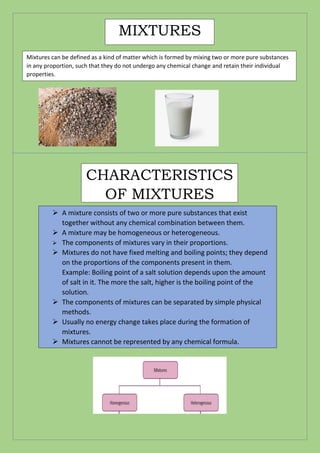
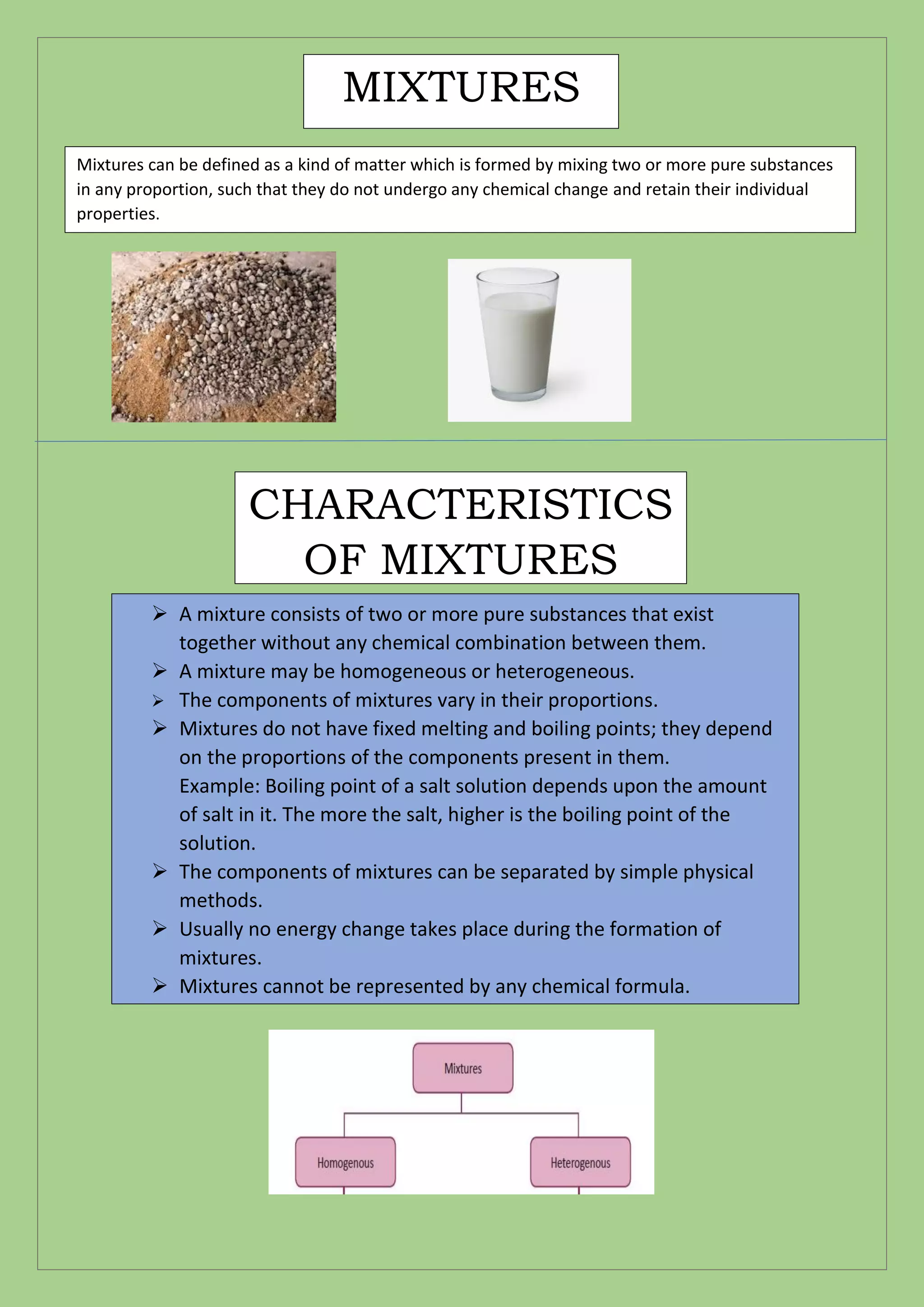
Mixtures can be defined as a kind of matter which is formed by mixing two or more pure substances
in any proportion, such that they do not undergo any chemical change and retain their individual
properties.
CHARACTERISTICS
OF MIXTURES
➢ A mixture consists of two or more pure substances that exist
together without any chemical combination between them.
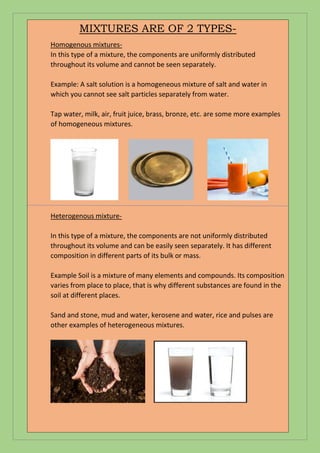
➢ A mixture may be homogeneous or heterogeneous.
➢ The components of mixtures vary in their proportions.
➢ Mixtures do not have fixed melting and boiling points; they depend
on the proportions of the components present in them.
Example: Boiling point of a salt solution depends upon the amount
of salt in it. The more the salt, higher is the boiling point of the
solution.
➢ The components of mixtures can be separated by simple physical
methods.
➢ Usually no energy change takes place during the formation of
mixtures.
➢ Mixtures cannot be represented by any chemical formula.
MIXTURES ARE OF 2 TYPES-
Homogenous mixtures-
In this type of a mixture, the components are uniformly distributed
throughout its volume and cannot be seen separately.
Example: A salt solution is a homogeneous mixture of salt and water in
which you cannot see salt particles separately from water.
Tap water, milk, air, fruit juice, brass, bronze, etc. are some more examples
of homogeneous mixtures.
Heterogenous mixture-
In this type of a mixture, the components are not uniformly distributed
throughout its volume and can be easily seen separately. It has different
composition in different parts of its bulk or mass.
Example Soil is a mixture of many elements and compounds. Its composition
varies from place to place, that is why different substances are found in the
soil at different places.
Sand and stone, mud and water, kerosene and water, rice and pulses are
other examples of heterogeneous mixtures.
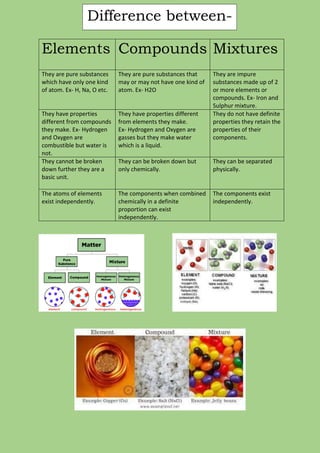
Elements Compounds Mixtures
They are pure substances
which have only one kind
of atom. Ex- H, Na, O etc.
They are pure substances that
may or may not have one kind of
atom. Ex- H2O
They are impure
substances made up of 2
or more elements or
compounds. Ex- Iron and
Sulphur mixture.
They have properties
different from compounds
they make. Ex- Hydrogen
and Oxygen are
combustible but water is
not.
They have properties different
from elements they make.
Ex- Hydrogen and Oxygen are
gasses but they make water
which is a liquid.
They do not have definite
properties they retain the
properties of their
components.
They cannot be broken
down further they are a
basic unit.
They can be broken down but
only chemically.
They can be separated
physically.
The atoms of elements
exist independently.
The components when combined
chemically in a definite
proportion can exist
independently.
The components exist
independently.
Difference between-
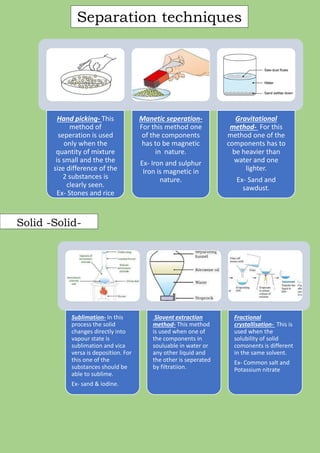
Hand picking- This
method of
seperation is used
only when the
quantity of mixture
is small and the the
size difference of the
2 substances is
clearly seen.
Ex- Stones and rice
Manetic seperation-
For this method one
of the components
has to be magnetic
in nature.
Ex- Iron and sulphur
Iron is magnetic in
nature.
Gravitational
method- For this
method one of the
components has to
be heavier than
water and one
lighter.
Ex- Sand and
sawdust.
Sublimation- In this
process the solid
changes directly into
vapour state is
sublimation and vica
versa is deposition. For
this one of the
substances should be
able to sublime.
Ex- sand & iodine.
Slovent extraction
method- This method
is used when one of
the components in
souluable in water or
any other liquid and
the other is seperated
by filtratiion.
Fractional
crystallisation- This is
used when the
solubility of solid
comonents is different
in the same solvent.
Ex- Common salt and
Potassium nitrate
Separation techniques
Solid -Solid-
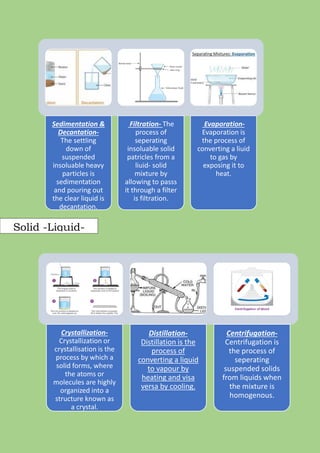
Sedimentation &
Decantation-
The settling
down of
suspended
insoluable heavy
particles is
sedimentation
and pouring out
the clear liquid is
decantation.
Filtration- The
process of
seperating
insoluable solid
patricles from a
liuid- solid
mixture by
allowing to passs
it through a filter
is filtration.
Evaporation-
Evaporation is
the process of
converting a liuid
to gas by
exposing it to
heat.
Crystallization-
Crystallization or
crystallisation is the
process by which a
solid forms, where
the atoms or
molecules are highly
organized into a
structure known as
a crystal.
Distillation-
Distillation is the
process of
converting a liquid
to vapour by
heating and visa
versa by cooling.
Centrifugation-
Centrifugation is
the process of
seperating
suspended solids
from liquids when
the mixture is
homogenous.
Solid -Liquid-
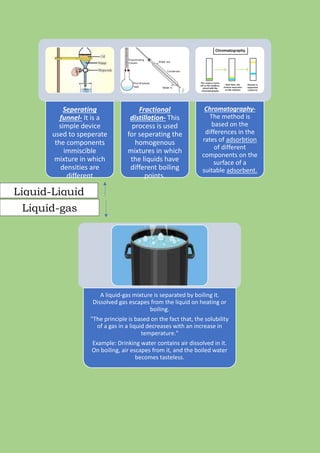
Seperating
funnel- It is a
simple device
used to speperate
the components
immiscible
mixture in which
densities are
different
Fractional
distillation- This
process is used
for seperating the
homogenous
mixtures in which
the liquids have
different boiling
points.
Chromatography-
The method is
based on the
differences in the
rates of adsorbtion
of different
components on the
surface of a
suitable adsorbent.
A liquid-gas mixture is separated by boiling it.
Dissolved gas escapes from the liquid on heating or
boiling.
"The principle is based on the fact that, the solubility
of a gas in a liquid decreases with an increase in
temperature."
Example: Drinking water contains air dissolved in it.
On boiling, air escapes from it, and the boiled water
becomes tasteless.
Liquid-Liquid
Liquid-gas
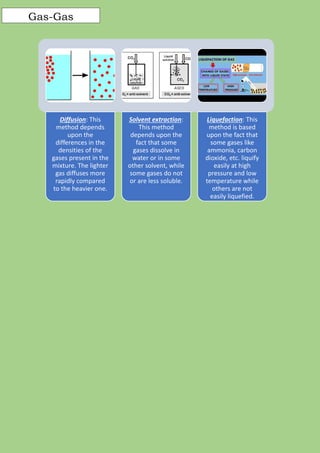
Diffusion: This
method depends
upon the
differences in the
densities of the
gases present in the
mixture. The lighter
gas diffuses more
rapidly compared
to the heavier one.
Solvent extraction:
This method
depends upon the
fact that some
gases dissolve in
water or in some
other solvent, while
some gases do not
or are less soluble.
Liquefaction: This
method is based
upon the fact that
some gases like
ammonia, carbon
dioxide, etc. liquify
easily at high
pressure and low
temperature while
others are not
easily liquefied.
Gas-Gas

Mixtures and-separation

  • 1.
    MIXTURES Mixtures can bedefined as a kind of matter which is formed by mixing two or more pure substances in any proportion, such that they do not undergo any chemical change and retain their individual properties. CHARACTERISTICS OF MIXTURES ➢ A mixture consists of two or more pure substances that exist together without any chemical combination between them. ➢ A mixture may be homogeneous or heterogeneous. ➢ The components of mixtures vary in their proportions. ➢ Mixtures do not have fixed melting and boiling points; they depend on the proportions of the components present in them. Example: Boiling point of a salt solution depends upon the amount of salt in it. The more the salt, higher is the boiling point of the solution. ➢ The components of mixtures can be separated by simple physical methods. ➢ Usually no energy change takes place during the formation of mixtures. ➢ Mixtures cannot be represented by any chemical formula.
  • 2.
    MIXTURES ARE OF2 TYPES- Homogenous mixtures- In this type of a mixture, the components are uniformly distributed throughout its volume and cannot be seen separately. Example: A salt solution is a homogeneous mixture of salt and water in which you cannot see salt particles separately from water. Tap water, milk, air, fruit juice, brass, bronze, etc. are some more examples of homogeneous mixtures. Heterogenous mixture- In this type of a mixture, the components are not uniformly distributed throughout its volume and can be easily seen separately. It has different composition in different parts of its bulk or mass. Example Soil is a mixture of many elements and compounds. Its composition varies from place to place, that is why different substances are found in the soil at different places. Sand and stone, mud and water, kerosene and water, rice and pulses are other examples of heterogeneous mixtures.
  • 3.
    Elements Compounds Mixtures Theyare pure substances which have only one kind of atom. Ex- H, Na, O etc. They are pure substances that may or may not have one kind of atom. Ex- H2O They are impure substances made up of 2 or more elements or compounds. Ex- Iron and Sulphur mixture. They have properties different from compounds they make. Ex- Hydrogen and Oxygen are combustible but water is not. They have properties different from elements they make. Ex- Hydrogen and Oxygen are gasses but they make water which is a liquid. They do not have definite properties they retain the properties of their components. They cannot be broken down further they are a basic unit. They can be broken down but only chemically. They can be separated physically. The atoms of elements exist independently. The components when combined chemically in a definite proportion can exist independently. The components exist independently. Difference between-
  • 4.
    Hand picking- This methodof seperation is used only when the quantity of mixture is small and the the size difference of the 2 substances is clearly seen. Ex- Stones and rice Manetic seperation- For this method one of the components has to be magnetic in nature. Ex- Iron and sulphur Iron is magnetic in nature. Gravitational method- For this method one of the components has to be heavier than water and one lighter. Ex- Sand and sawdust. Sublimation- In this process the solid changes directly into vapour state is sublimation and vica versa is deposition. For this one of the substances should be able to sublime. Ex- sand & iodine. Slovent extraction method- This method is used when one of the components in souluable in water or any other liquid and the other is seperated by filtratiion. Fractional crystallisation- This is used when the solubility of solid comonents is different in the same solvent. Ex- Common salt and Potassium nitrate Separation techniques Solid -Solid-
  • 5.
    Sedimentation & Decantation- The settling downof suspended insoluable heavy particles is sedimentation and pouring out the clear liquid is decantation. Filtration- The process of seperating insoluable solid patricles from a liuid- solid mixture by allowing to passs it through a filter is filtration. Evaporation- Evaporation is the process of converting a liuid to gas by exposing it to heat. Crystallization- Crystallization or crystallisation is the process by which a solid forms, where the atoms or molecules are highly organized into a structure known as a crystal. Distillation- Distillation is the process of converting a liquid to vapour by heating and visa versa by cooling. Centrifugation- Centrifugation is the process of seperating suspended solids from liquids when the mixture is homogenous. Solid -Liquid-
  • 6.
    Seperating funnel- It isa simple device used to speperate the components immiscible mixture in which densities are different Fractional distillation- This process is used for seperating the homogenous mixtures in which the liquids have different boiling points. Chromatography- The method is based on the differences in the rates of adsorbtion of different components on the surface of a suitable adsorbent. A liquid-gas mixture is separated by boiling it. Dissolved gas escapes from the liquid on heating or boiling. "The principle is based on the fact that, the solubility of a gas in a liquid decreases with an increase in temperature." Example: Drinking water contains air dissolved in it. On boiling, air escapes from it, and the boiled water becomes tasteless. Liquid-Liquid Liquid-gas
  • 7.
    Diffusion: This method depends uponthe differences in the densities of the gases present in the mixture. The lighter gas diffuses more rapidly compared to the heavier one. Solvent extraction: This method depends upon the fact that some gases dissolve in water or in some other solvent, while some gases do not or are less soluble. Liquefaction: This method is based upon the fact that some gases like ammonia, carbon dioxide, etc. liquify easily at high pressure and low temperature while others are not easily liquefied. Gas-Gas