Properties of
Matter
 Chemistry is the scientific study of the properties and
behavior of matter. It is a natural science that covers
the elements that make up matter to the compounds
made of atoms, molecules and ions: their
composition, structure, properties, behavior and the
changes they undergo during a reaction with other
substances.
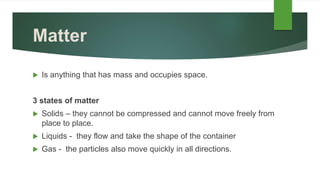
Matter
 Is anything that has mass and occupies space.
3 states of matter
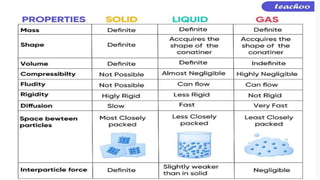
 Solids – they cannot be compressed and cannot move freely from
place to place.
 Liquids - they flow and take the shape of the container
 Gas - the particles also move quickly in all directions.
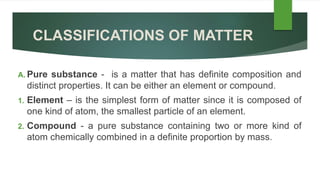
CLASSIFICATIONS OF MATTER
A. Pure substance - is a matter that has definite composition and
distinct properties. It can be either an element or compound.
1. Element – is the simplest form of matter since it is composed of
one kind of atom, the smallest particle of an element.
2. Compound - a pure substance containing two or more kind of
atom chemically combined in a definite proportion by mass.
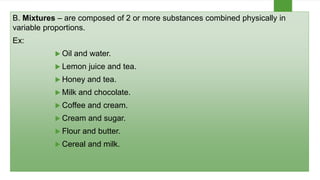
B. Mixtures – are composed of 2 or more substances combined physically in
variable proportions.
Ex:
 Oil and water.
 Lemon juice and tea.
 Honey and tea.
 Milk and chocolate.
 Coffee and cream.
 Cream and sugar.
 Flour and butter.
 Cereal and milk.
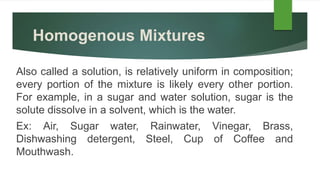
Homogenous Mixtures
Also called a solution, is relatively uniform in composition;
every portion of the mixture is likely every other portion.
For example, in a sugar and water solution, sugar is the
solute dissolve in a solvent, which is the water.
Ex: Air, Sugar water, Rainwater, Vinegar, Brass,
Dishwashing detergent, Steel, Cup of Coffee and
Mouthwash.
Heterogeneous Mixture
A mixture whose composition varies from one position to another.
Ex:
 Salad
 Mixed nuts
 Oil and water
 Bowl of cereal
 Halo halo
 pizza
Separating Mixtures
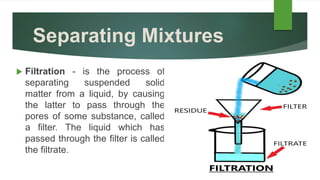
 Filtration - is the process of
separating suspended solid
matter from a liquid, by causing
the latter to pass through the
pores of some substance, called
a filter. The liquid which has
passed through the filter is called
the filtrate.
Decantation and Centrifugation
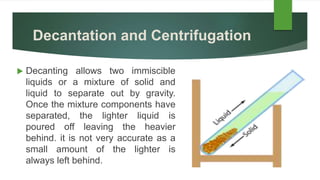
 Decanting allows two immiscible
liquids or a mixture of solid and
liquid to separate out by gravity.
Once the mixture components have
separated, the lighter liquid is
poured off leaving the heavier
behind. it is not very accurate as a
small amount of the lighter is
always left behind.
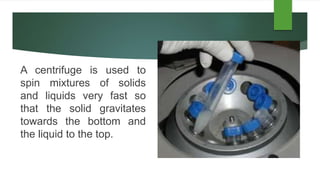
A centrifuge is used to
spin mixtures of solids
and liquids very fast so
that the solid gravitates
towards the bottom and
the liquid to the top.
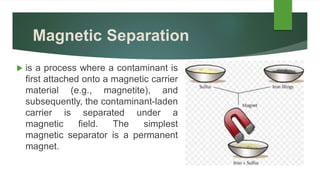
Magnetic Separation
 is a process where a contaminant is
first attached onto a magnetic carrier
material (e.g., magnetite), and
subsequently, the contaminant-laden
carrier is separated under a
magnetic field. The simplest
magnetic separator is a permanent
magnet.
Evaporation, melting and
sublimation
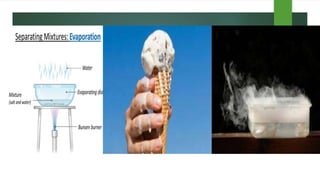
 Evaporation - is a type of vaporization that occurs on the surface of a
liquid as it changes into the gas phase.
 Melting - a physical process that results in the phase transition of a
substance from a solid to a liquid. This occurs when the internal energy
of the solid increases, typically by the application of heat or pressure.
 Sublimation - is the transition of a substance directly from a solid state
to a gas state. It does not pass through the usual liquid state, and only
occurs at specific temperatures and pressures.
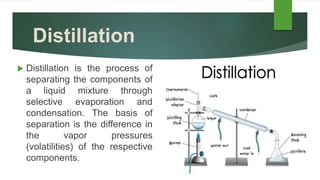
Distillation
 Distillation is the process of
separating the components of
a liquid mixture through
selective evaporation and
condensation. The basis of
separation is the difference in
the vapor pressures
(volatilities) of the respective
components.
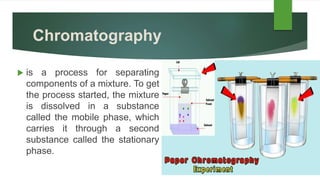
Chromatography
 is a process for separating
components of a mixture. To get
the process started, the mixture
is dissolved in a substance
called the mobile phase, which
carries it through a second
substance called the stationary
phase.
Properties of Matter.pptx

Properties of Matter.pptx

  • 1.
  • 3.
     Chemistry isthe scientific study of the properties and behavior of matter. It is a natural science that covers the elements that make up matter to the compounds made of atoms, molecules and ions: their composition, structure, properties, behavior and the changes they undergo during a reaction with other substances.
  • 4.
    Matter  Is anythingthat has mass and occupies space. 3 states of matter  Solids – they cannot be compressed and cannot move freely from place to place.  Liquids - they flow and take the shape of the container  Gas - the particles also move quickly in all directions.
  • 6.
    CLASSIFICATIONS OF MATTER A.Pure substance - is a matter that has definite composition and distinct properties. It can be either an element or compound. 1. Element – is the simplest form of matter since it is composed of one kind of atom, the smallest particle of an element. 2. Compound - a pure substance containing two or more kind of atom chemically combined in a definite proportion by mass.
  • 7.
    B. Mixtures –are composed of 2 or more substances combined physically in variable proportions. Ex:  Oil and water.  Lemon juice and tea.  Honey and tea.  Milk and chocolate.  Coffee and cream.  Cream and sugar.  Flour and butter.  Cereal and milk.
  • 8.
    Homogenous Mixtures Also calleda solution, is relatively uniform in composition; every portion of the mixture is likely every other portion. For example, in a sugar and water solution, sugar is the solute dissolve in a solvent, which is the water. Ex: Air, Sugar water, Rainwater, Vinegar, Brass, Dishwashing detergent, Steel, Cup of Coffee and Mouthwash.
  • 9.
    Heterogeneous Mixture A mixturewhose composition varies from one position to another. Ex:  Salad  Mixed nuts  Oil and water  Bowl of cereal  Halo halo  pizza
  • 10.
    Separating Mixtures  Filtration- is the process of separating suspended solid matter from a liquid, by causing the latter to pass through the pores of some substance, called a filter. The liquid which has passed through the filter is called the filtrate.
  • 11.
    Decantation and Centrifugation Decanting allows two immiscible liquids or a mixture of solid and liquid to separate out by gravity. Once the mixture components have separated, the lighter liquid is poured off leaving the heavier behind. it is not very accurate as a small amount of the lighter is always left behind.
  • 12.
    A centrifuge isused to spin mixtures of solids and liquids very fast so that the solid gravitates towards the bottom and the liquid to the top.
  • 13.
    Magnetic Separation  isa process where a contaminant is first attached onto a magnetic carrier material (e.g., magnetite), and subsequently, the contaminant-laden carrier is separated under a magnetic field. The simplest magnetic separator is a permanent magnet.
  • 14.
    Evaporation, melting and sublimation Evaporation - is a type of vaporization that occurs on the surface of a liquid as it changes into the gas phase.  Melting - a physical process that results in the phase transition of a substance from a solid to a liquid. This occurs when the internal energy of the solid increases, typically by the application of heat or pressure.  Sublimation - is the transition of a substance directly from a solid state to a gas state. It does not pass through the usual liquid state, and only occurs at specific temperatures and pressures.
  • 16.
    Distillation  Distillation isthe process of separating the components of a liquid mixture through selective evaporation and condensation. The basis of separation is the difference in the vapor pressures (volatilities) of the respective components.
  • 17.
    Chromatography  is aprocess for separating components of a mixture. To get the process started, the mixture is dissolved in a substance called the mobile phase, which carries it through a second substance called the stationary phase.