TheState
The constitutions set s our three
powers: legislative, executive, and
judicial.
1. Legislative power
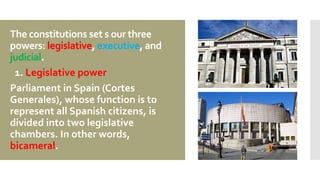
Parliament in Spain (Cortes
Generales), whose function is to
represent all Spanish citizens, is
divided into two legislative
chambers. In other words,
bicameral.
TheCongress
of Deputies
andThe
Senate
The lower chamber:The Congress of Deputies (El Congreso de los Diputados)
The members of this chamber are called diputados (deputies) and they approve and veto
laws.They belong to different political parties and their number depends on the number of
votes they receive in the general elections.
The upper chamber:The Senate (El Senado)
The members of this chamber are called senadores (senators).They make sure the
AutonomousCommunities follow theConstitution.
Senators can also pass laws but they cannot veto them.
The two chambers of Parliament make joint decisions on budgets and controlling the
Executive.
Check out!1
Answer the
questions in
your
notebook. (We
will find out
correct
answers in the
class)
Which parliamentary chamber has
the most power?
What are two of those powers?
Who represents the Autonomous
Communities?
Differences and similarities
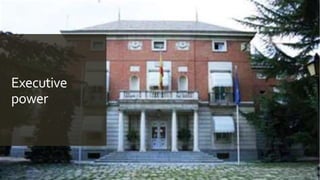
Executive
power
Executive Power
Challenge1
Research 22
ministries and
activities they
carry out (upload
it on Manage
bac) Doyouremember
thetopicsoftheEU you
investigated?
 The party that gets the most voters in the
elections forms the Government. The Prime
Minister is selected by members of the
Congress. He, or she, is the head of the
Government and chooses the ministers who
will help him or her.
 There are ministers for different areas.They
propose ideas that are voted on in
Parliament.There are 22 ministries in Spain.
What are they? Investigate one of the 22
ministries and make a list of some of the
areas they cover and activities they carry out.
(upload it on Manage bac)
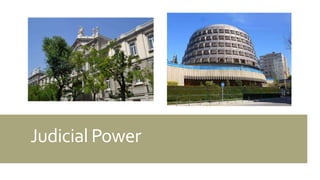
Judicial Power
Judicial Power
refers to the
court and
tribunals.There
are composed of
judges and
magistrates who
ensure the laws
are obeyed.
 The highest judicial bodies are the Supreme Court (El
Tribunal Supremo) and the Constitutional Court (El
Tribunal Constitutional)
 The Supreme Court
 can accept or reject sentences passed in the lower
court.
 can start legal proceedings against ministers,
senators and even the Prime Minister if necessary.
 The Constitutional Court
 has the power to decide whether laws are in
accordance with the Constitution. It can also reject
decisions by the Supreme Court.
Check up! 2
Answer the
questions in your
notebook. (We
will find out
correct answers
in the class)
 Who choose the Prime Minister?(Link!
Executive power)
 Who decides whether a law violates the
Constitution?
 What is the main opposition party and who is
its leader in Spain?
 When are the next general elections?
 Find out the names of the last 5 Ministers of
Education and put them in chronological
order.
Critical
Thinking:
Criteria D
(in the class,
debate)
There are currently 22 ministers. Do
you think there should be others? Make
suggestions. Justify your answers.
Challenge 2
Make an
infographic
(upload it on
Manage bac)
Vote for the
best poster.
 Aims: Understand how the Spanish State is organised and present
information clearly for others to understand. (a difference
between an infographic and a mind map)
 Method:
 1. Make a note of all the different institutions within the State,
their functions and their powers using what you´ve learnt from
this ppt.
 2.Do extra research to find any key facts or figures you think might
be interesting.
 3. Plan what information you want to show. It doesn´t have to
include everything from your research.
 4 .Decide on the design of your infographic. Search on the Internet
for ideas on how designers have displayed other topics if you
need inspiration.
 5. Design your infographic.
 6. Display it for the rest of the class and vote for the best poster.
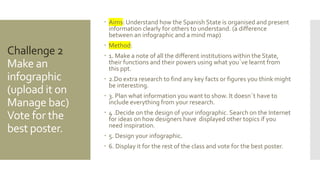
Examples of
infographics.
The state

The state

  • 2.
  • 3.
    The constitutions sets our three powers: legislative, executive, and judicial. 1. Legislative power Parliament in Spain (Cortes Generales), whose function is to represent all Spanish citizens, is divided into two legislative chambers. In other words, bicameral.
  • 4.
    TheCongress of Deputies andThe Senate The lowerchamber:The Congress of Deputies (El Congreso de los Diputados) The members of this chamber are called diputados (deputies) and they approve and veto laws.They belong to different political parties and their number depends on the number of votes they receive in the general elections. The upper chamber:The Senate (El Senado) The members of this chamber are called senadores (senators).They make sure the AutonomousCommunities follow theConstitution. Senators can also pass laws but they cannot veto them. The two chambers of Parliament make joint decisions on budgets and controlling the Executive.
  • 5.
    Check out!1 Answer the questionsin your notebook. (We will find out correct answers in the class) Which parliamentary chamber has the most power? What are two of those powers? Who represents the Autonomous Communities? Differences and similarities
  • 6.
  • 7.
    Executive Power Challenge1 Research 22 ministriesand activities they carry out (upload it on Manage bac) Doyouremember thetopicsoftheEU you investigated?  The party that gets the most voters in the elections forms the Government. The Prime Minister is selected by members of the Congress. He, or she, is the head of the Government and chooses the ministers who will help him or her.  There are ministers for different areas.They propose ideas that are voted on in Parliament.There are 22 ministries in Spain. What are they? Investigate one of the 22 ministries and make a list of some of the areas they cover and activities they carry out. (upload it on Manage bac)
  • 8.
  • 9.
    Judicial Power refers tothe court and tribunals.There are composed of judges and magistrates who ensure the laws are obeyed.  The highest judicial bodies are the Supreme Court (El Tribunal Supremo) and the Constitutional Court (El Tribunal Constitutional)  The Supreme Court  can accept or reject sentences passed in the lower court.  can start legal proceedings against ministers, senators and even the Prime Minister if necessary.  The Constitutional Court  has the power to decide whether laws are in accordance with the Constitution. It can also reject decisions by the Supreme Court.
  • 10.
    Check up! 2 Answerthe questions in your notebook. (We will find out correct answers in the class)  Who choose the Prime Minister?(Link! Executive power)  Who decides whether a law violates the Constitution?  What is the main opposition party and who is its leader in Spain?  When are the next general elections?  Find out the names of the last 5 Ministers of Education and put them in chronological order.
  • 11.
    Critical Thinking: Criteria D (in theclass, debate) There are currently 22 ministers. Do you think there should be others? Make suggestions. Justify your answers.
  • 12.
    Challenge 2 Make an infographic (uploadit on Manage bac) Vote for the best poster.  Aims: Understand how the Spanish State is organised and present information clearly for others to understand. (a difference between an infographic and a mind map)  Method:  1. Make a note of all the different institutions within the State, their functions and their powers using what you´ve learnt from this ppt.  2.Do extra research to find any key facts or figures you think might be interesting.  3. Plan what information you want to show. It doesn´t have to include everything from your research.  4 .Decide on the design of your infographic. Search on the Internet for ideas on how designers have displayed other topics if you need inspiration.  5. Design your infographic.  6. Display it for the rest of the class and vote for the best poster.
  • 13.