MatterMatter
For Review:For Review:
 Matter is anything thatMatter is anything that
takes up space (hastakes up space (has
volume) and has mass.volume) and has mass.
 Mass: amount of matterMass: amount of matter
in an objectin an object
 Volume: amount of spaceVolume: amount of space
occupied by an objectoccupied by an object
States of MatterStates of Matter
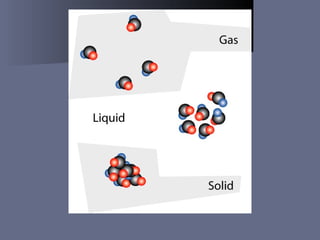
 Solid – has a definite shape and definiteSolid – has a definite shape and definite
volumevolume
 Liquid – has a definite volume, but takesLiquid – has a definite volume, but takes
the shape of its containerthe shape of its container
 Gas – takes both the shape and volume ofGas – takes both the shape and volume of
its containerits container
States of Matter:States of Matter:
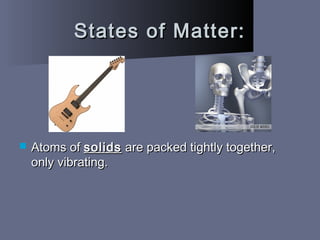
 Atoms ofAtoms of solidssolids are packed tightly together,are packed tightly together,
only vibrating.only vibrating.
States of Matter:States of Matter:
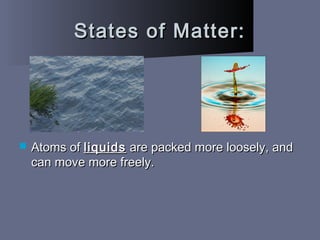
 Atoms ofAtoms of liquidsliquids are packed more loosely, andare packed more loosely, and
can move more freely.can move more freely.
States of Matter:States of Matter:
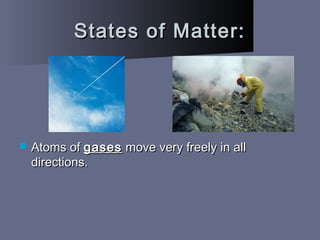
 Atoms ofAtoms of gasesgases move very freely in allmove very freely in all
directions.directions.
Changes In MatterChanges In Matter
Properties of MatterProperties of Matter
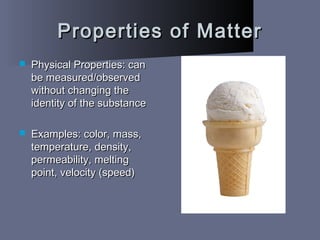
 Physical Properties: canPhysical Properties: can
be measured/observedbe measured/observed
without changing thewithout changing the
identity of the substanceidentity of the substance
 Examples: color, mass,Examples: color, mass,
temperature, density,temperature, density,
permeability, meltingpermeability, melting
point, velocity (speed)point, velocity (speed)
Properties of MatterProperties of Matter
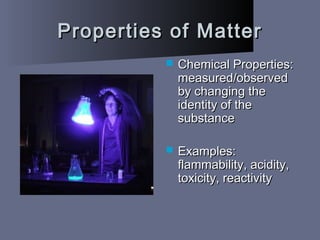
 Chemical Properties:Chemical Properties:
measured/observedmeasured/observed
by changing theby changing the
identity of theidentity of the
substancesubstance
 Examples:Examples:
flammability, acidity,flammability, acidity,
toxicity, reactivitytoxicity, reactivity
Changes In Matter:Changes In Matter:
PhysicalPhysical
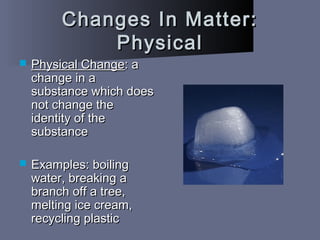
 Physical ChangePhysical Change: a: a
change in achange in a
substance which doessubstance which does
not change thenot change the
identity of theidentity of the
substancesubstance
 Examples: boilingExamples: boiling
water, breaking awater, breaking a
branch off a tree,branch off a tree,
melting ice cream,melting ice cream,
recycling plasticrecycling plastic
Changes In Matter:Changes In Matter:
ChemicalChemical
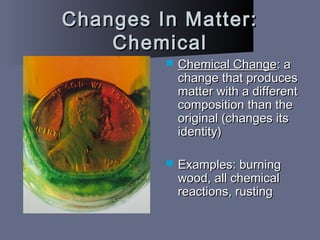
 Chemical ChangeChemical Change: a: a
change that produceschange that produces
matter with a differentmatter with a different
composition than thecomposition than the
original (changes itsoriginal (changes its
identity)identity)
 Examples: burningExamples: burning
wood, all chemicalwood, all chemical
reactions, rustingreactions, rusting
Are these physical orAre these physical or
chemical changes?chemical changes?
1.1. Cars combust fuel for power.Cars combust fuel for power.
2.2. Water condenses on the windows on a cold day.Water condenses on the windows on a cold day.
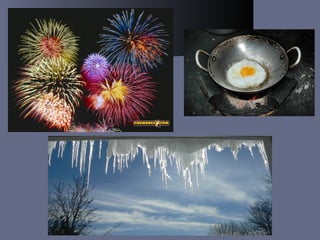
3.3. A carnival worker lights a firework and it ignites.A carnival worker lights a firework and it ignites.
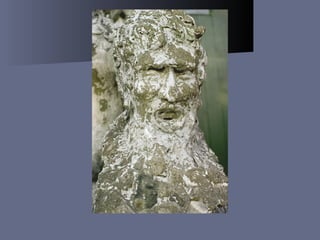
4.4. Acid rain degrades statues made of certain materials.Acid rain degrades statues made of certain materials.
5.5. Cooking an egg.Cooking an egg.
Things to RememberThings to Remember
 Simple changes in state are NOT chemicalSimple changes in state are NOT chemical
changes. (i.e. freezing water, melting achanges. (i.e. freezing water, melting a
metal, boiling a solution) – What can you dometal, boiling a solution) – What can you do
to something to change its state?to something to change its state?
 Chemical changes are anyChemical changes are any
changes/reactions in which the end result ischanges/reactions in which the end result is
chemically different from what you startedchemically different from what you started
with.with.
 Combustion (burning) is reacting somethingCombustion (burning) is reacting something
with oxygen and is always a chemicalwith oxygen and is always a chemical
change.change.
Substances andSubstances and
MixturesMixtures
What is a substance?What is a substance?
SubstancesSubstances
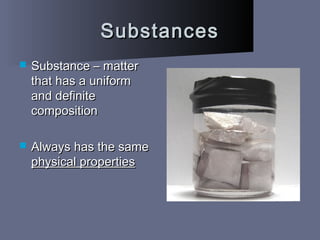
 Substance – matterSubstance – matter
that has a uniformthat has a uniform
and definiteand definite
compositioncomposition
 Always has the sameAlways has the same
physical propertiesphysical properties
SubstancesSubstances
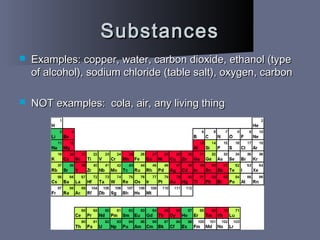
 Examples: copper, water, carbon dioxide, ethanol (typeExamples: copper, water, carbon dioxide, ethanol (type
of alcohol), sodium chloride (table salt), oxygen, carbonof alcohol), sodium chloride (table salt), oxygen, carbon
 NOT examples: cola, air, any living thingNOT examples: cola, air, any living thing
MixturesMixtures
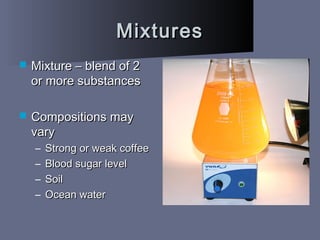
 Mixture – blend of 2Mixture – blend of 2
or more substancesor more substances
 Compositions mayCompositions may
varyvary
– Strong or weak coffeeStrong or weak coffee
– Blood sugar levelBlood sugar level
– SoilSoil
– Ocean waterOcean water
MixturesMixtures
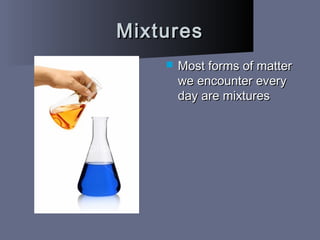
 Most forms of matterMost forms of matter
we encounter everywe encounter every
day are mixturesday are mixtures
MixturesMixtures
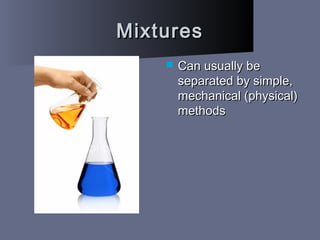
 Can usually beCan usually be
separated by simple,separated by simple,
mechanical (physical)mechanical (physical)
methodsmethods
Two Types of MixturesTwo Types of Mixtures
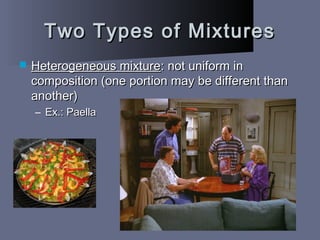
 Heterogeneous mixtureHeterogeneous mixture: not uniform in: not uniform in
composition (one portion may be different thancomposition (one portion may be different than
another)another)
– Ex.: PaellaEx.: Paella
Two Types of MixturesTwo Types of Mixtures
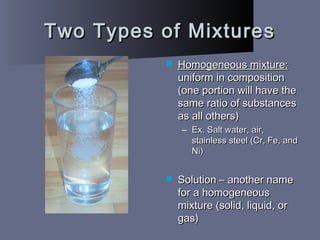
 Homogeneous mixture:Homogeneous mixture:
uniform in compositionuniform in composition
(one portion will have the(one portion will have the
same ratio of substancessame ratio of substances
as all others)as all others)
– Ex. Salt water, air,Ex. Salt water, air,
stainless steel (Cr, Fe, andstainless steel (Cr, Fe, and
Ni)Ni)
 Solution – another nameSolution – another name
for a homogeneousfor a homogeneous
mixture (solid, liquid, ormixture (solid, liquid, or
gas)gas)
Heterogeneous MixturesHeterogeneous Mixtures
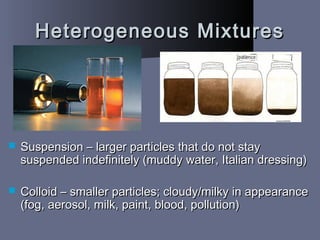
 Suspension – larger particles that do not staySuspension – larger particles that do not stay
suspended indefinitely (muddy water, Italian dressing)suspended indefinitely (muddy water, Italian dressing)
 Colloid – smaller particles; cloudy/milky in appearanceColloid – smaller particles; cloudy/milky in appearance
(fog, aerosol, milk, paint, blood, pollution)(fog, aerosol, milk, paint, blood, pollution)
Separating MixturesSeparating Mixtures
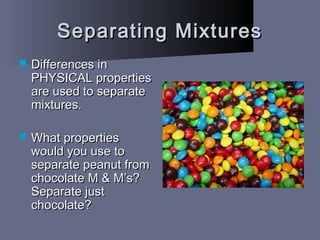
 Differences inDifferences in
PHYSICAL propertiesPHYSICAL properties
are used to separateare used to separate
mixtures.mixtures.
 What propertiesWhat properties
would you use towould you use to
separate peanut fromseparate peanut from
chocolate M & M’s?chocolate M & M’s?
Separate justSeparate just
chocolate?chocolate?
Separating MixturesSeparating Mixtures
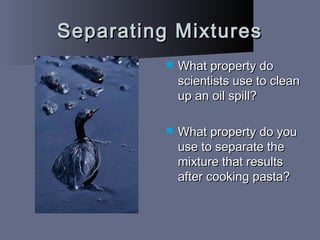
 What property doWhat property do
scientists use to cleanscientists use to clean
up an oil spill?up an oil spill?
 What property do youWhat property do you
use to separate theuse to separate the
mixture that resultsmixture that results
after cooking pasta?after cooking pasta?
Separating MixturesSeparating Mixtures
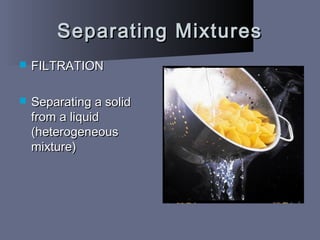
 FILTRATIONFILTRATION
 Separating a solidSeparating a solid
from a liquidfrom a liquid
(heterogeneous(heterogeneous
mixture)mixture)
Separating MixturesSeparating Mixtures
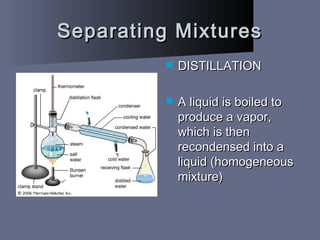
 DISTILLATIONDISTILLATION
 A liquid is boiled toA liquid is boiled to
produce a vapor,produce a vapor,
which is thenwhich is then
recondensed into arecondensed into a
liquid (homogeneousliquid (homogeneous
mixture)mixture)

Matter (Part 1)

  • 1.
  • 2.
    For Review:For Review: Matter is anything thatMatter is anything that takes up space (hastakes up space (has volume) and has mass.volume) and has mass.  Mass: amount of matterMass: amount of matter in an objectin an object  Volume: amount of spaceVolume: amount of space occupied by an objectoccupied by an object
  • 3.
    States of MatterStatesof Matter  Solid – has a definite shape and definiteSolid – has a definite shape and definite volumevolume  Liquid – has a definite volume, but takesLiquid – has a definite volume, but takes the shape of its containerthe shape of its container  Gas – takes both the shape and volume ofGas – takes both the shape and volume of its containerits container
  • 4.
    States of Matter:Statesof Matter:  Atoms ofAtoms of solidssolids are packed tightly together,are packed tightly together, only vibrating.only vibrating.
  • 5.
    States of Matter:Statesof Matter:  Atoms ofAtoms of liquidsliquids are packed more loosely, andare packed more loosely, and can move more freely.can move more freely.
  • 6.
    States of Matter:Statesof Matter:  Atoms ofAtoms of gasesgases move very freely in allmove very freely in all directions.directions.
  • 8.
  • 9.
    Properties of MatterPropertiesof Matter  Physical Properties: canPhysical Properties: can be measured/observedbe measured/observed without changing thewithout changing the identity of the substanceidentity of the substance  Examples: color, mass,Examples: color, mass, temperature, density,temperature, density, permeability, meltingpermeability, melting point, velocity (speed)point, velocity (speed)
  • 10.
    Properties of MatterPropertiesof Matter  Chemical Properties:Chemical Properties: measured/observedmeasured/observed by changing theby changing the identity of theidentity of the substancesubstance  Examples:Examples: flammability, acidity,flammability, acidity, toxicity, reactivitytoxicity, reactivity
  • 11.
    Changes In Matter:ChangesIn Matter: PhysicalPhysical  Physical ChangePhysical Change: a: a change in achange in a substance which doessubstance which does not change thenot change the identity of theidentity of the substancesubstance  Examples: boilingExamples: boiling water, breaking awater, breaking a branch off a tree,branch off a tree, melting ice cream,melting ice cream, recycling plasticrecycling plastic
  • 12.
    Changes In Matter:ChangesIn Matter: ChemicalChemical  Chemical ChangeChemical Change: a: a change that produceschange that produces matter with a differentmatter with a different composition than thecomposition than the original (changes itsoriginal (changes its identity)identity)  Examples: burningExamples: burning wood, all chemicalwood, all chemical reactions, rustingreactions, rusting
  • 13.
    Are these physicalorAre these physical or chemical changes?chemical changes? 1.1. Cars combust fuel for power.Cars combust fuel for power. 2.2. Water condenses on the windows on a cold day.Water condenses on the windows on a cold day. 3.3. A carnival worker lights a firework and it ignites.A carnival worker lights a firework and it ignites. 4.4. Acid rain degrades statues made of certain materials.Acid rain degrades statues made of certain materials. 5.5. Cooking an egg.Cooking an egg.
  • 15.
    Things to RememberThingsto Remember  Simple changes in state are NOT chemicalSimple changes in state are NOT chemical changes. (i.e. freezing water, melting achanges. (i.e. freezing water, melting a metal, boiling a solution) – What can you dometal, boiling a solution) – What can you do to something to change its state?to something to change its state?  Chemical changes are anyChemical changes are any changes/reactions in which the end result ischanges/reactions in which the end result is chemically different from what you startedchemically different from what you started with.with.  Combustion (burning) is reacting somethingCombustion (burning) is reacting something with oxygen and is always a chemicalwith oxygen and is always a chemical change.change.
  • 17.
  • 18.
    What is asubstance?What is a substance?
  • 19.
    SubstancesSubstances  Substance –matterSubstance – matter that has a uniformthat has a uniform and definiteand definite compositioncomposition  Always has the sameAlways has the same physical propertiesphysical properties
  • 20.
    SubstancesSubstances  Examples: copper,water, carbon dioxide, ethanol (typeExamples: copper, water, carbon dioxide, ethanol (type of alcohol), sodium chloride (table salt), oxygen, carbonof alcohol), sodium chloride (table salt), oxygen, carbon  NOT examples: cola, air, any living thingNOT examples: cola, air, any living thing
  • 21.
    MixturesMixtures  Mixture –blend of 2Mixture – blend of 2 or more substancesor more substances  Compositions mayCompositions may varyvary – Strong or weak coffeeStrong or weak coffee – Blood sugar levelBlood sugar level – SoilSoil – Ocean waterOcean water
  • 22.
    MixturesMixtures  Most formsof matterMost forms of matter we encounter everywe encounter every day are mixturesday are mixtures
  • 23.
    MixturesMixtures  Can usuallybeCan usually be separated by simple,separated by simple, mechanical (physical)mechanical (physical) methodsmethods
  • 24.
    Two Types ofMixturesTwo Types of Mixtures  Heterogeneous mixtureHeterogeneous mixture: not uniform in: not uniform in composition (one portion may be different thancomposition (one portion may be different than another)another) – Ex.: PaellaEx.: Paella
  • 25.
    Two Types ofMixturesTwo Types of Mixtures  Homogeneous mixture:Homogeneous mixture: uniform in compositionuniform in composition (one portion will have the(one portion will have the same ratio of substancessame ratio of substances as all others)as all others) – Ex. Salt water, air,Ex. Salt water, air, stainless steel (Cr, Fe, andstainless steel (Cr, Fe, and Ni)Ni)  Solution – another nameSolution – another name for a homogeneousfor a homogeneous mixture (solid, liquid, ormixture (solid, liquid, or gas)gas)
  • 26.
    Heterogeneous MixturesHeterogeneous Mixtures Suspension – larger particles that do not staySuspension – larger particles that do not stay suspended indefinitely (muddy water, Italian dressing)suspended indefinitely (muddy water, Italian dressing)  Colloid – smaller particles; cloudy/milky in appearanceColloid – smaller particles; cloudy/milky in appearance (fog, aerosol, milk, paint, blood, pollution)(fog, aerosol, milk, paint, blood, pollution)
  • 27.
    Separating MixturesSeparating Mixtures Differences inDifferences in PHYSICAL propertiesPHYSICAL properties are used to separateare used to separate mixtures.mixtures.  What propertiesWhat properties would you use towould you use to separate peanut fromseparate peanut from chocolate M & M’s?chocolate M & M’s? Separate justSeparate just chocolate?chocolate?
  • 28.
    Separating MixturesSeparating Mixtures What property doWhat property do scientists use to cleanscientists use to clean up an oil spill?up an oil spill?  What property do youWhat property do you use to separate theuse to separate the mixture that resultsmixture that results after cooking pasta?after cooking pasta?
  • 29.
    Separating MixturesSeparating Mixtures FILTRATIONFILTRATION  Separating a solidSeparating a solid from a liquidfrom a liquid (heterogeneous(heterogeneous mixture)mixture)
  • 30.
    Separating MixturesSeparating Mixtures DISTILLATIONDISTILLATION  A liquid is boiled toA liquid is boiled to produce a vapor,produce a vapor, which is thenwhich is then recondensed into arecondensed into a liquid (homogeneousliquid (homogeneous mixture)mixture)