Introduction to Solutions (Chapter 5)7 SCIENCE
How do solutions relate to matter?Atoms make up all matter on earth; therefore solutions are made from atomsWhen atoms combine they are called chemical compoundsEx: What atoms make up the chemical compound water?These chemical compounds cannot be separated by physical processes like squeezing, filtering etcIf a substance can be broken down by physical processes it is called a mixture
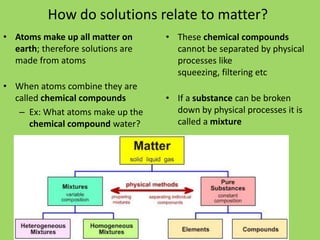
MixturesA mixture is a combination of substances that can be separated by physical means Ex: boiling saltwater to separate the salt from the waterTwo types of mixtures:HeterogeneousHomogeneous
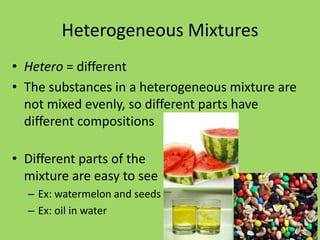
Heterogeneous MixturesHetero = differentThe substances in a heterogeneous mixture are not mixed evenly, so different parts have different compositionsDifferent parts of the  mixture are easy to seeEx: watermelon and seedsEx: oil in water
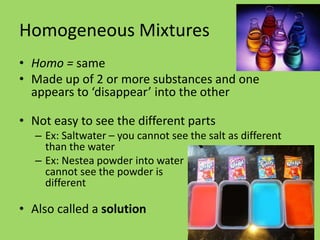
Homogeneous MixturesHomo = same Made up of 2 or more substances and one appears to ‘disappear’ into the otherNot easy to see the different partsEx: Saltwater – you cannot see the salt as different than the waterEx: Nestea powder into water cannot see the powder is differentAlso called a solution
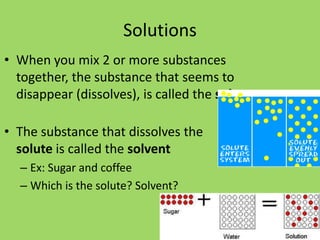
Solutions When you mix 2 or more substances together, the substance that seems to disappear (dissolves), is called the soluteThe substance that dissolves the solute is called the solventEx: Sugar and coffeeWhich is the solute? Solvent?
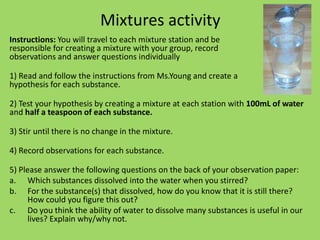
Mixtures activityInstructions:You will travel to each mixture station and be responsible for creating a mixture with your group, record observations and answer questions individually1) Read and follow the instructions from Ms.Young and create a hypothesis for each substance. 2) Test your hypothesis by creating a mixture at each station with 100mL of water and half a teaspoon of each substance.3) Stir until there is no change in the mixture.4) Record observations for each substance.5) Please answer the following questions on the back of your observation paper:Which substances dissolved into the water when you stirred?For the substance(s) that dissolved, how do you know that it is still there? How could you figure this out?Do you think the ability of water to dissolve many substances is useful in our lives? Explain why/why not.

Introduction to solutions (chapter 5)

  • 1.
    Introduction to Solutions(Chapter 5)7 SCIENCE
  • 2.
    How do solutionsrelate to matter?Atoms make up all matter on earth; therefore solutions are made from atomsWhen atoms combine they are called chemical compoundsEx: What atoms make up the chemical compound water?These chemical compounds cannot be separated by physical processes like squeezing, filtering etcIf a substance can be broken down by physical processes it is called a mixture
  • 3.
    MixturesA mixture isa combination of substances that can be separated by physical means Ex: boiling saltwater to separate the salt from the waterTwo types of mixtures:HeterogeneousHomogeneous
  • 4.
    Heterogeneous MixturesHetero =differentThe substances in a heterogeneous mixture are not mixed evenly, so different parts have different compositionsDifferent parts of the mixture are easy to seeEx: watermelon and seedsEx: oil in water
  • 5.
    Homogeneous MixturesHomo =same Made up of 2 or more substances and one appears to ‘disappear’ into the otherNot easy to see the different partsEx: Saltwater – you cannot see the salt as different than the waterEx: Nestea powder into water cannot see the powder is differentAlso called a solution
  • 6.
    Solutions When youmix 2 or more substances together, the substance that seems to disappear (dissolves), is called the soluteThe substance that dissolves the solute is called the solventEx: Sugar and coffeeWhich is the solute? Solvent?
  • 7.
    Mixtures activityInstructions:You willtravel to each mixture station and be responsible for creating a mixture with your group, record observations and answer questions individually1) Read and follow the instructions from Ms.Young and create a hypothesis for each substance. 2) Test your hypothesis by creating a mixture at each station with 100mL of water and half a teaspoon of each substance.3) Stir until there is no change in the mixture.4) Record observations for each substance.5) Please answer the following questions on the back of your observation paper:Which substances dissolved into the water when you stirred?For the substance(s) that dissolved, how do you know that it is still there? How could you figure this out?Do you think the ability of water to dissolve many substances is useful in our lives? Explain why/why not.