UNIT1INTERACTION
◦What are three main functions of our
body?
◦1. Interaction
◦2. Nutrition
◦3. Reproduction
Interaction
We percieve the world through our senses: sight, touch, smell,
hearing and taste allow us to explore the environment around us.
All the information received by our senses is processed by our most
important organ, the brain.
The brain is home to the conscious and unconscious mind, as well as
our emotions and memory.
It controls our involuntary and voluntary actions, such as breathing,
or digesting our food, as well as our thinking and decision making.
What other types of involuntary actions do we have?
Check out
◦ Why is the brain so important? What information does it process?
◦ What are feelings and emotions?
◦ Why are our senses important? What would happen if we lost the use of one or
more of them?
◦ Which body parts or organs do you associate with the functions of interaction?
◦ Brain, stomach, sense organs, muscles, heart, skeleton, kidneys, lungs
◦ Our body moves in response to the information sent from the brain. Which
system enables us to move?
◦ What is the differences between a voluntary and involuntary muscle? Give an
example of each.
◦ Why it is important to keep fit and healthy? What happens if we do not look
after our bodies?
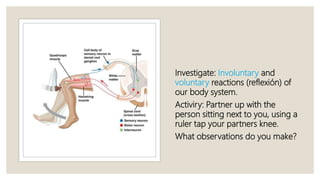
Investigate: Involuntary and
voluntary reactions (reflexión) of
our body system.
Activiry: Partner up with the
person sitting next to you, using a
ruler tap your partners knee.
What observations do you make?
Topics for investigation
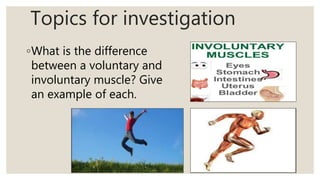
◦What is the difference
between a voluntary and
involuntary muscle? Give
an example of each.
The nervous system
◦ Living organisms are made up of cells. Cells that perform the same
function come together to create tissue. Tissues group together to
form organs. Organs that work together from the systems which
make up the bodies of organisms. One of these systems is the
nervous system.
◦ The nervous system sends messages from the brain to different
parts of the body, such as the locomotor system or musculoskeletal
system, which allows us to respond to the stimuli from our sense. It
is also controls our internal systems such as digestive or respiratory
systems.
Which organ system interacts with most
other systems in the body?
◦Nervous system
◦Our nervous system interacts with every other system
in your body. In the same way that all of your cells
need oxygen transported by the circulatory system,
all of your tissues and organs require instruction and
direction from the nervous system.
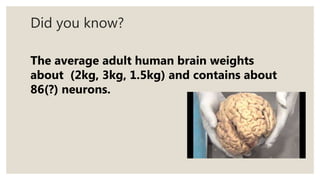
Did you know?
The average adult human brain weights
about (2kg, 3kg, 1.5kg) and contains about
86(?) neurons.
The Central nervous system
◦ Brain
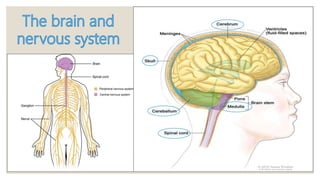
◦ The brain controls our nervous system. It is protected by the skull (or cranium).
It is made up of three main parts.
◦ The cerebrum is the biggest part of our brain. This is where we process the
information from our senses and where we do our cognitive thinking. We use
the cerebrum to take decisions, to study or to play a game.
◦ The main role of the cerebellum is controlling our movements, coordination and
balance.
◦ The brain stem is the continuation of the spinal cord. It controls involuntary
actions such as our heartbeat, breathing and sleeping.
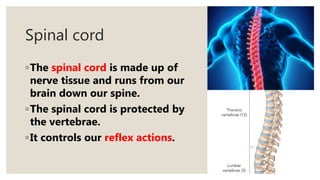
Spinal cord
◦The spinal cord is made up of
nerve tissue and runs from our
brain down our spine.
◦The spinal cord is protected by
the vertebrae.
◦It controls our reflex actions.
Unit 1 interaction no.1

Unit 1 interaction no.1

  • 2.
  • 3.
    ◦What are threemain functions of our body? ◦1. Interaction ◦2. Nutrition ◦3. Reproduction
  • 4.
    Interaction We percieve theworld through our senses: sight, touch, smell, hearing and taste allow us to explore the environment around us. All the information received by our senses is processed by our most important organ, the brain. The brain is home to the conscious and unconscious mind, as well as our emotions and memory. It controls our involuntary and voluntary actions, such as breathing, or digesting our food, as well as our thinking and decision making. What other types of involuntary actions do we have?
  • 5.
    Check out ◦ Whyis the brain so important? What information does it process? ◦ What are feelings and emotions? ◦ Why are our senses important? What would happen if we lost the use of one or more of them? ◦ Which body parts or organs do you associate with the functions of interaction? ◦ Brain, stomach, sense organs, muscles, heart, skeleton, kidneys, lungs ◦ Our body moves in response to the information sent from the brain. Which system enables us to move? ◦ What is the differences between a voluntary and involuntary muscle? Give an example of each. ◦ Why it is important to keep fit and healthy? What happens if we do not look after our bodies?
  • 6.
    Investigate: Involuntary and voluntaryreactions (reflexión) of our body system. Activiry: Partner up with the person sitting next to you, using a ruler tap your partners knee. What observations do you make?
  • 7.
    Topics for investigation ◦Whatis the difference between a voluntary and involuntary muscle? Give an example of each.
  • 8.
    The nervous system ◦Living organisms are made up of cells. Cells that perform the same function come together to create tissue. Tissues group together to form organs. Organs that work together from the systems which make up the bodies of organisms. One of these systems is the nervous system. ◦ The nervous system sends messages from the brain to different parts of the body, such as the locomotor system or musculoskeletal system, which allows us to respond to the stimuli from our sense. It is also controls our internal systems such as digestive or respiratory systems.
  • 9.
    Which organ systeminteracts with most other systems in the body? ◦Nervous system ◦Our nervous system interacts with every other system in your body. In the same way that all of your cells need oxygen transported by the circulatory system, all of your tissues and organs require instruction and direction from the nervous system.
  • 10.
    Did you know? Theaverage adult human brain weights about (2kg, 3kg, 1.5kg) and contains about 86(?) neurons.
  • 11.
    The Central nervoussystem ◦ Brain ◦ The brain controls our nervous system. It is protected by the skull (or cranium). It is made up of three main parts. ◦ The cerebrum is the biggest part of our brain. This is where we process the information from our senses and where we do our cognitive thinking. We use the cerebrum to take decisions, to study or to play a game. ◦ The main role of the cerebellum is controlling our movements, coordination and balance. ◦ The brain stem is the continuation of the spinal cord. It controls involuntary actions such as our heartbeat, breathing and sleeping.
  • 13.
    Spinal cord ◦The spinalcord is made up of nerve tissue and runs from our brain down our spine. ◦The spinal cord is protected by the vertebrae. ◦It controls our reflex actions.

Editor's Notes

  • #5 Respiration, beating of heart,
  • #7 Reflex action