Trigonometry

  Yash Soni
     X-A


               1
Trigonometry

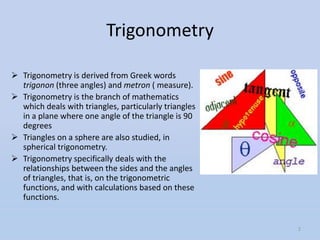
 Trigonometry is derived from Greek words
  trigonon (three angles) and metron ( measure).
 Trigonometry is the branch of mathematics
  which deals with triangles, particularly triangles
  in a plane where one angle of the triangle is 90
  degrees
 Triangles on a sphere are also studied, in
  spherical trigonometry.
 Trigonometry specifically deals with the
  relationships between the sides and the angles
  of triangles, that is, on the trigonometric
  functions, and with calculations based on these
  functions.


                                                       2
History
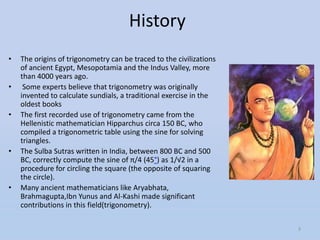
•   The origins of trigonometry can be traced to the civilizations
    of ancient Egypt, Mesopotamia and the Indus Valley, more
    than 4000 years ago.
•    Some experts believe that trigonometry was originally
    invented to calculate sundials, a traditional exercise in the
    oldest books
•   The first recorded use of trigonometry came from the
    Hellenistic mathematician Hipparchus circa 150 BC, who
    compiled a trigonometric table using the sine for solving
    triangles.
•   The Sulba Sutras written in India, between 800 BC and 500
    BC, correctly compute the sine of π/4 (45°) as 1/√2 in a
    procedure for circling the square (the opposite of squaring
    the circle).
•   Many ancient mathematicians like Aryabhata,
    Brahmagupta,Ibn Yunus and Al-Kashi made significant
    contributions in this field(trigonometry).

                                                                     3
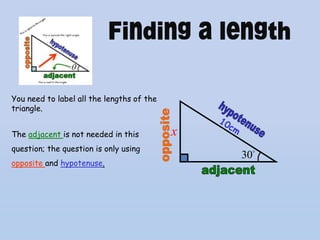
You need to label all the lengths of the
triangle.


The adjacent is not needed in this         x
question; the question is only using
                                               30
opposite and hypotenuse.
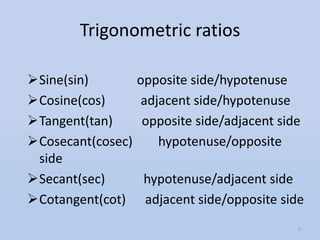
Trigonometric ratios

Sine(sin)         opposite side/hypotenuse
Cosine(cos)        adjacent side/hypotenuse
Tangent(tan)       opposite side/adjacent side
Cosecant(cosec)       hypotenuse/opposite
 side
Secant(sec)        hypotenuse/adjacent side
Cotangent(cot)     adjacent side/opposite side
                                              5
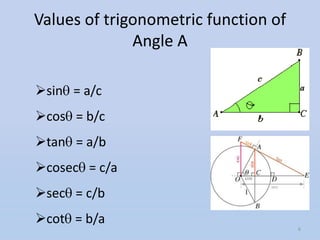
Values of trigonometric function of
              Angle A

sin = a/c
cos = b/c
tan = a/b
cosec = c/a
sec = c/b
cot = b/a
                                      6
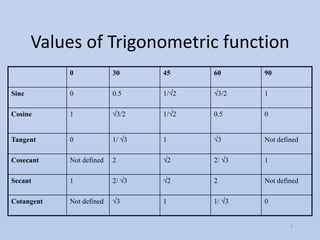
Values of Trigonometric function
            0             30        45      60        90

Sine        0             0.5       1/ 2        3/2   1

Cosine      1                 3/2   1/ 2    0.5       0


Tangent     0             1/ 3      1           3     Not defined

Cosecant    Not defined   2             2   2/ 3      1

Secant      1             2/ 3          2   2         Not defined

Cotangent   Not defined       3     1       1/ 3      0


                                                              7
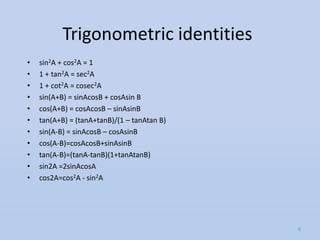
Trigonometric identities
•   sin2A + cos2A = 1
•   1 + tan2A = sec2A
•   1 + cot2A = cosec2A
•   sin(A+B) = sinAcosB + cosAsin B
•   cos(A+B) = cosAcosB – sinAsinB
•   tan(A+B) = (tanA+tanB)/(1 – tanAtan B)
•   sin(A-B) = sinAcosB – cosAsinB
•   cos(A-B)=cosAcosB+sinAsinB
•   tan(A-B)=(tanA-tanB)(1+tanAtanB)
•   sin2A =2sinAcosA
•   cos2A=cos2A - sin2A


                                             8
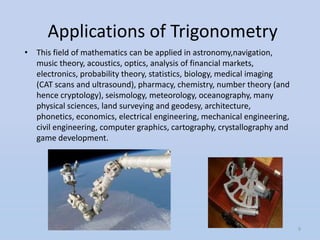
Applications of Trigonometry
• This field of mathematics can be applied in astronomy,navigation,
  music theory, acoustics, optics, analysis of financial markets,
  electronics, probability theory, statistics, biology, medical imaging
  (CAT scans and ultrasound), pharmacy, chemistry, number theory (and
  hence cryptology), seismology, meteorology, oceanography, many
  physical sciences, land surveying and geodesy, architecture,
  phonetics, economics, electrical engineering, mechanical engineering,
  civil engineering, computer graphics, cartography, crystallography and
  game development.


                                                                           9
Applications of Trigonometry in
                 Astronomy
•   Since ancient times trigonometry was used in astronomy.
•   The technique of triangulation is used to measure the distance to nearby stars.
•    In 240 B.C., a mathematician named Eratosthenes discovered the radius of the
    Earth using trigonometry and geometry.
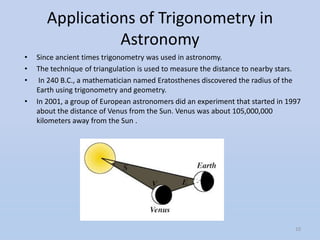
•   In 2001, a group of European astronomers did an experiment that started in 1997
    about the distance of Venus from the Sun. Venus was about 105,000,000
    kilometers away from the Sun .


                                                                                 10
Application of Trigonometry in
                   Architecture
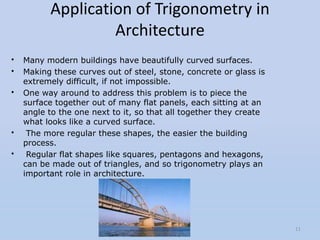
•   Many modern buildings have beautifully curved surfaces.
•   Making these curves out of steel, stone, concrete or glass is
    extremely difficult, if not impossible.
•   One way around to address this problem is to piece the
    surface together out of many flat panels, each sitting at an
    angle to the one next to it, so that all together they create
    what looks like a curved surface.
•    The more regular these shapes, the easier the building
    process.
•    Regular flat shapes like squares, pentagons and hexagons,
    can be made out of triangles, and so trigonometry plays an
    important role in architecture.


                                                                    11

Trigonometry project

  • 1.
  • 2.
    Trigonometry  Trigonometry isderived from Greek words trigonon (three angles) and metron ( measure).  Trigonometry is the branch of mathematics which deals with triangles, particularly triangles in a plane where one angle of the triangle is 90 degrees  Triangles on a sphere are also studied, in spherical trigonometry.  Trigonometry specifically deals with the relationships between the sides and the angles of triangles, that is, on the trigonometric functions, and with calculations based on these functions. 2
  • 3.
    History • The origins of trigonometry can be traced to the civilizations of ancient Egypt, Mesopotamia and the Indus Valley, more than 4000 years ago. • Some experts believe that trigonometry was originally invented to calculate sundials, a traditional exercise in the oldest books • The first recorded use of trigonometry came from the Hellenistic mathematician Hipparchus circa 150 BC, who compiled a trigonometric table using the sine for solving triangles. • The Sulba Sutras written in India, between 800 BC and 500 BC, correctly compute the sine of π/4 (45°) as 1/√2 in a procedure for circling the square (the opposite of squaring the circle). • Many ancient mathematicians like Aryabhata, Brahmagupta,Ibn Yunus and Al-Kashi made significant contributions in this field(trigonometry). 3
  • 4.
    You need tolabel all the lengths of the triangle. The adjacent is not needed in this x question; the question is only using 30 opposite and hypotenuse.
  • 5.
    Trigonometric ratios Sine(sin) opposite side/hypotenuse Cosine(cos) adjacent side/hypotenuse Tangent(tan) opposite side/adjacent side Cosecant(cosec) hypotenuse/opposite side Secant(sec) hypotenuse/adjacent side Cotangent(cot) adjacent side/opposite side 5
  • 6.
    Values of trigonometricfunction of Angle A sin = a/c cos = b/c tan = a/b cosec = c/a sec = c/b cot = b/a 6
  • 7.
    Values of Trigonometricfunction 0 30 45 60 90 Sine 0 0.5 1/ 2 3/2 1 Cosine 1 3/2 1/ 2 0.5 0 Tangent 0 1/ 3 1 3 Not defined Cosecant Not defined 2 2 2/ 3 1 Secant 1 2/ 3 2 2 Not defined Cotangent Not defined 3 1 1/ 3 0 7
  • 8.
    Trigonometric identities • sin2A + cos2A = 1 • 1 + tan2A = sec2A • 1 + cot2A = cosec2A • sin(A+B) = sinAcosB + cosAsin B • cos(A+B) = cosAcosB – sinAsinB • tan(A+B) = (tanA+tanB)/(1 – tanAtan B) • sin(A-B) = sinAcosB – cosAsinB • cos(A-B)=cosAcosB+sinAsinB • tan(A-B)=(tanA-tanB)(1+tanAtanB) • sin2A =2sinAcosA • cos2A=cos2A - sin2A 8
  • 9.
    Applications of Trigonometry •This field of mathematics can be applied in astronomy,navigation, music theory, acoustics, optics, analysis of financial markets, electronics, probability theory, statistics, biology, medical imaging (CAT scans and ultrasound), pharmacy, chemistry, number theory (and hence cryptology), seismology, meteorology, oceanography, many physical sciences, land surveying and geodesy, architecture, phonetics, economics, electrical engineering, mechanical engineering, civil engineering, computer graphics, cartography, crystallography and game development. 9
  • 10.
    Applications of Trigonometryin Astronomy • Since ancient times trigonometry was used in astronomy. • The technique of triangulation is used to measure the distance to nearby stars. • In 240 B.C., a mathematician named Eratosthenes discovered the radius of the Earth using trigonometry and geometry. • In 2001, a group of European astronomers did an experiment that started in 1997 about the distance of Venus from the Sun. Venus was about 105,000,000 kilometers away from the Sun . 10
  • 11.
    Application of Trigonometryin Architecture • Many modern buildings have beautifully curved surfaces. • Making these curves out of steel, stone, concrete or glass is extremely difficult, if not impossible. • One way around to address this problem is to piece the surface together out of many flat panels, each sitting at an angle to the one next to it, so that all together they create what looks like a curved surface. • The more regular these shapes, the easier the building process. • Regular flat shapes like squares, pentagons and hexagons, can be made out of triangles, and so trigonometry plays an important role in architecture. 11