Power Point Presentation on
Introduction of Trigonometry
By:-
Kumar Prashant Dwivedi
M.sc(Physics), B.Ed.
Level:- 10th
Subject:- maths
Chapter:- Introduction of Trigonometry
No. of period required:- 10
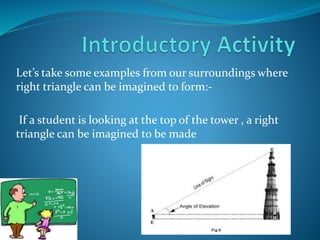
Let’s take some examples from our surroundings where
right triangle can be imagined to form:-
If a student is looking at the top of the tower , a right
triangle can be imagined to be made
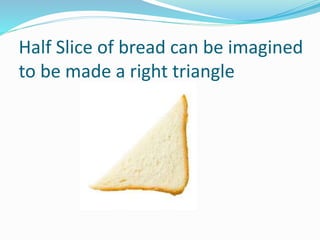
Half Slice of bread can be imagined
to be made a right triangle
 In all the situation distances or heights can be
found by using some mathematical techniques
which comes under a branch of mathematics
called trigonometry.
 Trigonometry is derived from Greek words
Tri + gon + metron
(three) (sides) (measure)
In fact Trigonometry is the study of relation
between the sides and angles of a triangle.
Historical Background
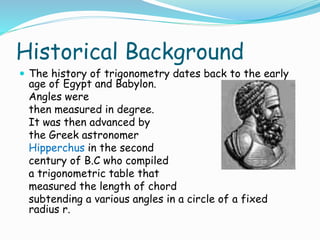
 The history of trigonometry dates back to the early
age of Egypt and Babylon.
Angles were
then measured in degree.
It was then advanced by
the Greek astronomer
Hipperchus in the second
century of B.C who compiled
a trigonometric table that
measured the length of chord
subtending a various angles in a circle of a fixed
radius r.
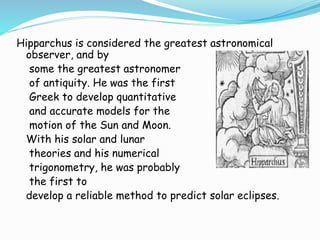
Hipparchus is considered the greatest astronomical
observer, and by
some the greatest astronomer
of antiquity. He was the first
Greek to develop quantitative
and accurate models for the
motion of the Sun and Moon.
With his solar and lunar
theories and his numerical
trigonometry, he was probably
the first to
develop a reliable method to predict solar eclipses.
Key Concepts
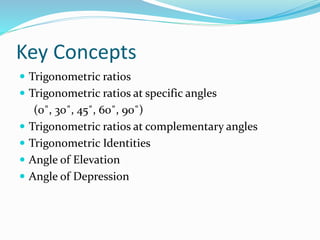
 Trigonometric ratios
 Trigonometric ratios at specific angles
(0˚, 30˚, 45˚, 60˚, 90˚)
 Trigonometric ratios at complementary angles
 Trigonometric Identities
 Angle of Elevation
 Angle of Depression
Methodology
 Previous knowledge testing
 Demonstration Method
 Explanation by giving examples
 Relating to daily life
 Concrete to abstract thinking
 Simple to complex
 Learning by doing
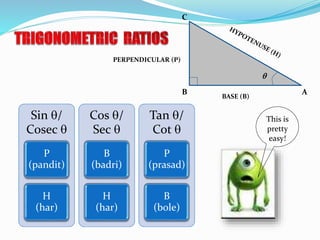
B A
C
Sin /
Cosec 
P
(pandit)
H
(har)
Cos /
Sec 
B
(badri)
H
(har)
Tan /
Cot 
P
(prasad)
B
(bole)
This is
pretty
easy!
BASE (B)
PERPENDICULAR (P)

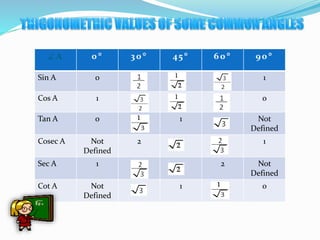
 A 0 30 45 6 0 90
Sin A 0 1
Cos A 1 0
Tan A 0 1 Not
Defined
Cosec A Not
Defined
2 1
Sec A 1 2 Not
Defined
Cot A Not
Defined
1 0
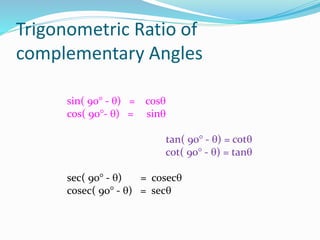
Trigonometric Ratio of
complementary Angles
sin( 90° - ) = cos
cos( 90°- ) = sin
tan( 90° - ) = cot
cot( 90° - ) = tan
sec( 90° - ) = cosec
cosec( 90° - ) = sec
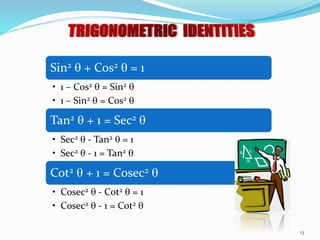
Sin2  + Cos2  = 1
• 1 – Cos2  = Sin2 
• 1 – Sin2  = Cos2 
Tan2  + 1 = Sec2 
• Sec2  - Tan2  = 1
• Sec2  - 1 = Tan2 
Cot2  + 1 = Cosec2 
• Cosec2  - Cot2  = 1
• Cosec2  - 1 = Cot2 
13
Vocabulary / Terminology Used
 Right Triangle
 Base, perpendicular and hypotenuse
 Sine ,Cosine, Tangent, Cotangent, Secant and
Cosecant
 Elevation
 Depression
Life Skills Integrated
 Identify and problem solving Attitudes
 It enhance Scientific Skill which improves critical
thinking.
Historically, it was developed for astronomy and geography, but
scientists have been using it for centuries for other purposes, too.
Besides other fields of mathematics, trigonometry is used in
physics, engineering, and chemistry.
Within mathematics, trigonometry is used primarily in
calculus (which is perhaps its greatest application), linear
algebra, and statistics. Since these fields are used throughout
the natural and social sciences, trigonometry is a very
useful subject to know.
Applications
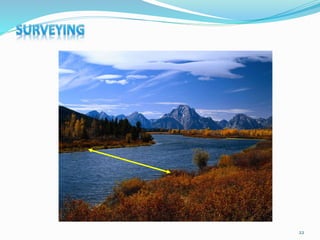
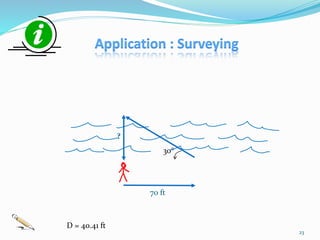
 Measuring inaccessible lengths
 Height of a building (tree, tower, etc.)
 Width of a river (canyon, etc.)
 Angle of elevation and depression
17
18
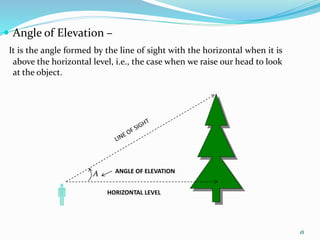
 Angle of Elevation –
It is the angle formed by the line of sight with the horizontal when it is
above the horizontal level, i.e., the case when we raise our head to look
at the object.

A
HORIZONTAL LEVEL
ANGLE OF ELEVATION
19
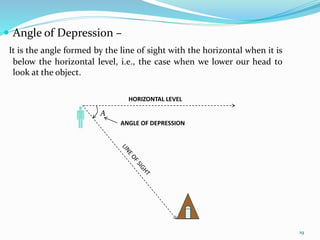
 Angle of Depression –
It is the angle formed by the line of sight with the horizontal when it is
below the horizontal level, i.e., the case when we lower our head to
look at the object.
 A
HORIZONTAL LEVEL
ANGLE OF DEPRESSION
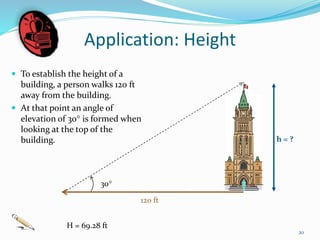
Application: Height
 To establish the height of a
building, a person walks 120 ft
away from the building.
 At that point an angle of
elevation of 30 is formed when
looking at the top of the
building.
20
30
120 ft
h = ?
H = 69.28 ft
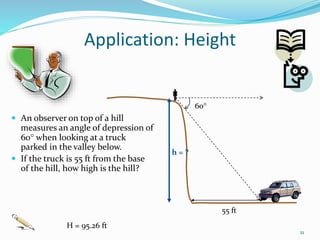
Application: Height
 An observer on top of a hill
measures an angle of depression of
60 when looking at a truck
parked in the valley below.
 If the truck is 55 ft from the base
of the hill, how high is the hill?
21

60
h = ?
55 ft
H = 95.26 ft
22
23
?
70 ft
30
D = 40.41 ft
24
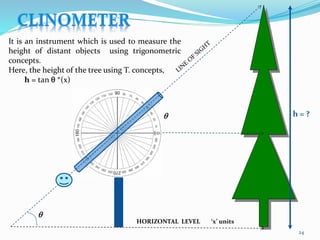
h = ?
HORIZONTAL LEVEL


It is an instrument which is used to measure the
height of distant objects using trigonometric
concepts.
Here, the height of the tree using T. concepts,
h = tan  *(x)
‘x’ units
Triangle Jokes
Trigonometry jokes are a sine of the times.
Fake tan: The major threat to trigonometry
Q. What does trigonometry have in common with a
beach?
A: Tan Gents
Trigonometry for farmers: swine and coswine.
When were trigonometry tables used? “B. C.”, Before
Calculators.
26
Trigonometry begins in the right triangle, but it doesn’t have to be restricted
to triangles. The trigonometric functions carry the ideas of triangle
trigonometry into a broader world of real-valued functions and wave forms.
Trig functions are the relationships amongst various sides in right triangles.
The enormous number of applications of trigonometry include astronomy,
geography, optics, electronics, probability theory, statistics, biology, medical
imaging (CAT scans and ultrasound), pharmacy, seismology, land surveying,
architecture.
I get it!
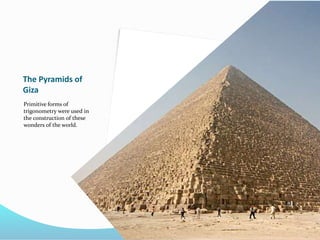
The Pyramids of
Giza
Primitive forms of
trigonometry were used in
the construction of these
wonders of the world.
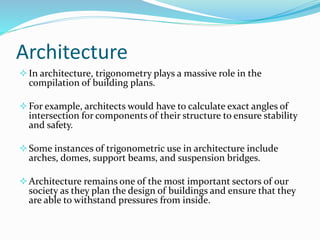
Architecture
In architecture, trigonometry plays a massive role in the
compilation of building plans.
For example, architects would have to calculate exact angles of
intersection for components of their structure to ensure stability
and safety.
Some instances of trigonometric use in architecture include
arches, domes, support beams, and suspension bridges.
Architecture remains one of the most important sectors of our
society as they plan the design of buildings and ensure that they
are able to withstand pressures from inside.
How do I get involved in
Architecture?
Classes to TAke Salary and Benefits
 Physics
 Geometry
 Trigonometry
 Pre-Calculus and Calculus
 Engineering
 3-D Design
 Drawing
 * Art classes will assist you in
being able to conceptualize
objects!
 Most architects start out with a salary of
Rs 371268 + per year , and through
experience, may earn up to Rs 500000 or
above
 Becoming an architect will open you to
many more careers, including interior
design and building design!
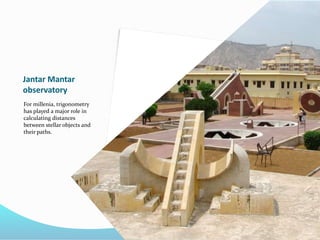
Jantar Mantar
observatory
For millenia, trigonometry
has played a major role in
calculating distances
between stellar objects and
their paths.
Astronomy
Astronomy has been studied for millennia by civilizations in all
regions of the world.
In our modern age, being able to apply Astronomy helps us to
calculate distances between stars and learn more about the
universe.
Astronomers use the method of parallax, or the movement of the
star against the background as we orbit the sun, to discover new
information about galaxies.
Menelaus’ Theorem helps astronomers gather information by
providing a backdrop in spherical triangle calculation.
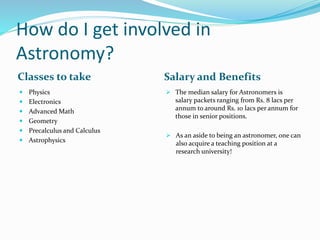
How do I get involved in
Astronomy?
Classes to take Salary and Benefits
 Physics
 Electronics
 Advanced Math
 Geometry
 Precalculus and Calculus
 Astrophysics
 The median salary for Astronomers is
salary packets ranging from Rs. 8 lacs per
annum to around Rs. 10 lacs per annum for
those in senior positions.
 As an aside to being an astronomer, one can
also acquire a teaching position at a
research university!
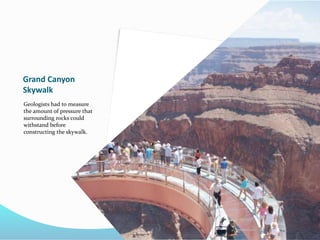
Grand Canyon
Skywalk
Geologists had to measure
the amount of pressure that
surrounding rocks could
withstand before
constructing the skywalk.
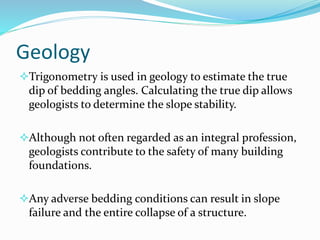
Geology
Trigonometry is used in geology to estimate the true
dip of bedding angles. Calculating the true dip allows
geologists to determine the slope stability.
Although not often regarded as an integral profession,
geologists contribute to the safety of many building
foundations.
Any adverse bedding conditions can result in slope
failure and the entire collapse of a structure.
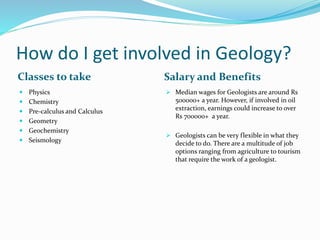
How do I get involved in Geology?
Classes to take Salary and Benefits
 Physics
 Chemistry
 Pre-calculus and Calculus
 Geometry
 Geochemistry
 Seismology
 Median wages for Geologists are around Rs
500000+ a year. However, if involved in oil
extraction, earnings could increase to over
Rs 700000+ a year.
 Geologists can be very flexible in what they
decide to do. There are a multitude of job
options ranging from agriculture to tourism
that require the work of a geologist.
Reference offline/online:-
NCERT text book of mathematics
www.britanica.com
www.mathsfun.com
http://math.lotsoflessons.com
Home Assignment
1. Related Exercises from text book and exemplar book
of mathematics.
2. Activity:- to prepare a chart of T-ratios, T-ratios at
specific angles, T-identities.
3. Project:- make clinometer ( in group)
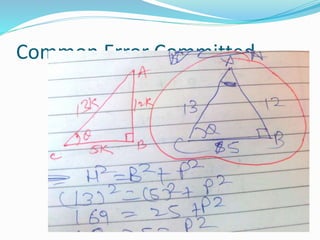
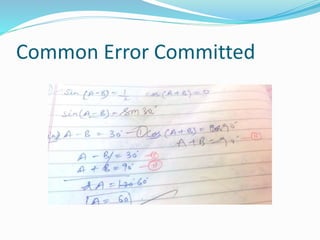
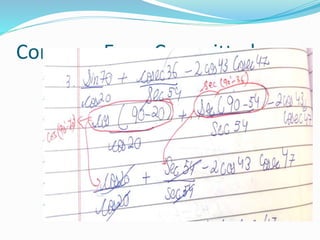
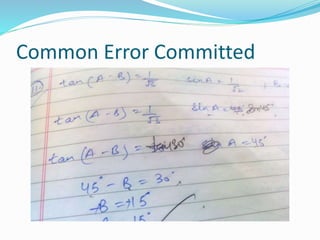
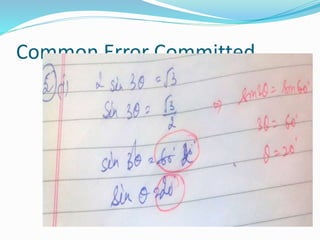
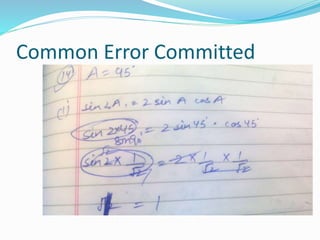
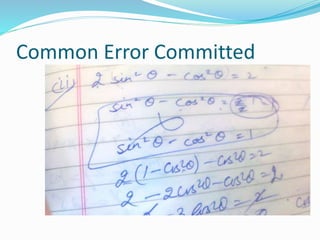
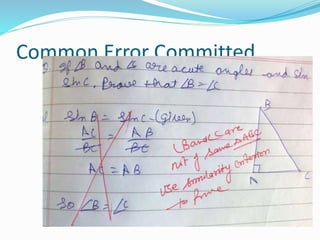
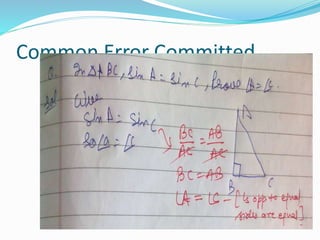
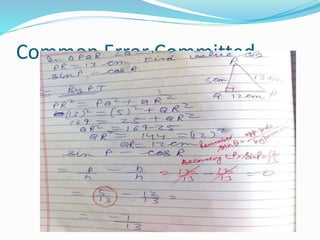
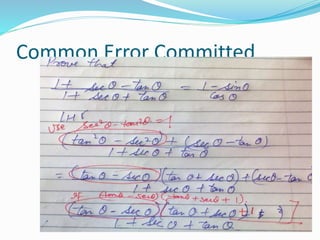
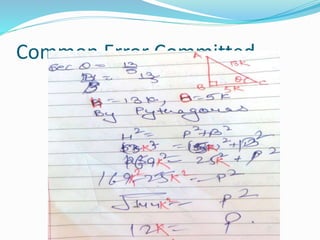
Common Error Committed
Remedial Plan
 Make awareness regarding the ratio by giving examples
from daily life.
 Group leaders will be assigned to make correction by
guiding them.
 Similar problem assigned to practices related to each
concept will be given.
Thanks
&
Have A Nice Day

Introduction of trigonometry

  • 1.
    Power Point Presentationon Introduction of Trigonometry By:- Kumar Prashant Dwivedi M.sc(Physics), B.Ed.
  • 2.
    Level:- 10th Subject:- maths Chapter:-Introduction of Trigonometry No. of period required:- 10
  • 3.
    Let’s take someexamples from our surroundings where right triangle can be imagined to form:- If a student is looking at the top of the tower , a right triangle can be imagined to be made
  • 4.
    Half Slice ofbread can be imagined to be made a right triangle
  • 5.
     In allthe situation distances or heights can be found by using some mathematical techniques which comes under a branch of mathematics called trigonometry.  Trigonometry is derived from Greek words Tri + gon + metron (three) (sides) (measure) In fact Trigonometry is the study of relation between the sides and angles of a triangle.
  • 6.
    Historical Background  Thehistory of trigonometry dates back to the early age of Egypt and Babylon. Angles were then measured in degree. It was then advanced by the Greek astronomer Hipperchus in the second century of B.C who compiled a trigonometric table that measured the length of chord subtending a various angles in a circle of a fixed radius r.
  • 7.
    Hipparchus is consideredthe greatest astronomical observer, and by some the greatest astronomer of antiquity. He was the first Greek to develop quantitative and accurate models for the motion of the Sun and Moon. With his solar and lunar theories and his numerical trigonometry, he was probably the first to develop a reliable method to predict solar eclipses.
  • 8.
    Key Concepts  Trigonometricratios  Trigonometric ratios at specific angles (0˚, 30˚, 45˚, 60˚, 90˚)  Trigonometric ratios at complementary angles  Trigonometric Identities  Angle of Elevation  Angle of Depression
  • 9.
    Methodology  Previous knowledgetesting  Demonstration Method  Explanation by giving examples  Relating to daily life  Concrete to abstract thinking  Simple to complex  Learning by doing
  • 10.
    B A C Sin / Cosec P (pandit) H (har) Cos / Sec  B (badri) H (har) Tan / Cot  P (prasad) B (bole) This is pretty easy! BASE (B) PERPENDICULAR (P) 
  • 11.
     A 030 45 6 0 90 Sin A 0 1 Cos A 1 0 Tan A 0 1 Not Defined Cosec A Not Defined 2 1 Sec A 1 2 Not Defined Cot A Not Defined 1 0
  • 12.
    Trigonometric Ratio of complementaryAngles sin( 90° - ) = cos cos( 90°- ) = sin tan( 90° - ) = cot cot( 90° - ) = tan sec( 90° - ) = cosec cosec( 90° - ) = sec
  • 13.
    Sin2  +Cos2  = 1 • 1 – Cos2  = Sin2  • 1 – Sin2  = Cos2  Tan2  + 1 = Sec2  • Sec2  - Tan2  = 1 • Sec2  - 1 = Tan2  Cot2  + 1 = Cosec2  • Cosec2  - Cot2  = 1 • Cosec2  - 1 = Cot2  13
  • 14.
    Vocabulary / TerminologyUsed  Right Triangle  Base, perpendicular and hypotenuse  Sine ,Cosine, Tangent, Cotangent, Secant and Cosecant  Elevation  Depression
  • 15.
    Life Skills Integrated Identify and problem solving Attitudes  It enhance Scientific Skill which improves critical thinking.
  • 16.
    Historically, it wasdeveloped for astronomy and geography, but scientists have been using it for centuries for other purposes, too. Besides other fields of mathematics, trigonometry is used in physics, engineering, and chemistry. Within mathematics, trigonometry is used primarily in calculus (which is perhaps its greatest application), linear algebra, and statistics. Since these fields are used throughout the natural and social sciences, trigonometry is a very useful subject to know.
  • 17.
    Applications  Measuring inaccessiblelengths  Height of a building (tree, tower, etc.)  Width of a river (canyon, etc.)  Angle of elevation and depression 17
  • 18.
    18  Angle ofElevation – It is the angle formed by the line of sight with the horizontal when it is above the horizontal level, i.e., the case when we raise our head to look at the object.  A HORIZONTAL LEVEL ANGLE OF ELEVATION
  • 19.
    19  Angle ofDepression – It is the angle formed by the line of sight with the horizontal when it is below the horizontal level, i.e., the case when we lower our head to look at the object.  A HORIZONTAL LEVEL ANGLE OF DEPRESSION
  • 20.
    Application: Height  Toestablish the height of a building, a person walks 120 ft away from the building.  At that point an angle of elevation of 30 is formed when looking at the top of the building. 20 30 120 ft h = ? H = 69.28 ft
  • 21.
    Application: Height  Anobserver on top of a hill measures an angle of depression of 60 when looking at a truck parked in the valley below.  If the truck is 55 ft from the base of the hill, how high is the hill? 21  60 h = ? 55 ft H = 95.26 ft
  • 22.
  • 23.
  • 24.
    24 h = ? HORIZONTALLEVEL   It is an instrument which is used to measure the height of distant objects using trigonometric concepts. Here, the height of the tree using T. concepts, h = tan  *(x) ‘x’ units
  • 25.
    Triangle Jokes Trigonometry jokesare a sine of the times. Fake tan: The major threat to trigonometry Q. What does trigonometry have in common with a beach? A: Tan Gents Trigonometry for farmers: swine and coswine. When were trigonometry tables used? “B. C.”, Before Calculators.
  • 26.
    26 Trigonometry begins inthe right triangle, but it doesn’t have to be restricted to triangles. The trigonometric functions carry the ideas of triangle trigonometry into a broader world of real-valued functions and wave forms. Trig functions are the relationships amongst various sides in right triangles. The enormous number of applications of trigonometry include astronomy, geography, optics, electronics, probability theory, statistics, biology, medical imaging (CAT scans and ultrasound), pharmacy, seismology, land surveying, architecture. I get it!
  • 27.
    The Pyramids of Giza Primitiveforms of trigonometry were used in the construction of these wonders of the world.
  • 28.
    Architecture In architecture, trigonometryplays a massive role in the compilation of building plans. For example, architects would have to calculate exact angles of intersection for components of their structure to ensure stability and safety. Some instances of trigonometric use in architecture include arches, domes, support beams, and suspension bridges. Architecture remains one of the most important sectors of our society as they plan the design of buildings and ensure that they are able to withstand pressures from inside.
  • 29.
    How do Iget involved in Architecture? Classes to TAke Salary and Benefits  Physics  Geometry  Trigonometry  Pre-Calculus and Calculus  Engineering  3-D Design  Drawing  * Art classes will assist you in being able to conceptualize objects!  Most architects start out with a salary of Rs 371268 + per year , and through experience, may earn up to Rs 500000 or above  Becoming an architect will open you to many more careers, including interior design and building design!
  • 30.
    Jantar Mantar observatory For millenia,trigonometry has played a major role in calculating distances between stellar objects and their paths.
  • 31.
    Astronomy Astronomy has beenstudied for millennia by civilizations in all regions of the world. In our modern age, being able to apply Astronomy helps us to calculate distances between stars and learn more about the universe. Astronomers use the method of parallax, or the movement of the star against the background as we orbit the sun, to discover new information about galaxies. Menelaus’ Theorem helps astronomers gather information by providing a backdrop in spherical triangle calculation.
  • 32.
    How do Iget involved in Astronomy? Classes to take Salary and Benefits  Physics  Electronics  Advanced Math  Geometry  Precalculus and Calculus  Astrophysics  The median salary for Astronomers is salary packets ranging from Rs. 8 lacs per annum to around Rs. 10 lacs per annum for those in senior positions.  As an aside to being an astronomer, one can also acquire a teaching position at a research university!
  • 33.
    Grand Canyon Skywalk Geologists hadto measure the amount of pressure that surrounding rocks could withstand before constructing the skywalk.
  • 34.
    Geology Trigonometry is usedin geology to estimate the true dip of bedding angles. Calculating the true dip allows geologists to determine the slope stability. Although not often regarded as an integral profession, geologists contribute to the safety of many building foundations. Any adverse bedding conditions can result in slope failure and the entire collapse of a structure.
  • 35.
    How do Iget involved in Geology? Classes to take Salary and Benefits  Physics  Chemistry  Pre-calculus and Calculus  Geometry  Geochemistry  Seismology  Median wages for Geologists are around Rs 500000+ a year. However, if involved in oil extraction, earnings could increase to over Rs 700000+ a year.  Geologists can be very flexible in what they decide to do. There are a multitude of job options ranging from agriculture to tourism that require the work of a geologist.
  • 36.
    Reference offline/online:- NCERT textbook of mathematics www.britanica.com www.mathsfun.com http://math.lotsoflessons.com
  • 37.
    Home Assignment 1. RelatedExercises from text book and exemplar book of mathematics. 2. Activity:- to prepare a chart of T-ratios, T-ratios at specific angles, T-identities. 3. Project:- make clinometer ( in group)
  • 38.
  • 39.
  • 40.
  • 41.
  • 42.
  • 43.
  • 44.
  • 45.
  • 46.
  • 47.
  • 48.
  • 49.
  • 50.
    Remedial Plan  Makeawareness regarding the ratio by giving examples from daily life.  Group leaders will be assigned to make correction by guiding them.  Similar problem assigned to practices related to each concept will be given.
  • 51.