PRANAY
RAJPUT
 X-B
Heights and Distances


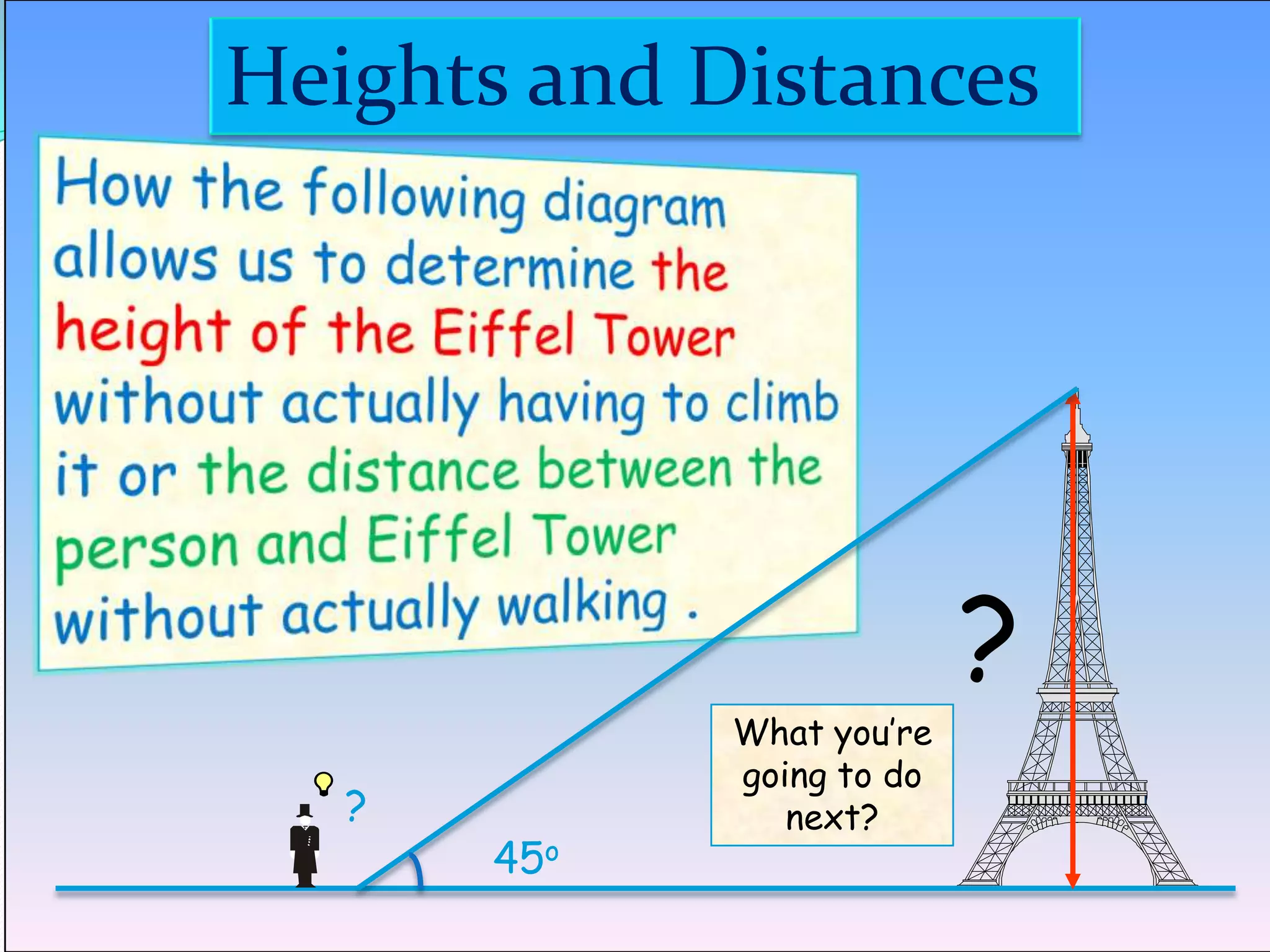
                           ?
             What you’re
             going to do
   ?            next?
       45o
In this situation , the distance or the heights can
be founded by using mathematical techniques,
which comes under a branch of ‘trigonometry’.
The word ‘ trigonometry’ is derived from the
Greek word ‘tri’ meaning three , ‘gon’ meaning
sides and ‘metron’ meaning measures.

Trigonometry is concerned with the relationship
between the angles and sides of triangles. An
understanding of these relationships enables
unknown angles and sides to be calculated
without recourse to direct measurement.
Applications include finding heights/distances of
objects.
Trigonometry
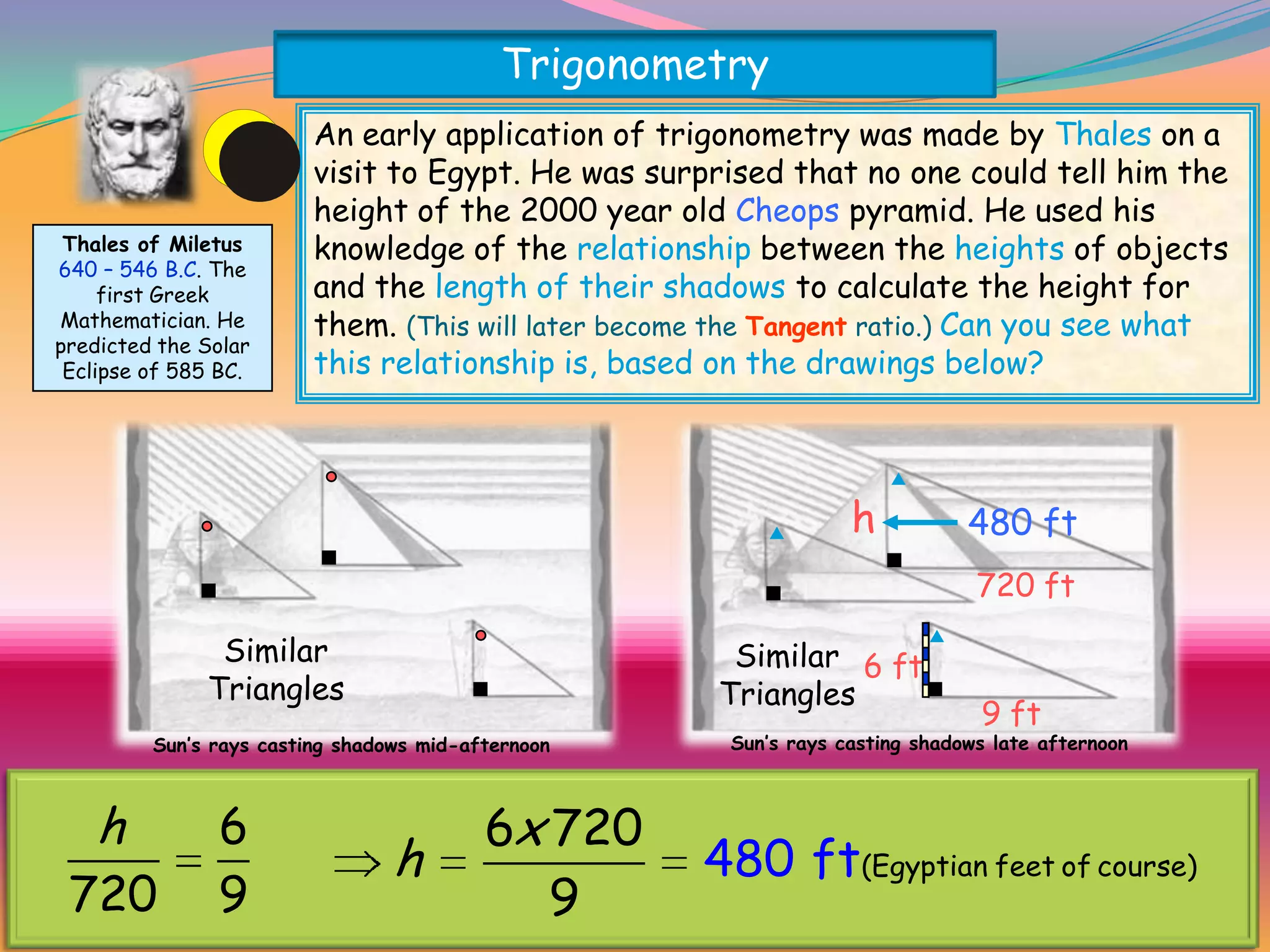
                           An early application of trigonometry was made by Thales on a
                           visit to Egypt. He was surprised that no one could tell him the
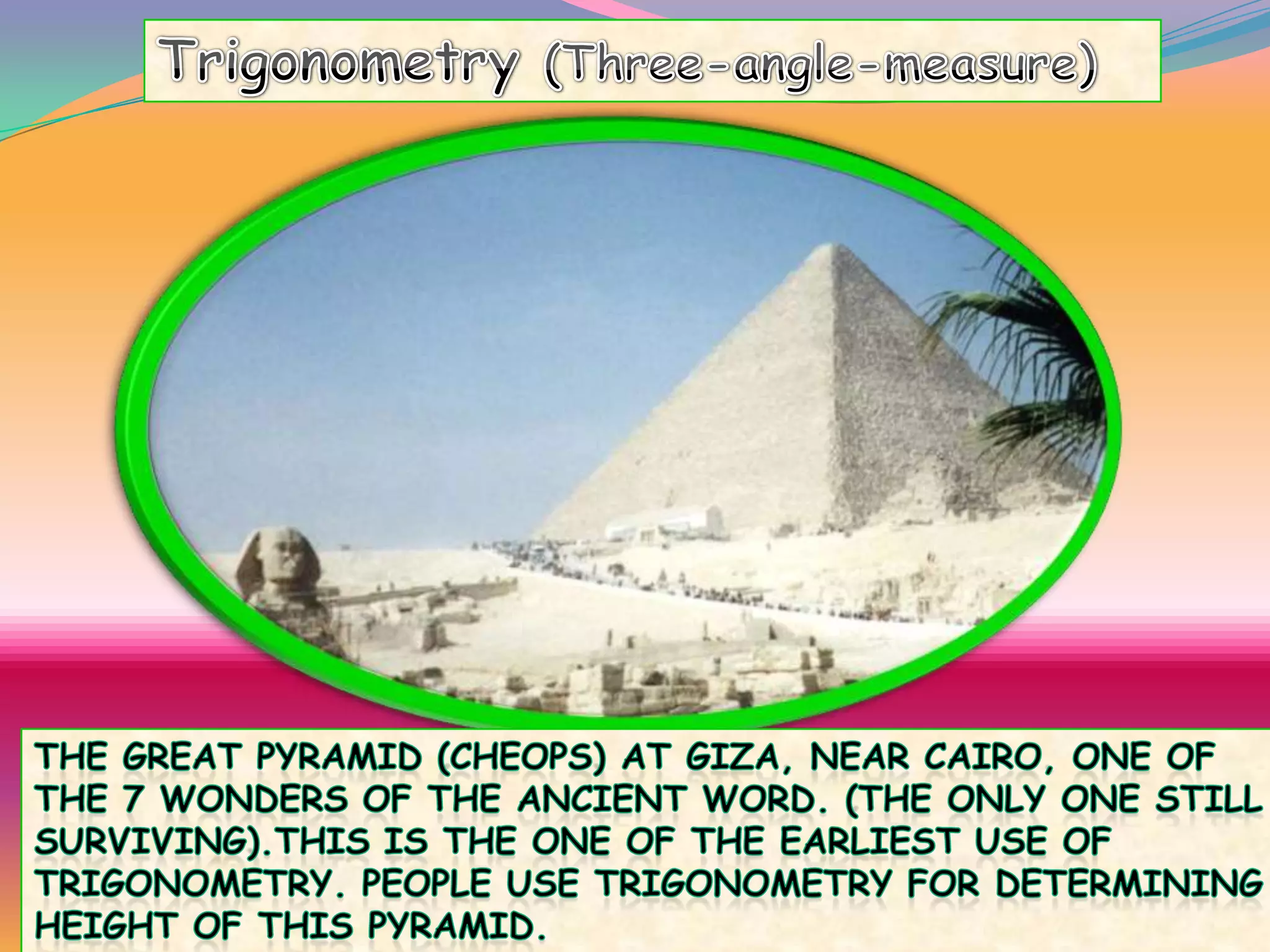
                           height of the 2000 year old Cheops pyramid. He used his
   Thales of Miletus       knowledge of the relationship between the heights of objects
  640 – 546 B.C. The
       first Greek         and the length of their shadows to calculate the height for
  Mathematician. He        them. (This will later become the Tangent ratio.) Can you see what
  predicted the Solar
   Eclipse of 585 BC.      this relationship is, based on the drawings below?


                                                                     h           480 ft
                                                                                  720 ft

                 Similar                                 Similar 6 ft
                Triangles                               Triangles
                                                                                  9 ft
           Sun’s rays casting shadows mid-afternoon      Sun’s rays casting shadows late afternoon


Thales may not have used similar triangles directly to solve the problem but
    h
he knew that6the ratio of the 6x 720 horizontal sides of each triangle was
                              vertical to
                       h                    480 ft sun. Can you use the
constant and unchanging for different heights of the (Egyptian feet of course)
   720 9                         9
measurements shown above to find the height of Cheops?
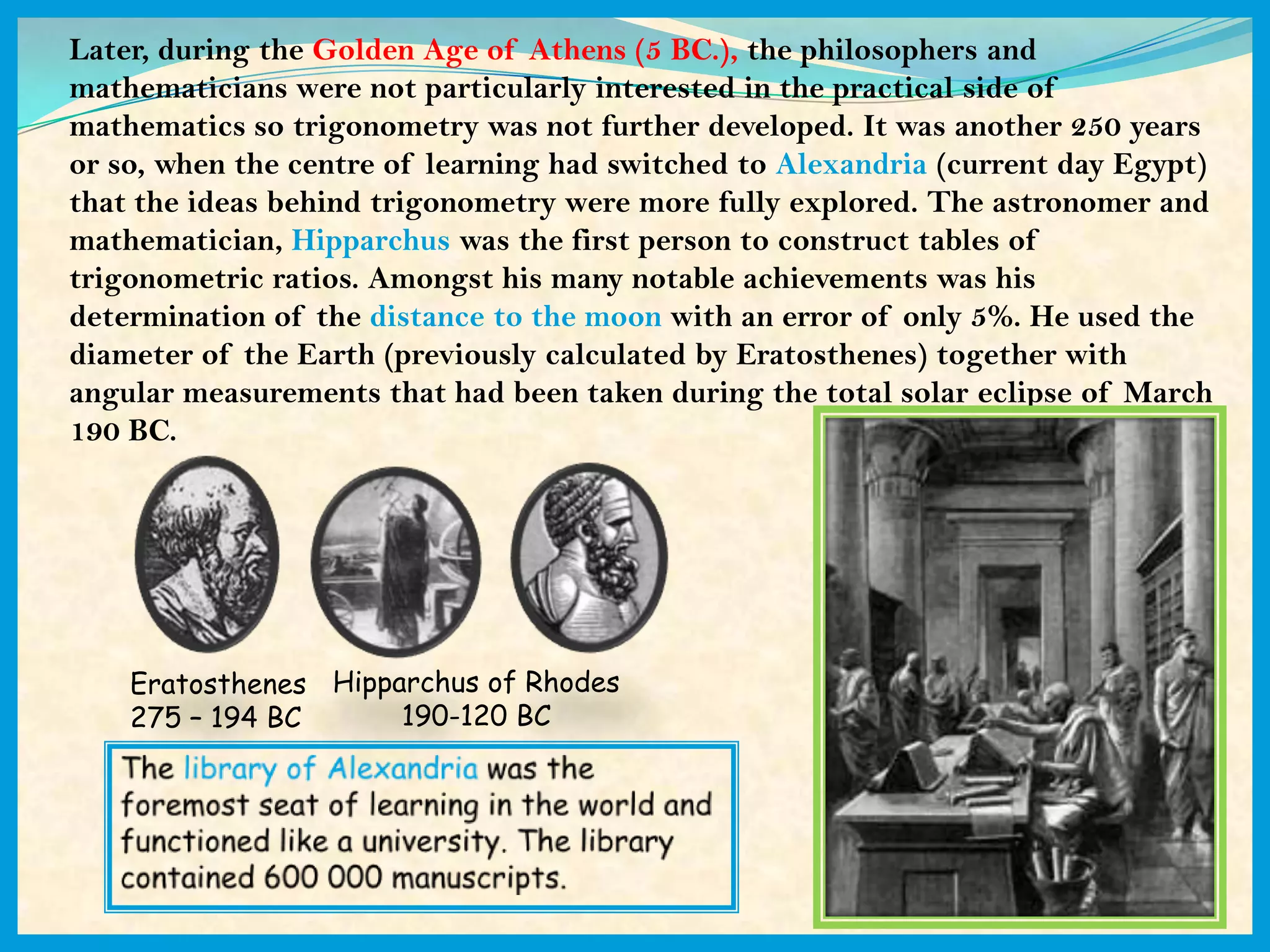
Later, during the Golden Age of Athens (5 BC.), the philosophers and
mathematicians were not particularly interested in the practical side of
mathematics so trigonometry was not further developed. It was another 250 years
or so, when the centre of learning had switched to Alexandria (current day Egypt)
that the ideas behind trigonometry were more fully explored. The astronomer and
mathematician, Hipparchus was the first person to construct tables of
trigonometric ratios. Amongst his many notable achievements was his
determination of the distance to the moon with an error of only 5%. He used the
diameter of the Earth (previously calculated by Eratosthenes) together with
angular measurements that had been taken during the total solar eclipse of March
190 BC.


    Eratosthenes Hipparchus of Rhodes
    275 – 194 BC      190-120 BC
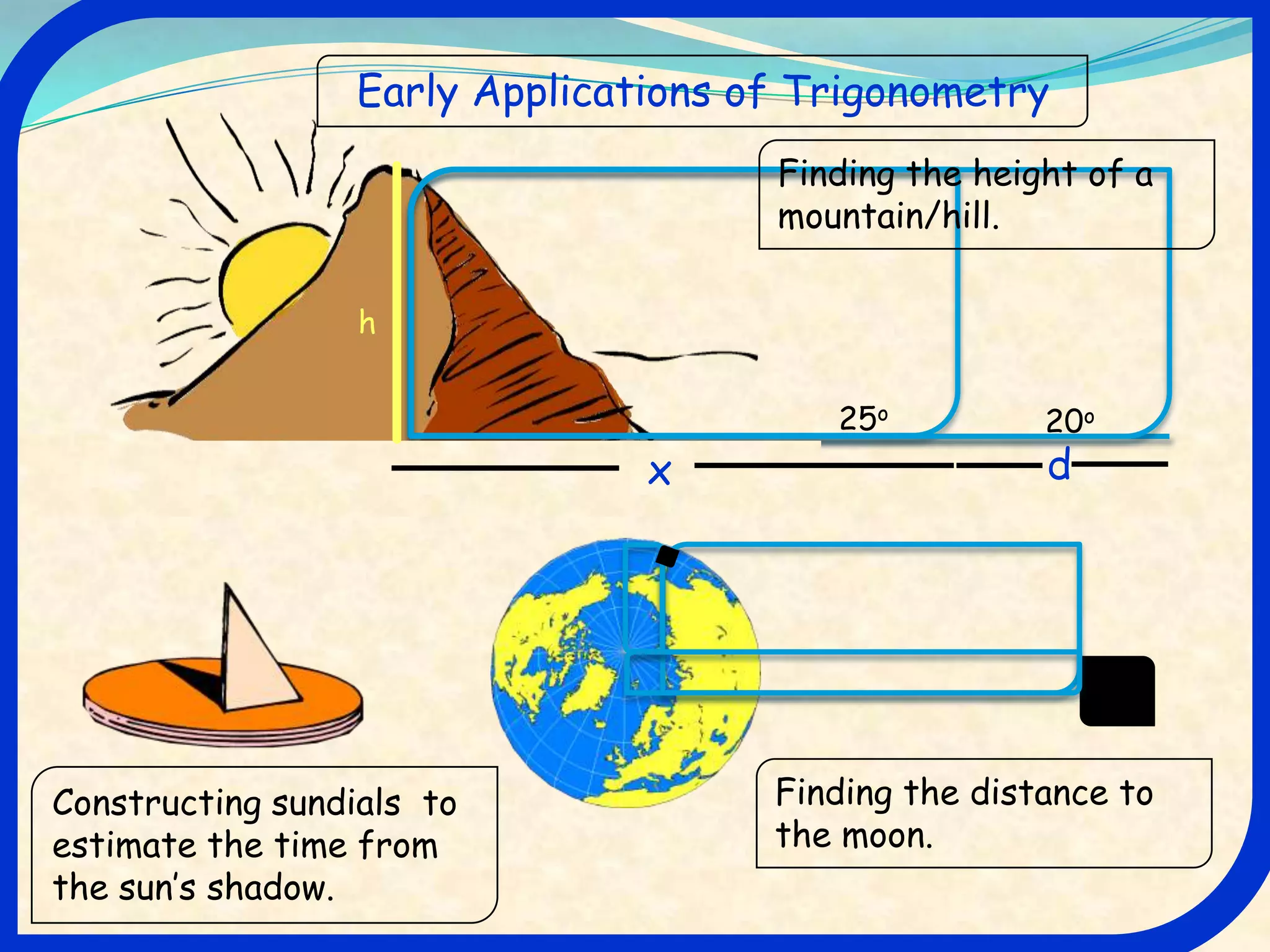
Early Applications of Trigonometry
                                      Finding the height of a
                                      mountain/hill.

                  h


                                         25o          20o
                                x                     d


Constructing sundials to              Finding the distance to
estimate the time from                the moon.
the sun’s shadow.
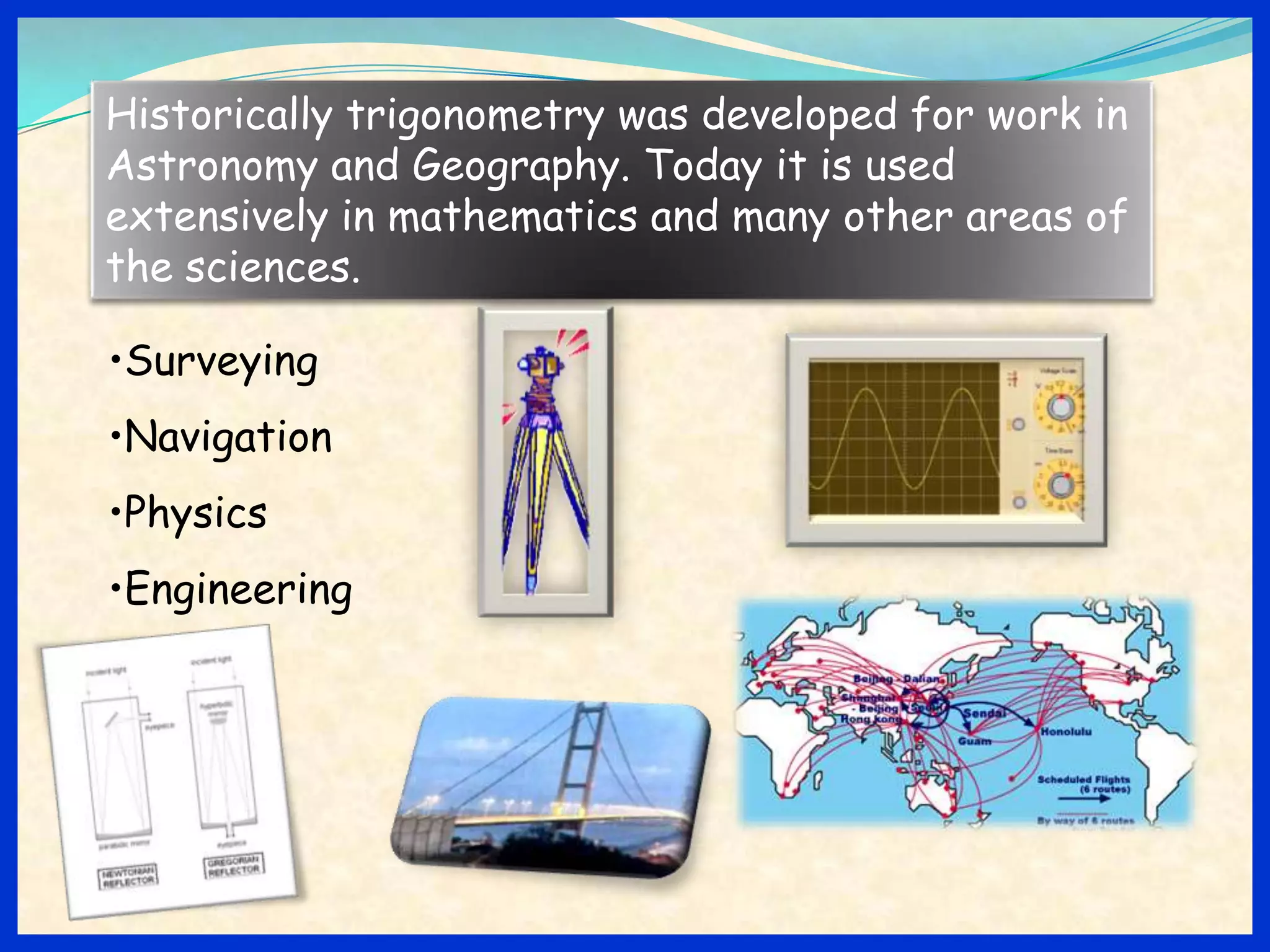
Historically trigonometry was developed for work in
Astronomy and Geography. Today it is used
extensively in mathematics and many other areas of
the sciences.

•Surveying
•Navigation
•Physics
•Engineering
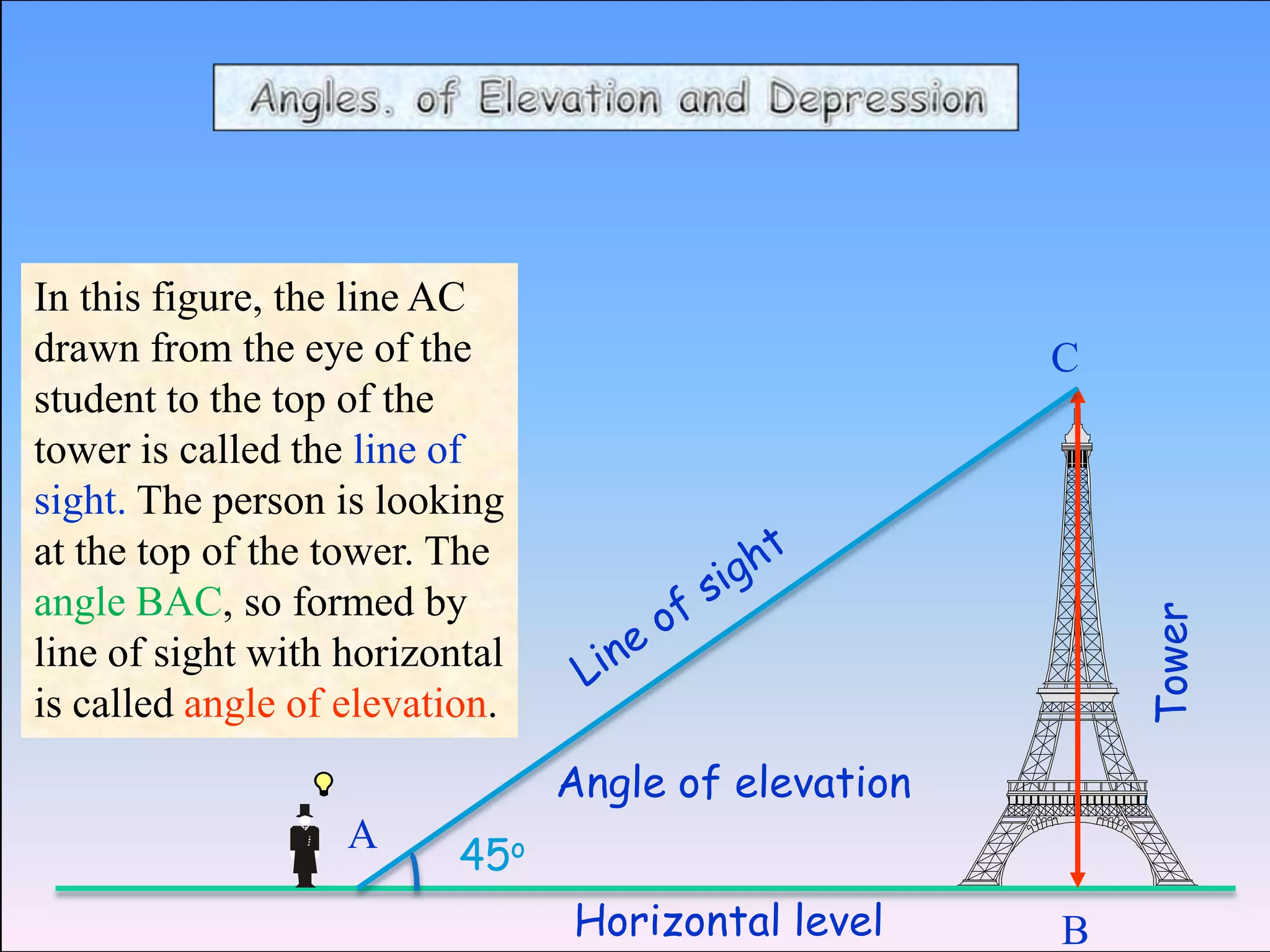
In this figure, the line AC
drawn from the eye of the                            C
student to the top of the
tower is called the line of
sight. The person is looking
at the top of the tower. The
angle BAC, so formed by


                                                         Tower
line of sight with horizontal
is called angle of elevation.
                                Angle of elevation
                   A
                          45o
                                Horizontal level     B
A
                         Horizontal level
               45o

                Angle of
                depression
Mountain


                                            Object
                                                C

           B
Method of finding the heights or the distances
                                                  C


                                                  Tower
                         Angle of elevation
            A      45o

                      Horizontal level        B

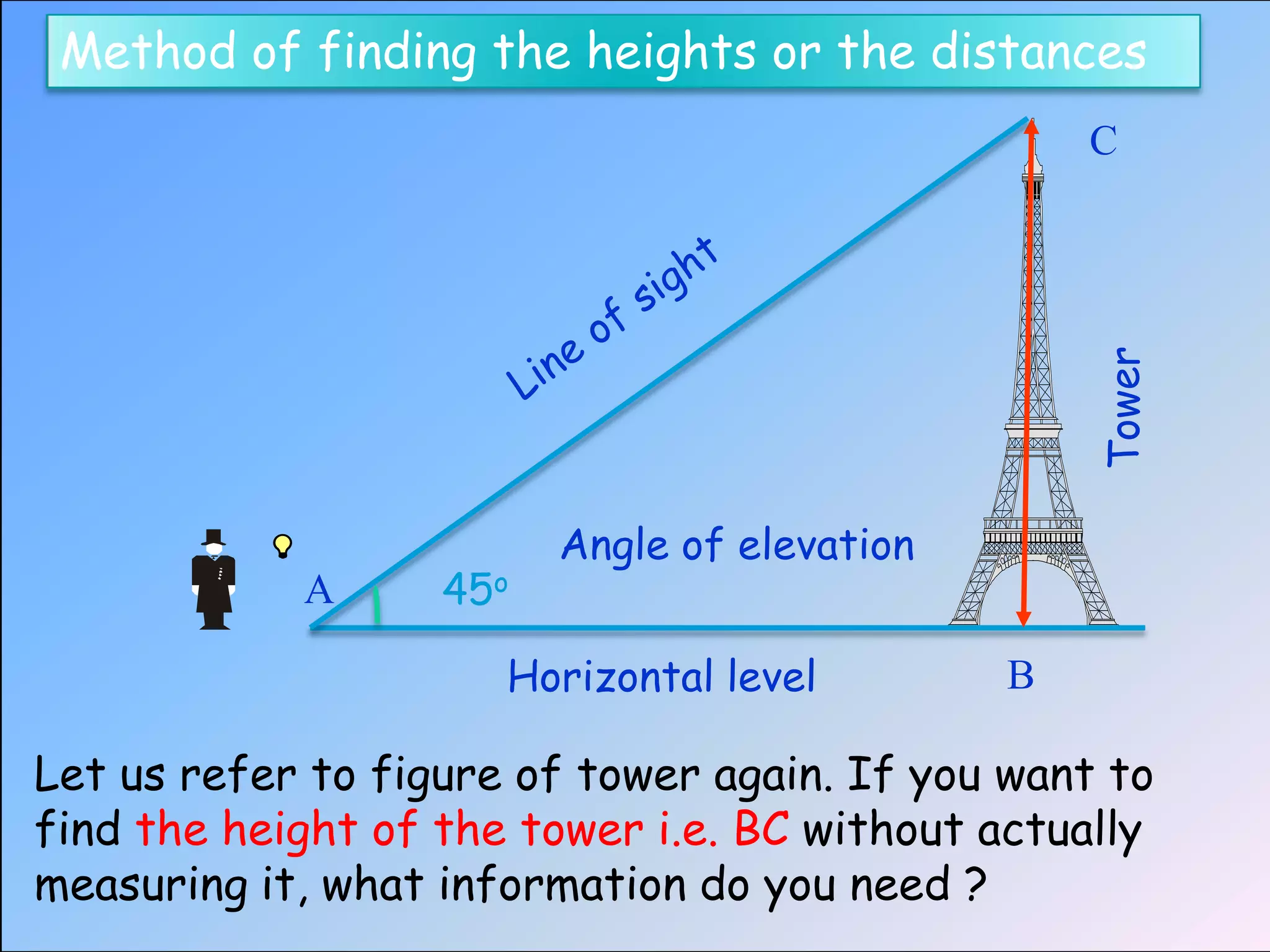
Let us refer to figure of tower again. If you want to
find the height of the tower i.e. BC without actually
measuring it, what information do you need ?
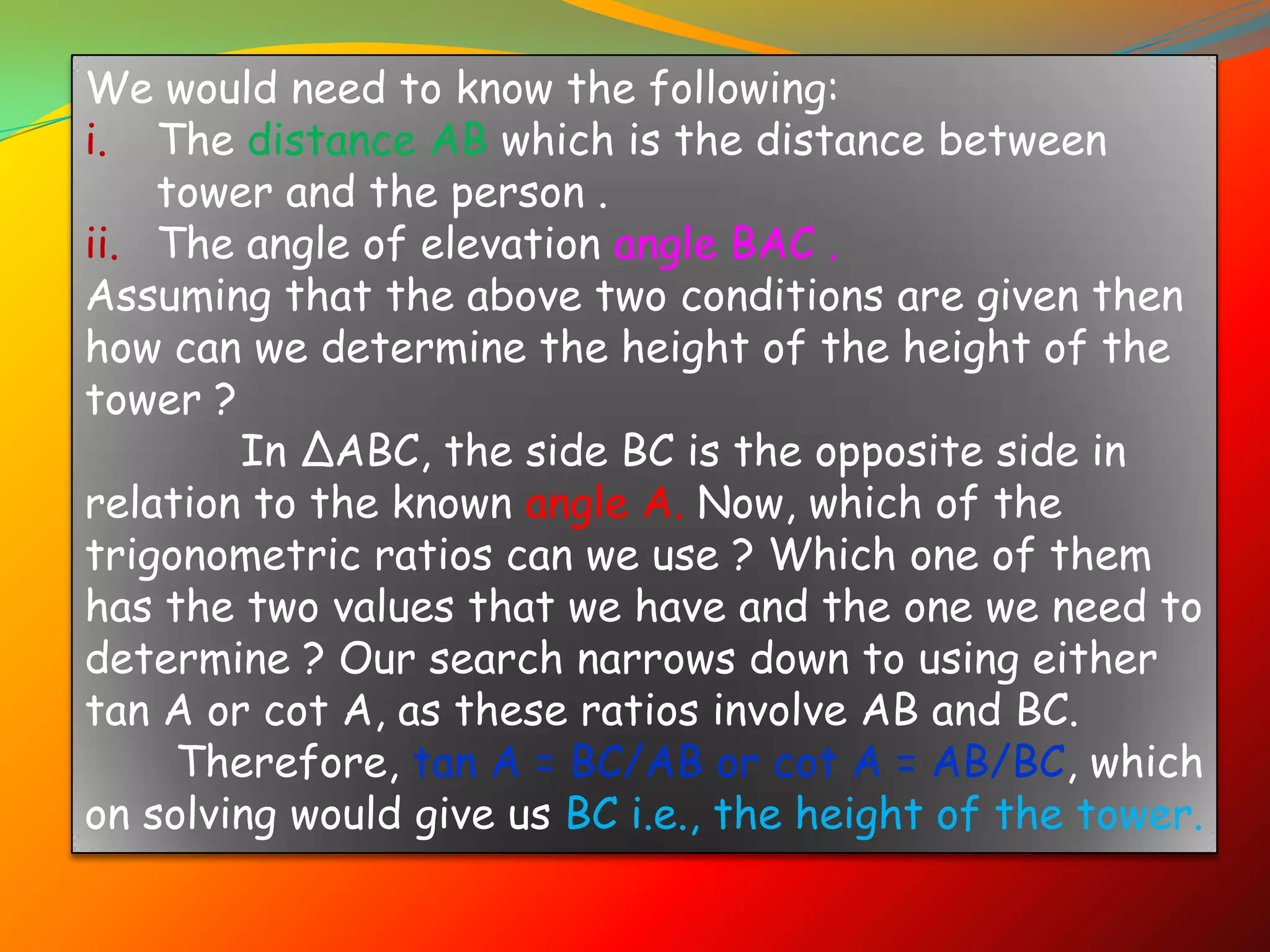
We would need to know the following:
i. The distance AB which is the distance between
    tower and the person .
ii. The angle of elevation angle BAC .
Assuming that the above two conditions are given then
how can we determine the height of the height of the
tower ?
        In ∆ABC, the side BC is the opposite side in
relation to the known angle A. Now, which of the
trigonometric ratios can we use ? Which one of them
has the two values that we have and the one we need to
determine ? Our search narrows down to using either
tan A or cot A, as these ratios involve AB and BC.
     Therefore, tan A = BC/AB or cot A = AB/BC, which
on solving would give us BC i.e., the height of the tower.
Some Applications
 of trigonometry
 based on finding
   heights and
     distance
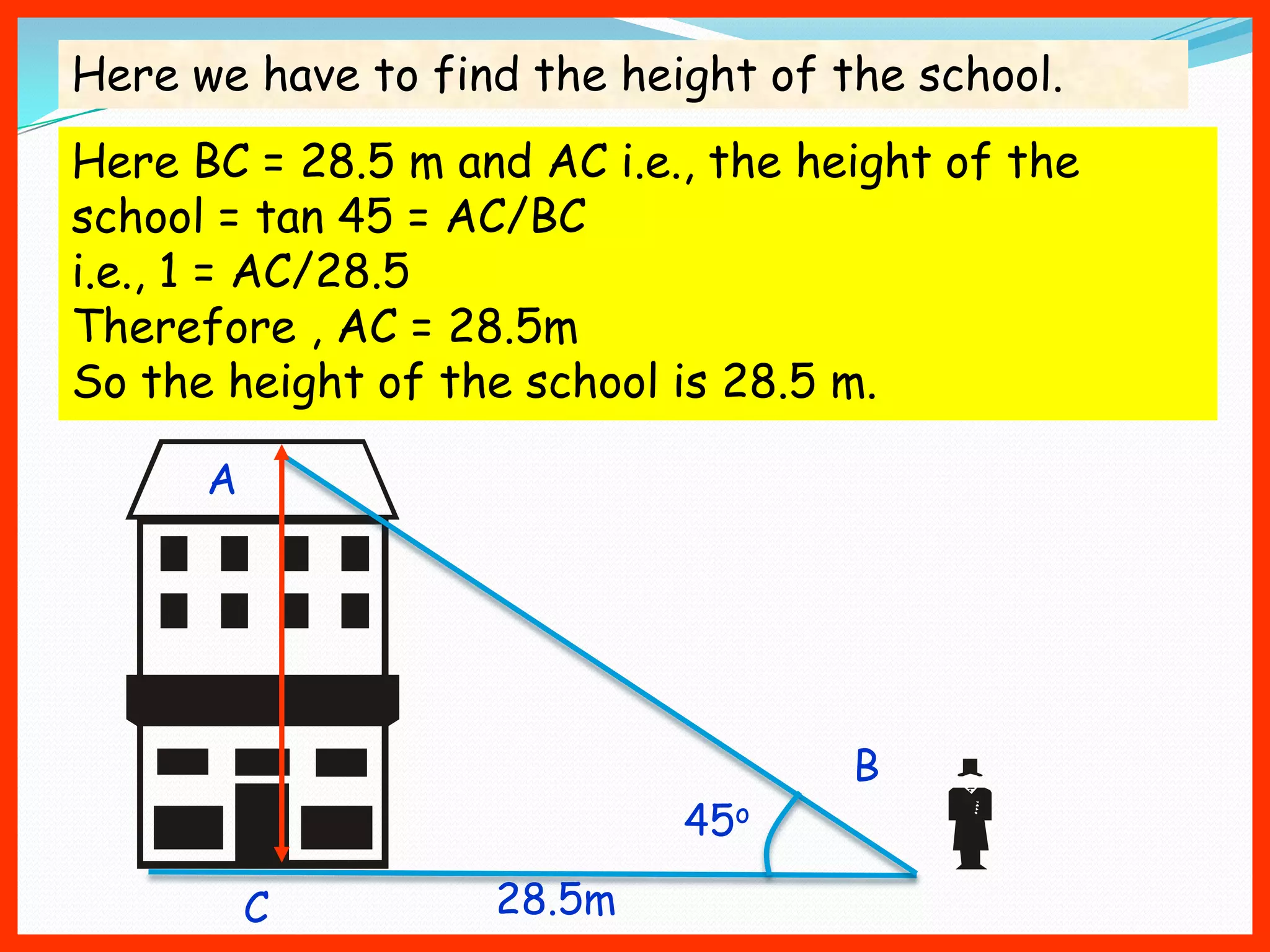
Here we have to find the height of the school.
Here BC = 28.5 m and AC i.e., the height of the
school = tan 45 = AC/BC
i.e., 1 = AC/28.5
Therefore , AC = 28.5m
So the height of the school is 28.5 m.

      A


                                    B
                            45o

          C        28.5m
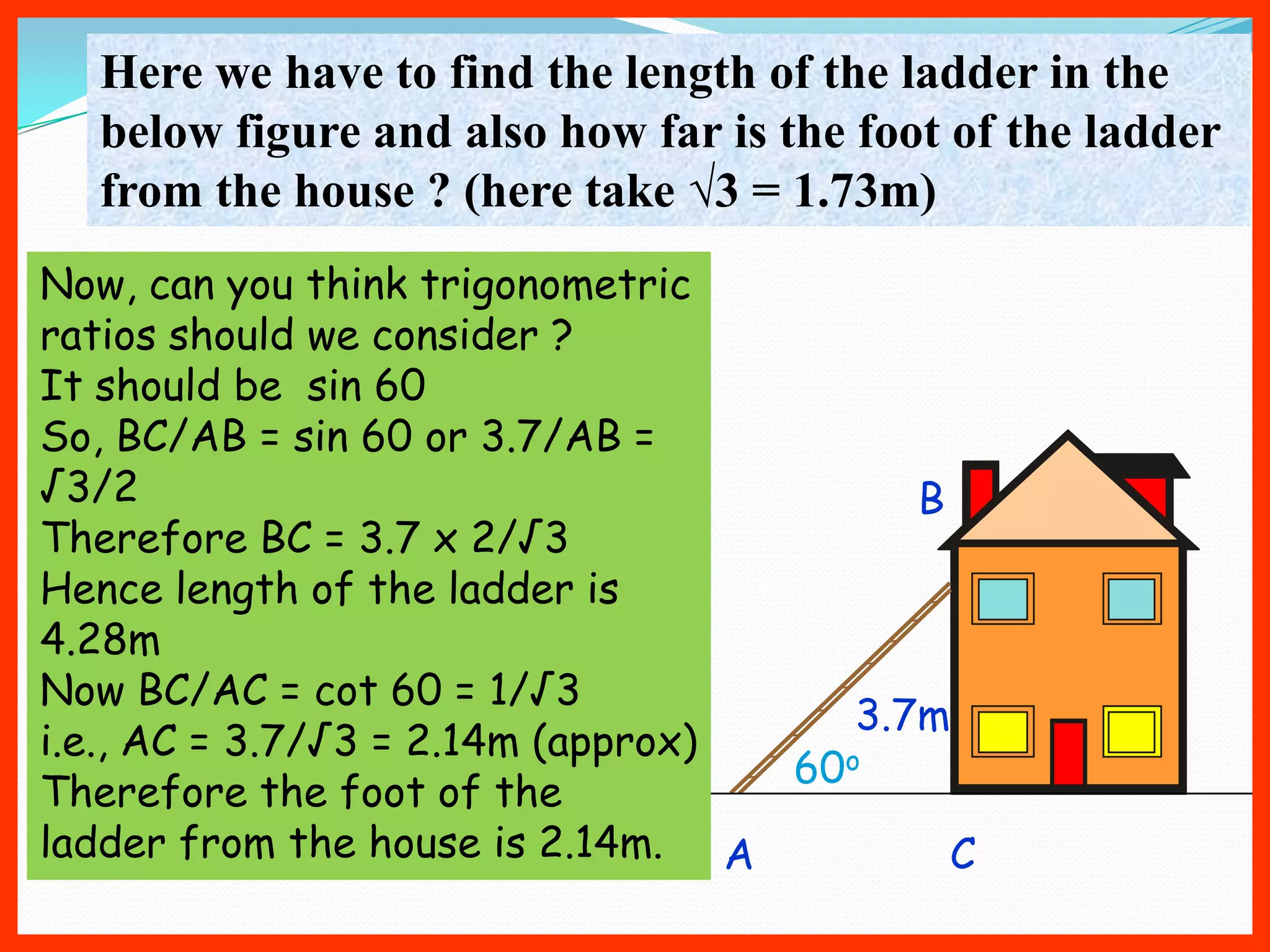
Here we have to find the length of the ladder in the
  below figure and also how far is the foot of the ladder
  from the house ? (here take √3 = 1.73m)
Now, can you think trigonometric
ratios should we consider ?
It should be sin 60
So, BC/AB = sin 60 or 3.7/AB =
√3/2                                     B
Therefore BC = 3.7 x 2/√3
Hence length of the ladder is
4.28m
Now BC/AC = cot 60 = 1/√3
                                      3.7m
i.e., AC = 3.7/√3 = 2.14m (approx)
                                   60o
Therefore the foot of the
ladder from the house is 2.14m. A          C
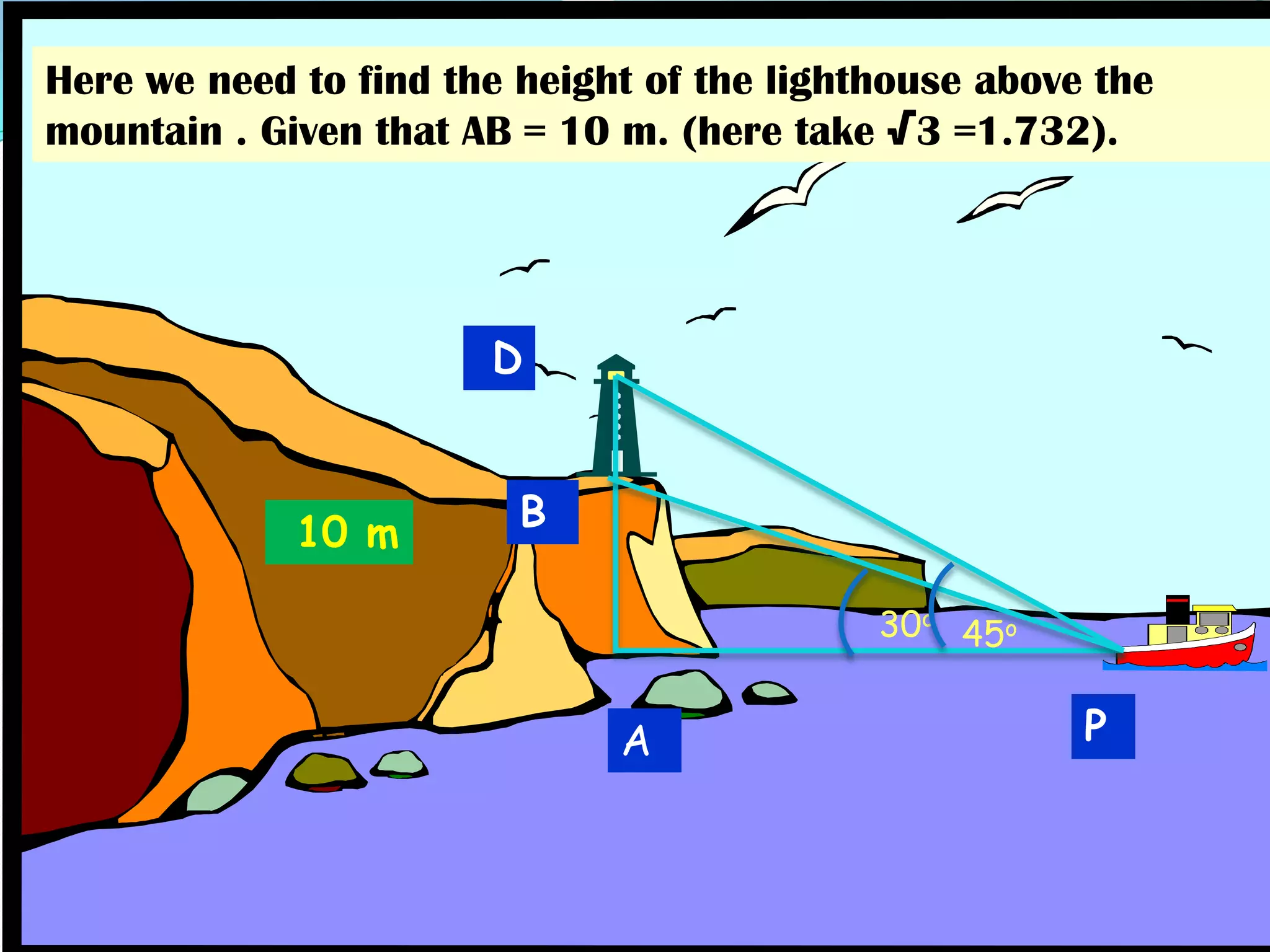
Here we need to find the height of the lighthouse above the
mountain . Given that AB = 10 m. (here take √3 =1.732).


                       D


             10 m        B

                                            30o 45o


                              A                        P
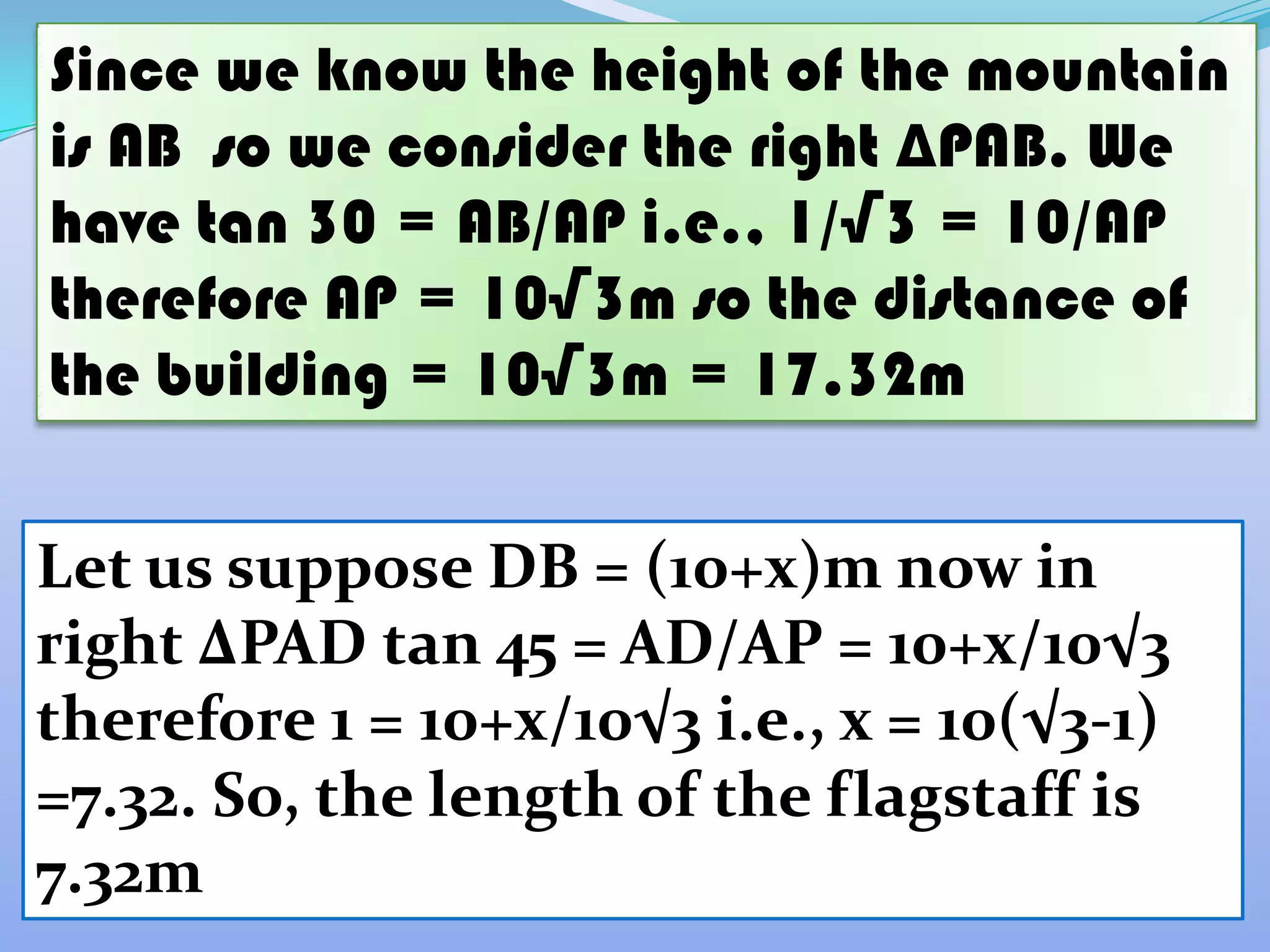
Since we know the height of the mountain
is AB so we consider the right ∆PAB. We
have tan 30 = AB/AP i.e., 1/√3 = 10/AP
therefore AP = 10√3m so the distance of
the building = 10√3m = 17.32m


Let us suppose DB = (10+x)m now in
right ∆PAD tan 45 = AD/AP = 10+x/10√3
therefore 1 = 10+x/10√3 i.e., x = 10(√3-1)
=7.32. So, the length of the flagstaff is
7.32m
Summary
   The line of sight is the line drawn from the eye of
    the observer to the point in the object viewed by
    the observer.
   The angle of elevation of an object viewed, is the
    angle formed by the line of sight with the horizontal
    when it is above the horizontal level, i.e., the case
    when we raise our head to look at the object.
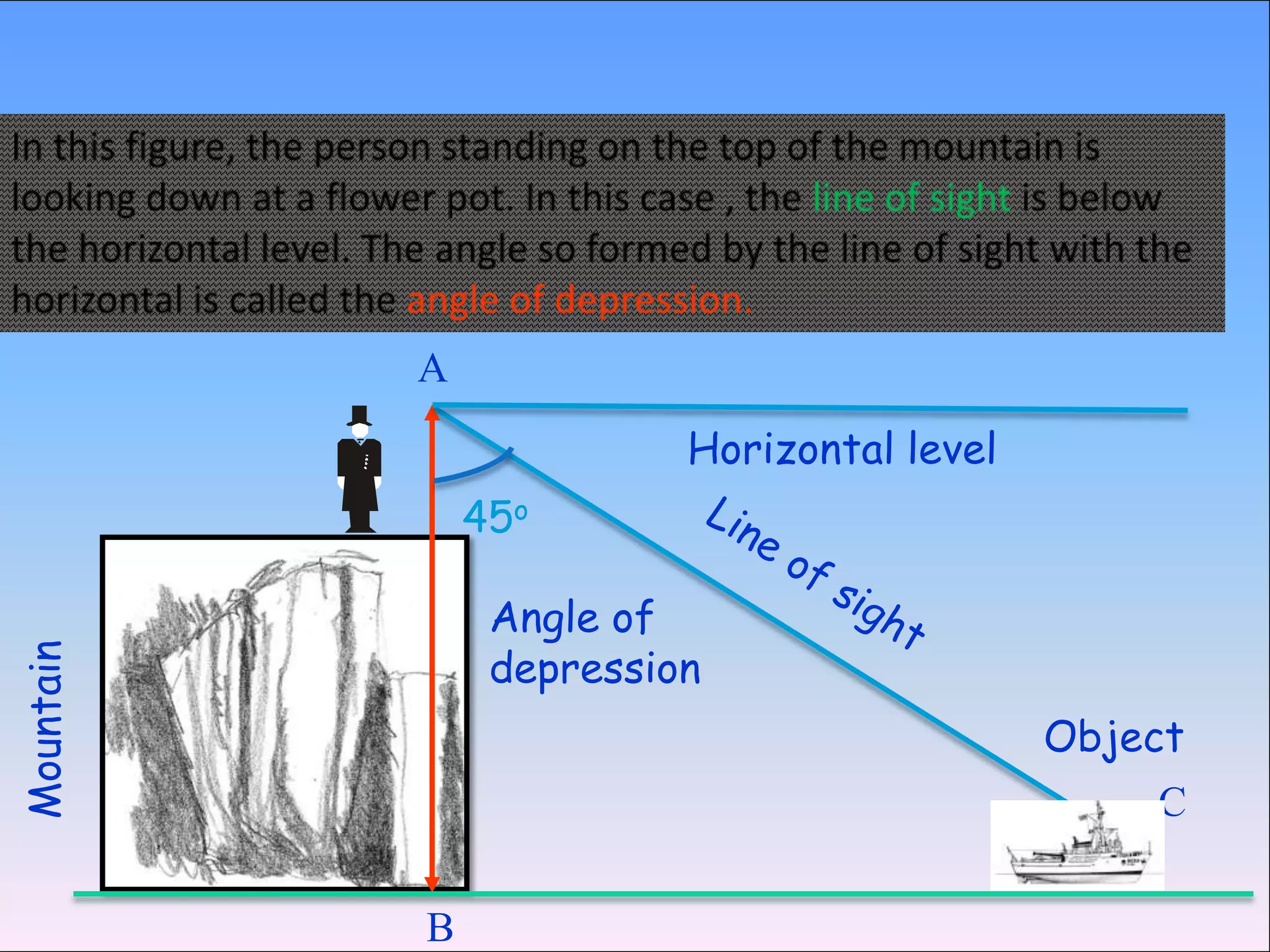
   The angle of depression of an object viewed, is the
    angle formed by the line of sight with the horizontal
    when it is below the horizontal level , i.e., the case
    when we lower our the head to look at the object.
   The height or length of an object or the distance
    between two distant objects can be determined with
    the help of trigonometric ratios.
Thank you

Height and distances

  • 1.
  • 2.
    Heights and Distances ? What you’re going to do ? next? 45o
  • 3.
    In this situation, the distance or the heights can be founded by using mathematical techniques, which comes under a branch of ‘trigonometry’. The word ‘ trigonometry’ is derived from the Greek word ‘tri’ meaning three , ‘gon’ meaning sides and ‘metron’ meaning measures. Trigonometry is concerned with the relationship between the angles and sides of triangles. An understanding of these relationships enables unknown angles and sides to be calculated without recourse to direct measurement. Applications include finding heights/distances of objects.
  • 6.
    Trigonometry An early application of trigonometry was made by Thales on a visit to Egypt. He was surprised that no one could tell him the height of the 2000 year old Cheops pyramid. He used his Thales of Miletus knowledge of the relationship between the heights of objects 640 – 546 B.C. The first Greek and the length of their shadows to calculate the height for Mathematician. He them. (This will later become the Tangent ratio.) Can you see what predicted the Solar Eclipse of 585 BC. this relationship is, based on the drawings below? h 480 ft 720 ft Similar Similar 6 ft Triangles Triangles 9 ft Sun’s rays casting shadows mid-afternoon Sun’s rays casting shadows late afternoon Thales may not have used similar triangles directly to solve the problem but h he knew that6the ratio of the 6x 720 horizontal sides of each triangle was vertical to h 480 ft sun. Can you use the constant and unchanging for different heights of the (Egyptian feet of course) 720 9 9 measurements shown above to find the height of Cheops?
  • 7.
    Later, during theGolden Age of Athens (5 BC.), the philosophers and mathematicians were not particularly interested in the practical side of mathematics so trigonometry was not further developed. It was another 250 years or so, when the centre of learning had switched to Alexandria (current day Egypt) that the ideas behind trigonometry were more fully explored. The astronomer and mathematician, Hipparchus was the first person to construct tables of trigonometric ratios. Amongst his many notable achievements was his determination of the distance to the moon with an error of only 5%. He used the diameter of the Earth (previously calculated by Eratosthenes) together with angular measurements that had been taken during the total solar eclipse of March 190 BC. Eratosthenes Hipparchus of Rhodes 275 – 194 BC 190-120 BC
  • 8.
    Early Applications ofTrigonometry Finding the height of a mountain/hill. h 25o 20o x d Constructing sundials to Finding the distance to estimate the time from the moon. the sun’s shadow.
  • 9.
    Historically trigonometry wasdeveloped for work in Astronomy and Geography. Today it is used extensively in mathematics and many other areas of the sciences. •Surveying •Navigation •Physics •Engineering
  • 10.
    In this figure,the line AC drawn from the eye of the C student to the top of the tower is called the line of sight. The person is looking at the top of the tower. The angle BAC, so formed by Tower line of sight with horizontal is called angle of elevation. Angle of elevation A 45o Horizontal level B
  • 11.
    A Horizontal level 45o Angle of depression Mountain Object C B
  • 12.
    Method of findingthe heights or the distances C Tower Angle of elevation A 45o Horizontal level B Let us refer to figure of tower again. If you want to find the height of the tower i.e. BC without actually measuring it, what information do you need ?
  • 13.
    We would needto know the following: i. The distance AB which is the distance between tower and the person . ii. The angle of elevation angle BAC . Assuming that the above two conditions are given then how can we determine the height of the height of the tower ? In ∆ABC, the side BC is the opposite side in relation to the known angle A. Now, which of the trigonometric ratios can we use ? Which one of them has the two values that we have and the one we need to determine ? Our search narrows down to using either tan A or cot A, as these ratios involve AB and BC. Therefore, tan A = BC/AB or cot A = AB/BC, which on solving would give us BC i.e., the height of the tower.
  • 14.
    Some Applications oftrigonometry based on finding heights and distance
  • 15.
    Here we haveto find the height of the school. Here BC = 28.5 m and AC i.e., the height of the school = tan 45 = AC/BC i.e., 1 = AC/28.5 Therefore , AC = 28.5m So the height of the school is 28.5 m. A B 45o C 28.5m
  • 16.
    Here we haveto find the length of the ladder in the below figure and also how far is the foot of the ladder from the house ? (here take √3 = 1.73m) Now, can you think trigonometric ratios should we consider ? It should be sin 60 So, BC/AB = sin 60 or 3.7/AB = √3/2 B Therefore BC = 3.7 x 2/√3 Hence length of the ladder is 4.28m Now BC/AC = cot 60 = 1/√3 3.7m i.e., AC = 3.7/√3 = 2.14m (approx) 60o Therefore the foot of the ladder from the house is 2.14m. A C
  • 17.
    Here we needto find the height of the lighthouse above the mountain . Given that AB = 10 m. (here take √3 =1.732). D 10 m B 30o 45o A P
  • 18.
    Since we knowthe height of the mountain is AB so we consider the right ∆PAB. We have tan 30 = AB/AP i.e., 1/√3 = 10/AP therefore AP = 10√3m so the distance of the building = 10√3m = 17.32m Let us suppose DB = (10+x)m now in right ∆PAD tan 45 = AD/AP = 10+x/10√3 therefore 1 = 10+x/10√3 i.e., x = 10(√3-1) =7.32. So, the length of the flagstaff is 7.32m
  • 19.
    Summary  The line of sight is the line drawn from the eye of the observer to the point in the object viewed by the observer.  The angle of elevation of an object viewed, is the angle formed by the line of sight with the horizontal when it is above the horizontal level, i.e., the case when we raise our head to look at the object.  The angle of depression of an object viewed, is the angle formed by the line of sight with the horizontal when it is below the horizontal level , i.e., the case when we lower our the head to look at the object.  The height or length of an object or the distance between two distant objects can be determined with the help of trigonometric ratios.
  • 20.