Cdt.T.NavilanSidharth
X std. – B sec.
ROLL NO : 6087
PALLAVA HOUSE
SAINIK SCHOOL AMARAVATHINAGAR
USES OF
TRIGONOMETRY
Trigonometry is mainly used in
astronomy to measure distances of
various stars. It is also used in
measurement of heights of mountains,
buildings, monument, etc..
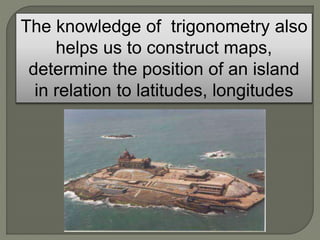
The knowledge of trigonometry also
helps us to construct maps,
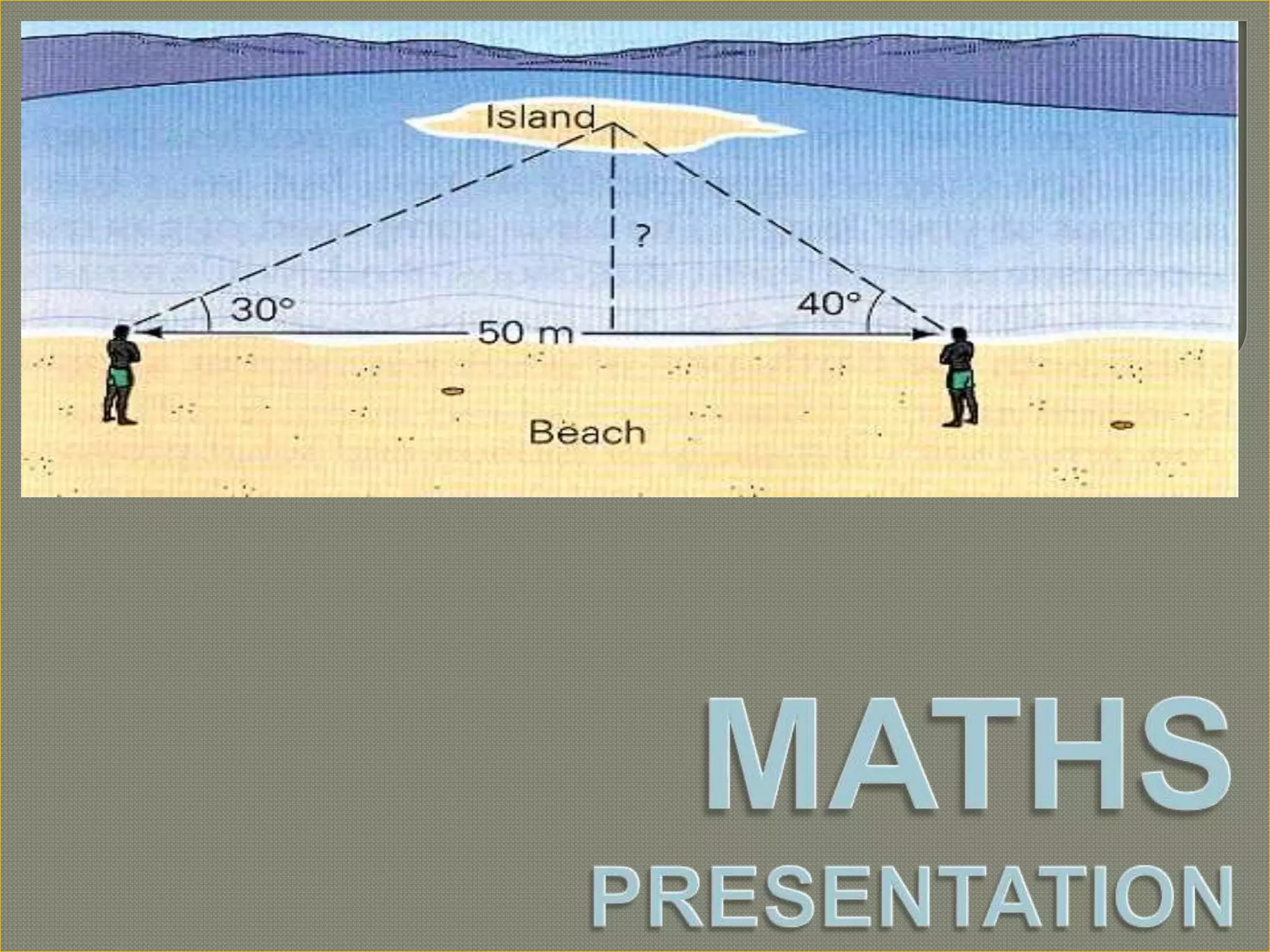
determine the position of an island
in relation to latitudes, longitudes
It is a surveying
instrument on the basis of
Trigonometry .
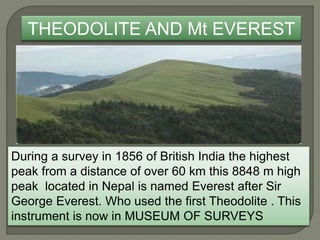
THEODOLITE AND Mt EVEREST
During a survey in 1856 of British India the highest
peak from a distance of over 60 km this 8848 m high
peak located in Nepal is named Everest after Sir
George Everest. Who used the first Theodolite . This
instrument is now in MUSEUM OF SURVEYS
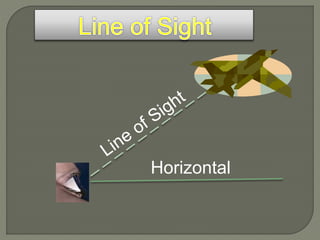
Horizontal
Angle of
Elevation
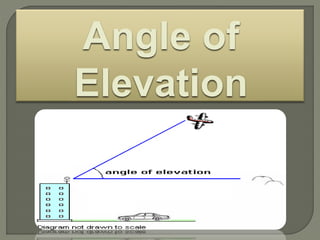
The angle which the line of sight
makes with a horizontal line
drawn away from their eyes is
called the angle of Elevation of
aero plane from them.
Angle of Elevation
Angle of
Depression
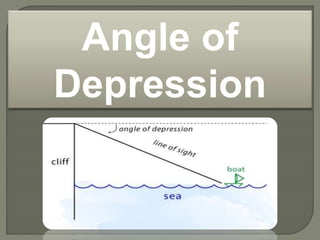
The angle below horizontal that an observer
must look to see an object that is lower than
the observer. Note: The angle of depression is
congruent to the angle of elevation (this
assumes the object is close enough to the
observer so that the horizontals for the
observer and the object are effectively parallel
Angle of Depression
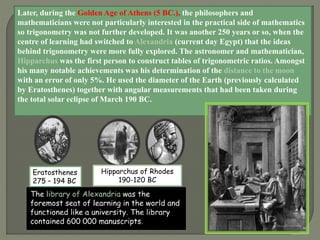
Later, during the Golden Age of Athens (5 BC.), the philosophers and
mathematicians were not particularly interested in the practical side of mathematics
so trigonometry was not further developed. It was another 250 years or so, when the
centre of learning had switched to Alexandria (current day Egypt) that the ideas
behind trigonometry were more fully explored. The astronomer and mathematician,
Hipparchus was the first person to construct tables of trigonometric ratios. Amongst
his many notable achievements was his determination of the distance to the moon
with an error of only 5%. He used the diameter of the Earth (previously calculated
by Eratosthenes) together with angular measurements that had been taken during
the total solar eclipse of March 190 BC.
Eratosthenes
275 – 194 BC
Hipparchus of Rhodes
190-120 BC
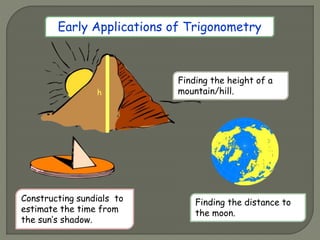
Early Applications of Trigonometry
Finding the height of a
mountain/hill.
Constructing sundials to
estimate the time from
the sun’s shadow.
Finding the distance to
the moon.
h
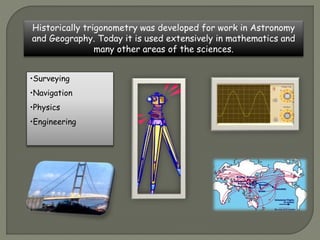
Historically trigonometry was developed for work in Astronomy
and Geography. Today it is used extensively in mathematics and
many other areas of the sciences.
•Surveying
•Navigation
•Physics
•Engineering
Now let us Solve some
problem related to
Height and Distance
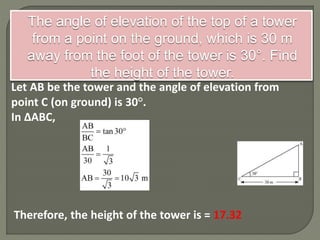
The angle of elevation of the top of a tower
from a point on the ground, which is 30 m
away from the foot of the tower is 30°. Find
the height of the tower.
Let AB be the tower and the angle of elevation from
point C (on ground) is 30°.
In ΔABC,
Therefore, the height of the tower is = 17.32
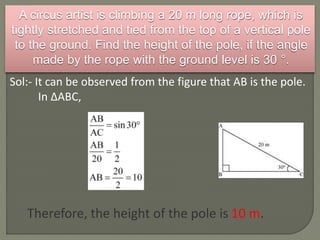
A circus artist is climbing a 20 m long rope, which is
tightly stretched and tied from the top of a vertical pole
to the ground. Find the height of the pole, if the angle
made by the rope with the ground level is 30 °.
Sol:- It can be observed from the figure that AB is the pole.
In ΔABC,
Therefore, the height of the pole is 10 m.
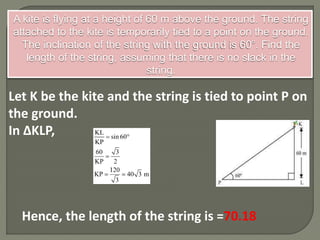
A kite is flying at a height of 60 m above the ground. The string
attached to the kite is temporarily tied to a point on the ground.
The inclination of the string with the ground is 60°. Find the
length of the string, assuming that there is no slack in the
string.
Let K be the kite and the string is tied to point P on
the ground.
In ΔKLP,
Hence, the length of the string is =70.18
BY:T.NAVILAN SIDHARTH

some applications of trigonometry 10th std.

  • 3.
    Cdt.T.NavilanSidharth X std. –B sec. ROLL NO : 6087 PALLAVA HOUSE SAINIK SCHOOL AMARAVATHINAGAR
  • 4.
  • 5.
    Trigonometry is mainlyused in astronomy to measure distances of various stars. It is also used in measurement of heights of mountains, buildings, monument, etc..
  • 6.
    The knowledge oftrigonometry also helps us to construct maps, determine the position of an island in relation to latitudes, longitudes
  • 7.
    It is asurveying instrument on the basis of Trigonometry .
  • 8.
    THEODOLITE AND MtEVEREST During a survey in 1856 of British India the highest peak from a distance of over 60 km this 8848 m high peak located in Nepal is named Everest after Sir George Everest. Who used the first Theodolite . This instrument is now in MUSEUM OF SURVEYS
  • 9.
  • 11.
  • 12.
    The angle whichthe line of sight makes with a horizontal line drawn away from their eyes is called the angle of Elevation of aero plane from them. Angle of Elevation
  • 13.
  • 14.
    The angle belowhorizontal that an observer must look to see an object that is lower than the observer. Note: The angle of depression is congruent to the angle of elevation (this assumes the object is close enough to the observer so that the horizontals for the observer and the object are effectively parallel Angle of Depression
  • 18.
    Later, during theGolden Age of Athens (5 BC.), the philosophers and mathematicians were not particularly interested in the practical side of mathematics so trigonometry was not further developed. It was another 250 years or so, when the centre of learning had switched to Alexandria (current day Egypt) that the ideas behind trigonometry were more fully explored. The astronomer and mathematician, Hipparchus was the first person to construct tables of trigonometric ratios. Amongst his many notable achievements was his determination of the distance to the moon with an error of only 5%. He used the diameter of the Earth (previously calculated by Eratosthenes) together with angular measurements that had been taken during the total solar eclipse of March 190 BC. Eratosthenes 275 – 194 BC Hipparchus of Rhodes 190-120 BC
  • 19.
    Early Applications ofTrigonometry Finding the height of a mountain/hill. Constructing sundials to estimate the time from the sun’s shadow. Finding the distance to the moon. h
  • 20.
    Historically trigonometry wasdeveloped for work in Astronomy and Geography. Today it is used extensively in mathematics and many other areas of the sciences. •Surveying •Navigation •Physics •Engineering
  • 21.
    Now let usSolve some problem related to Height and Distance
  • 22.
    The angle ofelevation of the top of a tower from a point on the ground, which is 30 m away from the foot of the tower is 30°. Find the height of the tower. Let AB be the tower and the angle of elevation from point C (on ground) is 30°. In ΔABC, Therefore, the height of the tower is = 17.32
  • 23.
    A circus artistis climbing a 20 m long rope, which is tightly stretched and tied from the top of a vertical pole to the ground. Find the height of the pole, if the angle made by the rope with the ground level is 30 °. Sol:- It can be observed from the figure that AB is the pole. In ΔABC, Therefore, the height of the pole is 10 m.
  • 24.
    A kite isflying at a height of 60 m above the ground. The string attached to the kite is temporarily tied to a point on the ground. The inclination of the string with the ground is 60°. Find the length of the string, assuming that there is no slack in the string. Let K be the kite and the string is tied to point P on the ground. In ΔKLP, Hence, the length of the string is =70.18
  • 25.