“Mathematics is notabout
numbers, equations,
computations, or algorithms: it is
about understanding.
1
1
2.
Look UP!
Look
DOWN!
Sta. CruzNational High School – Lipay High School
School I.D.: 301034
Magsaysay Park, Pob. South, Sta. Cruz, Zambales
3.
TASK ANALYSIS
LEAST MASTEREDSKILLS
▰Use of Trigonometric Ratios in Solving Real-Life Problems
Involving Right Triangles
Sub Tasks
▰ Illustrates angles of elevation and angles of depressions
▰ Distinguish between angles of elevations and angles of
depressions
▰ Solve problems involving right triangles
3
4.
4
OVERVIEW
Trigonometry - thebranch of Mathematics that studies
relationship involving the lengths and angles of a triangle. The word
“Trigonometry” is derived from the Greek words, “Tri” (meaning three),
“Gon” (meaning sides), and “Metron” (meaning measure).
There are six functions of an angle used in trigonometry.
Their names and abbreviations are sine (sin), cosine (cos), tangent (tan),
cotangent (cot), secant (sec), and cosect (cos).
Trigonometric functions are used in obtaining unknown
angles and distance from known and measured angles in geometric
figures. It developed from a need to compute angles and distances in
such fields as Astronomy, Map Making, Surveying, etc.Problems involving
angles and distances in one plane are covered din Plane Trigonometry.
In this SIM, trigonometry is used to solve for particular real-
life problems involving right triangles.
5.
5
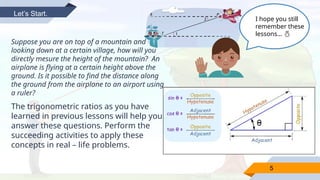
Suppose you areon top of a mountain and
looking down at a certain village, how will you
directly mesure the height of the mountain? An
airplane is flying at a certain height above the
ground. Is it possible to find the distance along
the ground from the airplane to an airport using
a ruler?
The trigonometric ratios as you have
learned in previous lessons will help you
answer these questions. Perform the
succeeding activities to apply these
concepts in real – life problems.
I hope you still
remember these
lessons…
Let’s Start.
6.
ACTIVITY 1
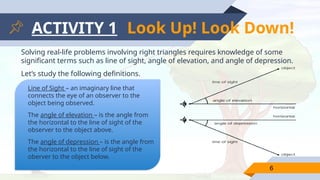
Solving real-lifeproblems involving right triangles requires knowledge of some
significant terms such as line of sight, angle of elevation, and angle of depression.
Let’s study the following definitions.
6
Line of Sight – an imaginary line that
connects the eye of an observer to the
object being observed.
The angle of elevation – is the angle from
the horizontal to the line of sight of the
observer to the object above.
The angle of depression – is the angle from
the horizontal to the line of sight of the
oberver to the object below.
Look Up! Look Down!
7.
7
Do This! FigureAngle of
Elevation
Angle of
Depression
Line of
Sight
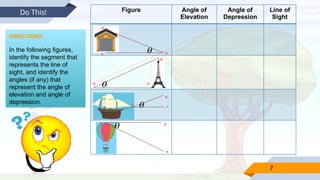
DIRECTIONS:
In the following figures,
identify the segment that
represents the line of
sight, and identify the
angles (if any) that
represent the angle of
elevation and angle of
depression.
a
b
c
m
n
o
𝜃
𝜃
𝜃
𝜃
r
s
t
y
x
z
8.
8
ACTIVITY 2 ProcessMe!
The study of trigonometric ratios originated from geometric problems
involving triangles. Solving a trriangle means finding the lengths of the sides and the
measures of the angles of the triangle. Trigonometric ratios may be used to solve
problems involving angles of elevation and depression.
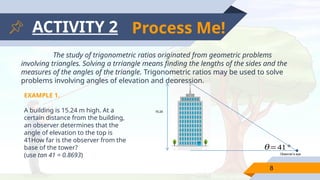
EXAMPLE 1.
A building is 15.24 m high. At a
certain distance from the building,
an observer determines that the
angle of elevation to the top is
41How far is the observer from the
base of the tower?
(use tan 41 = 0.8693)
15.24
Observer’s eye
𝜃=41 °
9.
9
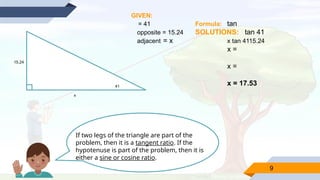
15.24
41
x
GIVEN:
= 41 Formula:tan
opposite = 15.24 SOLUTIONS: tan 41
adjacent = x x tan 4115.24
x =
x =
x = 17.53
If two legs of the triangle are part of the
problem, then it is a tangent ratio. If the
hypotenuse is part of the problem, then it is
either a sine or cosine ratio.
10.
10
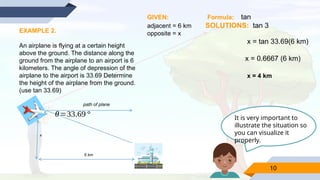
EXAMPLE 2.
An airplaneis flying at a certain height
above the ground. The distance along the
ground from the airplane to an airport is 6
kilometers. The angle of depression of the
airplane to the airport is 33.69 Determine
the height of the airplane from the ground.
(use tan 33.69)
x
6 km
path of plane
θ=33.69°
GIVEN: Formula: tan
adjacent = 6 km SOLUTIONS: tan 3
opposite = x
x = tan 33.69(6 km)
x = 0.6667 (6 km)
x = 4 km
It is very important to
illustrate the situation so
you can visualize it
properly.
11.
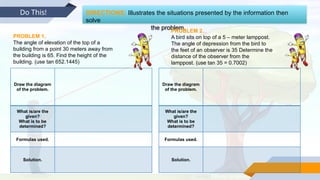
Do This! DIRECTIONS:Illustrates the situations presented by the information then
solve
the problem.
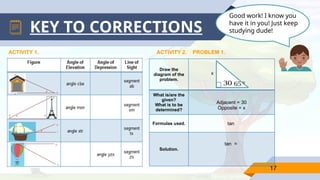
PROBLEM 1.
The angle of elevation of the top of a
building from a point 30 meters away from
the building is 65. Find the height of the
building. (use tan 652.1445)
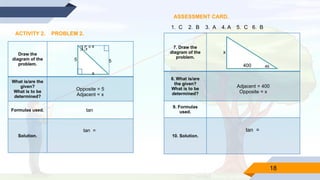
PROBLEM 2.
A bird sits on top of a 5 – meter lamppost.
The angle of depression from the bird to
the feet of an observer is 35 Determine the
distance of the observer from the
lamppost. (use tan 35 = 0.7002)
Draw the diagram
of the problem.
What is/are the
given?
What is to be
determined?
Formulas used.
Solution.
Draw the diagram
of the problem.
What is/are the
given?
What is to be
determined?
Formulas used.
Solution.
12.
12
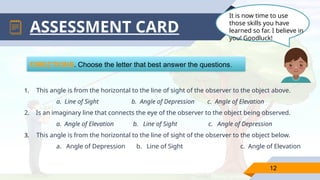
ASSESSMENT CARD
DIRECTIONS. Choosethe letter that best answer the questions.
1. This angle is from the horizontal to the line of sight of the observer to the object above.
a. Line of Sight b. Angle of Depression c. Angle of Elevation
2. Is an imaginary line that connects the eye of the observer to the object being observed.
a. Angle of Elevation b. Line of Sight c. Angle of Depression
3. This angle is from the horizontal to the line of sight of the observer to the object below.
a. Angle of Depression b. Line of Sight c. Angle of Elevation
It is now time to use
those skills you have
learned so far. I believe in
you! Goodluck!
13.
13
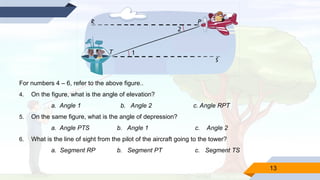
For numbers 4– 6, refer to the above figure..
4. On the figure, what is the angle of elevation?
a. Angle 1 b. Angle 2 c. Angle RPT
5. On the same figure, what is the angle of depression?
a. Angle PTS b. Angle 1 c. Angle 2
6. What is the line of sight from the pilot of the aircraft going to the tower?
a. Segment RP b. Segment PT c. Segment TS
14.
14
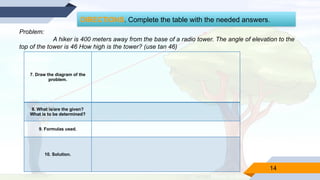
Problem:
A hiker is400 meters away from the base of a radio tower. The angle of elevation to the
top of the tower is 46 How high is the tower? (use tan 46)
7. Draw the diagram of the
problem.
8. What is/are the given?
What is to be determined?
9. Formulas used.
10. Solution.
DIRECTIONS. Complete the table with the needed answers.
15.
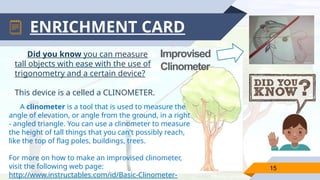
ENRICHMENT CARD
A clinometeris a tool that is used to measure the
angle of elevation, or angle from the ground, in a right
- angled triangle. You can use a clinometer to measure
the height of tall things that you can't possibly reach,
like the top of flag poles, buildings, trees.
For more on how to make an improvised clinometer,
visit the following web page:
http://www.instructables.com/id/Basic-Clinometer-
15
Improvised
Clinometer
Did you know you can measure
tall objects with ease with the use of
trigonometry and a certain device?
This device is a celled a CLINOMETER.
17
KEY TO CORRECTIONS
ACTIVITY1. ACTIVITY 2. PROBLEM 1.
Draw the
diagram of the
problem.
What is/are the
given?
What is to be
determined?
Adjacent = 30
Opposite = x
Formulas used. tan
Solution.
tan =
x
65 °
30
Good work! I know you
have it in you! Just keep
studying dude!
18.
18
ASSESSMENT CARD.
ACTIVITY 2.PROBLEM 2.
Draw the
diagram of the
problem.
What is/are the
given?
What is to be
determined?
Opposite = 5
Adjacent = x
Formulas used. tan
Solution.
tan =
1. C 2. B 3. A 4. A 5. C 6. B
7. Draw the
diagram of the
problem.
8. What is/are
the given?
What is to be
determined?
Adjacent = 400
Opposite = x
9. Formulas
used.
10. Solution.
tan =
x
x
5
5
35°
46
400
x






![Earth Science activity -First Day -[1].pptx](https://cdn.slidesharecdn.com/ss_thumbnails/earthscience-firstday-1-250903072910-94467441-thumbnail.jpg?width=640&height=640&fit=bounds)


