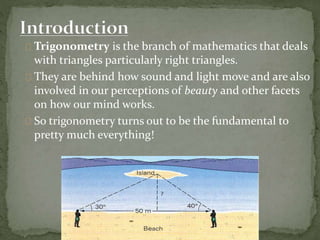
Trigonometry is the branch of mathematics that deals 
with triangles particularly right triangles. 
They are behind how sound and light move and are also 
involved in our perceptions of beauty and other facets 
on how our mind works. 
So trigonometry turns out to be the fundamental to 
pretty much everything!
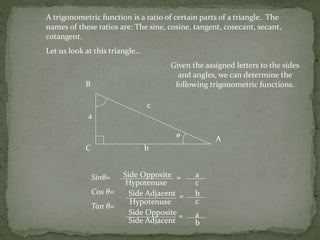
A trigonometric function is a ratio of certain parts of a triangle. The 
names of these ratios are: The sine, cosine, tangent, cosecant, secant, 
cotangent. 
Let us look at this triangle… 
a 
c 
b 
ө 
A 
B 
C 
Given the assigned letters to the sides 
and angles, we can determine the 
following trigonometric functions. 
Sinθ= 
Cos θ= 
Tan θ= 
Side Opposite 
Hypotenuse 
Side Adjacent 
Hypotenuse 
Side Opposite 
Side Adjacent 
= 
= 
a 
c 
b 
c 
= a 
b
1 
1 
1 
1 
1 
 
45 
2 
45 
2 
45 
 
  
Sin 
Cos 
Tan 
3 
1 
3 
 
30 
2 
30 
1 
2 
30 
 
 
Sin 
Cos 
Tan 
3 
3 
1 
1 
 
60 
2 
60 
2 
60 
 
 
Sin 
Cos 
Tan 
0 
0 
  
1 
  
0 
1 
0 
1 
1 
0 
0 
1 
0 
  
Sin 
Cos 
Tan 
Sin 
Cos 
1 
  
0 
1 
 
Tan n . 
d 
0 
90 
1 
90 
1 
1 
90 
 
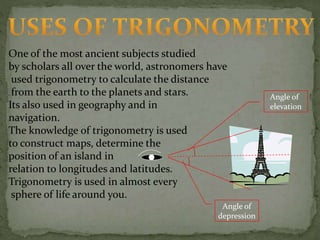
One of the most ancient subjects studied 
by scholars all over the world, astronomers have 
used trigonometry to calculate the distance 
from the earth to the planets and stars. 
Its also used in geography and in 
navigation. 
The knowledge of trigonometry is used 
to construct maps, determine the 
position of an island in 
relation to longitudes and latitudes. 
Trigonometry is used in almost every 
sphere of life around you. 
Angle of 
depression 
Angle of 
elevation
Angle of Elevation: In the picture below, an observer 
is standing at the top of a building is looking straight 
ahead (horizontal line). The observer must raise his 
eyes to see the airplane (slanting line). This is known 
as the angle of elevation. 
Angle of elevation 
Horizontal
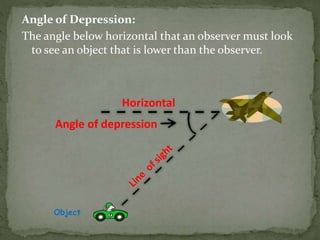
Angle of Depression: 
The angle below horizontal that an observer must look 
to see an object that is lower than the observer. 
Horizontal 
Angle of depression 
Object
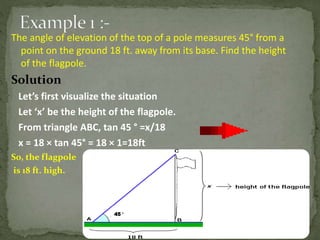
The angle of elevation of the top of a pole measures 45° from a 
point on the ground 18 ft. away from its base. Find the height 
of the flagpole. 
Solution 
Let’s first visualize the situation 
Let ‘x’ be the height of the flagpole. 
From triangle ABC, tan 45 ° =x/18 
x = 18 × tan 45° = 18 × 1=18ft 
So, the flagpole 
is 18 ft. high. 
45 °
A tower stands on the ground. The angle of elevation 
from a point on the ground which is 30 metres away from the foot 
Of the tower is 30⁰. Find the height of the tower. (Take √3 = 1.732) 
Let AB be the tower h metre high. 
Let C be a point on the ground 
which is 30 m away from point B, 
the foot of the tower. 
30⁰ 
So BC = 30 m 
Then ACB = 30⁰ 
Now we have to find AB i.e. height ‘h’ 
of the tower . 
30 m 
h 
A 
B 
C 
Solution .
Now we shall find the trigonometric ratio combining 
AB and BC . 
AB 
B 
tan 30⁰ 
1 
√3 
h 
30 
h 30 
√3 
30 x √3 
√3 x √3 
30 x √3 
3 
10√3 m 
10 x 1.732 m 
17.32 m 
Hence, height of the tower = 17.32 m 
30⁰ 
30 m 
h 
A 
B 
C
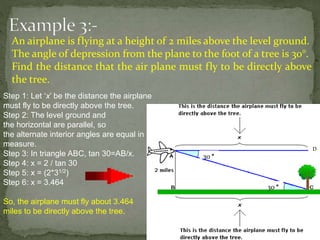
An airplane is flying at a height of 2 miles above the level ground. 
The angle of depression from the plane to the foot of a tree is 30°. 
Find the distance that the air plane must fly to be directly above 
the tree. 
30 ° 
30 ° 
Step 1: Let ‘x’ be the distance the airplane 
must fly to be directly above the tree. 
Step 2: The level ground and 
the horizontal are parallel, so 
the alternate interior angles are equal in 
measure. 
Step 3: In triangle ABC, tan 30=AB/x. 
Step 4: x = 2 / tan 30 
Step 5: x = (2*31/2) 
Step 6: x = 3.464 
So, the airplane must fly about 3.464 
miles to be directly above the tree. 
D
Trigonometry, Applications of Trigonometry CBSE Class X Project

Trigonometry, Applications of Trigonometry CBSE Class X Project

  • 2.
    Trigonometry is thebranch of mathematics that deals with triangles particularly right triangles. They are behind how sound and light move and are also involved in our perceptions of beauty and other facets on how our mind works. So trigonometry turns out to be the fundamental to pretty much everything!
  • 3.
    A trigonometric functionis a ratio of certain parts of a triangle. The names of these ratios are: The sine, cosine, tangent, cosecant, secant, cotangent. Let us look at this triangle… a c b ө A B C Given the assigned letters to the sides and angles, we can determine the following trigonometric functions. Sinθ= Cos θ= Tan θ= Side Opposite Hypotenuse Side Adjacent Hypotenuse Side Opposite Side Adjacent = = a c b c = a b
  • 4.
    1 1 1 1 1  45 2 45 2 45    Sin Cos Tan 3 1 3  30 2 30 1 2 30   Sin Cos Tan 3 3 1 1  60 2 60 2 60   Sin Cos Tan 0 0   1   0 1 0 1 1 0 0 1 0   Sin Cos Tan Sin Cos 1   0 1  Tan n . d 0 90 1 90 1 1 90  
  • 5.
    One of themost ancient subjects studied by scholars all over the world, astronomers have used trigonometry to calculate the distance from the earth to the planets and stars. Its also used in geography and in navigation. The knowledge of trigonometry is used to construct maps, determine the position of an island in relation to longitudes and latitudes. Trigonometry is used in almost every sphere of life around you. Angle of depression Angle of elevation
  • 6.
    Angle of Elevation:In the picture below, an observer is standing at the top of a building is looking straight ahead (horizontal line). The observer must raise his eyes to see the airplane (slanting line). This is known as the angle of elevation. Angle of elevation Horizontal
  • 7.
    Angle of Depression: The angle below horizontal that an observer must look to see an object that is lower than the observer. Horizontal Angle of depression Object
  • 8.
    The angle ofelevation of the top of a pole measures 45° from a point on the ground 18 ft. away from its base. Find the height of the flagpole. Solution Let’s first visualize the situation Let ‘x’ be the height of the flagpole. From triangle ABC, tan 45 ° =x/18 x = 18 × tan 45° = 18 × 1=18ft So, the flagpole is 18 ft. high. 45 °
  • 9.
    A tower standson the ground. The angle of elevation from a point on the ground which is 30 metres away from the foot Of the tower is 30⁰. Find the height of the tower. (Take √3 = 1.732) Let AB be the tower h metre high. Let C be a point on the ground which is 30 m away from point B, the foot of the tower. 30⁰ So BC = 30 m Then ACB = 30⁰ Now we have to find AB i.e. height ‘h’ of the tower . 30 m h A B C Solution .
  • 10.
    Now we shallfind the trigonometric ratio combining AB and BC . AB B tan 30⁰ 1 √3 h 30 h 30 √3 30 x √3 √3 x √3 30 x √3 3 10√3 m 10 x 1.732 m 17.32 m Hence, height of the tower = 17.32 m 30⁰ 30 m h A B C
  • 11.
    An airplane isflying at a height of 2 miles above the level ground. The angle of depression from the plane to the foot of a tree is 30°. Find the distance that the air plane must fly to be directly above the tree. 30 ° 30 ° Step 1: Let ‘x’ be the distance the airplane must fly to be directly above the tree. Step 2: The level ground and the horizontal are parallel, so the alternate interior angles are equal in measure. Step 3: In triangle ABC, tan 30=AB/x. Step 4: x = 2 / tan 30 Step 5: x = (2*31/2) Step 6: x = 3.464 So, the airplane must fly about 3.464 miles to be directly above the tree. D