INTRODUCTION TO 
TRIGNOMETRY 
MADE BY: KRISHNARAJ MISHRA 
SUBJECT:MATHS 
SUBMITTED TO: NM GIRI SIR
1) Introduction to trignometry 
2) History 
3) Trignometric ratios 
4) Values of trignometric function 
5) Trignometric ratios of some specific angles 
6) Trignometric ratios of some complementry angles 
7) Trignometric identities 
8) Conclusion
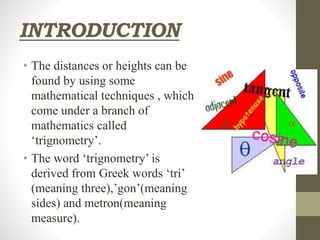
INTRODUCTION 
• The distances or heights can be 
found by using some 
mathematical techniques , which 
come under a branch of 
mathematics called 
‘trignometry’. 
• The word ‘trignometry’ is 
derived from Greek words ‘tri’ 
(meaning three),’gon’(meaning 
sides) and metron(meaning 
measure).
INTRODUCTION 
Trigonometry is the branch of mathematics which 
deals with triangles, particularly triangles in a plane 
where one angle of the triangle is 90 degrees 
Triangles on a sphere are also studied, in spherical 
trigonometry. 
Trigonometry specifically deals with the relationships 
between the sides and the angles of triangles, that is, on 
the trigonometric functions, and with calculations 
based on these functions.
History 
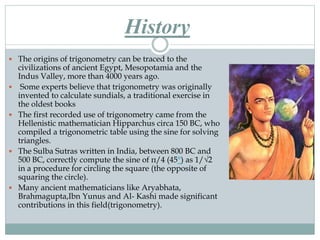
 The origins of trigonometry can be traced to the 
civilizations of ancient Egypt, Mesopotamia and the 
Indus Valley, more than 4000 years ago. 
 Some experts believe that trigonometry was originally 
invented to calculate sundials, a traditional exercise in 
the oldest books 
 The first recorded use of trigonometry came from the 
Hellenistic mathematician Hipparchus circa 150 BC, who 
compiled a trigonometric table using the sine for solving 
triangles. 
 The Sulba Sutras written in India, between 800 BC and 
500 BC, correctly compute the sine of π/4 (45°) as 1/√2 
in a procedure for circling the square (the opposite of 
squaring the circle). 
 Many ancient mathematicians like Aryabhata, 
Brahmagupta,Ibn Yunus and Al- Kashi made significant 
contributions in this field(trigonometry).
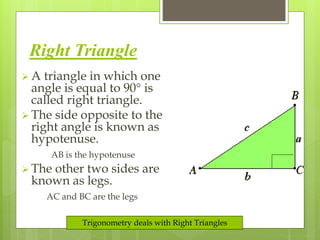
Right Triangle 
 A triangle in which one 
angle is equal to 90 is 
called right triangle. 
 The side opposite to the 
right angle is known as 
hypotenuse. 
AB is the hypotenuse 
 The other two sides are 
known as legs. 
AC and BC are the legs 
Trigonometry deals with Right Triangles
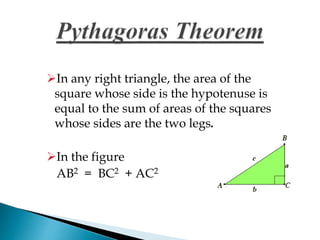
In any right triangle, the area of the 
square whose side is the hypotenuse is 
equal to the sum of areas of the squares 
whose sides are the two legs. 
In the figure 
AB2 = BC2 + AC2
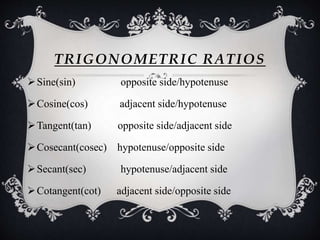
TRIGONOMETRIC RATIOS 
 Sine(sin) opposite side/hypotenuse 
Cosine(cos) adjacent side/hypotenuse 
Tangent(tan) opposite side/adjacent side 
Cosecant(cosec) hypotenuse/opposite side 
 Secant(sec) hypotenuse/adjacent side 
Cotangent(cot) adjacent side/opposite side
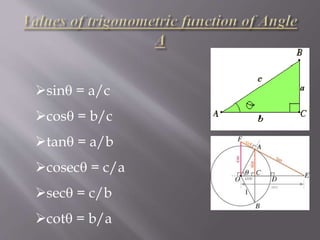
sin = a/c 
cos = b/c 
tan = a/b 
cosec = c/a 
sec = c/b 
cot = b/a
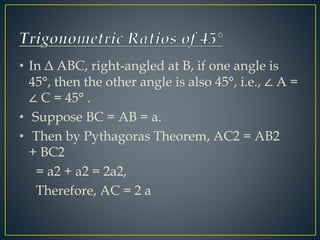
• In Δ ABC, right-angled at B, if one angle is 
45°, then the other angle is also 45°, i.e., ∠ A = 
∠ C = 45° . 
• Suppose BC = AB = a. 
• Then by Pythagoras Theorem, AC2 = AB2 
+ BC2 
= a2 + a2 = 2a2, 
Therefore, AC = 2 a
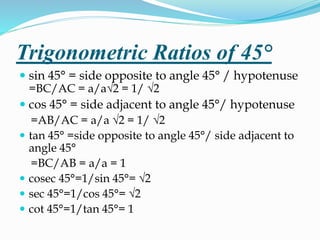
Trigonometric Ratios of 45° 
 sin 45° = side opposite to angle 45° / hypotenuse 
=BC/AC = a/a√2 = 1/ √2 
 cos 45° = side adjacent to angle 45°/ hypotenuse 
=AB/AC = a/a √2 = 1/ √2 
 tan 45° =side opposite to angle 45°/ side adjacent to 
angle 45° 
=BC/AB = a/a = 1 
 cosec 45°=1/sin 45°= √2 
 sec 45°=1/cos 45°= √2 
 cot 45°=1/tan 45°= 1
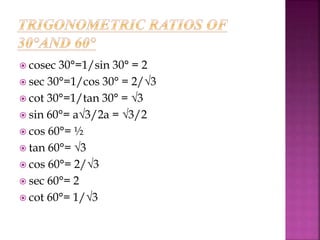
 cosec 30°=1/sin 30° = 2 
 sec 30°=1/cos 30° = 2/√3 
 cot 30°=1/tan 30° = √3 
 sin 60°= a√3/2a = √3/2 
 cos 60°= ½ 
 tan 60°= √3 
 cos 60°= 2/√3 
 sec 60°= 2 
 cot 60°= 1/√3
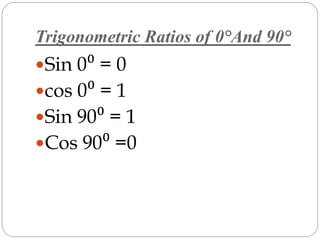
Trigonometric Ratios of 0°And 90° 
Sin 0⁰ = 0 
cos 0⁰ = 1 
Sin 90⁰ = 1 
Cos 90⁰ =0
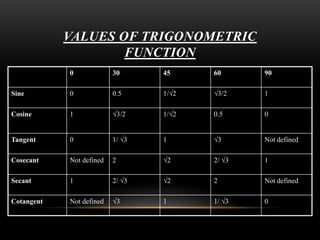
VALUES OF TRIGONOMETRIC 
FUNCTION 
0 30 45 60 90 
Sine 0 0.5 1/2 3/2 1 
Cosine 1 3/2 1/2 0.5 0 
Tangent 0 1/ 3 1 3 Not defined 
Cosecant Not defined 2 2 2/ 3 1 
Secant 1 2/ 3 2 2 Not defined 
Cotangent Not defined 3 1 1/ 3 0
RELATION BETWEEN DIFFERENT 
TRIGONOMETRIC IDENTITIES 
Sine 
Cosine 
Tangent 
Cosecant 
Secant 
Cotangent
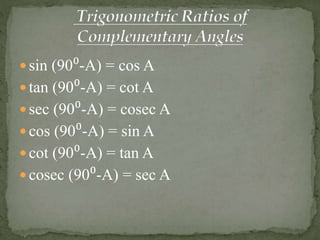
 sin (90⁰-A) = cos A 
 tan (90⁰-A) = cot A 
 sec (90⁰-A) = cosec A 
 cos (90⁰-A) = sin A 
 cot (90⁰-A) = tan A 
 cosec (90⁰-A) = sec A
Trigonometric identities 
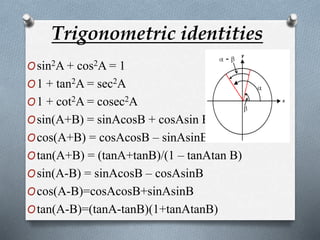
Osin2A + cos2A = 1 
O1 + tan2A = sec2A 
O1 + cot2A = cosec2A 
Osin(A+B) = sinAcosB + cosAsin B 
Ocos(A+B) = cosAcosB – sinAsinB 
Otan(A+B) = (tanA+tanB)/(1 – tanAtan B) 
Osin(A-B) = sinAcosB – cosAsinB 
Ocos(A-B)=cosAcosB+sinAsinB 
Otan(A-B)=(tanA-tanB)(1+tanAtanB)
Trigonometric identities 
 
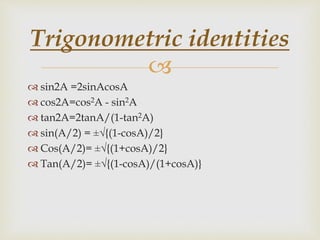
 sin2A =2sinAcosA 
 cos2A=cos2A - sin2A 
 tan2A=2tanA/(1-tan2A) 
 sin(A/2) = ±{(1-cosA)/2} 
 Cos(A/2)= ±{(1+cosA)/2} 
 Tan(A/2)= ±{(1-cosA)/(1+cosA)}
Conclusion 
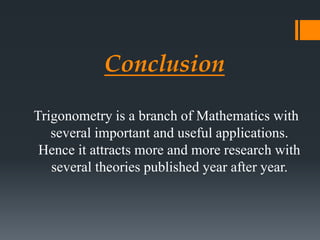
Trigonometry is a branch of Mathematics with 
several important and useful applications. 
Hence it attracts more and more research with 
several theories published year after year.
Thank You……..

Introduction to trignometry

  • 1.
    INTRODUCTION TO TRIGNOMETRY MADE BY: KRISHNARAJ MISHRA SUBJECT:MATHS SUBMITTED TO: NM GIRI SIR
  • 2.
    1) Introduction totrignometry 2) History 3) Trignometric ratios 4) Values of trignometric function 5) Trignometric ratios of some specific angles 6) Trignometric ratios of some complementry angles 7) Trignometric identities 8) Conclusion
  • 3.
    INTRODUCTION • Thedistances or heights can be found by using some mathematical techniques , which come under a branch of mathematics called ‘trignometry’. • The word ‘trignometry’ is derived from Greek words ‘tri’ (meaning three),’gon’(meaning sides) and metron(meaning measure).
  • 4.
    INTRODUCTION Trigonometry isthe branch of mathematics which deals with triangles, particularly triangles in a plane where one angle of the triangle is 90 degrees Triangles on a sphere are also studied, in spherical trigonometry. Trigonometry specifically deals with the relationships between the sides and the angles of triangles, that is, on the trigonometric functions, and with calculations based on these functions.
  • 5.
    History  Theorigins of trigonometry can be traced to the civilizations of ancient Egypt, Mesopotamia and the Indus Valley, more than 4000 years ago.  Some experts believe that trigonometry was originally invented to calculate sundials, a traditional exercise in the oldest books  The first recorded use of trigonometry came from the Hellenistic mathematician Hipparchus circa 150 BC, who compiled a trigonometric table using the sine for solving triangles.  The Sulba Sutras written in India, between 800 BC and 500 BC, correctly compute the sine of π/4 (45°) as 1/√2 in a procedure for circling the square (the opposite of squaring the circle).  Many ancient mathematicians like Aryabhata, Brahmagupta,Ibn Yunus and Al- Kashi made significant contributions in this field(trigonometry).
  • 6.
    Right Triangle A triangle in which one angle is equal to 90 is called right triangle.  The side opposite to the right angle is known as hypotenuse. AB is the hypotenuse  The other two sides are known as legs. AC and BC are the legs Trigonometry deals with Right Triangles
  • 7.
    In any righttriangle, the area of the square whose side is the hypotenuse is equal to the sum of areas of the squares whose sides are the two legs. In the figure AB2 = BC2 + AC2
  • 8.
    TRIGONOMETRIC RATIOS Sine(sin) opposite side/hypotenuse Cosine(cos) adjacent side/hypotenuse Tangent(tan) opposite side/adjacent side Cosecant(cosec) hypotenuse/opposite side  Secant(sec) hypotenuse/adjacent side Cotangent(cot) adjacent side/opposite side
  • 9.
    sin = a/c cos = b/c tan = a/b cosec = c/a sec = c/b cot = b/a
  • 10.
    • In ΔABC, right-angled at B, if one angle is 45°, then the other angle is also 45°, i.e., ∠ A = ∠ C = 45° . • Suppose BC = AB = a. • Then by Pythagoras Theorem, AC2 = AB2 + BC2 = a2 + a2 = 2a2, Therefore, AC = 2 a
  • 11.
    Trigonometric Ratios of45°  sin 45° = side opposite to angle 45° / hypotenuse =BC/AC = a/a√2 = 1/ √2  cos 45° = side adjacent to angle 45°/ hypotenuse =AB/AC = a/a √2 = 1/ √2  tan 45° =side opposite to angle 45°/ side adjacent to angle 45° =BC/AB = a/a = 1  cosec 45°=1/sin 45°= √2  sec 45°=1/cos 45°= √2  cot 45°=1/tan 45°= 1
  • 12.
     cosec 30°=1/sin30° = 2  sec 30°=1/cos 30° = 2/√3  cot 30°=1/tan 30° = √3  sin 60°= a√3/2a = √3/2  cos 60°= ½  tan 60°= √3  cos 60°= 2/√3  sec 60°= 2  cot 60°= 1/√3
  • 13.
    Trigonometric Ratios of0°And 90° Sin 0⁰ = 0 cos 0⁰ = 1 Sin 90⁰ = 1 Cos 90⁰ =0
  • 14.
    VALUES OF TRIGONOMETRIC FUNCTION 0 30 45 60 90 Sine 0 0.5 1/2 3/2 1 Cosine 1 3/2 1/2 0.5 0 Tangent 0 1/ 3 1 3 Not defined Cosecant Not defined 2 2 2/ 3 1 Secant 1 2/ 3 2 2 Not defined Cotangent Not defined 3 1 1/ 3 0
  • 15.
    RELATION BETWEEN DIFFERENT TRIGONOMETRIC IDENTITIES Sine Cosine Tangent Cosecant Secant Cotangent
  • 16.
     sin (90⁰-A)= cos A  tan (90⁰-A) = cot A  sec (90⁰-A) = cosec A  cos (90⁰-A) = sin A  cot (90⁰-A) = tan A  cosec (90⁰-A) = sec A
  • 17.
    Trigonometric identities Osin2A+ cos2A = 1 O1 + tan2A = sec2A O1 + cot2A = cosec2A Osin(A+B) = sinAcosB + cosAsin B Ocos(A+B) = cosAcosB – sinAsinB Otan(A+B) = (tanA+tanB)/(1 – tanAtan B) Osin(A-B) = sinAcosB – cosAsinB Ocos(A-B)=cosAcosB+sinAsinB Otan(A-B)=(tanA-tanB)(1+tanAtanB)
  • 18.
    Trigonometric identities   sin2A =2sinAcosA  cos2A=cos2A - sin2A  tan2A=2tanA/(1-tan2A)  sin(A/2) = ±{(1-cosA)/2}  Cos(A/2)= ±{(1+cosA)/2}  Tan(A/2)= ±{(1-cosA)/(1+cosA)}
  • 19.
    Conclusion Trigonometry isa branch of Mathematics with several important and useful applications. Hence it attracts more and more research with several theories published year after year.
  • 20.