Design & Engineering
BE-102
Naseel Ibnu Azeez.M.P
Asst. Professor,
Dept. of Mechanical Engineering,
MEA-Engineering College,
Perinthalmanna.
Email: naseel@live.com
Material Selection
&
Design Standards
Material Selection
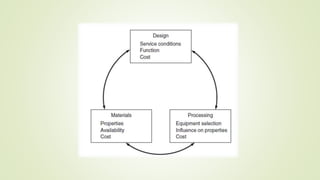
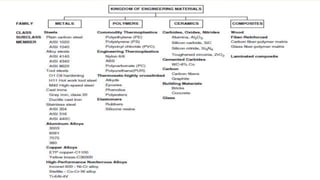
There are over 100,000 engineering materials to choose from. The typical design engineer should have ready access
to information on 30 to 60 materials, depending on the range of applications he or she deals with.
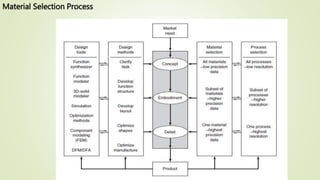
Material Selection Process
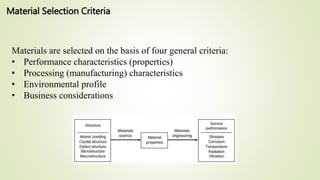
Materials are selected on the basis of four general criteria:
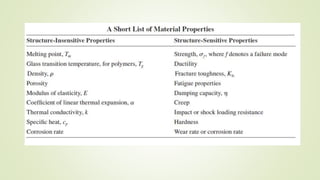
• Performance characteristics (properties)
• Processing (manufacturing) characteristics
• Environmental profile
• Business considerations
Material Selection Criteria
Material Selection Criteria's
1.Availability
 Are there multiple sources of supply?
 What is the likelihood of availability in the future?
 Is the material available in the forms needed (tubes, wide sheet, etc.)?
2. Size limitations and tolerances on available material shapes and forms,
e.g., sheet thickness or tube wall concentricity
3. Excessive variability in properties
4.Environmental impact, including ability to recycle the material
5. Cost. Materials selection comes down to buying properties at the best available
price
Material Selection Example
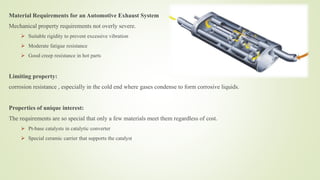
Consider the question of materials selection for an automotive exhaust system. The product
design specification states that it must provide the following functions:
 Conduct engine exhaust gases away from the engine
 Prevent noxious fumes from entering the car
 Cool the exhaust gases
 Reduce the engine noise
 Reduce the exposure of automobile body parts to exhaust gases
 Affect the engine performance as little as possible
 Help control unwanted exhaust emissions
 Have an acceptably long service life
 Have a reasonable cost, both as original equipment and as a replacement part
Material Requirements for an Automotive Exhaust System
Mechanical property requirements not overly severe.
 Suitable rigidity to prevent excessive vibration
 Moderate fatigue resistance
 Good creep resistance in hot parts
Limiting property:
corrosion resistance , especially in the cold end where gases condense to form corrosive liquids.
Properties of unique interest:
The requirements are so special that only a few materials meet them regardless of cost.
 Pt-base catalysts in catalytic converter
 Special ceramic carrier that supports the catalyst
Previous materials used:
Low-carbon steel with corrosion-resistant coatings.
Material is relatively inexpensive, readily formed and welded. Life of tailpipe and muffler is limited.
Newer materials used:
With greater emphasis on automotive quality, many producers have moved to specially developed stainless steels with
improved corrosion and creep properties. Ferritic 11% Cr alloys are used in the cold end components and 17 to 20% Cr
ferritic alloys and austenitic Cr-Ni alloys in the hot end of the system.
Rubber as Washer
Steel as structure support
Polythene as bag
Thermocol for packing Leather as Belt
Titanium alloy for Medical Implants
Why these materials are suitable for particular applications as mentioned bellow
Tolerance
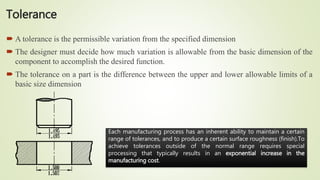
 A tolerance is the permissible variation from the specified dimension
 The designer must decide how much variation is allowable from the basic dimension of the
component to accomplish the desired function.
 The tolerance on a part is the difference between the upper and lower allowable limits of a
basic size dimension
Each manufacturing process has an inherent ability to maintain a certain
range of tolerances, and to produce a certain surface roughness (finish).To
achieve tolerances outside of the normal range requires special
processing that typically results in an exponential increase in the
manufacturing cost.
Types of Tolerance
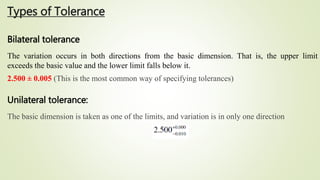
Bilateral tolerance
The variation occurs in both directions from the basic dimension. That is, the upper limit
exceeds the basic value and the lower limit falls below it.
2.500 ± 0.005 (This is the most common way of specifying tolerances)
Unilateral tolerance:
The basic dimension is taken as one of the limits, and variation is in only one direction
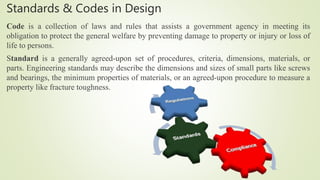
Standards & Codes in Design
Code is a collection of laws and rules that assists a government agency in meeting its
obligation to protect the general welfare by preventing damage to property or injury or loss of
life to persons.
Standard is a generally agreed-upon set of procedures, criteria, dimensions, materials, or
parts. Engineering standards may describe the dimensions and sizes of small parts like screws
and bearings, the minimum properties of materials, or an agreed-upon procedure to measure a
property like fracture toughness.
Some Background:
 The U.S. federal government is the largest single creator
and user of standards: more than 45,000 (by current
estimates)!
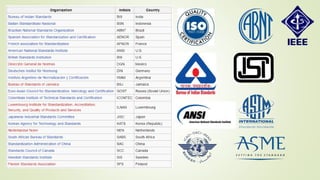
 About 210 organization are designated Standard
Development Organizations (SDO’s)
 Most Standards (about 90%) come from about 20 of these
SDO’s
 ASTM, ASME, IEEE, AISI (ASM), ASCE, MilStd (Mil Specs), are
some of the most important SDO’s
Taking them Global!
 ANSI and (U.S. National Committee (USNC)) are the U.S.
clearing house for Standards and a founding member of ISO!
 Internationally we see Standard Organization in each of the
major Industrial Nations and several Umbrella Groups:
 International Organization for Standardization (ISO)
 International Electro-technical Commission (IEC)
 International Telecommunication Union (ITU)
Why Standards & Codes ?
• it makes the best practice available to everyone, thereby ensuring efficiency and safety.
• it promotes interchangeability and compatibility. With respect to the second point, anyone who has traveled
widely in other countries will understand the compatibility problems with connecting plugs and electrical voltage
and frequency when trying to use small appliances
How they’re used:
 Standards are a
“COMMUNICATION” tool that
allows all users to speak the
same language when reacting to
products or processes
 They provide a “Legal,” or at
least enforceable, means to
evaluate acceptability and sale-
ability of products and/or
services
 They can be taught and applied
globally!
 They, ultimately, are designed to
protect the public from
questionable designs, products
and practices
 They teach us, as
engineers, how we can
best meet environmental,
health, safety and societal
responsibilities
Reference
• George E Dieter, Linda C. Schmidt- Engineering Design
• Dym, C. L., Little, P. and Orwin, E. J., Engineering Design - A
Project based introduction-Wiley
• Haik, Y. And Shahin, M. T., Engineering Design Process, Cengage
Learning
• Balmer, R. T., Keat, W. D., Wise, G., and Kosky, P., Exploring
Engineering, Third Edition: An Introduction to Engineering and
Design
• V.B Bhandari- Design of Machine Elements
• Donald A Norman- Living With Complexity
• Jorma Tuomaala- Creative Engineering Design
• Don Norman- Design of everyday things
www.slideshare.net/naseelazeeniya
Material Selection and Design Standards

Material Selection and Design Standards

  • 1.
    Design & Engineering BE-102 NaseelIbnu Azeez.M.P Asst. Professor, Dept. of Mechanical Engineering, MEA-Engineering College, Perinthalmanna. Email: naseel@live.com Material Selection & Design Standards
  • 2.
    Material Selection There areover 100,000 engineering materials to choose from. The typical design engineer should have ready access to information on 30 to 60 materials, depending on the range of applications he or she deals with.
  • 4.
  • 5.
    Materials are selectedon the basis of four general criteria: • Performance characteristics (properties) • Processing (manufacturing) characteristics • Environmental profile • Business considerations Material Selection Criteria
  • 8.
    Material Selection Criteria's 1.Availability Are there multiple sources of supply?  What is the likelihood of availability in the future?  Is the material available in the forms needed (tubes, wide sheet, etc.)? 2. Size limitations and tolerances on available material shapes and forms, e.g., sheet thickness or tube wall concentricity 3. Excessive variability in properties 4.Environmental impact, including ability to recycle the material 5. Cost. Materials selection comes down to buying properties at the best available price
  • 9.
    Material Selection Example Considerthe question of materials selection for an automotive exhaust system. The product design specification states that it must provide the following functions:  Conduct engine exhaust gases away from the engine  Prevent noxious fumes from entering the car  Cool the exhaust gases  Reduce the engine noise  Reduce the exposure of automobile body parts to exhaust gases  Affect the engine performance as little as possible  Help control unwanted exhaust emissions  Have an acceptably long service life  Have a reasonable cost, both as original equipment and as a replacement part
  • 10.
    Material Requirements foran Automotive Exhaust System Mechanical property requirements not overly severe.  Suitable rigidity to prevent excessive vibration  Moderate fatigue resistance  Good creep resistance in hot parts Limiting property: corrosion resistance , especially in the cold end where gases condense to form corrosive liquids. Properties of unique interest: The requirements are so special that only a few materials meet them regardless of cost.  Pt-base catalysts in catalytic converter  Special ceramic carrier that supports the catalyst
  • 11.
    Previous materials used: Low-carbonsteel with corrosion-resistant coatings. Material is relatively inexpensive, readily formed and welded. Life of tailpipe and muffler is limited. Newer materials used: With greater emphasis on automotive quality, many producers have moved to specially developed stainless steels with improved corrosion and creep properties. Ferritic 11% Cr alloys are used in the cold end components and 17 to 20% Cr ferritic alloys and austenitic Cr-Ni alloys in the hot end of the system.
  • 12.
    Rubber as Washer Steelas structure support Polythene as bag Thermocol for packing Leather as Belt Titanium alloy for Medical Implants Why these materials are suitable for particular applications as mentioned bellow
  • 13.
    Tolerance  A toleranceis the permissible variation from the specified dimension  The designer must decide how much variation is allowable from the basic dimension of the component to accomplish the desired function.  The tolerance on a part is the difference between the upper and lower allowable limits of a basic size dimension Each manufacturing process has an inherent ability to maintain a certain range of tolerances, and to produce a certain surface roughness (finish).To achieve tolerances outside of the normal range requires special processing that typically results in an exponential increase in the manufacturing cost.
  • 14.
    Types of Tolerance Bilateraltolerance The variation occurs in both directions from the basic dimension. That is, the upper limit exceeds the basic value and the lower limit falls below it. 2.500 ± 0.005 (This is the most common way of specifying tolerances) Unilateral tolerance: The basic dimension is taken as one of the limits, and variation is in only one direction
  • 15.
    Standards & Codesin Design Code is a collection of laws and rules that assists a government agency in meeting its obligation to protect the general welfare by preventing damage to property or injury or loss of life to persons. Standard is a generally agreed-upon set of procedures, criteria, dimensions, materials, or parts. Engineering standards may describe the dimensions and sizes of small parts like screws and bearings, the minimum properties of materials, or an agreed-upon procedure to measure a property like fracture toughness.
  • 16.
    Some Background:  TheU.S. federal government is the largest single creator and user of standards: more than 45,000 (by current estimates)!  About 210 organization are designated Standard Development Organizations (SDO’s)  Most Standards (about 90%) come from about 20 of these SDO’s  ASTM, ASME, IEEE, AISI (ASM), ASCE, MilStd (Mil Specs), are some of the most important SDO’s
  • 17.
    Taking them Global! ANSI and (U.S. National Committee (USNC)) are the U.S. clearing house for Standards and a founding member of ISO!  Internationally we see Standard Organization in each of the major Industrial Nations and several Umbrella Groups:  International Organization for Standardization (ISO)  International Electro-technical Commission (IEC)  International Telecommunication Union (ITU)
  • 18.
    Why Standards &Codes ? • it makes the best practice available to everyone, thereby ensuring efficiency and safety. • it promotes interchangeability and compatibility. With respect to the second point, anyone who has traveled widely in other countries will understand the compatibility problems with connecting plugs and electrical voltage and frequency when trying to use small appliances
  • 19.
    How they’re used: Standards are a “COMMUNICATION” tool that allows all users to speak the same language when reacting to products or processes  They provide a “Legal,” or at least enforceable, means to evaluate acceptability and sale- ability of products and/or services  They can be taught and applied globally!  They, ultimately, are designed to protect the public from questionable designs, products and practices  They teach us, as engineers, how we can best meet environmental, health, safety and societal responsibilities
  • 21.
    Reference • George EDieter, Linda C. Schmidt- Engineering Design • Dym, C. L., Little, P. and Orwin, E. J., Engineering Design - A Project based introduction-Wiley • Haik, Y. And Shahin, M. T., Engineering Design Process, Cengage Learning • Balmer, R. T., Keat, W. D., Wise, G., and Kosky, P., Exploring Engineering, Third Edition: An Introduction to Engineering and Design • V.B Bhandari- Design of Machine Elements • Donald A Norman- Living With Complexity • Jorma Tuomaala- Creative Engineering Design • Don Norman- Design of everyday things www.slideshare.net/naseelazeeniya