CENTRAL INSTITUTE OF PLASTICS ENGINEERING & TECHNOLGOY
               GUINDY, CHENNAI - 600 032


        MATERIAL SELECTION
          CRITERIA FOR
         SPECIFIC END USE

                Dr.T.O. VARGHEESE
                 CIPET, CHENNAI
How do we decide which Plastics, if any,
is best for a particular application?
Material Selection is not as difficult as it might
appear but it does require an awareness of the
general behaviour of plastics as a group , as
well as a familiarity with the special
characteristics of individual plastics.

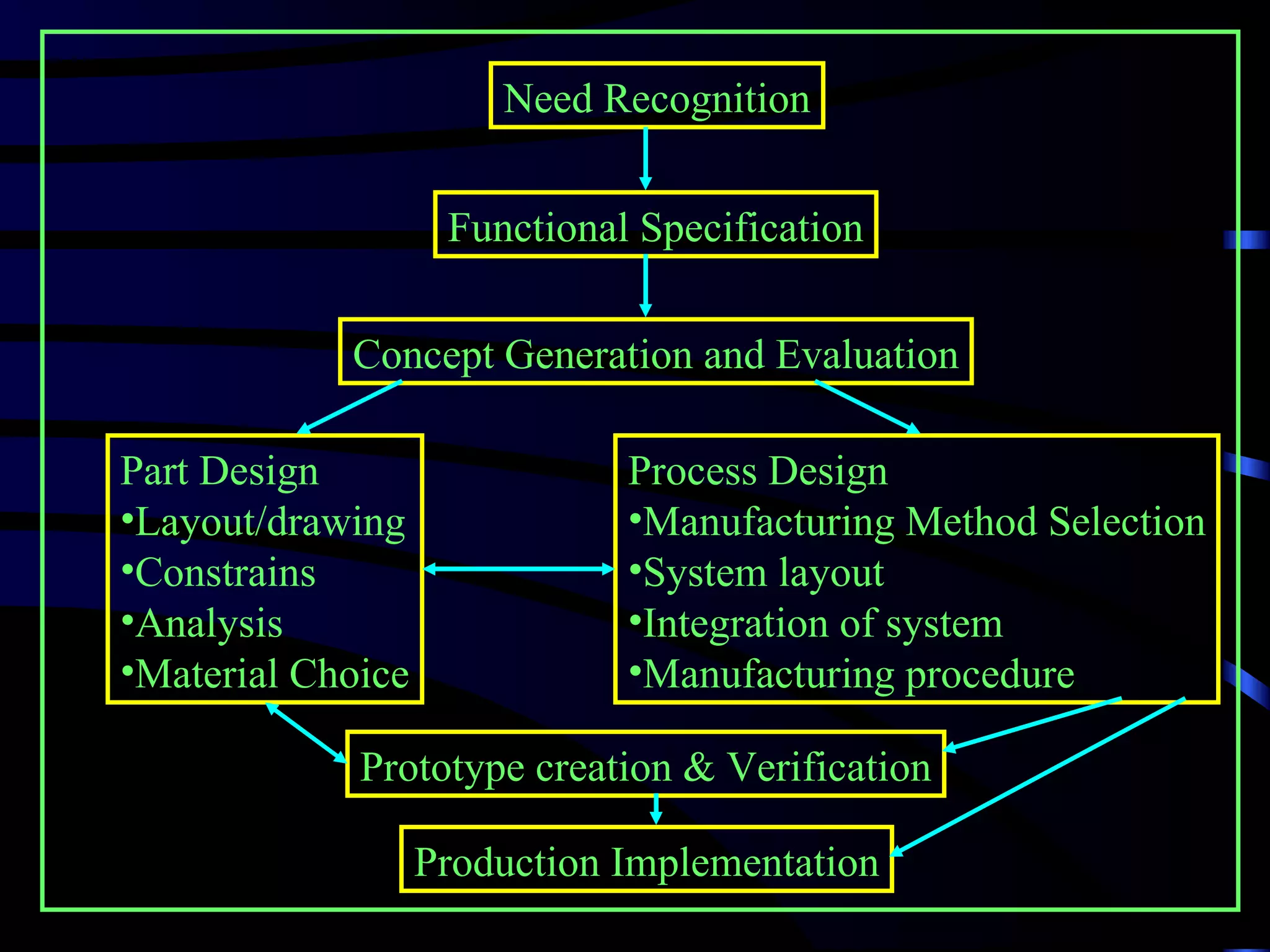
Need Recognition


                    Functional Specification


            Concept Generation and Evaluation

Part Design                   Process Design
•Layout/drawing               •Manufacturing Method Selection
•Constrains                   •System layout
•Analysis                     •Integration of system
•Material Choice              •Manufacturing procedure

             Prototype creation & Verification

                   Production Implementation
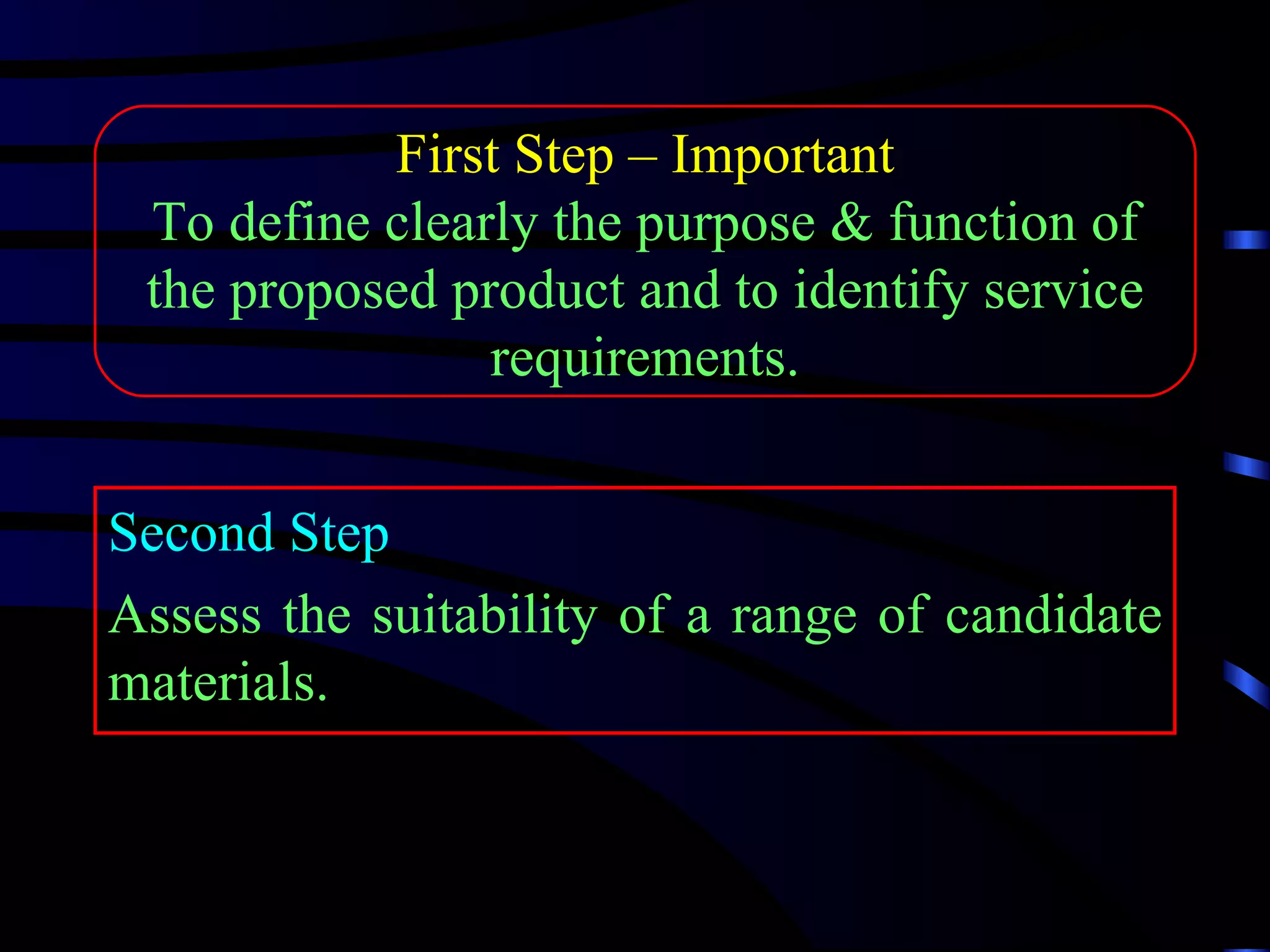
First Step – Important
 To define clearly the purpose & function of
 the proposed product and to identify service
                requirements.


Second Step
Assess the suitability of a range of candidate
materials.
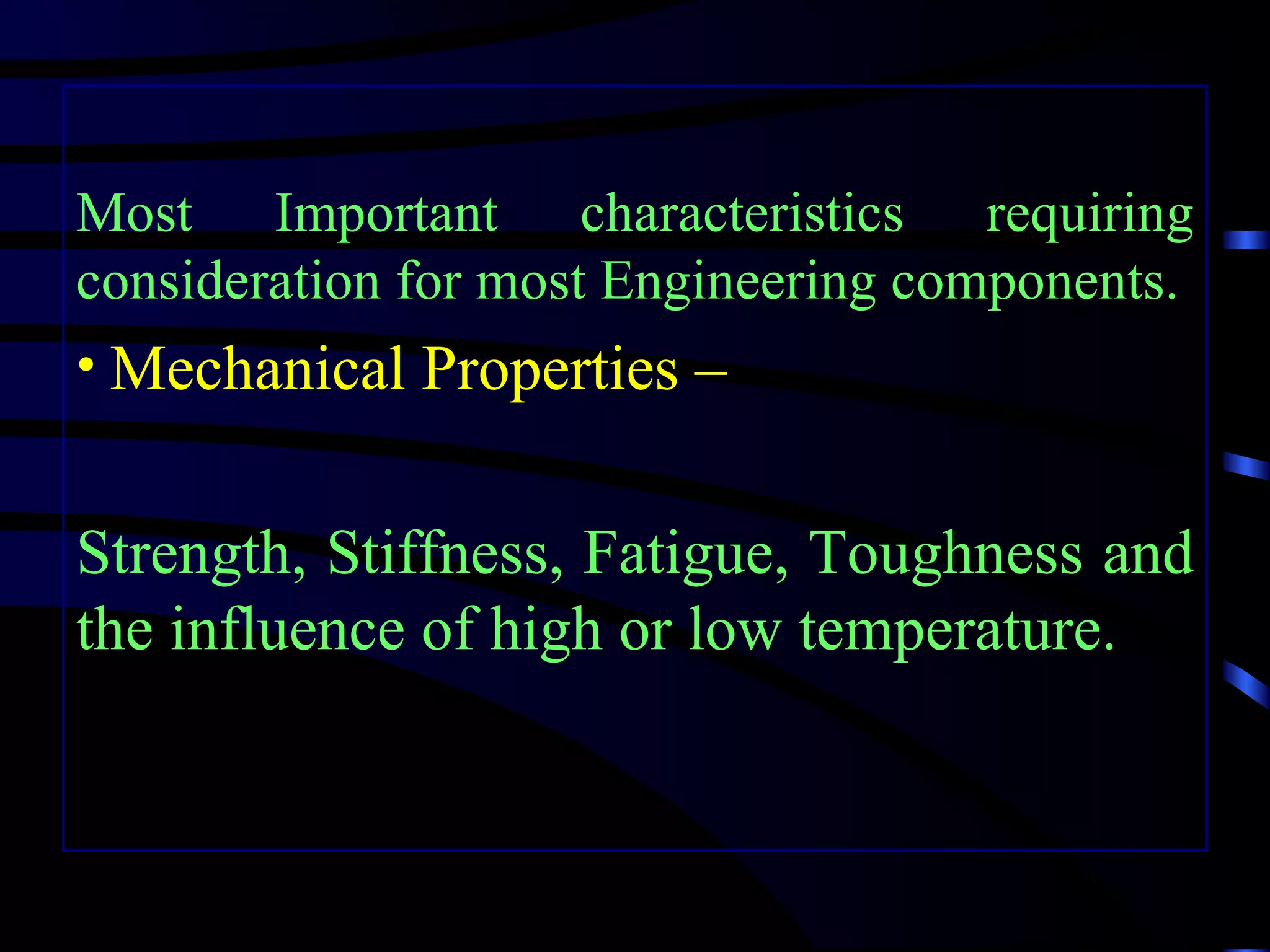
Most Important characteristics requiring
consideration for most Engineering components.
• Mechanical Properties –


Strength, Stiffness, Fatigue, Toughness and
the influence of high or low temperature.
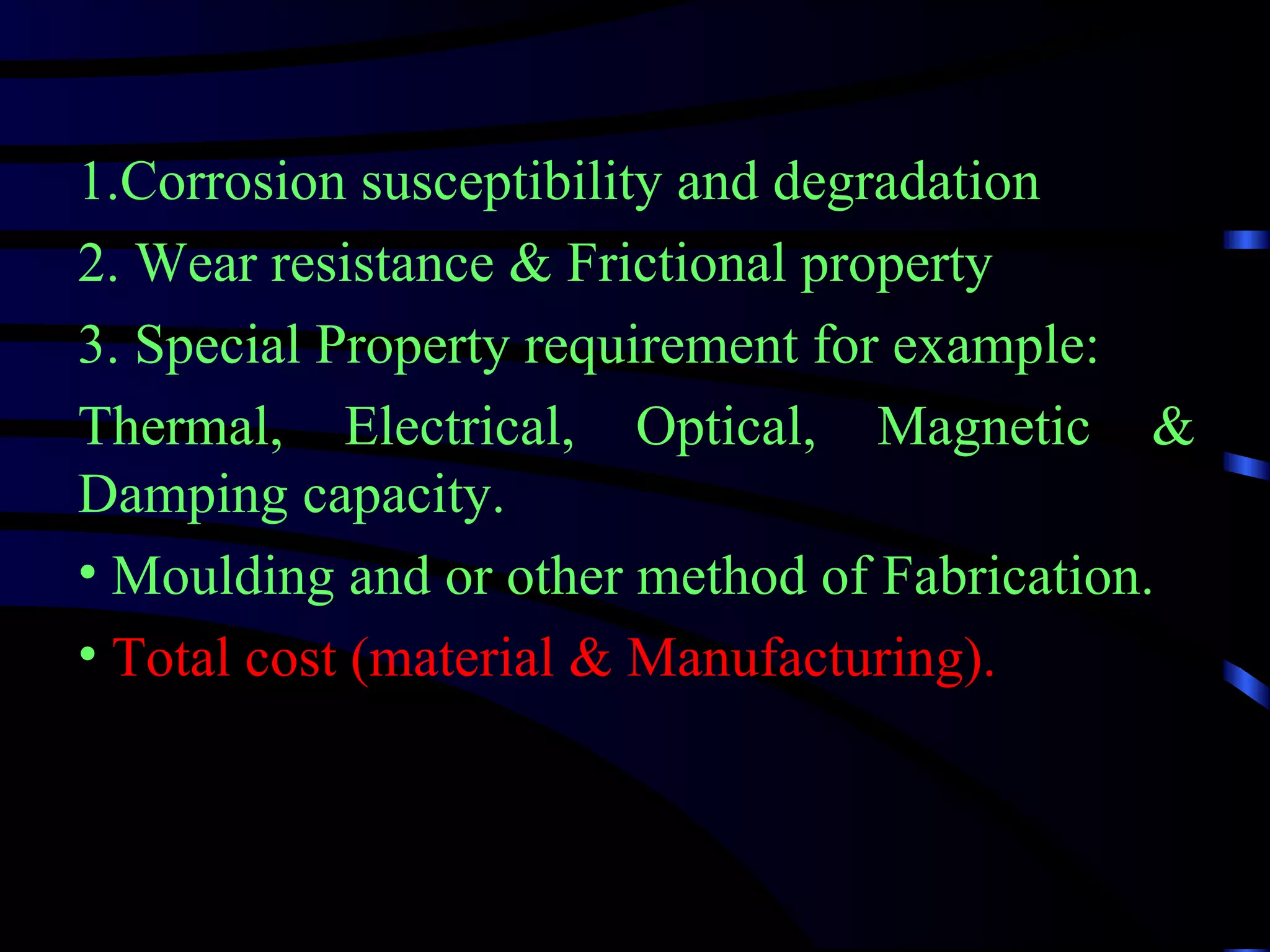
1.Corrosion susceptibility and degradation
2. Wear resistance & Frictional property
3. Special Property requirement for example:
Thermal, Electrical, Optical, Magnetic &
Damping capacity.
• Moulding and or other method of Fabrication.
• Total cost (material & Manufacturing).
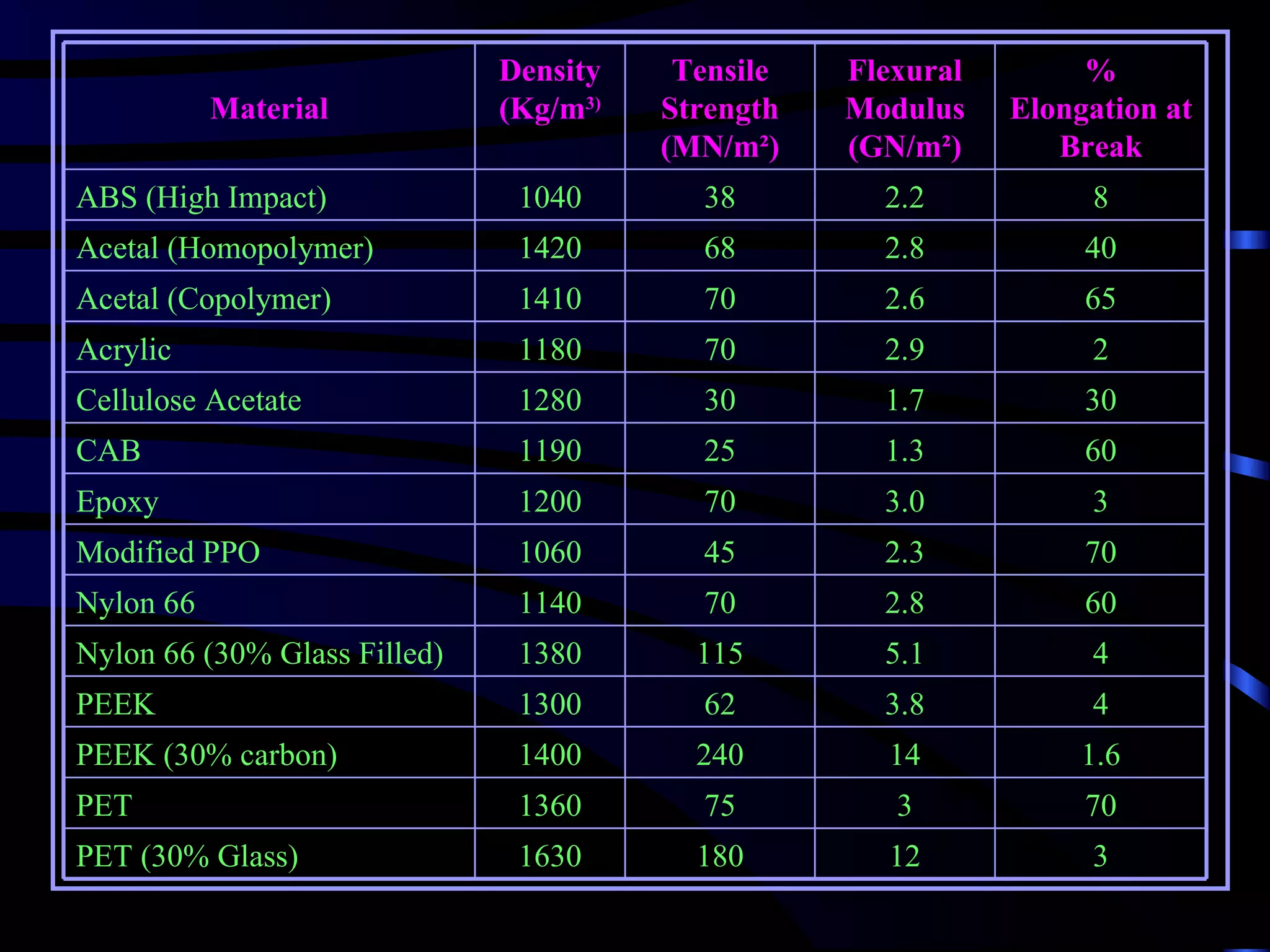
Density    Tensile   Flexural        %
           Material           (Kg/m3)   Strength   Modulus    Elongation at
                                        (MN/m²)    (GN/m²)       Break
ABS (High Impact)              1040       38         2.2           8
Acetal (Homopolymer)           1420       68         2.8           40
Acetal (Copolymer)             1410       70         2.6           65
Acrylic                        1180       70         2.9           2
Cellulose Acetate              1280       30         1.7           30
CAB                            1190       25         1.3           60
Epoxy                          1200       70         3.0           3
Modified PPO                   1060       45         2.3           70
Nylon 66                       1140       70         2.8           60
Nylon 66 (30% Glass Filled)    1380       115        5.1           4
PEEK                           1300       62         3.8           4
PEEK (30% carbon)              1400       240        14            1.6
PET                            1360       75          3            70
PET (30% Glass)                1630       180        12            3
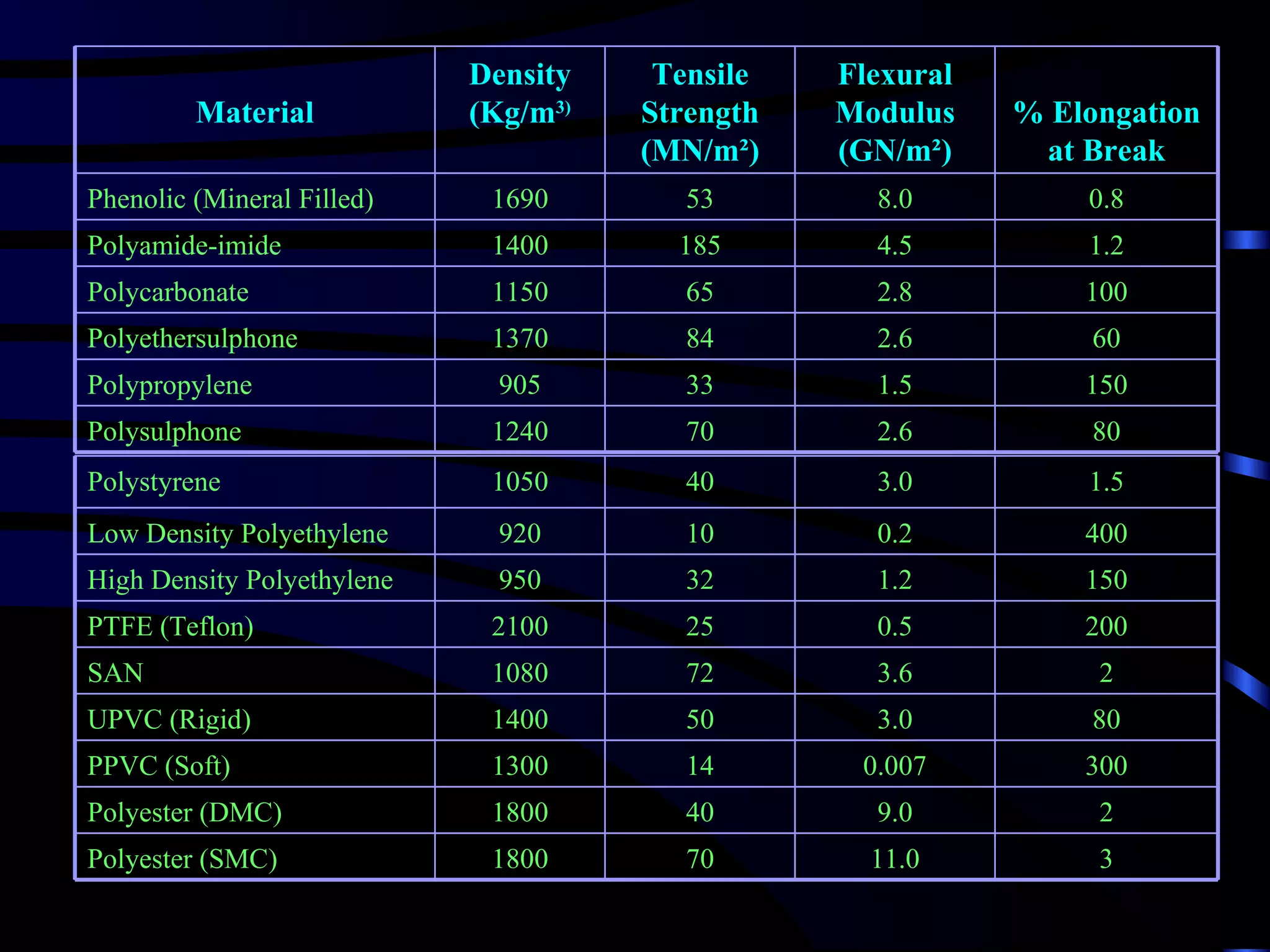
Density    Tensile   Flexural
         Material           (Kg/m3)   Strength   Modulus    % Elongation
                                      (MN/m²)    (GN/m²)     at Break
Phenolic (Mineral Filled)    1690        53        8.0          0.8
Polyamide-imide              1400       185        4.5          1.2
Polycarbonate                1150        65        2.8          100
Polyethersulphone            1370        84        2.6           60
Polypropylene                 905        33        1.5          150
Polysulphone                 1240        70        2.6           80
Polystyrene                  1050        40        3.0          1.5
Low Density Polyethylene      920        10        0.2          400
High Density Polyethylene     950        32        1.2          150
PTFE (Teflon)                2100        25        0.5          200
SAN                          1080        72        3.6           2
UPVC (Rigid)                 1400        50        3.0           80
PPVC (Soft)                  1300        14       0.007         300
Polyester (DMC)              1800        40        9.0           2
Polyester (SMC)              1800        70        11.0          3
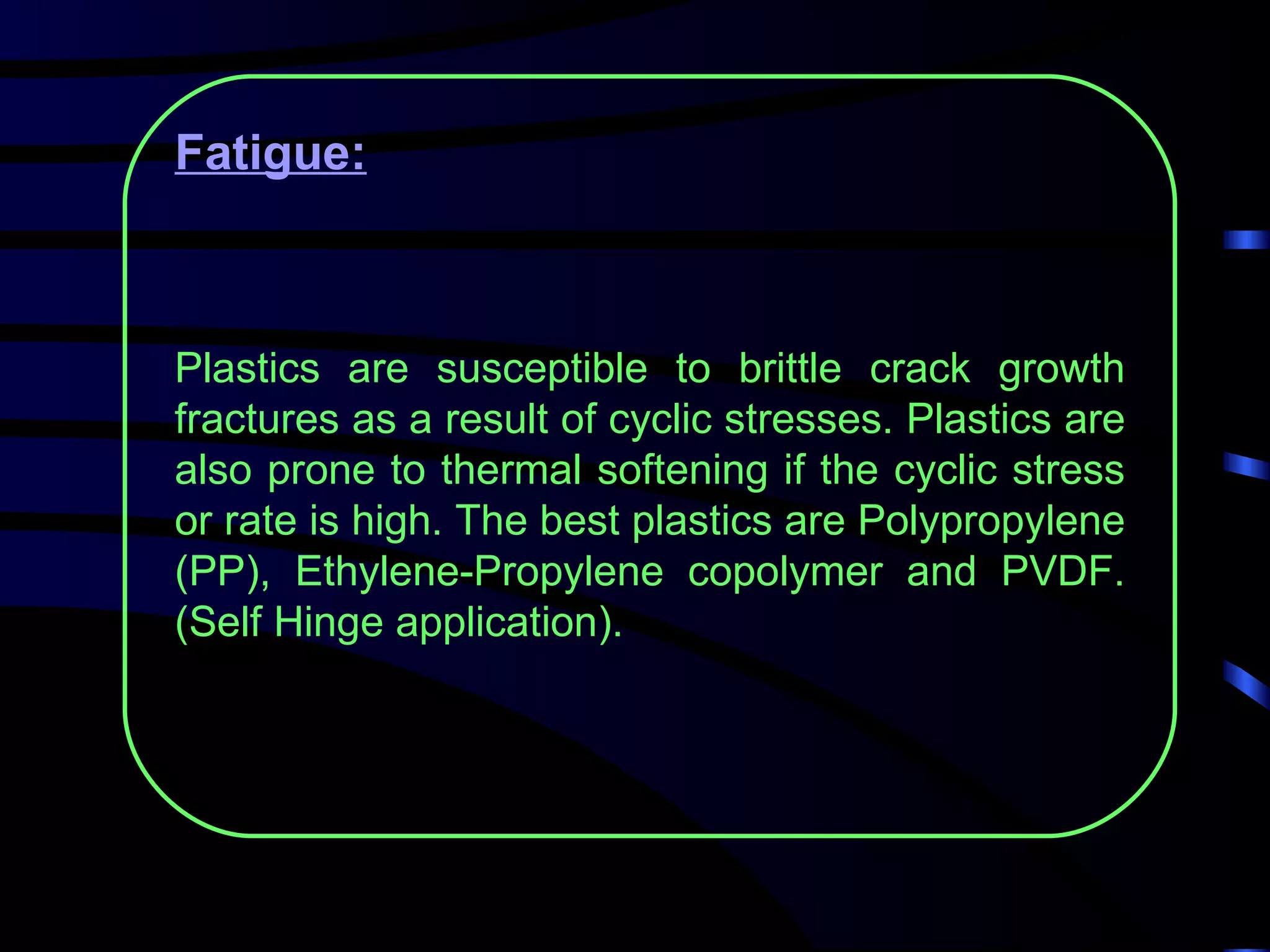
Fatigue:


Plastics are susceptible to brittle crack growth
fractures as a result of cyclic stresses. Plastics are
also prone to thermal softening if the cyclic stress
or rate is high. The best plastics are Polypropylene
(PP), Ethylene-Propylene copolymer and PVDF.
(Self Hinge application).
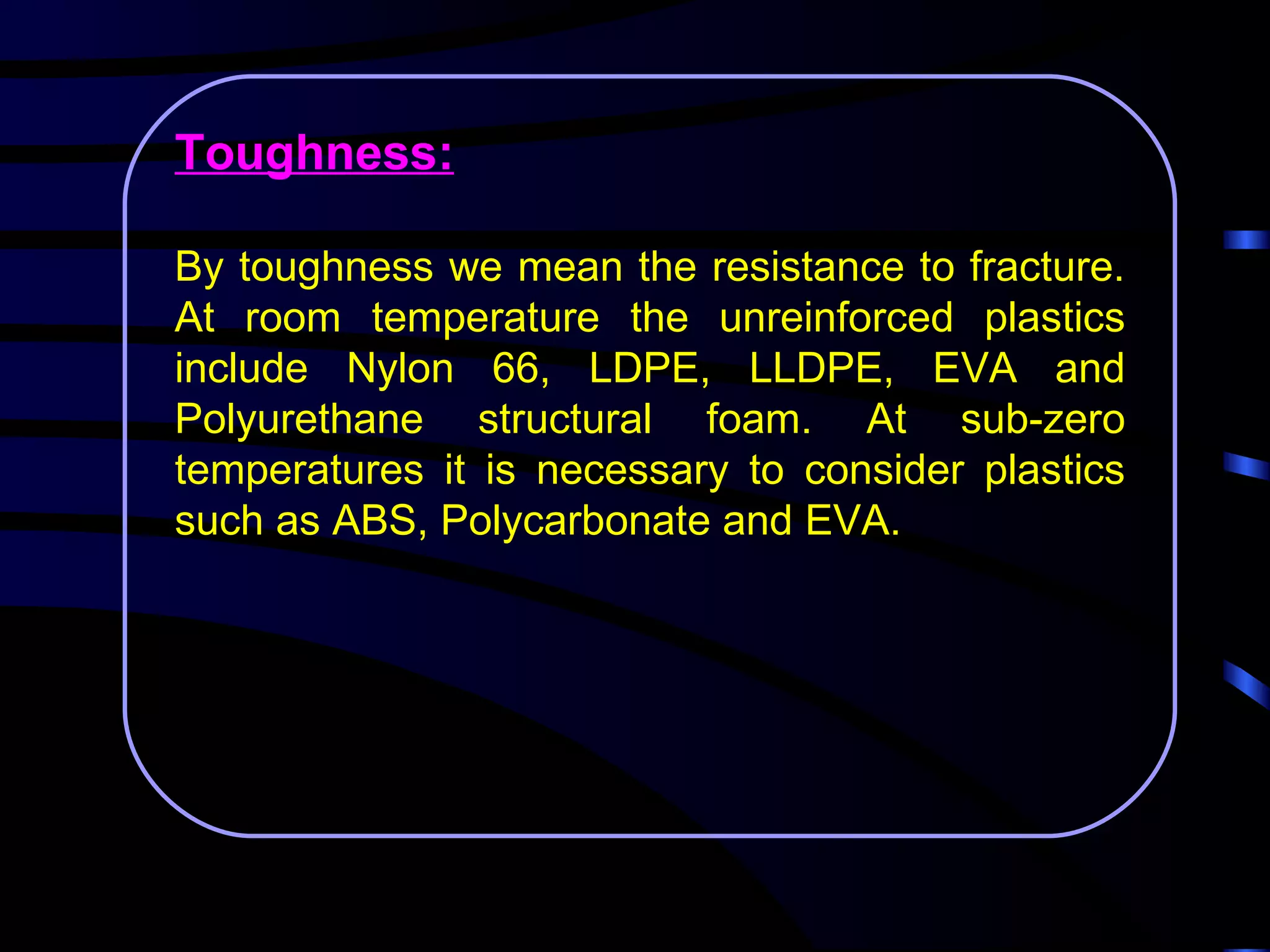
Toughness:

By toughness we mean the resistance to fracture.
At room temperature the unreinforced plastics
include Nylon 66, LDPE, LLDPE, EVA and
Polyurethane structural foam. At sub-zero
temperatures it is necessary to consider plastics
such as ABS, Polycarbonate and EVA.
Degradation:

Physical or Chemical attack:

Plastics are best corrosion resistance material.
Plastics are susceptible to chemical attack and
degradation. Degradation of plastics is also
caused by heat, stress and radiation. Generally
Crystalline plastics offer better environmental
resistance than Amorphous. Nylon 66, PEEK &
PPS. Noknown solvent at room temperature for
PP, PE, PPS & PEEK.
Weathering:

This generally occurs as a result of the combined
effect of water absorption and exposure to Ultra-
Violate radiation.

Oxidation:

This is caused by contact with oxidising acids,
exposure to UV.
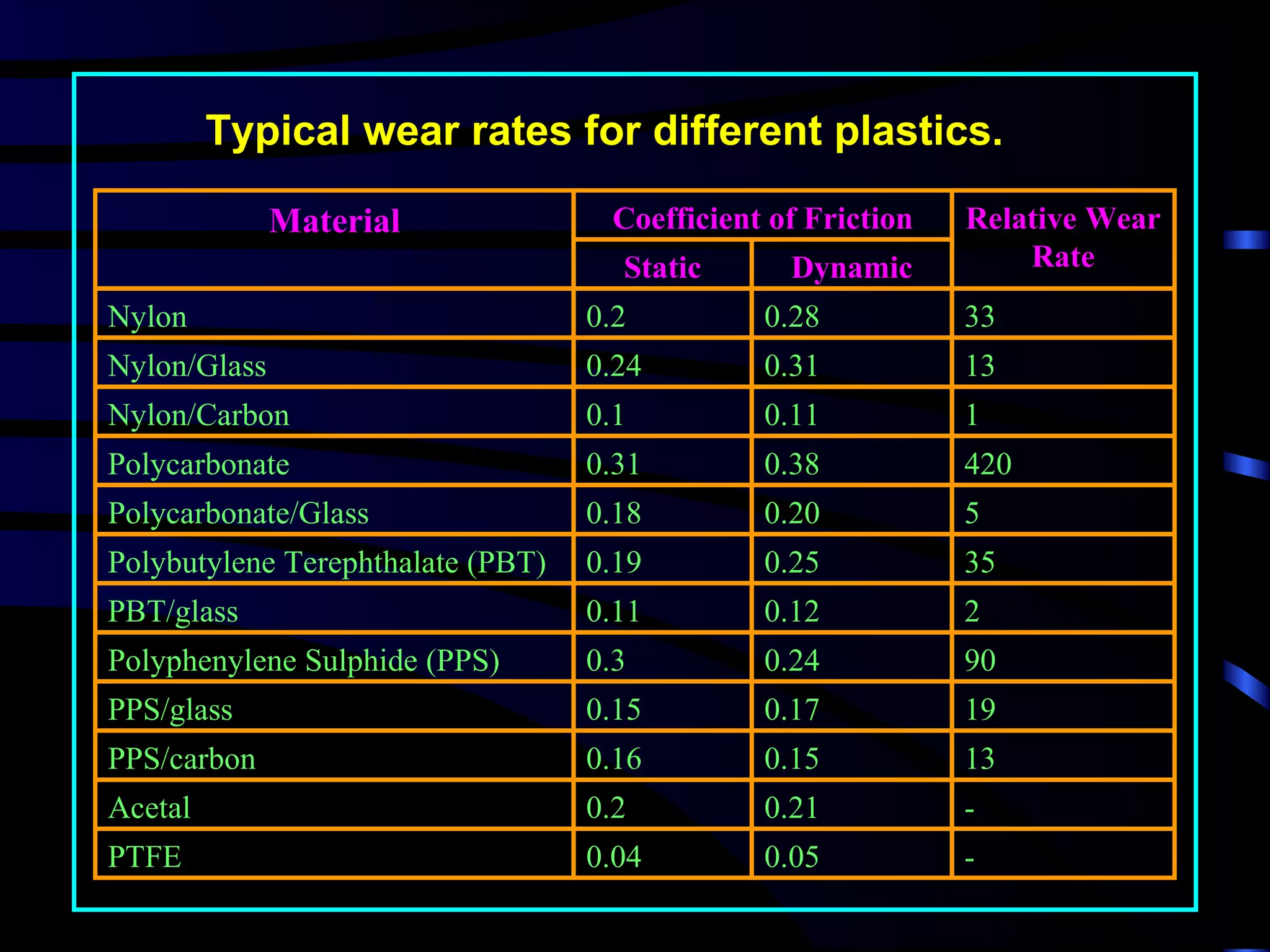
Wear Resistance and Frictional Properties:

The use of plastics in bearing application and in
situation where there is sliding contact e. g. gears,
piston rings, seals cams etc. The advantage of
plastics are low rates of wear in the absence of
conventional lubricants, low cof. The ability to
absorb shock and vibration with the ability to
operate with low noise and power consumption.
The plastics with the best resistance to wear are
Ultra High Molecular Weight Polyethylene (used in
Hip joint replacement) and PTFE lubricated
Polyamide (Nylon), Acetal & PBT
The plastics with the best resistance to wear are Ultra
High Molecular Weight Polyethylene (used in Hip joint
replacement) and PTFE lubricated Polyamide (Nylon),
Acetal & PBT. It is NOT recommended to use the same
plastics for both mating surfaces in applications such as
gear wheels.
Typical wear rates for different plastics.

              Material              Coefficient of Friction   Relative Wear
                                     Static      Dynamic          Rate
Nylon                              0.2         0.28           33
Nylon/Glass                        0.24        0.31           13
Nylon/Carbon                       0.1         0.11           1
Polycarbonate                      0.31        0.38           420
Polycarbonate/Glass                0.18        0.20           5
Polybutylene Terephthalate (PBT)   0.19        0.25           35
PBT/glass                          0.11        0.12           2
Polyphenylene Sulphide (PPS)       0.3         0.24           90
PPS/glass                          0.15        0.17           19
PPS/carbon                         0.16        0.15           13
Acetal                             0.2         0.21           -
PTFE                               0.04        0.05           -
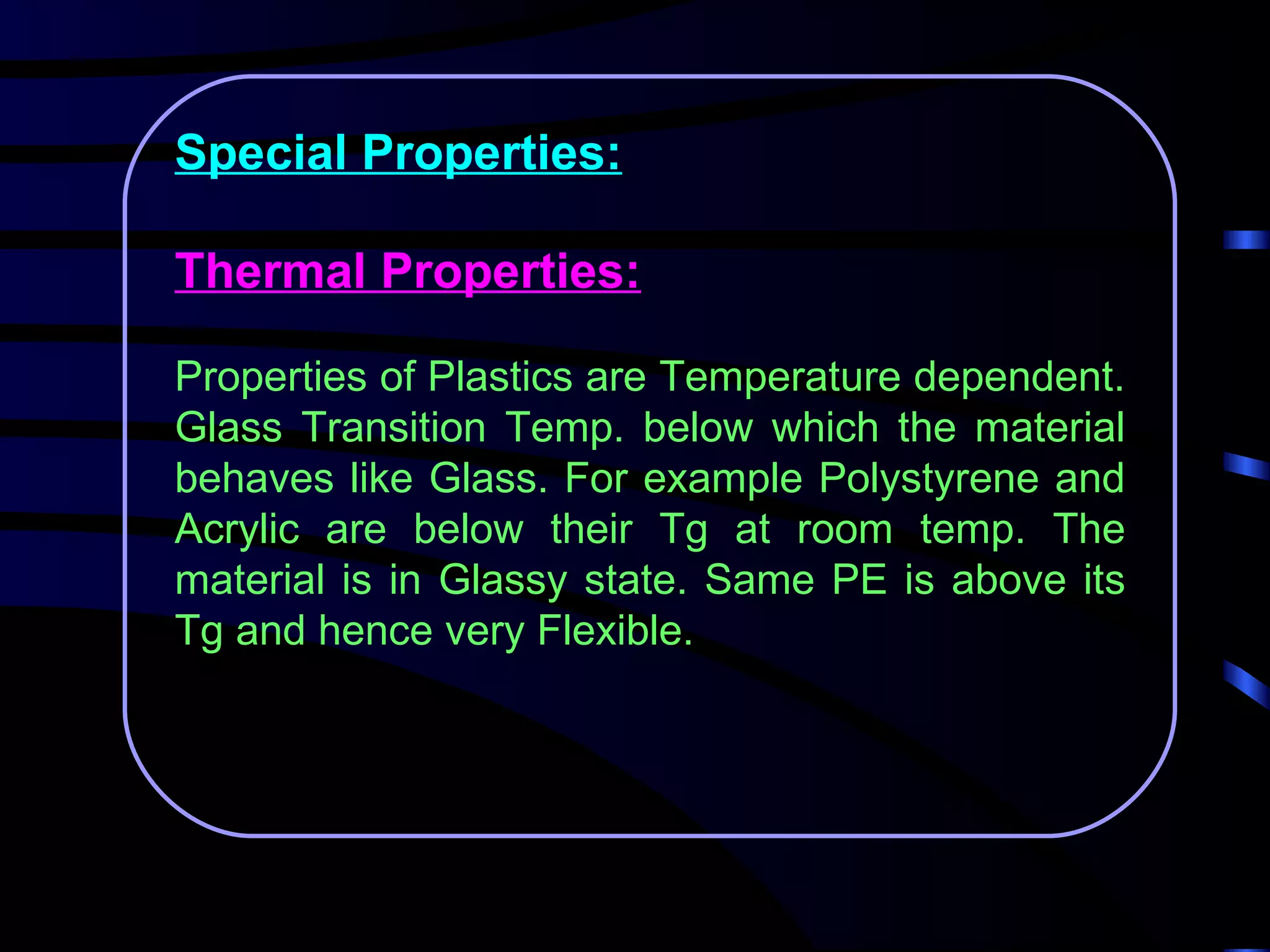
Special Properties:

Thermal Properties:

Properties of Plastics are Temperature dependent.
Glass Transition Temp. below which the material
behaves like Glass. For example Polystyrene and
Acrylic are below their Tg at room temp. The
material is in Glassy state. Same PE is above its
Tg and hence very Flexible.
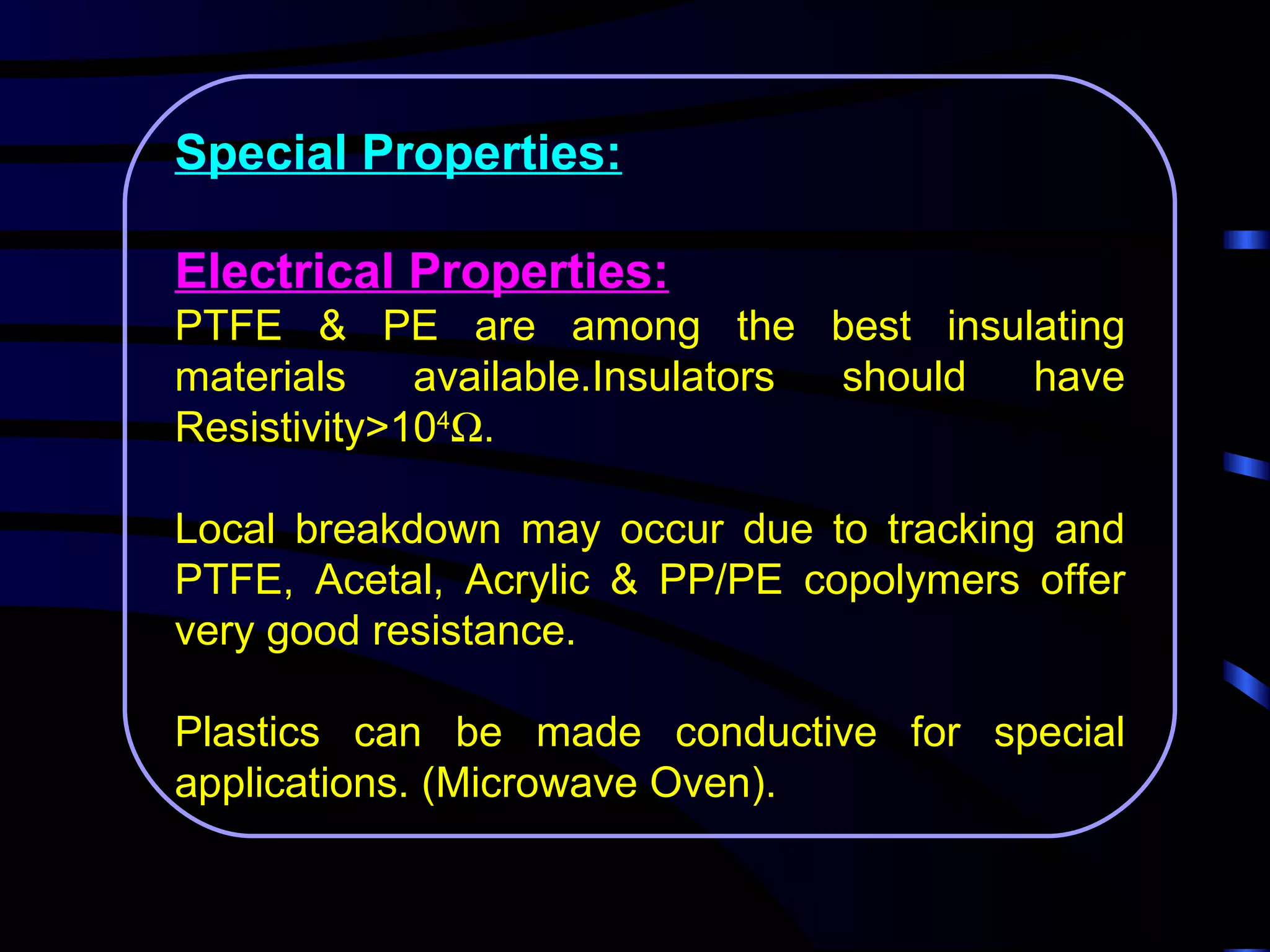
Special Properties:

Electrical Properties:
PTFE & PE are among the best insulating
materials    available.Insulators should have
Resistivity>104Ω.

Local breakdown may occur due to tracking and
PTFE, Acetal, Acrylic & PP/PE copolymers offer
very good resistance.

Plastics can be made conductive for special
applications. (Microwave Oven).
Conveyor
Hair dryer housing
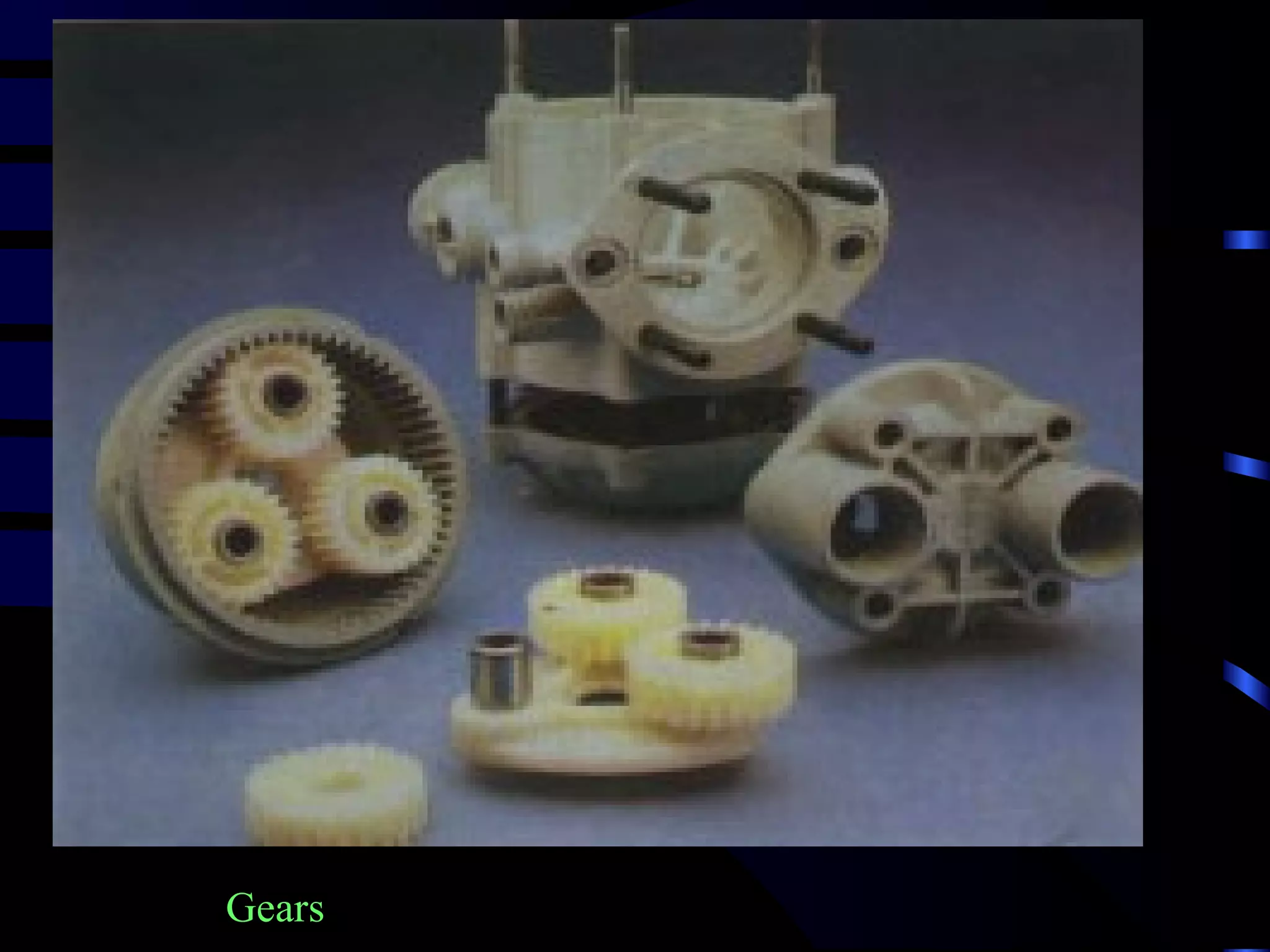
Gears
Compact disk
Water bottles
5.material selection criteria

5.material selection criteria

  • 1.
    CENTRAL INSTITUTE OFPLASTICS ENGINEERING & TECHNOLGOY GUINDY, CHENNAI - 600 032 MATERIAL SELECTION CRITERIA FOR SPECIFIC END USE Dr.T.O. VARGHEESE CIPET, CHENNAI
  • 2.
    How do wedecide which Plastics, if any, is best for a particular application? Material Selection is not as difficult as it might appear but it does require an awareness of the general behaviour of plastics as a group , as well as a familiarity with the special characteristics of individual plastics.
  • 3.
    Need Recognition Functional Specification Concept Generation and Evaluation Part Design Process Design •Layout/drawing •Manufacturing Method Selection •Constrains •System layout •Analysis •Integration of system •Material Choice •Manufacturing procedure Prototype creation & Verification Production Implementation
  • 4.
    First Step –Important To define clearly the purpose & function of the proposed product and to identify service requirements. Second Step Assess the suitability of a range of candidate materials.
  • 5.
    Most Important characteristicsrequiring consideration for most Engineering components. • Mechanical Properties – Strength, Stiffness, Fatigue, Toughness and the influence of high or low temperature.
  • 6.
    1.Corrosion susceptibility anddegradation 2. Wear resistance & Frictional property 3. Special Property requirement for example: Thermal, Electrical, Optical, Magnetic & Damping capacity. • Moulding and or other method of Fabrication. • Total cost (material & Manufacturing).
  • 7.
    Density Tensile Flexural % Material (Kg/m3) Strength Modulus Elongation at (MN/m²) (GN/m²) Break ABS (High Impact) 1040 38 2.2 8 Acetal (Homopolymer) 1420 68 2.8 40 Acetal (Copolymer) 1410 70 2.6 65 Acrylic 1180 70 2.9 2 Cellulose Acetate 1280 30 1.7 30 CAB 1190 25 1.3 60 Epoxy 1200 70 3.0 3 Modified PPO 1060 45 2.3 70 Nylon 66 1140 70 2.8 60 Nylon 66 (30% Glass Filled) 1380 115 5.1 4 PEEK 1300 62 3.8 4 PEEK (30% carbon) 1400 240 14 1.6 PET 1360 75 3 70 PET (30% Glass) 1630 180 12 3
  • 8.
    Density Tensile Flexural Material (Kg/m3) Strength Modulus % Elongation (MN/m²) (GN/m²) at Break Phenolic (Mineral Filled) 1690 53 8.0 0.8 Polyamide-imide 1400 185 4.5 1.2 Polycarbonate 1150 65 2.8 100 Polyethersulphone 1370 84 2.6 60 Polypropylene 905 33 1.5 150 Polysulphone 1240 70 2.6 80 Polystyrene 1050 40 3.0 1.5 Low Density Polyethylene 920 10 0.2 400 High Density Polyethylene 950 32 1.2 150 PTFE (Teflon) 2100 25 0.5 200 SAN 1080 72 3.6 2 UPVC (Rigid) 1400 50 3.0 80 PPVC (Soft) 1300 14 0.007 300 Polyester (DMC) 1800 40 9.0 2 Polyester (SMC) 1800 70 11.0 3
  • 9.
    Fatigue: Plastics are susceptibleto brittle crack growth fractures as a result of cyclic stresses. Plastics are also prone to thermal softening if the cyclic stress or rate is high. The best plastics are Polypropylene (PP), Ethylene-Propylene copolymer and PVDF. (Self Hinge application).
  • 10.
    Toughness: By toughness wemean the resistance to fracture. At room temperature the unreinforced plastics include Nylon 66, LDPE, LLDPE, EVA and Polyurethane structural foam. At sub-zero temperatures it is necessary to consider plastics such as ABS, Polycarbonate and EVA.
  • 11.
    Degradation: Physical or Chemicalattack: Plastics are best corrosion resistance material. Plastics are susceptible to chemical attack and degradation. Degradation of plastics is also caused by heat, stress and radiation. Generally Crystalline plastics offer better environmental resistance than Amorphous. Nylon 66, PEEK & PPS. Noknown solvent at room temperature for PP, PE, PPS & PEEK.
  • 12.
    Weathering: This generally occursas a result of the combined effect of water absorption and exposure to Ultra- Violate radiation. Oxidation: This is caused by contact with oxidising acids, exposure to UV.
  • 13.
    Wear Resistance andFrictional Properties: The use of plastics in bearing application and in situation where there is sliding contact e. g. gears, piston rings, seals cams etc. The advantage of plastics are low rates of wear in the absence of conventional lubricants, low cof. The ability to absorb shock and vibration with the ability to operate with low noise and power consumption. The plastics with the best resistance to wear are Ultra High Molecular Weight Polyethylene (used in Hip joint replacement) and PTFE lubricated Polyamide (Nylon), Acetal & PBT
  • 14.
    The plastics withthe best resistance to wear are Ultra High Molecular Weight Polyethylene (used in Hip joint replacement) and PTFE lubricated Polyamide (Nylon), Acetal & PBT. It is NOT recommended to use the same plastics for both mating surfaces in applications such as gear wheels.
  • 15.
    Typical wear ratesfor different plastics. Material Coefficient of Friction Relative Wear Static Dynamic Rate Nylon 0.2 0.28 33 Nylon/Glass 0.24 0.31 13 Nylon/Carbon 0.1 0.11 1 Polycarbonate 0.31 0.38 420 Polycarbonate/Glass 0.18 0.20 5 Polybutylene Terephthalate (PBT) 0.19 0.25 35 PBT/glass 0.11 0.12 2 Polyphenylene Sulphide (PPS) 0.3 0.24 90 PPS/glass 0.15 0.17 19 PPS/carbon 0.16 0.15 13 Acetal 0.2 0.21 - PTFE 0.04 0.05 -
  • 16.
    Special Properties: Thermal Properties: Propertiesof Plastics are Temperature dependent. Glass Transition Temp. below which the material behaves like Glass. For example Polystyrene and Acrylic are below their Tg at room temp. The material is in Glassy state. Same PE is above its Tg and hence very Flexible.
  • 17.
    Special Properties: Electrical Properties: PTFE& PE are among the best insulating materials available.Insulators should have Resistivity>104Ω. Local breakdown may occur due to tracking and PTFE, Acetal, Acrylic & PP/PE copolymers offer very good resistance. Plastics can be made conductive for special applications. (Microwave Oven).
  • 29.
  • 30.
  • 31.
  • 32.
  • 33.