Introduction to Plastic
material selection
▪ Engineers face several considerations when selecting the
optimum polymer material for a product
• Knowing full product requirements in a wide range of
environments
• Thoroughly understanding of the true functional behavior of the
polymer
• Using this knowledge to sift through an almost infinite
number of resin/additive combinations
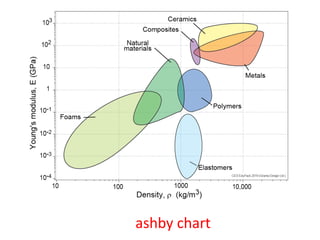
ashby chart
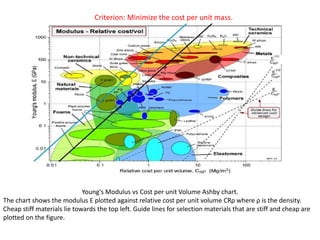
Young's Modulus vs Cost per unit Volume Ashby chart.
The chart shows the modulus E plotted against relative cost per unit volume CRρ where ρ is the density.
Cheap stiff materials lie towards the top left. Guide lines for selection materials that are stiff and cheap are
plotted on the figure.
Criterion: Minimize the cost per unit mass.
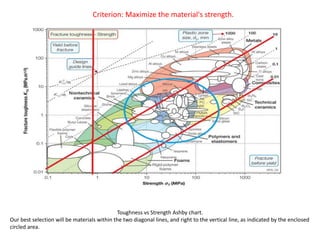
Toughness vs Strength Ashby chart.
Our best selection will be materials within the two diagonal lines, and right to the vertical line, as indicated by the enclosed
circled area.
Criterion: Maximize the material's strength.
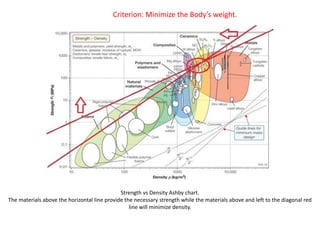
Strength vs Density Ashby chart.
The materials above the horizontal line provide the necessary strength while the materials above and left to the diagonal red
line will minimize density.
Criterion: Minimize the Body's weight.
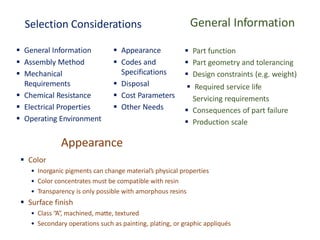
Selection Considerations
▪ General Information ▪ Appearance
▪ Assembly Method
▪ Mechanical
Requirements
▪ Chemical Resistance
▪ Electrical Properties
▪ Operating Environment
▪ Codes and
Specifications
▪ Disposal
▪ Cost Parameters
▪ Other Needs
General Information
▪ Part function
▪ Part geometry and tolerancing
▪ Design constraints (e.g. weight)
Servicing requirements
▪ Consequences of part failure
▪ Production scale
▪ Required service life
Appearance
▪ Color
• Inorganic pigments can change material’s physical properties
• Color concentrates must be compatible with resin
• Transparency is only possible with amorphous resins
▪ Surface finish
• Class “A”, machined, matte, textured
• Secondary operations such as painting, plating, or graphic appliqués
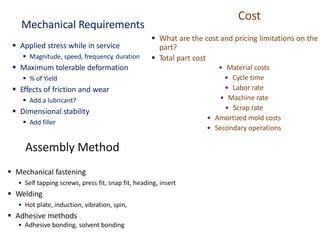
Mechanical Requirements
▪ Applied stress while in service
▪ Magnitude, speed, frequency, duration
▪ Maximum tolerable deformation
▪ % of Yield
▪ Effects of friction and wear
▪ Add a lubricant?
▪ Dimensional stability
▪ Add filler
Assembly Method
▪ Mechanical fastening
• Self tapping screws, press fit, snap fit, heading, insert
▪ Welding
• Hot plate, induction, vibration, spin,
▪ Adhesive methods
• Adhesive bonding, solvent bonding
Cost
▪ What are the cost and pricing limitations on the
part?
▪ Total part cost
• Material costs
• Cycle time
• Labor rate
• Machine rate
• Scrap rate
• Amortized mold costs
• Secondary operations
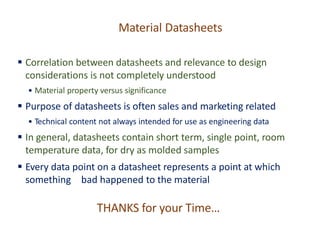
Material Datasheets
▪ Correlation between datasheets and relevance to design
considerations is not completely understood
• Material property versus significance
▪ Purpose of datasheets is often sales and marketing related
• Technical content not always intended for use as engineering data
▪ In general, datasheets contain short term, single point, room
temperature data, for dry as molded samples
▪ Every data point on a datasheet represents a point at which
something bad happened to the material
THANKS for your Time…

All About material selection for product design and development

  • 1.
    Introduction to Plastic materialselection ▪ Engineers face several considerations when selecting the optimum polymer material for a product • Knowing full product requirements in a wide range of environments • Thoroughly understanding of the true functional behavior of the polymer • Using this knowledge to sift through an almost infinite number of resin/additive combinations
  • 2.
  • 4.
    Young's Modulus vsCost per unit Volume Ashby chart. The chart shows the modulus E plotted against relative cost per unit volume CRρ where ρ is the density. Cheap stiff materials lie towards the top left. Guide lines for selection materials that are stiff and cheap are plotted on the figure. Criterion: Minimize the cost per unit mass.
  • 5.
    Toughness vs StrengthAshby chart. Our best selection will be materials within the two diagonal lines, and right to the vertical line, as indicated by the enclosed circled area. Criterion: Maximize the material's strength.
  • 6.
    Strength vs DensityAshby chart. The materials above the horizontal line provide the necessary strength while the materials above and left to the diagonal red line will minimize density. Criterion: Minimize the Body's weight.
  • 7.
    Selection Considerations ▪ GeneralInformation ▪ Appearance ▪ Assembly Method ▪ Mechanical Requirements ▪ Chemical Resistance ▪ Electrical Properties ▪ Operating Environment ▪ Codes and Specifications ▪ Disposal ▪ Cost Parameters ▪ Other Needs General Information ▪ Part function ▪ Part geometry and tolerancing ▪ Design constraints (e.g. weight) Servicing requirements ▪ Consequences of part failure ▪ Production scale ▪ Required service life Appearance ▪ Color • Inorganic pigments can change material’s physical properties • Color concentrates must be compatible with resin • Transparency is only possible with amorphous resins ▪ Surface finish • Class “A”, machined, matte, textured • Secondary operations such as painting, plating, or graphic appliqués
  • 8.
    Mechanical Requirements ▪ Appliedstress while in service ▪ Magnitude, speed, frequency, duration ▪ Maximum tolerable deformation ▪ % of Yield ▪ Effects of friction and wear ▪ Add a lubricant? ▪ Dimensional stability ▪ Add filler Assembly Method ▪ Mechanical fastening • Self tapping screws, press fit, snap fit, heading, insert ▪ Welding • Hot plate, induction, vibration, spin, ▪ Adhesive methods • Adhesive bonding, solvent bonding Cost ▪ What are the cost and pricing limitations on the part? ▪ Total part cost • Material costs • Cycle time • Labor rate • Machine rate • Scrap rate • Amortized mold costs • Secondary operations
  • 9.
    Material Datasheets ▪ Correlationbetween datasheets and relevance to design considerations is not completely understood • Material property versus significance ▪ Purpose of datasheets is often sales and marketing related • Technical content not always intended for use as engineering data ▪ In general, datasheets contain short term, single point, room temperature data, for dry as molded samples ▪ Every data point on a datasheet represents a point at which something bad happened to the material THANKS for your Time…