12/1/2014 
Presented by: 
Shailendra Pratap Singh (13MEBLA022) 
Venkatesh (13MEBLA025) 
Sahil Khambhati (13MEBLA008) 
Yogita Pawar (13MEBLA013) 
Shreya Badave (13MEBLA005) 
Submitted to: 
Mr. Bhaskar Goel 
POWDER 
METALLURGY
Powder Metallurgy 
 Essentially, Powder Metallurgy (PM) is an art & science of 
producing metal or metallic powders, and using them to make 
finished or semi-finished products. 
 Particulate technology is probably the oldest forming technique 
known to man. 
There are archeological evidences to prove that the ancient man 
knew something about it. 
12/1/2014 Powder Metallurgy
Powder Metallurgy 
An important point that comes out : 
The entire material need not be melted to fuse it. 
The working temperature is well below the melting point of the 
major constituent, making it a very suitable method to work 
with refractory materials, such as: W, Mo, Ta, Nb, oxides, 
carbides, etc. 
 It began with Platinum technology about 4 centuries ago… in 
those days, Platinum, [MP = 1774°C], was "refractory", and 
could not be melted. 
12/1/2014 Powder Metallurgy
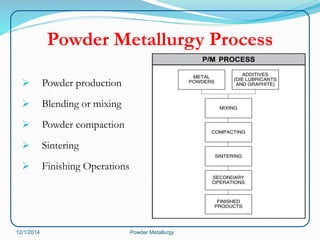
Powder Metallurgy Process 
 Powder production 
 Blending or mixing 
 Powder compaction 
 Sintering 
 Finishing Operations 
12/1/2014 Powder Metallurgy
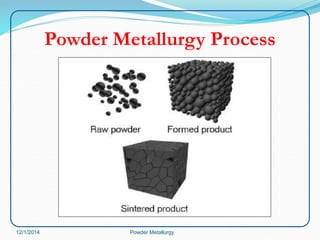
Powder Metallurgy Process 
12/1/2014 Powder Metallurgy
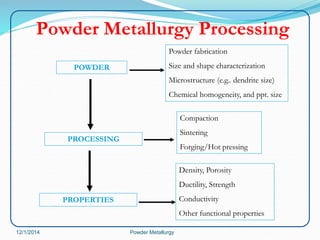
Powder Metallurgy Processing 
POWDER 
PROCESSING 
PROPERTIES 
Powder fabrication 
Size and shape characterization 
Microstructure (e.g.. dendrite size) 
Chemical homogeneity, and ppt. size 
12/1/2014 Powder Metallurgy 
Compaction 
Sintering 
Forging/Hot pressing 
Density, Porosity 
Ductility, Strength 
Conductivity 
Other functional properties
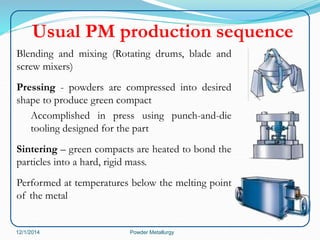
Usual PM production sequence 
Blending and mixing (Rotating drums, blade and 
screw mixers) 
Pressing - powders are compressed into desired 
shape to produce green compact 
Accomplished in press using punch-and-die 
tooling designed for the part 
Sintering – green compacts are heated to bond the 
particles into a hard, rigid mass. 
Performed at temperatures below the melting point 
of the metal 
12/1/2014 Powder Metallurgy
Production of Metallic Powders 
 In general, producers of metallic powders are not the same 
companies as those that make PM parts 
 Any metal can be made into powder form 
Three principal methods by which metallic powders are 
commercially produced 
 Atomization (by gas, water, also centrifugal one) 
 Chemical 
 Electrolytic 
 In addition, mechanical methods are occasionally used to reduce 
powder sizes 
12/1/2014 Powder Metallurgy
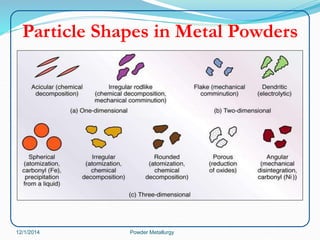
Particle Shapes in Metal Powders 
12/1/2014 Powder Metallurgy
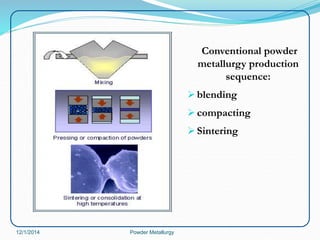
Conventional powder 
metallurgy production 
sequence: 
 blending 
 compacting 
 Sintering 
12/1/2014 Powder Metallurgy
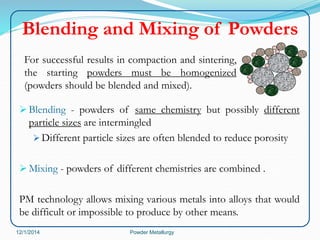
Blending and Mixing of Powders 
For successful results in compaction and sintering, 
the starting powders must be homogenized 
(powders should be blended and mixed). 
 Blending - powders of same chemistry but possibly different 
particle sizes are intermingled 
 Different particle sizes are often blended to reduce porosity 
 Mixing - powders of different chemistries are combined . 
PM technology allows mixing various metals into alloys that would 
be difficult or impossible to produce by other means. 
12/1/2014 Powder Metallurgy
Blending or Mixing 
 Blending a coarser fraction with a finer fraction ensures that the 
interstices between large particles will be filled out. 
Powders of different metals and other materials may be mixed in 
order to impart special physical and mechanical properties 
through metallic alloying. 
Lubricants may be mixed to improve the powder’s flow 
characteristics. 
 Binders such as wax or thermoplastic polymers are added to 
improve green strength. 
12/1/2014 Powder Metallurgy
Blending 
To make a homogeneous mass with uniform distribution of 
particle size and composition. 
Powders made by different processes have different sizes and 
shapes 
 Mixing powders of different metals/materials 
Combining is generally carried out in 
 Air or inert gases to avoid oxidation 
 Liquids for better mixing, elimination of dusts and reduced 
explosion hazards 
12/1/2014 Powder Metallurgy
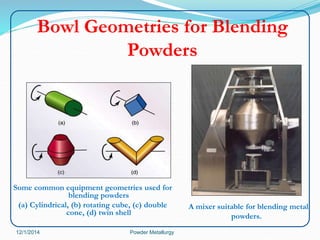
Bowl Geometries for Blending 
Powders 
12/1/2014 Powder Metallurgy 
A mixer suitable for blending metal 
powders. 
Some common equipment geometries used for 
blending powders 
(a) Cylindrical, (b) rotating cube, (c) double 
cone, (d) twin shell
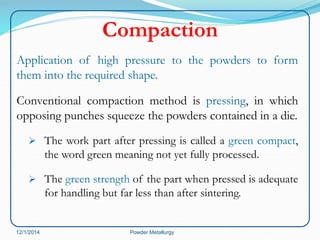
Compaction 
Application of high pressure to the powders to form 
them into the required shape. 
Conventional compaction method is pressing, in which 
opposing punches squeeze the powders contained in a die. 
 The work part after pressing is called a green compact, 
the word green meaning not yet fully processed. 
 The green strength of the part when pressed is adequate 
for handling but far less than after sintering. 
12/1/2014 Powder Metallurgy
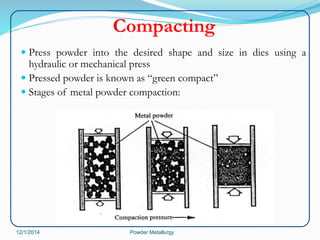
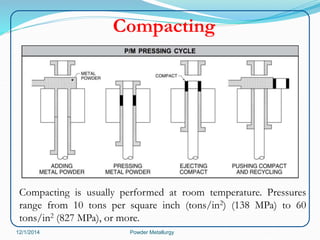
Compacting 
 Press powder into the desired shape and size in dies using a 
hydraulic or mechanical press 
 Pressed powder is known as “green compact” 
 Stages of metal powder compaction: 
12/1/2014 Powder Metallurgy
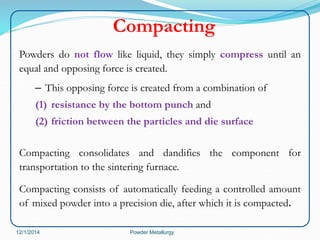
Compacting 
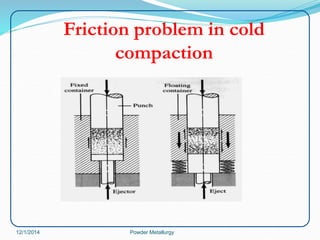
Powders do not flow like liquid, they simply compress until an 
equal and opposing force is created. 
– This opposing force is created from a combination of 
(1) resistance by the bottom punch and 
(2) friction between the particles and die surface 
Compacting consolidates and dandifies the component for 
transportation to the sintering furnace. 
Compacting consists of automatically feeding a controlled amount 
of mixed powder into a precision die, after which it is compacted. 
12/1/2014 Powder Metallurgy
Compacting 
Compacting is usually performed at room temperature. Pressures 
range from 10 tons per square inch (tons/in2) (138 MPa) to 60 
tons/in2 (827 MPa), or more. 
12/1/2014 Powder Metallurgy
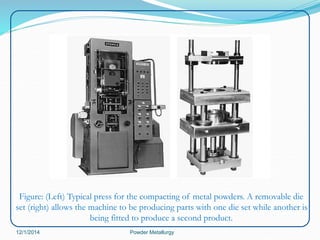
Figure: (Left) Typical press for the compacting of metal powders. A removable die 
set (right) allows the machine to be producing parts with one die set while another is 
being fitted to produce a second product. 
12/1/2014 Powder Metallurgy
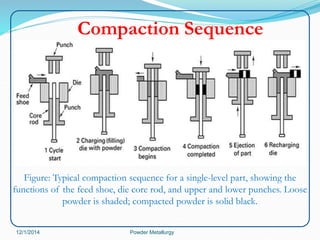
Compaction Sequence 
Figure: Typical compaction sequence for a single-level part, showing the 
functions of the feed shoe, die core rod, and upper and lower punches. Loose 
powder is shaded; compacted powder is solid black. 
12/1/2014 Powder Metallurgy
Friction problem in cold 
compaction 
12/1/2014 Powder Metallurgy
Sintering 
Heat treatment to bond the metallic particles, thereby increasing 
strength and hardness. 
Usually carried out at between 70% and 90% of the metal's melting 
point (absolute scale) 
– Generally agreed among researchers that the primary driving 
force for sintering is reduction of surface energy 
– Part shrinkage occurs during sintering due to pore size 
reduction 
12/1/2014 Powder Metallurgy
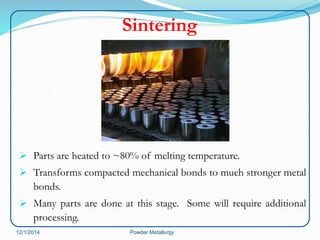
Sintering 
 Parts are heated to ~80% of melting temperature. 
 Transforms compacted mechanical bonds to much stronger metal 
bonds. 
 Many parts are done at this stage. Some will require additional 
processing. 
12/1/2014 Powder Metallurgy
Sintering Sequence 
 Parts are heated to 0.7~0.9 Tm. 
 Transforms compacted mechanical bonds to much stronger 
metallic bonds. 
Figure: Sintering on a microscopic scale: (1) particle bonding is 
initiated at contact points; (2) contact points grow into "necks"; (3) the 
pores between particles are reduced in size; and (4) grain boundaries 
develop between particles in place of the necked regions. 
12/1/2014 Powder Metallurgy
Sintering 
Third stage: 
Sintered product is cooled in a controlled atmosphere. 
– Prevents oxidation and thermal shock 
Gases commonly used for sintering: 
H2, N2, inert gases or vacuum 
12/1/2014 Powder Metallurgy
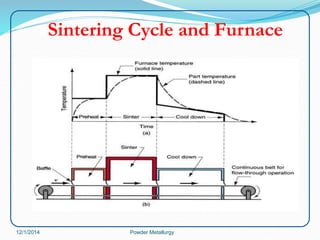
Sintering Cycle and Furnace 
12/1/2014 Powder Metallurgy
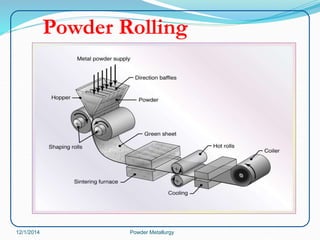
Powder Rolling 
12/1/2014 Powder Metallurgy
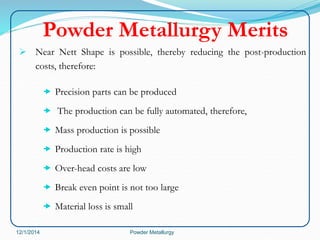
Powder Metallurgy Merits 
 Near Nett Shape is possible, thereby reducing the post-production 
costs, therefore: 
 Precision parts can be produced 
 The production can be fully automated, therefore, 
 Mass production is possible 
 Production rate is high 
 Over-head costs are low 
 Break even point is not too large 
 Material loss is small 
12/1/2014 Powder Metallurgy
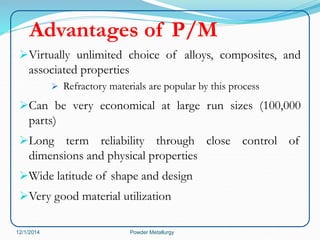
Advantages of P/M 
Virtually unlimited choice of alloys, composites, and 
associated properties 
 Refractory materials are popular by this process 
Can be very economical at large run sizes (100,000 
parts) 
Long term reliability through close control of 
dimensions and physical properties 
Wide latitude of shape and design 
Very good material utilization 
12/1/2014 Powder Metallurgy
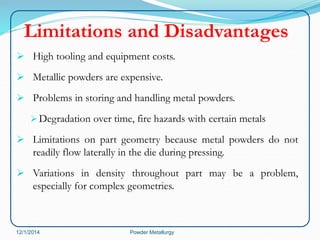
Limitations and Disadvantages 
 High tooling and equipment costs. 
 Metallic powders are expensive. 
 Problems in storing and handling metal powders. 
Degradation over time, fire hazards with certain metals 
 Limitations on part geometry because metal powders do not 
readily flow laterally in the die during pressing. 
 Variations in density throughout part may be a problem, 
especially for complex geometries. 
12/1/2014 Powder Metallurgy
Powder Metallurgy Disadvantages 
 Porous !! Not always desired. 
 Large components cannot be produced on a large scale. 
 Some shapes are difficult to be produced by the conventional 
p/m route. 
Whatever, the merits are so many that P/M, as a forming 
technique, is gaining popularity 
12/1/2014 Powder Metallurgy
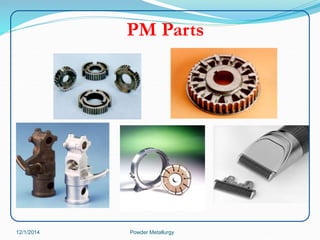
PM Parts 
12/1/2014 Powder Metallurgy
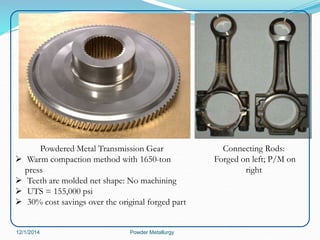
Connecting Rods: 
Forged on left; P/M on 
right 
Powdered Metal Transmission Gear 
 Warm compaction method with 1650-ton 
press 
 Teeth are molded net shape: No machining 
 UTS = 155,000 psi 
 30% cost savings over the original forged part 
12/1/2014 Powder Metallurgy

Powder metallurgy

  • 1.
    12/1/2014 Presented by: Shailendra Pratap Singh (13MEBLA022) Venkatesh (13MEBLA025) Sahil Khambhati (13MEBLA008) Yogita Pawar (13MEBLA013) Shreya Badave (13MEBLA005) Submitted to: Mr. Bhaskar Goel POWDER METALLURGY
  • 2.
    Powder Metallurgy Essentially, Powder Metallurgy (PM) is an art & science of producing metal or metallic powders, and using them to make finished or semi-finished products.  Particulate technology is probably the oldest forming technique known to man. There are archeological evidences to prove that the ancient man knew something about it. 12/1/2014 Powder Metallurgy
  • 3.
    Powder Metallurgy Animportant point that comes out : The entire material need not be melted to fuse it. The working temperature is well below the melting point of the major constituent, making it a very suitable method to work with refractory materials, such as: W, Mo, Ta, Nb, oxides, carbides, etc.  It began with Platinum technology about 4 centuries ago… in those days, Platinum, [MP = 1774°C], was "refractory", and could not be melted. 12/1/2014 Powder Metallurgy
  • 4.
    Powder Metallurgy Process  Powder production  Blending or mixing  Powder compaction  Sintering  Finishing Operations 12/1/2014 Powder Metallurgy
  • 5.
    Powder Metallurgy Process 12/1/2014 Powder Metallurgy
  • 6.
    Powder Metallurgy Processing POWDER PROCESSING PROPERTIES Powder fabrication Size and shape characterization Microstructure (e.g.. dendrite size) Chemical homogeneity, and ppt. size 12/1/2014 Powder Metallurgy Compaction Sintering Forging/Hot pressing Density, Porosity Ductility, Strength Conductivity Other functional properties
  • 7.
    Usual PM productionsequence Blending and mixing (Rotating drums, blade and screw mixers) Pressing - powders are compressed into desired shape to produce green compact Accomplished in press using punch-and-die tooling designed for the part Sintering – green compacts are heated to bond the particles into a hard, rigid mass. Performed at temperatures below the melting point of the metal 12/1/2014 Powder Metallurgy
  • 8.
    Production of MetallicPowders  In general, producers of metallic powders are not the same companies as those that make PM parts  Any metal can be made into powder form Three principal methods by which metallic powders are commercially produced  Atomization (by gas, water, also centrifugal one)  Chemical  Electrolytic  In addition, mechanical methods are occasionally used to reduce powder sizes 12/1/2014 Powder Metallurgy
  • 9.
    Particle Shapes inMetal Powders 12/1/2014 Powder Metallurgy
  • 10.
    Conventional powder metallurgyproduction sequence:  blending  compacting  Sintering 12/1/2014 Powder Metallurgy
  • 11.
    Blending and Mixingof Powders For successful results in compaction and sintering, the starting powders must be homogenized (powders should be blended and mixed).  Blending - powders of same chemistry but possibly different particle sizes are intermingled  Different particle sizes are often blended to reduce porosity  Mixing - powders of different chemistries are combined . PM technology allows mixing various metals into alloys that would be difficult or impossible to produce by other means. 12/1/2014 Powder Metallurgy
  • 12.
    Blending or Mixing  Blending a coarser fraction with a finer fraction ensures that the interstices between large particles will be filled out. Powders of different metals and other materials may be mixed in order to impart special physical and mechanical properties through metallic alloying. Lubricants may be mixed to improve the powder’s flow characteristics.  Binders such as wax or thermoplastic polymers are added to improve green strength. 12/1/2014 Powder Metallurgy
  • 13.
    Blending To makea homogeneous mass with uniform distribution of particle size and composition. Powders made by different processes have different sizes and shapes  Mixing powders of different metals/materials Combining is generally carried out in  Air or inert gases to avoid oxidation  Liquids for better mixing, elimination of dusts and reduced explosion hazards 12/1/2014 Powder Metallurgy
  • 14.
    Bowl Geometries forBlending Powders 12/1/2014 Powder Metallurgy A mixer suitable for blending metal powders. Some common equipment geometries used for blending powders (a) Cylindrical, (b) rotating cube, (c) double cone, (d) twin shell
  • 15.
    Compaction Application ofhigh pressure to the powders to form them into the required shape. Conventional compaction method is pressing, in which opposing punches squeeze the powders contained in a die.  The work part after pressing is called a green compact, the word green meaning not yet fully processed.  The green strength of the part when pressed is adequate for handling but far less than after sintering. 12/1/2014 Powder Metallurgy
  • 16.
    Compacting  Presspowder into the desired shape and size in dies using a hydraulic or mechanical press  Pressed powder is known as “green compact”  Stages of metal powder compaction: 12/1/2014 Powder Metallurgy
  • 17.
    Compacting Powders donot flow like liquid, they simply compress until an equal and opposing force is created. – This opposing force is created from a combination of (1) resistance by the bottom punch and (2) friction between the particles and die surface Compacting consolidates and dandifies the component for transportation to the sintering furnace. Compacting consists of automatically feeding a controlled amount of mixed powder into a precision die, after which it is compacted. 12/1/2014 Powder Metallurgy
  • 18.
    Compacting Compacting isusually performed at room temperature. Pressures range from 10 tons per square inch (tons/in2) (138 MPa) to 60 tons/in2 (827 MPa), or more. 12/1/2014 Powder Metallurgy
  • 19.
    Figure: (Left) Typicalpress for the compacting of metal powders. A removable die set (right) allows the machine to be producing parts with one die set while another is being fitted to produce a second product. 12/1/2014 Powder Metallurgy
  • 20.
    Compaction Sequence Figure:Typical compaction sequence for a single-level part, showing the functions of the feed shoe, die core rod, and upper and lower punches. Loose powder is shaded; compacted powder is solid black. 12/1/2014 Powder Metallurgy
  • 21.
    Friction problem incold compaction 12/1/2014 Powder Metallurgy
  • 22.
    Sintering Heat treatmentto bond the metallic particles, thereby increasing strength and hardness. Usually carried out at between 70% and 90% of the metal's melting point (absolute scale) – Generally agreed among researchers that the primary driving force for sintering is reduction of surface energy – Part shrinkage occurs during sintering due to pore size reduction 12/1/2014 Powder Metallurgy
  • 23.
    Sintering  Partsare heated to ~80% of melting temperature.  Transforms compacted mechanical bonds to much stronger metal bonds.  Many parts are done at this stage. Some will require additional processing. 12/1/2014 Powder Metallurgy
  • 24.
    Sintering Sequence Parts are heated to 0.7~0.9 Tm.  Transforms compacted mechanical bonds to much stronger metallic bonds. Figure: Sintering on a microscopic scale: (1) particle bonding is initiated at contact points; (2) contact points grow into "necks"; (3) the pores between particles are reduced in size; and (4) grain boundaries develop between particles in place of the necked regions. 12/1/2014 Powder Metallurgy
  • 25.
    Sintering Third stage: Sintered product is cooled in a controlled atmosphere. – Prevents oxidation and thermal shock Gases commonly used for sintering: H2, N2, inert gases or vacuum 12/1/2014 Powder Metallurgy
  • 26.
    Sintering Cycle andFurnace 12/1/2014 Powder Metallurgy
  • 27.
    Powder Rolling 12/1/2014Powder Metallurgy
  • 28.
    Powder Metallurgy Merits  Near Nett Shape is possible, thereby reducing the post-production costs, therefore:  Precision parts can be produced  The production can be fully automated, therefore,  Mass production is possible  Production rate is high  Over-head costs are low  Break even point is not too large  Material loss is small 12/1/2014 Powder Metallurgy
  • 29.
    Advantages of P/M Virtually unlimited choice of alloys, composites, and associated properties  Refractory materials are popular by this process Can be very economical at large run sizes (100,000 parts) Long term reliability through close control of dimensions and physical properties Wide latitude of shape and design Very good material utilization 12/1/2014 Powder Metallurgy
  • 30.
    Limitations and Disadvantages  High tooling and equipment costs.  Metallic powders are expensive.  Problems in storing and handling metal powders. Degradation over time, fire hazards with certain metals  Limitations on part geometry because metal powders do not readily flow laterally in the die during pressing.  Variations in density throughout part may be a problem, especially for complex geometries. 12/1/2014 Powder Metallurgy
  • 31.
    Powder Metallurgy Disadvantages  Porous !! Not always desired.  Large components cannot be produced on a large scale.  Some shapes are difficult to be produced by the conventional p/m route. Whatever, the merits are so many that P/M, as a forming technique, is gaining popularity 12/1/2014 Powder Metallurgy
  • 32.
    PM Parts 12/1/2014Powder Metallurgy
  • 33.
    Connecting Rods: Forgedon left; P/M on right Powdered Metal Transmission Gear  Warm compaction method with 1650-ton press  Teeth are molded net shape: No machining  UTS = 155,000 psi  30% cost savings over the original forged part 12/1/2014 Powder Metallurgy
  • 34.