WORKSHOP MANUFACTURING PRACTICES
SEMESTER – II
WELDING
BY
MANOJ KUMAR
DEPARTMENT OF MECHANICAL ENGINEERING
SCE SAHARSA
DATE 01-04-2020
Fabrication process
Joining two or more elements to make a single part is termed as fabrication
process. it is done by following methods:
 Mechanical joining by means of bolts, screws and rivets.
 Adhesive bonding by employing synthetic glues such as epoxy resins.
 Welding, brazing and soldering.
Welding
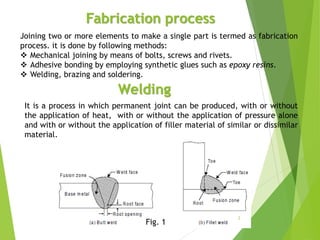
It is a process in which permanent joint can be produced, with or without
the application of heat, with or without the application of pressure alone
and with or without the application of filler material of similar or dissimilar
material.
Fig. 1
2
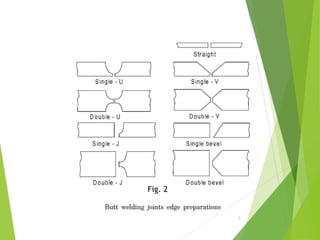
Fig. 2
3
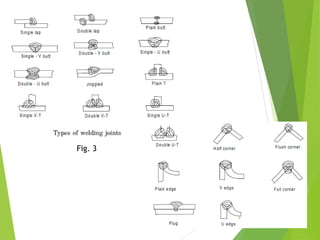
Fig. 3
4
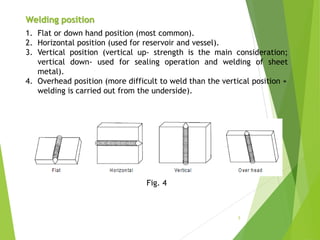
Welding position
1. Flat or down hand position (most common).
2. Horizontal position (used for reservoir and vessel).
3. Vertical position (vertical up- strength is the main consideration;
vertical down- used for sealing operation and welding of sheet
metal).
4. Overhead position (more difficult to weld than the vertical position +
welding is carried out from the underside).
Fig. 4
5
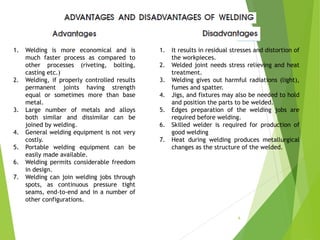
1. Welding is more economical and is
much faster process as compared to
other processes (riveting, bolting,
casting etc.)
2. Welding, if properly controlled results
permanent joints having strength
equal or sometimes more than base
metal.
3. Large number of metals and alloys
both similar and dissimilar can be
joined by welding.
4. General welding equipment is not very
costly.
5. Portable welding equipment can be
easily made available.
6. Welding permits considerable freedom
in design.
7. Welding can join welding jobs through
spots, as continuous pressure tight
seams, end-to-end and in a number of
other configurations.
1. It results in residual stresses and distortion of
the workpieces.
2. Welded joint needs stress relieving and heat
treatment.
3. Welding gives out harmful radiations (light),
fumes and spatter.
4. Jigs, and fixtures may also be needed to hold
and position the parts to be welded.
5. Edges preparation of the welding jobs are
required before welding.
6. Skilled welder is required for production of
good welding
7. Heat during welding produces metallurgical
changes as the structure of the welded.
6
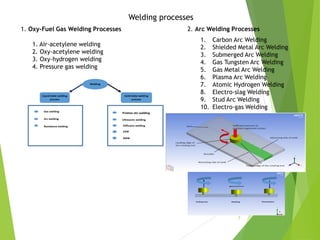
Welding processes
1. Oxy-Fuel Gas Welding Processes
1. Air-acetylene welding
2. Oxy-acetylene welding
3. Oxy-hydrogen welding
4. Pressure gas welding
2. Arc Welding Processes
1. Carbon Arc Welding
2. Shielded Metal Arc Welding
3. Submerged Arc Welding
4. Gas Tungsten Arc Welding
5. Gas Metal Arc Welding
6. Plasma Arc Welding
7. Atomic Hydrogen Welding
8. Electro-slag Welding
9. Stud Arc Welding
10. Electro-gas Welding
7
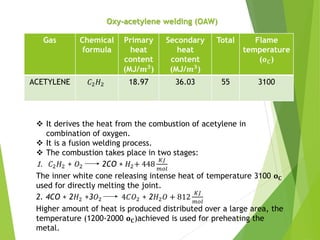
Oxy-acetylene welding (OAW)
Gas Chemical
formula
Primary
heat
content
(MJ/𝒎 𝟑
)
Secondary
heat
content
(MJ/𝒎 𝟑
)
Total Flame
temperature
(𝒐 𝑪)
ACETYLENE 𝐶2 𝐻2 18.97 36.03 55 3100
 It derives the heat from the combustion of acetylene in
combination of oxygen.
 It is a fusion welding process.
 The combustion takes place in two stages:
1. 𝐶2 𝐻2 + 𝑂2 2CO + 𝐻2+ 448
𝐾𝐽
𝑚𝑜𝑙
The inner white cone releasing intense heat of temperature 3100 𝐨 𝐂
used for directly melting the joint.
2. 4CO + 2𝐻2 +3𝑂2 4𝐶𝑂2 + 2𝐻2 𝑂 + 812
𝐾𝐽
𝑚𝑜𝑙
Higher amount of heat is produced distributed over a large area, the
temperature (1200-2000 𝐨 𝐂)achieved is used for preheating the
metal.
8
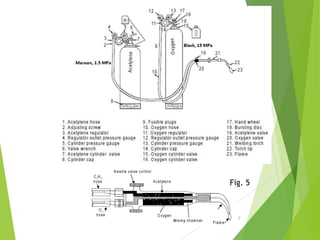
Fig. 5
9
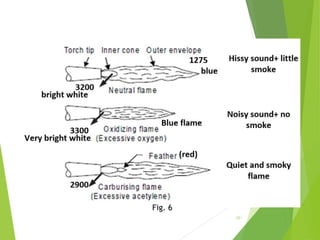
Fig. 6
10
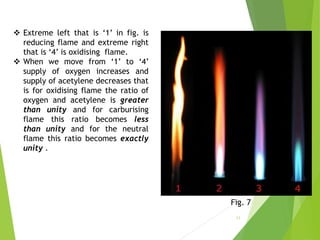
 Extreme left that is ‘1’ in fig. is
reducing flame and extreme right
that is ‘4’ is oxidising flame.
 When we move from ‘1’ to ‘4’
supply of oxygen increases and
supply of acetylene decreases that
is for oxidising flame the ratio of
oxygen and acetylene is greater
than unity and for carburising
flame this ratio becomes less
than unity and for the neutral
flame this ratio becomes exactly
unity .
Fig. 7
11
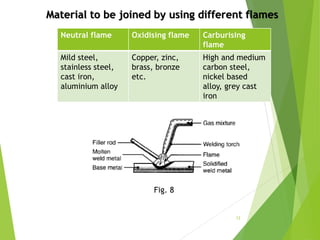
Neutral flame Oxidising flame Carburising
flame
Mild steel,
stainless steel,
cast iron,
aluminium alloy
Copper, zinc,
brass, bronze
etc.
High and medium
carbon steel,
nickel based
alloy, grey cast
iron
Material to be joined by using different flames
Fig. 8
12
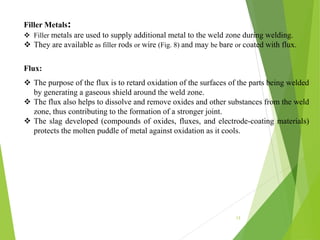
Filler Metals:
 Filler metals are used to supply additional metal to the weld zone during welding.
 They are available as filler rods or wire (Fig. 8) and may be bare or coated with flux.
 The purpose of the flux is to retard oxidation of the surfaces of the parts being welded
by generating a gaseous shield around the weld zone.
 The flux also helps to dissolve and remove oxides and other substances from the weld
zone, thus contributing to the formation of a stronger joint.
 The slag developed (compounds of oxides, fluxes, and electrode-coating materials)
protects the molten puddle of metal against oxidation as it cools.
Flux:
13
Welding Techniques
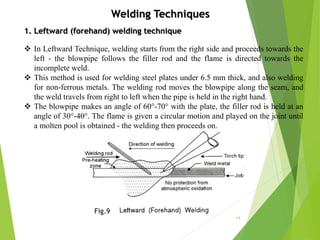
 In Leftward Technique, welding starts from the right side and proceeds towards the
left - the blowpipe follows the filler rod and the flame is directed towards the
incomplete weld.
 This method is used for welding steel plates under 6.5 mm thick, and also welding
for non-ferrous metals. The welding rod moves the blowpipe along the seam, and
the weld travels from right to left when the pipe is held in the right hand.
 The blowpipe makes an angle of 60°-70° with the plate, the filler rod is held at an
angle of 30°-40°. The flame is given a circular motion and played on the joint until
a molten pool is obtained - the welding then proceeds on.
1. Leftward (forehand) welding technique
Fig.9
14
2. Rightward (backhand) welding technique
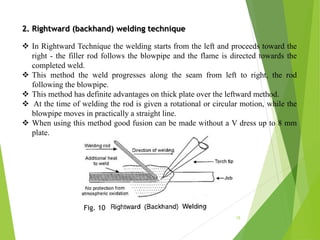
 In Rightward Technique the welding starts from the left and proceeds toward the
right - the filler rod follows the blowpipe and the flame is directed towards the
completed weld.
 This method the weld progresses along the seam from left to right, the rod
following the blowpipe.
 This method has definite advantages on thick plate over the leftward method.
 At the time of welding the rod is given a rotational or circular motion, while the
blowpipe moves in practically a straight line.
 When using this method good fusion can be made without a V dress up to 8 mm
plate.
Fig. 10
15
Gas cutting
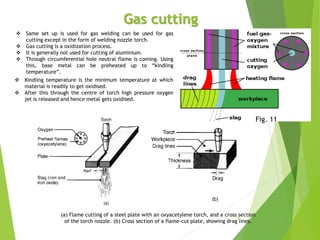
 Same set up is used for gas welding can be used for gas
cutting except in the form of welding nozzle torch.
 Gas cutting is a oxidization process.
 It is generally not used for cutting of aluminium.
 Through circumferential hole neutral flame is coming. Using
this, base metal can be preheated up to “kindling
temperature”.
 Kindling temperature is the minimum temperature at which
material is readily to get oxidised.
 After this through the centre of torch high pressure oxygen
jet is released and hence metal gets oxidised.
Fig. 11
(a) Flame cutting of a steel plate with an oxyacetylene torch, and a cross section
of the torch nozzle. (b) Cross section of a flame-cut plate, showing drag lines.
16
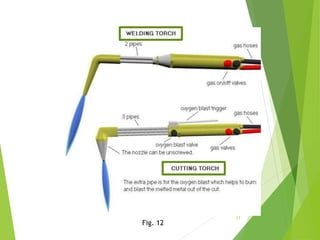
Fig. 12
17
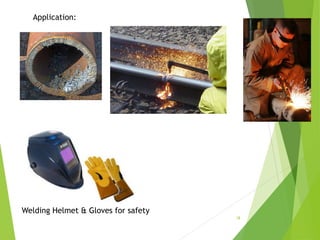
Application:
Welding Helmet & Gloves for safety
18
Safety Recommendations for Gas Welding
1. Never hang a torch with its hose on regulators or cylinder valves.
2. During working, if the welding tip becomes overheated it may be cooled by plunging the torch into
water; close the acetylene valve but leave a little oxygen flowing.
3. Always use the correct pressure regulators for a gas. Acetylene pressure regulator should never be
used with any other gas.
4. Do not move the cylinder by holding the pressure regulator and also handle pressure regulators
carefully.
5. Use pressure regulator only at pressures for which it is intended.
6. Open cylinder valves slowly to avoid straining the mechanism of pressure regulator.
7. Never use oil, grease or lubricant of any kind on regulator connections.
8. For repairs, calibrations and adjustments purposes, the pressure regulators should be sent to the
supplier.
9. Do cracking before connecting pressure regulator to the gas cylinder.
10. Inspect union nuts and connections on regulators before use to detect faulty seats which may
cause leakage of gas when the regulators are attached to the cylinder valves.
11.Hose connections shall be well fittings and clamped properly otherwise securely fastened to these
connections in such a manner as to withstand without leakage a pressure twice as great as the
maximum delivery pressure of the pressure regulators provided on the system.
12. Protect the hose from flying sparks, hot slag, hot workpiece and open flame. If dirt goes into
hose, blow through (with oxygen, not acetylene) before coupling to torch or regulator.
13. Store hose on a reel (an automobile wheel) when not in use.
14. Never allow the hose to come into contact with oil or grease; these deteriorate the rubber and
constitute a hazard with oxygen.
15. Use the correct color hose for oxygen (green/black) and acetylene (red) and never use oxygen
hose for acetylene or vice versa.
16. Always protect hose from being trampled on or run over. Avoid tangle and kinks. Never leave the
hose so that it can be tripped over. 19
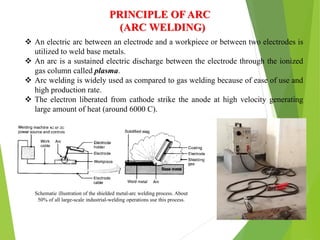
PRINCIPLE OF ARC
(ARC WELDING)
 An electric arc between an electrode and a workpiece or between two electrodes is
utilized to weld base metals.
 An arc is a sustained electric discharge between the electrode through the ionized
gas column called plasma.
 Arc welding is widely used as compared to gas welding because of ease of use and
high production rate.
 The electron liberated from cathode strike the anode at high velocity generating
large amount of heat (around 6000 C).
Schematic illustration of the shielded metal-arc welding process. About
50% of all large-scale industrial-welding operations use this process.
20
[a] Direct current
straight polarity
(DCSP) or direct
current electrode
negative (DCEN)
[b] Direct current
reverse polarity
(DCRP) or direct
current electrode
positive (DCEP)
[c] Alternative
current (AC)
 Electrode is ‘–ve’ and
workpiece is ‘+ve’.
 2/3 rd heat on w/p
and 1/3 rd heat on
electrode.
 Used for high
thickness w/p and
high melting point
material.
 Depth of penetration
is more.
 weld deposition rate
and welding speed will
be low.
 Electrode is ‘+ve’ and
workpiece is ‘-ve’.
 1/3 rd heat on w/p
and 2/3 rd heat on
electrode.
 Used for low thickness
w/p and low melting
point material.
 Depth of penetration
is less.
 weld deposition rate
and welding speed will
be more.
 50 % heat on w/p and
50 % heat on
electrode.
 Used for medium
thickness w/p and
intrmediate melting
point material.
 Depth of penetration
is intermediate.
 weld deposition rate
and welding speed will
be intermediate.
The effect of polarity and current type on
weld beads: (a) DC current with straight polarity; (b) DC
current with reverse polarity; (c) AC current.
21
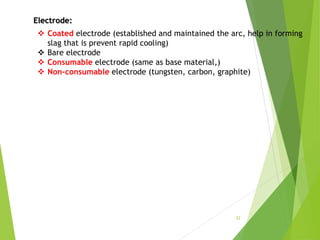
Electrode:
 Coated electrode (established and maintained the arc, help in forming
slag that is prevent rapid cooling)
 Bare electrode
 Consumable electrode (same as base material,)
 Non-consumable electrode (tungsten, carbon, graphite)
22
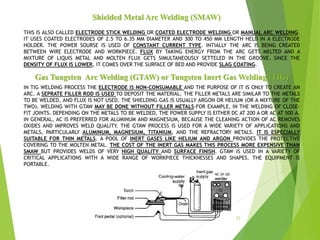
Gas Tungsten Arc Welding (GTAW) or Tungsten Inert Gas Welding (TIG)
THIS IS ALSO CALLED ELECTRODE STICK WELDING OR COATED ELECTRODE WELDING OR MANUAL ARC WELDING.
IT USES COATED ELECTRODES OF 2.5 TO 6.35 MM DIAMETER AND 300 TO 450 MM LENGTH HELD IN A ELECTRODE
HOLDER. THE POWER SOURSE IS USED OF CONSTANT CURRENT TYPE. INTIALLY THE ARC IS BEING CREATED
BETWEEN WIRE ELECTRODE AND WORKPIECE. FLUX BY TAKING ENERGY FROM THE ARC GETS MELTED AND A
MIXTURE OF LIQUIS METAL AND MOLTEN FLUX GETS SIMULTANEOUSLY SETTELED IN THE GROOVE. SINCE THE
DENSITY OF FLUX IS LOWER, IT COMES OVER THE SURFACE OF BED AND PROVIDE SLAG COATING.
Shielded Metal Arc Welding (SMAW)
IN TIG WELDING PROCESS THE ELECTRODE IS NON-CONSUMABLE AND THE PURPOSE OF IT IS ONLY TO CREATE AN
ARC. A SEPRATE FILLER ROD IS USED TO DEPOSIT THE MATERIAL. THE FILLER METALS ARE SIMILAR TO THE METALS
TO BE WELDED, AND FLUX IS NOT USED. THE SHIELDING GAS IS USUALLY ARGON OR HELIUM (OR A MIXTURE OF THE
TWO). WELDING WITH GTAW MAY BE DONE WITHOUT FILLER METALS-FOR EXAMPLE, IN THE WELDING OF CLOSE-
FIT JOINTS. DEPENDING ON THE METALS TO BE WELDED, THE POWER SUPPLY IS EITHER DC AT 200 A OR AC AT 500 A.
IN GENERAL, AC IS PREFERRED FOR ALUMINUM AND MAGNESIUM, BECAUSE THE CLEANING ACTION OF AC REMOVES
OXIDES AND IMPROVES WELD QUALITY. THE GTAW PROCESS IS USED FOR A WIDE VARIETY OF APPLICATIONS AND
METALS, PARTICULARLY ALUMINUM, MAGNESIUM, TITANIUM, AND THE REFRACTORY METALS. IT IS ESPECIALLY
SUITABLE FOR THIN METALS. A POOL OF INERT GASES LIKE HELIUM AND ARGON PROVIDES THE PROTECTIVE
COVERING TO THE MOLTEN METAL. THE COST OF THE INERT GAS MAKES THIS PROCESS MORE EXPENSIVE THAN
SMAW BUT PROVIDES WELDS OF VERY HIGH QUALITY AND SURFACE FINISH. GTAW IS USED IN A VARIETY OF
CRITICAL APPLICATIONS WITH A WIDE RANGE OF WORKPIECE THICKNESSES AND SHAPES. THE EQUIPMENT IS
PORTABLE.
23
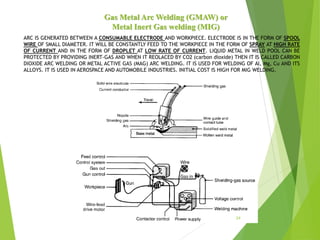
Gas Metal Arc Welding (GMAW) or
Metal Inert Gas welding (MIG)
ARC IS GENERATED BETWEEN A CONSUMABLE ELECTRODE AND WORKPIECE. ELECTRODE IS IN THE FORM OF SPOOL
WIRE OF SMALL DIAMETER. IT WILL BE CONSTANTLY FEED TO THE WORKPIECE IN THE FORM OF SPRAY AT HIGH RATE
OF CURRENT AND IN THE FORM OF DROPLET AT LOW RATE OF CURRENT. LIQUID METAL IN WELD POOL CAN BE
PROTECTED BY PROVIDING INERT-GAS AND WHEN IT REOLACED BY CO2 (carbon dioxide) THEN IT IS CALLED CARBON
DIOXIDE ARC WELDING OR METAL ACTIVE GAS (MAG) ARC WELDING. IT IS USED FOR WELDING OF Al, Mg, Cu AND ITS
ALLOYS. IT IS USED IN AEROSPACE AND AUTOMOBILE INDUSTRIES. INITIAL COST IS HIGH FOR MIG WELDING.
24
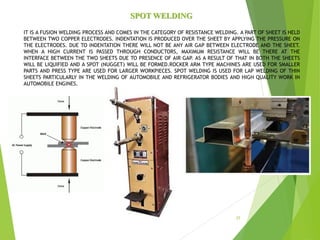
SPOT WELDING
IT IS A FUSION WELDING PROCESS AND COMES IN THE CATEGORY OF RESISTANCE WELDING. A PART OF SHEET IS HELD
BETWEEN TWO COPPER ELECTRODES. INDENTATION IS PRODUCED OVER THE SHEET BY APPLYING THE PRESSURE ON
THE ELECTRODES. DUE TO INDENTATION THERE WILL NOT BE ANY AIR GAP BETWEEN ELECTRODE AND THE SHEET.
WHEN A HIGH CURRENT IS PASSED THROUGH CONDUCTORS, MAXIMUM RESISTANCE WILL BE THERE AT THE
INTERFACE BETWEEN THE TWO SHEETS DUE TO PRESENCE OF AIR GAP. AS A RESULT OF THAT IN BOTH THE SHEETS
WILL BE LIQUIFIED AND A SPOT (NUGGET) WILL BE FORMED.ROCKER ARM TYPE MACHINES ARE USED FOR SMALLER
PARTS AND PRESS TYPE ARE USED FOR LARGER WORKPIECES. SPOT WELDING IS USED FOR LAP WELDING OF THIN
SHEETS PARTICULARLY IN THE WELDING OF AUTOMOBILE AND REFRIGERATOR BODIES AND HIGH QUALITY WORK IN
AUTOMOBILE ENGINES.
25
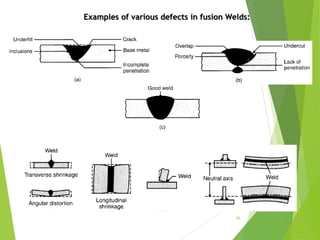
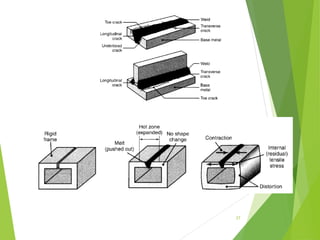
Examples of various defects in fusion Welds:
26
27
Solid/Liquid Welding
SolderingBrazing
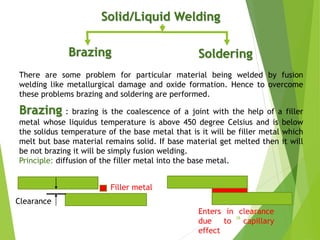
Brazing : brazing is the coalescence of a joint with the help of a filler
metal whose liquidus temperature is above 450 degree Celsius and is below
the solidus temperature of the base metal that is it will be filler metal which
melt but base material remains solid. If base material get melted then it will
be not brazing it will be simply fusion welding.
Principle: diffusion of the filler metal into the base metal.
There are some problem for particular material being welded by fusion
welding like metallurgical damage and oxide formation. Hence to overcome
these problems brazing and soldering are performed.
Clearance
Filler metal
Enters in clearance
due to capillary
effect
28
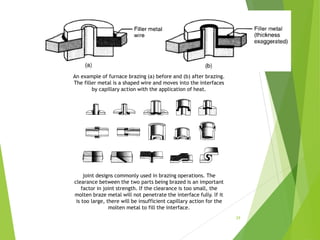
An example of furnace brazing (a) before and (b) after brazing.
The filler metal is a shaped wire and moves into the interfaces
by capillary action with the application of heat.
joint designs commonly used in brazing operations. The
clearance between the two parts being brazed is an important
factor in joint strength. lf the clearance is too small, the
molten braze metal will not penetrate the interface fully. lf it
is too large, there will be insufficient capillary action for the
molten metal to fill the interface.
29
Preparation before brazing:
 Joint has to designed properly i.e. clearance between two part controlled
critically. If more clearance provided there may be a chance to loss of capillary
effect and if it is less sufficient joint strength may not be achieved.
 Heating source must be provide adequate temperature at which filler metal
enter to the joint.
 Surface to be joined should be extremely cleaned. Any grease or oil present in
the joint prevent the flow of filler metal.
Advantages:
 Dissimilar metals can be joined, such as stainless steel to cast iron.
 Except aluminium and magnesium, brazing can joint almost all metal
 Due to lower temperature compare to arc and gas welding there is less chances
of distortion.
 Simplicity of the process.
 Joint can finished quickly without much skill.
Disadvantages:
 Not useful for high temperature service due to low melting temperature of
filler metal.
 colour of the filler metal in the brazed joint also may not matched with
that of base metal.
30
# Fluxes are added into the brazed joint to remove any of the oxide
present or prevent the formation of the oxides so that the base metal and
the filler metal remain pure during the joining.
 flux is the combination of borax, boric acid, chlorides, fluorides,
tetraborates and other wetting agent.
 For ferrous material flux is used as a paste of borax (75 %) and boric
acid (25 %).
 Fluxes should be provided in that much amount that it should be
present till the end of brazing.
 Fumes of fluxes are toxic hence proper ventilation required during
brazing.
# Filler metal are available depending upon which type of base metal to
be joined.
 Copper-based material are generally used for brazing ferrous material.
 Cu + Zn (less); used for brazing various steel
# Heating source: salt bath/molten metal bath, oxyacetylene torch,
controlled atmosphere furnace, electrical resistance heating, induction
heating.
31
Braze welding: braze welding differs from brazing in that manner that in
braze welding, the filler metal reaches the joint without the capillary
action since the gap is larger.
Soldering
Soldering is a method of joining similar or dissimilar metal, by means of a
filler metal whose liquidus temperature is below 450 degree Celsius .
 Strength of the joint is limited by the strength of the filler metal used.
 Neat and leak-proof joint + low resistance electrical joint.
 Not suitable for high temperature service.
 Filler metal enters the soldered joint by capillary action.
 A solder joint is weaker compared to a brazed joint.
 Joint need to be cleaned meticulously to provide chemically clean
surface to obtain a proper bond.
 Before soldering, solvent cleaning, acid pickling and mechanical
cleaning can also has to be done for proper and good soldering.
 Fluxes are used to remove oxide and prevent the filler material from
oxidizing.
 Flux >> Rosin + alcohol >> least active type >> used for electrical
soldering. 32
 Organic fluxes >> zinc chloride, ammonium chloride >> quick acting >>
used for non-electrical soldering work.
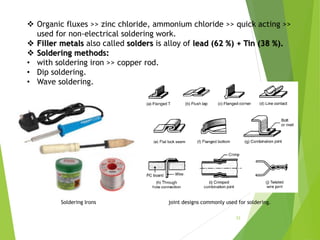
 Filler metals also called solders is alloy of lead (62 %) + Tin (38 %).
 Soldering methods:
• with soldering iron >> copper rod.
• Dip soldering.
• Wave soldering.
joint designs commonly used for soldering.
33
Soldering Irons

Welding

  • 1.
    WORKSHOP MANUFACTURING PRACTICES SEMESTER– II WELDING BY MANOJ KUMAR DEPARTMENT OF MECHANICAL ENGINEERING SCE SAHARSA DATE 01-04-2020
  • 2.
    Fabrication process Joining twoor more elements to make a single part is termed as fabrication process. it is done by following methods:  Mechanical joining by means of bolts, screws and rivets.  Adhesive bonding by employing synthetic glues such as epoxy resins.  Welding, brazing and soldering. Welding It is a process in which permanent joint can be produced, with or without the application of heat, with or without the application of pressure alone and with or without the application of filler material of similar or dissimilar material. Fig. 1 2
  • 3.
  • 4.
  • 5.
    Welding position 1. Flator down hand position (most common). 2. Horizontal position (used for reservoir and vessel). 3. Vertical position (vertical up- strength is the main consideration; vertical down- used for sealing operation and welding of sheet metal). 4. Overhead position (more difficult to weld than the vertical position + welding is carried out from the underside). Fig. 4 5
  • 6.
    1. Welding ismore economical and is much faster process as compared to other processes (riveting, bolting, casting etc.) 2. Welding, if properly controlled results permanent joints having strength equal or sometimes more than base metal. 3. Large number of metals and alloys both similar and dissimilar can be joined by welding. 4. General welding equipment is not very costly. 5. Portable welding equipment can be easily made available. 6. Welding permits considerable freedom in design. 7. Welding can join welding jobs through spots, as continuous pressure tight seams, end-to-end and in a number of other configurations. 1. It results in residual stresses and distortion of the workpieces. 2. Welded joint needs stress relieving and heat treatment. 3. Welding gives out harmful radiations (light), fumes and spatter. 4. Jigs, and fixtures may also be needed to hold and position the parts to be welded. 5. Edges preparation of the welding jobs are required before welding. 6. Skilled welder is required for production of good welding 7. Heat during welding produces metallurgical changes as the structure of the welded. 6
  • 7.
    Welding processes 1. Oxy-FuelGas Welding Processes 1. Air-acetylene welding 2. Oxy-acetylene welding 3. Oxy-hydrogen welding 4. Pressure gas welding 2. Arc Welding Processes 1. Carbon Arc Welding 2. Shielded Metal Arc Welding 3. Submerged Arc Welding 4. Gas Tungsten Arc Welding 5. Gas Metal Arc Welding 6. Plasma Arc Welding 7. Atomic Hydrogen Welding 8. Electro-slag Welding 9. Stud Arc Welding 10. Electro-gas Welding 7
  • 8.
    Oxy-acetylene welding (OAW) GasChemical formula Primary heat content (MJ/𝒎 𝟑 ) Secondary heat content (MJ/𝒎 𝟑 ) Total Flame temperature (𝒐 𝑪) ACETYLENE 𝐶2 𝐻2 18.97 36.03 55 3100  It derives the heat from the combustion of acetylene in combination of oxygen.  It is a fusion welding process.  The combustion takes place in two stages: 1. 𝐶2 𝐻2 + 𝑂2 2CO + 𝐻2+ 448 𝐾𝐽 𝑚𝑜𝑙 The inner white cone releasing intense heat of temperature 3100 𝐨 𝐂 used for directly melting the joint. 2. 4CO + 2𝐻2 +3𝑂2 4𝐶𝑂2 + 2𝐻2 𝑂 + 812 𝐾𝐽 𝑚𝑜𝑙 Higher amount of heat is produced distributed over a large area, the temperature (1200-2000 𝐨 𝐂)achieved is used for preheating the metal. 8
  • 9.
  • 10.
  • 11.
     Extreme leftthat is ‘1’ in fig. is reducing flame and extreme right that is ‘4’ is oxidising flame.  When we move from ‘1’ to ‘4’ supply of oxygen increases and supply of acetylene decreases that is for oxidising flame the ratio of oxygen and acetylene is greater than unity and for carburising flame this ratio becomes less than unity and for the neutral flame this ratio becomes exactly unity . Fig. 7 11
  • 12.
    Neutral flame Oxidisingflame Carburising flame Mild steel, stainless steel, cast iron, aluminium alloy Copper, zinc, brass, bronze etc. High and medium carbon steel, nickel based alloy, grey cast iron Material to be joined by using different flames Fig. 8 12
  • 13.
    Filler Metals:  Fillermetals are used to supply additional metal to the weld zone during welding.  They are available as filler rods or wire (Fig. 8) and may be bare or coated with flux.  The purpose of the flux is to retard oxidation of the surfaces of the parts being welded by generating a gaseous shield around the weld zone.  The flux also helps to dissolve and remove oxides and other substances from the weld zone, thus contributing to the formation of a stronger joint.  The slag developed (compounds of oxides, fluxes, and electrode-coating materials) protects the molten puddle of metal against oxidation as it cools. Flux: 13
  • 14.
    Welding Techniques  InLeftward Technique, welding starts from the right side and proceeds towards the left - the blowpipe follows the filler rod and the flame is directed towards the incomplete weld.  This method is used for welding steel plates under 6.5 mm thick, and also welding for non-ferrous metals. The welding rod moves the blowpipe along the seam, and the weld travels from right to left when the pipe is held in the right hand.  The blowpipe makes an angle of 60°-70° with the plate, the filler rod is held at an angle of 30°-40°. The flame is given a circular motion and played on the joint until a molten pool is obtained - the welding then proceeds on. 1. Leftward (forehand) welding technique Fig.9 14
  • 15.
    2. Rightward (backhand)welding technique  In Rightward Technique the welding starts from the left and proceeds toward the right - the filler rod follows the blowpipe and the flame is directed towards the completed weld.  This method the weld progresses along the seam from left to right, the rod following the blowpipe.  This method has definite advantages on thick plate over the leftward method.  At the time of welding the rod is given a rotational or circular motion, while the blowpipe moves in practically a straight line.  When using this method good fusion can be made without a V dress up to 8 mm plate. Fig. 10 15
  • 16.
    Gas cutting  Sameset up is used for gas welding can be used for gas cutting except in the form of welding nozzle torch.  Gas cutting is a oxidization process.  It is generally not used for cutting of aluminium.  Through circumferential hole neutral flame is coming. Using this, base metal can be preheated up to “kindling temperature”.  Kindling temperature is the minimum temperature at which material is readily to get oxidised.  After this through the centre of torch high pressure oxygen jet is released and hence metal gets oxidised. Fig. 11 (a) Flame cutting of a steel plate with an oxyacetylene torch, and a cross section of the torch nozzle. (b) Cross section of a flame-cut plate, showing drag lines. 16
  • 17.
  • 18.
    Application: Welding Helmet &Gloves for safety 18
  • 19.
    Safety Recommendations forGas Welding 1. Never hang a torch with its hose on regulators or cylinder valves. 2. During working, if the welding tip becomes overheated it may be cooled by plunging the torch into water; close the acetylene valve but leave a little oxygen flowing. 3. Always use the correct pressure regulators for a gas. Acetylene pressure regulator should never be used with any other gas. 4. Do not move the cylinder by holding the pressure regulator and also handle pressure regulators carefully. 5. Use pressure regulator only at pressures for which it is intended. 6. Open cylinder valves slowly to avoid straining the mechanism of pressure regulator. 7. Never use oil, grease or lubricant of any kind on regulator connections. 8. For repairs, calibrations and adjustments purposes, the pressure regulators should be sent to the supplier. 9. Do cracking before connecting pressure regulator to the gas cylinder. 10. Inspect union nuts and connections on regulators before use to detect faulty seats which may cause leakage of gas when the regulators are attached to the cylinder valves. 11.Hose connections shall be well fittings and clamped properly otherwise securely fastened to these connections in such a manner as to withstand without leakage a pressure twice as great as the maximum delivery pressure of the pressure regulators provided on the system. 12. Protect the hose from flying sparks, hot slag, hot workpiece and open flame. If dirt goes into hose, blow through (with oxygen, not acetylene) before coupling to torch or regulator. 13. Store hose on a reel (an automobile wheel) when not in use. 14. Never allow the hose to come into contact with oil or grease; these deteriorate the rubber and constitute a hazard with oxygen. 15. Use the correct color hose for oxygen (green/black) and acetylene (red) and never use oxygen hose for acetylene or vice versa. 16. Always protect hose from being trampled on or run over. Avoid tangle and kinks. Never leave the hose so that it can be tripped over. 19
  • 20.
    PRINCIPLE OF ARC (ARCWELDING)  An electric arc between an electrode and a workpiece or between two electrodes is utilized to weld base metals.  An arc is a sustained electric discharge between the electrode through the ionized gas column called plasma.  Arc welding is widely used as compared to gas welding because of ease of use and high production rate.  The electron liberated from cathode strike the anode at high velocity generating large amount of heat (around 6000 C). Schematic illustration of the shielded metal-arc welding process. About 50% of all large-scale industrial-welding operations use this process. 20
  • 21.
    [a] Direct current straightpolarity (DCSP) or direct current electrode negative (DCEN) [b] Direct current reverse polarity (DCRP) or direct current electrode positive (DCEP) [c] Alternative current (AC)  Electrode is ‘–ve’ and workpiece is ‘+ve’.  2/3 rd heat on w/p and 1/3 rd heat on electrode.  Used for high thickness w/p and high melting point material.  Depth of penetration is more.  weld deposition rate and welding speed will be low.  Electrode is ‘+ve’ and workpiece is ‘-ve’.  1/3 rd heat on w/p and 2/3 rd heat on electrode.  Used for low thickness w/p and low melting point material.  Depth of penetration is less.  weld deposition rate and welding speed will be more.  50 % heat on w/p and 50 % heat on electrode.  Used for medium thickness w/p and intrmediate melting point material.  Depth of penetration is intermediate.  weld deposition rate and welding speed will be intermediate. The effect of polarity and current type on weld beads: (a) DC current with straight polarity; (b) DC current with reverse polarity; (c) AC current. 21
  • 22.
    Electrode:  Coated electrode(established and maintained the arc, help in forming slag that is prevent rapid cooling)  Bare electrode  Consumable electrode (same as base material,)  Non-consumable electrode (tungsten, carbon, graphite) 22
  • 23.
    Gas Tungsten ArcWelding (GTAW) or Tungsten Inert Gas Welding (TIG) THIS IS ALSO CALLED ELECTRODE STICK WELDING OR COATED ELECTRODE WELDING OR MANUAL ARC WELDING. IT USES COATED ELECTRODES OF 2.5 TO 6.35 MM DIAMETER AND 300 TO 450 MM LENGTH HELD IN A ELECTRODE HOLDER. THE POWER SOURSE IS USED OF CONSTANT CURRENT TYPE. INTIALLY THE ARC IS BEING CREATED BETWEEN WIRE ELECTRODE AND WORKPIECE. FLUX BY TAKING ENERGY FROM THE ARC GETS MELTED AND A MIXTURE OF LIQUIS METAL AND MOLTEN FLUX GETS SIMULTANEOUSLY SETTELED IN THE GROOVE. SINCE THE DENSITY OF FLUX IS LOWER, IT COMES OVER THE SURFACE OF BED AND PROVIDE SLAG COATING. Shielded Metal Arc Welding (SMAW) IN TIG WELDING PROCESS THE ELECTRODE IS NON-CONSUMABLE AND THE PURPOSE OF IT IS ONLY TO CREATE AN ARC. A SEPRATE FILLER ROD IS USED TO DEPOSIT THE MATERIAL. THE FILLER METALS ARE SIMILAR TO THE METALS TO BE WELDED, AND FLUX IS NOT USED. THE SHIELDING GAS IS USUALLY ARGON OR HELIUM (OR A MIXTURE OF THE TWO). WELDING WITH GTAW MAY BE DONE WITHOUT FILLER METALS-FOR EXAMPLE, IN THE WELDING OF CLOSE- FIT JOINTS. DEPENDING ON THE METALS TO BE WELDED, THE POWER SUPPLY IS EITHER DC AT 200 A OR AC AT 500 A. IN GENERAL, AC IS PREFERRED FOR ALUMINUM AND MAGNESIUM, BECAUSE THE CLEANING ACTION OF AC REMOVES OXIDES AND IMPROVES WELD QUALITY. THE GTAW PROCESS IS USED FOR A WIDE VARIETY OF APPLICATIONS AND METALS, PARTICULARLY ALUMINUM, MAGNESIUM, TITANIUM, AND THE REFRACTORY METALS. IT IS ESPECIALLY SUITABLE FOR THIN METALS. A POOL OF INERT GASES LIKE HELIUM AND ARGON PROVIDES THE PROTECTIVE COVERING TO THE MOLTEN METAL. THE COST OF THE INERT GAS MAKES THIS PROCESS MORE EXPENSIVE THAN SMAW BUT PROVIDES WELDS OF VERY HIGH QUALITY AND SURFACE FINISH. GTAW IS USED IN A VARIETY OF CRITICAL APPLICATIONS WITH A WIDE RANGE OF WORKPIECE THICKNESSES AND SHAPES. THE EQUIPMENT IS PORTABLE. 23
  • 24.
    Gas Metal ArcWelding (GMAW) or Metal Inert Gas welding (MIG) ARC IS GENERATED BETWEEN A CONSUMABLE ELECTRODE AND WORKPIECE. ELECTRODE IS IN THE FORM OF SPOOL WIRE OF SMALL DIAMETER. IT WILL BE CONSTANTLY FEED TO THE WORKPIECE IN THE FORM OF SPRAY AT HIGH RATE OF CURRENT AND IN THE FORM OF DROPLET AT LOW RATE OF CURRENT. LIQUID METAL IN WELD POOL CAN BE PROTECTED BY PROVIDING INERT-GAS AND WHEN IT REOLACED BY CO2 (carbon dioxide) THEN IT IS CALLED CARBON DIOXIDE ARC WELDING OR METAL ACTIVE GAS (MAG) ARC WELDING. IT IS USED FOR WELDING OF Al, Mg, Cu AND ITS ALLOYS. IT IS USED IN AEROSPACE AND AUTOMOBILE INDUSTRIES. INITIAL COST IS HIGH FOR MIG WELDING. 24
  • 25.
    SPOT WELDING IT ISA FUSION WELDING PROCESS AND COMES IN THE CATEGORY OF RESISTANCE WELDING. A PART OF SHEET IS HELD BETWEEN TWO COPPER ELECTRODES. INDENTATION IS PRODUCED OVER THE SHEET BY APPLYING THE PRESSURE ON THE ELECTRODES. DUE TO INDENTATION THERE WILL NOT BE ANY AIR GAP BETWEEN ELECTRODE AND THE SHEET. WHEN A HIGH CURRENT IS PASSED THROUGH CONDUCTORS, MAXIMUM RESISTANCE WILL BE THERE AT THE INTERFACE BETWEEN THE TWO SHEETS DUE TO PRESENCE OF AIR GAP. AS A RESULT OF THAT IN BOTH THE SHEETS WILL BE LIQUIFIED AND A SPOT (NUGGET) WILL BE FORMED.ROCKER ARM TYPE MACHINES ARE USED FOR SMALLER PARTS AND PRESS TYPE ARE USED FOR LARGER WORKPIECES. SPOT WELDING IS USED FOR LAP WELDING OF THIN SHEETS PARTICULARLY IN THE WELDING OF AUTOMOBILE AND REFRIGERATOR BODIES AND HIGH QUALITY WORK IN AUTOMOBILE ENGINES. 25
  • 26.
    Examples of variousdefects in fusion Welds: 26
  • 27.
  • 28.
    Solid/Liquid Welding SolderingBrazing Brazing :brazing is the coalescence of a joint with the help of a filler metal whose liquidus temperature is above 450 degree Celsius and is below the solidus temperature of the base metal that is it will be filler metal which melt but base material remains solid. If base material get melted then it will be not brazing it will be simply fusion welding. Principle: diffusion of the filler metal into the base metal. There are some problem for particular material being welded by fusion welding like metallurgical damage and oxide formation. Hence to overcome these problems brazing and soldering are performed. Clearance Filler metal Enters in clearance due to capillary effect 28
  • 29.
    An example offurnace brazing (a) before and (b) after brazing. The filler metal is a shaped wire and moves into the interfaces by capillary action with the application of heat. joint designs commonly used in brazing operations. The clearance between the two parts being brazed is an important factor in joint strength. lf the clearance is too small, the molten braze metal will not penetrate the interface fully. lf it is too large, there will be insufficient capillary action for the molten metal to fill the interface. 29
  • 30.
    Preparation before brazing: Joint has to designed properly i.e. clearance between two part controlled critically. If more clearance provided there may be a chance to loss of capillary effect and if it is less sufficient joint strength may not be achieved.  Heating source must be provide adequate temperature at which filler metal enter to the joint.  Surface to be joined should be extremely cleaned. Any grease or oil present in the joint prevent the flow of filler metal. Advantages:  Dissimilar metals can be joined, such as stainless steel to cast iron.  Except aluminium and magnesium, brazing can joint almost all metal  Due to lower temperature compare to arc and gas welding there is less chances of distortion.  Simplicity of the process.  Joint can finished quickly without much skill. Disadvantages:  Not useful for high temperature service due to low melting temperature of filler metal.  colour of the filler metal in the brazed joint also may not matched with that of base metal. 30
  • 31.
    # Fluxes areadded into the brazed joint to remove any of the oxide present or prevent the formation of the oxides so that the base metal and the filler metal remain pure during the joining.  flux is the combination of borax, boric acid, chlorides, fluorides, tetraborates and other wetting agent.  For ferrous material flux is used as a paste of borax (75 %) and boric acid (25 %).  Fluxes should be provided in that much amount that it should be present till the end of brazing.  Fumes of fluxes are toxic hence proper ventilation required during brazing. # Filler metal are available depending upon which type of base metal to be joined.  Copper-based material are generally used for brazing ferrous material.  Cu + Zn (less); used for brazing various steel # Heating source: salt bath/molten metal bath, oxyacetylene torch, controlled atmosphere furnace, electrical resistance heating, induction heating. 31
  • 32.
    Braze welding: brazewelding differs from brazing in that manner that in braze welding, the filler metal reaches the joint without the capillary action since the gap is larger. Soldering Soldering is a method of joining similar or dissimilar metal, by means of a filler metal whose liquidus temperature is below 450 degree Celsius .  Strength of the joint is limited by the strength of the filler metal used.  Neat and leak-proof joint + low resistance electrical joint.  Not suitable for high temperature service.  Filler metal enters the soldered joint by capillary action.  A solder joint is weaker compared to a brazed joint.  Joint need to be cleaned meticulously to provide chemically clean surface to obtain a proper bond.  Before soldering, solvent cleaning, acid pickling and mechanical cleaning can also has to be done for proper and good soldering.  Fluxes are used to remove oxide and prevent the filler material from oxidizing.  Flux >> Rosin + alcohol >> least active type >> used for electrical soldering. 32
  • 33.
     Organic fluxes>> zinc chloride, ammonium chloride >> quick acting >> used for non-electrical soldering work.  Filler metals also called solders is alloy of lead (62 %) + Tin (38 %).  Soldering methods: • with soldering iron >> copper rod. • Dip soldering. • Wave soldering. joint designs commonly used for soldering. 33 Soldering Irons