Materials Selection in Design
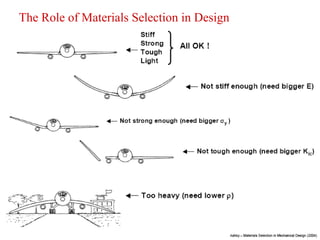
The Role of Materials Selection in Design
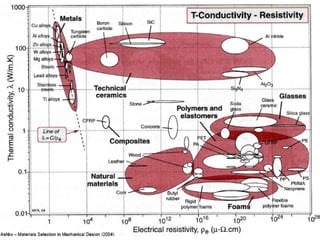
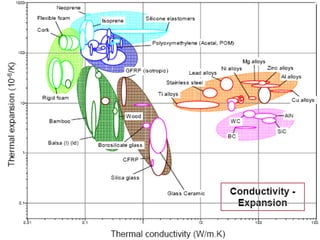
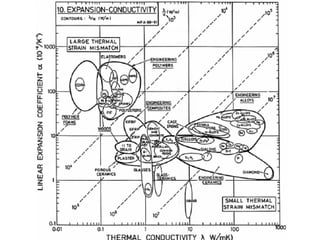
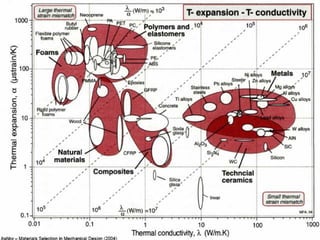
Exploring relationships - Materials Property Charts
The Materials Selection Process –Design Models
Selecting materials –Materials Indices
Case Studies of Materials Selection using CES
The Role of Materials Selection in Design
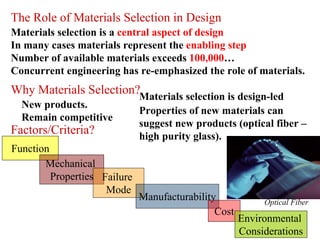
Materials selection is a central aspect of design
In many cases materials represent the enabling step
Number of available materials exceeds 100,000…
Concurrent engineering has re-emphasized the role of materials.
The Role of Materials Selection in Design
Why Materials Selection?
New products.
Remain competitive
Factors/Criteria?
Function
Mechanical
Properties Failure
Mode
Manufacturability
Cost
Environmental
Considerations
Materials selection is design-led
Properties of new materials can
suggest new products (optical fiber –
high purity glass).
Optical Fiber
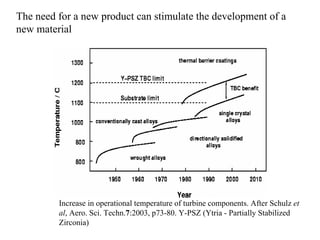
The need for a new product can stimulate the development of a
new material
Increase in operational temperature of turbine components. After Schulz et
al, Aero. Sci. Techn.7:2003, p73-80. Y-PSZ (Ytria - Partially Stabilized
Zirconia)
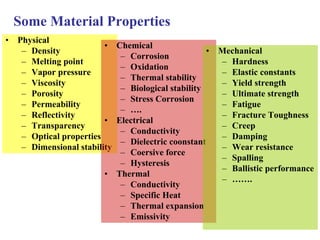
Some Material Properties
• Physical
– Density
– Melting point
– Vapor pressure
– Viscosity
– Porosity
– Permeability
– Reflectivity
– Transparency
– Optical properties
– Dimensional stability
• Chemical
– Corrosion
– Oxidation
– Thermal stability
– Biological stability
– Stress Corrosion
– ….
• Electrical
– Conductivity
– Dielectric coonstant
– Coersive force
– Hysteresis
• Thermal
– Conductivity
– Specific Heat
– Thermal expansion
– Emissivity
• Mechanical
– Hardness
– Elastic constants
– Yield strength
– Ultimate strength
– Fatigue
– Fracture Toughness
– Creep
– Damping
– Wear resistance
– Spalling
– Ballistic performance
– …….
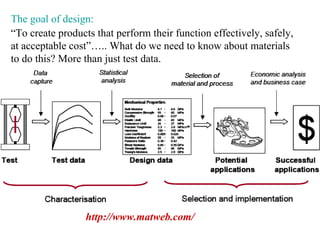
http://www.matweb.com/
The goal of design:
“To create products that perform their function effectively, safely,
at acceptable cost”….. What do we need to know about materials
to do this? More than just test data.
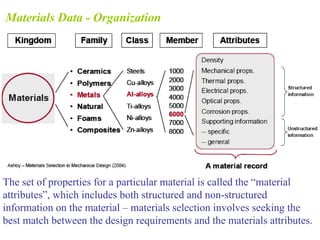
Materials Data - Organization
The set of properties for a particular material is called the “material
attributes”, which includes both structured and non-structured
information on the material – materials selection involves seeking the
best match between the design requirements and the materials attributes.
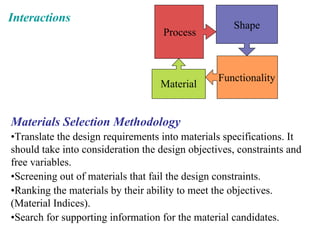
Interactions
Material
Process
Shape
Functionality
Materials Selection Methodology
•Translate the design requirements into materials specifications. It
should take into consideration the design objectives, constraints and
free variables.
•Screening out of materials that fail the design constraints.
•Ranking the materials by their ability to meet the objectives.
(Material Indices).
•Search for supporting information for the material candidates.
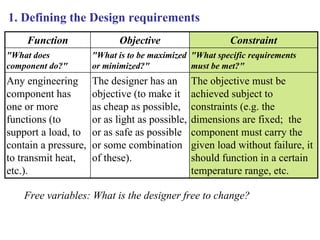
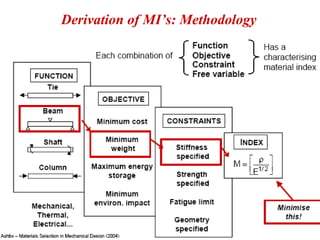
Function Objective Constraint
"What does
component do?"
"What is to be maximized
or minimized?"
"What specific requirements
must be met?"
Any engineering
component has
one or more
functions (to
support a load, to
contain a pressure,
to transmit heat,
etc.).
The designer has an
objective (to make it
as cheap as possible,
or as light as possible,
or as safe as possible
or some combination
of these).
The objective must be
achieved subject to
constraints (e.g. the
dimensions are fixed; the
component must carry the
given load without failure, it
should function in a certain
temperature range, etc.
Free variables: What is the designer free to change?
1. Defining the Design requirements
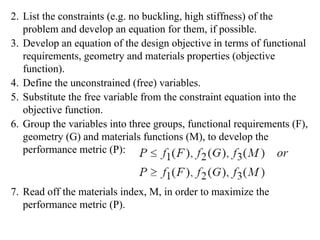
2. List the constraints (e.g. no buckling, high stiffness) of the
problem and develop an equation for them, if possible.
3. Develop an equation of the design objective in terms of functional
requirements, geometry and materials properties (objective
function).
4. Define the unconstrained (free) variables.
5. Substitute the free variable from the constraint equation into the
objective function.
6. Group the variables into three groups, functional requirements (F),
geometry (G) and materials functions (M), to develop the
performance metric (P):
7. Read off the materials index, M, in order to maximize the
performance metric (P).
Materials Selection Charts
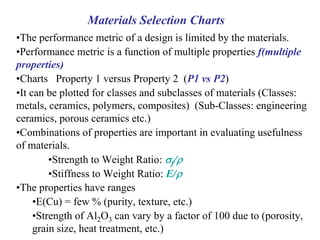
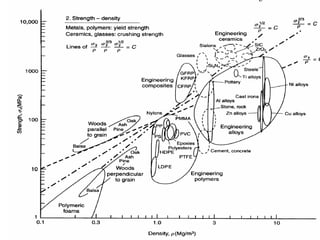
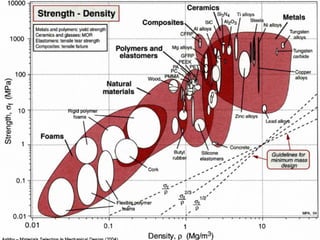
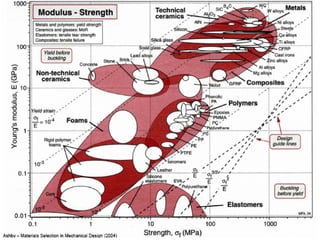
•The performance metric of a design is limited by the materials.
•Performance metric is a function of multiple properties f(multiple
properties)
•Charts Property 1 versus Property 2 (P1 vs P2)
•It can be plotted for classes and subclasses of materials (Classes:
metals, ceramics, polymers, composites) (Sub-Classes: engineering
ceramics, porous ceramics etc.)
•Combinations of properties are important in evaluating usefulness
of materials.
•Strength to Weight Ratio: σf/ρ
•Stiffness to Weight Ratio: E/ρ
•The properties have ranges
•E(Cu) = few % (purity, texture, etc.)
•Strength of Al2O3 can vary by a factor of 100 due to (porosity,
grain size, heat treatment, etc.)
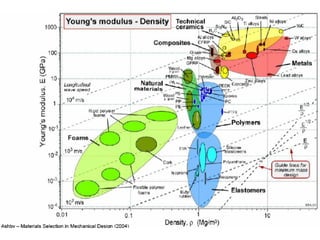
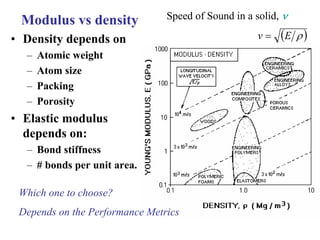
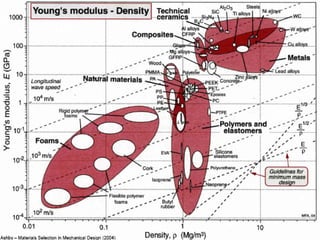
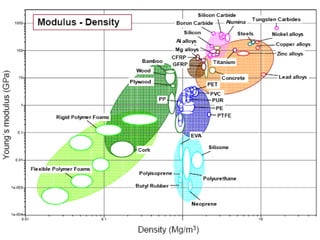
Modulus vs density
• Density depends on
– Atomic weight
– Atom size
– Packing
– Porosity
• Elastic modulus
depends on:
– Bond stiffness
– # bonds per unit area.
Which one to choose?
Depends on the Performance Metrics
Speed of Sound in a solid, ν
( )
ρ
E
v =
Material Indices
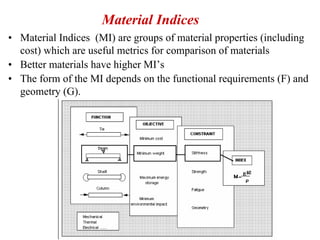
• Material Indices (MI) are groups of material properties (including
cost) which are useful metrics for comparison of materials
• Better materials have higher MI’s
• The form of the MI depends on the functional requirements (F) and
geometry (G).
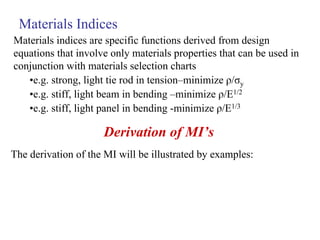
Materials indices are specific functions derived from design
equations that involve only materials properties that can be used in
conjunction with materials selection charts
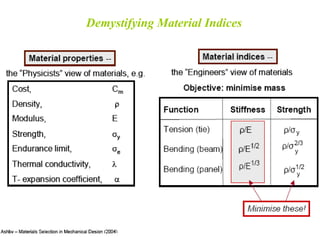
•e.g. strong, light tie rod in tension–minimize ρ/σy
•e.g. stiff, light beam in bending –minimize ρ/E1/2
•e.g. stiff, light panel in bending -minimize ρ/E1/3
Materials Indices
Derivation of MI’s
The derivation of the MI will be illustrated by examples:
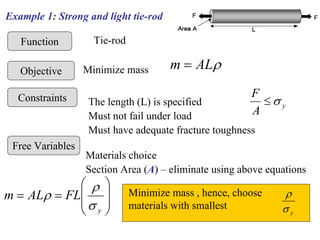
Example 1: Strong and light tie-rod
Function
Objective
Constraints
Free Variables
Tie-rod
Minimize mass ρ
AL
m =
The length (L) is specified
Must not fail under load
Must have adequate fracture toughness
y
A
F
σ
≤
Materials choice
Section Area (A) – eliminate using above equations
⎟
⎟
⎠
⎞
⎜
⎜
⎝
⎛
=
=
y
FL
AL
m
σ
ρ
ρ Minimize mass , hence, choose
materials with smallest
y
σ
ρ
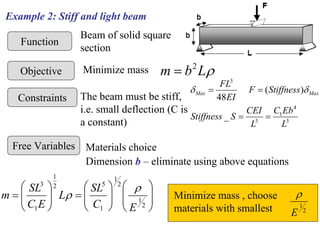
Example 2: Stiff and light beam
Function
Objective
Constraints
Free Variables
Beam of solid square
section
Minimize mass ρ
L
b
m 2
=
The beam must be stiff,
i.e. small deflection (C is
a constant) 3
4
1
3
3
_
)
(
48
L
Eb
C
L
CEI
S
Stiffness
Stiffness
F
EI
FL
Max
Max
=
=
=
= δ
δ
Materials choice
Dimension b – eliminate using above equations
⎟
⎟
⎠
⎞
⎜
⎜
⎝
⎛
⎟
⎟
⎠
⎞
⎜
⎜
⎝
⎛
=
⎟
⎟
⎠
⎞
⎜
⎜
⎝
⎛
=
2
1
2
1
1
5
2
1
1
3
E
C
SL
L
E
C
SL
m
ρ
ρ Minimize mass , choose
materials with smallest 2
1
E
ρ
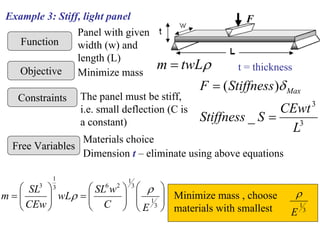
Example 3: Stiff, light panel
Function
Objective
Constraints
Free Variables
Panel with given
width (w) and
length (L)
Minimize mass
ρ
twL
m =
The panel must be stiff,
i.e. small deflection (C is
a constant)
Materials choice
Dimension t – eliminate using above equations
⎟
⎟
⎠
⎞
⎜
⎜
⎝
⎛
⎟
⎟
⎠
⎞
⎜
⎜
⎝
⎛
=
⎟
⎟
⎠
⎞
⎜
⎜
⎝
⎛
=
3
1
3
1
2
6
3
1
3
E
C
w
SL
wL
CEw
SL
m
ρ
ρ Minimize mass , choose
materials with smallest 3
1
E
ρ
F
t = thickness
3
3
_
)
(
L
CEwt
S
Stiffness
Stiffness
F Max
=
= δ
Derivation of MI’s: Methodology
Demystifying Material Indices
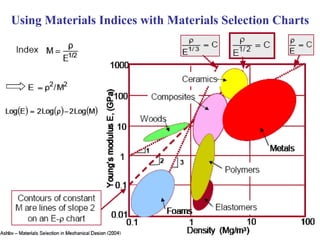
Using Materials Indices with Materials Selection Charts
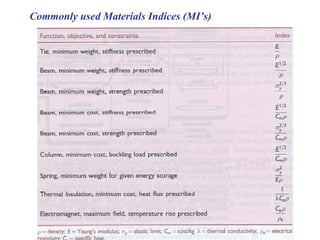
Commonly used Materials Indices (MI’s)
Standards
and codes
(ISO 14000)
Supplier
information
Sector-specific
approval
(FDA, MilSpec)
z Supporting information,
general: what else do you need to know?
FE modules
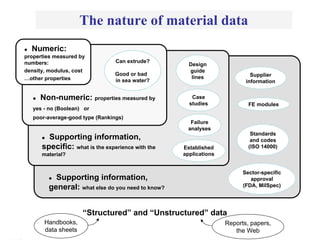
The nature of material data
z Supporting information,
specific: what is the experience with the
material?
Design
guide
lines
Established
applications
Failure
analyses
Case
studies
“Structured” and “Unstructured” data
Handbooks,
data sheets
Reports, papers,
the Web
z Non-numeric: properties measured by
yes - no (Boolean) or
poor-average-good type (Rankings)
Can extrude?
Good or bad
in sea water?
z Numeric:
properties measured by
numbers:
density, modulus, cost
…other properties
U it 1 F 1 8
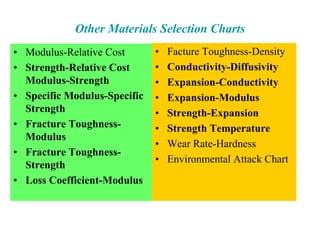
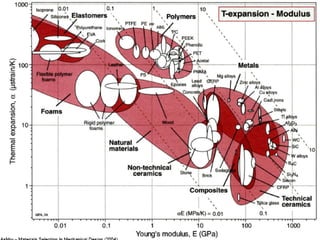
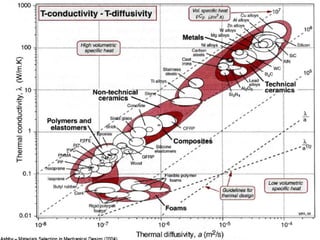
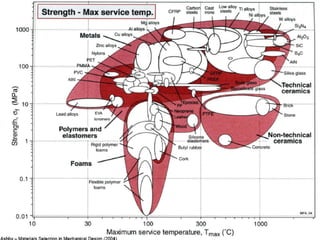
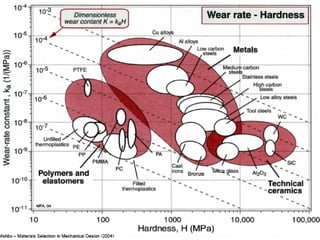
Other Materials Selection Charts
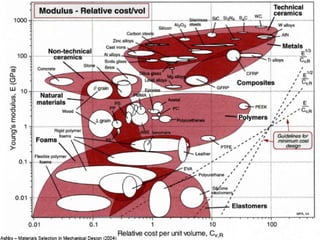
• Modulus-Relative Cost
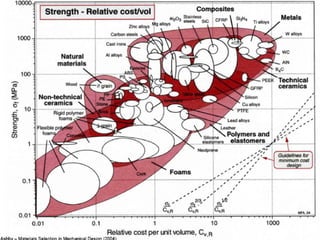
• Strength-Relative Cost
Modulus-Strength
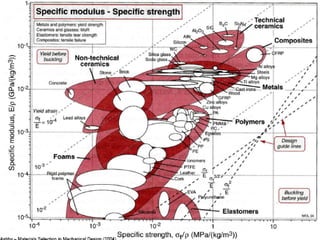
• Specific Modulus-Specific
Strength
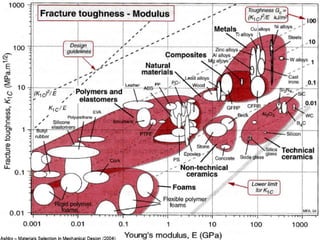
• Fracture Toughness-
Modulus
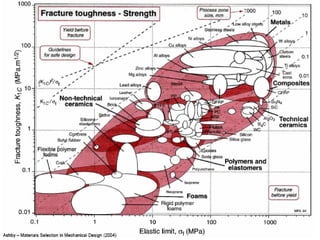
• Fracture Toughness-
Strength
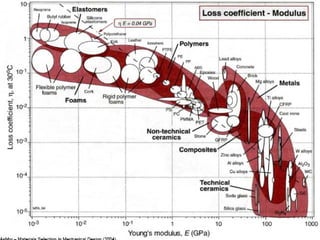
• Loss Coefficient-Modulus
• Facture Toughness-Density
• Conductivity-Diffusivity
• Expansion-Conductivity
• Expansion-Modulus
• Strength-Expansion
• Strength Temperature
• Wear Rate-Hardness
• Environmental Attack Chart
Summary: Material Indices
• A method is necessary for translating design requirements into a
prescription for a material
• Modulus-Density charts
– Reveal a method of using lines of constant
to allow selection of materials for minimum weight and
deflection-limited design.
• Material Index
– Combination of material properties which characterize
performance in a given application.
• Performance of a material:
3
,
2
,
1
1
=
n
E n
ρ
⎥
⎦
⎤
⎢
⎣
⎡
⎟
⎟
⎠
⎞
⎜
⎜
⎝
⎛
⎟
⎟
⎠
⎞
⎜
⎜
⎝
⎛
⎟
⎟
⎠
⎞
⎜
⎜
⎝
⎛
=
M
stics
Characteri
Material
G
Parameters
Geometeric
F
Needs
Functional
f
p
,
,
,
,
,
)
(
)
(
)
( 3
2
1 M
f
G
f
F
f
p =
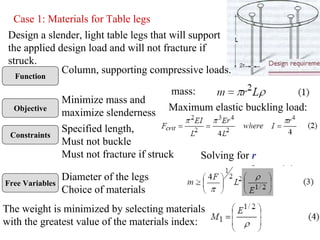
Case 1: Materials for Table legs
Design a slender, light table legs that will support
the applied design load and will not fracture if
struck.
Function
Objective
Constraints
Free Variables
Column, supporting compressive loads.
Minimize mass and
maximize slenderness
Specified length,
Must not buckle
Must not fracture if struck
Diameter of the legs
Choice of materials
mass:
Maximum elastic buckling load:
Solving for r
The weight is minimized by selecting materials
with the greatest value of the materials index:
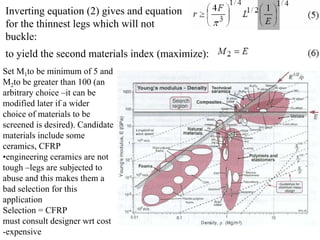
Inverting equation (2) gives and equation
for the thinnest legs which will not
buckle:
to yield the second materials index (maximize):
Set M1to be minimum of 5 and
M2to be greater than 100 (an
arbitrary choice –it can be
modified later if a wider
choice of materials to be
screened is desired). Candidate
materials include some
ceramics, CFRP
•engineering ceramics are not
tough –legs are subjected to
abuse and this makes them a
bad selection for this
application
Selection = CFRP
must consult designer wrt cost
-expensive
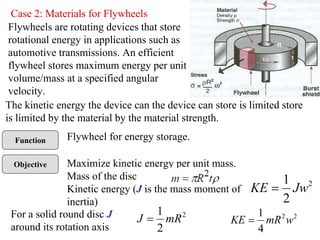
Case 2: Materials for Flywheels
Flywheels are rotating devices that store
rotational energy in applications such as
automotive transmissions. An efficient
flywheel stores maximum energy per unit
volume/mass at a specified angular
velocity.
Function
Objective
The kinetic energy the device can the device can store is limited store
is limited by the material by the material strength.
Flywheel for energy storage.
Maximize kinetic energy per unit mass.
Mass of the disc
Kinetic energy (J is the mass moment of
inertia)
2
2
1
Jw
KE =
For a solid round disc J
around its rotation axis
2
2
1
mR
J = 2
2
4
1
w
mR
KE =
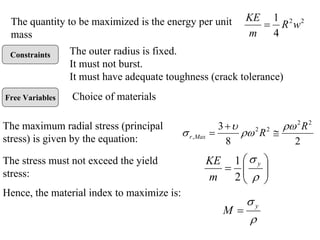
Constraints
Free Variables
The quantity to be maximized is the energy per unit
mass
2
2
4
1
w
R
m
KE
=
The outer radius is fixed.
It must not burst.
It must have adequate toughness (crack tolerance)
Choice of materials
The maximum radial stress (principal
stress) is given by the equation: 2
8
3 2
2
2
2
,
R
R
Max
r
ρω
ρω
υ
σ ≅
+
=
The stress must not exceed the yield
stress: ⎟
⎟
⎠
⎞
⎜
⎜
⎝
⎛
=
ρ
σ y
m
KE
2
1
Hence, the material index to maximize is:
ρ
σ y
M =
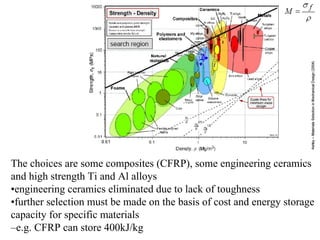
The choices are some composites (CFRP), some engineering ceramics
and high strength Ti and Al alloys
•engineering ceramics eliminated due to lack of toughness
•further selection must be made on the basis of cost and energy storage
capacity for specific materials
–e.g. CFRP can store 400kJ/kg
Case 3: Materials for Passive Solar Heating
A simple way of storing solar energy for
residential heating is by heating the walls
during the day and transferring heat to the
interior via forced convection at night.
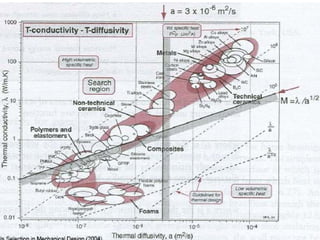
Need to diffuse heat from the outer to inner
surface in 12h. For architectural reasons,
the wall thickness (W) cannot exceed 0.5m
Function
Objective
Heat storage medium
Maximize thermal energy storage per unit material cost.
Constraints
Free Variables
Heat diffusion time through wall time (t) ~12h
Wall thickness w<0.5m
Working temperature TMax ~ 100oC
Wall thickness w.
Choice of materials
What material will maximize the thermal energy captured by the wall
while retaining the required heat diffusion time of up to 12h?
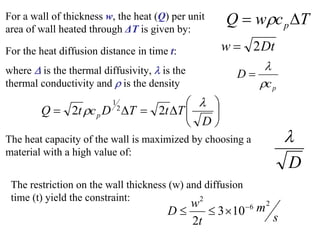
For a wall of thickness w, the heat (Q) per unit
area of wall heated through ΔT is given by:
T
c
w
Q pΔ
= ρ
For the heat diffusion distance in time t:
where Δ is the thermal diffusivity, λ is the
thermal conductivity and ρ is the density
Dt
w 2
=
p
c
D
ρ
λ
=
⎟
⎠
⎞
⎜
⎝
⎛
Δ
=
Δ
=
D
T
t
T
D
c
t
Q p
λ
ρ 2
2 2
1
The heat capacity of the wall is maximized by choosing a
material with a high value of:
D
λ
The restriction on the wall thickness (w) and diffusion
time (t) yield the constraint:
s
m
t
w
D
2
6
2
10
3
2
−
×
≤
≤
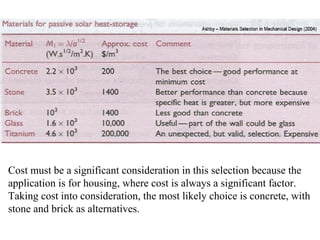
Cost must be a significant consideration in this selection because the
application is for housing, where cost is always a significant factor.
Taking cost into consideration, the most likely choice is concrete, with
stone and brick as alternatives.
M.F. Ashby, “Materials Selection in Mechanical Design, 2ndEd.”
•multiple sources listed in appendices of the book
•materials selection charts in lecture Appendix
Other references :
•ASM Metals Handbook
•Perry’s Chemical Engineering Handbook
•CRC Handbook of Mathematics and Physics
•ASM Handbook of Ceramics and Composites
Literature Resources
Material Selection in Design.pdf

  • 1.
    Materials Selection inDesign The Role of Materials Selection in Design Exploring relationships - Materials Property Charts The Materials Selection Process –Design Models Selecting materials –Materials Indices Case Studies of Materials Selection using CES
  • 2.
    The Role ofMaterials Selection in Design
  • 3.
    Materials selection isa central aspect of design In many cases materials represent the enabling step Number of available materials exceeds 100,000… Concurrent engineering has re-emphasized the role of materials. The Role of Materials Selection in Design Why Materials Selection? New products. Remain competitive Factors/Criteria? Function Mechanical Properties Failure Mode Manufacturability Cost Environmental Considerations Materials selection is design-led Properties of new materials can suggest new products (optical fiber – high purity glass). Optical Fiber
  • 4.
    The need fora new product can stimulate the development of a new material Increase in operational temperature of turbine components. After Schulz et al, Aero. Sci. Techn.7:2003, p73-80. Y-PSZ (Ytria - Partially Stabilized Zirconia)
  • 5.
    Some Material Properties •Physical – Density – Melting point – Vapor pressure – Viscosity – Porosity – Permeability – Reflectivity – Transparency – Optical properties – Dimensional stability • Chemical – Corrosion – Oxidation – Thermal stability – Biological stability – Stress Corrosion – …. • Electrical – Conductivity – Dielectric coonstant – Coersive force – Hysteresis • Thermal – Conductivity – Specific Heat – Thermal expansion – Emissivity • Mechanical – Hardness – Elastic constants – Yield strength – Ultimate strength – Fatigue – Fracture Toughness – Creep – Damping – Wear resistance – Spalling – Ballistic performance – …….
  • 6.
    http://www.matweb.com/ The goal ofdesign: “To create products that perform their function effectively, safely, at acceptable cost”….. What do we need to know about materials to do this? More than just test data.
  • 7.
    Materials Data -Organization The set of properties for a particular material is called the “material attributes”, which includes both structured and non-structured information on the material – materials selection involves seeking the best match between the design requirements and the materials attributes.
  • 9.
    Interactions Material Process Shape Functionality Materials Selection Methodology •Translatethe design requirements into materials specifications. It should take into consideration the design objectives, constraints and free variables. •Screening out of materials that fail the design constraints. •Ranking the materials by their ability to meet the objectives. (Material Indices). •Search for supporting information for the material candidates.
  • 10.
    Function Objective Constraint "Whatdoes component do?" "What is to be maximized or minimized?" "What specific requirements must be met?" Any engineering component has one or more functions (to support a load, to contain a pressure, to transmit heat, etc.). The designer has an objective (to make it as cheap as possible, or as light as possible, or as safe as possible or some combination of these). The objective must be achieved subject to constraints (e.g. the dimensions are fixed; the component must carry the given load without failure, it should function in a certain temperature range, etc. Free variables: What is the designer free to change? 1. Defining the Design requirements
  • 11.
    2. List theconstraints (e.g. no buckling, high stiffness) of the problem and develop an equation for them, if possible. 3. Develop an equation of the design objective in terms of functional requirements, geometry and materials properties (objective function). 4. Define the unconstrained (free) variables. 5. Substitute the free variable from the constraint equation into the objective function. 6. Group the variables into three groups, functional requirements (F), geometry (G) and materials functions (M), to develop the performance metric (P): 7. Read off the materials index, M, in order to maximize the performance metric (P).
  • 12.
    Materials Selection Charts •Theperformance metric of a design is limited by the materials. •Performance metric is a function of multiple properties f(multiple properties) •Charts Property 1 versus Property 2 (P1 vs P2) •It can be plotted for classes and subclasses of materials (Classes: metals, ceramics, polymers, composites) (Sub-Classes: engineering ceramics, porous ceramics etc.) •Combinations of properties are important in evaluating usefulness of materials. •Strength to Weight Ratio: σf/ρ •Stiffness to Weight Ratio: E/ρ •The properties have ranges •E(Cu) = few % (purity, texture, etc.) •Strength of Al2O3 can vary by a factor of 100 due to (porosity, grain size, heat treatment, etc.)
  • 13.
    Modulus vs density •Density depends on – Atomic weight – Atom size – Packing – Porosity • Elastic modulus depends on: – Bond stiffness – # bonds per unit area. Which one to choose? Depends on the Performance Metrics Speed of Sound in a solid, ν ( ) ρ E v =
  • 14.
    Material Indices • MaterialIndices (MI) are groups of material properties (including cost) which are useful metrics for comparison of materials • Better materials have higher MI’s • The form of the MI depends on the functional requirements (F) and geometry (G).
  • 15.
    Materials indices arespecific functions derived from design equations that involve only materials properties that can be used in conjunction with materials selection charts •e.g. strong, light tie rod in tension–minimize ρ/σy •e.g. stiff, light beam in bending –minimize ρ/E1/2 •e.g. stiff, light panel in bending -minimize ρ/E1/3 Materials Indices Derivation of MI’s The derivation of the MI will be illustrated by examples:
  • 16.
    Example 1: Strongand light tie-rod Function Objective Constraints Free Variables Tie-rod Minimize mass ρ AL m = The length (L) is specified Must not fail under load Must have adequate fracture toughness y A F σ ≤ Materials choice Section Area (A) – eliminate using above equations ⎟ ⎟ ⎠ ⎞ ⎜ ⎜ ⎝ ⎛ = = y FL AL m σ ρ ρ Minimize mass , hence, choose materials with smallest y σ ρ
  • 17.
    Example 2: Stiffand light beam Function Objective Constraints Free Variables Beam of solid square section Minimize mass ρ L b m 2 = The beam must be stiff, i.e. small deflection (C is a constant) 3 4 1 3 3 _ ) ( 48 L Eb C L CEI S Stiffness Stiffness F EI FL Max Max = = = = δ δ Materials choice Dimension b – eliminate using above equations ⎟ ⎟ ⎠ ⎞ ⎜ ⎜ ⎝ ⎛ ⎟ ⎟ ⎠ ⎞ ⎜ ⎜ ⎝ ⎛ = ⎟ ⎟ ⎠ ⎞ ⎜ ⎜ ⎝ ⎛ = 2 1 2 1 1 5 2 1 1 3 E C SL L E C SL m ρ ρ Minimize mass , choose materials with smallest 2 1 E ρ
  • 18.
    Example 3: Stiff,light panel Function Objective Constraints Free Variables Panel with given width (w) and length (L) Minimize mass ρ twL m = The panel must be stiff, i.e. small deflection (C is a constant) Materials choice Dimension t – eliminate using above equations ⎟ ⎟ ⎠ ⎞ ⎜ ⎜ ⎝ ⎛ ⎟ ⎟ ⎠ ⎞ ⎜ ⎜ ⎝ ⎛ = ⎟ ⎟ ⎠ ⎞ ⎜ ⎜ ⎝ ⎛ = 3 1 3 1 2 6 3 1 3 E C w SL wL CEw SL m ρ ρ Minimize mass , choose materials with smallest 3 1 E ρ F t = thickness 3 3 _ ) ( L CEwt S Stiffness Stiffness F Max = = δ
  • 19.
  • 20.
  • 21.
    Using Materials Indiceswith Materials Selection Charts
  • 24.
    Commonly used MaterialsIndices (MI’s)
  • 25.
    Standards and codes (ISO 14000) Supplier information Sector-specific approval (FDA,MilSpec) z Supporting information, general: what else do you need to know? FE modules The nature of material data z Supporting information, specific: what is the experience with the material? Design guide lines Established applications Failure analyses Case studies “Structured” and “Unstructured” data Handbooks, data sheets Reports, papers, the Web z Non-numeric: properties measured by yes - no (Boolean) or poor-average-good type (Rankings) Can extrude? Good or bad in sea water? z Numeric: properties measured by numbers: density, modulus, cost …other properties U it 1 F 1 8
  • 26.
    Other Materials SelectionCharts • Modulus-Relative Cost • Strength-Relative Cost Modulus-Strength • Specific Modulus-Specific Strength • Fracture Toughness- Modulus • Fracture Toughness- Strength • Loss Coefficient-Modulus • Facture Toughness-Density • Conductivity-Diffusivity • Expansion-Conductivity • Expansion-Modulus • Strength-Expansion • Strength Temperature • Wear Rate-Hardness • Environmental Attack Chart
  • 27.
    Summary: Material Indices •A method is necessary for translating design requirements into a prescription for a material • Modulus-Density charts – Reveal a method of using lines of constant to allow selection of materials for minimum weight and deflection-limited design. • Material Index – Combination of material properties which characterize performance in a given application. • Performance of a material: 3 , 2 , 1 1 = n E n ρ ⎥ ⎦ ⎤ ⎢ ⎣ ⎡ ⎟ ⎟ ⎠ ⎞ ⎜ ⎜ ⎝ ⎛ ⎟ ⎟ ⎠ ⎞ ⎜ ⎜ ⎝ ⎛ ⎟ ⎟ ⎠ ⎞ ⎜ ⎜ ⎝ ⎛ = M stics Characteri Material G Parameters Geometeric F Needs Functional f p , , , , , ) ( ) ( ) ( 3 2 1 M f G f F f p =
  • 45.
    Case 1: Materialsfor Table legs Design a slender, light table legs that will support the applied design load and will not fracture if struck. Function Objective Constraints Free Variables Column, supporting compressive loads. Minimize mass and maximize slenderness Specified length, Must not buckle Must not fracture if struck Diameter of the legs Choice of materials mass: Maximum elastic buckling load: Solving for r The weight is minimized by selecting materials with the greatest value of the materials index:
  • 46.
    Inverting equation (2)gives and equation for the thinnest legs which will not buckle: to yield the second materials index (maximize): Set M1to be minimum of 5 and M2to be greater than 100 (an arbitrary choice –it can be modified later if a wider choice of materials to be screened is desired). Candidate materials include some ceramics, CFRP •engineering ceramics are not tough –legs are subjected to abuse and this makes them a bad selection for this application Selection = CFRP must consult designer wrt cost -expensive
  • 47.
    Case 2: Materialsfor Flywheels Flywheels are rotating devices that store rotational energy in applications such as automotive transmissions. An efficient flywheel stores maximum energy per unit volume/mass at a specified angular velocity. Function Objective The kinetic energy the device can the device can store is limited store is limited by the material by the material strength. Flywheel for energy storage. Maximize kinetic energy per unit mass. Mass of the disc Kinetic energy (J is the mass moment of inertia) 2 2 1 Jw KE = For a solid round disc J around its rotation axis 2 2 1 mR J = 2 2 4 1 w mR KE =
  • 48.
    Constraints Free Variables The quantityto be maximized is the energy per unit mass 2 2 4 1 w R m KE = The outer radius is fixed. It must not burst. It must have adequate toughness (crack tolerance) Choice of materials The maximum radial stress (principal stress) is given by the equation: 2 8 3 2 2 2 2 , R R Max r ρω ρω υ σ ≅ + = The stress must not exceed the yield stress: ⎟ ⎟ ⎠ ⎞ ⎜ ⎜ ⎝ ⎛ = ρ σ y m KE 2 1 Hence, the material index to maximize is: ρ σ y M =
  • 49.
    The choices aresome composites (CFRP), some engineering ceramics and high strength Ti and Al alloys •engineering ceramics eliminated due to lack of toughness •further selection must be made on the basis of cost and energy storage capacity for specific materials –e.g. CFRP can store 400kJ/kg
  • 50.
    Case 3: Materialsfor Passive Solar Heating A simple way of storing solar energy for residential heating is by heating the walls during the day and transferring heat to the interior via forced convection at night. Need to diffuse heat from the outer to inner surface in 12h. For architectural reasons, the wall thickness (W) cannot exceed 0.5m Function Objective Heat storage medium Maximize thermal energy storage per unit material cost. Constraints Free Variables Heat diffusion time through wall time (t) ~12h Wall thickness w<0.5m Working temperature TMax ~ 100oC Wall thickness w. Choice of materials What material will maximize the thermal energy captured by the wall while retaining the required heat diffusion time of up to 12h?
  • 51.
    For a wallof thickness w, the heat (Q) per unit area of wall heated through ΔT is given by: T c w Q pΔ = ρ For the heat diffusion distance in time t: where Δ is the thermal diffusivity, λ is the thermal conductivity and ρ is the density Dt w 2 = p c D ρ λ = ⎟ ⎠ ⎞ ⎜ ⎝ ⎛ Δ = Δ = D T t T D c t Q p λ ρ 2 2 2 1 The heat capacity of the wall is maximized by choosing a material with a high value of: D λ The restriction on the wall thickness (w) and diffusion time (t) yield the constraint: s m t w D 2 6 2 10 3 2 − × ≤ ≤
  • 53.
    Cost must bea significant consideration in this selection because the application is for housing, where cost is always a significant factor. Taking cost into consideration, the most likely choice is concrete, with stone and brick as alternatives.
  • 54.
    M.F. Ashby, “MaterialsSelection in Mechanical Design, 2ndEd.” •multiple sources listed in appendices of the book •materials selection charts in lecture Appendix Other references : •ASM Metals Handbook •Perry’s Chemical Engineering Handbook •CRC Handbook of Mathematics and Physics •ASM Handbook of Ceramics and Composites Literature Resources