Material Requirement Planning
(MRP)
Submited By
Mr. Pankaj kumar sethi
Miss. Smrutirekha Behera
Contributors to MRP
• Material Requirements Planning
was introduced in the 1970’s
What is MRP?
• MRP is a production planning,scheduling
and inventory control system used to
manage manufacturing processes.
• Computerized Inventory Control
• Production Planning System
• Management Information System
• Manufacturing Control System
Objective of MRP
• To provide the right parts at the right time
to meet the schedules for completed
products.
The Scope of MRP
• Dependent demand – Demand for items that
are sub-assemblies, parts or raw materials to
be used in the production of finished goods.
• Independent demand – finished products
The Function of MRP
• Inventory control
• Bill of material processing
• Elementary scheduling
When to use MRP
• Job Shop Production
• Complex Products
• Assemble-to-Order Environments
• Discrete and Dependent Demand Items
What can MRP do?
• Reduce Inventory Levels
• Reduce Component
Shortages
• Improve Shipping
Performance
• Improve Customer
Service
• Improve Productivity
• Simplified and Accurate
Scheduling
• Reduce Purchasing Cost
• Improve Production
Schedules
• Reduce Manufacturing
Cost
• Reduce Lead Times
• Less Scrap and Rework
• Higher Production
Quality
What can MRP do?
• Improve
Communication
• Improve Plant
Efficiency
• Reduce Freight Cost
• Reduction in Excess
Inventory
• Reduce Overtime
• Improve Supply
Schedules
• Improve Calculation of
Material Requirements
• Improve Competitive
Position
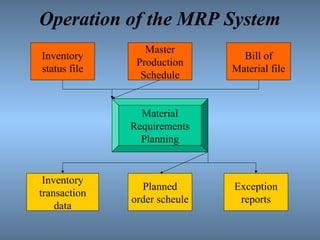
Operation of the MRP System
Inventory
status file
Master
Production
Schedule
Bill of
Material file
Material
Requirements
Planning
Inventory
transaction
data
Planned
order scheule
Exception
reports
MRP Inputs
• Inventory status file
• Master Production Schedule
• Bill of Material file
Inventory status file
• On-Hand Quantities
• On-Order Quantities
• Lot Sizes
• Safety Stock
• Lead Time
Master Production Schedule
• Schedule of Finished Products
• Represents Production, not Demand
• Combination of Customer Orders and
Demand Forecasts
• What Needs to be Produced
Bill of material file
• This file provides the information
regarding all the materials, parts and
sub-assemblies that so into the end
product.
• The bill of materials can be viewed as
having a series of levels, each of which
represent a stage in the manufacture of
the end product.
MRP Outputs
• Inventory transaction data
• Planned order schedule
• Exception reports
Summary of MRP
MRP is a…..
• Computerized Inventory Control
• Production Planning System
that…..
• Schedules Component Items as Needed
which will…..
• Track Inventory and…..
• Help you in many other aspects of business
CONCLUSION
• We conclude that MRP is a computer-based
production planning and inventory control
system. That schedules component items as
needed which will track inventory and help you
in many other aspects of business.
• MPR is very much essential for manufacturing
company
Material requirement planning presentation

Material requirement planning presentation

  • 1.
    Material Requirement Planning (MRP) SubmitedBy Mr. Pankaj kumar sethi Miss. Smrutirekha Behera
  • 2.
    Contributors to MRP •Material Requirements Planning was introduced in the 1970’s
  • 3.
    What is MRP? •MRP is a production planning,scheduling and inventory control system used to manage manufacturing processes. • Computerized Inventory Control • Production Planning System • Management Information System • Manufacturing Control System
  • 4.
    Objective of MRP •To provide the right parts at the right time to meet the schedules for completed products.
  • 5.
    The Scope ofMRP • Dependent demand – Demand for items that are sub-assemblies, parts or raw materials to be used in the production of finished goods. • Independent demand – finished products
  • 6.
    The Function ofMRP • Inventory control • Bill of material processing • Elementary scheduling
  • 7.
    When to useMRP • Job Shop Production • Complex Products • Assemble-to-Order Environments • Discrete and Dependent Demand Items
  • 8.
    What can MRPdo? • Reduce Inventory Levels • Reduce Component Shortages • Improve Shipping Performance • Improve Customer Service • Improve Productivity • Simplified and Accurate Scheduling • Reduce Purchasing Cost • Improve Production Schedules • Reduce Manufacturing Cost • Reduce Lead Times • Less Scrap and Rework • Higher Production Quality
  • 9.
    What can MRPdo? • Improve Communication • Improve Plant Efficiency • Reduce Freight Cost • Reduction in Excess Inventory • Reduce Overtime • Improve Supply Schedules • Improve Calculation of Material Requirements • Improve Competitive Position
  • 10.
    Operation of theMRP System Inventory status file Master Production Schedule Bill of Material file Material Requirements Planning Inventory transaction data Planned order scheule Exception reports
  • 11.
    MRP Inputs • Inventorystatus file • Master Production Schedule • Bill of Material file
  • 12.
    Inventory status file •On-Hand Quantities • On-Order Quantities • Lot Sizes • Safety Stock • Lead Time
  • 13.
    Master Production Schedule •Schedule of Finished Products • Represents Production, not Demand • Combination of Customer Orders and Demand Forecasts • What Needs to be Produced
  • 14.
    Bill of materialfile • This file provides the information regarding all the materials, parts and sub-assemblies that so into the end product. • The bill of materials can be viewed as having a series of levels, each of which represent a stage in the manufacture of the end product.
  • 15.
    MRP Outputs • Inventorytransaction data • Planned order schedule • Exception reports
  • 16.
    Summary of MRP MRPis a….. • Computerized Inventory Control • Production Planning System that….. • Schedules Component Items as Needed which will….. • Track Inventory and….. • Help you in many other aspects of business
  • 17.
    CONCLUSION • We concludethat MRP is a computer-based production planning and inventory control system. That schedules component items as needed which will track inventory and help you in many other aspects of business. • MPR is very much essential for manufacturing company

Editor's Notes

  • #3 Material Requirements Planning was introduced in the 1970’s. Much of the credit goes to three individuals by the names of Joseph Orlicky, George Plossl, and Oliver Wight. The American Production and Inventory Control Society (APICS), which was endorsed by Orlicky, Plossl, and Wight, was also credited with the introduction of MRP.
  • #4 MRP is a system that controls inventory levels, plans production, helps supply management with important information, and helps with the manufacturing control system with respect to the production of assembled parts.
  • #8 There are certain environments or situations in which it is better and more efficient to use MRP. These environments and situations are as follows.
  • #9 MRP can do many things to help your company succeed. Probably the most important quality of MRP is the fact that it will help your company with inventory. It plans production so that the right materials are at the right place at the right time.
  • #10 Here are some qualities of MRP. MRP determines the latest possible time to product goods, buy materials, and add manufacturing value. Proper MRP can keep cash in the firm and still fulfill all production demands.
  • #11 The is an overview of how the MRP system works. The Orange boxes indicate the inputs into the MRP system. The MRP system then processes the information and delivers outputs as indicated by the yellow boxes.
  • #12 The three main inputs into the MRP system are product structure files, master production schedules, and inventory master files. These three main inputs summarize the input requirements described earlier.
  • #13 The product structure file contains a bill of material for every item produced. In other words, this file contains all the component parts for a larger item. For example if you are producing a car, the component parts for the car would be the screws, steel, rubber, and so on. Not only does the product structure contain all the component parts, it also supplies information for in which order the product is to be assembled. The MRP system accesses the product structure file to determine which component items need to be scheduled.
  • #14 The master production schedule specifies which end items or finished products the company is to produce, how many are needed, and when they are needed. The numbers that are on the master production schedule represent production, not demand, may be a combination of customer orders and demand forecasts, and gives what needs to be produced.
  • #15 This file includes all the numbers from inventory. The MRP system keeps track of your inventory and when more items need to be ordered. It is important that you inventory numbers are accurate from the beginning in order for the MRP system to work properly.
  • #16 The MRP system delivers two main outputs along with various other reports. The two main outputs are manufacturing orders which can be released to shop floors for in-house production and purchasing orders which are sent to outside suppliers. The various reports offer suggested changes in previous plans or existing schedules.
  • #17 Read the Summary above.
  • #18 All information on this slide show was gathered from the above resources.