Materials Requirements Planning Fun stuff
Materials Management A plant organizing function that assures a predictable flow of components and other inputs through a transformation process. It coordinates the activities of both the internal and external factory What  is needed  When i.e. Inventory micro issues
Development of MRP After WWII - D>>S Companies use quarterly ordering systems based on confirmed orders WWII boom settles down D = S backlog of orders decreases quarterly systems become more based on forecasts In move from confirmed orders to forecasts, quarterly systems become less and less accurate Wight, others develop MRP  takes forecasts, breaks them down via dependent demand into weekly schedules
Up to 1970s, extensive use of Q and P models why? Simple to use, limited information requirements, “optional” Why move to MRP? problems with Q and P models high levels of inventory high stockouts poor customer services “ Order launch & Expedite” Prior to MRP
Major changes high cost of inventory increased availability of more powerful computers decreasing cost of computers MRP now supported by extensive body of software Other Factors
 
Dependent Demand Demand for components driven by the production schedule It is derived - not forecasted Consists of WIP and raw materials Lumpy- discrete, irregular quantities Concept of Parent/Component Time Bucket
MRP and Dependent Demand Independent Demand Finished Goods independent demand in MPS Problem with Dependent Demand  information generated challenge - generating 100% CSL past approach – Q, P new approach - MRP
Remember This??    MPS Principles The MPS must be in concert with the production plan The MPS must drive the entire materials management system Include all known requirements in the preparation of the MPS and the FAS Minimize the number of items needed to adequately express the MPS and the FAS
Plan showing availability Build schedule Stated in BoM terms What is the MPS?
A complete, current and accurate database one set of records high emphasis on data accuracy quick correction of error in db accessible to all who need data Remember this? Keys to MPC
Capacity Maximum Effective Demonstrated Demand management Capacity management level chase mixed Requires coordination with marketing Issues Considered
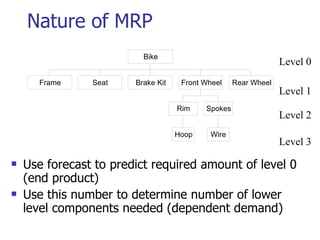
Nature of MRP Use forecast to predict required amount of level 0 (end product) Use this number to determine number of lower level components needed (dependent demand) Level 0 Level 1 Level 2 Level 3
Implementation of MRP Forecast becomes  gross requirements  for MRP system Break down gross requirements into  time buckets Calculate  net requirements -  difference between units required (i.e. gross requirements or derivation plus orders for that period) and units expected to be available in inventory
Key inputs to MRP MPS - merges forecasts and production capacity BOM - gives components needed for each end product in terms of part numbers Inventory Records -  must  be accurate, as MRP uses this information as the basis of its calculations; should design inventory system to ensure accuracy Order Status - use  scheduled receipts  to distinguish those orders that have actually been released Planned Lead Times - gives the  when  information
Brunswick Motors Applying MRP to Inventory Planning & Scheduling
 
MRP Elements Gross Requirements On-Hand Inventory Allocations Scheduled Receipts Net Requirements Planned Order Releases Time-phasing Parent/Component
MRP Elements Planning factors System nervousness Firm planning Explosion Time buckets Action bucket Rolling the Schedule Net Change vs. Regenerative MRP
Advantages of MRP Forward looking when planning (visibility) Useful simulator Provides valid, credible priorities priorities reflect actual needs, not implied needs. Provides mangers with control over the execution system Forms basis for building credible, valid formal system
MRP Works Best When... End Products are Standardized Batch Production End product is moderately complex The end product is assembled from a set of components and raw materials
Limitations of MRP only looks at materials, ignores capacity, shop floor conditions requires user discipline requires accurate information/data requires valid MPS not appropriate for all areas high volume production projects
Capacity Requirements Planning Wait a second -  just because MRP says produce X, are we able to produce X? Need to evaluate the capacity to see if it can meet plan Need all of MRP information plus: 1. How much capacity a process requires to make 1 unit of a product 2. When does the process need the hours (time) of capacity
MRP Closed Loop MRP MRP II Distribution Requirements Planning DRP II Enterprise Requirement Planning Types of MRP Systems
 
Reports Master Schedule Indented Bill of Materials BOM - Item Requirements Scheduled Receipts Planned Orders
 
ABC Analysis Which items are C items?  B items? Which item should we order ahead furthest? Which should we spend the most time on? Spend time and effort on A + B items carry small quantities review frequently
ABC Analysis Manage C items by: carrying inventories concentrating with a few suppliers stockless buying review infrequently

Ch17 Mrp

  • 1.
  • 2.
    Materials Management Aplant organizing function that assures a predictable flow of components and other inputs through a transformation process. It coordinates the activities of both the internal and external factory What is needed When i.e. Inventory micro issues
  • 3.
    Development of MRPAfter WWII - D>>S Companies use quarterly ordering systems based on confirmed orders WWII boom settles down D = S backlog of orders decreases quarterly systems become more based on forecasts In move from confirmed orders to forecasts, quarterly systems become less and less accurate Wight, others develop MRP takes forecasts, breaks them down via dependent demand into weekly schedules
  • 4.
    Up to 1970s,extensive use of Q and P models why? Simple to use, limited information requirements, “optional” Why move to MRP? problems with Q and P models high levels of inventory high stockouts poor customer services “ Order launch & Expedite” Prior to MRP
  • 5.
    Major changes highcost of inventory increased availability of more powerful computers decreasing cost of computers MRP now supported by extensive body of software Other Factors
  • 6.
  • 7.
    Dependent Demand Demandfor components driven by the production schedule It is derived - not forecasted Consists of WIP and raw materials Lumpy- discrete, irregular quantities Concept of Parent/Component Time Bucket
  • 8.
    MRP and DependentDemand Independent Demand Finished Goods independent demand in MPS Problem with Dependent Demand information generated challenge - generating 100% CSL past approach – Q, P new approach - MRP
  • 9.
    Remember This?? MPS Principles The MPS must be in concert with the production plan The MPS must drive the entire materials management system Include all known requirements in the preparation of the MPS and the FAS Minimize the number of items needed to adequately express the MPS and the FAS
  • 10.
    Plan showing availabilityBuild schedule Stated in BoM terms What is the MPS?
  • 11.
    A complete, currentand accurate database one set of records high emphasis on data accuracy quick correction of error in db accessible to all who need data Remember this? Keys to MPC
  • 12.
    Capacity Maximum EffectiveDemonstrated Demand management Capacity management level chase mixed Requires coordination with marketing Issues Considered
  • 13.
    Nature of MRPUse forecast to predict required amount of level 0 (end product) Use this number to determine number of lower level components needed (dependent demand) Level 0 Level 1 Level 2 Level 3
  • 14.
    Implementation of MRPForecast becomes gross requirements for MRP system Break down gross requirements into time buckets Calculate net requirements - difference between units required (i.e. gross requirements or derivation plus orders for that period) and units expected to be available in inventory
  • 15.
    Key inputs toMRP MPS - merges forecasts and production capacity BOM - gives components needed for each end product in terms of part numbers Inventory Records - must be accurate, as MRP uses this information as the basis of its calculations; should design inventory system to ensure accuracy Order Status - use scheduled receipts to distinguish those orders that have actually been released Planned Lead Times - gives the when information
  • 16.
    Brunswick Motors ApplyingMRP to Inventory Planning & Scheduling
  • 17.
  • 18.
    MRP Elements GrossRequirements On-Hand Inventory Allocations Scheduled Receipts Net Requirements Planned Order Releases Time-phasing Parent/Component
  • 19.
    MRP Elements Planningfactors System nervousness Firm planning Explosion Time buckets Action bucket Rolling the Schedule Net Change vs. Regenerative MRP
  • 20.
    Advantages of MRPForward looking when planning (visibility) Useful simulator Provides valid, credible priorities priorities reflect actual needs, not implied needs. Provides mangers with control over the execution system Forms basis for building credible, valid formal system
  • 21.
    MRP Works BestWhen... End Products are Standardized Batch Production End product is moderately complex The end product is assembled from a set of components and raw materials
  • 22.
    Limitations of MRPonly looks at materials, ignores capacity, shop floor conditions requires user discipline requires accurate information/data requires valid MPS not appropriate for all areas high volume production projects
  • 23.
    Capacity Requirements PlanningWait a second - just because MRP says produce X, are we able to produce X? Need to evaluate the capacity to see if it can meet plan Need all of MRP information plus: 1. How much capacity a process requires to make 1 unit of a product 2. When does the process need the hours (time) of capacity
  • 24.
    MRP Closed LoopMRP MRP II Distribution Requirements Planning DRP II Enterprise Requirement Planning Types of MRP Systems
  • 25.
  • 26.
    Reports Master ScheduleIndented Bill of Materials BOM - Item Requirements Scheduled Receipts Planned Orders
  • 27.
  • 28.
    ABC Analysis Whichitems are C items? B items? Which item should we order ahead furthest? Which should we spend the most time on? Spend time and effort on A + B items carry small quantities review frequently
  • 29.
    ABC Analysis ManageC items by: carrying inventories concentrating with a few suppliers stockless buying review infrequently

Editor's Notes

  • #14 dependent demand - demand for components that results from demand for higher level product
  • #15 gross requirements time buckets
  • #16 Why are part numbers important? They are unambiguous descriptors of the parts. English (text) descriptions could get confused. What is “pegging” or “drilling”? Identifying linkages between parent and components, typically in order to formulate the where-used report. This report states the applications of particular components. What might be some of the tools used to ensure accurate inventory records? bar codes cycle counting formal stockroom procedures - locked stockrooms