Markers-Assisted Breeding in Rice
Banoth Madhu
Ph.D Research Scholar
Genetics and Plant Breeding
Tamil Nadu Agricultural University, Coimbatore
Marker-Assisted Selection for Conventional Breeding: Why?
• Difficult traits
• Traits with low heritability
• Pyramiding of resistance genes
• Selection at seedling stage
• Distinguish homo & heterozygotes
• Selection for recessive genes
• No question of biosafety and bioethics, etc.
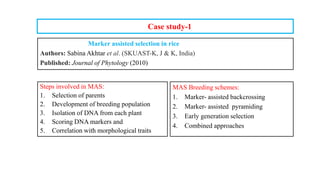
Case study-1
Marker assisted selection in rice
Authors: Sabina Akhtar et al. (SKUAST-K, J & K, India)
Published: Journal of Phytology (2010)
Steps involved in MAS:
1. Selection of parents
2. Development of breeding population
3. Isolation of DNA from each plant
4. Scoring DNA markers and
5. Correlation with morphological traits
MAS Breeding schemes:
1. Marker- assisted backcrossing
2. Marker- assisted pyramiding
3. Early generation selection
4. Combined approaches
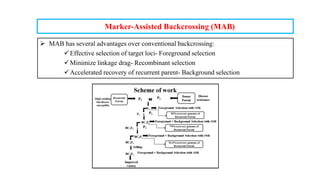
Marker-Assisted Backcrossing (MAB)
 MAB has several advantages over conventional backcrossing:
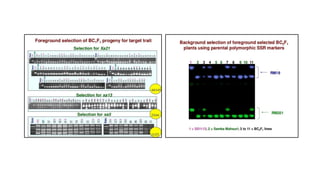
Effective selection of target loci- Foreground selection
Minimize linkage drag- Recombinant selection
Accelerated recovery of recurrent parent- Background selection
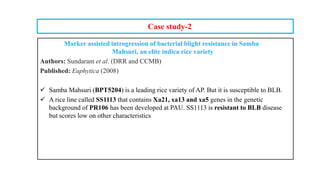
Case study-2
Marker assisted introgression of bacterial blight resistance in Samba
Mahsuri, an elite indica rice variety
Authors: Sundaram et al. (DRR and CCMB)
Published: Euphytica (2008)
 Samba Mahsuri (BPT5204) is a leading rice variety of AP. But it is susceptible to BLB.
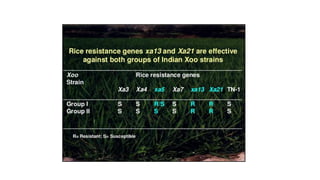
 A rice line called SS1113 that contains Xa21, xa13 and xa5 genes in the genetic
background of PR106 has been developed at PAU. SS1113 is resistant to BLB disease
but scores low on other characteristics
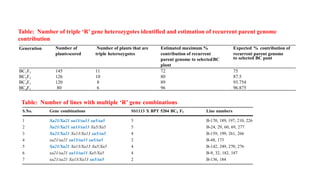
Generation Number of
plantsscored
Number of plants that are
triple heterozygotes
Estimated maximum %
contribution of recurrent
parent genome to selectedBC
plant
Expected % contribution of
recurrent parent genome
to selected BC pant
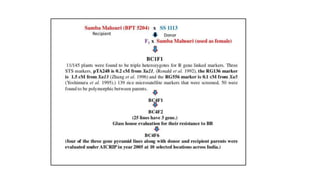
BC1F1 145 11 72 75
BC2F1 126 10 80 87.5
BC3F1 120 8 89 93.754
BC4F1 80 6 96 96.875
Table: Number of triple ‘R’ gene heterozygotes identified and estimation of recurrent parent genome
contribution
S.No. Gene combinations SS1113 X BPT 5204 BC4 F2 Line numbers
1 Xa21/Xa21 xa13/xa13 xa5/xa5 5 B-170, 189, 197, 210, 226
2 Xa21/Xa21 xa13/xa13 Xa5/Xa5 5 B-24, 29, 60, 69, 277
3 Xa21/Xa21 Xa13/Xa13 xa5/xa5 4 B-159, 199, 261, 266
4 xa21/xa21 xa13/xa13 xa5/xa5 2 B-48, 173
5 Xa21/Xa21 Xa13/Xa13 Xa5/Xa5 4 B-142, 249, 270, 276
6 xa21/xa21 xa13/xa13 Xa5/Xa5 4 B-9, 32, 182, 187
7 xa21/xa21 Xa13/Xa13 xa5/xa5 2 B-136, 184
Table: Number of lines with multiple ‘R’ gene combinations
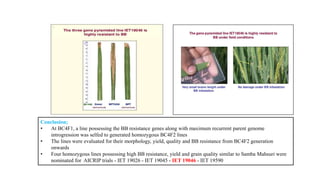
Conclusion;
• At BC4F1, a line possessing the BB resistance genes along with maximum recurrent parent genome
introgression was selfed to generated homozygous BC4F2 lines
• The lines were evaluated for their morphology, yield, quality and BB resistance from BC4F2 generation
onwards
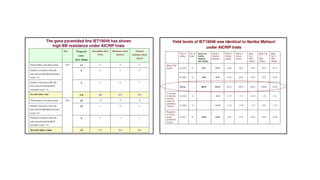
• Four homozygous lines possessing high BB resistance, yield and grain quality similar to Samba Mahsuri were
nominated for AICRIP trials - IET 19026 - IET 19045 - IET 19046 - IET 19590
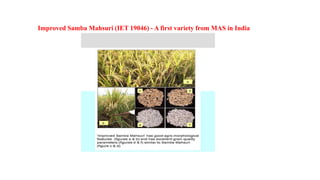
Improved Samba Mahsuri (IET 19046) - A first variety from MAS in India
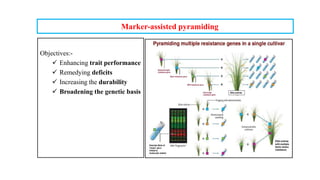
Marker-assisted pyramiding
Objectives:-
 Enhancing trait performance
 Remedying deficits
 Increasing the durability
 Broadening the genetic basis
Early generation MAS
 MAS conducted at F2 or F3 stage
 The main advantage is to discard many plant with unwanted gene combinations
 Advantages for later stages of the breeding program because resources can be used to
focus on fewer lines
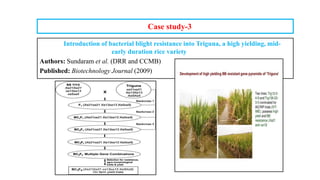
Case study-3
Introduction of bacterial blight resistance into Triguna, a high yielding, mid-
early duration rice variety
Authors: Sundaram et al. (DRR and CCMB)
Published: Biotechnology Journal (2009)
Combined approaches
 “Marker directed phenotyping or Tandem selection”
 To maximize genetic gain
 Level of recombination between marker and QTL
 To reduce population sizes
 Save time and reduce cost
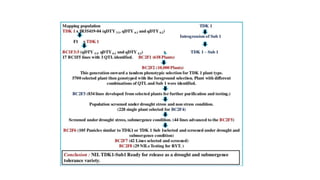
Case study-4
Combining drought and submergence tolerance in rice: marker-assisted
breeding and QTL combination effects
Authors: Shalabh Dixit and Anshuman Singh et al. (IRRI and DRR)
Published: Molecular Breeding (2017)
 TDK1 is a popular rice variety from the Lao PDR. Originally developed for irrigated conditions,
this variety suffers a high decline in yield under drought conditions.
 Studies have identified three quantitative trait loci (QTLs) for grain yield under drought conditions,
qDTY3.1, qDTY6.1, and qDTY6.2, that show a high effect in the background of this variety.
 We report here the pyramiding of these three QTLs with SUB1 that provides 2–3 weeks of
tolerance to complete submergence, with the aim to develop drought- and submergence-tolerant
near-isogenic lines (NILs) of TDK1.
Achievements of MAS in India
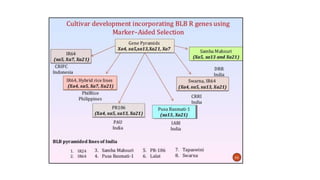
1. Three BB resistance genes (Xa5, Xa13, Xa21) introgress into the rice variety Sambha
Mahsuri (BPT-5204) released in India as “Improved Sambha Mahsuri” (IET 19046)-
DRR & CCMB
2. BB resistance genes (Xa13, Xa21) introgress into the rice variety Pusa Basmati 1 (PB 1)
and released as “Improved Pusa Basmati (IPB 1)”- IARI
3. Blast resistance genes - Pi1, Pi2 (CRRI & UAS)
4. Gall midge resistance genes - Gm1, Gm10 (TNAU)
5. Submergence tolerance variety: Swarna- Sub 1 and Sambha Mahsuri- Sub1 Show
increased submergence tolerance (IRRI, DRR and CRRI)
6. Improved Pusa RH10 - resistant to BB and blast (IARI)

Marker Assisted Breeding in Rice.pptx

  • 1.
    Markers-Assisted Breeding inRice Banoth Madhu Ph.D Research Scholar Genetics and Plant Breeding Tamil Nadu Agricultural University, Coimbatore
  • 2.
    Marker-Assisted Selection forConventional Breeding: Why? • Difficult traits • Traits with low heritability • Pyramiding of resistance genes • Selection at seedling stage • Distinguish homo & heterozygotes • Selection for recessive genes • No question of biosafety and bioethics, etc.
  • 3.
    Case study-1 Marker assistedselection in rice Authors: Sabina Akhtar et al. (SKUAST-K, J & K, India) Published: Journal of Phytology (2010) Steps involved in MAS: 1. Selection of parents 2. Development of breeding population 3. Isolation of DNA from each plant 4. Scoring DNA markers and 5. Correlation with morphological traits MAS Breeding schemes: 1. Marker- assisted backcrossing 2. Marker- assisted pyramiding 3. Early generation selection 4. Combined approaches
  • 4.
    Marker-Assisted Backcrossing (MAB) MAB has several advantages over conventional backcrossing: Effective selection of target loci- Foreground selection Minimize linkage drag- Recombinant selection Accelerated recovery of recurrent parent- Background selection
  • 5.
    Case study-2 Marker assistedintrogression of bacterial blight resistance in Samba Mahsuri, an elite indica rice variety Authors: Sundaram et al. (DRR and CCMB) Published: Euphytica (2008)  Samba Mahsuri (BPT5204) is a leading rice variety of AP. But it is susceptible to BLB.  A rice line called SS1113 that contains Xa21, xa13 and xa5 genes in the genetic background of PR106 has been developed at PAU. SS1113 is resistant to BLB disease but scores low on other characteristics
  • 9.
    Generation Number of plantsscored Numberof plants that are triple heterozygotes Estimated maximum % contribution of recurrent parent genome to selectedBC plant Expected % contribution of recurrent parent genome to selected BC pant BC1F1 145 11 72 75 BC2F1 126 10 80 87.5 BC3F1 120 8 89 93.754 BC4F1 80 6 96 96.875 Table: Number of triple ‘R’ gene heterozygotes identified and estimation of recurrent parent genome contribution S.No. Gene combinations SS1113 X BPT 5204 BC4 F2 Line numbers 1 Xa21/Xa21 xa13/xa13 xa5/xa5 5 B-170, 189, 197, 210, 226 2 Xa21/Xa21 xa13/xa13 Xa5/Xa5 5 B-24, 29, 60, 69, 277 3 Xa21/Xa21 Xa13/Xa13 xa5/xa5 4 B-159, 199, 261, 266 4 xa21/xa21 xa13/xa13 xa5/xa5 2 B-48, 173 5 Xa21/Xa21 Xa13/Xa13 Xa5/Xa5 4 B-142, 249, 270, 276 6 xa21/xa21 xa13/xa13 Xa5/Xa5 4 B-9, 32, 182, 187 7 xa21/xa21 Xa13/Xa13 xa5/xa5 2 B-136, 184 Table: Number of lines with multiple ‘R’ gene combinations
  • 10.
    Conclusion; • At BC4F1,a line possessing the BB resistance genes along with maximum recurrent parent genome introgression was selfed to generated homozygous BC4F2 lines • The lines were evaluated for their morphology, yield, quality and BB resistance from BC4F2 generation onwards • Four homozygous lines possessing high BB resistance, yield and grain quality similar to Samba Mahsuri were nominated for AICRIP trials - IET 19026 - IET 19045 - IET 19046 - IET 19590
  • 12.
    Improved Samba Mahsuri(IET 19046) - A first variety from MAS in India
  • 13.
    Marker-assisted pyramiding Objectives:-  Enhancingtrait performance  Remedying deficits  Increasing the durability  Broadening the genetic basis
  • 15.
    Early generation MAS MAS conducted at F2 or F3 stage  The main advantage is to discard many plant with unwanted gene combinations  Advantages for later stages of the breeding program because resources can be used to focus on fewer lines
  • 16.
    Case study-3 Introduction ofbacterial blight resistance into Triguna, a high yielding, mid- early duration rice variety Authors: Sundaram et al. (DRR and CCMB) Published: Biotechnology Journal (2009)
  • 17.
    Combined approaches  “Markerdirected phenotyping or Tandem selection”  To maximize genetic gain  Level of recombination between marker and QTL  To reduce population sizes  Save time and reduce cost
  • 18.
    Case study-4 Combining droughtand submergence tolerance in rice: marker-assisted breeding and QTL combination effects Authors: Shalabh Dixit and Anshuman Singh et al. (IRRI and DRR) Published: Molecular Breeding (2017)  TDK1 is a popular rice variety from the Lao PDR. Originally developed for irrigated conditions, this variety suffers a high decline in yield under drought conditions.  Studies have identified three quantitative trait loci (QTLs) for grain yield under drought conditions, qDTY3.1, qDTY6.1, and qDTY6.2, that show a high effect in the background of this variety.  We report here the pyramiding of these three QTLs with SUB1 that provides 2–3 weeks of tolerance to complete submergence, with the aim to develop drought- and submergence-tolerant near-isogenic lines (NILs) of TDK1.
  • 20.
    Achievements of MASin India 1. Three BB resistance genes (Xa5, Xa13, Xa21) introgress into the rice variety Sambha Mahsuri (BPT-5204) released in India as “Improved Sambha Mahsuri” (IET 19046)- DRR & CCMB 2. BB resistance genes (Xa13, Xa21) introgress into the rice variety Pusa Basmati 1 (PB 1) and released as “Improved Pusa Basmati (IPB 1)”- IARI 3. Blast resistance genes - Pi1, Pi2 (CRRI & UAS) 4. Gall midge resistance genes - Gm1, Gm10 (TNAU) 5. Submergence tolerance variety: Swarna- Sub 1 and Sambha Mahsuri- Sub1 Show increased submergence tolerance (IRRI, DRR and CRRI) 6. Improved Pusa RH10 - resistant to BB and blast (IARI)