

Topic: Gene action
in
breeding plants
BY:
Muhammad Zulqarnain
17-Arid-4757
Arid agriculture University Rawalpindi
Gene Action
Introduction
 Gene are the functional units that govern
the development of various characters of
an individual.
 Gene Action refer to the behavior or mode
of expression of genes in a genetic
populations.
 Gene control synthesis of proteins which
in turn control expression of various traits
of in organism.
Gene Action
 Gene Action s understood through the
stud of various biochemical nature of
gene and there mode of action in
biochemical pathways
 First studied by Archibald Edward
Garrod (1902) in man and subsequently
by other in smaller organisms like
Drosophila , Neurospora and Bacteria.
Gene Action in plant
breeding
 Knowledge of gene action helps in the
selection of parents for use in hybridization
programmes and also in the choice of
appropriate breeding procedure for the
genetics improvement of various quantitative
characters.
 Klence insight into the nature of gene action
involved in the expression of various
quantitative characters is essential to a plant
breeder for starting a judicious breeding
programme.
Main Features of Gene
Action
1. Gene Action is measured in term of
components of genetics variance or
combining ability variance and effects .
2. Depending upon the genetic variance ,
gene action is of three type , viz. additive
gene action, dominance gene action and
the epistatic gene action. Dominance
and epistatic gene action jointly are
referred to as non-additive gene action.
Main features of Gene
Action
3. Gene Action can be studied with the
help of various biometrical techniques
such as diallel analysis, partial diallel
cross .triallel analysis, quadriallel
analysis line X tester analysis
generation biparental cross and triple
test cross analysis
4. Gene Action is affected by various
factors.
Gene Action and Plant
Breeding
 The science of plant genetics trace back to
Mendel’s classic studies with garden peas.
 Mendel’s evaluated crosses of pure lines
and by scoring phenotypes he deduced the
existence of genes and determined their
mode of action.
 Plant breeder identify superior genotype
and develop new cultivars by selecting
plants possessing desirable phenotype
derive from genetic recombination.
Gene Action and Plant
Breeding
 Alleles with a dominant ,Additive or
deleterious phenotypic effect heritability
differently depending on whether they are
in homozygous or heterozygous condition
 An understanding of how heterozygosity
of how homozygosity affect gene action
and interaction will facilitate decision
about whether the end product in
breeding programs should be hybrids or
in bred lines
 The understanding of gene action is
of paramount importance to plant
breeders.
 Knowledge of the way gene act and
interact will determine which breeding
system optimizes gene action more
effectively and will eluciate the role of
the breeding systems in the evolution
of crop plants.
Types of gene Action
Allelic Gene Action and Interaction
Co-dominance
Incomplete dominance
Types of Gene Action
Nonallelic Gene Action and Interaction
 Supplementary gene
 complementary gene
 lethal gene
 Inhibitory gene
 Epistatic gene
 pleiotropic gene
Gene Action And system of reproduction
 Self fertilization
 Cross fertilizations
 Asexual reproduction
 Genetic basis of Heterosis
 Implication in breeding
Factors Affecting Gene
Action
 Types of Genetic Material
 Mode of pollination
 Mode of inheritance
 Existence of linkage
 Sample size
 Sampling method
 Method of calculation
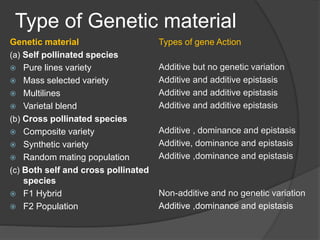
Type of Genetic material
Genetic material
(a) Self pollinated species
 Pure lines variety
 Mass selected variety
 Multilines
 Varietal blend
(b) Cross pollinated species
 Composite variety
 Synthetic variety
 Random mating population
(c) Both self and cross pollinated
species
 F1 Hybrid
 F2 Population
Types of gene Action
Additive but no genetic variation
Additive and additive epistasis
Additive , dominance and epistasis
Additive, dominance and epistasis
Additive ,dominance and epistasis
Non-additive and no genetic variation
Additive ,dominance and epistasis
Mode of pollination
 The gene action is greatly influenced by
the mode of pollination of plant species
 The additive gene action is associated with
homozygosity and ,therefore it is expected
to be maximum in self-pollinated species
 The non-additive gene action is associated
with heterozygosity and therefore it is
expected to be more in cross pollinated
species and minimum in self-pollinated
crops
Mode of Inheritance
 Some characters are governed by one or
few genes.
 Such characters are known as qualitative
characters or oligogeneic characters
 On the other hand some characters are
controlled by several genes
 Such characters are referred to as
quantitative or polygenic characters.
 Thus inheritance is of two type, viz.
oligogenic and ploygenic
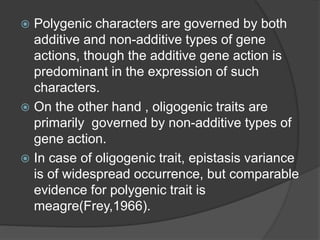
 Polygenic characters are governed by both
additive and non-additive types of gene
actions, though the additive gene action is
predominant in the expression of such
characters.
 On the other hand , oligogenic traits are
primarily governed by non-additive types of
gene action.
 In case of oligogenic trait, epistasis variance
is of widespread occurrence, but comparable
evidence for polygenic trait is
meagre(Frey,1966).
Existence of linkage
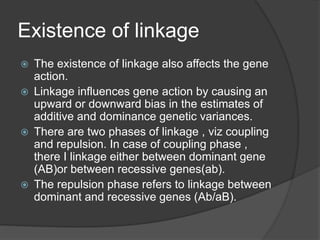
 The existence of linkage also affects the gene
action.
 Linkage influences gene action by causing an
upward or downward bias in the estimates of
additive and dominance genetic variances.
 There are two phases of linkage , viz coupling
and repulsion. In case of coupling phase ,
there I linkage either between dominant gene
(AB)or between recessive genes(ab).
 The repulsion phase refers to linkage between
dominant and recessive genes (Ab/aB).
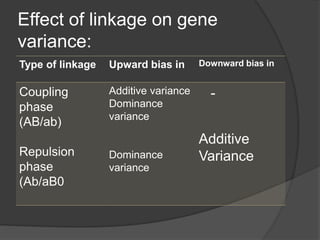
Effect of linkage on gene
variance:
Type of linkage Upward bias in Downward bias in
Coupling
phase
(AB/ab)
Repulsion
phase
(Ab/aB0
Additive variance
Dominance
variance
Dominance
variance
-
Additive
Variance
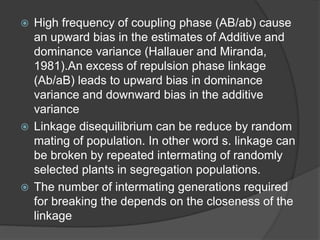
 High frequency of coupling phase (AB/ab) cause
an upward bias in the estimates of Additive and
dominance variance (Hallauer and Miranda,
1981).An excess of repulsion phase linkage
(Ab/aB) leads to upward bias in dominance
variance and downward bias in the additive
variance
 Linkage disequilibrium can be reduce by random
mating of population. In other word s. linkage can
be broken by repeated intermating of randomly
selected plants in segregation populations.
 The number of intermating generations required
for breaking the depends on the closeness of the
linkage
Sampling Method
 Two main sampling method:
 Random and baised sampling
 The random sampling method generally
provide true estimates of genetic
variance and hence of gene action
 The baised sampling on the other hand
will not give representative , estimates of
genetic variance and thereby gene
action.
Method of calculation
 Several biometrical techniques are used for the
estimation of genetic variance
 The estimates of genetic variance obtained by
various method will vary to some extent.
Moreover , use of some mating designs is
based on certain genetical assumption to
obtain valid estimates of genetics variance.
 Failure to meet one or more of these
assumption may result in biased estimates of
genetic components of variance.
Selection of parents
 Selection of parents for hybridization is on
important step in plant breeding.
 Good general combining parents can be
indentified by combining ability analysis.
 In self pollinated species, good general
combining parents can be used in the
hybridization programme for obtaining
superior sergeants in the segregating
generations and in cross pollinated species
such parents can be used for the
development of synthesis and composite
varieties.
Gene action  in  breeding plants

Gene action in breeding plants

  • 2.
    Topic: Gene action in breedingplants BY: Muhammad Zulqarnain 17-Arid-4757 Arid agriculture University Rawalpindi
  • 3.
    Gene Action Introduction  Geneare the functional units that govern the development of various characters of an individual.  Gene Action refer to the behavior or mode of expression of genes in a genetic populations.  Gene control synthesis of proteins which in turn control expression of various traits of in organism.
  • 4.
    Gene Action  GeneAction s understood through the stud of various biochemical nature of gene and there mode of action in biochemical pathways  First studied by Archibald Edward Garrod (1902) in man and subsequently by other in smaller organisms like Drosophila , Neurospora and Bacteria.
  • 5.
    Gene Action inplant breeding  Knowledge of gene action helps in the selection of parents for use in hybridization programmes and also in the choice of appropriate breeding procedure for the genetics improvement of various quantitative characters.  Klence insight into the nature of gene action involved in the expression of various quantitative characters is essential to a plant breeder for starting a judicious breeding programme.
  • 6.
    Main Features ofGene Action 1. Gene Action is measured in term of components of genetics variance or combining ability variance and effects . 2. Depending upon the genetic variance , gene action is of three type , viz. additive gene action, dominance gene action and the epistatic gene action. Dominance and epistatic gene action jointly are referred to as non-additive gene action.
  • 7.
    Main features ofGene Action 3. Gene Action can be studied with the help of various biometrical techniques such as diallel analysis, partial diallel cross .triallel analysis, quadriallel analysis line X tester analysis generation biparental cross and triple test cross analysis 4. Gene Action is affected by various factors.
  • 8.
    Gene Action andPlant Breeding  The science of plant genetics trace back to Mendel’s classic studies with garden peas.  Mendel’s evaluated crosses of pure lines and by scoring phenotypes he deduced the existence of genes and determined their mode of action.  Plant breeder identify superior genotype and develop new cultivars by selecting plants possessing desirable phenotype derive from genetic recombination.
  • 9.
    Gene Action andPlant Breeding  Alleles with a dominant ,Additive or deleterious phenotypic effect heritability differently depending on whether they are in homozygous or heterozygous condition  An understanding of how heterozygosity of how homozygosity affect gene action and interaction will facilitate decision about whether the end product in breeding programs should be hybrids or in bred lines
  • 10.
     The understandingof gene action is of paramount importance to plant breeders.  Knowledge of the way gene act and interact will determine which breeding system optimizes gene action more effectively and will eluciate the role of the breeding systems in the evolution of crop plants.
  • 11.
    Types of geneAction Allelic Gene Action and Interaction Co-dominance Incomplete dominance Incomplete dominance
  • 12.
    Types of GeneAction Nonallelic Gene Action and Interaction  Supplementary gene  complementary gene  lethal gene  Inhibitory gene  Epistatic gene  pleiotropic gene
  • 13.
    Gene Action Andsystem of reproduction  Self fertilization  Cross fertilizations  Asexual reproduction  Genetic basis of Heterosis  Implication in breeding
  • 14.
    Factors Affecting Gene Action Types of Genetic Material  Mode of pollination  Mode of inheritance  Existence of linkage  Sample size  Sampling method  Method of calculation
  • 15.
    Type of Geneticmaterial Genetic material (a) Self pollinated species  Pure lines variety  Mass selected variety  Multilines  Varietal blend (b) Cross pollinated species  Composite variety  Synthetic variety  Random mating population (c) Both self and cross pollinated species  F1 Hybrid  F2 Population Types of gene Action Additive but no genetic variation Additive and additive epistasis Additive and additive epistasis Additive and additive epistasis Additive , dominance and epistasis Additive, dominance and epistasis Additive ,dominance and epistasis Non-additive and no genetic variation Additive ,dominance and epistasis
  • 16.
    Mode of pollination The gene action is greatly influenced by the mode of pollination of plant species  The additive gene action is associated with homozygosity and ,therefore it is expected to be maximum in self-pollinated species  The non-additive gene action is associated with heterozygosity and therefore it is expected to be more in cross pollinated species and minimum in self-pollinated crops
  • 17.
    Mode of Inheritance Some characters are governed by one or few genes.  Such characters are known as qualitative characters or oligogeneic characters  On the other hand some characters are controlled by several genes  Such characters are referred to as quantitative or polygenic characters.  Thus inheritance is of two type, viz. oligogenic and ploygenic
  • 18.
     Polygenic charactersare governed by both additive and non-additive types of gene actions, though the additive gene action is predominant in the expression of such characters.  On the other hand , oligogenic traits are primarily governed by non-additive types of gene action.  In case of oligogenic trait, epistasis variance is of widespread occurrence, but comparable evidence for polygenic trait is meagre(Frey,1966).
  • 19.
    Existence of linkage The existence of linkage also affects the gene action.  Linkage influences gene action by causing an upward or downward bias in the estimates of additive and dominance genetic variances.  There are two phases of linkage , viz coupling and repulsion. In case of coupling phase , there I linkage either between dominant gene (AB)or between recessive genes(ab).  The repulsion phase refers to linkage between dominant and recessive genes (Ab/aB).
  • 20.
    Effect of linkageon gene variance: Type of linkage Upward bias in Downward bias in Coupling phase (AB/ab) Repulsion phase (Ab/aB0 Additive variance Dominance variance Dominance variance - Additive Variance
  • 21.
     High frequencyof coupling phase (AB/ab) cause an upward bias in the estimates of Additive and dominance variance (Hallauer and Miranda, 1981).An excess of repulsion phase linkage (Ab/aB) leads to upward bias in dominance variance and downward bias in the additive variance  Linkage disequilibrium can be reduce by random mating of population. In other word s. linkage can be broken by repeated intermating of randomly selected plants in segregation populations.  The number of intermating generations required for breaking the depends on the closeness of the linkage
  • 22.
    Sampling Method  Twomain sampling method:  Random and baised sampling  The random sampling method generally provide true estimates of genetic variance and hence of gene action  The baised sampling on the other hand will not give representative , estimates of genetic variance and thereby gene action.
  • 23.
    Method of calculation Several biometrical techniques are used for the estimation of genetic variance  The estimates of genetic variance obtained by various method will vary to some extent. Moreover , use of some mating designs is based on certain genetical assumption to obtain valid estimates of genetics variance.  Failure to meet one or more of these assumption may result in biased estimates of genetic components of variance.
  • 24.
    Selection of parents Selection of parents for hybridization is on important step in plant breeding.  Good general combining parents can be indentified by combining ability analysis.  In self pollinated species, good general combining parents can be used in the hybridization programme for obtaining superior sergeants in the segregating generations and in cross pollinated species such parents can be used for the development of synthesis and composite varieties.