COAL IN PENNSYLVANIA
Introduction Uses:  -  Generate electricity -  Iron and steel production -  Medicines, plastics,  synthetic rubber,  fertilizer, cosmetics,  food products, paint,  dyes, fibers of our  clothes
History - Stretches back over 250 years - Aristotle (Greek philosopher)  mentioned coal in his book  Meteorology -  Became major industry with  invention of steam engine  (1700)  - Coal in PA: 1 st  mentioned in  1752 (mapped by John  Pattin near Saltsburg)
Coal as an industry in PA Greatest year: 1918 330,000 miners  277,000,000 tons $705,000,000 at the time 1930’s: Great Depression Production grinds to a  stop  Oil and natural gas  became common
1960-1990: Production drops further due to - Rise of electric utilities - Nuclear energy - More strict environmental regulations
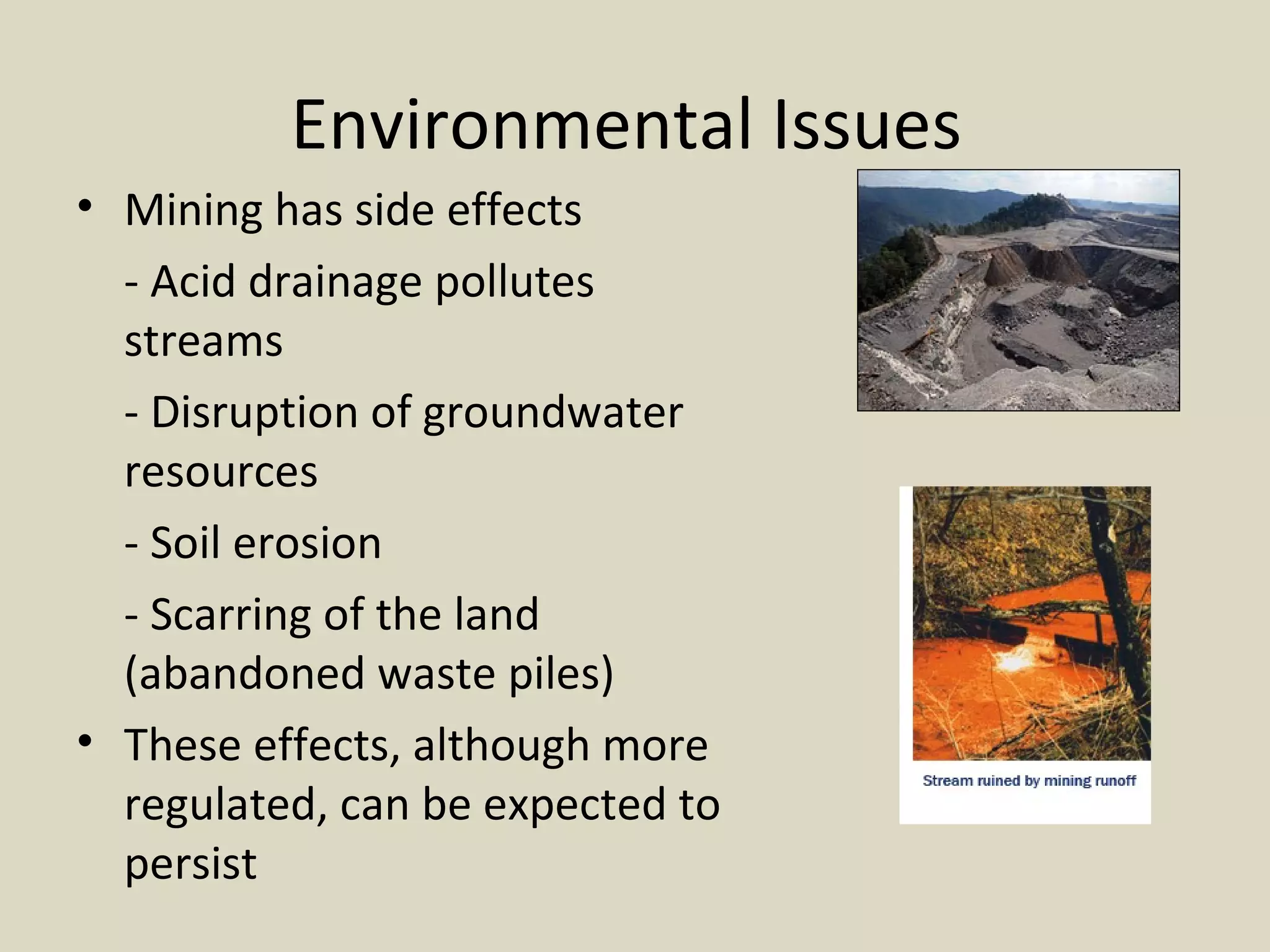
Coal output in PA in 2004 totaled 75,000,000 tons 50% now comes from large underground mines in Greene County 7,000 Pennsylvanians were directly employed in coal mining in 2004
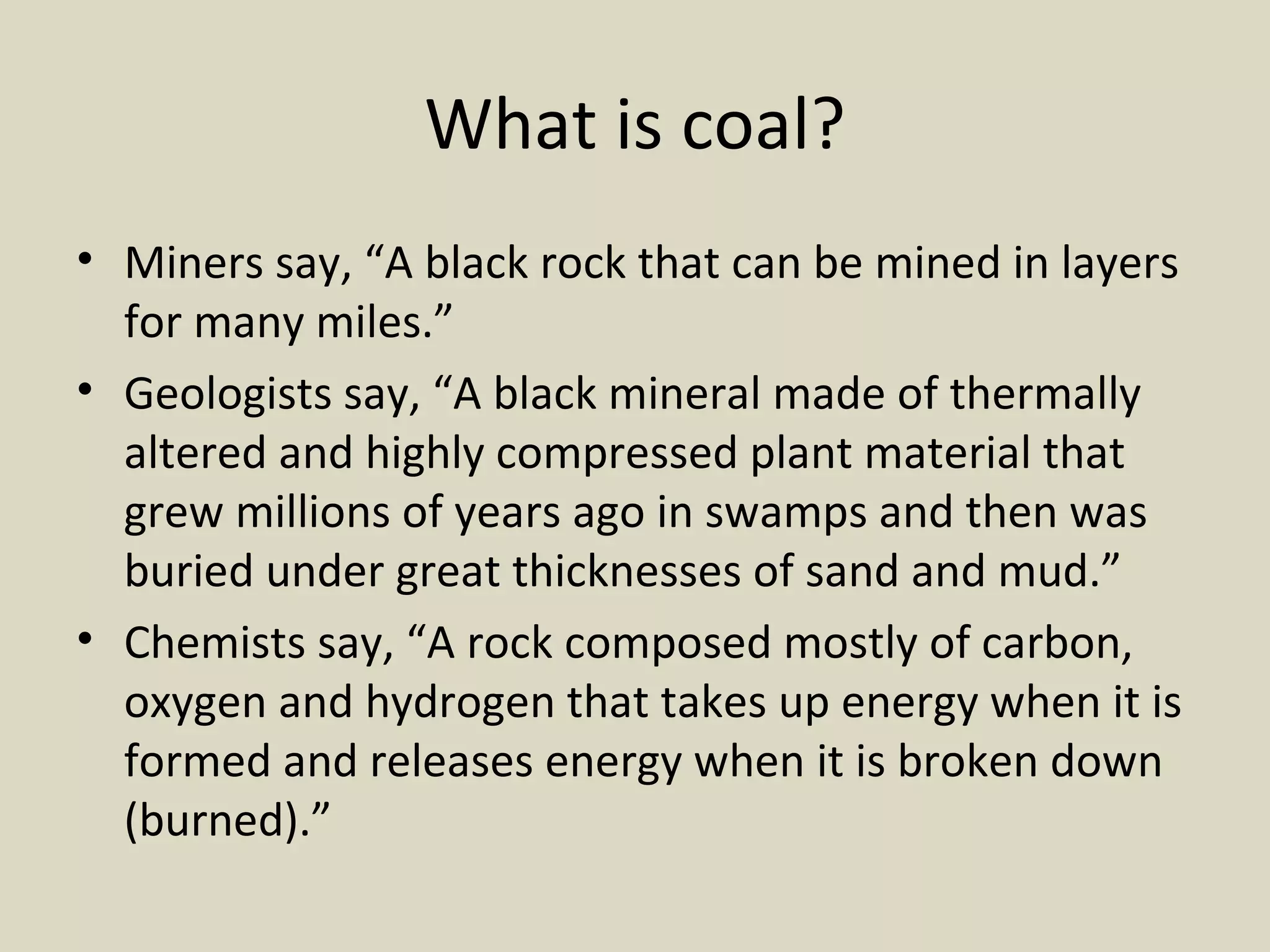
Environmental Issues  Mining has side effects  - Acid drainage pollutes  streams - Disruption of groundwater  resources - Soil erosion - Scarring of the land  (abandoned waste piles) These effects, although more regulated, can be expected to persist
What is coal? Miners say, “A black rock that can be mined in layers for many miles.” Geologists say, “A black mineral made of thermally altered and highly compressed plant material that grew millions of years ago in swamps and then was buried under great thicknesses of sand and mud.”  Chemists say, “A rock composed mostly of carbon, oxygen and hydrogen that takes up energy when it is formed and releases energy when it is broken down (burned).”
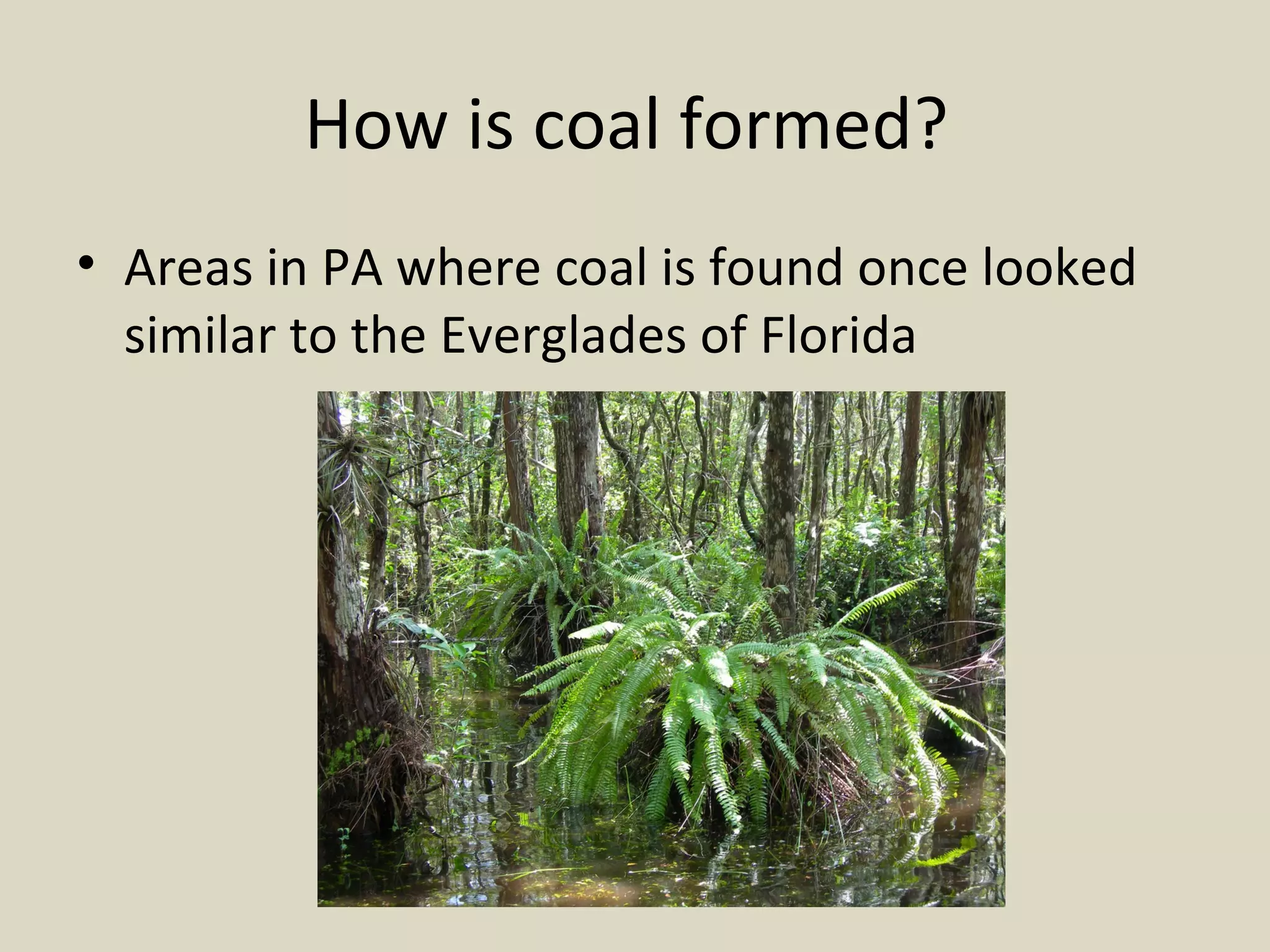
How is coal formed?  Areas in PA where coal is found once looked similar to the Everglades of Florida
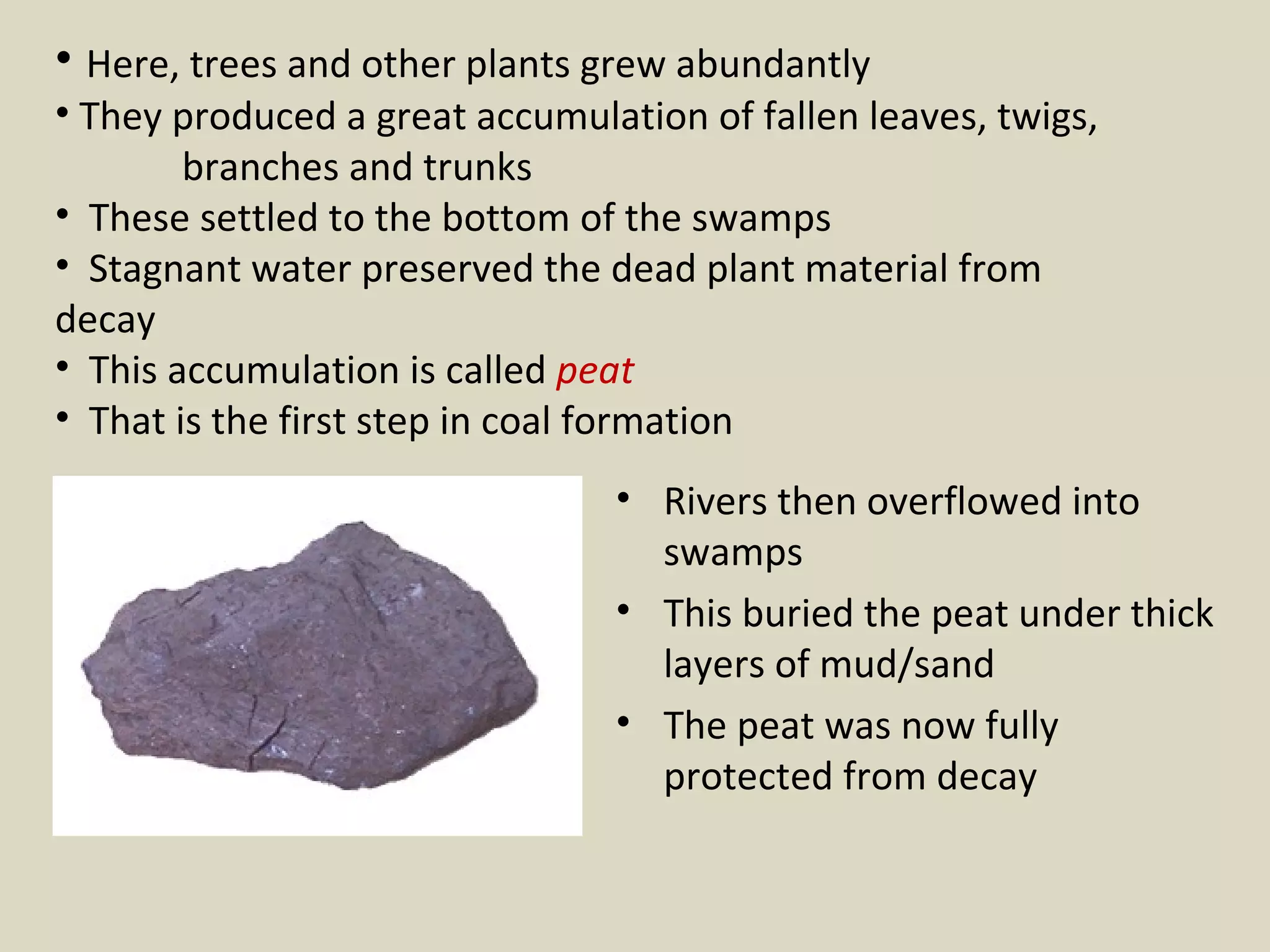
Here, trees and other plants grew abundantly They produced a great accumulation of fallen leaves, twigs,  branches and trunks  These settled to the bottom of the swamps  Stagnant water preserved the dead plant material from  decay  This accumulation is called  peat That is the first step in coal formation Rivers then overflowed into swamps This buried the peat under thick layers of mud/sand The peat was now fully protected from decay
Bacteria then began to break down the peat They stripped the plant material to rotted wood/leaves As mud/sand layers grew thicker above, the peat was compressed tighter  As the peat was pushed further and further down, it became exposed to hotter temperatures The increasing heat turns the peat to lignite, subbituminous coal, bituminous coal, and , finally, anthracite
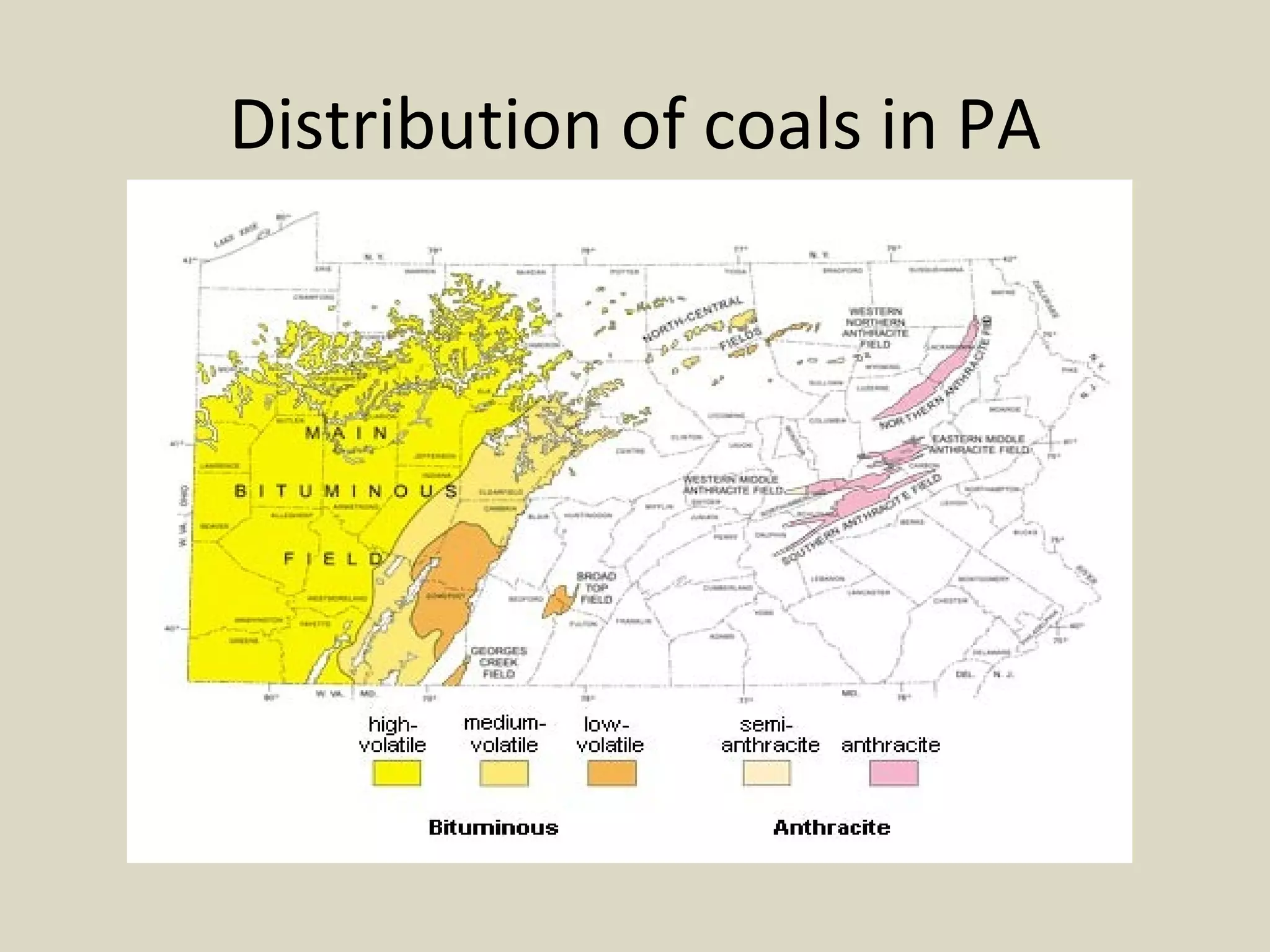
Distribution of coals in PA
Coal Reserves in PA Prior to any mining, PA had reserves of over 107,000,000,000 tons Approximately 31,400,000,000 tons have been mined That leaves 76,000,000,000 tons untouched What remains seems thinner, more difficult and more expensive to recover
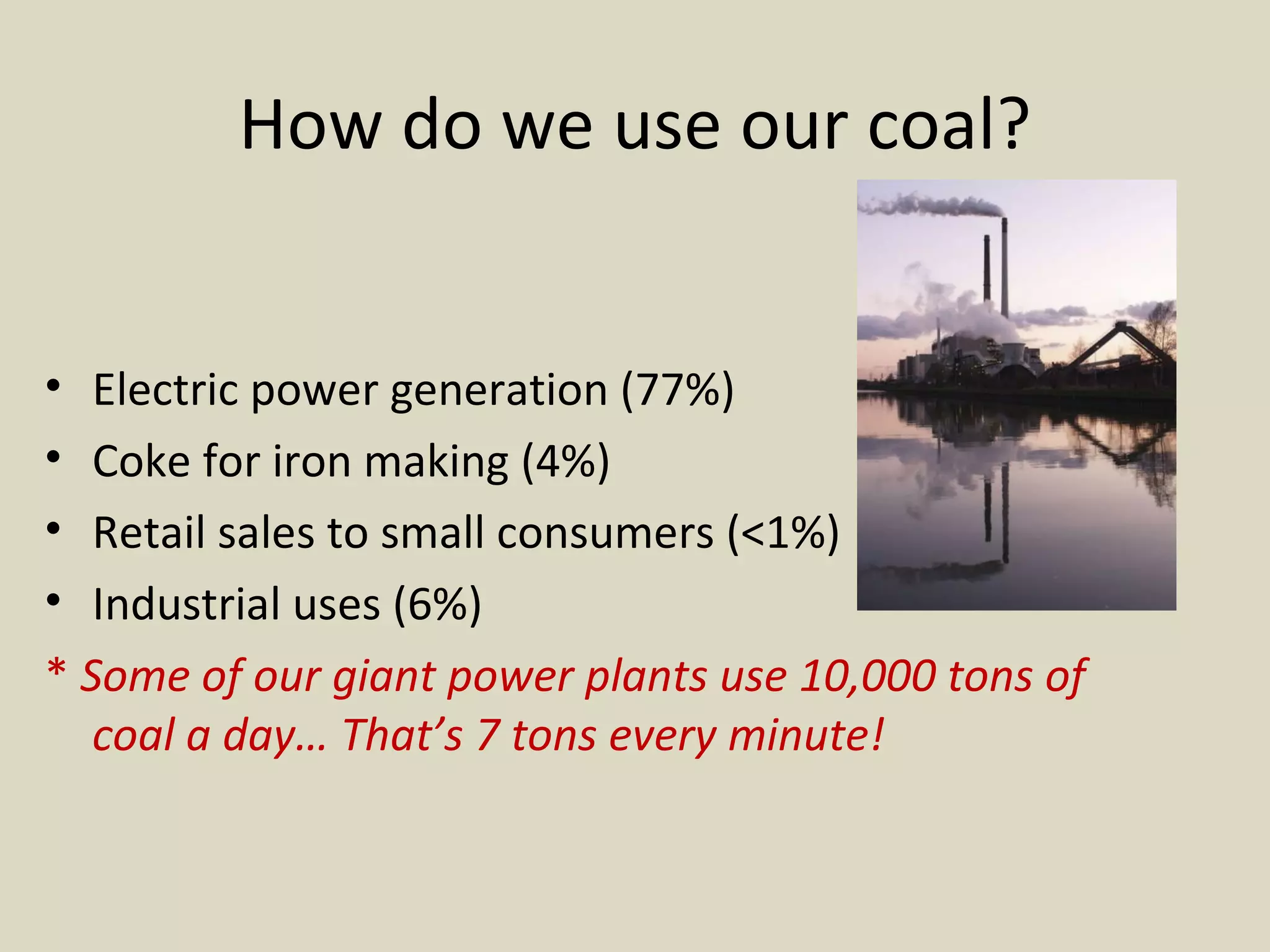
How do we use our coal? Electric power generation (77%) Coke for iron making (4%) Retail sales to small consumers (<1%) Industrial uses (6%) *  Some of our giant power plants use 10,000 tons of coal a day… That’s 7 tons every minute!
Your Future The United States has the world's largest known coal reserves, about 263.8 billion tons.  This is enough coal to last approximately 225 years at today's level of use.  But the burning of coal releases harmful greenhouse gases into the atmosphere. We must invest in the development of  clean coal technologies  in order to reduce our dependence on foreign oil. This will ensure that we can continue  to support our comfortable lifestyles while maintaining our wonderful planet Earth.
references Edmunds, W.E., 2002, Coal in Pennsylvania (2 nd  ed.): Pennsylvania Geological Survey, 4 th  ser., Educational Series 7, 28 p. Pennsylvania web site:  www.state.pa.us Department of Conservation and Natural Resources Web site:  www.dcnr.state.pa.us Bureau of Topographic and Geologic Survey Web site:  www.dcnr.state.pa.us/topogeo Energy Kid’s Page Web site:  http://www.eia.doe.gov/kids/energyfacts/sources/non-renewable/coal.html

Coal In Pa

  • 1.
  • 2.
    Introduction Uses: - Generate electricity - Iron and steel production - Medicines, plastics, synthetic rubber, fertilizer, cosmetics, food products, paint, dyes, fibers of our clothes
  • 3.
    History - Stretchesback over 250 years - Aristotle (Greek philosopher) mentioned coal in his book Meteorology - Became major industry with invention of steam engine (1700) - Coal in PA: 1 st mentioned in 1752 (mapped by John Pattin near Saltsburg)
  • 4.
    Coal as anindustry in PA Greatest year: 1918 330,000 miners 277,000,000 tons $705,000,000 at the time 1930’s: Great Depression Production grinds to a stop Oil and natural gas became common
  • 5.
    1960-1990: Production dropsfurther due to - Rise of electric utilities - Nuclear energy - More strict environmental regulations
  • 6.
    Coal output inPA in 2004 totaled 75,000,000 tons 50% now comes from large underground mines in Greene County 7,000 Pennsylvanians were directly employed in coal mining in 2004
  • 7.
    Environmental Issues Mining has side effects - Acid drainage pollutes streams - Disruption of groundwater resources - Soil erosion - Scarring of the land (abandoned waste piles) These effects, although more regulated, can be expected to persist
  • 8.
    What is coal?Miners say, “A black rock that can be mined in layers for many miles.” Geologists say, “A black mineral made of thermally altered and highly compressed plant material that grew millions of years ago in swamps and then was buried under great thicknesses of sand and mud.” Chemists say, “A rock composed mostly of carbon, oxygen and hydrogen that takes up energy when it is formed and releases energy when it is broken down (burned).”
  • 9.
    How is coalformed? Areas in PA where coal is found once looked similar to the Everglades of Florida
  • 10.
    Here, trees andother plants grew abundantly They produced a great accumulation of fallen leaves, twigs, branches and trunks These settled to the bottom of the swamps Stagnant water preserved the dead plant material from decay This accumulation is called peat That is the first step in coal formation Rivers then overflowed into swamps This buried the peat under thick layers of mud/sand The peat was now fully protected from decay
  • 11.
    Bacteria then beganto break down the peat They stripped the plant material to rotted wood/leaves As mud/sand layers grew thicker above, the peat was compressed tighter As the peat was pushed further and further down, it became exposed to hotter temperatures The increasing heat turns the peat to lignite, subbituminous coal, bituminous coal, and , finally, anthracite
  • 12.
  • 13.
    Coal Reserves inPA Prior to any mining, PA had reserves of over 107,000,000,000 tons Approximately 31,400,000,000 tons have been mined That leaves 76,000,000,000 tons untouched What remains seems thinner, more difficult and more expensive to recover
  • 14.
    How do weuse our coal? Electric power generation (77%) Coke for iron making (4%) Retail sales to small consumers (<1%) Industrial uses (6%) * Some of our giant power plants use 10,000 tons of coal a day… That’s 7 tons every minute!
  • 15.
    Your Future TheUnited States has the world's largest known coal reserves, about 263.8 billion tons.  This is enough coal to last approximately 225 years at today's level of use. But the burning of coal releases harmful greenhouse gases into the atmosphere. We must invest in the development of clean coal technologies in order to reduce our dependence on foreign oil. This will ensure that we can continue to support our comfortable lifestyles while maintaining our wonderful planet Earth.
  • 16.
    references Edmunds, W.E.,2002, Coal in Pennsylvania (2 nd ed.): Pennsylvania Geological Survey, 4 th ser., Educational Series 7, 28 p. Pennsylvania web site: www.state.pa.us Department of Conservation and Natural Resources Web site: www.dcnr.state.pa.us Bureau of Topographic and Geologic Survey Web site: www.dcnr.state.pa.us/topogeo Energy Kid’s Page Web site: http://www.eia.doe.gov/kids/energyfacts/sources/non-renewable/coal.html