Map & Globes
Map
ย 
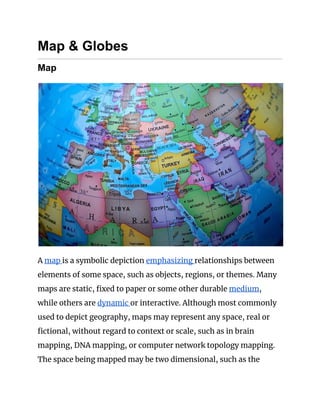
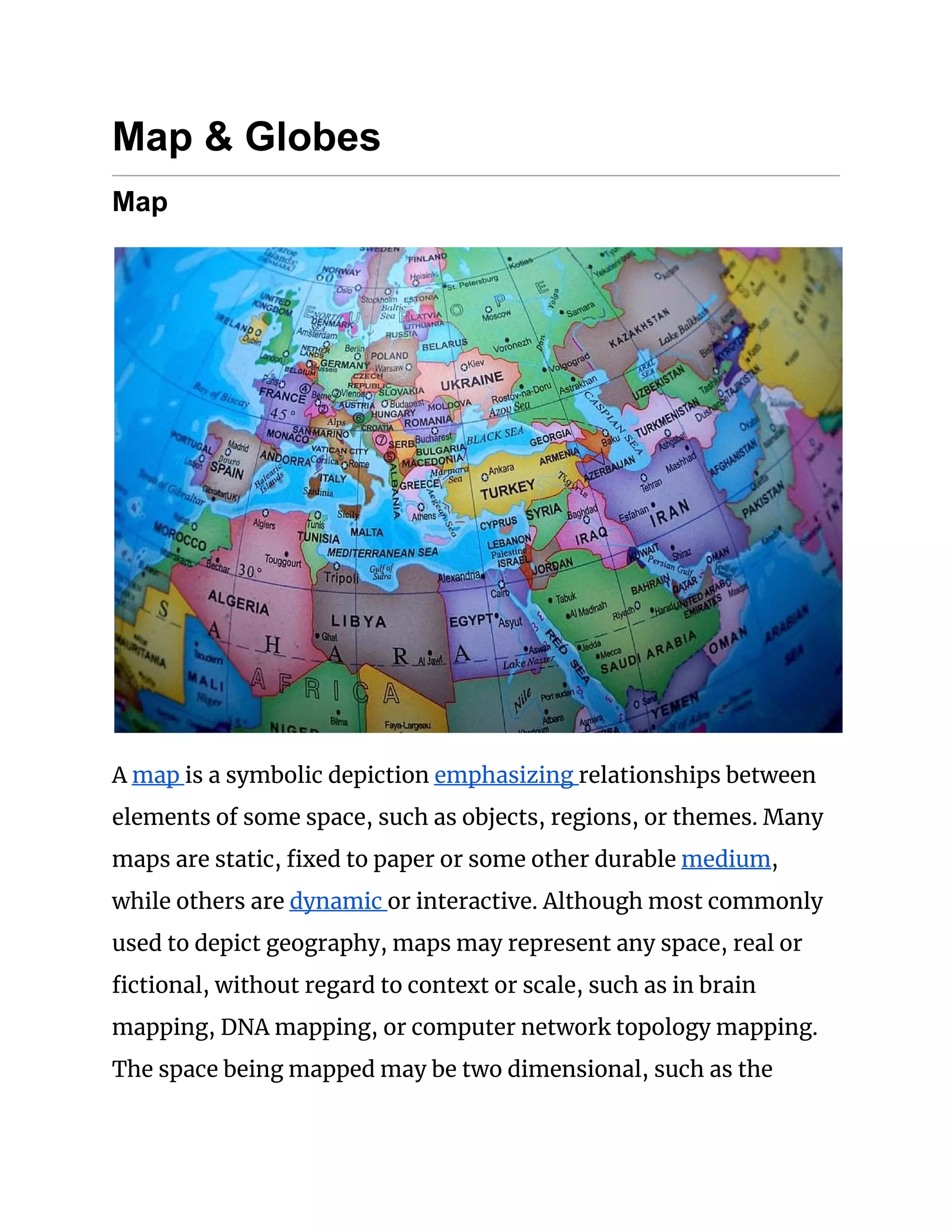
A โ€‹map โ€‹is a symbolic depiction โ€‹emphasizing โ€‹relationships betweenย 
elements of some space, such as objects, regions, or themes. Manyย 
maps are static, fixed to paper or some other durable โ€‹mediumโ€‹,ย 
while others are โ€‹dynamic โ€‹or interactive. Although most commonlyย 
used to depict geography, maps may represent any space, real orย 
fictional, without regard to context or scale, such as in brainย 
mapping, DNA mapping, or computer network topology mapping.ย 
The space being mapped may be two dimensional, such as theย 
surface of the earth, three dimensional, such as the interior of theย 
earth, or even more abstract spaces of any dimension, such as ariseย 
in modeling phenomena having many independent variables.ย 
AddressBazar.com is an Bangladeshi Online Yellow Page. From here you
will find important and necessary information of various โ€‹Maps and Globes
related Organizations in Bangladesh.
Although โ€‹the earliest maps known are of the heavens, geographicย 
maps โ€‹of territory have a very long tradition and exist from ancientย 
times. The word "map" comes from the medieval Latin Mappaย 
mundi, wherein mappa meant napkin or cloth and mundi the world.ย 
Thus, "map" became a shortened term referring to aย 
two-dimensional representation of the surface of the world.ย 
Geographic mapsย 
Cartography โ€‹or map-making is the study and practice of craftingย 
representations of the Earth upon a flat surface (see Hisโ€‹tโ€‹ory ofย 
cartography), and one who makes maps is called a cartographer.ย 
Road maps are perhaps the most widely used maps today, and formย 
a subset of navigational maps, which also include aeronautical andย 
nautical charts, railroad network maps, and hiking and bicyclingย 
maps. In terms of quantity, the largest number of drawn mapย 
sheets is probably made up by local surveys, carried out byย 
municipalities, utilities, tax assessors, emergency servicesย 
providers, and other local agencies. Many national surveyingย 
projects have been carried out by the military, such as the Britishย 
Ordnance Survey: a civilian government agency, internationallyย 
renowned for its comprehensively detailed work.ย 
In addition to location information, maps may also be used toย 
portray contour lines indicating constant values of elevation,ย 
temperature, โ€‹rainfallโ€‹, etc.ย 
Orientation of mapsย 
ย 
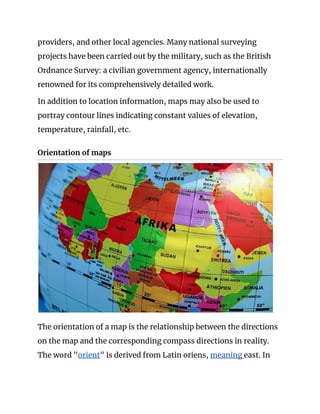
The orientation of a map is the relationship between the directionsย 
on the map and the corresponding compass directions in reality.ย 
The word "โ€‹orientโ€‹" is derived from Latin oriens, โ€‹meaning โ€‹east. Inย 
the Middle Ages โ€‹many โ€‹maps, including the T and O โ€‹mapsโ€‹, wereย 
drawn with east at the โ€‹top โ€‹(meaning that the direction "up" on theย 
map corresponds to East on the compass). The most commonย 
cartographic convention is that north is at the top of a map.ย 
Maps not oriented with north at the top:ย 
โ— Maps from non-Western traditions are oriented in a varietyย 
of ways. Old maps of Edo show the Japanese imperial palaceย 
as the "top", but also at the centre of the map. Labels on theย 
map are oriented in such a way that you cannot read themย 
properly unless you put the imperial palace above yourย 
head.ย 
โ— Medieval European T and O maps such as the Herefordย 
Mappa Mundi were centred on Jerusalem with East at theย 
top. Indeed, prior to the reintroduction of Ptolemy'sย 
Geography to Europe around 1400, there was no singleย 
convention in the West. Portolan charts, for example, areย 
oriented to the shores they describe.ย 
โ— Maps of cities bordering a sea are often conventionallyย 
oriented with the sea at the top.ย 
โ— Route and channel maps have traditionally been oriented toย 
the road or waterway they describe.ย 
โ— Polar maps of the Arctic or Antarctic regions areย 
conventionally centred on the pole; the direction Northย 
would be towards or away from the centre of the map,ย 
respectively. Typical maps of the Arctic have 0ยฐ meridianย 
towards the bottom of the page; maps of the Antarctic haveย 
the 0ยฐ meridian towards the top of the page.ย 
โ— Reversed maps, also known as Upside-Down maps orย 
South-Up maps, reverse the North is up convention andย 
have south at the top. Ancient Africans including in Ancientย 
Egypt utilised this orientation, as some maps in Brazil doย 
today.ย 
โ— Buckminster Fuller's Dymaxion maps are based on aย 
projection of the Earth's sphere onto an icosahedron. Theย 
resulting triangular pieces may be arranged in any order orย 
orientation.ย 
Scale and accuracyย 
ย 
Many maps are drawn to a scale expressed as a ratio, such asย 
1:10,000, which means that 1 unit of measurement on the mapย 
corresponds to 10,000 of that same unit on the ground. The scaleย 
statement can be โ€‹accurate โ€‹when the region โ€‹mapped โ€‹is small enoughย 
for the curvature of the Earth to be neglected, such as a city map.ย 
Mapping โ€‹larger regions, where curvature cannot be ignored,ย 
requires projections to map from the curved surface of the Earth toย 
the plane. The impossibility of flattening the sphere to the planeย 
without distortion means that the map cannot have constant scale.ย 
Rather, on most projections the best that can be attained is accurateย 
scale along one or two paths on the projection. Because scale differsย 
everywhere, it can only be measured meaningfully as point scaleย 
per location. Most maps strive to keep point scale variation withinย 
narrow bounds. Although the scale statement is nominal it isย 
usually accurate enough for most purposes unless the map covers aย 
large fraction of the earth. At the scope of a world map, scale as aย 
single number is practically meaningless throughout most of theย 
map. Instead, it usually refers to the scale along the equator.ย 
Some maps, called cartograms, have the scale deliberately distortedย 
to reflect information other than land area or distance. Forย 
example, this map (at the right) of Europe has been distorted toย 
show population distribution, while the rough shape of theย 
continent is still discernible.ย 
Another example of distorted scale is the famous Londonย 
Underground map. The basic geographical structure is respectedย 
but the tube lines (and the River Thames) are smoothed to clarifyย 
the relationships between stations. Near the center of the mapย 
stations are spaced out more than near the edges of the map.ย 
Further inaccuracies may be deliberate. For example, cartographersย 
may simply omit military installations or remove features solely inย 
order to enhance the clarity of the map. For example, a road mapย 
may not show railroads, smaller waterways or other prominentย 
non-road objects, and even if it does, it may show them less clearlyย 
(e.g. dashed or dotted lines/outlines) than the main roads. Knownย 
as decluttering, the practice makes the subject matter that the userย 
is interested in easier to read, usually without sacrificing overallย 
accuracy. Software-based maps often allow the user to toggleย 
decluttering between ON, OFF and AUTO as needed. In AUTO theย 
degree of decluttering is adjusted as the user changes the scaleย 
being displayed.ย 
Map projectionย 
Geographic maps use a projection to translate theย 
three-dimensional real surface of the geoid to a two-dimensionalย 
picture. Projection always distorts the surface. There are many waysย 
to apportion the distortion, and so there are many map projections.ย 
Which projection to use depends on the purpose of the map.ย 
ย 
Globeย 
A โ€‹globe โ€‹is a spherical model of Earth, of โ€‹some โ€‹other celestial body,ย 
or of the celestial sphere. Globes serve purposes similar to someย 
maps, but unlike maps, do not distort the surface that they portrayย 
except to scale it down. A model globe of Earth is called a terrestrialย 
globe. A model globe of the celestial sphere is called a celestialย 
globe.ย 
ย 
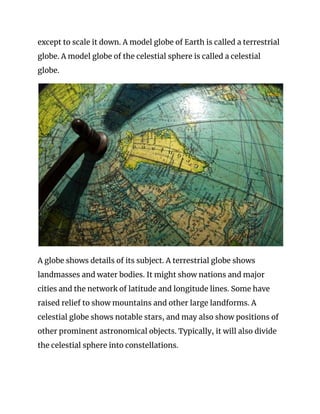
A globe shows details of its subject. A terrestrial globe showsย 
landmasses and water bodies. It might show nations and majorย 
cities and the network of latitude and longitude lines. Some haveย 
raised relief to show mountains and other large landforms. Aย 
celestial globe shows notable stars, and may also show positions ofย 
other prominent astronomical objects. Typically, it will also divideย 
the celestial sphere into constellations.ย 
The word globe comes from the Latin word globus, meaningย 
"sphere". Globes have a long history. The first known mention of aย 
globe is from Strabo, describing the Globe of Crates from about 150ย 
BC. The oldest โ€‹surviving โ€‹terrestrial globe is the Erdapfel, wroughtย 
by Martin Behaim in 1492. The oldest surviving celestial globe sitsย 
atop the Farnese Atlas, carved in the 2nd century Roman Empire.ย 
ย 

Map & globes

  • 1.
    Map & Globes Map ย  Aโ€‹map โ€‹is a symbolic depiction โ€‹emphasizing โ€‹relationships betweenย  elements of some space, such as objects, regions, or themes. Manyย  maps are static, fixed to paper or some other durable โ€‹mediumโ€‹,ย  while others are โ€‹dynamic โ€‹or interactive. Although most commonlyย  used to depict geography, maps may represent any space, real orย  fictional, without regard to context or scale, such as in brainย  mapping, DNA mapping, or computer network topology mapping.ย  The space being mapped may be two dimensional, such as theย 
  • 2.
    surface of theearth, three dimensional, such as the interior of theย  earth, or even more abstract spaces of any dimension, such as ariseย  in modeling phenomena having many independent variables.ย  AddressBazar.com is an Bangladeshi Online Yellow Page. From here you will find important and necessary information of various โ€‹Maps and Globes related Organizations in Bangladesh. Although โ€‹the earliest maps known are of the heavens, geographicย  maps โ€‹of territory have a very long tradition and exist from ancientย  times. The word "map" comes from the medieval Latin Mappaย  mundi, wherein mappa meant napkin or cloth and mundi the world.ย  Thus, "map" became a shortened term referring to aย  two-dimensional representation of the surface of the world.ย  Geographic mapsย  Cartography โ€‹or map-making is the study and practice of craftingย  representations of the Earth upon a flat surface (see Hisโ€‹tโ€‹ory ofย  cartography), and one who makes maps is called a cartographer.ย  Road maps are perhaps the most widely used maps today, and formย  a subset of navigational maps, which also include aeronautical andย  nautical charts, railroad network maps, and hiking and bicyclingย  maps. In terms of quantity, the largest number of drawn mapย  sheets is probably made up by local surveys, carried out byย  municipalities, utilities, tax assessors, emergency servicesย 
  • 3.
    providers, and otherlocal agencies. Many national surveyingย  projects have been carried out by the military, such as the Britishย  Ordnance Survey: a civilian government agency, internationallyย  renowned for its comprehensively detailed work.ย  In addition to location information, maps may also be used toย  portray contour lines indicating constant values of elevation,ย  temperature, โ€‹rainfallโ€‹, etc.ย  Orientation of mapsย  ย  The orientation of a map is the relationship between the directionsย  on the map and the corresponding compass directions in reality.ย  The word "โ€‹orientโ€‹" is derived from Latin oriens, โ€‹meaning โ€‹east. Inย 
  • 4.
    the Middle Agesโ€‹many โ€‹maps, including the T and O โ€‹mapsโ€‹, wereย  drawn with east at the โ€‹top โ€‹(meaning that the direction "up" on theย  map corresponds to East on the compass). The most commonย  cartographic convention is that north is at the top of a map.ย  Maps not oriented with north at the top:ย  โ— Maps from non-Western traditions are oriented in a varietyย  of ways. Old maps of Edo show the Japanese imperial palaceย  as the "top", but also at the centre of the map. Labels on theย  map are oriented in such a way that you cannot read themย  properly unless you put the imperial palace above yourย  head.ย  โ— Medieval European T and O maps such as the Herefordย  Mappa Mundi were centred on Jerusalem with East at theย  top. Indeed, prior to the reintroduction of Ptolemy'sย  Geography to Europe around 1400, there was no singleย  convention in the West. Portolan charts, for example, areย  oriented to the shores they describe.ย  โ— Maps of cities bordering a sea are often conventionallyย  oriented with the sea at the top.ย  โ— Route and channel maps have traditionally been oriented toย  the road or waterway they describe.ย  โ— Polar maps of the Arctic or Antarctic regions areย  conventionally centred on the pole; the direction Northย  would be towards or away from the centre of the map,ย  respectively. Typical maps of the Arctic have 0ยฐ meridianย  towards the bottom of the page; maps of the Antarctic haveย  the 0ยฐ meridian towards the top of the page.ย  โ— Reversed maps, also known as Upside-Down maps orย  South-Up maps, reverse the North is up convention andย  have south at the top. Ancient Africans including in Ancientย 
  • 5.
    Egypt utilised thisorientation, as some maps in Brazil doย  today.ย  โ— Buckminster Fuller's Dymaxion maps are based on aย  projection of the Earth's sphere onto an icosahedron. Theย  resulting triangular pieces may be arranged in any order orย  orientation.ย  Scale and accuracyย  ย  Many maps are drawn to a scale expressed as a ratio, such asย  1:10,000, which means that 1 unit of measurement on the mapย  corresponds to 10,000 of that same unit on the ground. The scaleย  statement can be โ€‹accurate โ€‹when the region โ€‹mapped โ€‹is small enoughย  for the curvature of the Earth to be neglected, such as a city map.ย 
  • 6.
    Mapping โ€‹larger regions,where curvature cannot be ignored,ย  requires projections to map from the curved surface of the Earth toย  the plane. The impossibility of flattening the sphere to the planeย  without distortion means that the map cannot have constant scale.ย  Rather, on most projections the best that can be attained is accurateย  scale along one or two paths on the projection. Because scale differsย  everywhere, it can only be measured meaningfully as point scaleย  per location. Most maps strive to keep point scale variation withinย  narrow bounds. Although the scale statement is nominal it isย  usually accurate enough for most purposes unless the map covers aย  large fraction of the earth. At the scope of a world map, scale as aย  single number is practically meaningless throughout most of theย  map. Instead, it usually refers to the scale along the equator.ย  Some maps, called cartograms, have the scale deliberately distortedย  to reflect information other than land area or distance. Forย  example, this map (at the right) of Europe has been distorted toย  show population distribution, while the rough shape of theย  continent is still discernible.ย  Another example of distorted scale is the famous Londonย  Underground map. The basic geographical structure is respectedย  but the tube lines (and the River Thames) are smoothed to clarifyย  the relationships between stations. Near the center of the mapย  stations are spaced out more than near the edges of the map.ย 
  • 7.
    Further inaccuracies maybe deliberate. For example, cartographersย  may simply omit military installations or remove features solely inย  order to enhance the clarity of the map. For example, a road mapย  may not show railroads, smaller waterways or other prominentย  non-road objects, and even if it does, it may show them less clearlyย  (e.g. dashed or dotted lines/outlines) than the main roads. Knownย  as decluttering, the practice makes the subject matter that the userย  is interested in easier to read, usually without sacrificing overallย  accuracy. Software-based maps often allow the user to toggleย  decluttering between ON, OFF and AUTO as needed. In AUTO theย  degree of decluttering is adjusted as the user changes the scaleย  being displayed.ย  Map projectionย  Geographic maps use a projection to translate theย  three-dimensional real surface of the geoid to a two-dimensionalย  picture. Projection always distorts the surface. There are many waysย  to apportion the distortion, and so there are many map projections.ย  Which projection to use depends on the purpose of the map.ย  ย  Globeย  A โ€‹globe โ€‹is a spherical model of Earth, of โ€‹some โ€‹other celestial body,ย  or of the celestial sphere. Globes serve purposes similar to someย  maps, but unlike maps, do not distort the surface that they portrayย 
  • 8.
    except to scaleit down. A model globe of Earth is called a terrestrialย  globe. A model globe of the celestial sphere is called a celestialย  globe.ย  ย  A globe shows details of its subject. A terrestrial globe showsย  landmasses and water bodies. It might show nations and majorย  cities and the network of latitude and longitude lines. Some haveย  raised relief to show mountains and other large landforms. Aย  celestial globe shows notable stars, and may also show positions ofย  other prominent astronomical objects. Typically, it will also divideย  the celestial sphere into constellations.ย 
  • 9.
    The word globecomes from the Latin word globus, meaningย  "sphere". Globes have a long history. The first known mention of aย  globe is from Strabo, describing the Globe of Crates from about 150ย  BC. The oldest โ€‹surviving โ€‹terrestrial globe is the Erdapfel, wroughtย  by Martin Behaim in 1492. The oldest surviving celestial globe sitsย  atop the Farnese Atlas, carved in the 2nd century Roman Empire.ย  ย