MANAGEMENT OF MULTIPLE TRAUMA
Raywat Chunhasuwankul
Division of Trauma Surgery
Faculty of Medicine Siriraj Hospital
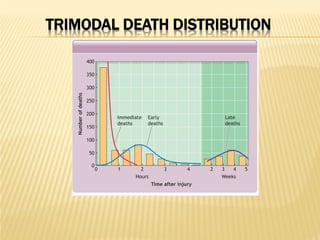
TRIMODAL DEATH DISTRIBUTION
TRAUMA CONCEPT
● ABCDE approach to evaluation and
treatment
● Treat greatest threat to life first
● Definitive diagnosis not immediately
important
● Time is of the essence
● Do no further harm
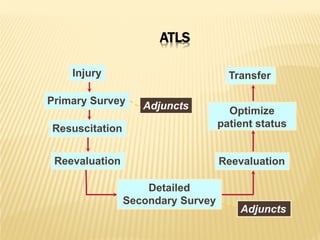
ATLS
Transfer
Reevaluation
Adjuncts
Adjuncts
Primary Survey
Resuscitation
Reevaluation
Detailed
Secondary Survey
Injury
Optimize
patient status
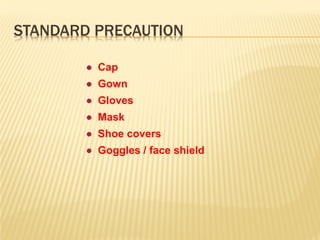
● Cap
● Gown
● Gloves
● Mask
● Shoe covers
● Goggles / face shield
STANDARD PRECAUTION
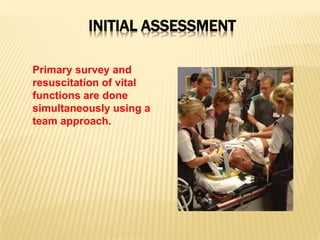
INITIAL ASSESSMENT
Primary survey and
resuscitation of vital
functions are done
simultaneously using a
team approach.
WHAT IS A QUICK, SIMPLE WAY
TO ASSESS A PATIENT IN 10 SECONDS?
Quick Assessment
INITIAL ASSESSMENT
Airway with c-spine protection
Breathing / ventilation / oxygenation
Circulation: stop the bleeding!
Disability / neurological status
Expose / Environment / body temperature
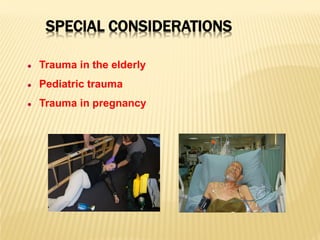
SPECIAL CONSIDERATIONS
● Trauma in the elderly
● Pediatric trauma
● Trauma in pregnancy
PRIMARY SURVEY
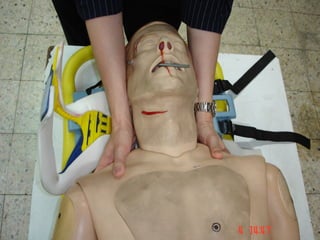
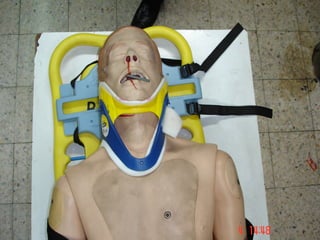
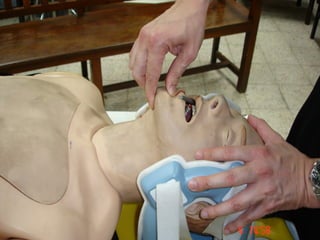
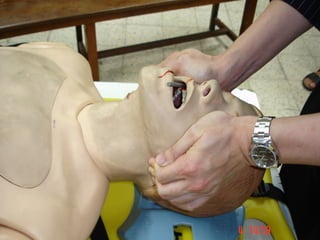
Establish patent airway and
protect c-spine
Occult airway injury
Progressive loss of airway
Equipment failure
Inability to intubate
Pitfalls
Airway
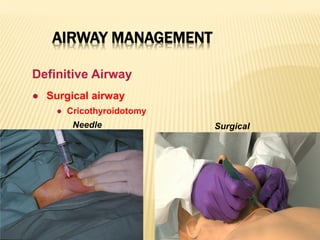
AIRWAY MANAGEMENT
● Surgical airway
● Cricothyroidotomy
Needle
Definitive Airway
Surgical
PRIMARY SURVEY
Assess and ensure adequate
oxygenation and ventilation
● Respiratory rate
● Chest movement
● Air entry
● Oxygen saturation
Breathing
BREATHING & VENTILATION
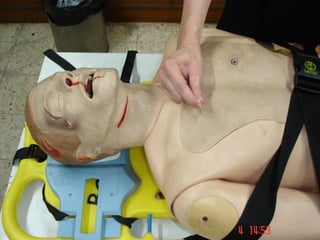
“ Look , feel , palpate and listen “ for
Tension pneumothorax
Open pneumothorax
Severe flail chest
Resuscitation
Oxygenation : FiO2 > 0.85
( mask with bag 10 l/min )
PRIMARY SURVEY
Breathing
Airway versus ventilation problem?
latrogenic pneumothorax
or
tension pneumothorax?
Pitfalls
TENSION PNEUMOTHORAX
High pressure pneumothorax causing cardiovascular
compromised status
* chest injury
* dyspnea & tachypnea
* distended neck vein
* deviated trachea
* hypotension
* tympanic on percussion
* absent breath sound
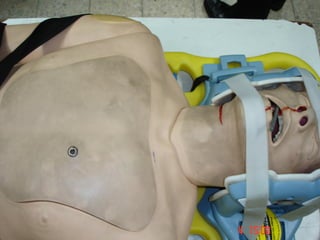
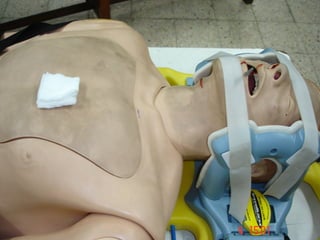
OPEN PNEUMOTHORAX
Abnormal connection between pleural cavity and
atmosphere causing inability to ventilate the
lungs
Resuscitation : three-sided dressing
: ICD
: Oxygenation
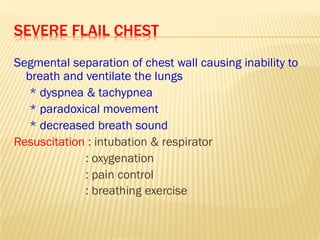
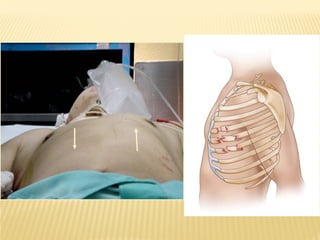
SEVERE FLAIL CHEST
Segmental separation of chest wall causing inability to
breath and ventilate the lungs
* dyspnea & tachypnea
* paradoxical movement
* decreased breath sound
Resuscitation : intubation & respirator
: oxygenation
: pain control
: breathing exercise
PRIMARY SURVEY
● Control hemorrhage
● Restore volume
● Reassess patient
Elderly
Children
Athletes
Medications
Circulatory Management
Pitfalls
CIRCULATION & HEMORRHAGE CONTROL
Stop external bleeding !!
Signs of shock
Grading of shock
Source(s) of shock
Massive Hemothorax
Cardiac tamponade
Massive Hemorrhage
Resuscitation and Oxygenation
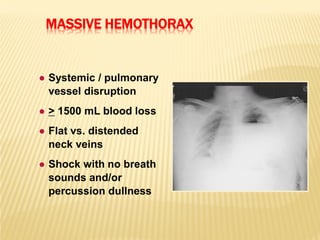
MASSIVE HEMOTHORAX
● Systemic / pulmonary
vessel disruption
● > 1500 mL blood loss
● Flat vs. distended
neck veins
● Shock with no breath
sounds and/or
percussion dullness
CARDIAC TAMPONADE
Obstructive shock
Beck’s triad : Hypotension
: Distant heart sound
: Engorged neck vein
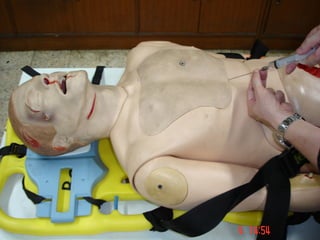
Pericardiocentesis
Thoracotomy
HYPOVOLUMIA
 Class I : <15% ; HR <100 ; normal BP ;
: RR ~ 14-20
 Class II : 15% - 30% ; HR > 100
: normal BP ; RR ~ 20-30
 Class III : 30% - 40% ; HR > 120
: hypotension ; RR 30-40
 Class IV : > 40% ; HR > 140
: profound shock
** Blood volume ~ 70 cc / kg body weight
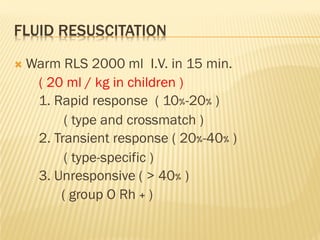
FLUID RESUSCITATION
 Warm RLS 2000 ml I.V. in 15 min.
( 20 ml / kg in children )
1. Rapid response ( 10%-20% )
( type and crossmatch )
2. Transient response ( 20%-40% )
( type-specific )
3. Unresponsive ( > 40% )
( group O Rh + )
Disability
● Baseline neurologic evaluation
● Glasgow Coma Scale score
● Pupillary response
Observe for
neurologic
deterioration
PRIMARY SURVEY
Caution
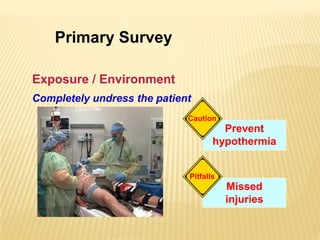
Prevent
hypothermia
Exposure / Environment
Completely undress the patient
Missed
injuries
Primary Survey
Pitfalls
Caution
EXPOSURE & ENVIRONMENTAL CONTROL
Undress
Log-roll
Missed areas
P.R.
Keep warm
ADJUNCTS TO PRIMARY SURVEY AND
RESUSCITATION
Monitoring : V/S , EKG , O2 Sat , Urine output
Catheters : Foley’s , N-G
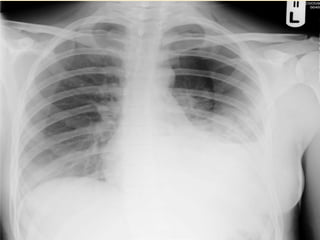
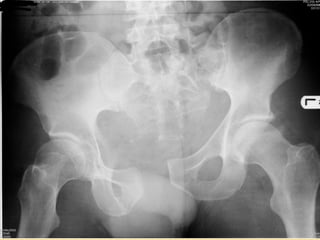
Investigations : CXR , Pelvis
: FAST or DPL
Re-evaluation !!
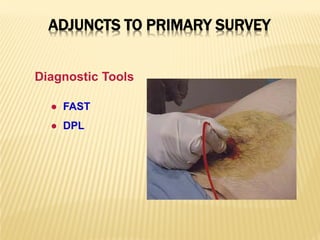
ADJUNCTS TO PRIMARY SURVEY
Diagnostic Tools
● FAST
● DPL
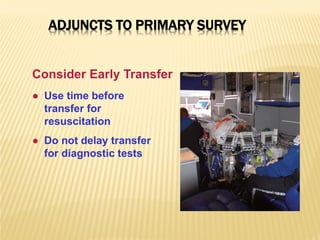
● Use time before
transfer for
resuscitation
● Do not delay transfer
for diagnostic tests
Consider Early Transfer
ADJUNCTS TO PRIMARY SURVEY
WHEN DO I START THE SECONDARY SURVEY?
After
● Primary survey is completed
● ABCDEs are reassessed
● Vital functions are returning to normal
Secondary Survey
SECONDARY SURVEY
History : AMPLE
P.E. : Head
: Maxillofacial
: C-spine and neck
: Chest
: Abdomen
: Pelvis and perineum
: Extremities
: Neurological function
SECONDARY SURVEY
History
Allergies
Medications
Past illnesses, Personal history, Pregnancy
Last meal
Events / Environment / Mechanism
ADJUNCTS TO SECONDARY SURVEY
Monitoring
Catheters
Investigations
Re-evaluation !!
DEFINITE CARE
O.R.
ICU
IPD
OPD
Consult
Refer
PEDIATRIC TRAUMA
Most common cause of death
Neurologic and respiratory derangements far
exceed hemodynamic derangements.
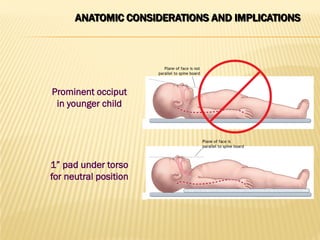
ANATOMIC CONSIDERATIONS AND IMPLICATIONS
Prominent occiput
in younger child
1” pad under torso
for neutral position
PHYSIOLOGY
What physiologic differences will impact on
my management of pediatric trauma
patients?
• Age-specific vital signs
• Smaller blood volume (70 – 80 mL / kg)
• Decreased functional residual capacity
• Vigorous compensatory response
• Sudden deterioration
• Increased vagal tone
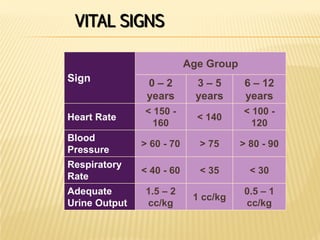
VITAL SIGNS
Sign
Age Group
0 – 2
years
3 – 5
years
6 – 12
years
Heart Rate
< 150 -
160
< 140
< 100 -
120
Blood
Pressure
> 60 - 70 > 75 > 80 - 90
Respiratory
Rate
< 40 - 60 < 35 < 30
Adequate
Urine Output
1.5 – 2
cc/kg
1 cc/kg
0.5 – 1
cc/kg
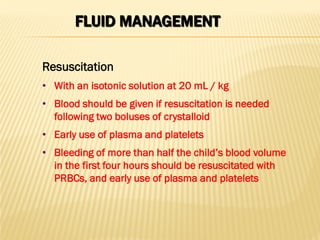
FLUID MANAGEMENT
• With an isotonic solution at 20 mL / kg
• Blood should be given if resuscitation is needed
following two boluses of crystalloid
• Early use of plasma and platelets
• Bleeding of more than half the child’s blood volume
in the first four hours should be resuscitated with
PRBCs, and early use of plasma and platelets
Resuscitation
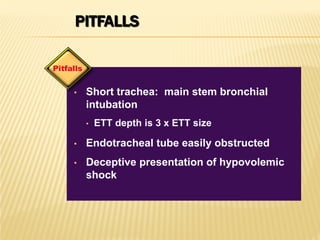
PITFALLS
• Short trachea: main stem bronchial
intubation
• ETT depth is 3 x ETT size
• Endotracheal tube easily obstructed
• Deceptive presentation of hypovolemic
shock
Pitfalls
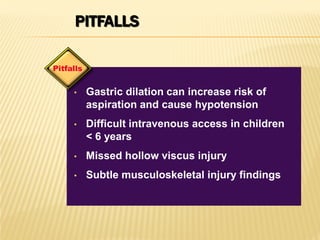
PITFALLS
• Gastric dilation can increase risk of
aspiration and cause hypotension
• Difficult intravenous access in children
< 6 years
• Missed hollow viscus injury
• Subtle musculoskeletal injury findings
Pitfalls
GERIATRIC TRAUMA
 Age-related changes in anatomy and physiology
 Preexisting diseases and co-morbidities
 Medications
 Possibility of elder maltreatment
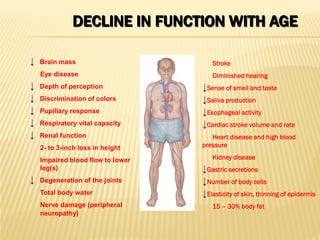
DECLINE IN FUNCTION WITH AGE
↓ Brain mass
Eye disease
↓ Depth of perception
↓ Discrimination of colors
↓ Pupillary response
↓ Respiratory vital capacity
↓ Renal function
2- to 3-inch loss in height
Impaired blood flow to lower
leg(s)
↓ Degeneration of the joints
Total body water
Nerve damage (peripheral
neuropathy)
Stroke
Diminished hearing
↓Sense of smell and taste
↓Saliva production
↓Esophageal activity
↓Cardiac stroke volume and rate
Heart disease and high blood
pressure
Kidney disease
↓Gastric secretions
↓Number of body cells
↓Elasticity of skin, thinning of epidermis
15 – 30% body fat
UNIQUE AIRWAY PROBLEMS
• ABCDE
• Priorities are the same
• Decreased cardiopulmonary reserve may
require early intubation
• Factors affecting airway management
• Dentition (including dentures)
• Nasopharyngeal mucosal fragility
• Cervical arthritis
UNIQUE BREATHING PROBLEMS
• Diminished respiratory reserve
• Use of supplemental oxygen
• COPD
• Chest injuries poorly tolerated
• “Minor” chest injuries with major effects
UNIQUE CIRCULATORY PROBLEMS
• Decreased cardiovascular function and reserve
• Cautious fluid administration
• Increased BP, decreased HR, and loss of renal
function with age
• Anticoagulants and other medications
• Pharmacologic effects
• Catecholamine effects and dysrhythmias
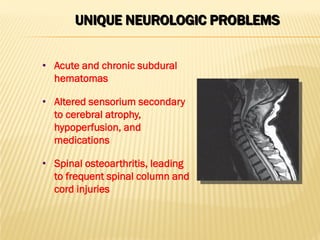
UNIQUE NEUROLOGIC PROBLEMS
• Acute and chronic subdural
hematomas
• Altered sensorium secondary
to cerebral atrophy,
hypoperfusion, and
medications
• Spinal osteoarthritis, leading
to frequent spinal column and
cord injuries
UNIQUE EXPOSURE PROBLEMS
• Abnormal thermoregulatory mechanism
• Increased sensitivity to hypothermia
• Increased risk of infection
• Lack of tetanus protection
UNIQUE MUSCULOSKELETAL PROBLEMS
• Most frequent cause of morbidity
• Susceptible to certain fractures
• Osteoporosis
• Preexisting deformities complicate evaluation
• Immobility can lead to complications
DRUGS THAT AFFECT RESUSCITATION
• Beta blockers
• Antihypertensives
• NSAIDS
• Anticoagulants
• Corticosteroids
• Diuretics
• Hypoglycemics
• Psychotropics
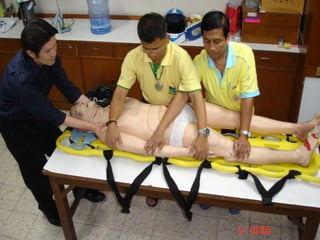
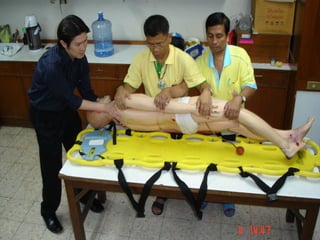
TRAUMA IN PREGNANCY
Is she pregnant ???????
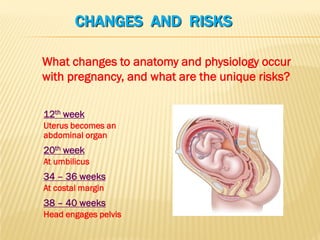
CHANGES AND RISKS
12th week
Uterus becomes an
abdominal organ
20th week
At umbilicus
34 – 36 weeks
At costal margin
38 – 40 weeks
Head engages pelvis
What changes to anatomy and physiology occur
with pregnancy, and what are the unique risks?
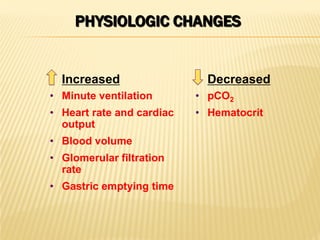
PHYSIOLOGIC CHANGES
Increased
• Minute ventilation
• Heart rate and cardiac
output
• Blood volume
• Glomerular filtration
rate
• Gastric emptying time
Decreased
• pCO2
• Hematocrit
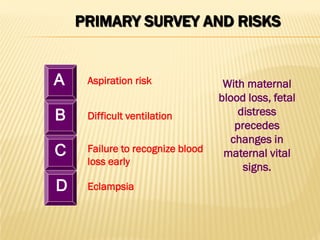
PRIMARY SURVEY AND RISKS
With maternal
blood loss, fetal
distress
precedes
changes in
maternal vital
signs.
A
B
D
Aspiration risk
C
Difficult ventilation
Failure to recognize blood
loss early
Eclampsia
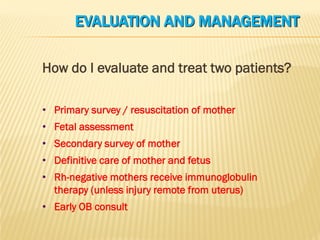
EVALUATION AND MANAGEMENT
How do I evaluate and treat two patients?
• Primary survey / resuscitation of mother
• Fetal assessment
• Secondary survey of mother
• Definitive care of mother and fetus
• Rh-negative mothers receive immunoglobulin
therapy (unless injury remote from uterus)
• Early OB consult

Management of multiple trauma

  • 1.
    MANAGEMENT OF MULTIPLETRAUMA Raywat Chunhasuwankul Division of Trauma Surgery Faculty of Medicine Siriraj Hospital
  • 2.
  • 3.
    TRAUMA CONCEPT ● ABCDEapproach to evaluation and treatment ● Treat greatest threat to life first ● Definitive diagnosis not immediately important ● Time is of the essence ● Do no further harm
  • 4.
  • 5.
    ● Cap ● Gown ●Gloves ● Mask ● Shoe covers ● Goggles / face shield STANDARD PRECAUTION
  • 6.
    INITIAL ASSESSMENT Primary surveyand resuscitation of vital functions are done simultaneously using a team approach.
  • 7.
    WHAT IS AQUICK, SIMPLE WAY TO ASSESS A PATIENT IN 10 SECONDS? Quick Assessment
  • 8.
    INITIAL ASSESSMENT Airway withc-spine protection Breathing / ventilation / oxygenation Circulation: stop the bleeding! Disability / neurological status Expose / Environment / body temperature
  • 9.
    SPECIAL CONSIDERATIONS ● Traumain the elderly ● Pediatric trauma ● Trauma in pregnancy
  • 10.
    PRIMARY SURVEY Establish patentairway and protect c-spine Occult airway injury Progressive loss of airway Equipment failure Inability to intubate Pitfalls Airway
  • 15.
    AIRWAY MANAGEMENT ● Surgicalairway ● Cricothyroidotomy Needle Definitive Airway Surgical
  • 16.
    PRIMARY SURVEY Assess andensure adequate oxygenation and ventilation ● Respiratory rate ● Chest movement ● Air entry ● Oxygen saturation Breathing
  • 17.
    BREATHING & VENTILATION “Look , feel , palpate and listen “ for Tension pneumothorax Open pneumothorax Severe flail chest Resuscitation Oxygenation : FiO2 > 0.85 ( mask with bag 10 l/min )
  • 18.
    PRIMARY SURVEY Breathing Airway versusventilation problem? latrogenic pneumothorax or tension pneumothorax? Pitfalls
  • 19.
    TENSION PNEUMOTHORAX High pressurepneumothorax causing cardiovascular compromised status * chest injury * dyspnea & tachypnea * distended neck vein * deviated trachea * hypotension * tympanic on percussion * absent breath sound
  • 21.
    OPEN PNEUMOTHORAX Abnormal connectionbetween pleural cavity and atmosphere causing inability to ventilate the lungs Resuscitation : three-sided dressing : ICD : Oxygenation
  • 24.
    SEVERE FLAIL CHEST Segmentalseparation of chest wall causing inability to breath and ventilate the lungs * dyspnea & tachypnea * paradoxical movement * decreased breath sound Resuscitation : intubation & respirator : oxygenation : pain control : breathing exercise
  • 26.
    PRIMARY SURVEY ● Controlhemorrhage ● Restore volume ● Reassess patient Elderly Children Athletes Medications Circulatory Management Pitfalls
  • 27.
    CIRCULATION & HEMORRHAGECONTROL Stop external bleeding !! Signs of shock Grading of shock Source(s) of shock Massive Hemothorax Cardiac tamponade Massive Hemorrhage Resuscitation and Oxygenation
  • 28.
    MASSIVE HEMOTHORAX ● Systemic/ pulmonary vessel disruption ● > 1500 mL blood loss ● Flat vs. distended neck veins ● Shock with no breath sounds and/or percussion dullness
  • 29.
    CARDIAC TAMPONADE Obstructive shock Beck’striad : Hypotension : Distant heart sound : Engorged neck vein Pericardiocentesis Thoracotomy
  • 31.
    HYPOVOLUMIA  Class I: <15% ; HR <100 ; normal BP ; : RR ~ 14-20  Class II : 15% - 30% ; HR > 100 : normal BP ; RR ~ 20-30  Class III : 30% - 40% ; HR > 120 : hypotension ; RR 30-40  Class IV : > 40% ; HR > 140 : profound shock ** Blood volume ~ 70 cc / kg body weight
  • 32.
    FLUID RESUSCITATION  WarmRLS 2000 ml I.V. in 15 min. ( 20 ml / kg in children ) 1. Rapid response ( 10%-20% ) ( type and crossmatch ) 2. Transient response ( 20%-40% ) ( type-specific ) 3. Unresponsive ( > 40% ) ( group O Rh + )
  • 33.
    Disability ● Baseline neurologicevaluation ● Glasgow Coma Scale score ● Pupillary response Observe for neurologic deterioration PRIMARY SURVEY Caution
  • 34.
    Prevent hypothermia Exposure / Environment Completelyundress the patient Missed injuries Primary Survey Pitfalls Caution
  • 35.
    EXPOSURE & ENVIRONMENTALCONTROL Undress Log-roll Missed areas P.R. Keep warm
  • 38.
    ADJUNCTS TO PRIMARYSURVEY AND RESUSCITATION Monitoring : V/S , EKG , O2 Sat , Urine output Catheters : Foley’s , N-G Investigations : CXR , Pelvis : FAST or DPL Re-evaluation !!
  • 41.
    ADJUNCTS TO PRIMARYSURVEY Diagnostic Tools ● FAST ● DPL
  • 42.
    ● Use timebefore transfer for resuscitation ● Do not delay transfer for diagnostic tests Consider Early Transfer ADJUNCTS TO PRIMARY SURVEY
  • 43.
    WHEN DO ISTART THE SECONDARY SURVEY? After ● Primary survey is completed ● ABCDEs are reassessed ● Vital functions are returning to normal Secondary Survey
  • 44.
    SECONDARY SURVEY History :AMPLE P.E. : Head : Maxillofacial : C-spine and neck : Chest : Abdomen : Pelvis and perineum : Extremities : Neurological function
  • 45.
    SECONDARY SURVEY History Allergies Medications Past illnesses,Personal history, Pregnancy Last meal Events / Environment / Mechanism
  • 46.
    ADJUNCTS TO SECONDARYSURVEY Monitoring Catheters Investigations Re-evaluation !!
  • 47.
  • 48.
    PEDIATRIC TRAUMA Most commoncause of death Neurologic and respiratory derangements far exceed hemodynamic derangements.
  • 49.
    ANATOMIC CONSIDERATIONS ANDIMPLICATIONS Prominent occiput in younger child 1” pad under torso for neutral position
  • 50.
    PHYSIOLOGY What physiologic differenceswill impact on my management of pediatric trauma patients? • Age-specific vital signs • Smaller blood volume (70 – 80 mL / kg) • Decreased functional residual capacity • Vigorous compensatory response • Sudden deterioration • Increased vagal tone
  • 51.
    VITAL SIGNS Sign Age Group 0– 2 years 3 – 5 years 6 – 12 years Heart Rate < 150 - 160 < 140 < 100 - 120 Blood Pressure > 60 - 70 > 75 > 80 - 90 Respiratory Rate < 40 - 60 < 35 < 30 Adequate Urine Output 1.5 – 2 cc/kg 1 cc/kg 0.5 – 1 cc/kg
  • 52.
    FLUID MANAGEMENT • Withan isotonic solution at 20 mL / kg • Blood should be given if resuscitation is needed following two boluses of crystalloid • Early use of plasma and platelets • Bleeding of more than half the child’s blood volume in the first four hours should be resuscitated with PRBCs, and early use of plasma and platelets Resuscitation
  • 53.
    PITFALLS • Short trachea:main stem bronchial intubation • ETT depth is 3 x ETT size • Endotracheal tube easily obstructed • Deceptive presentation of hypovolemic shock Pitfalls
  • 54.
    PITFALLS • Gastric dilationcan increase risk of aspiration and cause hypotension • Difficult intravenous access in children < 6 years • Missed hollow viscus injury • Subtle musculoskeletal injury findings Pitfalls
  • 55.
    GERIATRIC TRAUMA  Age-relatedchanges in anatomy and physiology  Preexisting diseases and co-morbidities  Medications  Possibility of elder maltreatment
  • 56.
    DECLINE IN FUNCTIONWITH AGE ↓ Brain mass Eye disease ↓ Depth of perception ↓ Discrimination of colors ↓ Pupillary response ↓ Respiratory vital capacity ↓ Renal function 2- to 3-inch loss in height Impaired blood flow to lower leg(s) ↓ Degeneration of the joints Total body water Nerve damage (peripheral neuropathy) Stroke Diminished hearing ↓Sense of smell and taste ↓Saliva production ↓Esophageal activity ↓Cardiac stroke volume and rate Heart disease and high blood pressure Kidney disease ↓Gastric secretions ↓Number of body cells ↓Elasticity of skin, thinning of epidermis 15 – 30% body fat
  • 57.
    UNIQUE AIRWAY PROBLEMS •ABCDE • Priorities are the same • Decreased cardiopulmonary reserve may require early intubation • Factors affecting airway management • Dentition (including dentures) • Nasopharyngeal mucosal fragility • Cervical arthritis
  • 58.
    UNIQUE BREATHING PROBLEMS •Diminished respiratory reserve • Use of supplemental oxygen • COPD • Chest injuries poorly tolerated • “Minor” chest injuries with major effects
  • 59.
    UNIQUE CIRCULATORY PROBLEMS •Decreased cardiovascular function and reserve • Cautious fluid administration • Increased BP, decreased HR, and loss of renal function with age • Anticoagulants and other medications • Pharmacologic effects • Catecholamine effects and dysrhythmias
  • 60.
    UNIQUE NEUROLOGIC PROBLEMS •Acute and chronic subdural hematomas • Altered sensorium secondary to cerebral atrophy, hypoperfusion, and medications • Spinal osteoarthritis, leading to frequent spinal column and cord injuries
  • 61.
    UNIQUE EXPOSURE PROBLEMS •Abnormal thermoregulatory mechanism • Increased sensitivity to hypothermia • Increased risk of infection • Lack of tetanus protection
  • 62.
    UNIQUE MUSCULOSKELETAL PROBLEMS •Most frequent cause of morbidity • Susceptible to certain fractures • Osteoporosis • Preexisting deformities complicate evaluation • Immobility can lead to complications
  • 63.
    DRUGS THAT AFFECTRESUSCITATION • Beta blockers • Antihypertensives • NSAIDS • Anticoagulants • Corticosteroids • Diuretics • Hypoglycemics • Psychotropics
  • 64.
    TRAUMA IN PREGNANCY Isshe pregnant ???????
  • 65.
    CHANGES AND RISKS 12thweek Uterus becomes an abdominal organ 20th week At umbilicus 34 – 36 weeks At costal margin 38 – 40 weeks Head engages pelvis What changes to anatomy and physiology occur with pregnancy, and what are the unique risks?
  • 66.
    PHYSIOLOGIC CHANGES Increased • Minuteventilation • Heart rate and cardiac output • Blood volume • Glomerular filtration rate • Gastric emptying time Decreased • pCO2 • Hematocrit
  • 67.
    PRIMARY SURVEY ANDRISKS With maternal blood loss, fetal distress precedes changes in maternal vital signs. A B D Aspiration risk C Difficult ventilation Failure to recognize blood loss early Eclampsia
  • 68.
    EVALUATION AND MANAGEMENT Howdo I evaluate and treat two patients? • Primary survey / resuscitation of mother • Fetal assessment • Secondary survey of mother • Definitive care of mother and fetus • Rh-negative mothers receive immunoglobulin therapy (unless injury remote from uterus) • Early OB consult